Page 17 of 340
Memory Seat and Mirrors (Option)
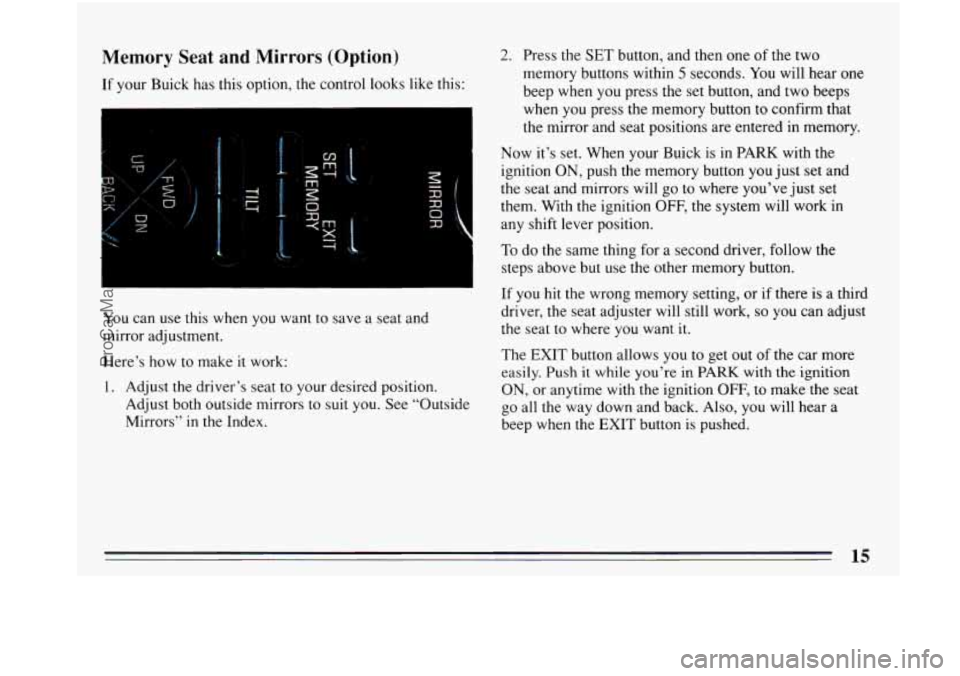
If your Buick has this option, the control looks like this:
I
You can use this when you want to save a seat and
mirror adjustment.
Here’s how to make it work:
1. Adjust the driver’s seat to your desired position.
Adjust both outside mirrors to suit you. See “Outside
Mirrors”
in the Index.
2. Press the SET button, and then one of the two
memory buttons within
5 seconds. You will hear one
beep when you press the set button, and two beeps
when
you press the memory button to confirm that
the mirror and seat positions are entered in memory.
Now it’s set. When your Buick
is in PARK with the
ignition
ON, push the memory button you just set and
the seat and mirrors will go to where you’ve just set
them. With the ignition
OFF, the system will work in
any shift lever position.
To
do the same thing for a second driver, follow the
steps above but use the other memory button.
If you hit the wrong memory setting, or if there is a third
driver, the seat adjuster will still work,
so you can adjust
the seat to where
you want it.
The EXIT button allows you to get out of the car more
easily. Push it while you’re
in PARK with the ignition
ON, or anytime with the ignition OFF, to make the seat
go all the way down and back. Also, you will hear a
beep when the EXIT button is pushed.
15
ProCarManuals.com
Page 108 of 340
Mirrors
Inside Mirror
Manual
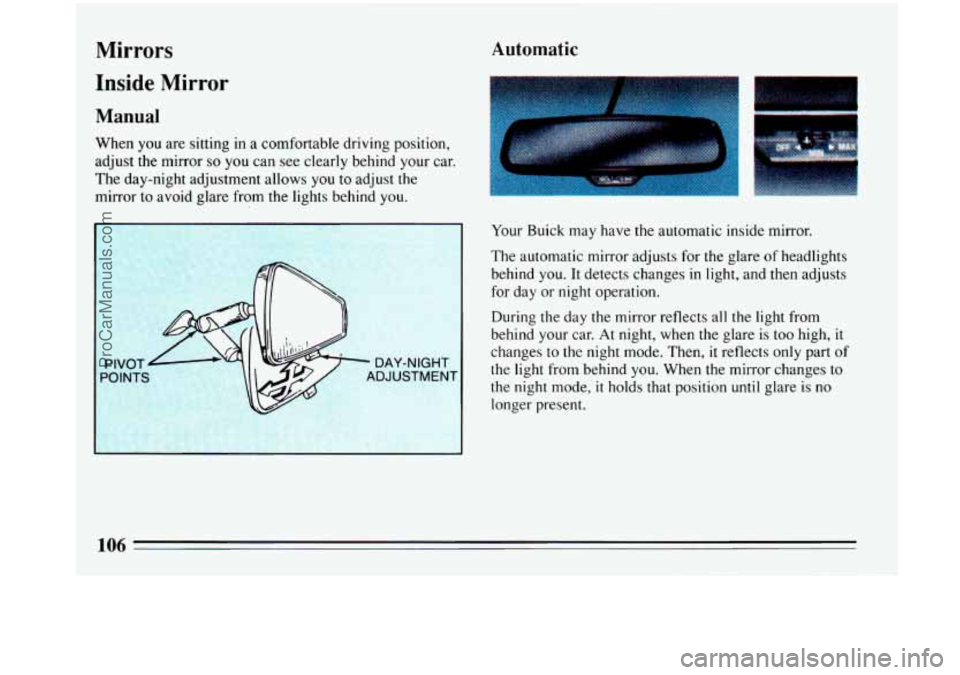
When you are sitting in a comfortable driving position,
adjust the mirror
so you can see clearly behind your car.
The day-night adjustment allows you to adjust
the
mirror to avoid glare from the lights behind you.
PI\,
Polr --!
1
I
7'- DAY-NIGHT
ADJUSTMENT
Automatic
Your Buick may have the automatic inside mirror.
The automatic mirror adjusts for the glare of headlights
behind you. It detects changes in light, and then adjusts
for day or night operation.
During the day the mirror reflects all the light from
behind your car. At night, when the glare
is too high, it
changes to the night mode. Then, it reflects only part of
the light from behind you. When the mirror changes to
the night mode,
it holds that position until glare is no
longer present.
ProCarManuals.com
Page 109 of 340
Settings
MIN: The minimum setting is suggested when driving
where glare conditions change often. “Min” works well
for city driving at night.
MAX: Maximum sensitivity is a good setting for
highway driving in light traffic. The mirror starts to
darken in any glare, such as headlights a long way
behind your
car.
OFF: The mirror will stay in the day mode.
Time Delay
The mirror delays before switching from the night back
to the day position. This delay prevents rapid changing
of the mirror as you drive under lights and through
traffic.
Cleaning Photocells
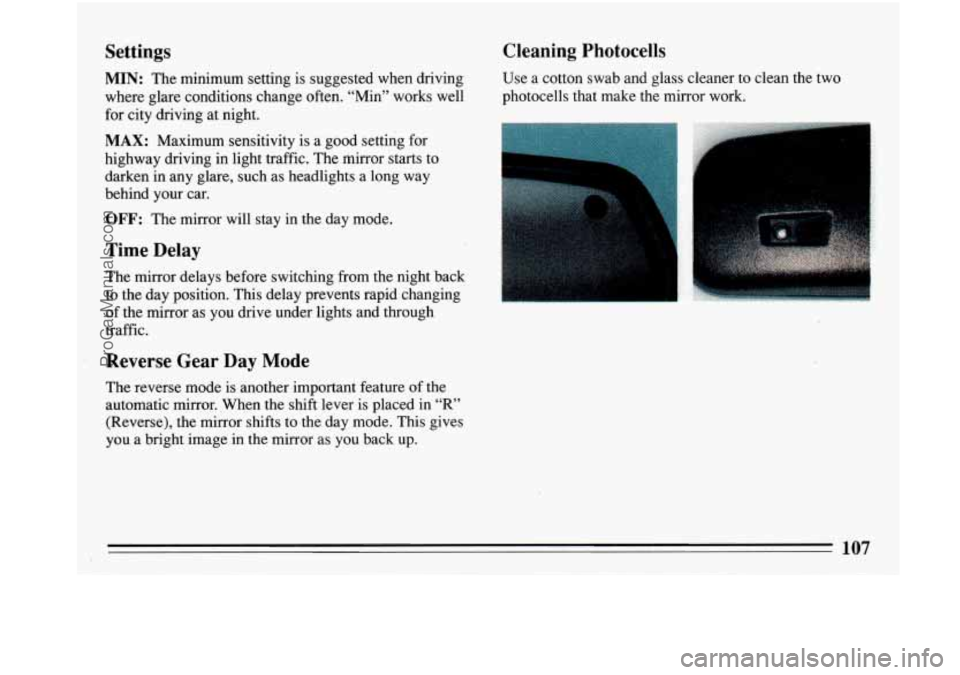
Use a cotton swab and glass cleaner to clean the two
photocells that make the mirror work.
Reverse Gear Day Mode
The reverse mode is another important feature of the
automatic mirror. .When the shift lever is placed in
“R”
(Reverse), the mirror shifts to the day mode. This gives
you a bright image in the mirror as you back up.
107
ProCarManuals.com
Page 110 of 340
Outside Mirrors
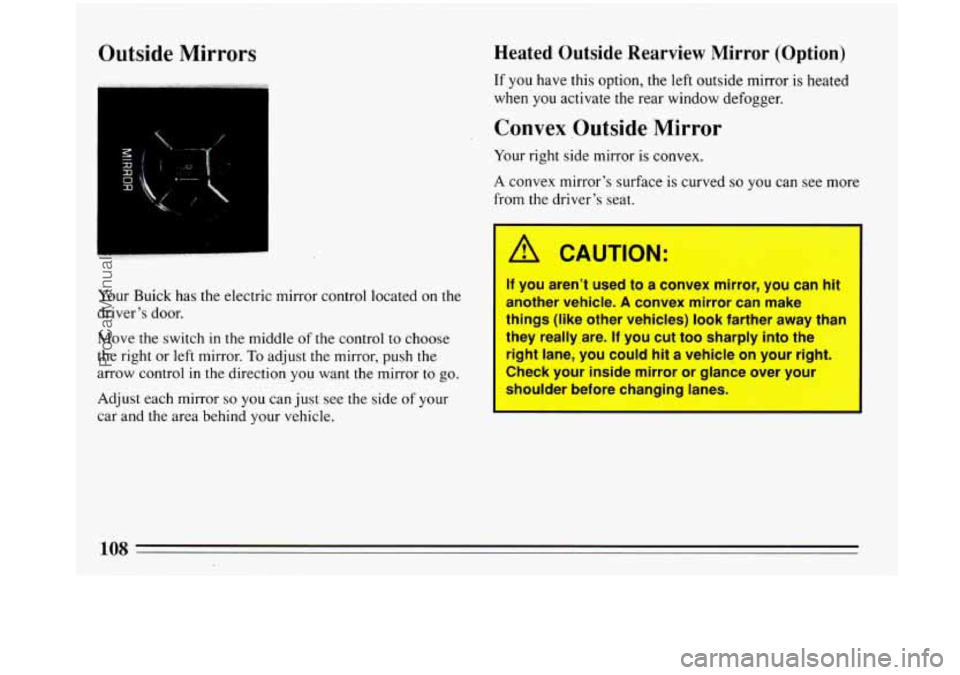
Your Buick has the electric mirror control located on the
driver’s door.
Move the switch in the middle
of the control to choose
the right or left mirror.
To adjust the mirror, push the
arrow control
in the direction you want the mirror to go.
Adjust each mirror
so you can just see the side of your
car and the area behind your vehicle.
Heated Outside Rearview Mirror (Option)
If you have this option, the left outside mirror is heated
when you activate the rear window defogger.
Convex .Outside Mirror
Your right side mirror is convex.
A convex mirror’s surface is curved
so you can see more
from the driver’s seat.
1 A CAUTION:
I
~ If you aren’t used to a convex mirror, you can hit
another vehicle.
A convex mirror can make
things (like other vehicles) look farther away than
they really.are. If you cut
too sharply into the
right lane, you could hit a vehicle on your right.
Check your inside mirror or glance over your
shoulder before changing lanes.
108
ProCarManuals.com
Page 116 of 340
Dual Sun Visors
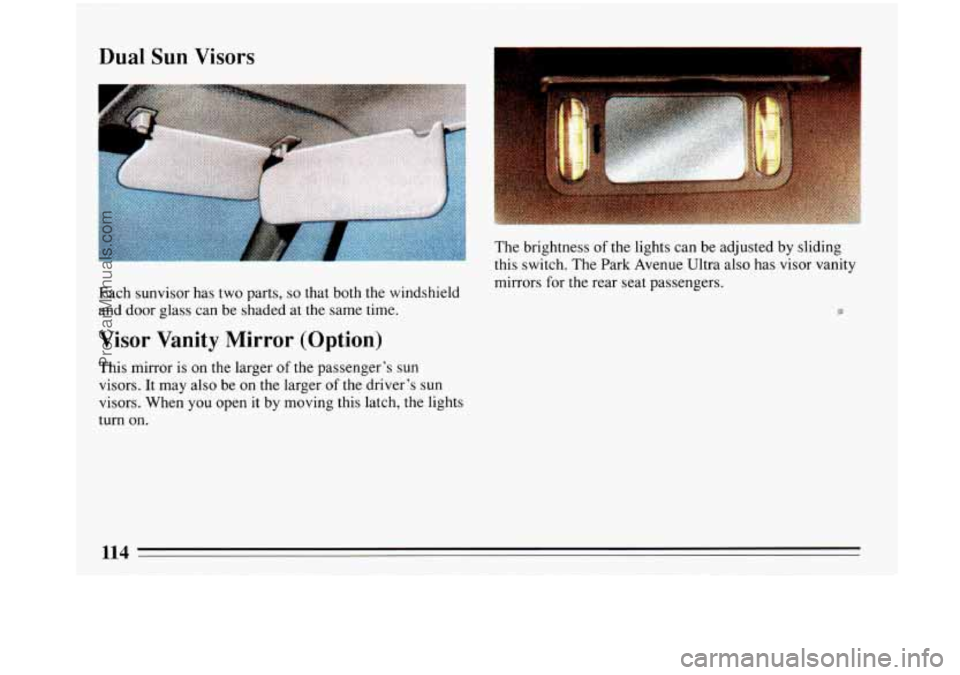
Each sunvisor has two parts, so that both the windshield
and door glass can be shaded at the same time.
Visor Vanity Mirror (Option)
This mirror is on the larger of the passenger’s sun
visors. It may also be on the larger of the driver’s sun
visors. When you open it
by moving this latch, the lights
turn on. The brightness
of
the lights can be adjusted by sliding
this switch. The Park Avenue Ultra also has visor vanity
mirrors for the rear seat passengers.
0
ProCarManuals.com
Page 138 of 340
Defrost Rear Window Defogger
This setting will direct most
of the air flow toward the
windshield. Use
DEFROST
when there is fog or ice on
the-windshield.
Defrost will work better if any ice and snow is cleared
from the hood and the air inlet area between the hood
and the windshield.
Blower speed will be controlled automatically, but
you
can choose another speed by pushing the HI or LO
buttons. The
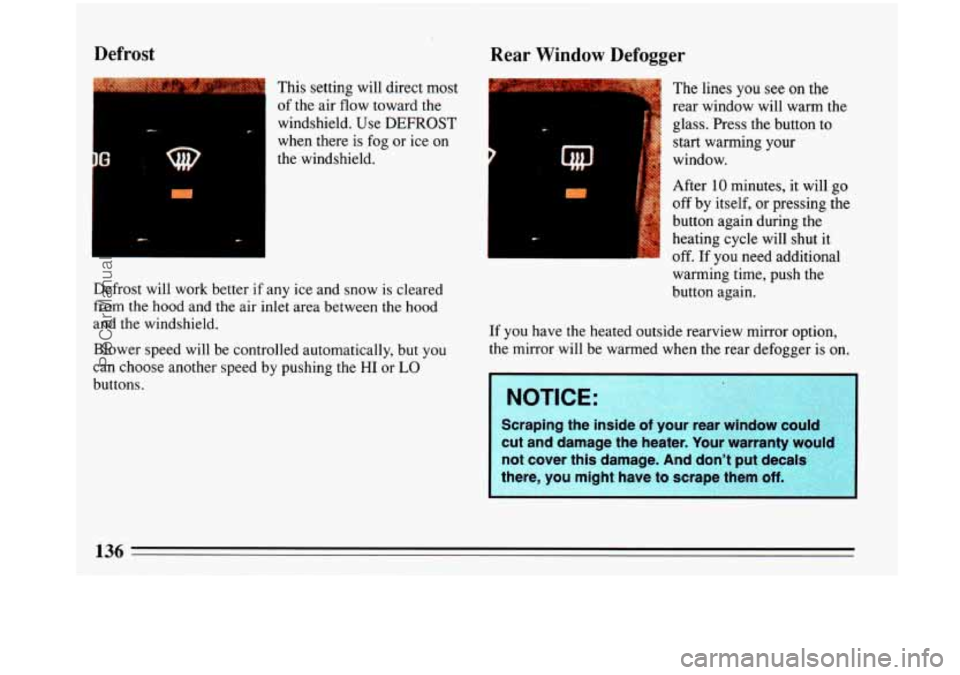
lines
you see on the
rear window will warm the
glass. Press the button to
start warming your
window.
After
10 minutes, it will go
off by itself, or pressing the
button again during the
heating cycle will shut it
off. If you need additional
warming time, push the
button again.
c. i
If you have the heated outside rearview mirror option,
the mirror will be warmed when the rear defogger is on.
1.
i NOTICE: , .' '2 , .. , ,.. ~. , ..~
I: Scraping the inside of your rear window could
cut and damage the heater. Your warranty would
ProCarManuals.com
Page 181 of 340
So here are some tips for passing:
“Drive ahead.” Look down the road, to the sides, and
to crossroads for situations that might affect your
passing patterns.
If you have any doubt whatsoever
about making a successful pass, wait for a better
time.
Watch for traffic signs, pavement markings, and
lines. If you can see a sign up ahead that might
indicate a turn or an intersection, delay your pass. A
broken center line usually indicates it’s all right to
pass (providing the road ahead is clear). Never cross
a solid line
on your side of the lane or a double solid
line, even if the road seems empty of approaching
traffic.
If you suspect that the driver of the vehicle you want
to pass isn’t aware of your presence, tap the
horn a
couple of times before passing.
Do not get too close to the vehicle you want to pass
while you’re awaiting an opportunity. For one thing,
following
too closely reduces your area of vision,
especially if you’re following
a larger vehicle. Also,
you won’t have adequate space if the vehicle ahead
suddenly slows or stops. Keep back a reasonable
distance.
When it looks like a chance to pass is coming up,
start to accelerate but stay in the right lane and don’t
get too close. Time your move
so you will be
increasing speed as
the time comes to move into the
other lane. If the way is clear to pass, you will have a
“running start’’ that more than makes up for the
distance you would lose by dropping back. And if
something happens to cause you to cancel your pass,
you need only slow down and drop back again and
wait for another opportunity.
If other cars are lined up to pass a slow vehicle, wait
your turn.
But take care that someone isn’t trying to
pass you as you pull out to pass the slow vehicle.
Remember to glance over your shoulder and check
the blind spot.
Check your mirrors, glance over your shoulder, and
start your
left lane change signal before moving out
of the right lane to pass. When you are far enough
ahead of the passed vehicle
to see its front in your
inside mirror, activate your right lane change signal
and move back into the right lane. (Remember that
your right outside mirror
is convex. The vehicle you
just passed may seem to be farther away from you
than it really
is.)
ProCarManuals.com
Page 183 of 340
vehicle is skidding. Learn to recognize warning clues --
such as enough water, ice or packed snow on the road to
make a “mirrored surface”
-- and slow down when you
have any doubt.
Remember: Any anti-lock braking system (ABS) helps
avoid only the braking skid. Steer the way
you want to
go-
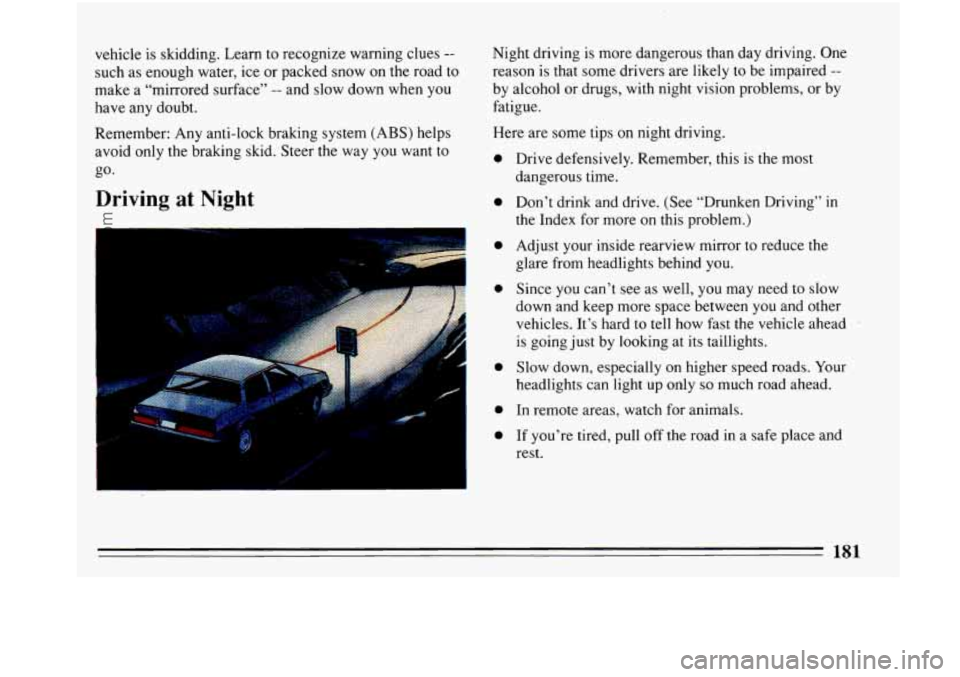
Driving at Night
...,.
.. -
Night driving is more dangerous than day driving. One
reason
is that some drivers are likely to be impaired --
by alcohol or drugs, with night vision problems, or by
fatigue.
Here are some tips on night driving.
0
0
0
c
0
0
0
Drive defensively. Remember, this is the most
dangerous time.
Don’t drink and drive. (See “Drunken Driving” in
the Index for more on this problem.)
Adjust your inside rearview mirror to reduce the
glare from headlights behind you.
Since you can’t see as well, you may need to slow
down and keep more space between you and other
vehicles. It’s hard
to tell how fast the vehicle ahead .
is going just by looking at its taillights.
Slow down, especially on higher speed roads. Your
headlights can light up only
so much road ahead.
In remote areas, watch for animals.
If you’re tired, pull off the road in a safe place and
rest.
ProCarManuals.com