1993 BUICK PARK AVENUE turn signal
[x] Cancel search: turn signalPage 61 of 340
Part 2 Features & Controls
Here you can learn about the many standard and optional features on your Buick. and information on starting. shifting
and braking
. Also explained are the instrument panel and the warning systems that tell you if everything is working
properly
.. and what to do if you have a problem .
Keys ........................................................................\
.... 60
DoorLocks
....................................................................... \
62
NewVehicleBreak-In .............................................................. 74
StartingtheEngine ................................................................. 76
ShiftingtheTransaxle
.............................................................. 80
Windows ........................................................................\
. 90
TiltSteeringWheel
................................................................ 90
Multi-FunctionLever
............................................................... 91
TurnandLaneChangeSignals ................................................... 91
Headlight High-Low Beam Change Signals
......................................... 91
WindshieldWiper/Washer
...................................................... 94
CruiseControl ................................................................ 96
Instrumentpanel
................................................................... 116
Speedometer and Odometer
..................................................... 117
Warning Lights and Gages
...................................................... 117
59
~ .. . ~ .. .. _.__~ ....... - ...... ... ..._- .... -
ProCarManuals.com
Page 93 of 340
The Turn Signal/Headlight Beam
Lever Turn Signal and Lane Change Indicator
H
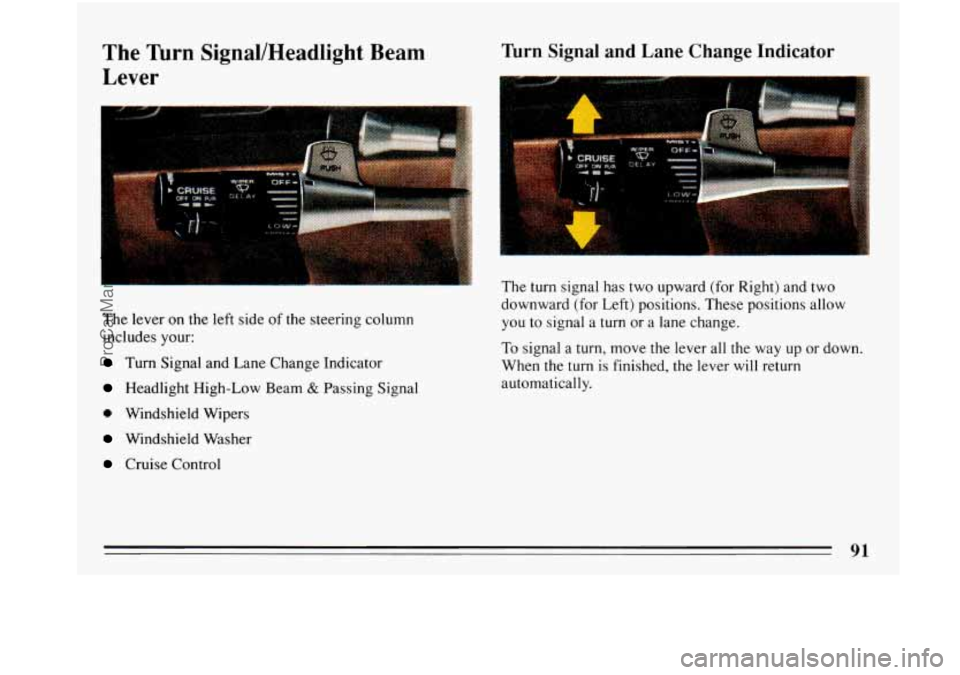
The lever on the left side of the steering column
includes your:
Turn Signal and Lane Change Indicator
Headlight High-Low Beam & Passing Signal
0 Windshield Wipers
Windshield Washer
Cruise Control
C!
The turn signal has two upward (for Right) and two
downward (for Left) positions. These positions allow
you to signal a turn or a lane change.
To signal a turn, move the lever all the way
up or down.
When the turn
is finished, the lever will return
automatically.
ProCarManuals.com
Page 94 of 340
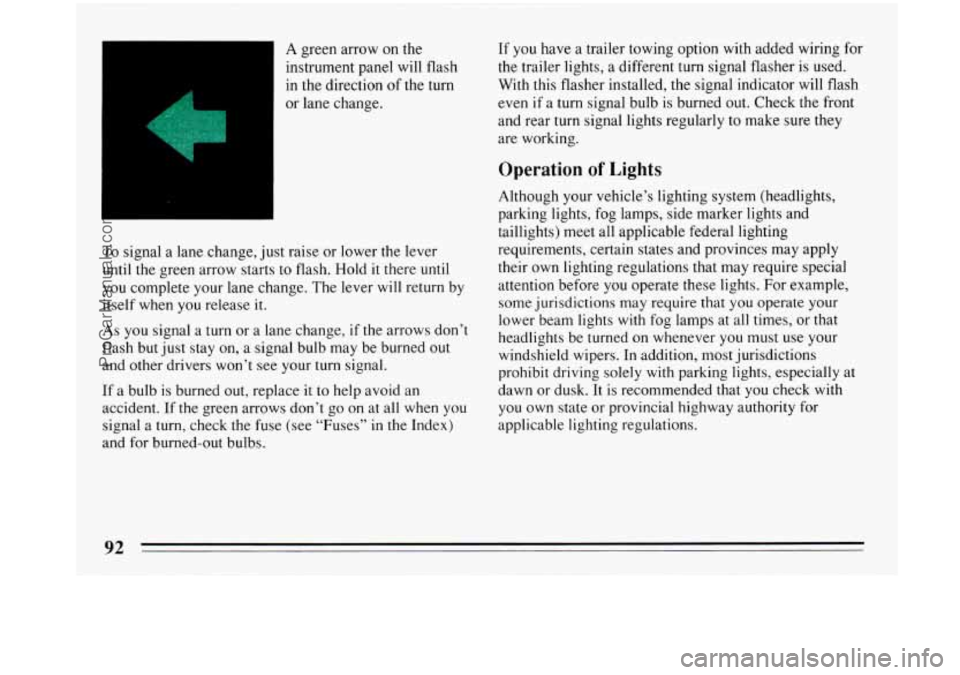
A green arrow on the
instrument panel
will flash
in the direction of the turn
or lane change.
To signal a lane change, just raise or lower the lever
until
the green arrow starts to flash. Hold it there until
you complete your lane change. The lever will return by
itself when you release it.
As you signal a turn or a lane change, if the arrows don’t
flash but just stay on, a signal bulb may be burned out
and other drivers won’t see your turn signal.
If a bulb is burned out, replace it to help avoid an
accident. If
the green arrows don’t go on at all when you
signal a turn, check the fuse (see “Fuses”
in the Index)
and for burned-out bulbs.
If you have a trailer towing option with added wiring for
the trailer lights, a different turn signal flasher is used.
With this flasher installed, the signal indicator will flash
even
if a turn signal bulb is burned out. Check the front
and rear turn signal lights regularly to make sure they
are working.
Operation of Lights
Although your vehicle’s lighting system (headlights,
parking lights, fog lamps, side marker lights and
taillights) meet all applicable federal lighting
requirements, certain states and provinces may apply
their own lighting regulations that may require special
attention before
you operate these lights. For example,
some jurisdictions may require that you operate your
lower beam lights with fog lamps at all times, or that
headlights be turned on whenever you must use your
windshield wipers. In addition, most jurisdictions
prohibit driving solely with parking lights, especially at
dawn or dusk. It is recommended that
you check with
you own state or provincial highway authority for
applicable lighting regulations.
ProCarManuals.com
Page 95 of 340
Headlight High-Low Beam
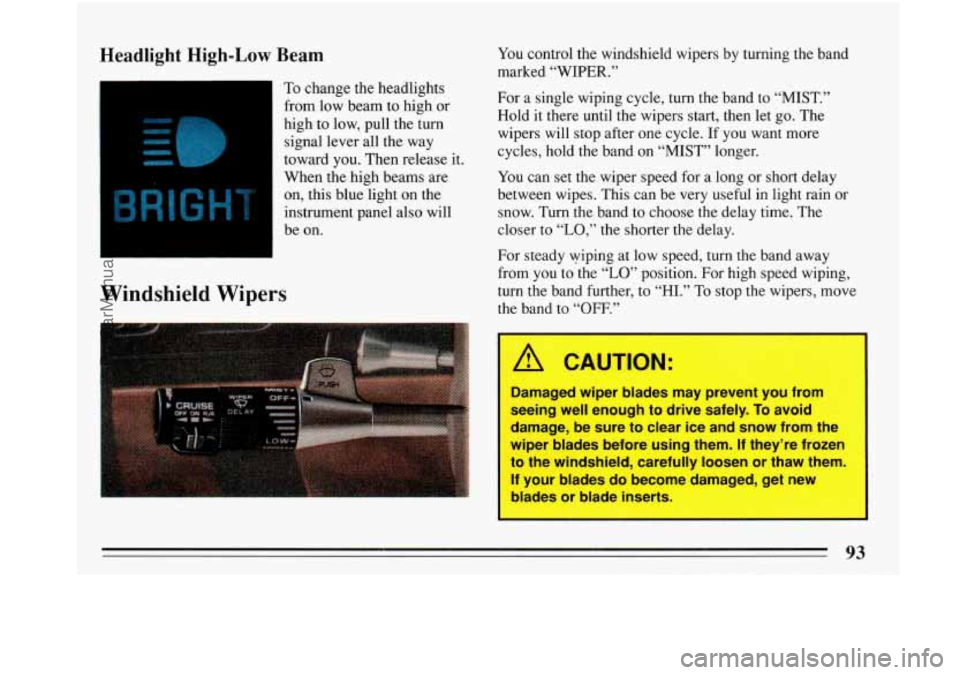
To change the headlights
from low beam to high or
high to low, pull the turn
signal lever. all the way
toward you. Then release it.
When the high beams are
on, this blue light on the
instrument panel also will
be on.
R 1J H
Windshield Wipers
You control the windshield wipers by turning the band
marked
“WIPER.”
For a single wiping cycle, turn the band to “MIST.”
Hold it there until the wipers start, then let go. The
wipers will stop after one cycle. If you want more
cycles, hold the band on “MIST” longer.
You can set the wiper speed for a long or short delay
between wipes. This can be very useful in light rain or
snow. Turn the band to choose the delay time. The
closer to
“LO,” the shorter the delay.
For steady wiping at low speed, turn the band away
from you to the
“LO” position. For high speed wiping,
turn the band further, to “HI.”
To stop the wipers, move
the band to
“OFF.”
A CAUTION:
Damaged wiper blades may prevent you from
seeing well enough to drive safely.
To avoid
damage, be sure to clear ice and snow from the
wiper blades before using them.
If they’re frozen
to the windshield, carefully loosen or thaw them.
If your blades do become damaged, get new
blades or blade inserts.
93
ProCarManuals.com
Page 119 of 340
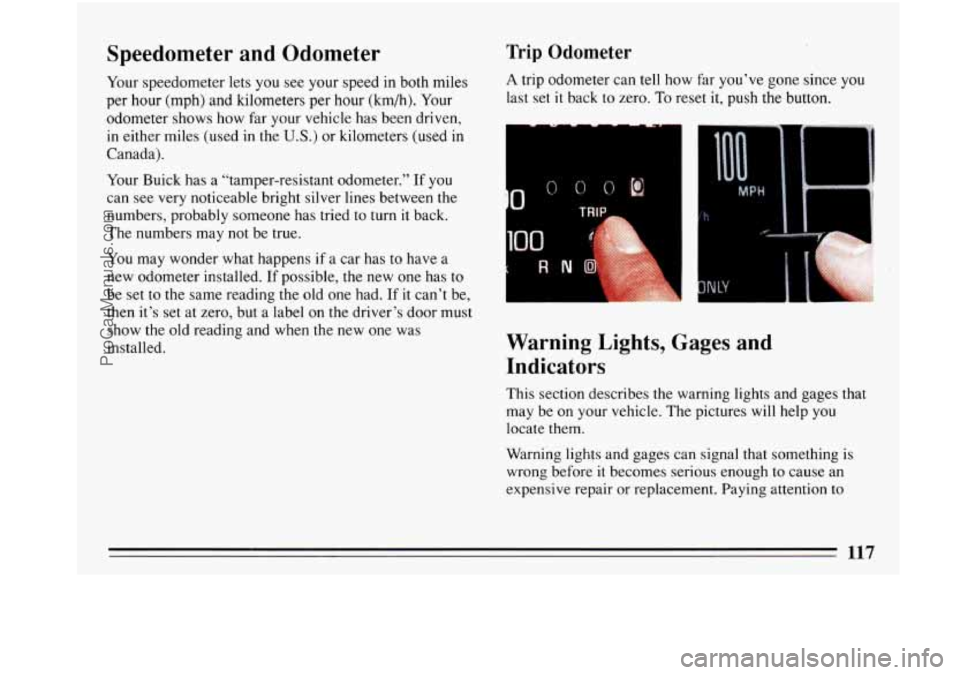
Speedometer and Odometer
Your speedometer lets you see your speed in both miles
per hour (mph) and kilometers per hour (km/h). Your
odometer shows how far your vehicle has been driven,
in either miles (used in the
U.S.) or kilometers (used in
Canada).
Your Buick has a “tamper-resistant odometer.”
If you
can see very noticeable bright silver lines between the
numbers, probably someone has tried to turn it back.
The numbers may not be true.
You may wonder what happens if a car has to have a
new odometer installed. If possible, the new one has to
be set
to the same reading the old one had. If it can’t be,
then it’s set at zero, but
a label on the driver’s door must
show the old reading and when the new one was
installed.
Trip Odometer
A trip odometer can tell how far you’ve gone since you
last set it back to zero. To reset it, push the button.
Warning Lights, Gages and
Indicators
This section describes the warning lights and gages that
may be on your vehicle. The pictures will help you
locate them.
Warning lights and gages can signal that something
is
wrong before it becomes serious enough to cause an
expensive repair or replacement. Paying attention
to
117
ProCarManuals.com
Page 168 of 340
time. A green arrow means you may drive in that lane.
Look for the signs posted to warn drivers what hours
and days these systems are in effect.
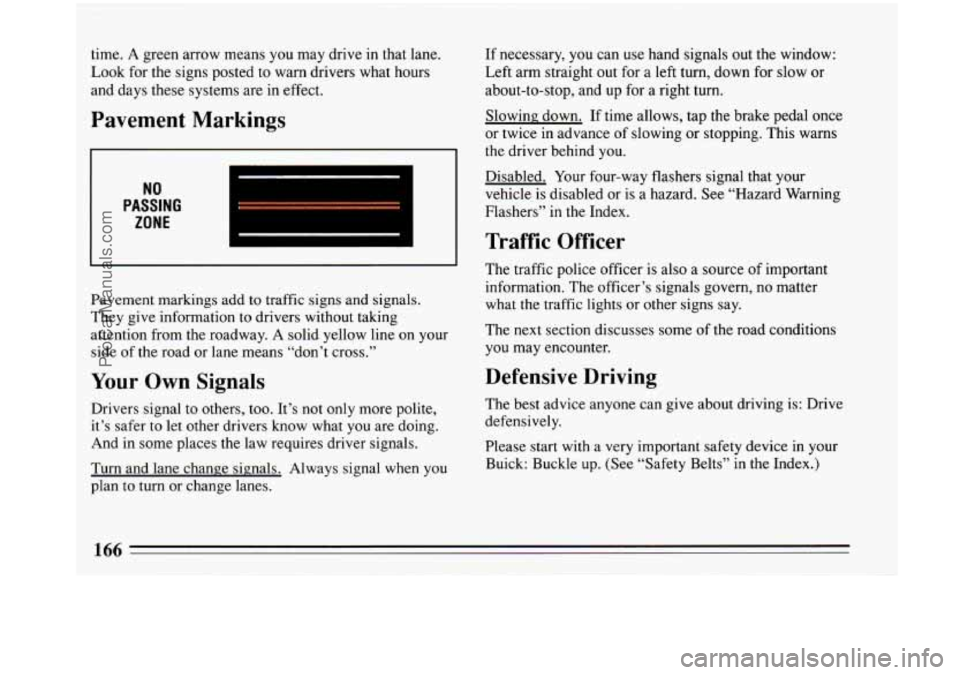
Pavement Markings
NO
PASSING
ZONE
Pavement markings add to traffic signs and signals.
They give information to drivers without taking
attention from the roadway. A solid yellow line
on your
side of the road
or lane means “don’t cross.”
Your Own Signals
Drivers signal to others, too. It’s not only more polite,
it’s safer to let other drivers know what you are doing.
And in some places the law requires driver signals.
Turn and lane change signals. Always signal when you
plan to turn or change lanes.
If necessary, you can use hand signals out the window:
Left arm straight
out for a left turn, down for slow or
about-to-stop, and up for a right turn.
Slowing down. If time allows, tap the brake pedal once
or twice in advance of slowing or stopping. This warns
the driver behind you.
Disabled. Your four-way flashers signal that your
vehicle
is disabled or is a hazard. See “Hazard Warning
Flashers” in the Index.
Traffic Officer
The traffic police officer is also a source of important
information. The officer’s signals govern, no matter
what the traffic lights or other signs say.
The next section discusses some of the road conditions
you may encounter.
Defensive Driving
The best advice anyone can give about driving is: Drive
defensively.
Please start with a very important safety device in your
Buick: Buckle up. (See “Safety Belts” in the Index.)
ProCarManuals.com
Page 181 of 340
So here are some tips for passing:
“Drive ahead.” Look down the road, to the sides, and
to crossroads for situations that might affect your
passing patterns.
If you have any doubt whatsoever
about making a successful pass, wait for a better
time.
Watch for traffic signs, pavement markings, and
lines. If you can see a sign up ahead that might
indicate a turn or an intersection, delay your pass. A
broken center line usually indicates it’s all right to
pass (providing the road ahead is clear). Never cross
a solid line
on your side of the lane or a double solid
line, even if the road seems empty of approaching
traffic.
If you suspect that the driver of the vehicle you want
to pass isn’t aware of your presence, tap the
horn a
couple of times before passing.
Do not get too close to the vehicle you want to pass
while you’re awaiting an opportunity. For one thing,
following
too closely reduces your area of vision,
especially if you’re following
a larger vehicle. Also,
you won’t have adequate space if the vehicle ahead
suddenly slows or stops. Keep back a reasonable
distance.
When it looks like a chance to pass is coming up,
start to accelerate but stay in the right lane and don’t
get too close. Time your move
so you will be
increasing speed as
the time comes to move into the
other lane. If the way is clear to pass, you will have a
“running start’’ that more than makes up for the
distance you would lose by dropping back. And if
something happens to cause you to cancel your pass,
you need only slow down and drop back again and
wait for another opportunity.
If other cars are lined up to pass a slow vehicle, wait
your turn.
But take care that someone isn’t trying to
pass you as you pull out to pass the slow vehicle.
Remember to glance over your shoulder and check
the blind spot.
Check your mirrors, glance over your shoulder, and
start your
left lane change signal before moving out
of the right lane to pass. When you are far enough
ahead of the passed vehicle
to see its front in your
inside mirror, activate your right lane change signal
and move back into the right lane. (Remember that
your right outside mirror
is convex. The vehicle you
just passed may seem to be farther away from you
than it really
is.)
ProCarManuals.com
Page 189 of 340
Tips on Driving in Fog
If you get caught in fog, turn your headlights on low
beam, even
in daytime. You’ll see -- and be seen --
better.
Don’t
use your high beams. The light will bounce off
the water droplets that make up fog and reflect back at
you.
Use your defogger. In high humidity, even a light
buildup of moisture on the inside of the glass will cut
down on your already limited visibility.
Run your
windshield wipers and washer occasionally. Moisture
can build up on the outside glass, and what seems to be
fog may actually be moisture
on the outside of your
windshield.
Treat dense fog as an emergency. Try to find a place
IO
pull off the road. Of course you want to respect
another’s property, but you might need
to put something
between you and moving vehicles
-- space, trees,
telephone poles, a private driveway, anything that
removes
you from other traffic.
If visibility is near zero and
you must stop but are
unsure whether you are away from the road, turn your
lights on, start your hazard warning flashers, and sound
your horn at intervals or when you hear approaching
traffic. Pass
other vehicles in fog only if you
can see far enough
ahead to pass safely. Even then, be prepared to delay
your pass if you suspect the fog is worse up ahead.
If
other vehicles try to pass you, make it easy for them.
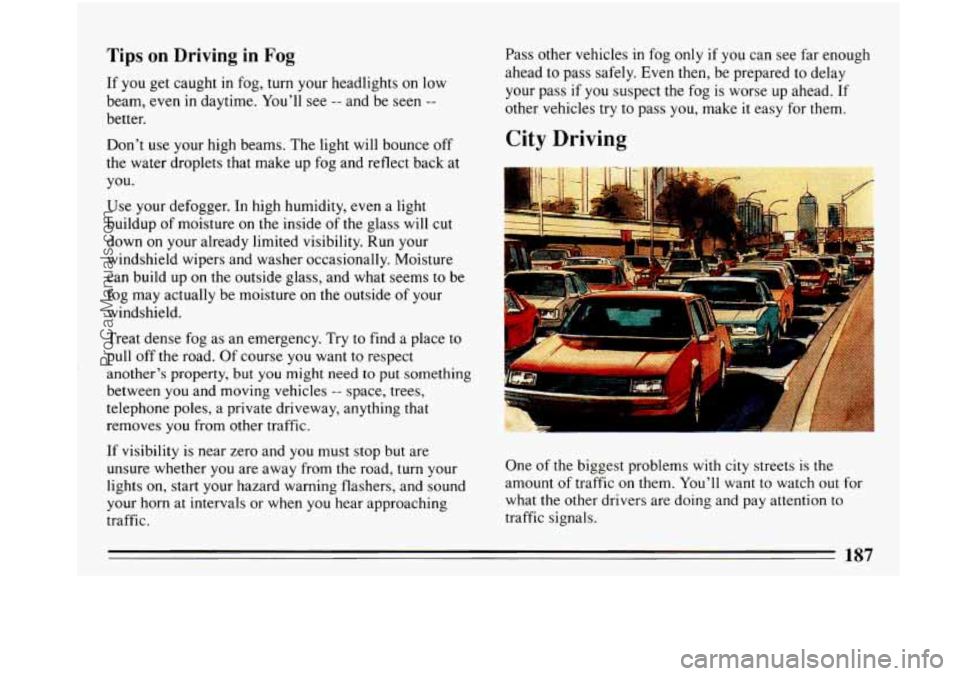
City Driving
L
One of the biggest problems with city streets is the
amount
of traffic on them. You’ll want to watch out for
what
the other drivers are doing and pay attention to
traffic signals.
187
ProCarManuals.com