1993 BUICK PARK AVENUE mirror
[x] Cancel search: mirrorPage 184 of 340
Night Vision
No one can see as well at night as in the daytime. But as
we get older these differences increase. A 50-year-old
driver may require at least twice as much light to see the
same thing at night as a 20-year-old.
What you do in the daytime can also affect your night
vision. For example,
if you spend the day in bright
sunshine
you are wise to wear sunglasses. Your eyes will
have less trouble adjusting to night.
But if you’re driving, don’t wear sunglasses at night.
They may cut down
on glare from headlights, but they
also make a lot of things invisible that should remain
visible
- such as parked cars, obstacles, pedestrians, or
even trains blocking railway crossings. You may want to
put on your sunglasses after you have pulled into a
brightly-lighted service
or refreshment area. Eyes
shielded from that glare may adjust more quickly to
darkness back
on the road. But be sure to remove your
sunglasses before you leave the service area.
You can be temporarily blinded by approaching lights. It
can take
a second or two, or even several seconds, for
your eyes to readjust
to the dark. When you are faced
with severe glare (as from a driver who doesn’t lower
the high beams, or a vehicle with misaimed headlights),
slow down a little. Avoid staring directly into the
approaching lights. If there is a line of opposing traffic, make occasional glances over
the line of headlights to
make certain that one
of the vehicles isn’t starting to
move into your lane. Once
you are past the bright lights,
give your eyes time to readjust before resuming speed.
High Beams
If the vehicle approaching you has its high beams on,
signal by flicking yours to high and then back to low
beam. This is the usual signal to lower the headlight
beams. If the other driver still doesn’t lower the beams,
resist the temptation to put your high beams
on. This
only makes two half-blinded drivers.
On a freeway, use your high beams
only in remote areas
where you won’t impair approaching drivers. In some
places, like cities, using high beams is illegal.
When you follow another vehicle on a freeway or
highway, use low beams. True, most vehicles now have
day-night mirrors that enable the driver to reduce glare.
But outside mirrors are not of this type and high beams
from behind can bother the driver ahead.
A Few More Night Driving Suggestions
Keep your windshield and all the glass on your vehicle
clean
-- inside and out. Glare at night is made much
worse by dirt on the glass. Even the inside of the glass
can build up a film caused by dust. Tobacco smoke also
ProCarManuals.com
Page 191 of 340
too-slow driving breaks a smooth traffic flow. Treat the
left lane on a freeway as a passing lane.
Entering the Freeway
At the entrance there is usually a ramp mat leads to the
freeway.
If you have a clear view of the freeway as you
drive along the entrance ramp, you should begin to
check traffic. Try to. determine where you expect to
blend with the flow.
If traffic is light, you may have no
problem. But if it is heavy, find a gap as you move along
the entering lane and time your approach. Try to merge
into the gap at,close to the prevailing speed. Switch on
your
turn signal, check your rearview mirrors as you
move along, and glance over your shoulder as often as
necessary. Try to blend smoothly with the traffi.c flow.
Driving on the Freeway
Once you are on the freeway, adjust your speed to the
posted limit or to the prevailing rate if it’s slower. Stay
in the right lane unless you want to ‘pass. If you are on a
two-lane freeway, treat the right Lane as the slow lane
and the left lane as the passing lane.
If you are on a three-lane freeway, treat the right lane as
the slower-speed through lane, the middle lane as the
higher-speed through lane, and
the left lane as the
passing lane. Before changing lanes, check
your rearview mirrors.
Then use your turn signal.
Just before
you leave the lane, glance quickly over your
shoulder to make sure there isn’t another vehicle in your
“blind” spot.
If you are moving from an outside.to a center lane on a
freeway having more than two lanes, make sure another
vehicle isn’t about to move into the same spot. Look at
the vehicles two lanes over and watch for telltale signs:
turn signals flashing,
an increase in speed, or moving
toward the edge of the lane. Be prepared to delay your
move.
.
Once you are moving on the freeway, make certain you
allow a reasonable following distance. Expect to move
slightly slower at night.
Leaving the Freeway
When you want to leave the freeway, move to the proper
lane well in advance. Dashing across lanes at the last
minute is dangerous.
If you miss your exit do not, under
any circumstances, stop and back up. Drive on to the
next exit.
At each.exit point is a’deceleration lane. Ideally it
should be long enough for you to enter it at freeway
speed (after signaling, of course) and then do your
ProCarManuals.com
Page 194 of 340
Then here are some tips:
e
e
e
e Make sure your vehicle is well ventilated, with a
comfortably cool interior.
Keep your eyes moving. Scan the road ahead and to
the sides. Check your rearview mirrors frequently
and your instruments from time
to time. This can
help you avoid
a fixed stare.
Wear
good sunglasses in bright light. Glare can
cause drowsiness. But don't wear sunglasses at
night. They will drastically reduce your overall
vision at the very time you need all the seeing power
you have.
If you get sleepy, pull off the road into a rest, service,
or parking area and take a nap, get some exercise, or
both. For safety, treat drowsiness
on the highway as
an emergency.
As in any driving situation, keep pace with traffic and
allow adequate following distances. Driving on
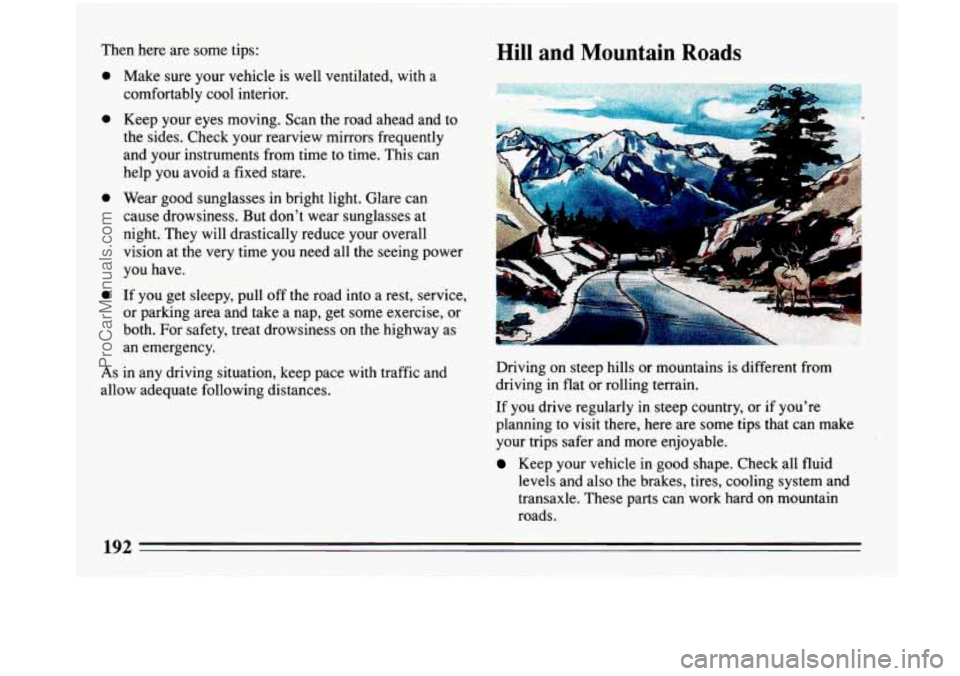
steep hills or mountains is different from
driving in flat or rolling terrain.
If you drive regularly
in steep country, or if you're
,planning to visit there, here are some tips that can make
your trips safer and more enjoyable.
Keep your vehicle in good shape. Check all fluid
levels and also the brakes, tires, cooling system and
transaxle. These parts can work hard
on mountain
roads.
192
ProCarManuals.com
Page 207 of 340
Driving with a Trailer
Towing a trailer requires a certain amount of experience.
Before setting
out for the open road, you’ll want to get
to know your rig. Acquaint yourself with the feel of
handling and braking with the added weight of the
trailer. And always keep in mind that the vehicle
you are
driving is now a good deal longer and not nearly
so
responsive as your vehicle is by itself.
Before you start, check the trailer hitch and platform,
safety chains, electrical connector, lights, tires and
mirror adjustment.
If the trailer has electric brakes, start
your vehicle and trailer moving and then apply the
trailer brake controller by hand
to be sure the brakes are
working. This lets you check your electrical connection
at the same time.
Passing
During your trip, check occasionally to be sure that the
load is secure, and that the lights and any trailer brakes
are still working.
Following Distance
Stay at least twice as far behind the vehicle ahead as you
would when driving your vehicle without a trailer. This
can help you avoid situations that require heavy braking
and sudden turns. You’ll
need more passing distance up ahead when
you’re towing a trailer. And, because you’re a good deal
longer, you’ll need to go much farther beyond the
passed vehicle before you can return to your lane.
Backing Up
Hold the bottom of the steering wheel with one hand.
Then, to move the trailer
to the left, just move that hand
to the
left. To move the trailer to the right, move your
hand to the right. Always back up slowly and, if
possible, have someone guide you.
Making Turns
When you’re turning with a trailer, make wider turns
than normal. Do this
so your trailer won’t strike soft
shoulders, curbs, road signs, trees, or other objects.
Avoid jerky or sudden maneuvers. Signal well
in
advance.
lbrn Signals When Towing a Trailer
When you tow a trailer, your vehicle has to have a
different turn signal flasher and extra wiring. The green
arrows on your instrument panel will flash whenever
you signal a turn or lane change. Properly hooked up,
ProCarManuals.com
Page 290 of 340
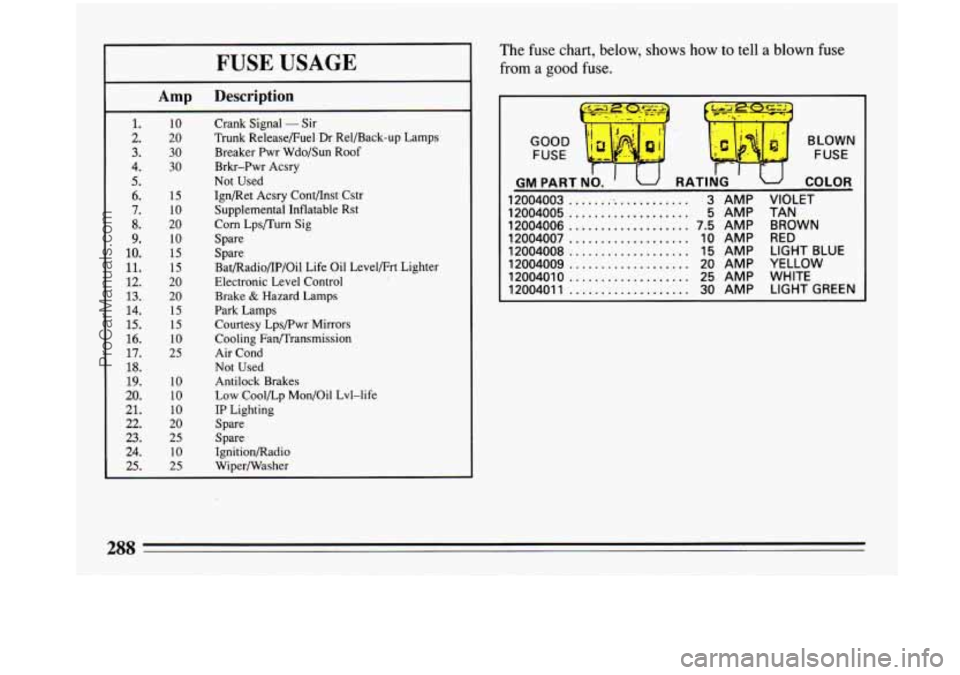
FUSE USAGE
Amp Description
1.
2.
3.
4.
5. 6.
7.
8.
9.
10.
11. 12.
13.
14.
15.
16. 17.
18.
19.
20.
21.
22.
23.
24.
25.
10
20
30
30
15
10
20
10
15
15
20
20
15
15
10
25
10
10
10
20
25
10
25
Crank Signal - Sir
Trunk Release/Fuel.Dr Rel/Back-up Lamps
Breaker Pwr Wdo/Sun Roof
Brkr-Pwr Acsry
Not Used
Ign/Ret Acsry ContDnst Cstr
Supplemental Inflatable Rst
Corn Lps/Turn Sig
Spare
Spare
Bat/Radio/IP/Oil Life Oil Level/Frt Lighter
Electronic Level Control
Brake
& Hazard Lamps
Park Lamps
Courtesy Lps/Pwr Mirrors
Cooling Fan/Transmission
Air Cond
Not Used
Antilock Brakes
Low Cool/Lp Mon/Oil Lvl-life
IP Lighting
Spare
Spare
IgnitionBadio
Wiperwasher
The fuse chart, below, shows how to tell a blown fuse
from a
good fuse.
GOOD
FUSE 1 BLOWN .r, ' \' gJ
'TI r
FUSE
GM PART NO. ' RATING ' COLOF
12004003 .................... 3 AMP VIOLET
12004005
................... 5 AMP TAN
12004006
................... 7.5 AMP BROWN
12004007
................... 10 AMP RED
12004008
................... 15 AMP LIGHT
BLUE
12004009
................... 20 AMP YELLOW
12004010
................... 25 AMP WHITE
1200401
1 ................... 30 AMP LIGHT
GREEN
ProCarManuals.com
Page 293 of 340
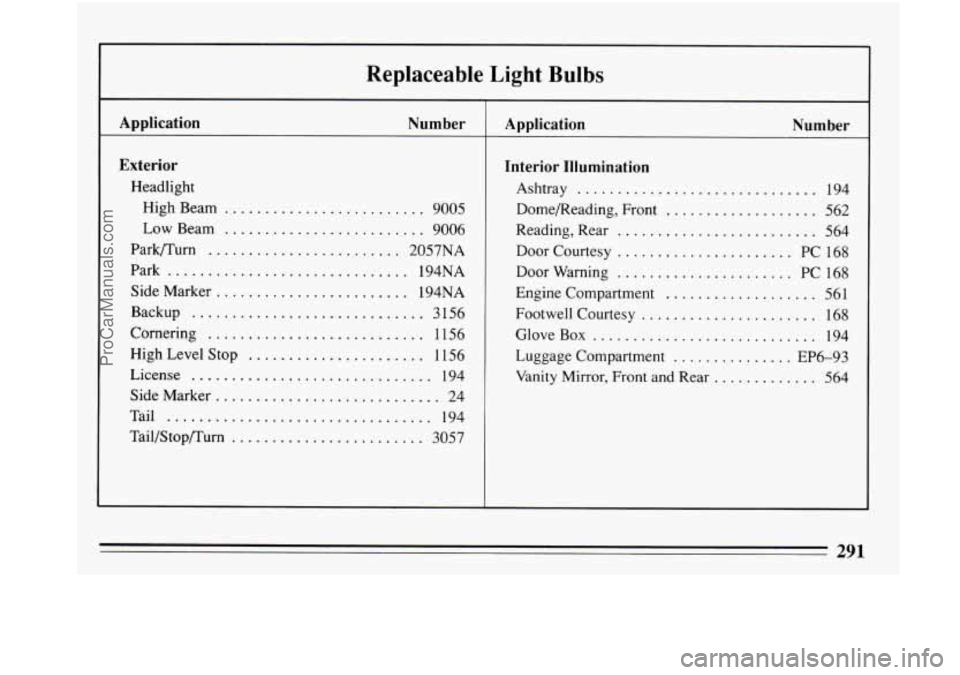
Replaceable Light Bulbs
Application Number
Exterior
Headlight High Beam
......................... 9005
Low Beam
......................... 9006
Park/Turn
........................ 2057NA
Park
.............................. 194NA
Side Marker
........................ 194NA
Backup
............................. 3156
Cornering
........................... 1156
High Level Stop
...................... 1156
License
.............................. 194
Side Marker
............................ 24
Tail
................................. 194
Tail/Stop/Turn
........................ 3057
Application Number
Interior Illumination
Ashtray .............................. 194
Dome/Reading. Front
................... 562
Reading. Rear
......................... 564
Door Courtesy
...................... PC 168
Door Warning
...................... PC 168
Engine Compartment
................... 561
Footwell Courtesy
...................... 168
GloveBox
............................ 194
Luggage Compartment
............... EP6-93
Vanity Mirror. Front and Rear
............. 564
ProCarManuals.com
Page 323 of 340
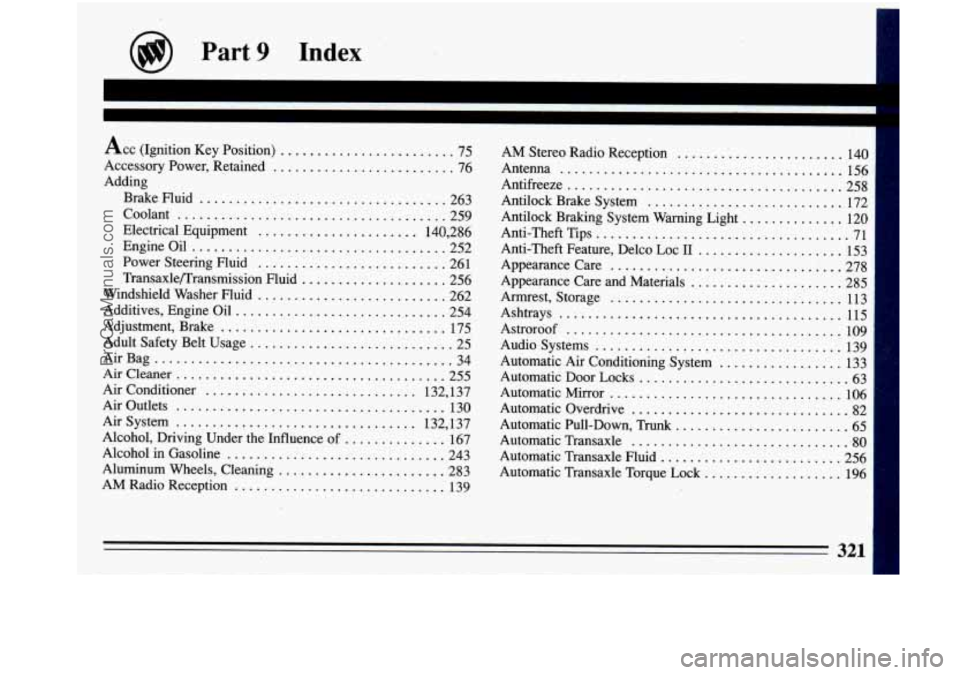
Part 9 Index
.
Ace (Ignition Key Position) ........................ 75
Accessory Power. Retained
......................... 76
Adding
Brake Fluid
.................................. 263
Coolant
..................................... 259
Electrical Equipment
...................... 140, 286
Engineoil
................................... 252
Power Steering Fluid
.......................... 261
Transaxle/Transmission Fluid
.................... 256
Windshield Washer Fluid
........................... 262
Additives, Engine Oil
............................. 254
Adjustment, Brake
............................... 175
Adult Safety Belt Usage
............................. 25
AirBag
.......................................... 34
Aircleaner
..................................... 255
Air Conditioner ............................. 132, 137
Air Outlets ..................................... 130
Air System
................................. 132, 137
Alcohol, Driving Under the Influence of
.............. 167
Alcohol
in Gasoline .............................. 243
Aluminum Wheels, Cleaning
....................... 283
AM Radio Reception ............................. 139 AM
Stereo Radio Reception
......................... 140
Antenna
....................................... 156
Antifreeze
...................................... 258
Antilock Brake System ........................... 172
Antilock Braking System Warning Light
.............. 120
Anti-TheftTips
................................... 71
Anti-Theft Feature, Delco LOC I1
.................... 153
Appearance Care
.................................. 278
Appearance Care and Materials
..................... 285
Armrest, Storage
................................ 113
Ashtrays
.. : ...................................... 115
Astroroof
...................................... 109
Audio Systems
.................................. 139
Automatic Air Conditioning System
................. 133
Automatic Door Locks
............................. 63
Automatic Mirror
................................ 106
Automatic Overdrive
.............................. 82
Automatic Pull-Down, Trunk
........................ 65
Automatic Transaxle
.............................. 80 I
Automatic Transaxle Fluid ......................... 256
Automatic Transaxle Torque Lock
................... 196
321
ProCarManuals.com
Page 325 of 340
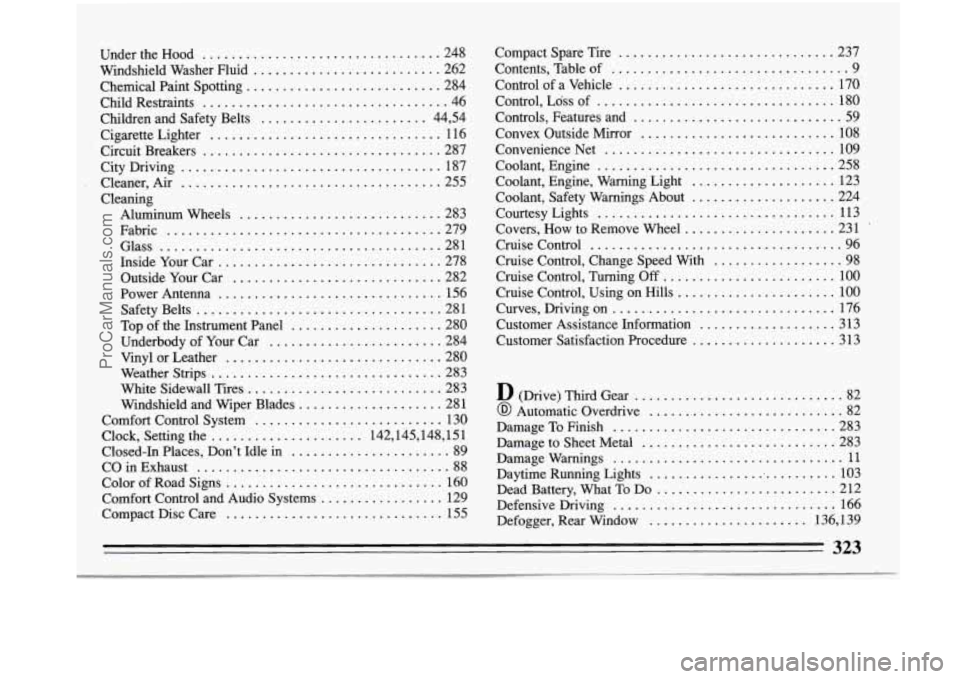
Under the Hood ............. ................... 248
Windshield Washer Fluid
.......................... 262
Chemical Paint Spotting
........................... 284
Child Restraints
.................................. 46
Children and Safety Belts
....................... 4434
Cigarette Lighter
................................ 1 16
Circuit Breakers
................................. 287
CityDriving
.................................... 187
Cleaner, Air
.................................... 255
Cleaning Aluminum Wheels
............................ 283
Fabric
...................................... 279
Glass
....................................... 281
Inside Your Car
............................... 278
Outside
Your Car ............................. 282
Power Antenna
............................... 156
Safety Belts
.................................. 281
Top of the Instrument Panel
..................... 280
Underbody
of Your Car ........................ 284
vinyl or Leather
.............................. 280
Weather
Strips ............................... -283
White Sidewall Tires
........................... 283
Windshield and Wiper Blades
.................... 281
Comfort Control System
.......................... 130
Clock, Setting the
..................... 142,145,148, 151
Closed-In Places, Don’t Idle in
...................... 89
COinExhaust
................................... 88
Color of Road Signs .............................. 160
Comfort Control and Audio Systems
................. 129
Compact Disc Care
.............................. 155 Compact Spare
Tire
.............................. 237
Contents. Table of
................................. 9
Contra1 of a Vehicle
.............................. 170
Control. Loss of ................................. 180
Controls. Features and
............................. 59
Convex Outside Mirror ........................... 108
Convenience Net
................................ 109
Coolant. Engine
................................. 258
Coolant. Engine. Warning Light
.................... 123
Coolant. Safety Warnings About
.................... 224
Courtesy Lights
................................. 113
Covers. How to Remove Wheel
..................... 231
Cruise Control
.................................. -96
Cruise Control. Change Speed With
.................. 98
Cruise Control. Turning
Off ........................ 100
Cruise Control. Using on Hills
...................... 100
Curves. Driving on
............................... 176
Customer Assistance Information
................... 313
Customer Satisfaction Procedure
.................... 313
D (Drive) Third Gear ............................. 82
@ Automatic Overdrive ........................... 82
Damage To Finish
............................... 283
Damage to Sheet Metal
........................... 283
Daytime Running Lights
........................... 103
Dead Battery. What To Do
......................... 212
Defensive Driving
............................... 166
Defogger. Rear Window
...................... 136. 139
Damagewarnings
................................ 11
323
ProCarManuals.com