Page 187 of 324
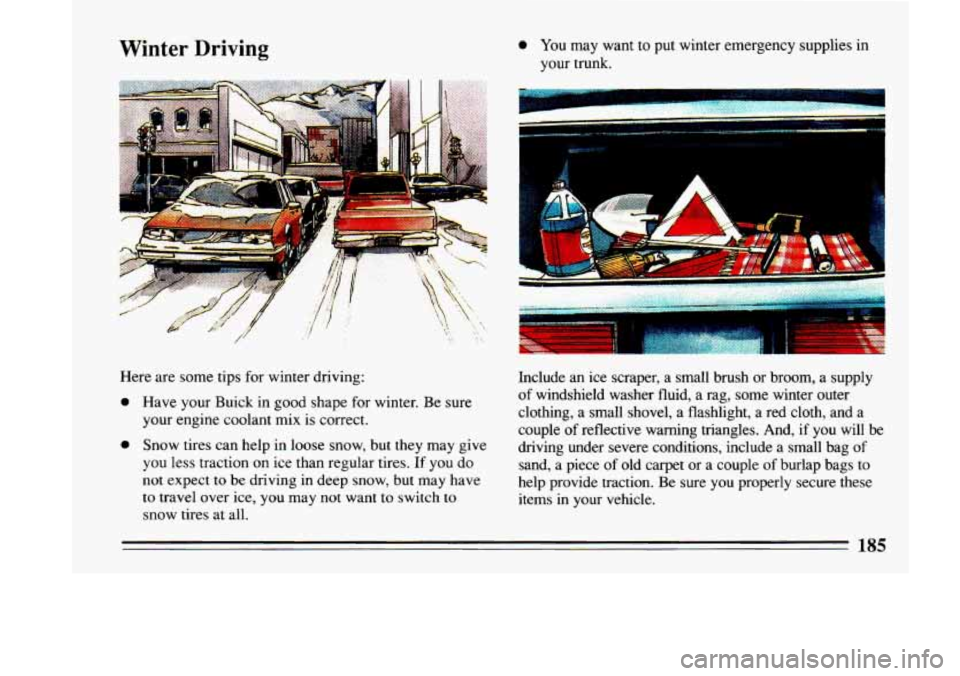
Winter Driving 0 You may want to put winter emergency supplies in
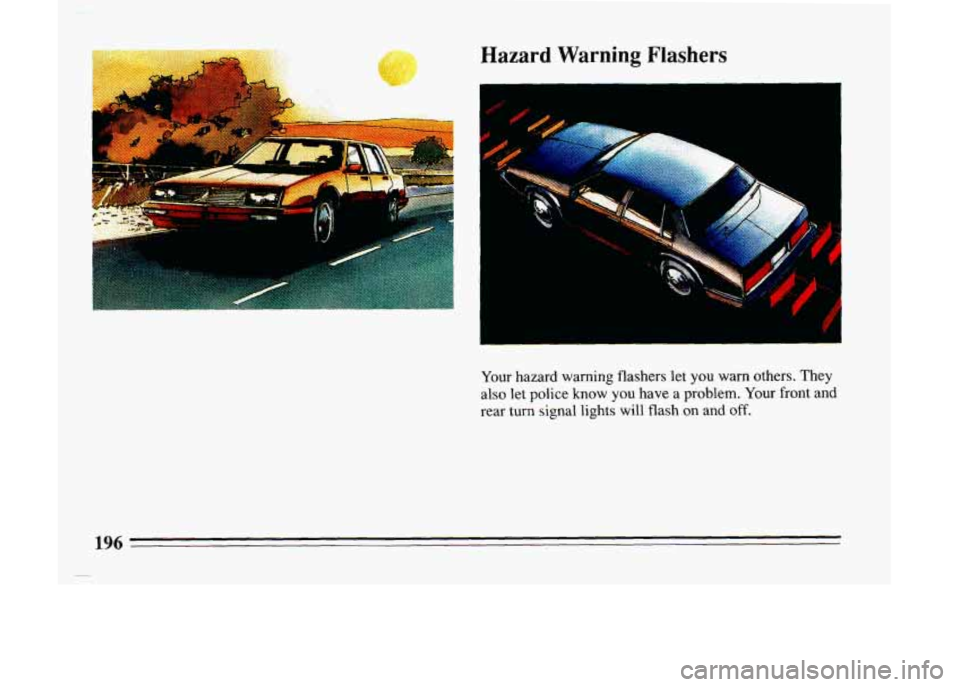
your trunk.
Here are some tips for winter driving:
0 Have your Buick in good shape for winter. Be sure
your engine coolant mix
is correct.
0 Snow tires can help in loose snow, but they may give
you less traction
on ice than regular tires. If you do
not expect
to be driving in deep snow, but may have
to travel over ice, you may not want to switch to
snow tires at all. Include an ice scraper,
a small brush
or broom, a supply
of windshield washer fluid, a rag, some winter outer
clothing, a small shovel, a flashlight, a red cloth, and a
couple
of reflective warning triangles. And, if you will be
driving under severe conditions, include a small bag
of
sand, a piece of old carpet or a couple of burlap bags to
help provide traction. Be sure you properly secure these
items in your vehicle.
185
Page 198 of 324
Hazard Warning Flashers
I
I
.-
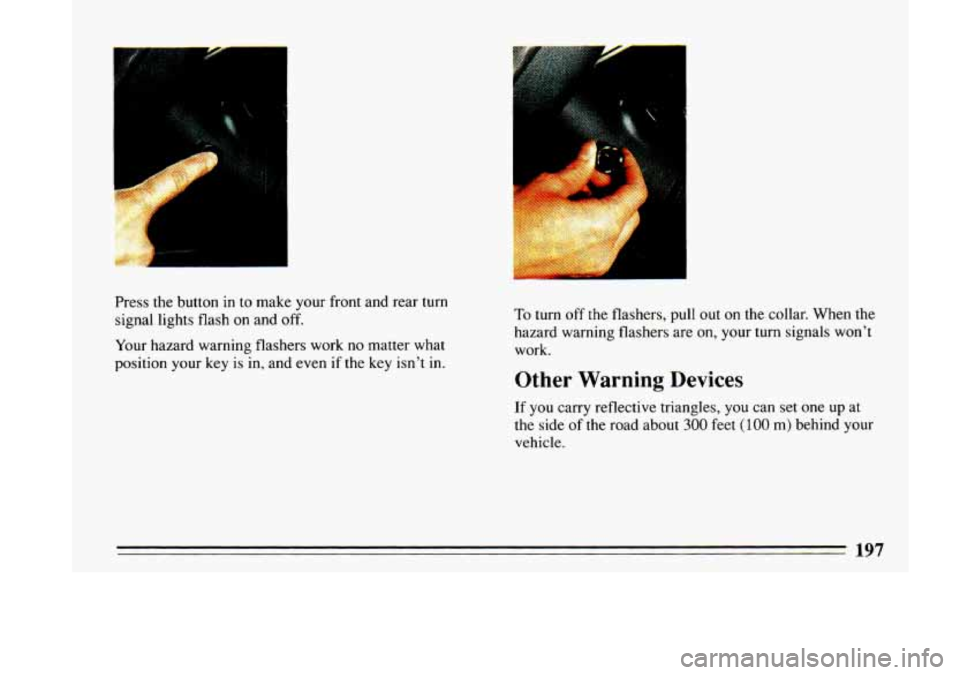
Your hazard warning flashers let you warn others. They
also
let police know you have a problem. Your front and
rear turn signal lights will flash on
and off.
196
Page 199 of 324
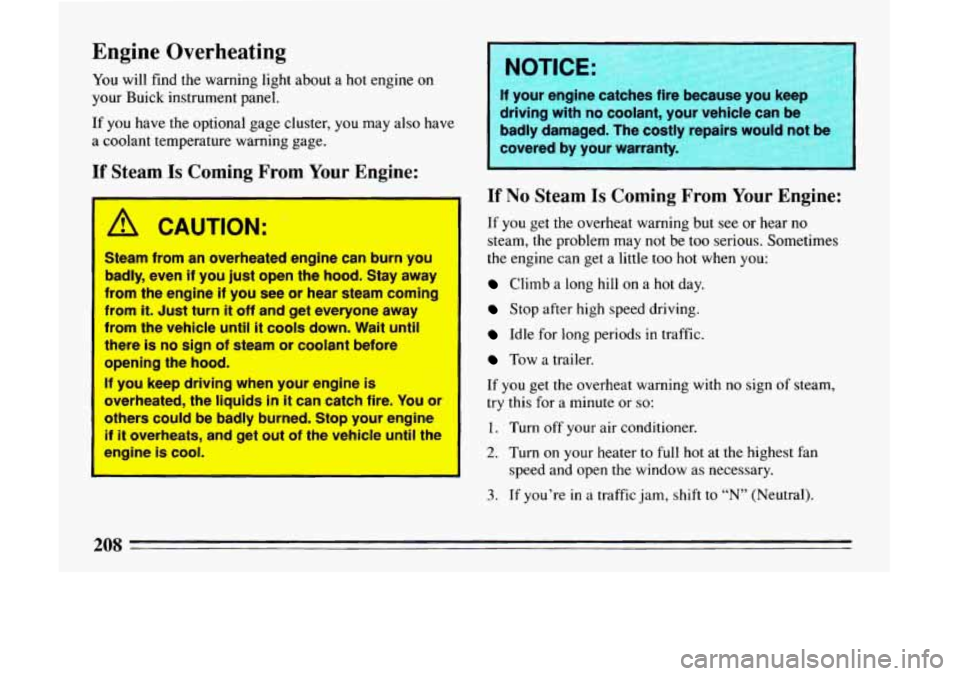
Press the button in to make your front and rear turn
signal lights flash on and
off.
Your hazard warning flashers work no matter what
position your key
is in, and even if the key isn't in.
To turn off the flashers, pull out on the collar. When the
hazard warning flashers are on, your turn signals won't
work.
Other Warning Devices
If you carry reflective triangles, you can set one up at
the side
of the road about 300 feet (1 00 m) behind your
vehicle.
197
Page 210 of 324
Engine Overheating
You will find the warning light about a hot engine on
your Buick instrument panel,
If you have the optional gage cluster, you may also have
a coolant temperature warning gage.
If Steam Is Coming From Your Engine:
CAUTION:
eam from an overheated engine can burn you
badly, even if you just open
the hood. Stay away
from
the engine if you see or hear steam coming
from
it. Just turn it off and get everyone away
From the vehicle until
it cools down. Wait until
there
is no sign of steam or coolant before
opening the hood.
If you keep driving when your engine is
overheated, the liquids in it can catch fire. You or
others could be badly burned. Stop your engine
if it overheats, and get out of the vehicle until the
engine is cool. badly
damaged. The costly
covered by your warranty.
If No Steam Is Coming From Your Engine:
If you get the overheat warning but see or hear no
steam, the problem may not be too serious. Sometimes
the engine can get a little too
hot when you:
Climb a long hill on a hot day.
Stop after high speed driving.
Idle for long periods in traffic.
Tow a trailer.
If you get the overheat warning with no sign of steam,
try this for a minute or so:
1. Turn off your air conditioner.
2. Turn on your heater to full hot at the highest fan
speed and open the window as necessary.
3. If you’re in a traffic jam, shift to “N” (Neutral).
208
Page 229 of 324
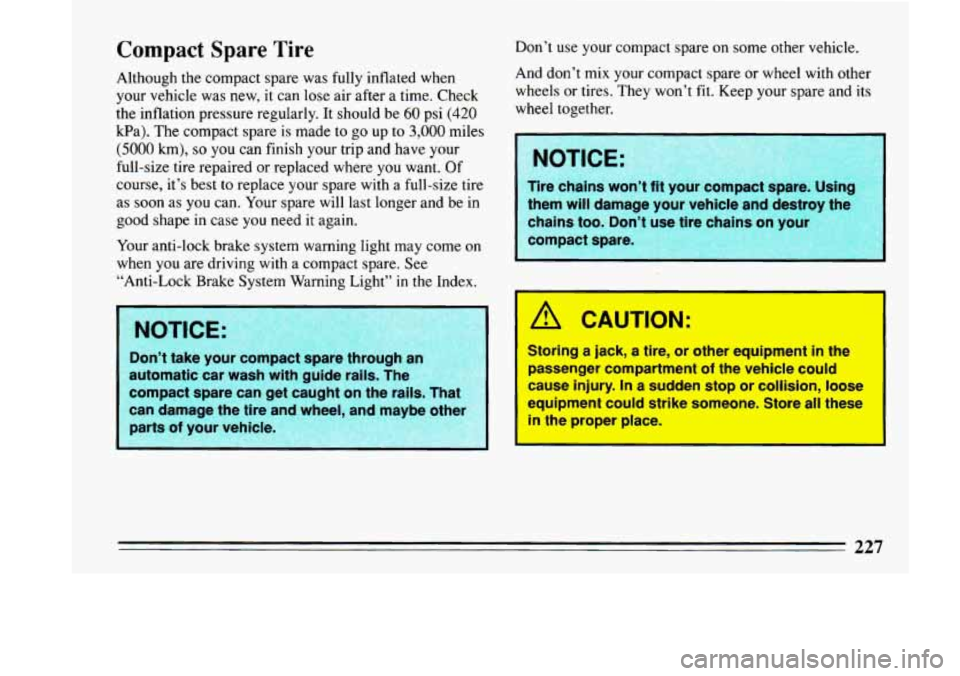
Compact Spare Tire
Although the compact spare was fully inflated when
your vehicle was new, it can lose air after a time. Check
the inflation pressure regularly. It should be
60 psi (420
Wa). The compact spare is made to go up to 3,000 miles
(5000 km), so you can finish your trip and have your
full-size tire repaired or replaced where you want. Of
course, it’s best
to replace your spare with a full-size tire
as soon as
you can. Your spare will last longer and be in
good shape in case you need it again.
Your anti-lock brake system warning light may come
on
when you are driving with a compact spare. See
“Anti-Lock Brake System Warning Light” in the Index. Don’t
use your
compact spare on some other vehicle.
And don’t mix your compact spare or wheel with other
wheels or tires. They won’t fit. Keep your spare and its
wheel together.
Tire chains wo
them will damage
y
chains too. Do
compact spar I
A CnUTION:
Storing a jack, a tire, or other equipment in the
passenger compartment of the vehicle could
cause injury. In a sudden stop or colllsian, loose
mwipment could strike someone. Store all these
.__ the proper place.
I
227
Page 245 of 324
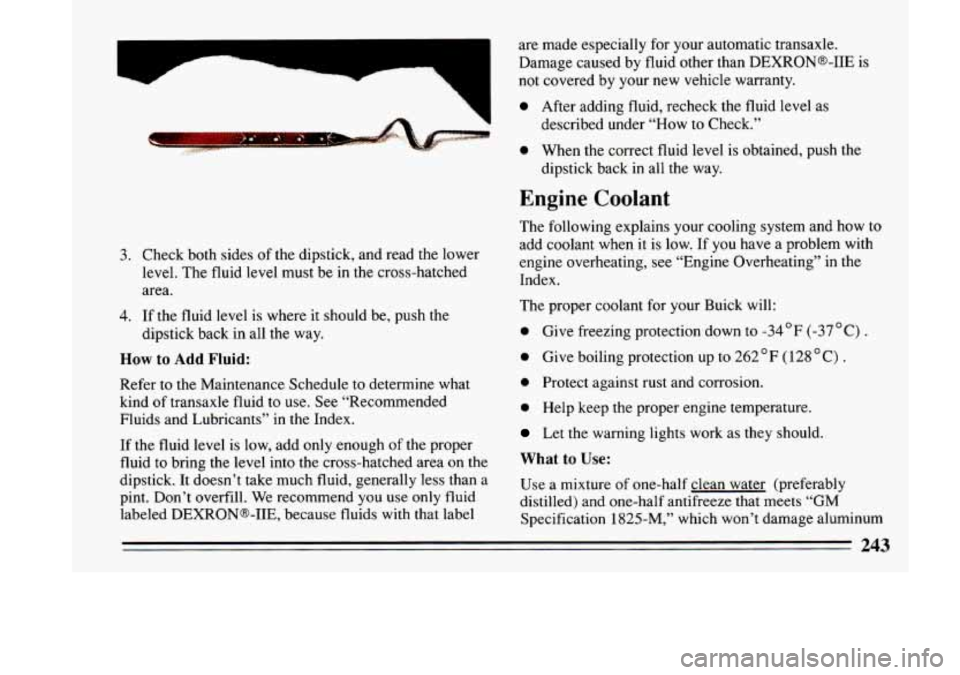
3.
4.
Check both sides of the dipstick, and read the lower
level. The fluid level must be in the cross-hatched
area.
If the fluid level is where it should be, push the
dipstick back in all the way.
How to Add Fluid:
Refer to the Maintenance Schedule to determine what
kind
of transaxle fluid to use. See “Recommended
Fluids and Lubricants” in the Index.
If the fluid level
is low, add only enough of the proper
fluid to bring the level into the cross-hatched area on the
dipstick. It doesn’t take much fluid, generally less than a
pint. Don’t overfill. We recommend you use only fluid
labeled DEXRONa-IIE, because fluids with that label are made especially for your automatic transaxle.
Damage caused by fluid other than DEXRONs-IIE
is
not covered by your new vehicle warranty.
0 After adding fluid, recheck the fluid level as
described under “How to Check.”
0 When the correct fluid level is obtained, push the
dipstick back in all the way.
Engine Coolant
The following explains your cooling system and how to
add coolant when it is low. If you have a problem with
engine overheating, see “Engine Overheating” in the
Index.
The proper coolant for your Buick will:
0 Give freezing protection down to -34OF (-37OC) .
0 Give boiling protection up to 262°F (128 “C) .
0 Protect against rust and corrosion.
0 Help keep the proper engine temperature.
Let the warning lights work as they should.
What to Use:
Use a mixture of one-half clean water (preferably
distilled) and one-half antifreeze that meets
“GM
Specification 1825-M,” which won’t damage aluminum
243
Page 250 of 324

Brake Master Cylinder
Your brake master cylinder is here. It is filled with
DOT-3 brake fluid. won’t
work at all.
So, it isn’t a good idea to “top off’
your brake fluid. Adding brake fluid won’t correct a
leak.
If you add fluid when your linings are worn, then
you’ll have too much fluid when you get new brake
linings. You should add (or remove) brake fluid, as
necessary, only when work
is done on the brake
hydraulic system.
A CAUTION:
If you have too much brake fluid, it can spill on
the engine. The fluid will burn if the engine is hat
,..ough. You or others could be burned, and you1
vehicle could be damaged. Add brake fluid only
when work is done on the brake hydraulic
system.
There are only two reasons why the brake fluid level in
your master cylinder might
go down. The first is that the
brake fluid goes down to an acceptable level during
normal brake lining wear. When new linings are put in,
the fluid level goes back up.
The other reason is that
fluid
is leaking out of the brake system. If it is, you
should have your brake system fixed, since a leak means
that sooner
or later your brakes won’t work well, or When your brake
fluid falls to a low level, your brake
warning light will come on. See “Brake System Warning
Light” in the Index.
When your brake fluid falls to a low
level, your brake
warning light will come
on and a chime will sound.
248
Page 276 of 324
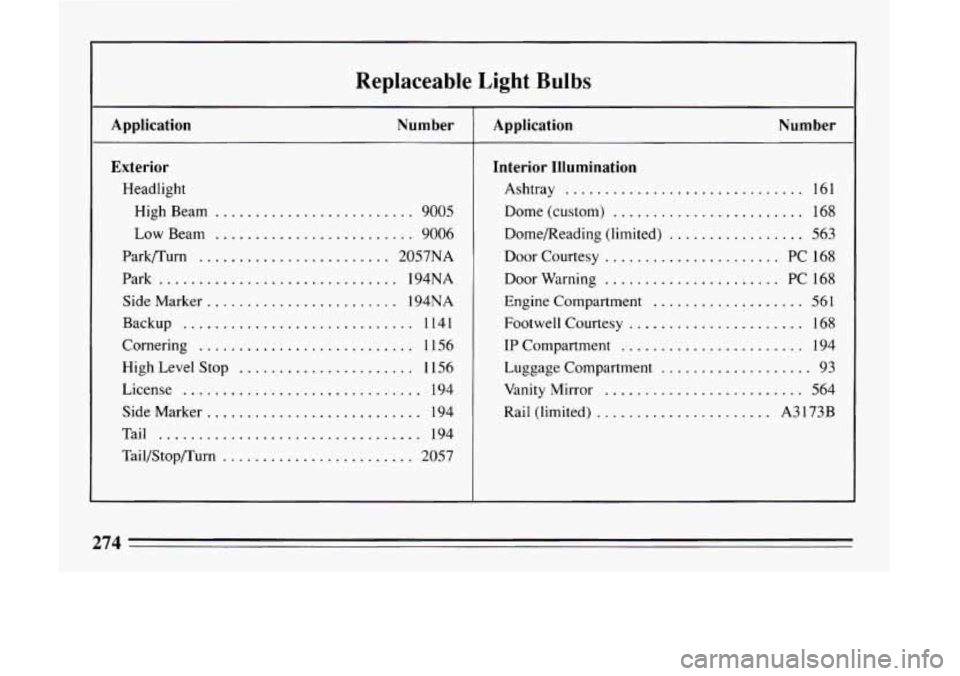
Replaceable Light Bulbs
Application Number
Exterior
Headlight High Beam
......................... 9005
Low Beam
......................... 9006
Parknurn
........................ 2057NA
Park
.............................. 194NA
Side Marker
........................ 194NA
Backup
............................. 1141
Cornering
........................... 1156
High Level Stop
...................... 1156
License
.............................. 194
Side Marker
........................... 194
Tail ................................. 194
Tail/Stop/Turn
........................ 2057
Application Number
Interior Illumination
Ashtray .............................. 161
Dome (custom)
........................ 168
Domemeading (limited)
................. 563
Door Courtesy ...................... PC 168
Door Warning
...................... PC 168
Engine Compartment
................... 561
Footwell Courtesy ...................... 168
IP Compartment ....................... 194
Luggage Compartment
................... 93
Vanity Mirror
......................... 564
Rail (limited) ...................... A3173B
274