1993 BUICK LESABRE ESP
[x] Cancel search: ESPPage 6 of 324
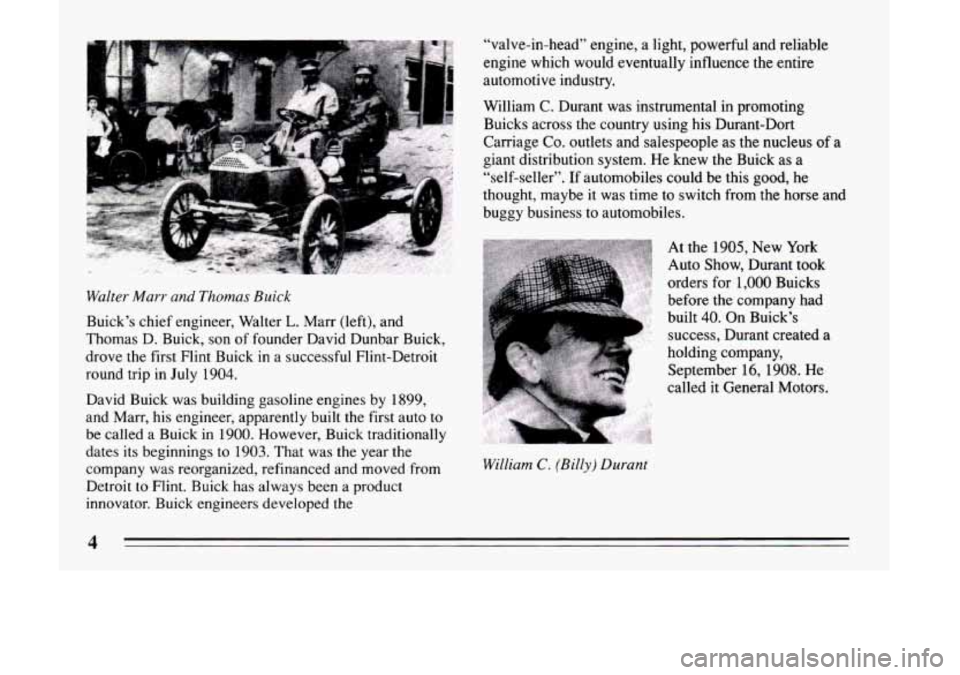
Walter Marr and Thomas Buick
Buick’s chief engineer, Walter L. Marr (left), and
Thomas
D. Buick, son of founder David Dunbar Buick,
drove the first Flint Buick in a successful Flint-Detroit
round trip in July 1904.
David Buick was building gasoline engines by 1899,
and Marr, his engineer, apparently built
the first auto to
be called a Buick in 1900. However, Buick traditionally
dates its beginnings to 1903. That was the year the
company was reorganized, refinanced and moved
from
Detroit to Flint. Buick has always been a product
innovator. Buick engineers developed the “valve-in-head”
engine, a light, powerful and reliable
engine which would eventually influence the entire
automotive industry.
William
C. Durant was instrumental in promoting
Buicks across the country using his Durant-Dort
Carriage Co. outlets and salespeople as the nucleus
of a
giant distribution system. He knew the Buick as a
“self-seller”. If automobiles could be this good, he
thought, maybe it was time to switch from the horse and
buggy business to automobiles.
At the 1905, New York
Auto Show, Durant took
orders for
1,000 Buicks
before
the company had
built 40. On Buick’s
’ . success, Durant created a
holding company,
September 16, 1908. He
called it General Motors.
..
William C. (Billy) Durant
4
Page 25 of 324
Here Are Questions Many People Ask
About Safety Belts -- and the
Answers
@ Won’t I be trapped in the vehicle after an
accident if I’m wearing a safety belt?
A: You could be -- whether you’re wearing a safety
belt or not. But you can easily unbuckle a safety
belt, even if you’re upside down. And your chance
of being conscious during and after an accident,
so
you can unbuckle and get out, is much greater if
you are belted.
@ Why don’t they just put in air bags so people
A: “Air bags,” or Supplemental Inflatable Restraint
won’t have to wear safety belts?
systems, are in some vehicles today and will be in
more of them in the future. But they are
supplemental systems only
-- so they work with safety
belts, not instead of them. Every “air bag”
system ever offered for sale has required the use of
safety belts. Even if you’re in a vehicle that has
“air bags,” you still have to buckle up to get the
most protection. That’s true not only in frontal
collisions, but especially in side and other
collisions.
@’ If I’m a good driver, and I never drive far from
home, why should
I wear safety belts?
A: You may be an excellent driver, but if you’re in an
accident
-- even one that isn’t your fault -- you and
your passengers can be
hurt. Being a good driver
doesn’t protect you from things beyond your
control, such as bad drivers.
Most accidents occur within
25 miles (40 km) of home.
And the greatest number of serious injuries and deaths
occur at speeds
of less than 40 mph (65 km/h).
Safety belts are for everyone.
- 23
Page 61 of 324
When a new LeSabre, is delivered, the dealer removes
the plugs from the keys, and gives them to the fist
owner. However, the ignition key may not have a plug.
Each plug has
a code on it that tells your dealer or a
qualified locksmith how to make extra keys. Keep the
plugs in a safe place.
If you lose your keys, you’ll be
able to have new ones made easily using these plugs.
If
your ignition keys don’t have plugs, go to your Buick
dealer
for the correct key code if you need a new
ignition key.
Key Reminder Warning
If you leave your keys in the ignition you will hear a
warning tone when
you open the driver’s door.
Door Locks
A CAUTION:
Unlocked doors can be dangerous.
Passengers
-- especially children -- can easily
open the
doors and fall out. When a door is
locked, the inside handle won’t open it.
Outsiders can easily enter through an unlocked
door when you
slow down or stop your vehicle.
This may not be
so obvious: You increase the
chance
of being thrown out of the vehicle in a
crash if the
doors aren’t locked. Wear safety
belts properly,
lock your doors, and you will be
far better
off whenever you drive your vehicle.
& 59
Page 65 of 324

I
-.. . BLK
LSSEMBLY LINE DIAGNOSTIC
NK (ALDL) CONNECTOR I
5. Still keeping the program terminal grounded, repeat
Step
4 with the second transmitter. If you disconnect
the ground wire before completing this step, only the
first transmitter is matched.
If you make a mistake,
disconnect the jumper wire and start over at Step
3.
6. Remove the jumper wire. (Note: The system will not
operate
if the jumper wire is still connected.)
7. Test the operation of both transmitters with the
vehicle.
3. Use a jumper wire with alligator clips at both ends to
ground (Terminal
A) to program (Terminal G).
Grounding the program terminal erases the system
memory and causes the doors
to lock and unlock
once. This means
the system is ready to be matched
to the transmitter.
4. Keeping the program terminal grounded, press the
UNLOCK button on the first transmitter. The door
locks will lock and unlock again to indicate
the
transmitter is now matched. If there is no response,
check the transmitter batteries. If
you do not want to
match a second transmitter, proceed to Step 6.
If the lock control does not work as it should, see your
Buick dealer.
Battery Replacement
Under normal use, the batteries in your key chain
transmitter should last about two years.
You can tell the batteries are weak if the transmitter
won’t work at
the normal range in any location. If you
have to get close to your vehicle before the transmitter
works, it’s probably time to change the batteries.
63
Page 68 of 324

To cancel the rear door lock: Theft
1. Unlock the door from the inside and open the door
from the outside.
I
CHILD
SECURITY
LOCK
SET LEVER
REAR DOORS ON BOTH
2. Move the lever all the way down.
3. Do the same for the other rear door.
The rear door locks will now work normally. Vehicle theft
is big business, especially in
some cities.
Although your Buick has
a number of theft deterrent
features, we know that nothing we put on it can make it
impossible to steal. However, there are ways
you can
help.
Kev in the ignition: If you walk away from your
vehicle with the keys inside, it’s an
easy target for joy
riders or professional thieves
-- so don’t do it.
When
you park your Buick and open the driver’s door,
you’ll hear a tone reminding
you to remove your key
from the ignition and take it with
you. Always do this.
Your steering wheel will be locked, and
so will your
ignition and transaxle. And remember
to lock the doors.
Parking at Night: Park in a lighted spot, close all
windows and lock your vehicle. Remember to keep your
valuables out
of sight. Put them in a storage area, or take
them with you.
Parking Lots:
If you park in a lot where someone will
be watching your vehicle, it’s best
to lock it up and take
your keys. But what if you have to leave your ignition
key? What if you have
to leave something valuable in
your vehicle?
66
Page 89 of 324

some jurisdictions may require that you operate your
lower beam lamps with fog lamps at all times, or that
headlamps be turned on whenever you must
use your
windshield wipers.
In addition, most jurisdictions
prohibit driving solely with parking lamps, especially at
dawn or dusk. It
is recommended that you check with
you own State or Provincial highway authority for
applicable lighting regulations.
Headlight High-Low Beam
’ To change the headlights
from low beam to high or
high to low, pull the turn
signal lever all the way
toward you. Then release it.
When the high beams are
on, this blue light on the
instrument panel also will
be on.
Windshield Wipers
... ,rll
You control the windshield wipers by turning the band
marked “WIPER.”
For a single wiping cycle, turn the band to “MIST.”
Hold it there
until the wipers start, then let go. The
wipers will stop after one cycle. If you want more
cycles, hold the band
on “MIST” longer.
You can set the wiper speed for a long
or short delay
between wipes. This can be very
useful in light rain or
snow. Turn the band
to choose the delay time. The
closer to
“LO,” the shorter the delay.
87
Page 129 of 324
Rear Window Defogger (Option)
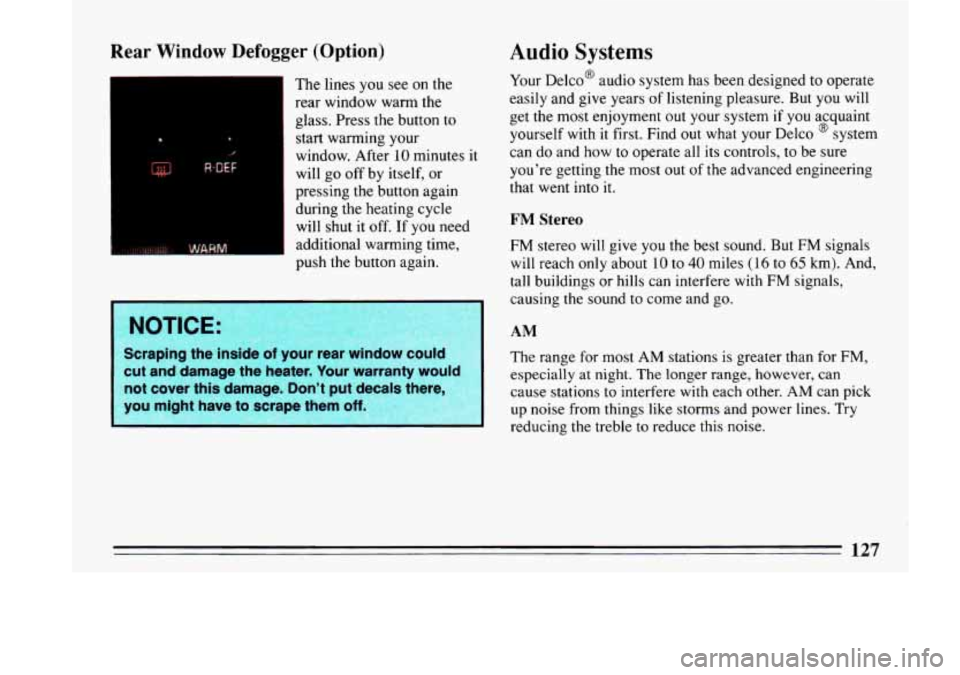
The lines you see on the
rear window warm the
glass. Press the button to
start warming your
1 window. After-10 minutes it
will go off by itself, or
pressing the button again
during the heating cycle will shut it off. If you need
additional warming time,
push the button again.
Scraping the inside of your rear window could
cut and damage the heater. Your warranty would
not cover this damage. Don’t put decals there
you might have to scrape them
off.
Audio Systems
Your Delco@ audio system has been designed to operate
easily and give years
of listening pleasure. But you will
get the most enjoyment out your system if you acquaint
yourself with it first. Find
out what your Delco @ system
can do and how
to operate all its controls, to be sure
you’re getting the most out of the advanced engineering
that went into
it.
FM Stereo
FM stereo will give you the best sound. But FM signals
will reach only about
10 to 40 miles (16 to 65 km). And,
tall buildings or hills can interfere with
FM signals,
causing the sound to come and go.
AM
The range for most AM stations is greater than for FM,
especially at night. The longer range, however, can
cause stations to interfere with each other. AM can pick
up noise from things like storms and power lines. Try
reducing the treble
to reduce this noise.
Page 132 of 324
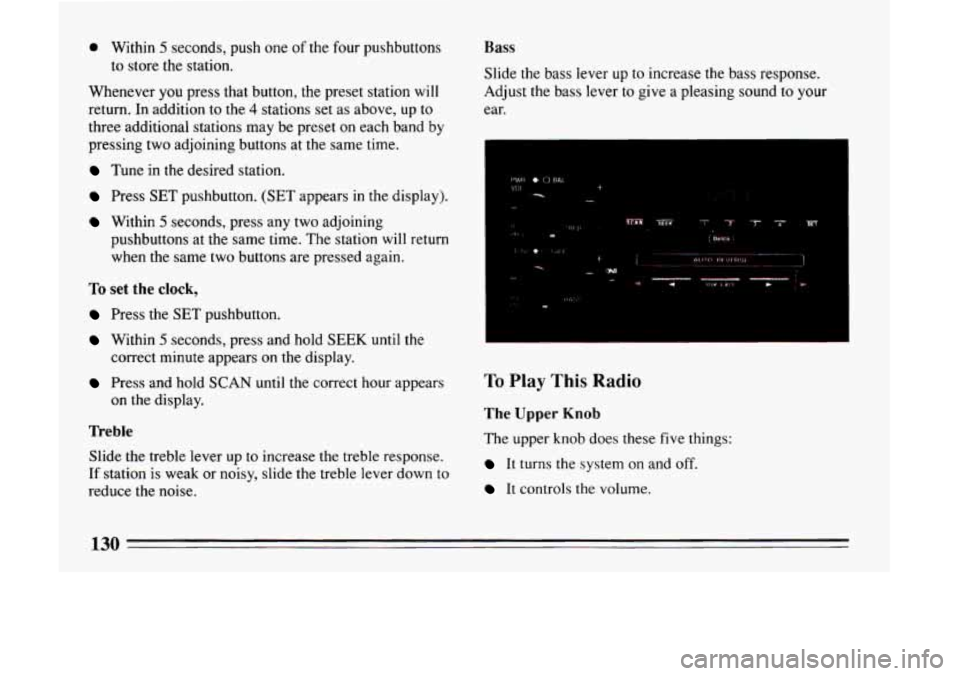
0 Within 5 seconds, push one of the four pushbuttons
to store
the station.
Whenever
you press that button, the preset station will
return. In addition to the 4 stations set as above, up to
three additional stations may be preset
on each band by
pressing two adjoining buttons at the same time.
Tune in the desired station.
Press SET pushbutton. (SET appears in the display).
Within 5 seconds, press any two adjoining
pushbuttons at the same time. The station will return
when the same two buttons are pressed again.
To set the clock,
Press the SET pushbutton.
Within 5 seconds, press and hold SEEK until the
correct minute appears on the display.
Press and hold SCAN until the correct hour appears
on the display.
Treble
Slide the treble lever up to increase the treble response.
If station is weak or noisy, slide
the treble lever down to
reduce the noise.
Bass
Slide the bass lever up to increase the bass response.
Adjust the bass lever to give a pleasing sound to your
ear.
To Play This Radio
The Upper Knob
The upper knob does these five things:
It turns the system on and off.
It controls the volume.
130