Page 73 of 324
4. If your engine still won’t start (or starts but then
stops),
it could be flooded with too much gasoline.
Try pushing your accelerator pedal all the way to the
floor and holding it there as you hold the key in
“Start” for about three seconds. If the car starts
briefly but then stops again, do the same thing, but
this time keep the pedal
down for five or six seconds.
This clears the extra gasoline
from the engine. After
waiting about
15 seconds, repeat the normal starting
procedure.
Driving Through Deep Standing
Water
NOTICE:
71
Page 75 of 324
PARK RNO321
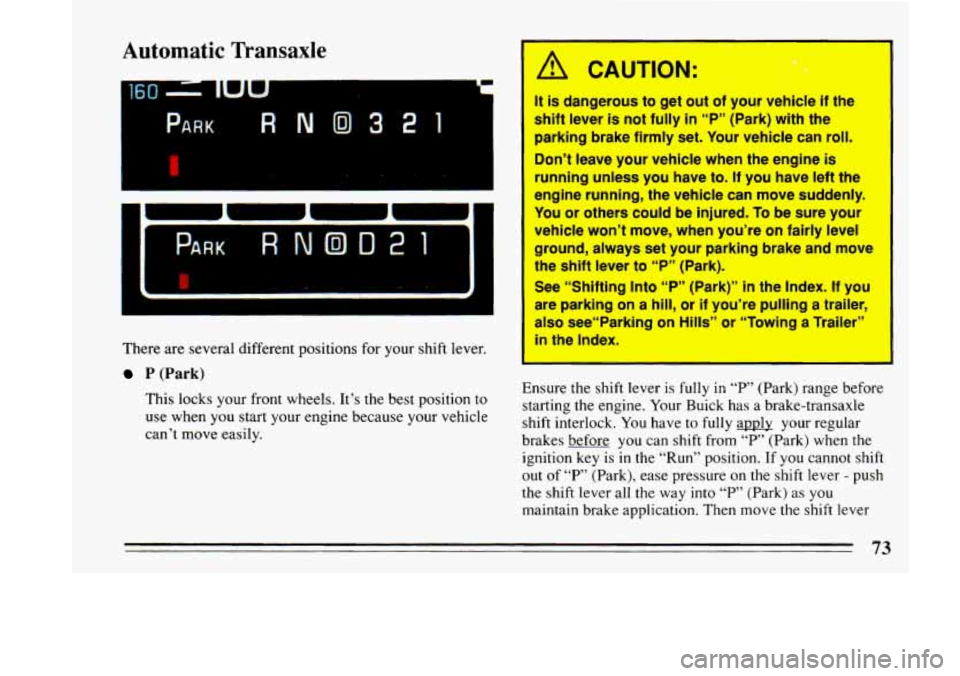
Automatic Transaxle
r
There are several different positions for your shift lever.
P (Park)
This locks your front wheels. It’s the best position to
use when you start your engine because your vehicle
can’t move easily.
A CAUTION: .
a -II
It is dangerous to get out of your vehicle If the
shift [ever is not fully in “P” (Park) with the
parking
brake firmly set. Your vehicle can roll.
Don’t leave your vehicle when ihe engine is
running unless you hsve to. If you have left the
engine
running, the vehicle can move suddenly.
You or others could be Injured. To be sure your
vehicle won’t move, when you’re on fairly level
ground, always set your parking brake and move
the shift lever to V“ (Park).
See “Shifting Into “P” (Park)” in the Index. If you
arb parkfng on a hill, or if you’re pulling a trailer,
also see“Parking on Hills” or “Towing a Trailer”
in’ the Index.
- i
Ensure the shift lever is fully in “F‘” (Park) range before
starting the engine. Your Buick has a brake-transaxle
shift interlock.
You have to fully apply your regular
brakes before
you can shift from “P” (Park) when the
ignition key is
in the “Run” position. If you cannot shift
out of “P” (Park), ease pressure on the shift lever - push
the shift lever all
the way into “P” (Park) as you
maintain brake application. Then move the shift lever
73
Page 81 of 324
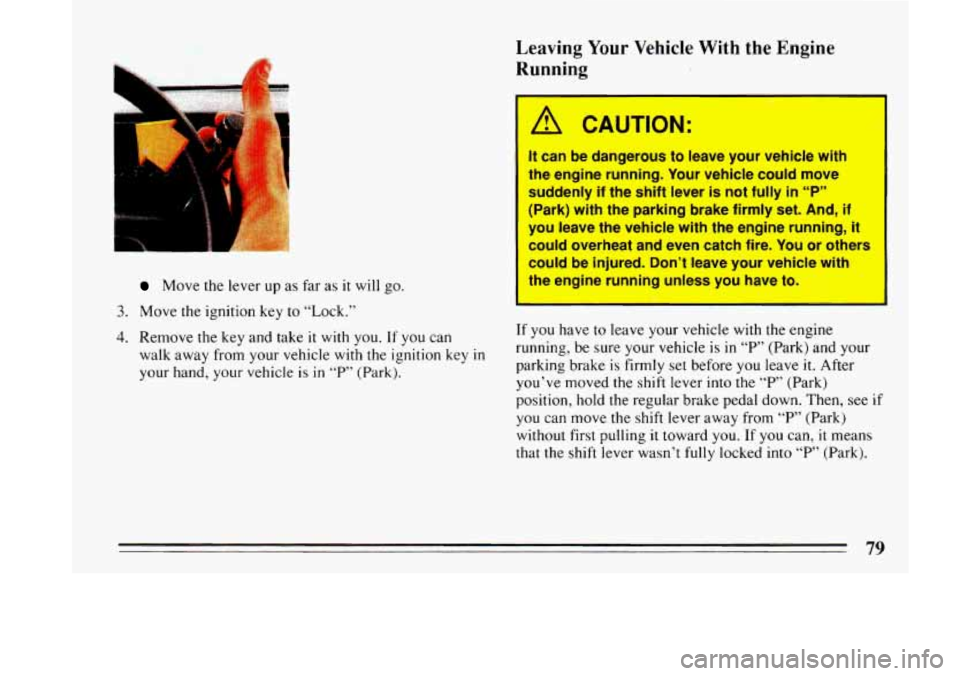
Leaving Your Vehicle With the Engine
Running
Move the lever up as far as it will go.
3. Move the ignition key to “Lock.”
4. Remove the key and take it with you. If you can
walk away from
your vehicle with the ignition key in
your hand, your vehicle is in “P” (Park).
It can be dangerous to leave your vehicle with
the engine running. Your vehicle could
move
suddenly if the shift lever is not fully in “P”
[Park) with the parking brake firmly set. And, if
you leave the vehicle with the engine running, St
could overheat and even catch fire. You or others
could be injured. Don’t leave your vehicle with
the engine running unless you have to.
If you have to leave your vehicle with the engine
running, be sure your vehicle is
in “P” (Park) and your
parking brake is firmly set before you leave it. After
you’ve moved the shift lever into the “P” (Park)
position, hold the regular brake pedal down. Then,
see if
you can move the shift lever away from
“P” (Park)
without first pulling it toward you. If
you can, it means
that the shift lever wasn’t fully locked into “P” (Park).
79
Page 82 of 324
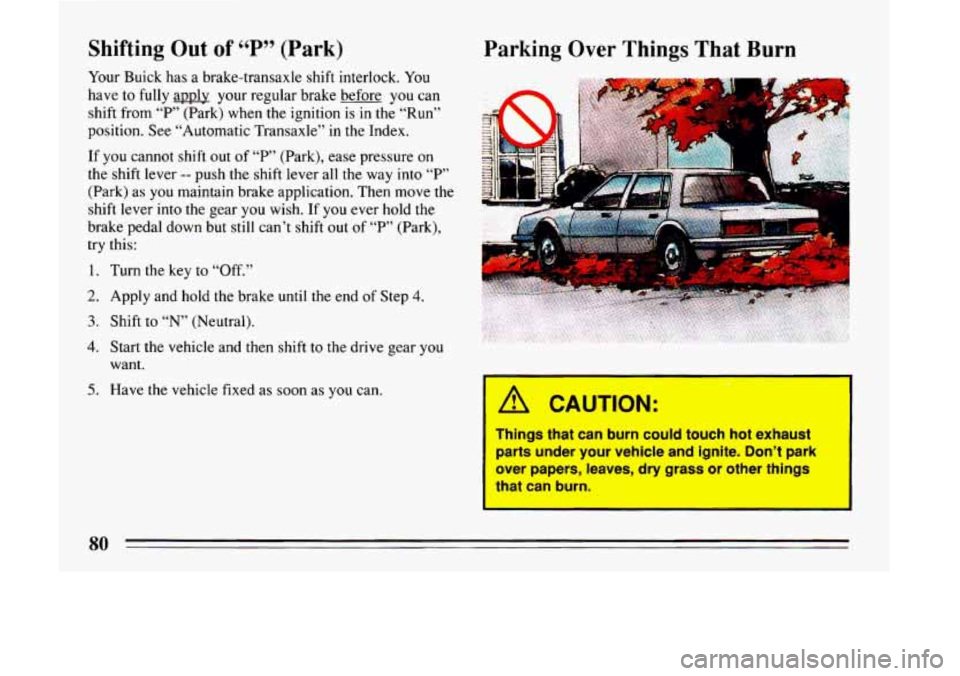
Shifting Out of ‘‘P” (Park)
Your Buick has a brake-transaxle shift interlock. You
have to fully apply your regular brake before you can
shift from
T“ (Park) when the ignition is in the “Run”
position. See “Automatic Transaxle” in the Index.
If you cannot shift out of “P” (Park), ease pressure on
the shift lever -- push the shift lever all the way into “P”
(Park) as you maintain brake application. Then move the
shift lever into the gear
you wish. If you ever hold the
brake pedal down but still can’t shift out of
“P” (Park),
try this:
1. Turn the key to “Off.”
2. Apply and hold the brake until the end of Step 4.
3. Shift to “N” (Neutral).
4. Start the vehicle and then shift to the drive gear you
want.
5. Have the vehicle fixed as soon as you can.
Parking Over Things That Burn
. ”. ..
6& VAU’. ,ON:
I
lings that can burn could touch hot exhaust
parts under your vehicle and ignite. Don’t park
over papers, leaves, dry grass or other things
that can burn.
80
Page 85 of 324
You may also have a lock out button. Push LOCK to
disable the power window switches. This will prevent
passengers from opening and closing the windows. Push
UNLOCK to allow your passengers to be able to use
their window switches again.
Horn
To sound the horn, press a pad with the horn symbol on
either side
of the steering wheel.
Remote Trunk Release
I! The trunk release switch in
the glove
box must be
“ON” for the “TRUNK”
button to work.
This feature allows
you to secure items in the trunk
when you must leave the ignition key with an attendant.
To secure the trunk, turn OFF the TRUNK RELEASE,
lock the glove box, then take the door key with you.
83
Page 86 of 324
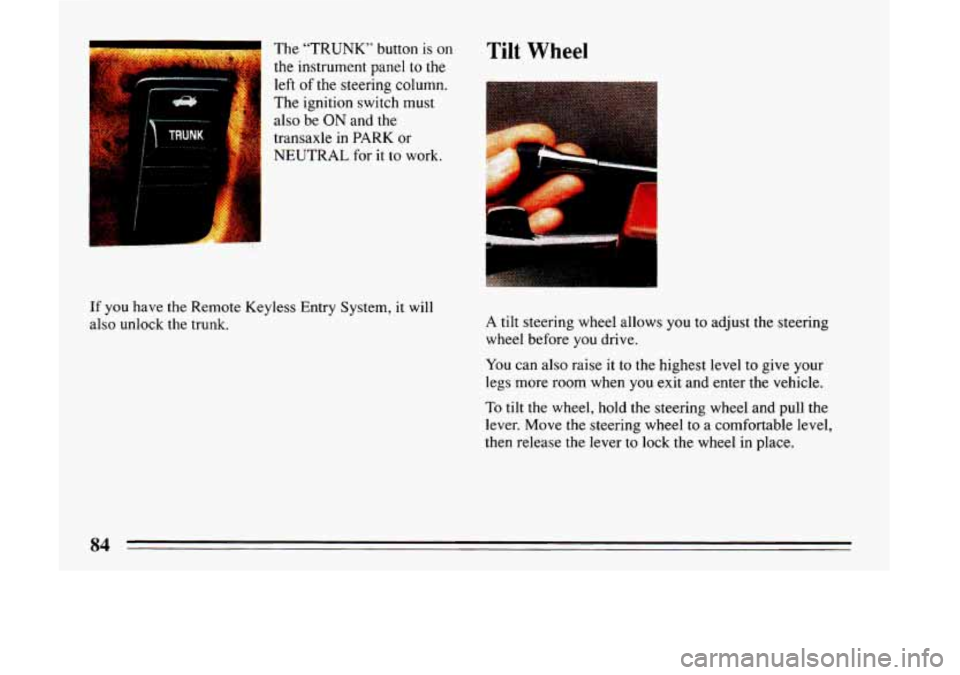
The “TRUNK” button is on
the instrument panel to
the
left of the steering column.
The ignition switch must
also be
ON and the
transaxle in PARK or
NEUTRAL for it to work.
If you have the Remote Keyless Entry System, it will
also unlock
the trunk.
Tilt Wheel
A tilt steering wheel allows you to adjust the steering
wheel before you drive.
You can also raise it to the highest level to give your
legs more room when
you exit and enter the vehicle.
To tilt the wheel, hold the steering wheel and pull the
lever. Move the steering wheel to a comfortable level,
then release the lever to lock the wheel in place.
Page 108 of 324
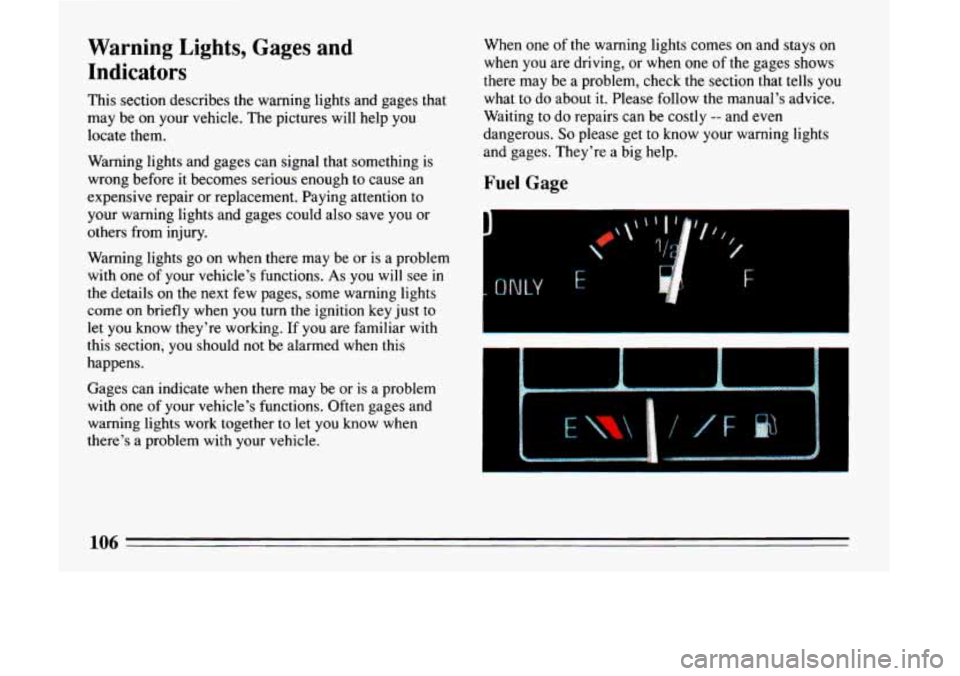
Warning Lights, Gages and
Indicators
This section describes the warning lights and gages that
may be on your vehicle. The pictures will help you
locate them.
Warning lights and gages can signal that something is
wrong before it becomes serious enough to cause an
expensive repair or replacement. Paying attention to
your warning lights and gages could also save
you or
others from injury.
Warning lights go on when there may be or
is a problem
with
one of your vehicle’s functions. As you will see in
the details
on the next few pages, some warning lights
come on briefly when
you turn the ignition key just to
let you know they’re working. If you are familiar with
this section, you should not be alarmed when this
happens.
Gages can indicate when there may be or is a problem
with one of your vehicle’s functions. Often gages and
warning lights work together to
let you how when
there’s a problem with your vehicle. When
one
of the warning lights comes on and stays on
when you are driving,
or when one of the gages shows
there may be
a problem, check the section that tells you
what to do about it. Please follow the manual’s advice.
Waiting to do repairs can be costly
-- and even
dangerous.
So please get to know your warning lights
and gages. They’re a big help.
Fuel Gage
r
F
”
I//,
0
ONLY E F F
106
Page 110 of 324

parking brake set, a chime will also come on until you
release the parking brake. If the light and chime stay on
after your parking brake is
fully released, it means you
have a brake problem. If the light and chime come on
while driving, pull
off the road and stop carefully. You
may notice that the pedal is harder to push. Or, the pedal
may go closer to the floor. It may take longer to stop. If
the light is still on, have the vehicle towed for service.
(See “Towing Your Car” in the Index.)
1 &!A CAUTION:
Your brake system may not be working properly
if the brake warning light is on. Rriving with the
brake warning light on can lead to an accident. If
the light is still on after you’ve pulled off the road
and stopped carefully, have the vehicle towed for
service.
Anti-Lock Brake System Warning Light
1-
ANTI
LOCK
With anti-lock, this light will go on when you start your
engine and may stay on for several seconds or
so. That’s
normal. If the light doesn’t come on, have it fixed
so it
will be ready to warn you if there is a problem.
If the light stays on or comes
on when you’re driving,
stop as soon as possible and turn the key off. Then start
the engine
to reset the system. If the light still stays on,
or comes
on again while you’re driving, your Buick
needs service. Unless
the regular brake system warning
light is also
on, you will still have brakes, but not
anti-lock brakes. If the regular brake system warning
light
is also on, see “Brake System Warning Light”
earlier
in this part.
108