1993 BUICK LESABRE change wheel
[x] Cancel search: change wheelPage 59 of 324

@ Part 2 Features & Controls I
I
L-
Here you can learn about the many standard and optional features on your Buick. and information on starting. shifting
and braking
. Also explained are the instrument panel and the warning systems that tell you if everything is working
properly
.. and what to do if you have a problem .
Part 2 includes:
Keys
........................................................................\
.... 58
DoorLocks ....................................................................... \
59
NewVehicleBreak-In .............................................................. 68
StartingtheEngine ................................................................. 70
ShiftingtheTransaxle .............................................................. 73
Windows ........................................................................\
. 82
Tilt Steering Wheel ................................................................ 84
Multi-Function Lever ............................................................... 85
TunrandLaneChangeSignals ................................................... 85
Headlight High-Low Beam Changer .............................................. 87
Windshield Wipermasher ...................................................... 87
CruiseControl ................................................................ 89
Instrumentpanel ................................................................... 104
Speedometer and Odometer ..................................................... 105
Warning Lights and Gages ...................................................... 106
57
Page 92 of 324
A CAUTION:
Cruise Control can be dangerous where
you can’t drive safely at a steady speed.
So, don’t use your Cruise Control on
winding roads or
in heavy traffic.
Cruise Control can be dangerous on
slippery roads. On such roads, fast
changes
in tire traction can cause needless
wheel spinning, and you could lose
control. Don’t use Cruise Control on
slippery roads.>
J
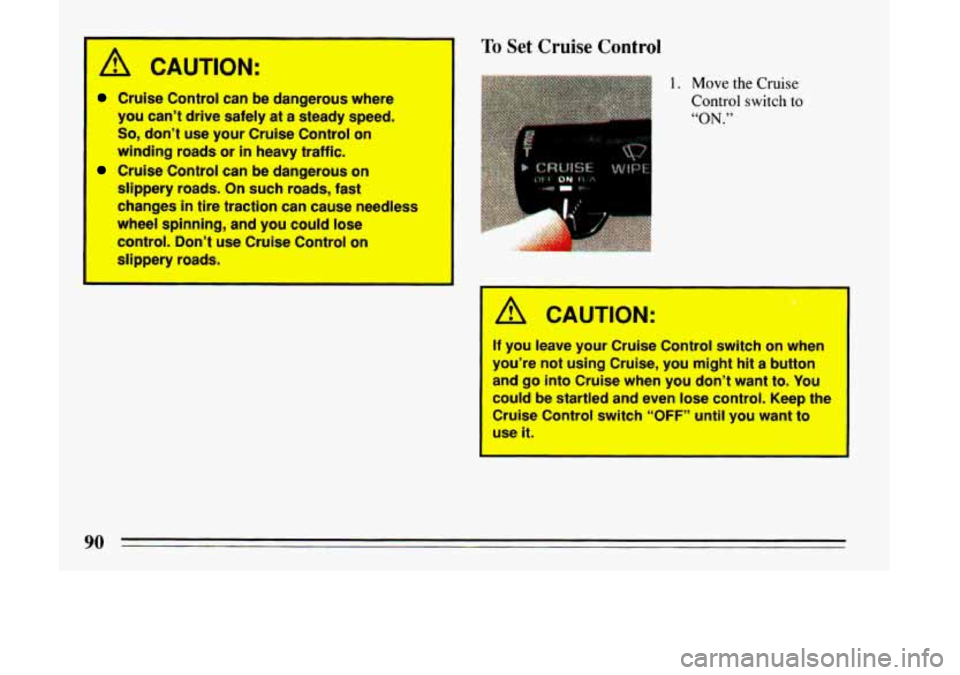
To Set Cruise Control
1.
. . . . . . .
Move the Cruise
Control switch to
“ON.”
I A CAUTION:
If you leave your Cruise Control switch on when
you’re not using Cruise, you might
hit a button
and go into Cruise when you
don’t want to. You
could
be startled and even lose control. Keep the
Cruise Control switch
“OFF” until you want to
use it.
90
Page 162 of 324

0 If your engine ever stops while you’re driving, brake
normally but don’t pump your brakes.
If you do, the
pedal may get harder to push down.
If your engine
stops, you will still have some power brake assist.
But
you will use it when you brake. Once the power assist
is used up, it may take longer to stop and the brake
pedal will be harder to push.
Anti-Lock Brakes (ABS)
Your Buick has an advanced electronic braking system
that will help prevent skidding.
This light
on the instrument panel will go on when you
start your vehicle.
See “Anti-lock Brake System Warning Light”
in the
Index.
@
ANTI
LOCK
‘1 ”. j ’ ;I
- -’ y- ..-
a,
rn
e,
Here’s how anti-lock works. Let’s say the road is wet.
You’re. driving safely. Suddenly an animal jumps
out in
front
of you.
You slam on the brakes. Here’s what happens with ABS.
A computer senses that wheels are slowing down. The
computer separately works the brakes at each front
wheel and at the rear wheels.
The anti-lock system can change the brake pressure
faster than any driver could. The computer
is
programmed to make the most of available tire and road
conditions.
160
Page 163 of 324
I
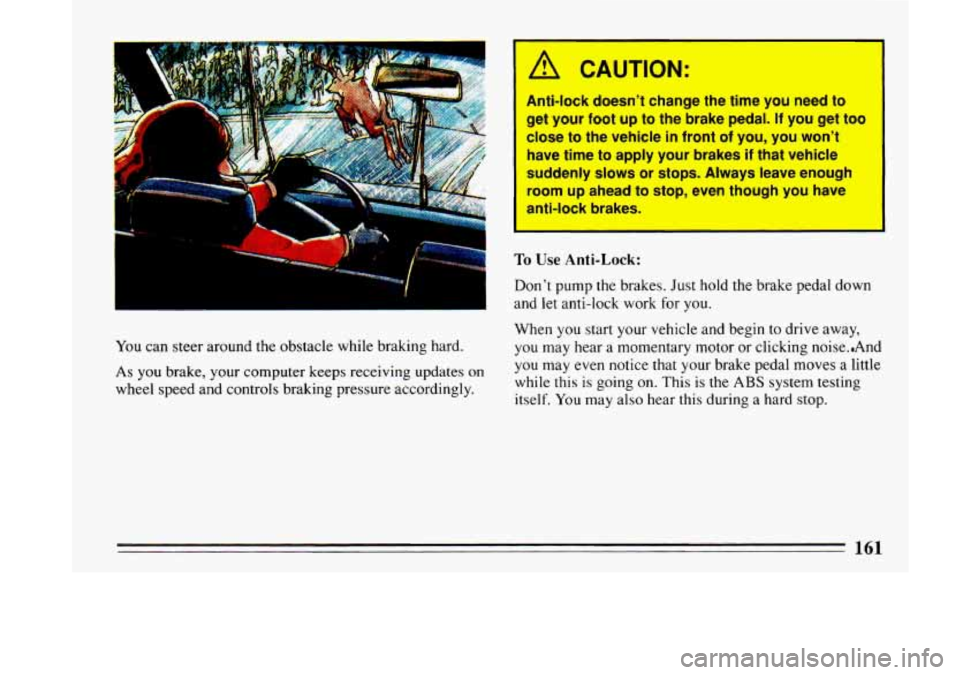
You can steer around the obstacle while braking hard.
As you brake, your computer keeps receiving updates on
wheel speed and controls braking pressure accordingly.
/A CAUTION:
1
1
Anti-lock doesn’t change the time you need to
get your foot up to the brake pedal. If you get too
close
to the vehicle in front of you, you won’t
have time to apply your brakes
if that vehicle
suddenly slows or stops. Always leave enough
room up ahead
to stop, even though you have
anti-lock brakes.
To Use Anti-Lock:
Don’t pump the brakes. Just hold the brake pedal down
and let anti-lock work for
you.
When you start your vehicle and begin to drive away,
you may hear a momentary motor or clicking noise..And
you may even notice that your brake pedal moves a little
while this
is going on. This is the ABS system testing
itself.
You may also hear this during a hard stop.
Page 170 of 324
0 Try not to pass more than one vehicle at a time on
two-lane roads. Reconsider before passing the
next
vehicle.
Don’t overtake a slowly moving vehicle too rapidly.
Even though
the brake lights are not flashing, it may
be slowing down or starting to turn.
following driver to get ahead of you. Perhaps
you
can ease a little to the right.
If you’re being passed, make it easy for the
Loss of Control
Let’s review what driving experts say about what
happens when the three control systems (brakes, steering
and acceleration) don’t have enough friction where the
tires meet the road
to do what the driver has asked.
In
any emergency, don’t give up. Keep trying to steer and
constantly seek an escape route or area of less danger.
Skidding
In a skid, a driver can lose control of the vehicle.
Defensive drivers avoid most skids by taking reasonable
care suited to existing conditions, and by
not “over-
driving” those conditions. But skids are always possible. The
three types of skids correspond
to your Buick‘s
three control systems. In
the braking skid your wheels
aren’t rolling. In
the steering or cornering skid, too
much speed or steering in a curve causes tires to slip and
lose cornering force. And in the acceleration skid too
much throttle causes the driving wheels
to spin.
A cornering skid and an acceleration skid are best
handled by easing your
foot off the accelerator pedal.
If your vehicle starts to slide (as when
you turn a comer
on a wet, snow-or icexovered road), ease your foot off
the accelerator pedal as soon as your feel the vehicle start
to slide. Quickly steer the way
you want the vehicle to
go. If you start steering quickly enough, your vehicle will
straighten
out. As it does, straighten the front wheels.
Of course, traction is reduced when water, snow, ice,
gravel, or other material is
on the road. For safety, you’ll
want
to slow down and adjust your driving to these
conditions. It is important to slow down
on slippery
surfaces because stopping distance will be longer and
vehicle control more limited.
While driving
on a surface with reduced traction, try
your best
to avoid sudden steering, acceleration, or
braking (including engine braking by shifting
to a lower
gear). Any sudden changes could cause tires to slide.
You may
not realize the surface is slippery until your
168
Page 180 of 324
Driving a Long Distance
Although most long trips today are made on freeways,
there are still many made on regular highways. Long-distance driving on freeways and regular
highways is the same in some ways. The trip has to be
planned and the vehicle prepared, you drive at
higher-than-city speeds, and there are longer turns
behind the wheel. You’ll enjoy your trip more if you and
your vehicle are in good shape. Here are some tips for a
successful long trip.
Before Leaving on a Long Trip
Make sure you’re ready. Try to be well rested. If you
must start when you’re not fresh
-- such as after a day’s
work
-- don’t plan to make too many miles that first part
of the journey. Wear comfortable clothing and shoes you
can easily drive
in.
Is your vehicle ready for a long trip? If you keep it
serviced and maintained,
it’s ready to go. If it needs
service, have it done before starting out. Of course,
you’!! find experienced and able service experts in
Buick dealerships all across North America. They’ll be
ready and willing to help
if you need it.
Here are some things you can check before a trip:
0
e
e
0
e
0
0
Windshield Washer Fluid: Is the reservoir full? Are
all windows clean inside and outside?
Wiper Blades: Are they in good shape?
Fuel, Engine Oil. Other Fluids: Have
you checked
all levels?
Lights: Are they all working? Are the lenses clean?
- Tires: They are vitally important to a safe,
trouble-free trip.
Is the tread good enough for
long-distance driving? Are the tires all inflated to the
recommended pressure?
Weather Forecasts: What’s the weather outlook
along your route? Should you delay your trip
a short
time to avoid a major storm system?
Maps:
Do you have up-to-date maps?
On the Road
Unless you are the only driver, it is good to share the
driving task with others. Limit turns behind the wheel to
about
100 miles (160 km) or two hours at a sitting.
Then, either change drivers or stop for some refreshment
like coffee, tea
or soft drinks and some limbering up.
But do stop and move around. Eat lightly along the way.
Heavier meals tend to make some people sleepy.
Page 191 of 324
from the cold. But do it as little as possible. Preserve the
fuel
as long as you can. To help keep warm, you can get
out of the vehicle and do some fairly vigorous exercises
every half hour or
so until help comes.
If You’re Stuck in Deep Snow
This manual explains how to get the vehicle out of deep
snow without damaging it. See “Rocking Your Vehicle”
in the Index.
Towing a Trailer
I- I
A CAUTION:
If you don’t use‘the correct equipment and drive
properly, you can lose control when you pull a
trailer. For example, if the trailer Is too heavy, the
brakes may not work well - or even at all. You
and your passengers could be seriously iniured.
Pull a trailer only if you have followed all tt
steps in this section.
I
vehicle and result in costly repairs not covered
by your warranty. To pull a traAer correctly,
follow I
the advice in this section.
Your car can tow a trailer. To identify what the vehicle
trailering capacity is for your vehicle, you should read
the information
in “Weight of the Trailer” that appears
later in this section. But trailering
is different than just
driving your vehicle by itself. Trailering means changes
in handling, durability, and fuel economy. Successful,
safe trailering takes correct equipment, and it has to be
used properly.
That’s the reason for this section. In it are many
time-tested, important trailering tips and safety rules. Many
of these are important for your safety and that of
your passengers. So please read this section carefully
before you pull a trailer.
Load-pulling components such as the engine, transaxle,
wheel assemblies, and tires are forced to work harder
against the drag
of the added weight. The engine is
required to operate at relatively higher speeds and under greater loads, generating extra heat. What’s more, the
189
Page 195 of 324
Following Distance
Stay at least twice as far behind the vehicle ahead as you
would when driving your vehicle without a trailer. This
can help
you avoid situations that require heavy braking
and sudden turns.
Passing
You’ll need more passing distance up ahead when
you’re towing a trailer. And, because you’re a good deal
longer, you’ll need to go much farther beyond the
passed vehicle before you can return
to your lane.
Backing Up
Hold the bottom of the steering wheel with one hand.
Then,
to move the trailer to the left, just move that hand
to the left. To move the trailer to the right, move your
hand
to the right. Always back up slowly and, if
possible, have someone guide you.
Making nrns
When you’re turning with a trailer, make wider turns
than normal. Do this
so your trailer won’t strike soft
shoulders, curbs, road signs, trees, or other objects.
Avoid jerky or sudden maneuvers. Signal well
in
advance.
Turn Signals When Towing a Trailer
When you tow a trailer, your vehicle has to have a
different turn signal flasher and extra wiring. The green
arrows
on your instrument panel will flash whenever
you signal a turn
or lane change. Properly hooked up,
the trailer lights will also flash, telling other drivers
you’re about to turn, change lanes or stop.
When towing a trailer, the green arrows on your
instrument panel will flash for turns even if the bulbs on
the trailer are burned out.
Thus, you may think drivers
behind you are seeing your signal when they are
not. It’s
important to check occasionally to be sure the trailer
bulbs are still working.
Driving On Grades
Reduce speed and shift to a lower gear before you start
down a long or steep downgrade. If you don’t shift
down,
you might have to use your brakes so much that
they would get hot and no longer work well.
On a long uphill grade, shift down to “D” (Drive) and
reduce your speed to around
45 mph (70 km/h) to
reduce the possibility of engine and transaxle
overheating.
193