Page 114 of 324
I NOTICE:
If you keep driving your vehicle wlrn rnis llgr In,
after a while the emission controls won’t worK as
well, your fuel economy won’t be as good and
your engine may not run
as smoothly. This could
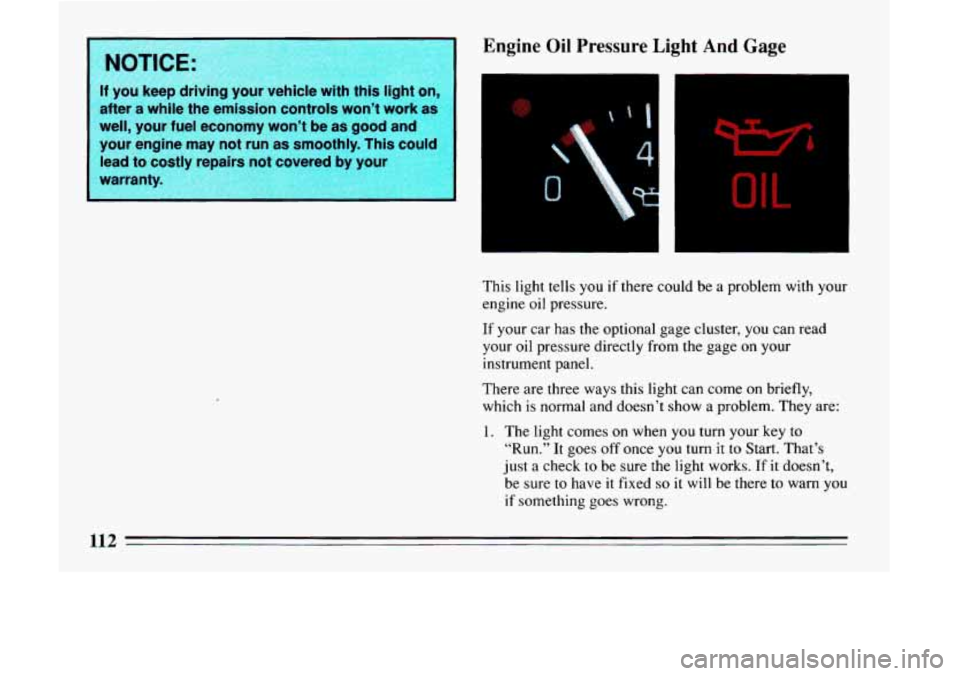
Engine Oil Pressure Light And Gage
i
This light tells you if there could be a problem with your
engine oil pressure.
If your car has the optional gage cluster, you can read
your oil pressure directly from the gage on your
instrument panel.
There are three ways this light can come
on briefly,
which is normal and doesn’t show a problem. They are:
1. The light comes on when you turn your key to
“Run.”
It goes off once you turn it to Start. That’s
just a check to be sure
the light works. If it doesn’t,
be sure to have
it fixed so it will be there to warn you
if something goes wrong.
112
Page 115 of 324
2. If you’re “idling” at a stop sign, the light may blink
3. If you make a hard stop, the light may come on for a
on and then off.
moment.
But, when this light comes
on and stays on, it means
oil isn’t going through your engine properly.
You could
be low on oil, or you might have some other oil
problem.
I
A CAUTION:
Don’t keep driving if the 001 pressure is low. If
you do, your engine can become so hot that it
catches fire. You or others could be burned.
Check your oil
as soon as possible and have
your vehicle serviced.
I
I
problems can ed
your warranty. I
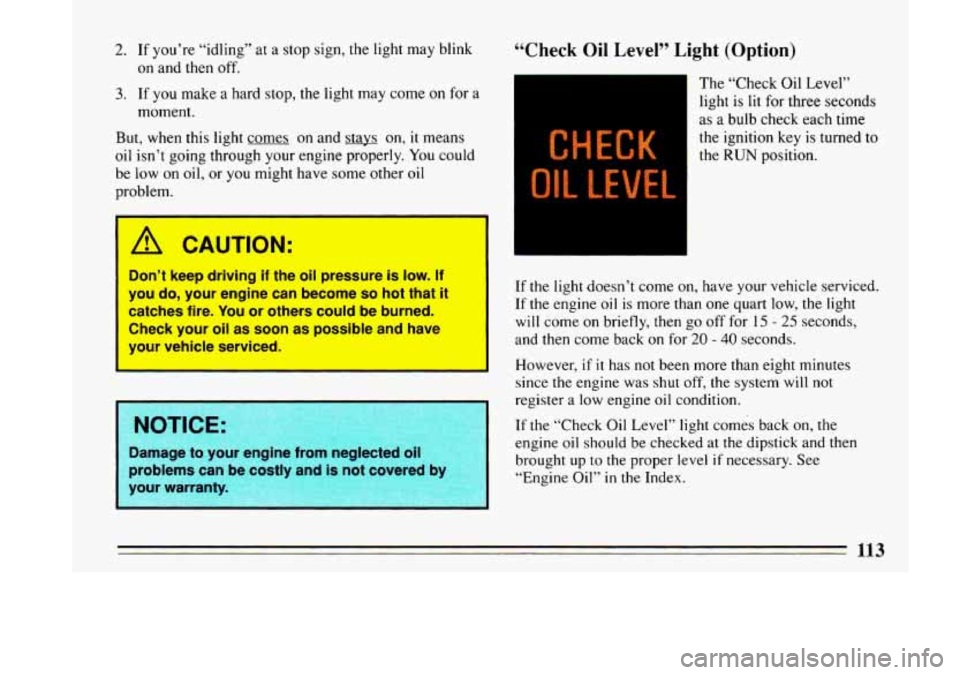
‘‘Check Oil Level” Light (Option)
CHECK
OIL LEVEL.,
The “Check Oil Level”
light is lit for three seconds
as a bulb check each time
the ignition key is turned to
the RUN position.
If
the light doesn’t come on, have your vehicle serviced.
If the engine
oil is more than one quart low, the light
will come
on briefly, then go off for 15 - 25 seconds,
and then come back
on for 20 - 40 seconds.
However,
if it has not been more than eight minutes
since the engine was
shut off, the system will not
register a low engine oil condition.
If the “Check Oil Level” light comes back on, the
engine oil should be checked at the dipstick and then
brought up
to the proper level if necessary. See
“Engine Oil”
in the Index.
Page 116 of 324
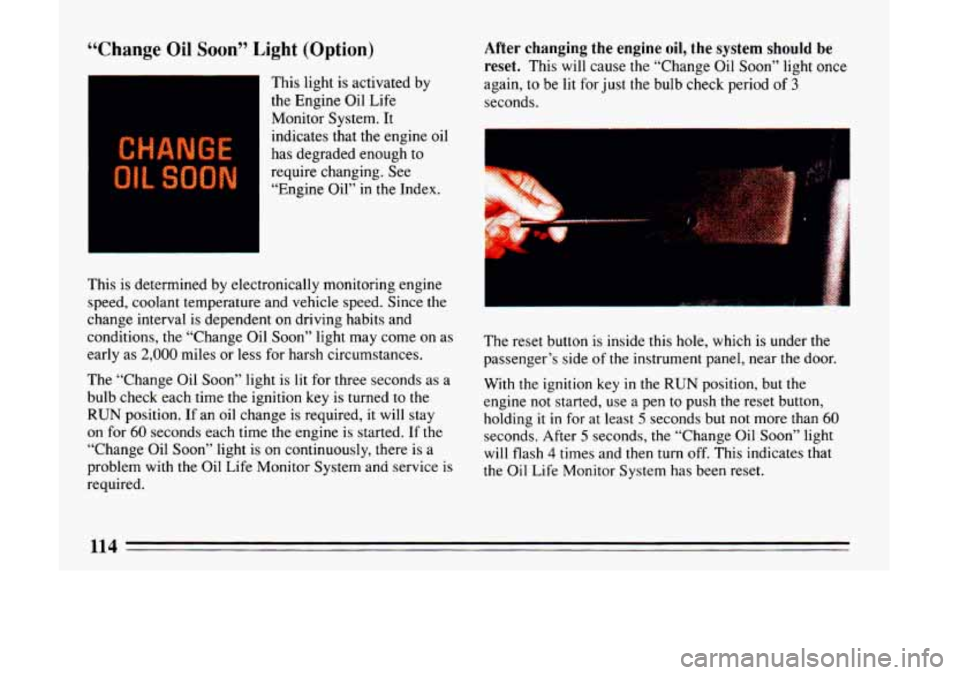
“Change Oil Soon’’ Light (Option)
This light is activated by
the Engine Oil Life
Monitor System. It
indicates that the engine oil
has degraded enough to
require changing. See
“Engine Oil”
in the Index.
After changing the engine oil, the system should be
reset.
This will cause the “Change Oil Soon” light once
again, to be lit for just
the bulb check period of 3
seconds.
This
is determined by electronically monitoring engine
speed, coolant temperature and vehicle speed. Since the
change interval is dependent on driving habits and
conditions, the “Change Oil Soon” light may come on as
early as
2,000 miles or less for harsh circumstances.
The “Change Oil Soon” light is lit for three seconds as a
bulb check each time the ignition key is turned to
the
RUN position. If an oil change is required, it will stay
on for 60 seconds each time the engine is started. If the
“Change Oil Soon” light is on continuously, there is a
problem with the Oil Life Monitor System and service
is
required. The reset button
is inside this hole, which is under the
passenger’s side of the instrument panel, near the door.
With the ignition key in
the RUN position, but the
engine not started, use a pen
to push the reset button,
holding
it in for at least 5 seconds but not more than 60
seconds. After 5 seconds, the “Change Oil Soon” light
will flash
4 times and then turn off. This indicates that
the Oil Life Monitor System has been reset.
1lA
I
Page 117 of 324
Volts Gage
OLTS
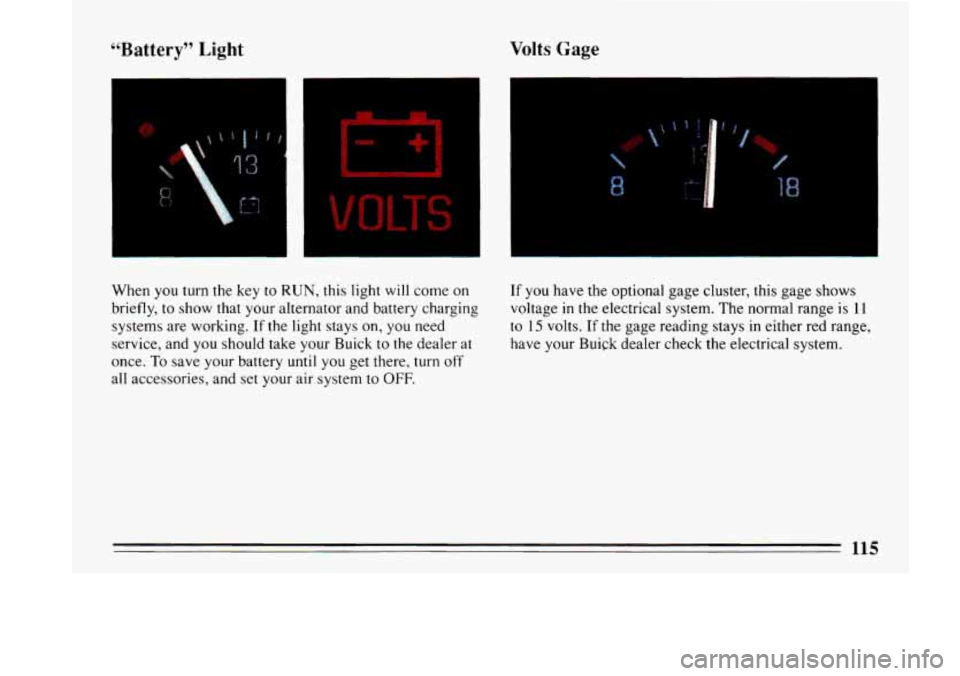
When you turn the key to RUN, this light will come on If you have the optional gage cluster, this gage shows
briefly,
to show that your alternator and battery charging voltage in the electrical system. The normal range is 11
systems are working. If the light stays on, you need to 15 volts. If the gage reading stays in either red range,
service, and you should take your Buick
to the dealer at have your Buick dealer check the electrical system.
once.
To save your battery until you get there, turn off
all accessories, and set your air system to OFF.
115
Page 141 of 324
FWD
Press and hold FWD to advance quickly within a track.
Release it to resume playing. Watch
the graphic display
to stop at a specific passage.
PREV
Press PREV to hear the previous track. Press it again to
move back one more track.
NEXT
Press NEXT to hear the next track instead of waiting
until the present track is finished. If you hold this
button, or press
it more than once, the disc will advance
further.
STFL
Press ST/PL (Stop/Play) and the disc will stop hd the
radio will play. Press
STPL again to restart the disc at
the point where it stopped.
Press the PWR button or
turn the ignition key off to stop
the disc player. The disc stays
in the player and will
resahe playing at the point where it stopped.
EJECT
Press EJCT, the disc will eject and the radio will play.
The disc will start at track
1 when you reinsert it.
As a feature to protect the disc, if you turn off the
ignition with the disc partway out of the slot (after
eject), it will be drawn back into the player
in about 30
seconds.
The disc will play at track
1 when the radio system is
turned on again.
Anti-Theft Feature
Delco-Loc I1 is a security feature for the compact disc
player. It can be used or ignored. If ignored, the system
plays normally. If it is used, your player won’t be usable
if it’s ever stolen, because it won’t turn on.
The instructions below
tell you how to enter your
personal secret code into the system.
If your car loses
battery power for any reason, you must unlock the
system with the secret code again before the system will
turn on.
Be sure to read through the entire procedure and become
familiar with the appropriate buttons and knobs before
itarting.
k.
139
Page 158 of 324
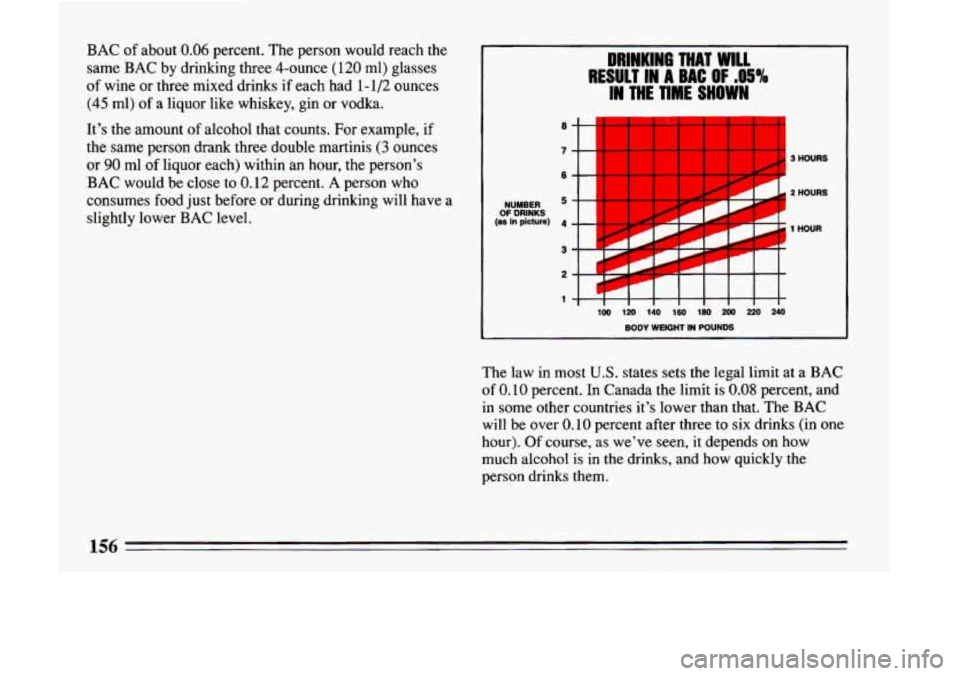
BAC of about 0.06 percent. The person would reach the
same BAC by drinking three 4-ounce
(120 ml) glasses
of wine or three mixed drinks if each had
1-1/2 ounces
(45 ml) of a liquor like whiskey, gin or vodka.
It’s the amount
of alcohol that counts. For example, if
the same person drank three double martinis (3 ounces
or
90 ml of liquor each) within an hour, the person’s
BAC would be close to
0.12 percent. A person who
consumes food just before or during drinking will have a
slightly lower BAC level.
D
Rr -.
OF DRINKS (as in picture) 4
5 THAT WILL
IN THE TIME SHOWN
r IN A BAC OF .05%
I
3 HOURS
’ - ? HOURS
‘ 1 HOUR
100 120 140 160 180 200 220 240
BODY WEIGHT IN POUNDS
The law in most U.S. states sets the legal limit at a BAC
of
0.10 percent. In Canada the limit is 0.08 percent, and
in some other countries it’s lower than that. The BAC
will be over 0.10 percent after three to six drinks (in one
hour).
Of course, as we’ve seen, it depends on how
much alcohol
is in the drinks, and how quickly the
person drinks them.
Page 199 of 324
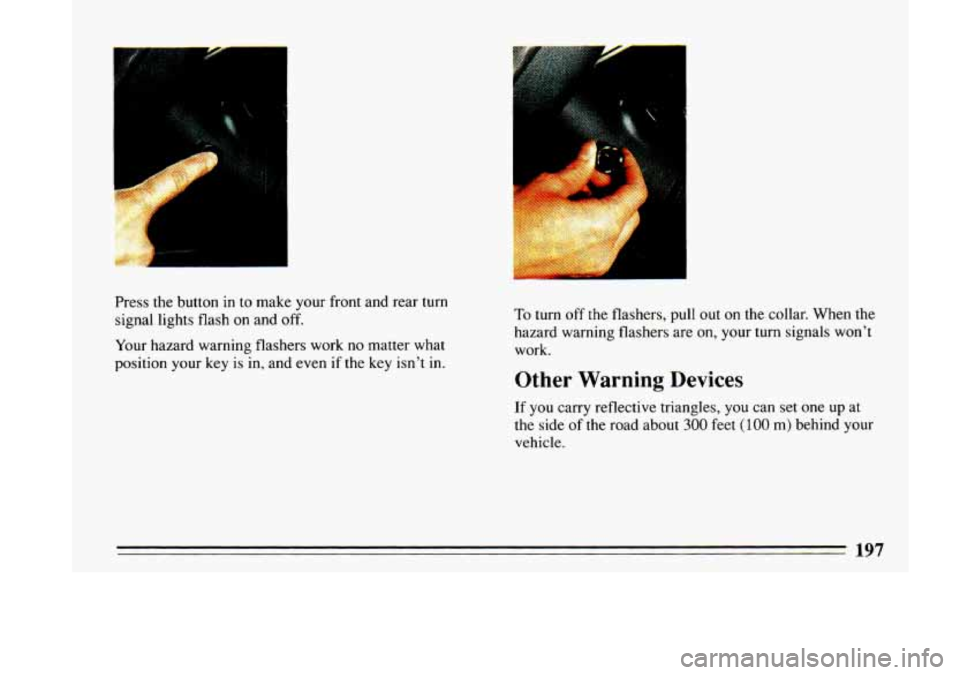
Press the button in to make your front and rear turn
signal lights flash on and
off.
Your hazard warning flashers work no matter what
position your key
is in, and even if the key isn't in.
To turn off the flashers, pull out on the collar. When the
hazard warning flashers are on, your turn signals won't
work.
Other Warning Devices
If you carry reflective triangles, you can set one up at
the side
of the road about 300 feet (1 00 m) behind your
vehicle.
197
Page 207 of 324
When your vehicle is being towed, have the ignition key
off. The steering wheel should be clamped in a
straight-ahead position, with a clamping device designed
for towing service.
Do not use the vehicle’s steering
column lock for this. The transaxle should be in Neutral
and the parking brake released.
Don’t have your vehicle towed on the front wheels,
unless
you must. If the vehicle must be towed on the
front wheels, don’t
go more than 55 mph (88 kph) or
farther than
500 miles (800 km) or your transaxle will
be damaged.
If these limits must be exceeded, then the
front wheels have to be supported on a dolly.
-
A CAUTION:
A vehicle can fall from a car carrier if it isn’t
properly secured, This can cause a collision,
serious personal injury and vehlcle damage. The
vehicle should be tightly secured with chains
or
steel cables before it is transported.
Don’t use substitutes (ropes, leather straps,
canvas webbing, etc.) that can be cut by sharp
zdges underneath the towed vehicle.