1992 VOLKSWAGEN TRANSPORTER cooling
[x] Cancel search: coolingPage 84 of 164
Downloaded from www.Manualslib.com manuals search engine
DRIVING
TIPS
• As the factory installation of a towing bracket includes the modification of the
cooling
system, this should also be done
when service installing a bracket. Other
wise
overheating may occur when the en gine is pulling hard (mountains, high ambi
ent temperature, heavy trailer loads).
Certain
vehicle versions can be equipped
with
a heavy-duty cooling system ex fac
tory,
even though the vehicle is delivered
without
a towing bracket. Details can be ob
tained from Volkswagen dealers.
• Volkswagen dealers have all the
necess
ary information on the installation of towing
brackets
and the
fitting
of a heavy-duty
cooling
system. The installation should
therefore be done by them.
• If, when towing a trailer for commercial
purposes,
the permissible
total
weight of
vehicle
and trailer - also
with
passenger
cars
- exceeds 3500 kg, it is necessary to in
stall and use a tachograph in most European
countries.
Operations
instructions
• When inserting the 13 plug
into
the
socket
on the vehicle, the ribbed sleeve on
the plug must be turned fully to the
right.
The
lid of the socket then engages over the
boss
on the
sleeve.
• If the
traffic
behind the trailer cannot be
seen
properly
with
the standard rear view mirrors, additional outside mirrors will be
necessary.
Both outside mirrors must be
fitted
on folding arms and adjusted to give
a
good view to the rear at all times.
• Pitching movements between towing
vehicle
and trailer can be reduced by heavy-
duty springs and shock absorbers on the rear axle. If these springs and shock ab
sorbers
have not already been
fitted
at the
factory, they can, in many
cases,
be servi
ce-installed
by a Volkswagen dealer.
• Pitching and snaking movements can
also
be reduced by stabilizers which can be
obtained from and
fitted
by Volkswagen
dealers
in most European countries. • The permissible trailer weight11 - see
page
151 -must not be
exceeded
on any
ac
count.
• When towing a trailer in mountainous re
gions,
note
that
the trailer weights given ir
the "Technical data" are only valid for gradi ents up to 10 or 12 %. If the trailer weigh'
is
below the permissible maximum a corre
spondingly steeper gradient can be
climbed.
• The given trailer weights are only appli
cable
for altitudes up to 1000 m above see
level.
As the engine
output
and thus the
climbing ability drops due to the decreasing
air density, the weight of vehicle and trailer must also be reduced by 10 % for eacr
further
1000 m or part thereof.
1 The permissible vehicle/trailer weight
con
sists
of the permissible
total
weight of towing vehicle plus the permissible
total
weight
of trailer. If the permissible trailer load is to be
fully utilized it may be necessary to reduce
the weight of the towing vehicle appropriate ly. The towing vehicle must however not be
lighter than the trailer.
82
www.vwT4camper.info - a useful website for owners and enthusiasts of VW T4 Transporter Campervans
Page 85 of 164

Downloaded from www.Manualslib.com manuals search engine
DRIVING
TIPS
• Where possible make
full
use of the maximum permissible drawbar weight on
call
of the towing bracket - see page 151 -
cut do not exceed it.
• While observing the permissible trailer
and
drawbar weight, distribute the load in
the trailer so
that
heavy objects are as near
as
possible to the axle. The objects must
a
so be secured so
that
they cannot slip
aoout.
• Check the
tyre
pressures on the towing
/ehicle
and the trailer.
• The headlight settings, should be
:hecked
with
trailer attached before mov- ng off and adjusted as necessary.
On
vehicles
with
headlight beam control it
is
only necessary to
turn
the knurled disc in
:ash
in the appropriate direction.
Driving
instructions
To
obtain the best possible handling of ve
hicle
and trailer, the following should be
noted:
• Try to avoid driving
with
an unladen ve
hicle
and a loaded trailer. If this cannot be
avoided,
only drive slowly to allow for the unfavourable weight distribution.
• As driving stability of vehicle and trailer
decreases
when the speed increases do not
drive at the maximum permissible top
speed
in unfavourable road, weather or
wind conditions - particularly when going downhill. In any
case
the speed must be reduced im
mediately the trailer shows the slightest
sign
of snaking. On no account try to stop
the snaking by accelerating.
• For safety reasons one should not drive faster than 80 km/h (50 mph). This also
applies
in countries where higher speeds
are permitted. • Always brake in good time. If the trailer
has
an overrun brake, apply the brakes gen
tly at
first
then firmly. This will avoid the
jerk
ing caused by the trailer wheels locking.
Change
down before going down a steep hill so
that
the engine can act as a brake.
• When a long climb in a low gear
with
ex tremely high engine revs must be nego
tiated at exceptionally high ambient temperatures the coolant temperature gauge must be observed. When the gauge needle
moves
to the
>~zza'
e~z of :ne
scale,
the road speed must be reduced immediately. If nevertheless ~g amp flashes,
stop immediately and si ow the engine to
cool
off at idling speed for several minutes.
• The cooling effect of the radiator fan
can
not be increased by changing down, be
cause
the speec of t~e
~a~
s ~o! dependent
on the engine
speed.
One should therefore not change down even when towing a
trailer as long as :-e e-g -e zar cope with out the vehicle speed dropping too much.
83
www.vwT4camper.info - a useful website for owners and enthusiasts of VW T4 Transporter Campervans
Page 97 of 164

Downloaded from www.Manualslib.com manuals search engine
GENERAL
MAINTENANCE
Engine
compartment
Page
Windscreen
washer
container
.. 108
Power
assisted
steering
fluid
reservoir*
100
Engine
oil filler
opening
97
Engine
oil
dipstick
97
Coolant
expansion
tank 102
Brake
fluid
reservoir
104
Battery
106 Attention
Particular care should be
taken
when working in the engine
com
partment!
•
Switch off engine, remove ignition key.
•
Pull handbrake on firmly.
•
Move gear lever into neutral or
"P"
position.
•
Allow engine to cool off.
•
As long as the engine is at op
erating temperature:
-
Do not put your hand into the radiator fan, it could switch on
suddenly.
-
Do not open the radiator cap be
cause
the cooling system is
under
pressure.
•
Avoid causing short circuits in
the electrical system - particular ly at the
battery
-.
•
If tests have to be
carried
out
with
the engine running,
there
is
an additional danger
present
from rotating parts - e.g.
V-belts,
generator, radiator fan etc. - and
from the high voltage ignition
system.
Attention must be paid to the warnings given in this Instruc
tion Manual and to the generally
applicable
safety regulations.
When topping up fluids one
should
ensure
that
they are not mistaken,
one
for the other, under any
circum
stances,
otherwise serious
func
tional defects
will
result.
So
that
leaks
are quickly de
tected
the ground underneath
the vehicle should be checked
reg
ularly.
If spots as caused by oil or
other
operating fluids can be seen, the vehicle should be
taken
to the
workshop for checking.
www.vwT4camper.info - a useful website for owners and enthusiasts of VW T4 Transporter Campervans
Page 103 of 164
Downloaded from www.Manualslib.com manuals search engine
GENERAL
MAINTENANCE
nere are two marks
with
which the oil level
:an be
checked.
• Outside on container (Fig.) • Inside on dipstick attached to the cap. ~he oil level should always be between the
MAX."
and "MIN" marks. When the level
"as
dropped down below the "MIN" mark
:^e
power assisted steering should be
:necked
at a Volkswagen dealer. It is not
sufficient merely to top up
with
hydraulic oil.
Note
f the power assisted steering fails at any
: me or when engine is not running (vehicle on tow) the vehicle remains fully steerable cut more force must be used to
turn
the
steering wheel. Cooling
system
Under
normal conditions the cooling
sys
tem is almost maintenance-free.
The vehicle is
fitted
with
a hinged radiator
which can be folded forward when required
- see page 104.
The cooling system is filled at the factory
with
a permanent coolant which is not
changed.
The coolant consists of water and
a
40 % concentration of our coolant additive
G
11 V8B (anti-freeze on glycol basis
with
anti-corrosion additives). This mixture not
only gives the necessary frost protection
down to -25 degrees C but also protects the
alloy parts in the cooling system against cor
rosion.
In addition it prevents scaling and ra
ises
the boiling point of the coolant.
The concentration of the coolant therefore must not be reduced in the summer or in
warm countries, by topping up
with
plain
water. The
coolant
additive
propor
tion
must
be at
least
40 %.
If greater protection against frost is re
quired, the proportion of G 11 V8B additive
can
be increased, but only up to 60 % other
wise the anti-freeze protection is reduced
and furthermore the cooling effect is im
paired.
Vehicles
for export to cold countries -s~a .
have frost protection down to -35 decrees
C.
Only
our G 11 V8B or an additive v/rs :~e
specification
TL-VW 774 B (markea or
container) should be added to the coolant.
The additives can be obtained from
Volks
wagen dealers.
Other
additives
can be
very
detri
mental
to the
anti-corrosion
effect
in
particular.
The
subsequent
corrosion
damage
can
lead
to
coolant
loss
resulting
in
major
engine
damage.
www.vwT4camper.info - a useful website for owners and enthusiasts of VW T4 Transporter Campervans
Page 104 of 164
Downloaded from www.Manualslib.com manuals search engine
GENERAL
MAINTENANCE
Checking
coolant
level
The
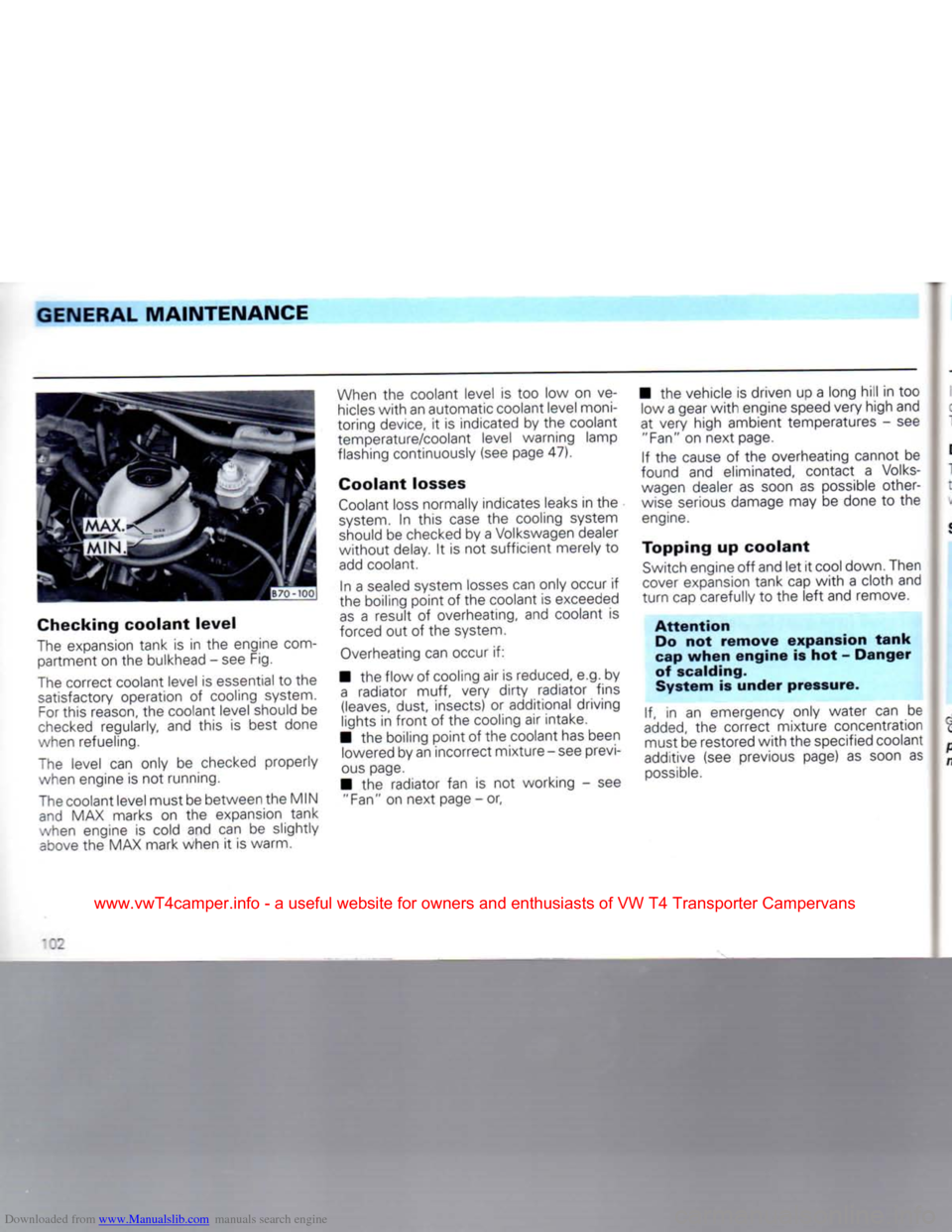
expansion tank
is in the
engine
com
partment on the bulkhead
-
see Fig.
The
correct coolant level
is
essential
to
the satisfactory operation
of
cooling system.
For
this reason, the coolant level should
be
checked
regularly,
and
this
is
best done
when refueling.
The
level
can
only
be
checked properly
when engine
is
not running.
The
coolant level must be between the MIN
and
MAX marks
on the
expansion tank
when engine
is
cold
and can be
slightly
above
the MAX mark when
it
is warm.
When
the
coolant level
is too low on ve
hicles
with
an automatic coolant level moni
toring device,
it is
indicated by the coolant
temperature/coolant level warning lamp
flashing continuously (see page 47).
Coolant
losses
Coolant
loss normally indicates leaks in the
system.
In
this
case
the
cooling system
should
be checked by a Volkswagen dealer
without
delay.
It is
not sufficient merely
to
add
coolant.
In
a
sealed system
losses
can only occur
if
the boiling point
of
the coolant is exceeded
as
a
result
of
overheating, and coolant
is
forced out
of
the system.
Overheating can occur
if:
• the flow
of
cooling air is reduced, e.g.
by
a
radiator
muff,
very
dirty
radiator fins
(leaves,
dust, insects)
or
additional driving
lights
in
front
of
the cooling air intake.
• the boiling point
of
the coolant has been lowered by an incorrect mixture
-
see previ
ous
page.
•
the
radiator
fan is not
working
- see
"Fan"
on next page
-
or, • the vehicle
is
driven up
a
long hill
in too
low a gear
with
engine speed very high and
at very high ambient temperatures
-
see
"Fan"
on
next page.
If
the
cause
of the
overheating cannot
be
found
and
eliminated, contact
a
Volks
wagen dealer
as
soon
as
possible other
wise
serious damage may
be
done
to the
engine.
Topping
up
coolant
Switch
engine
off
and let
it
cool down. Then
cover
expansion tank cap
with
a
cloth and
turn
cap carefully
to
the
left
and remove.
Attention
Do
not
remove
expansion
tank
cap
when
engine
is
hot
-
Danger
of scalding.
System
is
under
pressure.
If, in an
emergency only water
can be
added,
the
correct mixture concentration must be restored
with
the specified coolant
additive (see previous page)
as
soon
as
possible.
•02
www.vwT4camper.info - a useful website for owners and enthusiasts of VW T4 Transporter Campervans
Page 105 of 164
Downloaded from www.Manualslib.com manuals search engine
GENERAL
MAINTENANCE
"=
lot
of
coolant has been lost, only add cold
:_:olant after
the
engine has cooled down.
~~
is
will prevent engine damage.
Do
not
fill
above the MAX. mark.
~~e
excess
coolant will
be
forced
out
"rough
the
pressure relief valve
in the
cap .-.nen engine becomes
hot.
Screw
cap on again tightly. Attention
The coolant additive and the coolant are a danger to health.
The additive must therefore only be stored in the original
con
tainer
well
out of reach of
children.
If the coolant has to be
drained at any
time
it must be
caught and also stored in a safe
place.
Drained
coolant
should
not nor-
W*
mally
be
reused,
it
must
be
dis
posed
of,
bearing
in
mind
environ
mental
protection
regulations.
Fan
The radiator
fan is
driven electrically
and
controlled by a thermoswitch from the
cool
ant temperature (also from the engine
com
partment temperature on some models).
Attention
After the engine has been
switched off the fan can
con
tinue running for a
while
(up to
about 10 minutes)
with
the igni
tion off. It can also
start
to run
again suddenly
after
a short time, if the coolant temperature in
creases
due to
heat
build-up.
Special
care must therefore be
taken when working in the en gine compartment. Notes
•
If
the fan is not running although the
cool
ant temperature
is
very high,
the rse
should
be
checked
and if
necessary
re
newed
-
see page 122.
• The speed
of
the fan does not depeno
or
engine
speed.
The
cooling effect cannot
therefore
be
increased
by
changing down.
As
long as
the
engine runs smoothly and
a
gradient can
be
taken
without
a
large drop in speed
it
is not necessary to change down.
Driving in
winter
To
ensure
that
the
frost protection
is ad
equate, the coolant concentration should be
checked
and
if
necessary corrected, before
the cold
season
begins.
www.vwT4camper.info - a useful website for owners and enthusiasts of VW T4 Transporter Campervans
Page 118 of 164
Downloaded from www.Manualslib.com manuals search engine
GENERAL
MAINTENANCE
Winter
driving
T
Ac
The an«
safe
high
ensi
supf
with
poin
sub:
tech latei
• /
fori
any
thro
SWc
pete
A
In
m
s<
V
G
u
P
SI
a
s|
r<
In winter the following points should be
noted:
• Winter weather is particularly hard on the
battery
and it should therefore be
checked,
preferably by a Volkswagen
dealer, before the onset of cold weather. If the vehicle is not driven for several weeks
when the temperatures are very low, the
battery
should be taken out - for
further
in
formation see page 107.
• On a vehicle
with
a Diesel engine, winter
Diesel
must be used at temperatures below
0 degrees C - see page 87.
• The water should be drained out of the
Diesel
fuel
filter
before the onset of
winter.
This
operation is also included in the Lubri cation
Service.
• The anti-freeze in the cooling system should be checked before the cold
season
starts - see page 101.
• The engine oil viscosity must be correct for the ambient temperature - see page 99.
• Particularly in
winter,
frequent washing and waxing of the vehicle is the best way to protect it against harmful environmental in
fluences.
• In winter the windscreen washer
sys
tem should always be filled
with
a window
cleaning solution containing an anti-freeze
additive.
• To remove snow and ice
from
the win dows and mirrors, a plastic scraper should be used - see page 90.
• The road holding and handling can be im proved in winter road conditions by the use
of winter or All-weather tyres - see pages 114and146.
• When driving in mountainous districts in winter it is advisable to take snow chains
with
you. On some such roads, snow chains
are obligatory - see also page 114.
www.vwT4camper.info - a useful website for owners and enthusiasts of VW T4 Transporter Campervans
Page 138 of 164

Downloaded from www.Manualslib.com manuals search engine
TECHNICAL
DESCRIPTION
Engine
• 4 stroke petrol/Diesel engine, trans
verse
installation
• 4/5 cylinders in-line
• Cast-iron cylinder block
• 5/6 bearing crankshaft
• Sheet metal sump
• Alloy cylinder head
• Valves operated via toothed belt and overhead camshaft
• Maintenance free valve gear
with
hy draulic tappets
• Cooling system filled for life of vehicle
• Radiator
with
separate expansion tank • Electric radiator fan controlled by ther-
moswitch
• Maintenance free electronic ignition
• Long-life spark plugs
• Optical and acoustic oil pressure warn ing
• Low maintenance battery
with
high starting capacity
• Long-life low maintenance V-belts
• Thermostatically controlled intake air preheating
• Dry air cleaner
with
paper element • Fuel
injection
engines
have fully
electronic engine management (combined
control of injection and ignition systems).
• Emission control system
with
Lambda probe on petrol engines (not in all Export
markets)
•
Diesel
engines
with
distributor injec
tion
pump
with
cold start aid,
filter
preheat
ing,
self-bleeding fuel system
• Long life exhaust system.
'36
www.vwT4camper.info - a useful website for owners and enthusiasts of VW T4 Transporter Campervans