Page 691 of 1333
NOTE: Removal of turbocharger exhaust housing and water pipes at
turbocharger is not necessary when removing turbocharger
assembly. Stealth and 3000GT models have 2 (front and rear)
turbochargers.
Removal (Eclipse & Galant)
1) Disconnect negative battery cable. Drain engine coolant
and oil. On models with A/C, remove condenser fan motor assembly. On
all models, remove oxygen sensor. Remove oil dipstick guide and "O"
ring. See Figs. 8 and 9.
Fig. 8: Removing Turbocharger (Eclipse & Galant 2.0L)
Courtesy of Mitsubishi Motor Sales of America.
Fig. 9: Exploded View of Turbocharger Assembly (Eclipse & Galant
2.0L Shown; Stealth & 3000GT Similar)
Page 692 of 1333

Courtesy of Mitsubishi Motor Sales of America.
2) Disconnect air intake hose and vacuum hoses. Remove air
hose and air outlet housing. Remove heat protectors. Disconnect
exhaust pipe. Remove power steering oil pump and bracket. Remove
engine hanger bracket. Disconnect oil inlet pipe.
3) Disconnect coolant hose and tubes. Remove nuts and bolts
securing exhaust manifold. Remove exhaust manifold and gaskets.
Disconnect oil return pipe. Remove turbocharger assembly.
Removal (Stealth & 3000GT Front)
1) Disconnect negative battery cable. Drain engine oil and
coolant. Remove radiator. Disconnect exhaust pipe. Remove air intake
hose, air hoses and air pipe. Remove alternator and belt. Remove oil
dipstick guide.
2) Remove heat protector. Disconnect oxygen sensor electrical
connector. Remove oil return pipe. Remove turbocharger support bracket
and remove turbocharger from exhaust manifold. See Fig. 10.
Fig. 10: Removing Front Turbocharger (Stealth & 3000GT)
Courtesy of Mitsubishi Motor Sales of America.
Removal (Stealth & 3000GT Rear)
1) Disconnect battery cables and remove battery. Drain engine
oil and coolant. Remove accelerator cable. Remove air hose, air pipe
and heat protectors. Disconnect clutch booster vacuum hose. Remove air
Page 693 of 1333

intake hoses and EGR pipe. Disconnect oxygen sensor electrical
connector.
2) Remove oil pipe and EGR valve. Disconnect exhaust fitting
and remove rear heat protector. Remove oil return pipe. Remove
turbocharger assembly. See Fig. 11.
Fig. 11: Removing Rear Turbocharger (Stealth & 3000GT)
Courtesy of Mitsubishi Motor Sales of America.
Inspection
Check turbine and compressor wheels for cracking and other
damage. Make sure turbine and compressor wheels turn smoothly. Check
for oil leakage from turbocharger assembly. Check for proper wastegate
valve operation. See SYSTEM & COMPONENT TESTING article.
Installation
1) To install, reverse removal procedure. Before oil pipe
flare nut (above turbocharger) is installed, pour clean engine oil
into turbocharger. Ensure oil and air hoses are properly installed and
securely clamped.
2) Use new gaskets. Adjust accelerator cable (if necessary).\
Refill engine oil and coolant. Check for oil and coolant leaks.
Tighten all bolts to specification. See TORQUE SPECIFICATIONS table.
TORQUE SPECIFICATIONS
TORQUE SPECIFICATIONS TABLE������������������\
������������������\
������������������\
������������������\
������������������\
������������������\
�����������
Applications Ft. Lbs. (N.m)
Fuel Tank Nuts ............................. 15-22 (20-30)
Page 694 of 1333

Fuel Tank Drain Plug ....................... 11-18 (15-24)
Exhaust Manifold-To-Engine Nuts ............ 18-22 (24-30)
Exhaust Manifold-To-Turbocharger Bolts ..... 40-47 (54-64)
Exhaust Pipe Bolts ......................... 22-29 (30-39)
Oil Pipe-To-Engine ......................... 10-14 (14-19)
Oxygen (O2) Sensor ......................... 29-36 (39-49)
Plenum-To-Intake Manifold Bolts ............ 11-15 (15-20)
Water Pipe-To-Turbocharger
Except Stealth & 3000GT .................. 25-36 (34-49)
Stealth & 3000GT ............................... 22 (30)
INCH Lbs. (N.m)
Fuel Rail Bolts .......................... 84-108 (10-12)
Heat Protector Bolts ..................... 108-132 (12-15)
ISC Switch Screws ........................ 20-54 (2.5-4.5)
TPS Switch Screws ........................ 13-20 (1.5-2.5)
Wastegate Actuator Bolts ................... 84-108 (9-12)
������������������\
������������������\
������������������\
������������������\
������������������\
������������������\
�����������
Page 697 of 1333

WARNING: Avoid breathing R-134a refrigerant and PAG lubricant vapors,
exposure may irritate eyes, nose and throat. To remove
R-134a from system use R-134a recycling equipment that meets
SAE J2210 specifications. If accidental system discharge
occurs, ventilate work area before resuming service.
ANTI-LOCK BRAKE SYSTEM
The anti-lock brake system contains electronic equipment that
can be susceptible to interference caused by improperly installed or
high output radio transmitting equipment. Since this interference
could cause the possible loss of the anti-lock braking capability,
such equipment should be installed by qualified professionals.
On models equipped with anti-lock brake systems, ALWAYS
observe the following cautions:
* DO NOT attempt to bleed hydraulic system without first
referring to the appropriate ANTI-LOCK BRAKE SYSTEM article
in the BRAKES Section.
* DO NOT mix tire sizes. As long as tires remain close to the
original diameter, increasing the width is acceptable.
Rolling diameter must be identical for all 4 tires. Some
manufacturers recommend tires of the same brand, style and
type. Failure to follow this precaution may cause inaccurate
wheel speed readings.
* Use ONLY recommended brake fluids. DO NOT use silicone brake
fluids in an ABS-equipped vehicle.
REPLACING BLOWN FUSES
Before replacing a blown fuse, remove ignition key, turn off
all lights and accessories to avoid damaging the electrical system. Be
sure to use fuse with the correct indicated amperage rating. The use
of an incorrect amperage rating fuse may result in a dangerous
electrical system overload.
BATTERY WARNING
WARNING: When battery is disconnected, vehicles equipped with
computers may lose memory data. When battery power is
restored, driveability problems may exist on some vehicles.
These vehicles may require a relearn procedure. See
appropriate COMPUTER RELEARN PROCEDURES article in the
GENERAL INFORMATION section below.
BRAKE FLUID
For vehicles equipped with a traction control system, idle
engine while pouring brake fluid into reservoir.
CATALYTIC CONVERTER
Continued operation of vehicle with a severe malfunction
could cause converter to overheat, resulting in possible damage to
converter and vehicle.
ELECTROSTATIC DISCHARGE SENSITIVE (ESD) PARTS
WARNING: Many solid state electrical components can be damaged by
static electricity (ESD). Some will display a warning label,
but many will not. Discharge personal static electricity by
Page 698 of 1333

touching a metal ground point on the vehicle prior to
servicing any ESD sensitive component.
ENGINE OIL
CAUTION: Never use non-detergent or straight mineral oil.
FUEL SYSTEM SERVICE
WARNING: Relieve fuel system pressure prior to servicing any fuel
system component (fuel injection models).
HALOGEN BULBS
Halogen bulbs contain pressurized gas which may explode if
overheated. DO NOT touch glass portion of bulb with bare hands. Eye
protection should be worn when handling or working around halogen
bulbs.
POWER STEERING FLUID
When adding power steering fluid, avoid spilling. Damage to
alternator, located beneath power steering reservoir, could result.
RADIATOR CAP
CAUTION: Always disconnect the fan motor when working near the
radiator fan. The fan is temperature controlled and could
start at any time even when the ignition key is in the OFF
position. DO NOT loosen or remove radiator cap when cooling
system is hot.
RADIATOR FAN
WARNING: Keep hands away from radiator fan. Fan is controlled by a
thermostatic switch which may come on or run for up to 15
minutes even after engine is turned off.
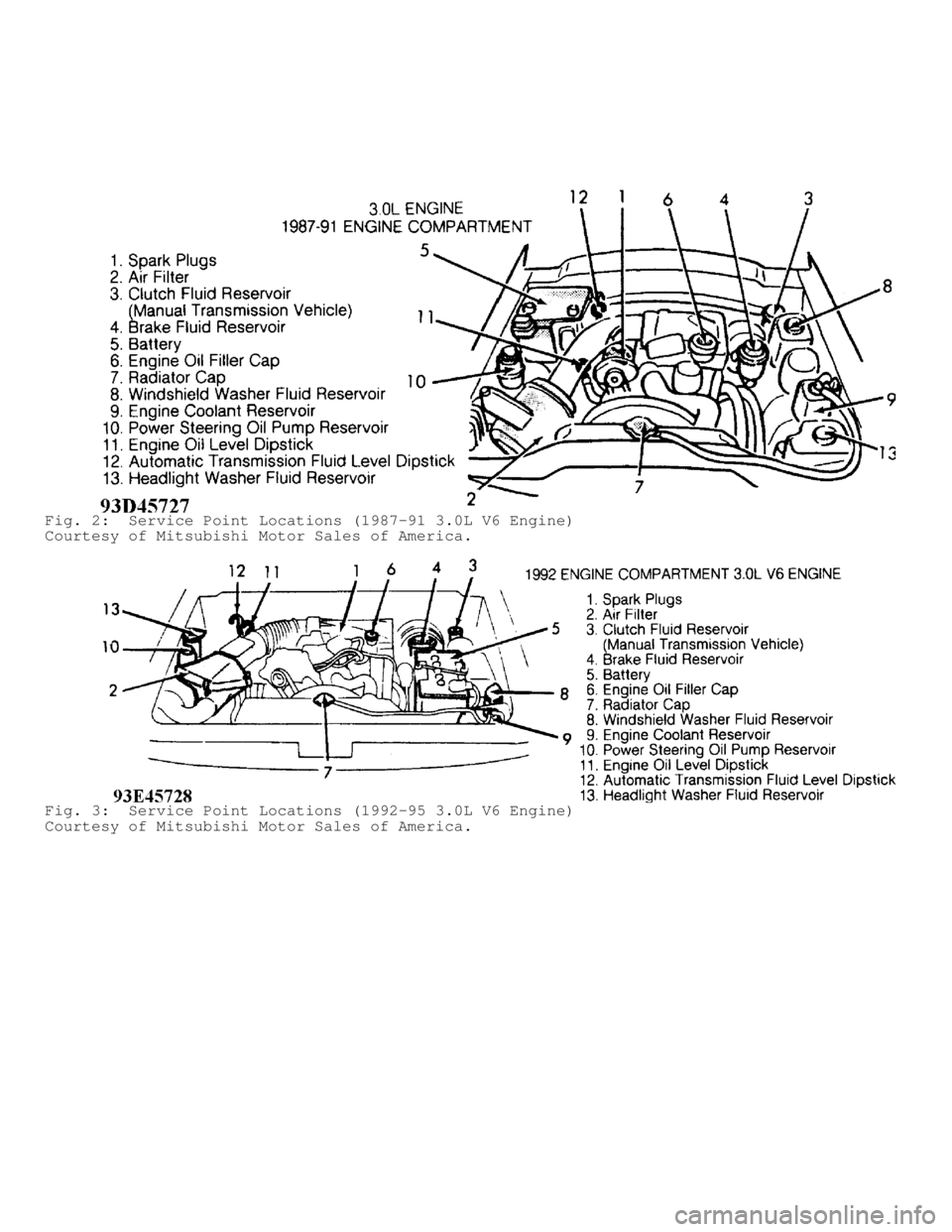
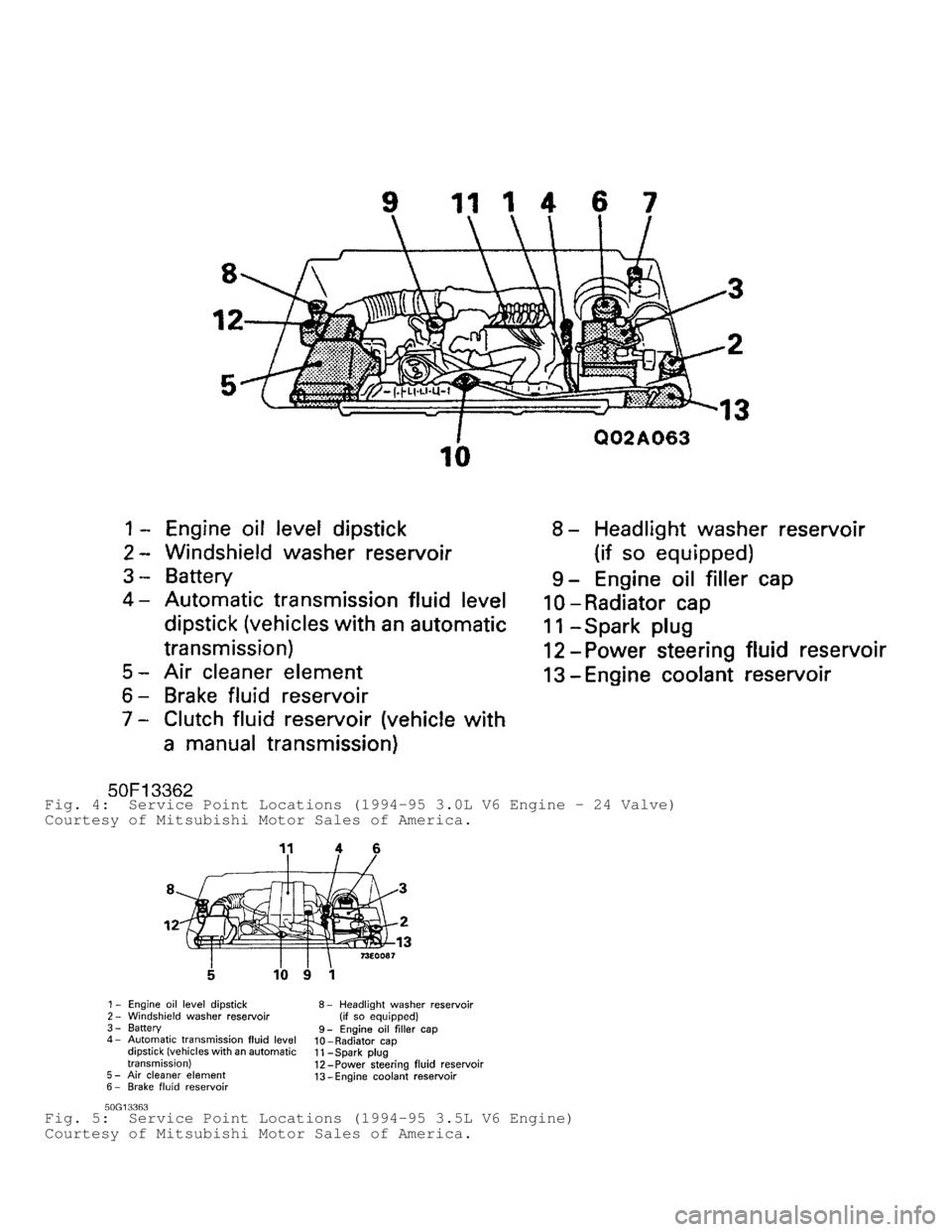
SERVICE POINT LOCATIONS
Fig. 1: Service Point Locations (1987-91 2.6L 4-Cylinder Engine)
Courtesy of Mitsubishi Motor Sales of America.
Page 699 of 1333
Fig. 2: Service Point Locations (1987-91 3.0L V6 Engine)
Courtesy of Mitsubishi Motor Sales of America.
Fig. 3: Service Point Locations (1992-95 3.0L V6 Engine)
Courtesy of Mitsubishi Motor Sales of America.
Page 700 of 1333
Fig. 4: Service Point Locations (1994-95 3.0L V6 Engine - 24 Valve)
Courtesy of Mitsubishi Motor Sales of America.
Fig. 5: Service Point Locations (1994-95 3.5L V6 Engine)
Courtesy of Mitsubishi Motor Sales of America.