1991 MITSUBISHI ECLIPSE tire pressure
[x] Cancel search: tire pressurePage 1119 of 1216
BODY - Aero Parts23-75
\18A0245
16A0765
18A041618A041C
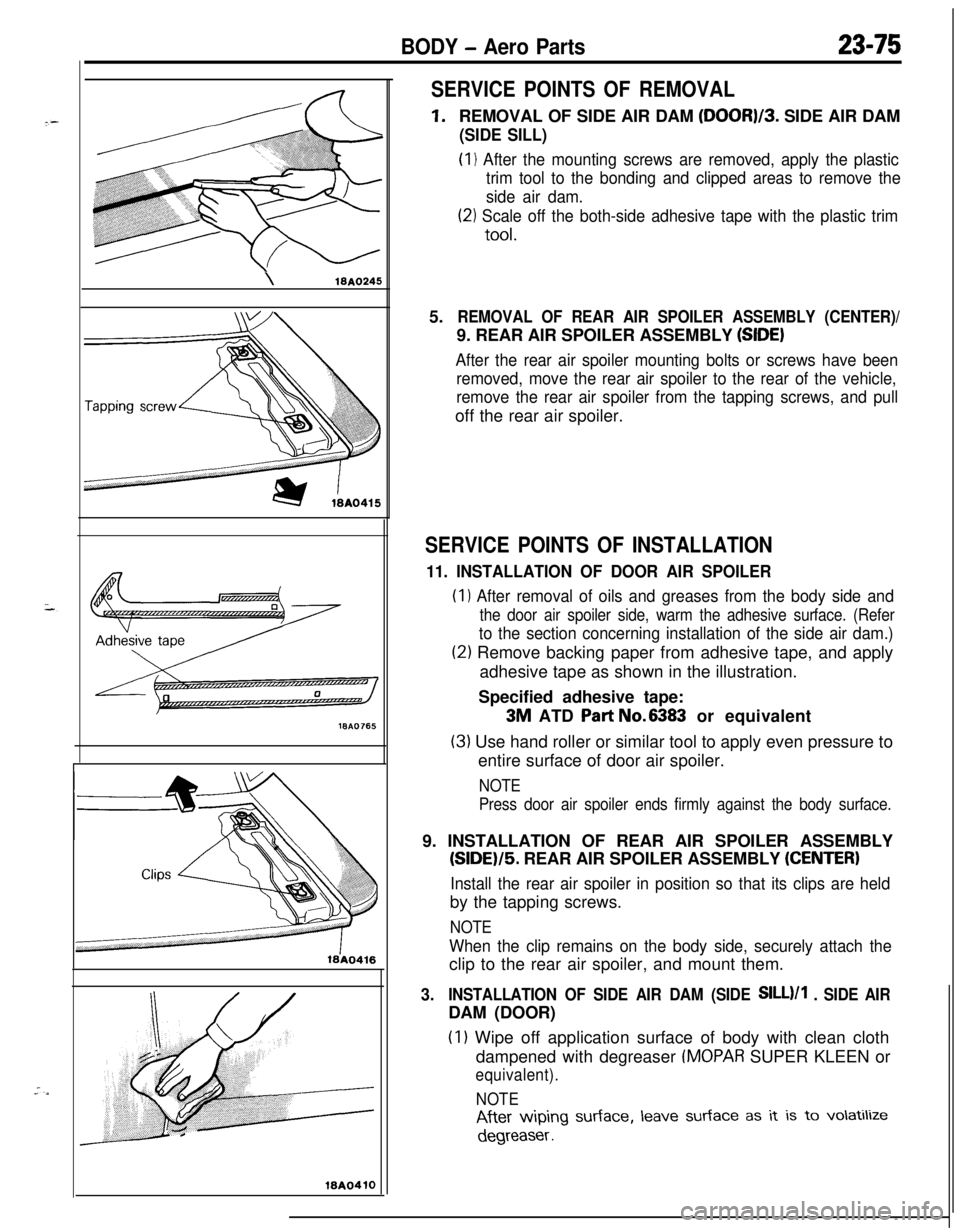
SERVICE POINTS OF REMOVAL
1.REMOVAL OF SIDE AIR DAM (DOOR)/3. SIDE AIR DAM
(SIDE SILL)(I
1 After the mounting screws are removed, apply the plastic
trim tool to the bonding and clipped areas to remove the
side air dam.
(21 Scale off the both-side adhesive tape with the plastic trim
tool.5.
REMOVAL OF REAR AIR SPOILER ASSEMBLY (CENTER)/9. REAR AIR SPOILER ASSEMBLY
(SIDE)
After the rear air spoiler mounting bolts or screws have been
removed, move the rear air spoiler to the rear of the vehicle,
remove the rear air spoiler from the tapping screws, and pulloff the rear air spoiler.
SERVICE POINTS OF INSTALLATION
11. INSTALLATION OF DOOR AIR SPOILER(I
1 After removal of oils and greases from the body side and
the door air spoiler side, warm the adhesive surface. (Refer
to the section concerning installation of the side air dam.)
(2) Remove backing paper from adhesive tape, and apply
adhesive tape as shown in the illustration.
Specified adhesive tape:
3M ATD Part No.6383 or equivalent
(3) Use hand roller or similar tool to apply even pressure to
entire surface of door air spoiler.
NOTE
Press door air spoiler ends firmly against the body surface.9. INSTALLATION OF REAR AIR SPOILER ASSEMBLY
(SIDE)/5. REAR AIR SPOILER ASSEMBLY (CENTER)
Install the rear air spoiler in position so that its clips are heldby the tapping screws.
NOTE
When the clip remains on the body side, securely attach theclip to the rear air spoiler, and mount them.
3.INSTALLATION OF SIDE AIR DAM (SIDE SILL)/1 . SIDE AIRDAM (DOOR)
(I 1 Wipe off application surface of body with clean cloth
dampened with degreaser
IMOPAR SUPER KLEEN or
equivalent).
NOTE
After wiping surface, leave surface as it is to volatilize
degreaser .
Page 1120 of 1216
23-76BODY - Aero Parts
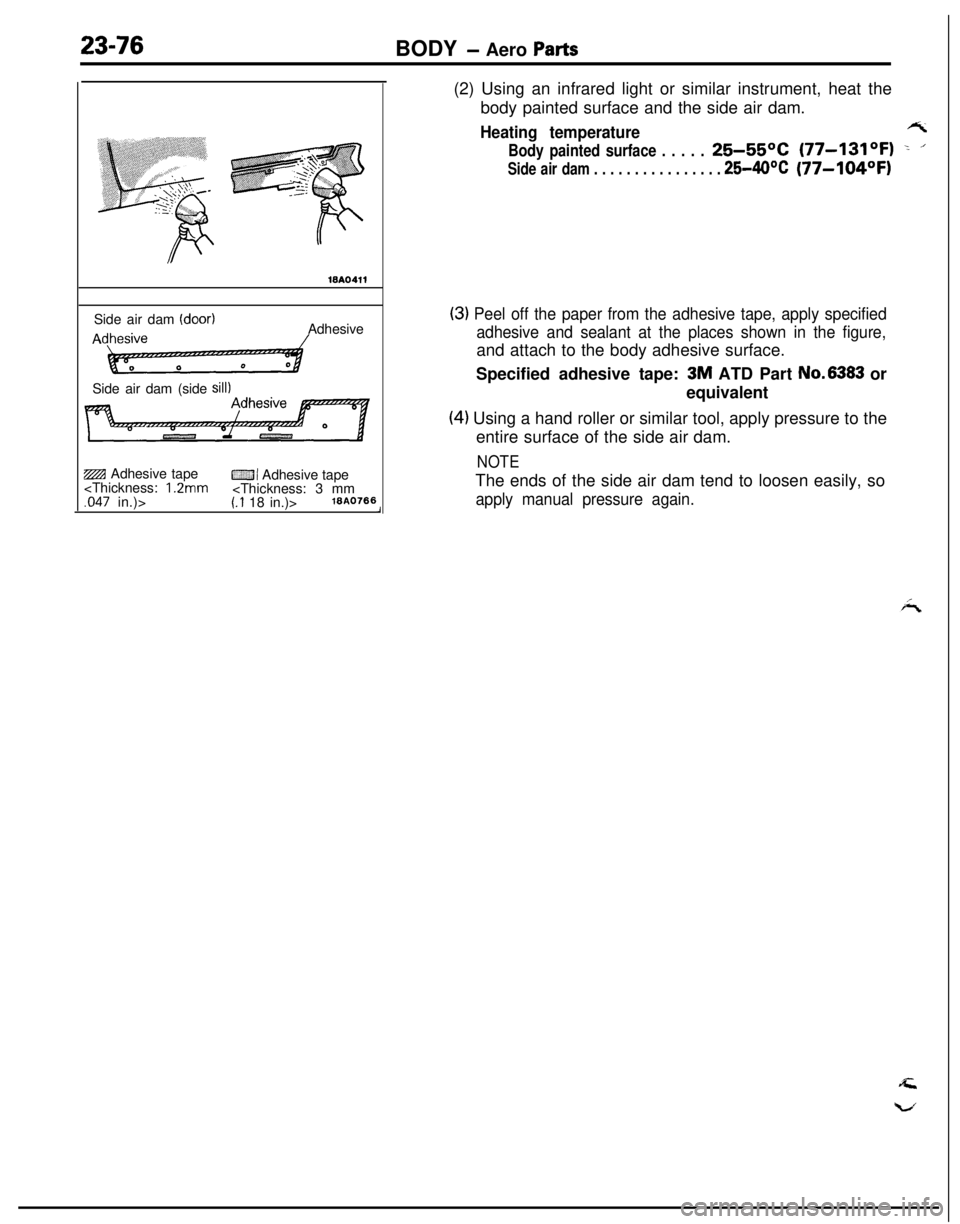
WA0411Side air dam
(door)AAdhesive
Side air dam (side
sill)ZBI Adhesive tape
CZJI Adhesive tape
body painted surface and the side air dam.
Heating temperaturert
Body painted surface . . . . .25-55OC (77-131OF) -. ’
Side air dam . . . . . . . . . . . . . . . . 25-40°C(77-104OFI
(3) Peel off the paper from the adhesive tape, apply specified
adhesive and sealant at the places shown in the figure,and attach to the body adhesive surface.
Specified adhesive tape:
3M ATD Part No.6383 or
equivalent
(4) Using a hand roller or similar tool, apply pressure to the
entire surface of the side air dam.
NOTEThe ends of the side air dam tend to loosen easily, so
apply manual pressure again.
Page 1163 of 1216
-.
HEATERS AND AIR CONDITIONING - Service Adjustment Procedures 241$19Oil collector can
2OAO464DISCHARGING SYSTEM
Since the air conditioning refrigerant system is pressurized, it
will be necessary to completely discharge the system (in a wellventilated area) before replacing any refrigerant component.
The procedure is as follows:
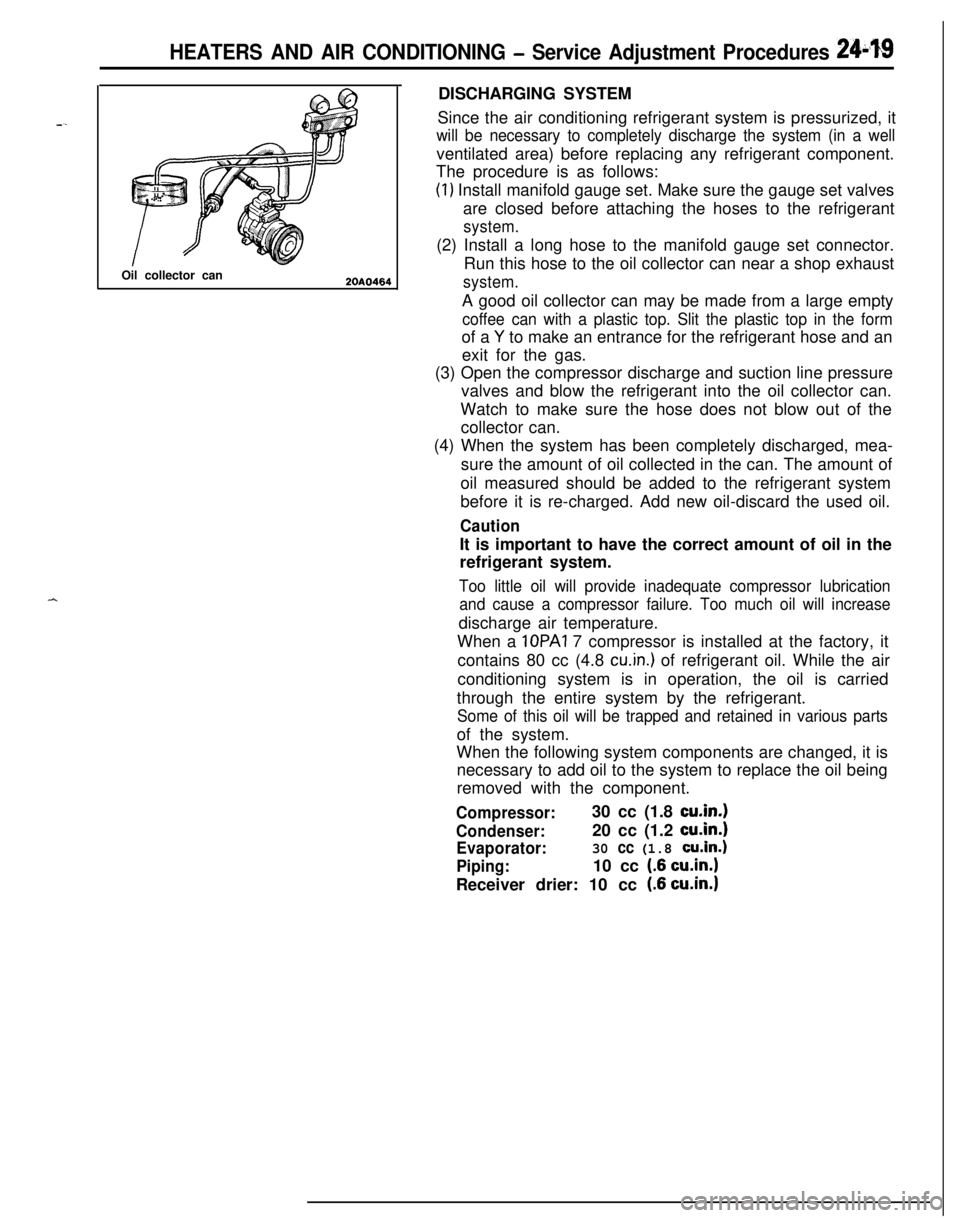
(1) Install manifold gauge set. Make sure the gauge set valves
are closed before attaching the hoses to the refrigerant
system.(2) Install a long hose to the manifold gauge set connector.
Run this hose to the oil collector can near a shop exhaust
system.A good oil collector can may be made from a large empty
coffee can with a plastic top. Slit the plastic top in the formof a
Y to make an entrance for the refrigerant hose and an
exit for the gas.
(3) Open the compressor discharge and suction line pressure
valves and blow the refrigerant into the oil collector can.
Watch to make sure the hose does not blow out of the
collector can.
(4) When the system has been completely discharged, mea-
sure the amount of oil collected in the can. The amount of
oil measured should be added to the refrigerant system
before it is re-charged. Add new oil-discard the used oil.
CautionIt is important to have the correct amount of oil in the
refrigerant system.
Too little oil will provide inadequate compressor lubrication
and cause a compressor failure. Too much oil will increasedischarge air temperature.
When a IOPAI 7 compressor is installed at the factory, it
contains 80 cc (4.8
cu.in.) of refrigerant oil. While the air
conditioning system is in operation, the oil is carried
through the entire system by the refrigerant.
Some of this oil will be trapped and retained in various partsof the system.
When the following system components are changed, it is
necessary to add oil to the system to replace the oil being
removed with the component.
Compressor:30 cc (1.8 cu.in.1
Condenser:20 cc (1.2 cu.in.1
Evaporator:30 cc (1.8 cu.in.)
Piping:10 cc (.6 cu.in.1Receiver drier: 10 cc
(.6 cu.in.1
Page 1166 of 1216
24-22 HEATERS AND AIR CONDITIONING - Service Adjustment Procedures(9) Charge through the suction side of the system by slowly
opening the suction manifold valve. Adjust the valve as
necessary so charging pressure does not exceed 345
kPa 6(50 psi). Maintain the temperature of the water in the pan w’
by adding warm water as necessary.
Note the weight of water added, to ensure accuracy when
determining amount of refrigerant added to system.
(lO)When specified refrigerant charge Max. 925
g (32 oz.) has
entered the system, close the gauge set manifold valves,
refrigerant manifold valves, and
reconnnect wiring. Each
can contains 397
g (14 oz.) of R-l 2. Use 2 l/2 cans.
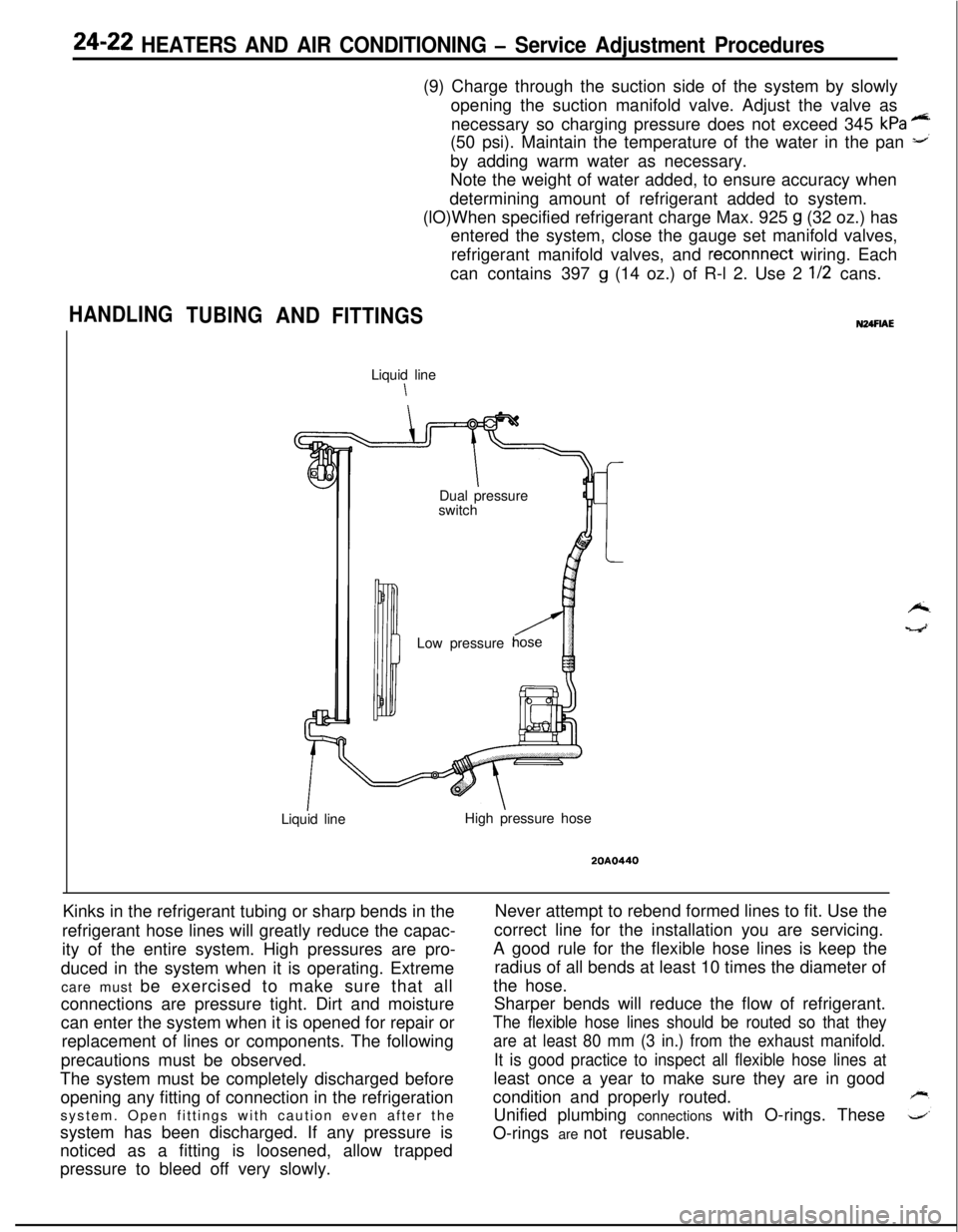
HANDLING
TUBINGANDFITTINGSLiquid line
\
IDual pressure
switch
Low pressure
Liquid lineHigh pressure hose
20A0440Kinks in the refrigerant tubing or sharp bends in the
refrigerant hose lines will greatly reduce the capac-
ity of the entire system. High pressures are pro-
duced in the system when it is operating. Extreme
care must be exercised to make sure that all
connections are pressure tight. Dirt and moisture
can enter the system when it is opened for repair or
replacement of lines or components. The following
precautions must be observed.
The system must be completely discharged before
opening any fitting of connection in the refrigeration
system. Open fittings with caution even after the
system has been discharged. If any pressure is
noticed as a fitting is loosened, allow trapped
pressure to bleed off very slowly.Never attempt to rebend formed lines to fit. Use the
correct line for the installation you are servicing.
A good rule for the flexible hose lines is keep the
radius of all bends at least 10 times the diameter of
the hose.
Sharper bends will reduce the flow of refrigerant.
The flexible hose lines should be routed so that they
are at least 80 mm (3 in.) from the exhaust manifold.
It is good practice to inspect all flexible hose lines atleast once a year to make sure they are in good
condition and properly routed.
Unified plumbing connections with O-rings. These
O-rings are not reusable.
Page 1168 of 1216
24-24 HEATERS AND AIR CONDITIONING - Service Adjustment Procedures
COMPRESSOR NOISENUFIABWhen investigating an air conditioning related noise, you must
first know the conditions when the noise occurs. These
conditions are: weather, vehicle speed, in gear or neutral,
engine temperature or any other special conditions.
Noises that develop during air conditioning operation can oftenbe misleading. For example: what sounds like a failed front
bearing or connecting rod, may be caused by loose bolts, nuts,mounting brackets, or a loose clutch assembly. Verify acces-
sory drive belt tension (power steering, or alternator).
Improper accessory drive belt tension can cause a misleading
noise when the compressor is engaged and little or no noise
when the compressor is disengaged.
Drive belts are speed sensitive. That is, at different engine
speeds, and depending upon belt tension, belts can develop
unusual noises that are often mistaken for mechanical prob-
lems within the compressor.
Adjustment Procedures
(1) Select a quiet area for testing. Duplicate conditions as
much as possible. Switch compressor on and off several
times to clearly identify compressor noise.
To duplicate high ambient conditions (high head pressure),restrict air flow through condenser. Install manifold gauge
set to make sure discharge pressure doesn’t exceed 2,070
kPa (300 psi).
(2) Tighten all compressor mounting bolts, clutch mounting
bolt, and compressor drive belt. Check to assure clutch coilis tight (no rotation or wobble).
(3) Check refrigerant hoses for rubbing or interference that cancause unusual noises.
(4) Check refrigerant charge (See “Charging the System”).
(5) Recheck compressor noise as in Step 1.
(6) If noise still exists, loosen compressor mounting bolts and
retorque. Repeat Step 1.
(7) If noise continues, replace compressor and repeat Step 1.
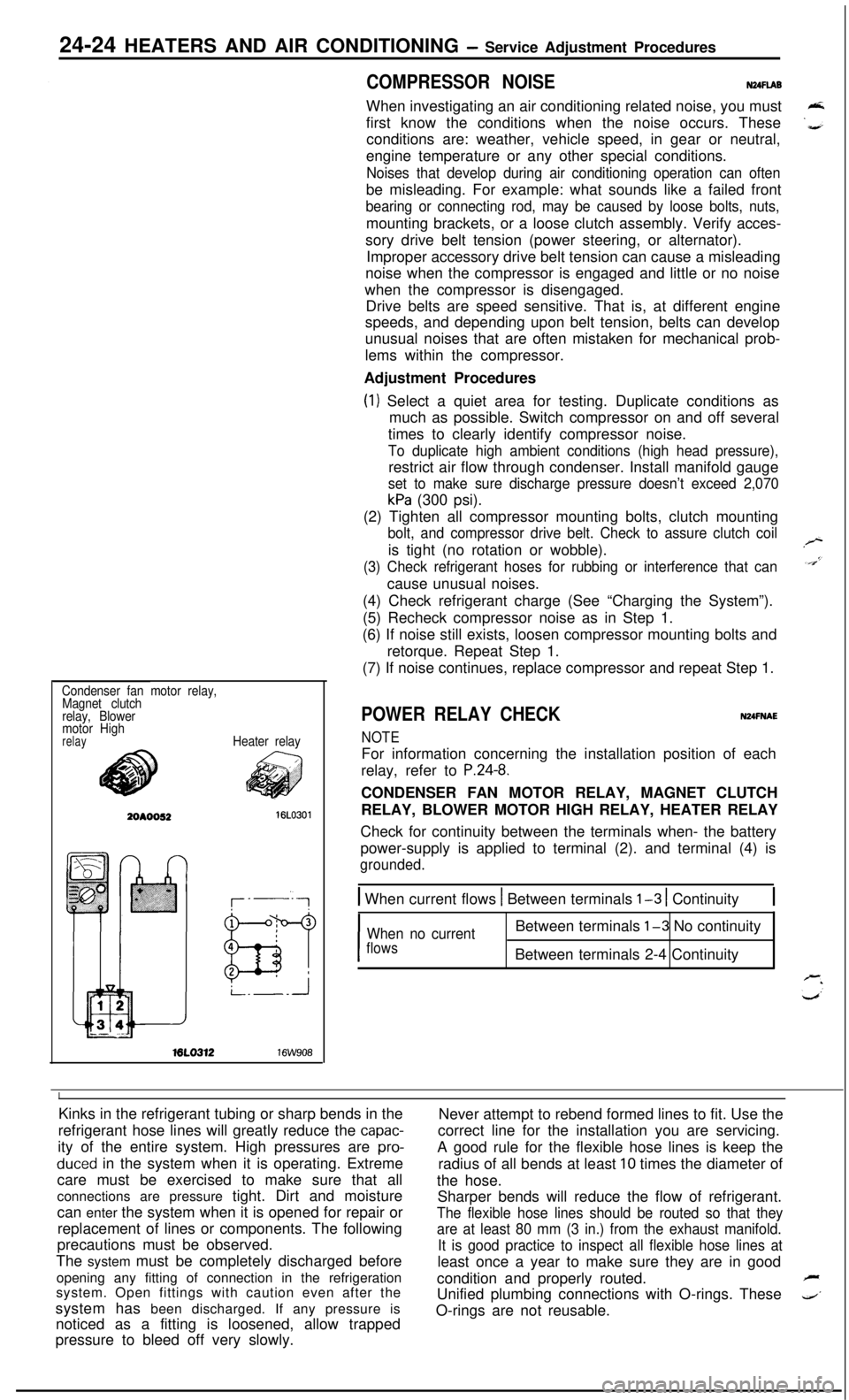
Condenser fan motor relay,
Magnet clutch
relay, Blower
motor High
relayHeater relayML0312
16W908
POWER RELAY CHECKNUFNAE
NOTEFor information concerning the installation position of each
relay, refer to
P.24-8.CONDENSER FAN MOTOR RELAY, MAGNET CLUTCH
RELAY, BLOWER MOTOR HIGH RELAY, HEATER RELAY
Check for continuity between the terminals when- the battery
power-supply is applied to terminal (2). and terminal (4) is
grounded.
1 When current flows 1 Between terminals l-3 1 Continuity1
I
When no currentBetween terminals l-3 No continuity
flowsBetween terminals 2-4 Continuity
IKinks in the refrigerant tubing or sharp bends in the
Never attempt to rebend formed lines to fit. Use the
refrigerant hose lines will greatly reduce the
capac-correct line for the installation you are servicing.
ity of the entire system. High pressures are
pro-A good rule for the flexible hose lines is keep the
duced in the system when it is operating. Extreme
radius of all bends at least 10 times the diameter of
care must be exercised to make sure that all
the hose.
connections are pressure tight. Dirt and moisture
Sharper bends will reduce the flow of refrigerant.
can enter the system when it is opened for repair or
The flexible hose lines should be routed so that theyreplacement of lines or components. The following
are at least 80 mm (3 in.) from the exhaust manifold.precautions must be observed.
It is good practice to inspect all flexible hose lines atThe system must be completely discharged before
least once a year to make sure they are in good
opening any fitting of connection in the refrigeration
condition and properly routed.
Fsystem. Open fittings with caution even after the
Unified plumbing connections with O-rings. These
4’system has been discharged. If any pressure is
noticed as a fitting is loosened, allow trappedO-rings are not reusable.
pressure to bleed off very slowly.