1991 MITSUBISHI ECLIPSE heating
[x] Cancel search: heatingPage 1057 of 1216
BODY - Troubleshooting23-13
OPERATION
TROUBLESHOOTING HINTS
-.l If the inside lock knobs of the doors are placedin the LOCK (or UNLOCK) position, the switch inthe door lock actuator will be “OFF” (or “ON”),
and the output transistor will be “ON” for 0.5
second according to the timer function in the
door lock control unit (or theft-alarm control unit).As a result, the LOCK side (or UNLOCK side) of
the door lock relay will be “ON”, operating the
actuators of all of the doors.
NOTE
The door lock actuator contains a PTC thermistor
to prevent damage caused by overheating of the
motor. If the central door lock is frequently used,the actuator may temporarily fail to operate. If it
returns to normal in a few minutes, it is not
defective.
1.
2.One of the door lock actuators fails to operate.
l Check the door actuator which fails to
operate.Cannot be placed in the LOCK or UNLOCK
position by the inside lock knob on either driver’s
or front passenger’s seat side.0 Check the switch in the actuator.0 Check the door lock control unit (or
theft-alarm control unit).
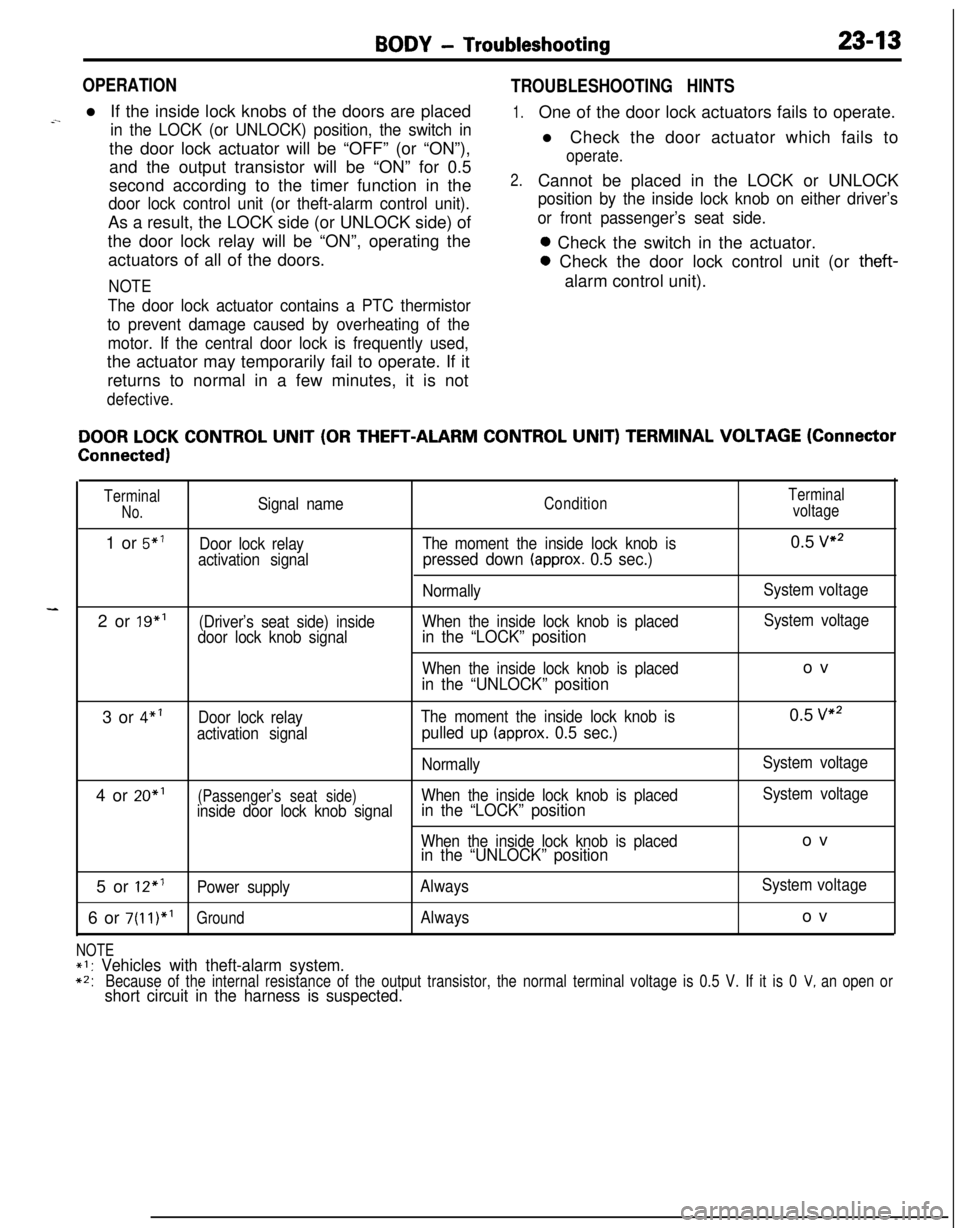
DOOR LOCK CONTROL UNIT (OR THEFT-ALARM CONTROL UNIT) TERMINAL VOLTAGE (Connector
Connected)
TerminalSignal nameConditionTerminalNo.voltage1 or
5”’Door lock relayThe moment the inside lock knob is0.5 vs2
activation signal
pressed down (approx. 0.5 sec.)
NormallySystem voltage2 or 19”’
(Driver’s seat side) insideWhen the inside lock knob is placedSystem voltage
door lock knob signalin the “LOCK” position
When the inside lock knob is placedov
in the “UNLOCK” position3 or
4”’Door lock relayThe moment the inside lock knob is0.5 v2
activation signalpulled up (approx. 0.5 sec.)
NormallySystem voltage4 or 20”’
(Passenger’s seat side)When the inside lock knob is placedSystem voltage
inside door lock knob signalin the “LOCK” position
When the inside lock knob is placedovin the “UNLOCK” position5 or
12*’Power supplyAlwaysSystem voltage6 or
7(11)*’GroundAlwaysov
NOTE*I: Vehicles with theft-alarm system.
*2:Because of the internal resistance of the output transistor, the normal terminal voltage is 0.5 V. If it is 0 V, an open orshort circuit in the harness is suspected.
Page 1093 of 1216
BODY - Moulding23-493.
REMOVAL OF QUARTER WINDOW MOULDING LOWER/
4. QUARTER WINDOW MOULDING UPPER/B. QUARTERWINDOW MOULDING FRONT
Refer to
P.23-61.6. REMOVAL OF
LIFTGATE MOULDING LOWERI7. LIFT-GATE MOULDING
UPPER/8. LIFTGATE MOULDING
SIDERefer to
P.23-62.
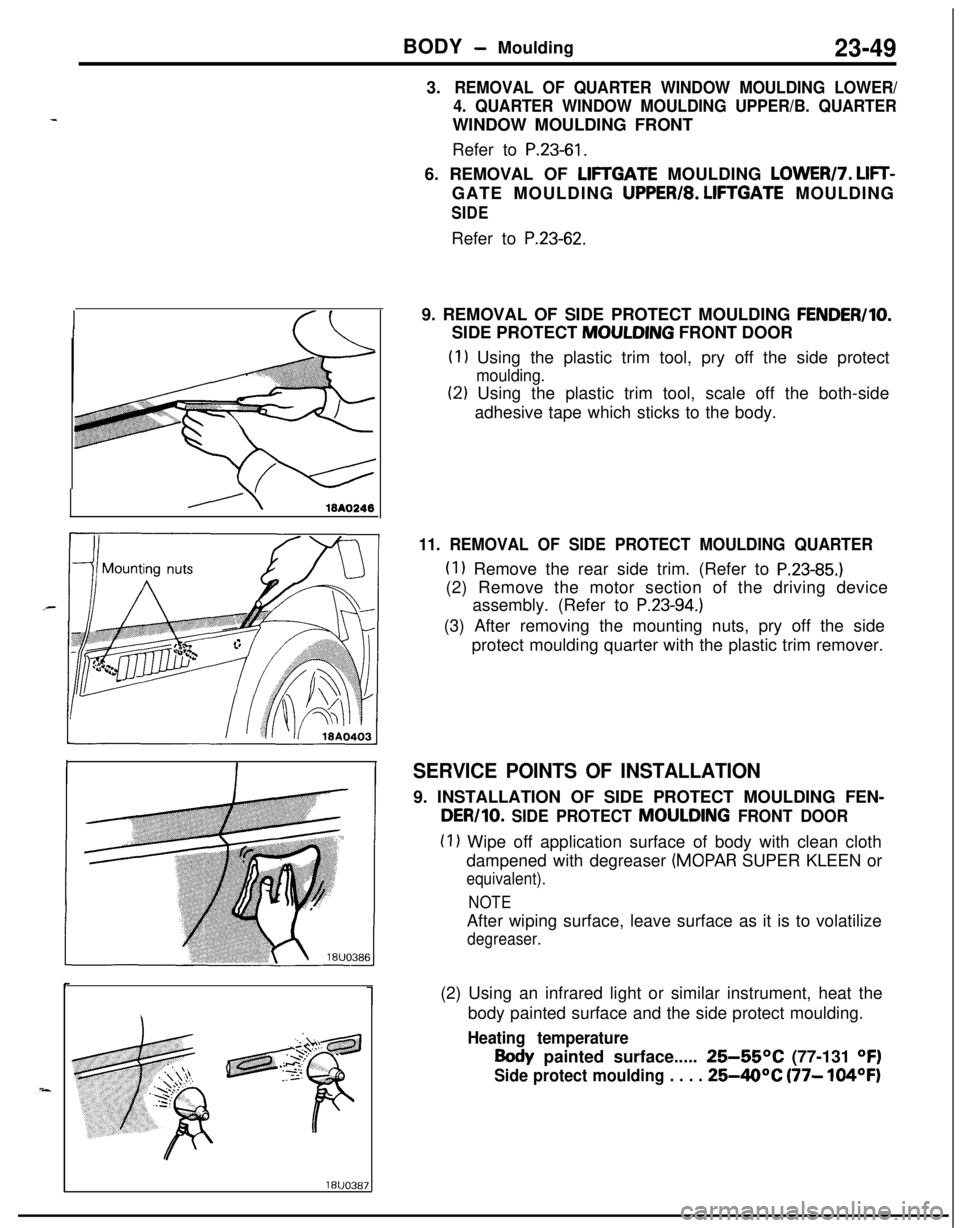
19. REMOVAL OF SIDE PROTECT MOULDING
FENDER/IO.SIDE PROTECT MOULDING FRONT DOOR
(1) Using the plastic trim tool, pry off the side protect
moulding.
(2) Using the plastic trim tool, scale off the both-side
adhesive tape which sticks to the body.
11. REMOVAL OF SIDE PROTECT MOULDING QUARTER
(1) Remove the rear side trim. (Refer to P.23-85.)(2) Remove the motor section of the driving device
assembly. (Refer to
P.23-94.)(3) After removing the mounting nuts, pry off the side
protect moulding quarter with the plastic trim remover.
SERVICE POINTS OF INSTALLATION9. INSTALLATION OF SIDE PROTECT MOULDING FEN-
DER/10. SIDE PROTECT MOULDING FRONT DOOR
(1) Wipe off application surface of body with clean cloth
dampened with degreaser
(MOPAR SUPER KLEEN or
equivalent).
NOTEAfter wiping surface, leave surface as it is to volatilize
degreaser.(2) Using an infrared light or similar instrument, heat the
body painted surface and the side protect moulding.
Heating temperature
Body painted surface..... 25-55OC (77-131 OF)
Side protect moulding . . . . 25-40°C (77- 104OF)
Page 1120 of 1216
23-76BODY - Aero Parts
WA0411Side air dam
(door)AAdhesive
Side air dam (side
sill)ZBI Adhesive tape
CZJI Adhesive tape
body painted surface and the side air dam.
Heating temperaturert
Body painted surface . . . . .25-55OC (77-131OF) -. ’
Side air dam . . . . . . . . . . . . . . . . 25-40°C(77-104OFI
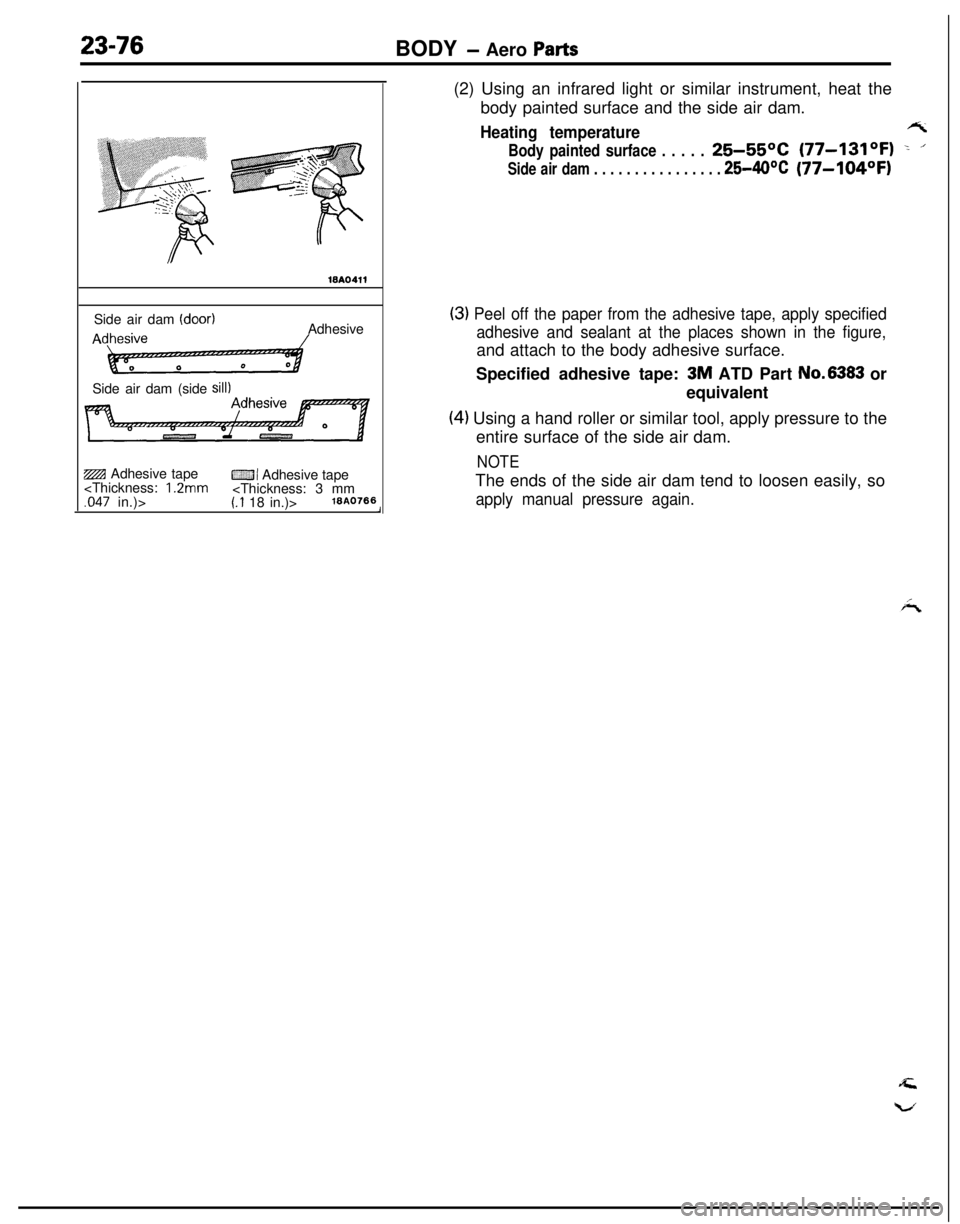
(3) Peel off the paper from the adhesive tape, apply specified
adhesive and sealant at the places shown in the figure,and attach to the body adhesive surface.
Specified adhesive tape:
3M ATD Part No.6383 or
equivalent
(4) Using a hand roller or similar tool, apply pressure to the
entire surface of the side air dam.
NOTEThe ends of the side air dam tend to loosen easily, so
apply manual pressure again.
Page 1156 of 1216
24-12 HEATERS AND AIR CONDITIONING - Service Adjustment Procedures
------__--210 2352,100 Pressure
(30) (33)(299) 2&
kPa(psi)2OPOO14(3) If the sight glass is clear and the magnetic clutch is
disengaged; the clutch is faulty or, the system is out of
refrigerant. Perform low pressure switch test to determine
condition. Check low pressure switch, and clutch coil for
electrical continuity.
(4) If the sight glass shows foam or bubbles, the system could
be low on charge. Occasional foam or bubbles are normal
when the ambient temperature is above
43°C (110°F) or
below
21°C (70°F).Adjust the engine speed to 1,500 rpm. Block the air-flow
thru the condenser to increase the compressor discharge
pressure to 1,422 to 1,520
kPa (206 to 220 psi). If sight
glass still shows bubbles or foam, system charge level is
low.The refrigerant system will not be low on charge unless
there is a leak. Find and repair the leak. If the leak can be
repaired without discharging the system an oil level check
is not necessary. Use the procedure for correcting low
refrigerant level found in the Refrigerant System Service
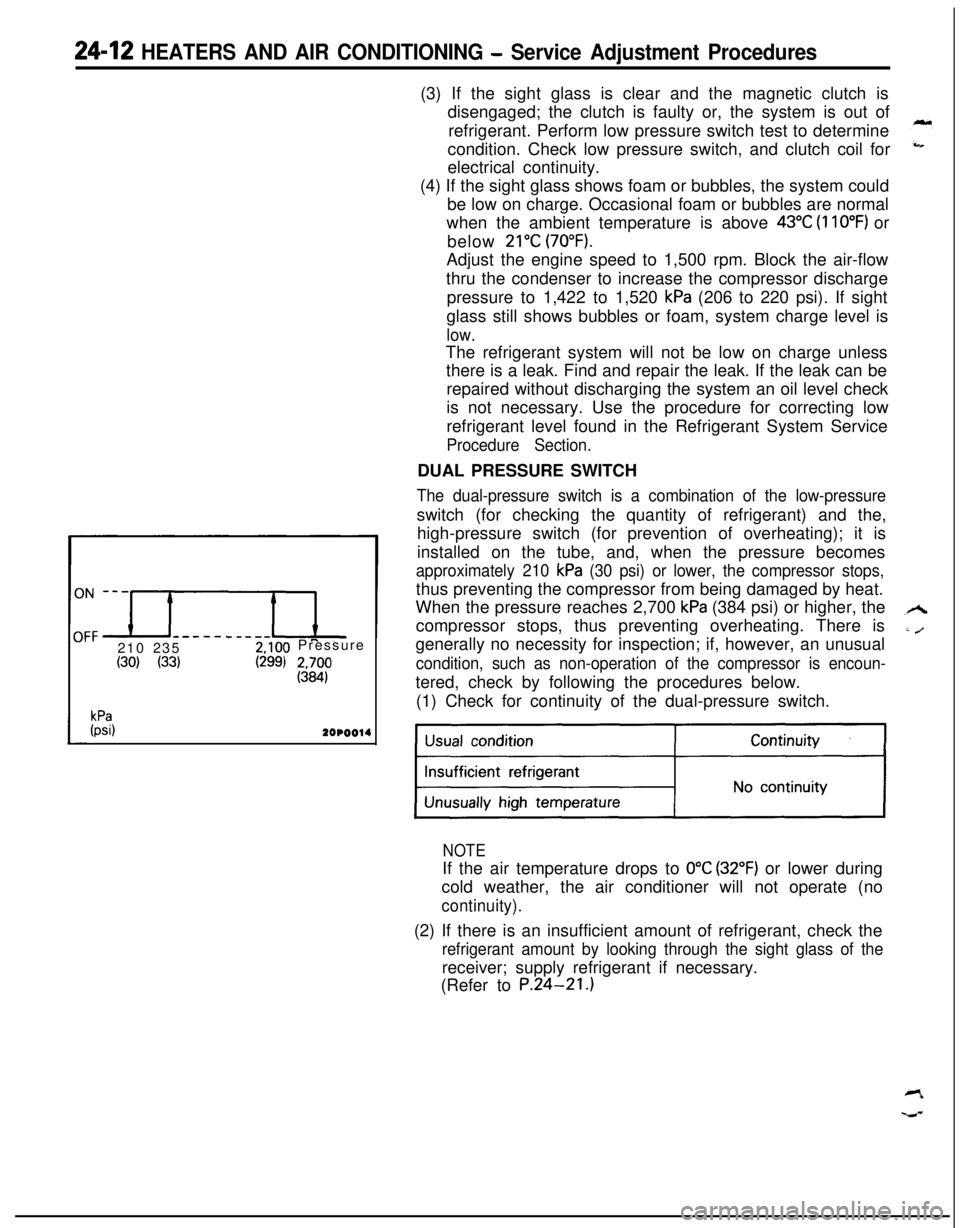
Procedure Section.DUAL PRESSURE SWITCH
The dual-pressure switch is a combination of the low-pressureswitch (for checking the quantity of refrigerant) and the,
high-pressure switch (for prevention of overheating); it is
installed on the tube, and, when the pressure becomes
approximately 210 kPa (30 psi) or lower, the compressor stops,thus preventing the compressor from being damaged by heat.
When the pressure reaches 2,700
kPa (384 psi) or higher, the
compressor stops, thus preventing overheating. There is
generally no necessity for inspection; if, however, an unusual
condition, such as non-operation of the compressor is encoun-tered, check by following the procedures below.
(1) Check for continuity of the dual-pressure switch.
NOTEIf the air temperature drops to
0°C (32°F) or lower during
cold weather, the air conditioner will not operate (no
continuity).(2) If there is an insufficient amount of refrigerant, check the
refrigerant amount by looking through the sight glass of thereceiver; supply refrigerant if necessary.
(Refer to P.24-21.)
Page 1157 of 1216
HEATERS AND AIR CONDITIONING - Service Adjustment Procedures 249*I3
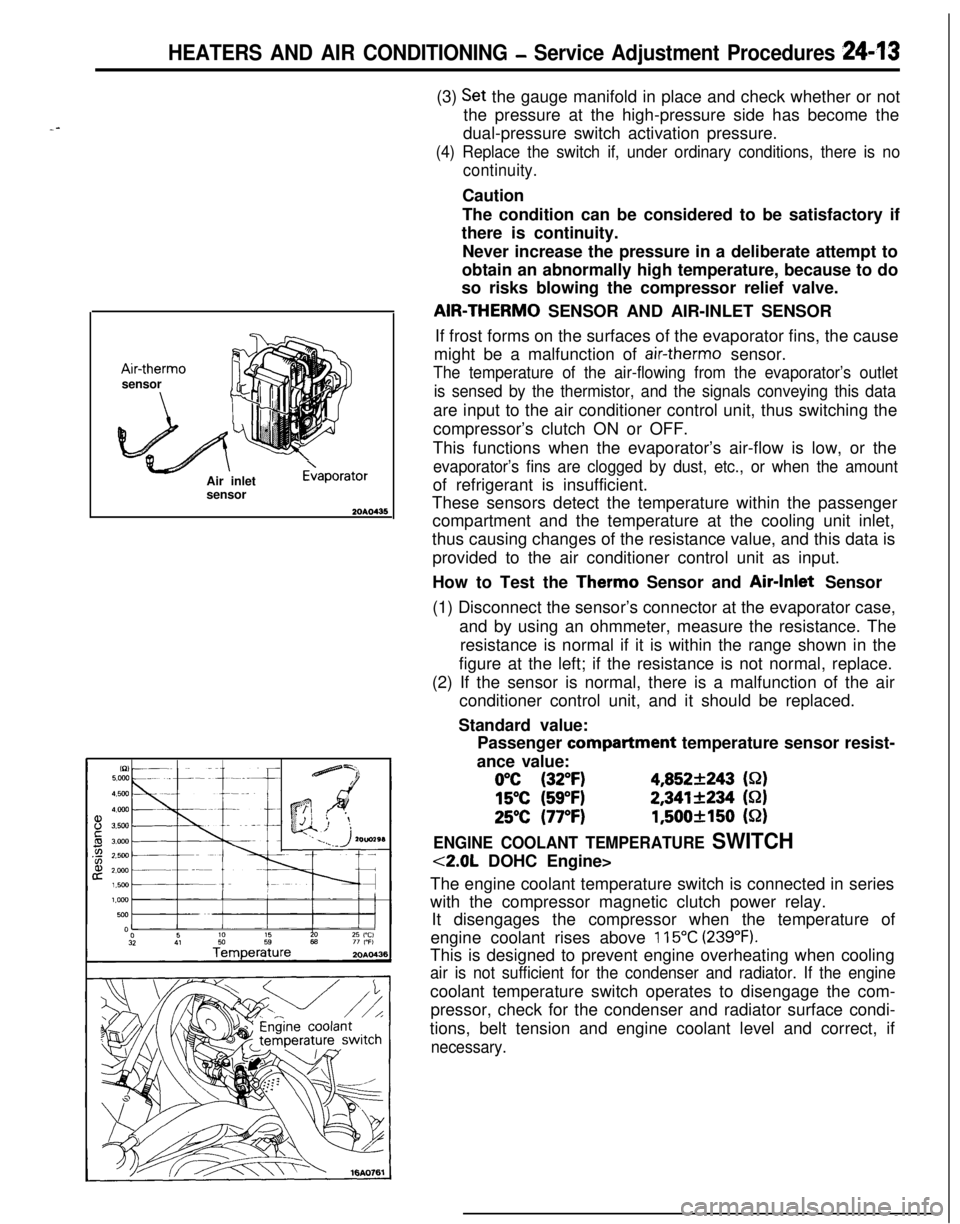
--Air-therm0
sensor
Air inlet
sensor
E>aporator(3)
Set the gauge manifold in place and check whether or not
the pressure at the high-pressure side has become the
dual-pressure switch activation pressure.
(4) Replace the switch if, under ordinary conditions, there is no
continuity.Caution
The condition can be considered to be satisfactory if
there is continuity.
Never increase the pressure in a deliberate attempt to
obtain an abnormally high temperature, because to do
so risks blowing the compressor relief valve.AIR-THERM0 SENSOR AND AIR-INLET SENSOR
If frost forms on the surfaces of the evaporator fins, the cause
might be a malfunction of
air-therm0 sensor.
The temperature of the air-flowing from the evaporator’s outlet
is sensed by the thermistor, and the signals conveying this dataare input to the air conditioner control unit, thus switching the
compressor’s clutch ON or OFF.
This functions when the evaporator’s air-flow is low, or the
evaporator’s fins are clogged by dust, etc., or when the amountof refrigerant is insufficient.
These sensors detect the temperature within the passenger
compartment and the temperature at the cooling unit inlet,
thus causing changes of the resistance value, and this data is
provided to the air conditioner control unit as input.
How to Test the Therm0 Sensor and Air-Inlet Sensor
(1) Disconnect the sensor’s connector at the evaporator case,
and by using an ohmmeter, measure the resistance. The
resistance is normal if it is within the range shown in the
figure at the left; if the resistance is not normal, replace.
(2) If the sensor is normal, there is a malfunction of the air
conditioner control unit, and it should be replaced.
Standard value:
Passenger compartment temperature sensor resist-
ance value:
0°C (32°F)4,852+243 (S-2)
15°C (59°F)2,341+234 (S-2)
25°C (77°F)1,500+150 (52)
ENGINE COOLANT TEMPERATURE SWITCH
<2.0L DOHC Engine>
The engine coolant temperature switch is connected in series
with the compressor magnetic clutch power relay.
It disengages the compressor when the temperature of
engine coolant rises above
115°C (239°F).This is designed to prevent engine overheating when cooling
air is not sufficient for the condenser and radiator. If the enginecoolant temperature switch operates to disengage the com-
pressor, check for the condenser and radiator surface condi-
tions, belt tension and engine coolant level and correct, if
necessary.
Page 1195 of 1216
HEATERS AND AIR CONDITIONING- Engine Coolant Temperature Switch24-51
ENGINE COOLANT TEMPERATURE SWITCH <2.0L DOHC Engine>
-.REMOVAL AND INSTALLATIONN24xA-
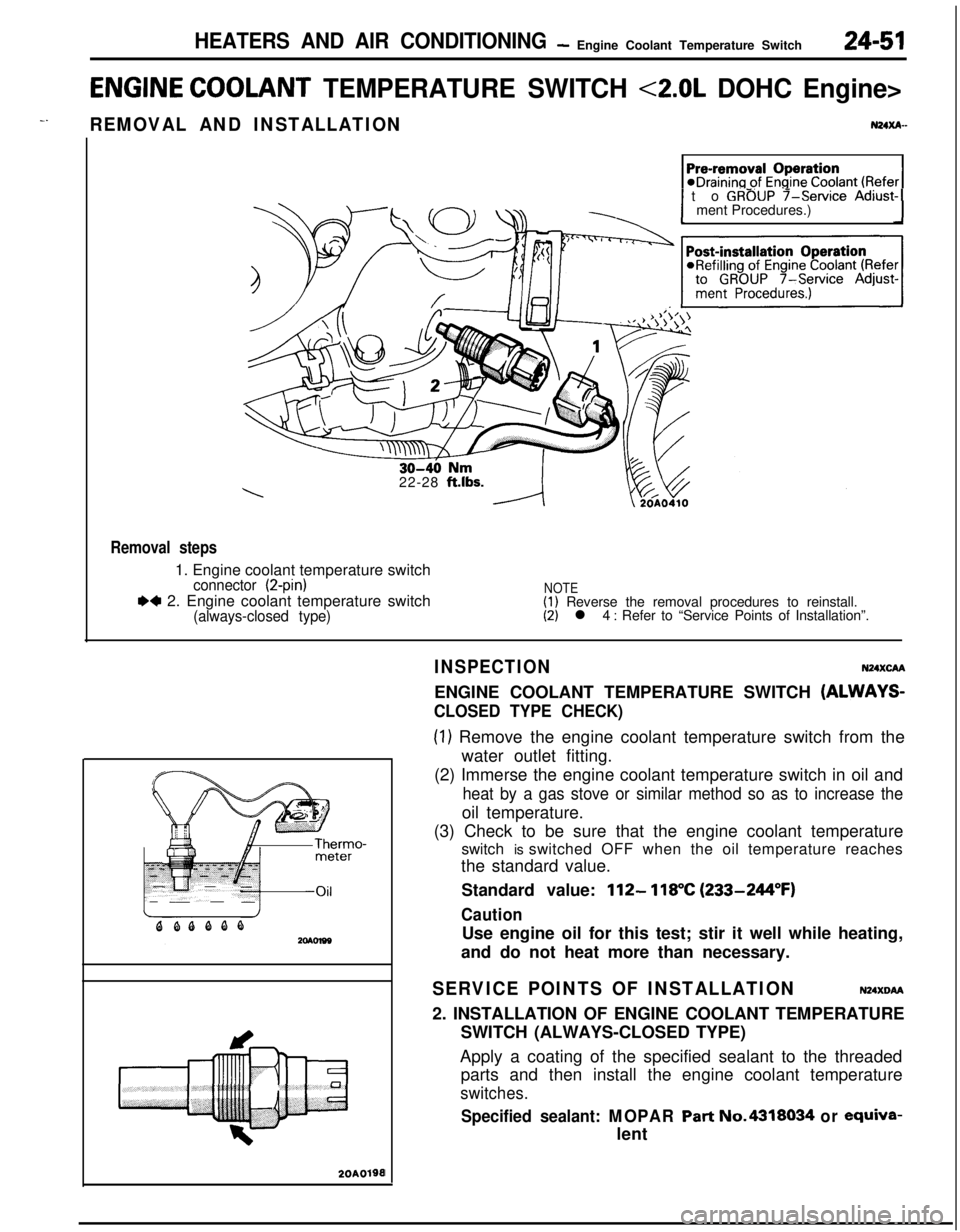
1 to GROUP f-service Adjust-1ment Procedures.)
22-28
ft.lbs.
Removal steps1. Engine coolant temperature switch
connector (2-pin)
.4 2. Engine coolant temperature switch(always-closed type)
NOTE(1) Reverse the removal procedures to reinstall.(2) l 4 : Refer to “Service Points of Installation”.
20A0190I
INSPECTIONN24XcAAENGINE COOLANT TEMPERATURE SWITCH
(ALWAYS-
CLOSED TYPE CHECK)
(1) Remove the engine coolant temperature switch from the
water outlet fitting.
(2) Immerse the engine coolant temperature switch in oil and
heat by a gas stove or similar method so as to increase theoil temperature.
(3) Check to be sure that the engine coolant temperature
switch is switched OFF when the oil temperature reaches
the standard value.
Standard value:
112- 118°C (233-244°F)
CautionUse engine oil for this test; stir it well while heating,
and do not heat more than necessary.
SERVICE POINTS OF INSTALLATIONN24XDM2. INSTALLATION OF ENGINE COOLANT TEMPERATURE
SWITCH (ALWAYS-CLOSED TYPE)
Apply a coating of the specified sealant to the threaded
parts and then install the engine coolant temperature
switches.
Specified sealant: MOPAR Part No.4318034 or ewiva-lent
Page 1216 of 1216
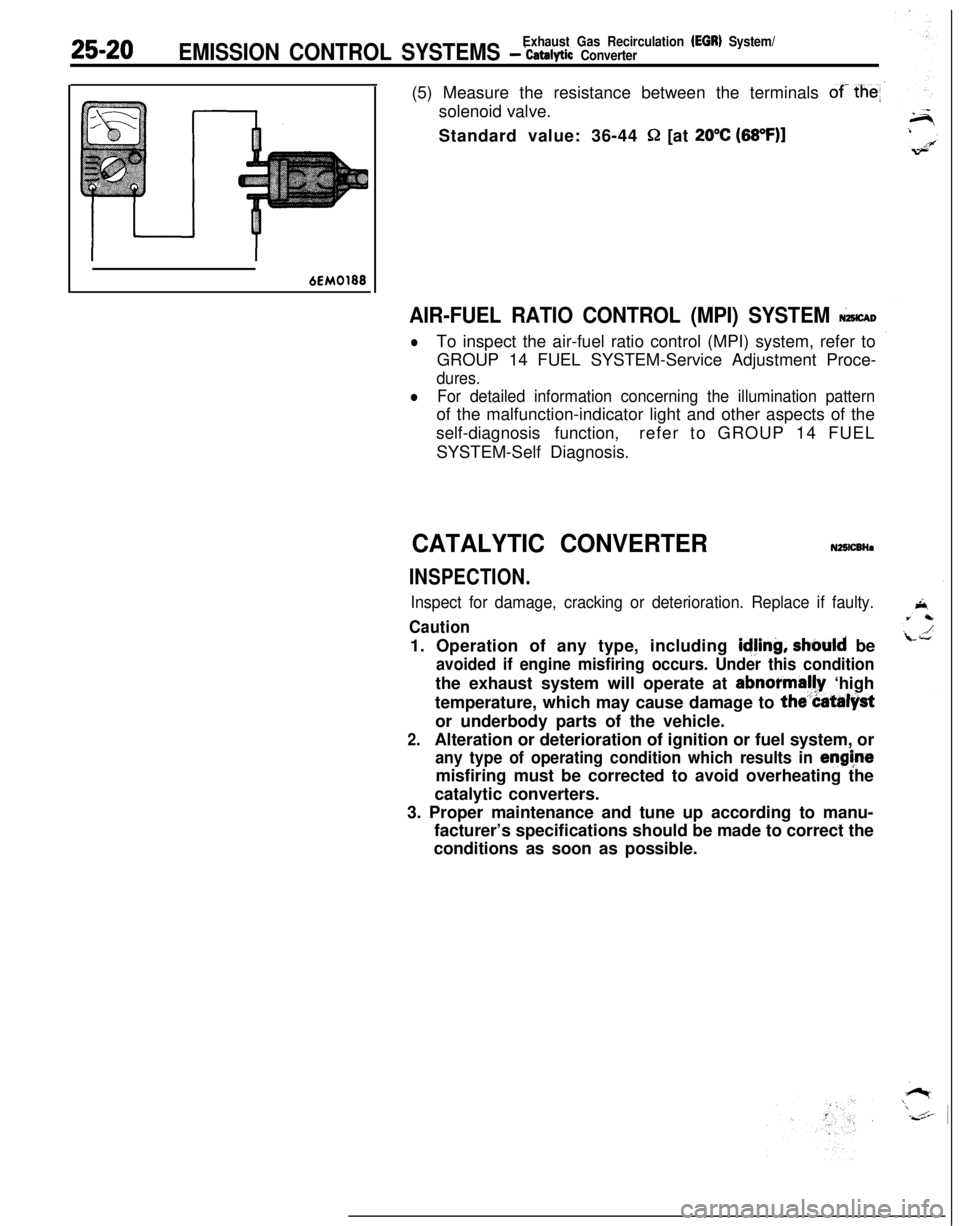
25-20Exhaust Gas Recirculation (EGR) System/EMISSION CONTROL SYSTEMS - ‘catalytic Converter(5) Measure the resistance between the terminals
of- the
Q [at 20°C (68OF)l
6EM0188
AIR-FUEL RATIO CONTROL (MPI) SYSTEM &CAD
lTo inspect the air-fuel ratio control (MPI) system, refer to
GROUP 14 FUEL SYSTEM-Service Adjustment Proce-
dures.
lFor detailed information concerning the illumination patternof the malfunction-indicator light and other aspects of the
self-diagnosis function,refer to GROUP 14 FUEL
SYSTEM-Self Diagnosis.
CATALYTIC CONVERTERN25lCBHa
INSPECTION.
Inspect for damage, cracking or deterioration. Replace if faulty.
Caution1. Operation of any type, including
idjing, should be
avoided if engine misfiring occurs. Under this conditionthe exhaust system will operate at abnormally ‘high
temperature, which may cause damage to
the”Catalystor underbody parts of the vehicle.
2.Alteration or deterioration of ignition or fuel system, or
any type of operating condition which results in enghtemisfiring must be corrected to avoid overheating the
catalytic converters.
3. Proper maintenance and tune up according to manu-
facturer’s specifications should be made to correct the
conditions as soon as possible.