Page 225 of 1216

BRAKES - Wheel Speed Sensor 545
14LOl89
Cross-section A-ACross-section B-B
12R015i
5. INSTALLATION OF FRONT SPEED SENSOR BRACKET
Assemble the speed sensor and the speed sensor bracket.
NOTE(1) The shape is different for the left and right speed
sensor brackets. Each bracket has an identification
symbol, so be sure to note these symbols
ahd. install
correctly.
FR: Indicates that the bracket is for the front speed
sensor.R: Indicates that the bracket is for the right wheel.
L: Indicates that the bracket is for the left wheel.
(2) Check to be sure, when installing the speed sensor to
the bracket, that the letters “FR” are visible.
4. INSTALLATION OF FRONT SPEED SENSOR(1) Temporarily install the speed sensor to the knuckle.Caution
Be careful when handling the pole piece at the tip of
the speed sensor and the toothed edge of the rotor
so as not to damage them by striking against other
parts.(2) Note the following points when connecting the speed
sensor cable, and secure the cable by the clip.
@ Secure the cable by the clip so that the white-
painted parts of the blackened parts (in the illustra-
tion) of the speed sensor cable are within the rangeof the angles indicated by cross-section A-A and
cross-section B-B in the illustration.
@ Check to be sure that the white-painted part
(shaded in the illustration) of the speed sensor cableis not twisted.Caution
Because there is the possibility of damage to the
cable during driving if the speed sensor cable is
twisted, care must be taken regarding thispoint.
(3) Insert a feeler gauge into the space between the speed
sensor’s pole piece and the rotor’s toothed surface, and
then tighten the speed sensor at the position where theclearance is the standard value all around.Standard value:
0.3-0.9 mm (.012-.035 in.)
NOTE
If the clearance between the speed sensor’s pole pieceand the rotor’s toothed surface is not within the
standard value range, it is probable that the rotor is
incorrectly installed, recheck installation.
Page 226 of 1216
BRAKES - G-sensor
G-SENSOR N&OVA8
REMOVAL AND INSTALLATION
14AO595
NOTEReverse the removal procedures to reinstall.
G-sensor removal steps
1. Wiring harness connector
2. G-sensor3. G-sensor bracket
14AO194
14A0195
INSPECTION
(1)Place the sensor on a level surface, then check that there isconductance between the terminals.
(2) Slowly inclining the G-sensor in the direction of forward
vehicle travel, check that there is no conductance above a
sensor angle of 30 degrees.
Page 227 of 1216
BRAKES - G-sensor /Electronic Control Unit 5-87
I
14AO198(3) Slowly inclining the G-sensor in the direction of reverse
vehicle travel, check that there is no conductance above a
sensor angle of 30 degrees.
ELECTRONIC CONTROL UNIT
ABS>NOSOZAEREMOVAL AND INSTALLATION
Pre-removal Operation
@Removal of the Quarter Trim (R.H.)(Refer to GROUP 23-Trim.)IPost-installation Operation
4*Installation of the
Quarter TrimI1 (RIt?.) (Refer to GROUP 23-Trim.)1
14AO584
Removal steps
4*1. Electronic control unit connection
l +2. Electronic control unit3. Bracket
NOTE(I) Reverse the removal procedures to reinstall.(2) 4e : Refer to “Service Points of Removal”.(3) l + : Refer to “Service Points of Installation”.
SERVICE POINTS OF REMOVAL
1. DISCONNECTION OF ELECTRONIC CONTROL UNIT
Unlock the connector and take the connector out.
Page 228 of 1216
BRAKES -El cteronic Control Unit /Parking Brakes
PARKING BRAKESREMOVAL AND INSTALLATION
*i(Refer to GROUP 23-Floor Console.)
SERVICE POINTS OF INSTALLATION
2. INSTALLATION OF ELECTRONIC CONTROL UNIT%When installing the electronic control unit to the bracket,
fasten the connector’s ground wire to the bracket.
After connecting the connector to the electronic control
unit, secure the connector by the holding spring.
Post-installation Operation
aParking Brake Lever Stroke Adjust-
NOSYA-
Parking brake lever removal steps
1. Adjusting nut2. Parking brake stayl + 3. Bushing4. Parking brake switchW 5. Parking brake lever
I I6 7
h
Parking brake cable removal steps
1. Adjusting nut6. Parking clip7. Retainer springl * 8. Parking brake cable
l?TFeverse the removal procedures to reinstall.(2) +e : Refer to “Service Points of Removal”.(3) I)4 : Refer to “Service Points of Installation”.
4
Page 229 of 1216
BRAKES - Parking Brakes5-89
Removal steps of the parking brake lever1. Adjusting nut
2. Parking brake stay
W 3. Bushing
4. Parking brake switch
l +5. Parking brake lever
Removal steps of the parking brake cable1. Adjusting nut
::6. Parking clip
7. Retainer spring
l + 8. Parking brake cable
14A0527
Pre-removal OperationaRemoval of Floor Console (Refer toGROUP 23-Floor Console)
@Parking Brake Lever Stroke Adjustment
l installation of
Floor Console (Refer to
NOTE(1) Reverse the removal procedures to reinstall.(2) 4e : Refer to “Service Points of Removal”.(3) l 4 : Refer to “Service Points of Installation”.
SERVICE POINTS OF REMOVAL
N05YBAJ
6. REMOVAL OF PARKING CLIP/7. RETAINER SPRING
Remove the parking clip and retainer spring and disconnectthe parking brake cable from the rear brake
as&mbly.
INSPECTIONNO5YCAIl Check the parking brake lever ratchet for wear.
lCheck the parking brake lever for damage and operation.
Page 230 of 1216
5-90BRAKES - Parking Brakes
Identification markSERVICE POINTS OF INSTALLATION
NO!iYDAKa
8. INSTALLATION OF PARKING BRAKE CABLECheck the parking brake cables for an identification
markand install as appropriate on the left and right sides.
ItemFWDAWDI
IdentificationLeft sideNoneYellow
markRight sideWhiteOrange
5.APPLICATION OF GREASE TO PARKING BRAKE LEVER
Apply a coating of the specified grease to each slidingpartsof the ratchet plate or the ratchet
pawl.
Grease: MOPAR Multi-mileage Lubricant
Part No. 2525035 or equivalent
Cross-section A-ACross-section B-B
14A041114AO442
&=4--
13. APPLICATION OF GREASE TO BUSHING
Apply a coating of the specified grease to the inner surfaceof the bushing.
Grease: MOPAR Multi-mileage 1 lhifinnt
Part No. 2525035 or eq
._I. ..v-.--uivalent
114A0414
Page 847 of 1216
AUTOMATIC TRANSAXLE - General Information21453
Torque converter
To
lubn(rear)
Torquezatlon4-Zconverter
control
valveFront clutch
Rear clutch
Low-reverbrakese
Ktckdown servo
‘-2 sh’+f [;valve\I
& Reducmg
;\Oil pan
II1-0 pressureue converter and lubrfcataon
r.-z~re
m Reducmg pressure
0 011 pump suctm pressure
0 Modulated lme pressure
0Pressure control solenoidvalve pressure
TFA0081
Page 869 of 1216
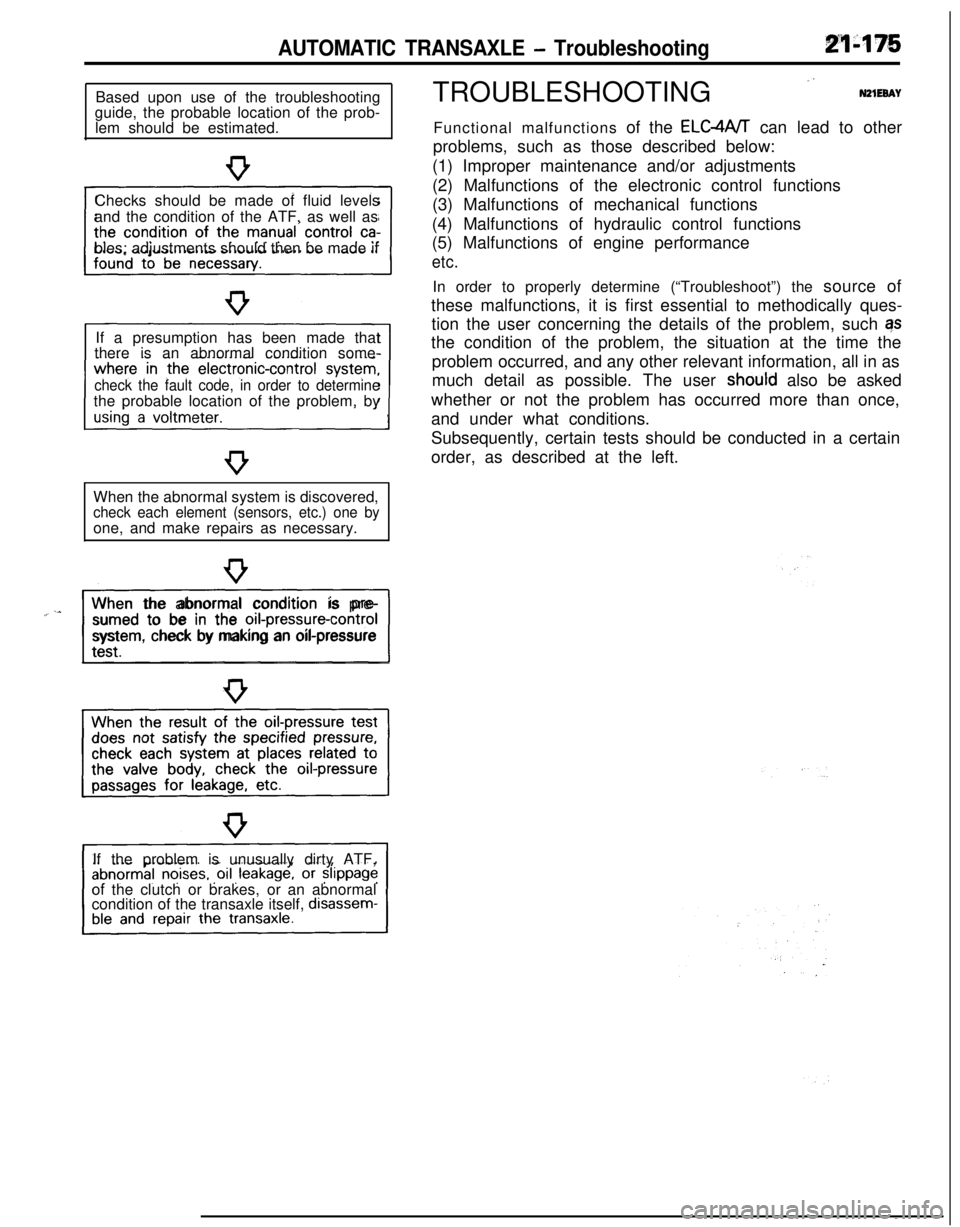
AUTOMATIC TRANSAXLE - TroubleshootingBased upon use of the troubleshooting
guide, the probable location of the prob-
lem should be estimated.
Checks should be made of fluid levels
and the condition of the ATF, as well as
bles; adjustments should then be made if
If a presumption has been made that
there is an abnormal condition some-
check the fault code, in order to determinethe probable location of the problem, by
When the abnormal system is discovered,
check each element (sensors, etc.) one byone, and make repairs as necessary.
“~^II_When the abnormal condition is pre-
sumed to be in the
orI-pressure-controlsystem, check by making an oil-pressure
If the problem is unusually dirty ATF,
of the clutch or brakes, or an abnormal
condition of the transaxle itself,
disassem-TROUBLESHOOTING
”N21EeAYFunctional malfunctions of the ELC4A/T can lead to other
problems, such as those described below:
(1) Improper maintenance and/or adjustments
(2) Malfunctions of the electronic control functions
(3) Malfunctions of mechanical functions
(4) Malfunctions of hydraulic control functions
(5) Malfunctions of engine performance
etc.In order to properly determine (“Troubleshoot”) the source of
these malfunctions, it is first essential to methodically ques-
tion the user concerning the details of the problem, such qs
the condition of the problem, the situation at the time the
problem occurred, and any other relevant information, all in as
much detail as possible. The user
shoutd also be asked
whether or not the problem has occurred more than once,
and under what conditions.
Subsequently, certain tests should be conducted in a certain
order, as described at the left.


