55-16 HEATERS AND MANUAL AIR CONDITIONER -Service Adjustment Procedures
LOW CHARGE~
If the system has not lost all of its refrigerant charge; locate and
repair all leaks. If it is necessary to increase the system
pressure to find the leak (because of an especially low charge)
‘iaadd of refrigerant. If it is oossible to reoair the leak without
discharging-the refrigerant system, use the procedure for
correcting low refrigerant level.
HANDLING TUBING AND FITTINGSM55FlAFKinks in the refrigerant tubing or sharp bends in the refrigerant
hose lines will greatly reduce the capacity of the entire system.
High pressures are produced in the system when it is
operating. Extreme care must be exercised to make sure that
all connections are pressure tight. Dirt and moisture can enter
the system when it is opened for repair or replacement of lines
or components. The following precautions must be observed.
The system must be completely discharged before opening
any fitting of connection in the refrigeration system. Open
fittings with caution even after the system has been dis-
charged. If any pressure is noticed as a fitting is loosened, allow
trapped pressure to bleed off very slowly.
Never attempt to rebend formed lines to fit. Use the correct
line for the installation you are servicing.
A good rule for the flexible hose lines is keep the radius of all
bends at least 10 times the diameter of the hose.
Sharper bends will reduce the flow of refrigerant. The flexible
hose lines should be routed so that they are at least 80 mm (3
in.) from the exhaust manifold. It is good practice to inspect all
flexible hose lines at least once a year to make sure they are in
good condition and properly routed.
\ Aj iUnified plumbing connections with O-rings. These O-rings are
-not reusable.
I
COMPRESSOR NOISEM55FlAD
When investigating an air conditioning related noise, you must
first know the conditions when the noise occurs. These
conditions are: weather, vehicle speed, in gear on neutral,
engine temperature or any other special conditions.
Noises that develop during air conditioning operation can often
be misleading. For example: what sounds like a failed front
bearing or connecting rod. may be caused by loose bolts, nuts,
mounting brackets, or a loose clutch assembly. Verify acces-
sory drive belt tension (power steering or alternator).
Improper accessory drive belt tension can cause a misleading
noise when the compressor is engaged and little or no noise
when the compressor is disengaged.
Drive belts are speed sensitive. That is, at different engine
speeds, and depending upon belt tension, belts can develop
unusual noises that are often mistaken for mechanical prob-
lems within the compressor.
TSB Revision
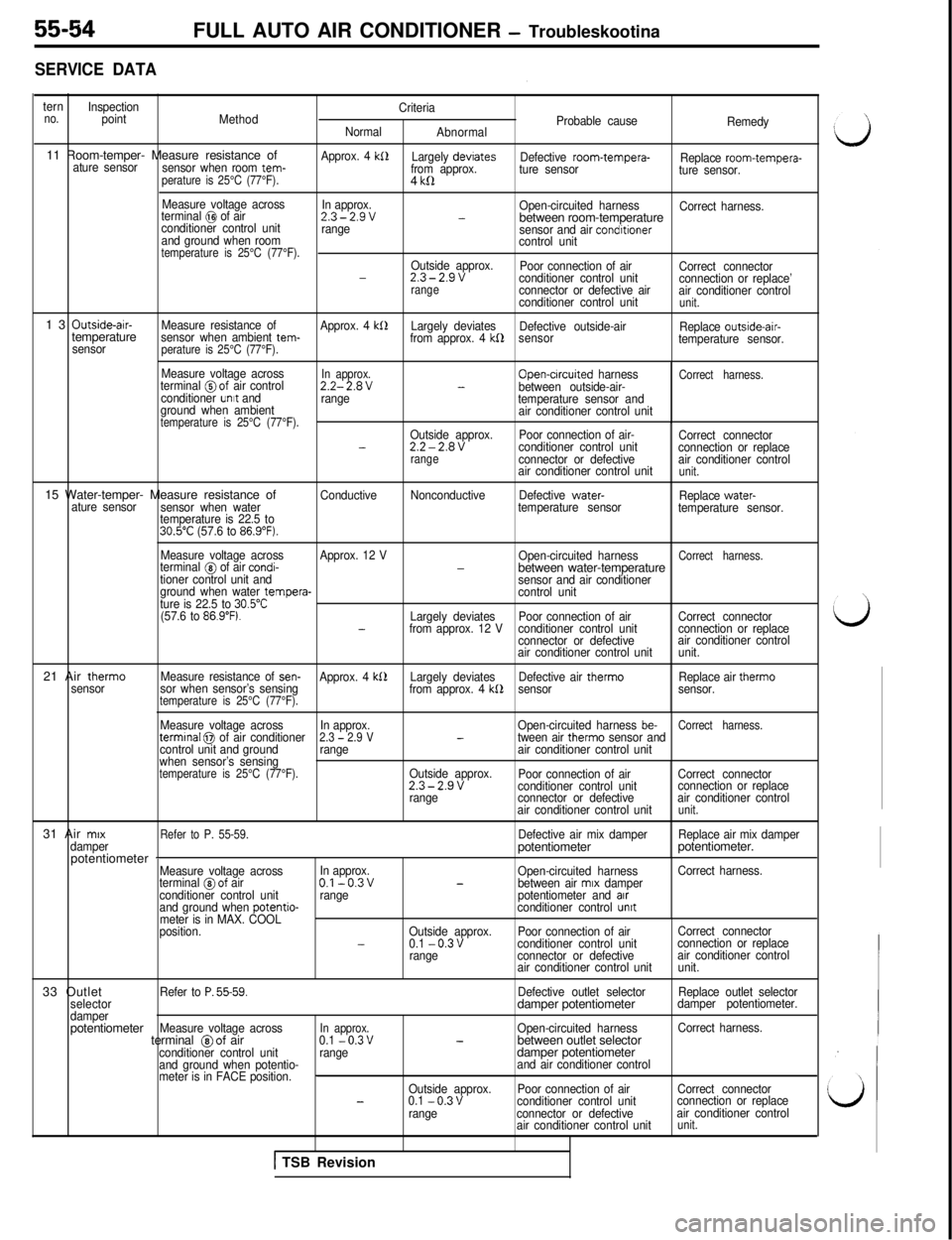
SERVICE DATA
ternno.Inspection
point
MethodCriteria
Probable cause
Normal
AbnormalRemedy11 Room-temper- Measure resistance of
sensor when room tem- ature sensorperature is 25°C (77°F).
Approx. 4 kS1Largely devrates
from approx.Defective room-tempera-
Replace room-tempera-
ture sensor
ture sensor.4
kll
Measure voltage across
In approx.
terminal @I of airOpen-circuited harness
Correct harness.2.3-2.9v-conditioner control unitbetween room-temperaturerange
sensor and air condrtionerand ground when room
control unittemperature is 25°C (77°F).Outside approx.
Poor connection of air
Correct connector-2.3-2.9vconditioner control unit
connection or replace’rangeconnector or defective air
air conditioner control
conditioner control unitunit.13
Outside-air-
Measure resistance of
Approx. 4 kllLargely deviates
Defective outside-air
Replace outside-air-temperaturesensor when ambient tem-
from approx. 4 kf2sensor
temperature sensor.
sensorperature is 25°C (77°F).
Measure voltage acrossIn approx.terminal @of air controlOpen-crrcuited harnessCorrect harness.2.2-2.8V-between outside-air-
conditioner unrt and
range
temperature sensor and
ground when ambient
air conditioner control unit
temperature is 25°C (77°F).Outside approx.Poor connection of air-
Correct connector-2.2-2.8Vconditioner control unit
connection or replacerangeconnector or defectiveair conditioner control
air conditioner control unitunit.15 Water-temper- Measure resistance of
ConductiveNonconductiveDefective water-
Replace water-
ature sensor
sensor when watertemperature sensor
temperature sensor.
temperature is 22.5 to
30.5”C (57.6 to 86.9”F).21 Air therm0
sensorMeasure voltage acrossApprox. 12 V
Open-circuited harness
Correct harness.terminal @ of air condi--between water-temperaturetioner control unit and
sensor and air conditioner
ground when water tempera-
control unit
ture is 22.5 to 30.5”C(57.6 to 86.9”F).Largely deviatesPoor connection of airCorrect connector-from approx. 12 Vconditioner control unitconnection or replace
connector or defectiveair conditioner control
air conditioner control unitunit.
Measure resistance of
sen-Approx. 4 kS2Largely deviatesDefective air therm0Replace air therm0
sor when sensor’s sensing
from approx. 4 kb2sensorsensor.temperature is 25°C (77°F).
Measure voltage acrossIn approx.Open-circuited harness be-Correct harness.termrnal 0 of air conditioner2.3 - 2.9 V-tween air therm0 sensor and
control unit and groundrangeair conditioner control unit
when sensor’s sensing
temperature is 25°C (77°F).Outside approx.
Poor connection of airCorrect connector2.3-2.9vconditioner control unitconnection or replace
rangeconnector or defectiveair conditioner control
air conditioner control unit
unit.31 Air
mrx
Refer to P. 55-59.Defective air mix damperReplace air mix damper
damperpotentiometerpotentiometer.
potentiometer
-Measure voltage acrossIn approx.
Open-circuited harnessCorrect harness.
terminal @of airO.l-0.3v-between air mrx damper
conditioner control unitrangepotentiometer and arrand ground when potentio-conditioner control unrtmeter is in MAX. COOL
position.Outside approx.Poor connection of airCorrect connector
-0.1 -0.3vconditioner control unitconnection or replace
rangeconnector or defectiveair conditioner control
air conditioner control unitunit.33 Outlet
Refer to P. 55-59.Defective outlet selectorReplace outlet selector
selectordamper potentiometerdamper potentiometer.
damperpotentiometer
Measure voltage acrossIn approx.Open-circuited harnessCorrect harness.terminal @of air0.1 -0.3v-between outlet selectorconditioner control unitrangedamper potentiometerand ground when potentio-and air conditioner control
meter is in FACE position._Outside approx.Poor connection of airCorrect connector-0.1 -0.3vconditioner control unitconnection or replace
rangeconnector or defectiveair conditioner control
air conditioner control unit
unit.FULL AUTO AIR CONDITIONER
- Troubleskootina
1 TSB Revision
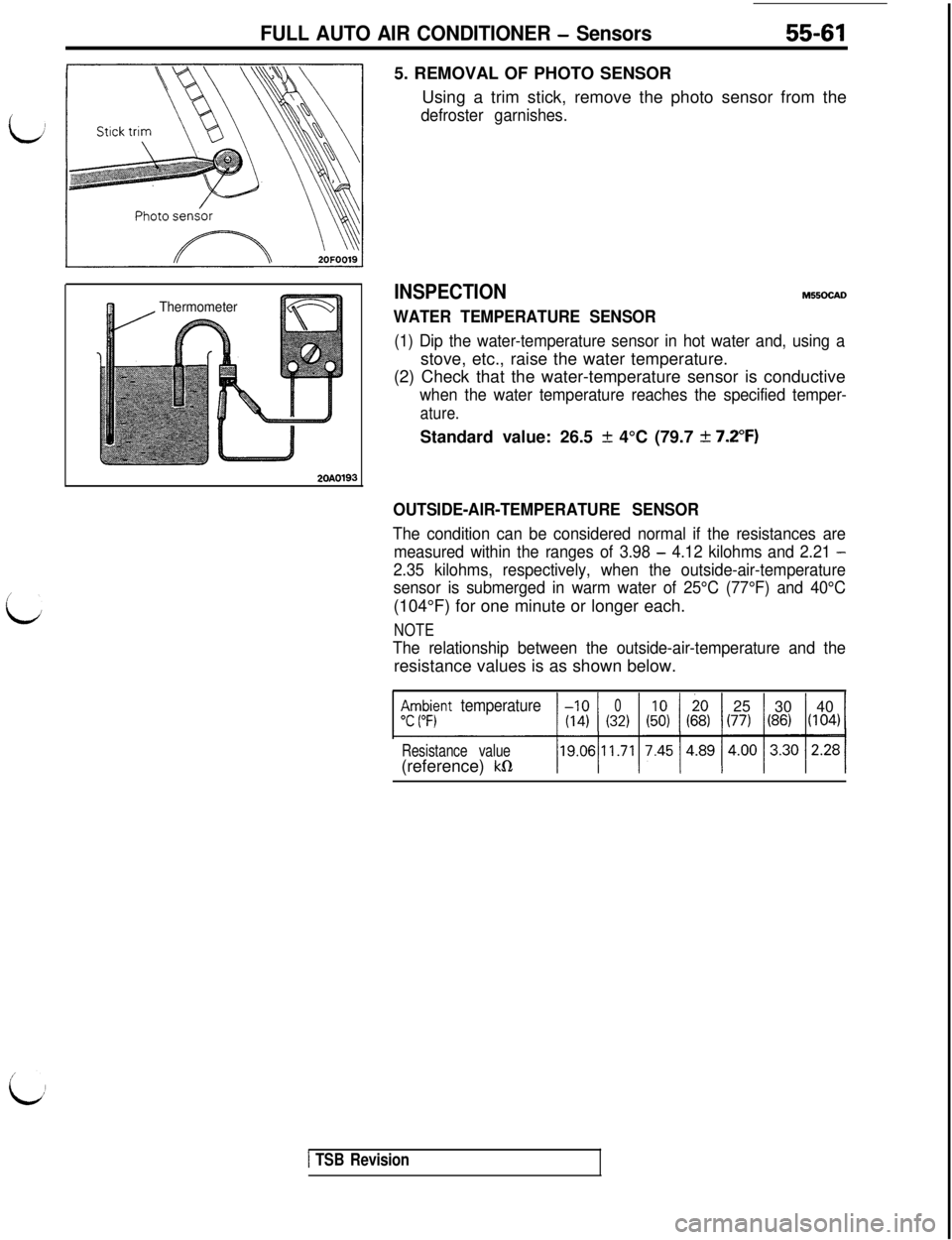
FULL AUTO AIR CONDITIONER - Sensors55-615. REMOVAL OF PHOTO SENSOR
Using a trim stick, remove the photo sensor from the
defroster garnishes.
Thermometer
2OAO19:
c
3
INSPECTIONM55OcALl
WATER TEMPERATURE SENSOR
(1) Dip the water-temperature sensor in hot water and, using astove, etc., raise the water temperature.
(2) Check that the water-temperature sensor is conductive
when the water temperature reaches the specified temper-
ature.Standard value: 26.5 + 4°C (79.7
+ 7.2”Fl
OUTSIDE-AIR-TEMPERATURE SENSOR
The condition can be considered normal if the resistances are
measured within the ranges of 3.98
- 4.12 kilohms and 2.21 -
2.35 kilohms, respectively, when the outside-air-temperature
sensor is submerged in warm water of 25°C (77°F) and 40°C(104°F) for one minute or longer each.
NOTE
The relationship between the outside-air-temperature and theresistance values is as shown below.
&$$nt temperatureI-10 /0110 / i01 25/ 301 40 /(14) (32) (50) (68) (77) (86) (104)
Resistance value(reference) k0
1 TSB Revision