Page 2734 of 4087
OK
NG
Type I
NG
Type II
NG
OK
OKNG
INSPECTION PROCEDURE
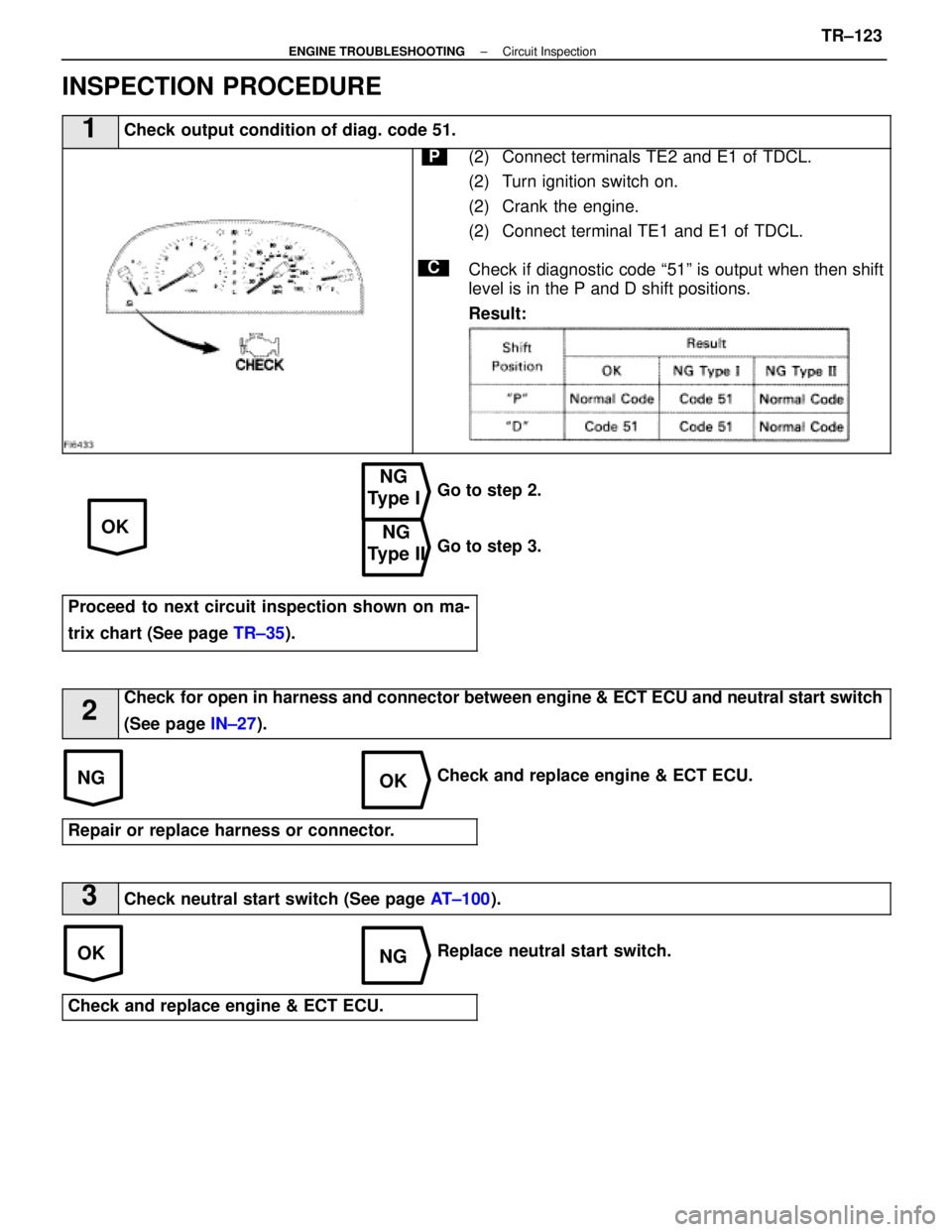
1Check output condition of diag. code 51.
C
P(2) Connect terminals TE2 and E1 of TDCL.
(2) Turn ignition switch on.
(2) Crank the engine.
(2) Connect terminal TE1 and E1 of TDCL.
Check if diagnostic code ª51º is output when then shift
level is in the P and D shift positions.
Result:
Go to step 2.
Go to step 3.
Proceed to next circuit inspection shown on ma-
trix chart (See page TR±35).
2
Check for open in harness and connector between engine & ECT ECU and neutral \
start switch
(See page IN±27).
Check and replace engine & ECT ECU.
Repair or replace harness or connector.
3Check neutral start switch (See page AT±100).
Replace neutral start switch.
Check and replace engine & ECT ECU.
±
ENGINE TROUBLESHOOTING Circuit InspectionTR±123
WhereEverybodyKnowsYourName
Page 2741 of 4087
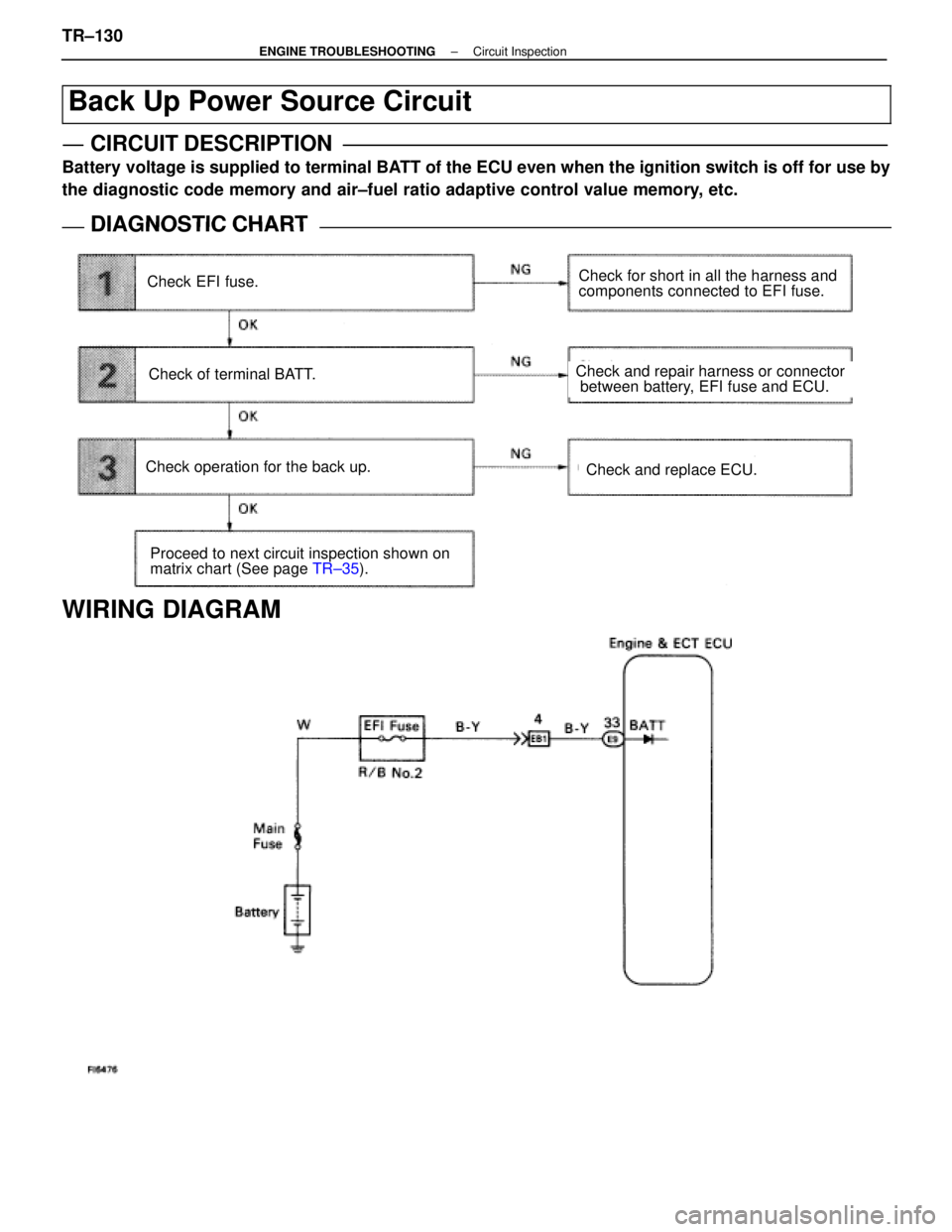
Back Up Power Source Circuit
CIRCUIT DESCRIPTION
Battery voltage is supplied to terminal BATT of the ECU even when the ignition switch is off for use by
the diagnostic code memory and air±fuel ratio adaptive control value mem\
ory, etc.
DIAGNOSTIC CHARTDIAGNOSTIC CHART
Check for short in all the harness and
components connected to EFI fuse.Check EFI fuse.
Check of terminal BATT.
Proceed to next circuit inspection shown on
matrix chart (See page TR±35).
Check operation for the back up.Check and replace ECU.
Check and repair harness or connector
between battery, EFI fuse and ECU.
WIRING DIAGRAM
TR±130±
ENGINE TROUBLESHOOTING Circuit Inspection
WhereEverybodyKnowsYourName
Page 2742 of 4087
OKNG
OKNG
YESNO
INSPECTION PROCEDURE
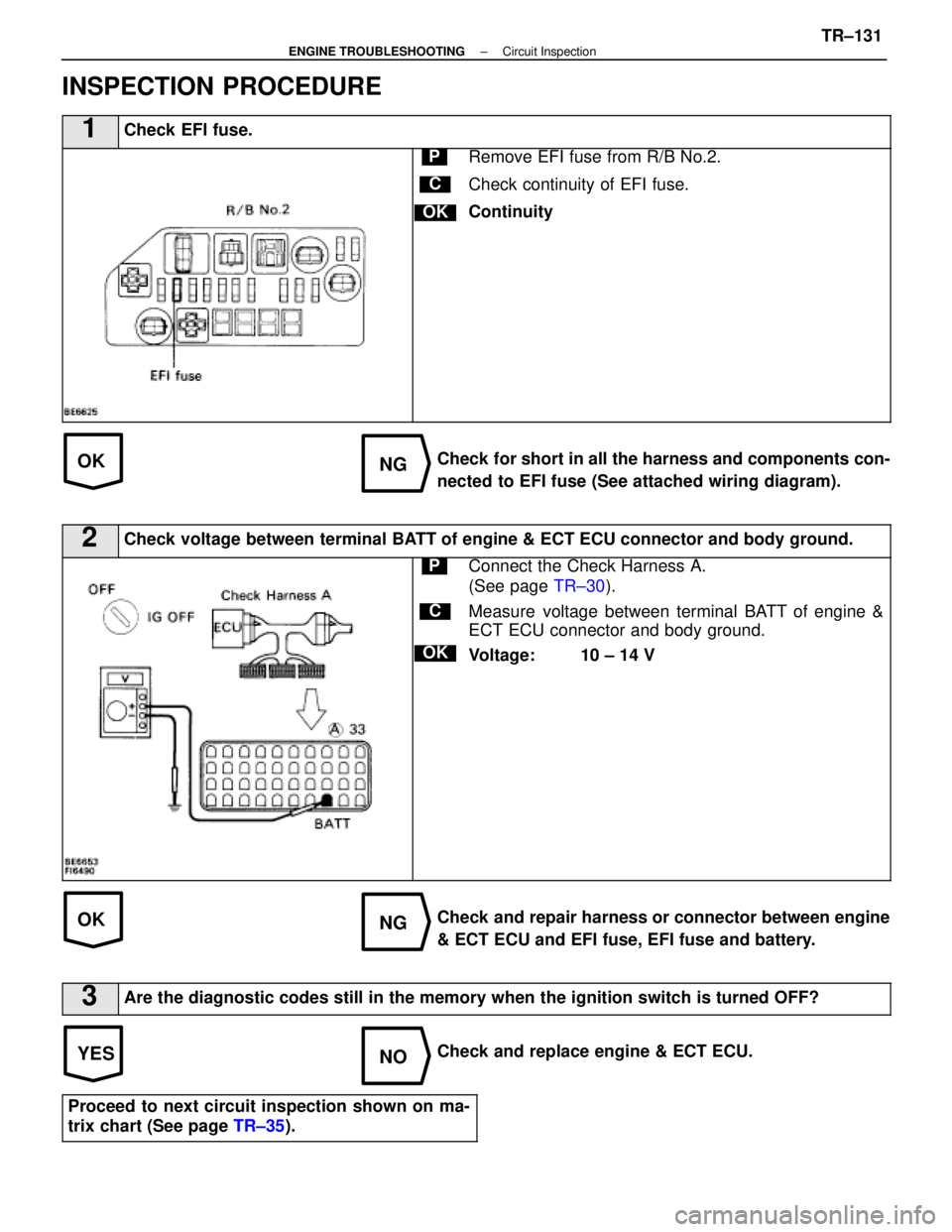
1Check EFI fuse.
C
OK
PRemove EFI fuse from R/B No.2.
Check continuity of EFI fuse.
Continuity
Check for short in all the harness and components con-
nected to EFI fuse (See attached wiring diagram).
2Check voltage between terminal BATT of engine & ECT ECU connector and body ground.
C
OK
PConnect the Check Harness A.
(See page TR±30).
Measure voltage between terminal BATT of engine &
ECT ECU connector and body ground.
Voltage: 10 ± 14 V
Check and repair harness or connector between engine
& ECT ECU and EFI fuse, EFI fuse and battery.
3Are the diagnostic codes still in the memory when the ignition switch is\
turned OFF?
Check and replace engine & ECT ECU.
Proceed to next circuit inspection shown on ma-
trix chart (See page TR±35).
±
ENGINE TROUBLESHOOTING Circuit InspectionTR±131
WhereEverybodyKnowsYourName
Page 2757 of 4087

TE1, TE2 Terminal Circuit
CIRCUIT DESCRIPTION
Terminal TE1 is located in the check connector in the engine compartment and terminals T\
E1 and TE2 are lo-
cated in the TDCL in the cabin. When these terminals are connected with \
the E1 terminal, diagnostic codes in
normal mode or test mode can be read from the ºCHECKº engine warning lig\
ht on the combination meter.
DIAGNOSTIC CHARTDIAGNOSTIC CHART
HINT: If terminals TE1 and TE2 are connected with terminal E1, diagnostic code is not output or test mode isnot activated.
Even though terminal TE1 is not connected with terminal E1, the ºCHEC\
Kº engine warning light blinks.
For the above phenomenon, the likely cause is an open or short in the wire \
harness, or malfunction inside
the ECU.
Check continuity between terminal E1 and
body ground.
Repair or replace harness or
connector.Check for open and short in harness and
connector between check connector TDCL
and ECU.
Check voltage of terminals TE1, TE2.
Check and replace ECU.
Repair or replace harness or
connector.
Check and replace ECU.
WIRING DIAGRAM
TR±146±
ENGINE TROUBLESHOOTING
WhereEverybodyKnowsYourName
Page 3032 of 4087

MAIN POINTS OF REMOVAL AND
INSTALLATION
NOTICE:
wIf the SRS (Supplemental Restraint System) connector is
disconnected with the ignition switch at ON or ACC,
diagnostic trouble codes will be recorded.
w Never use SRS parts from another vehicle. When
replacing parts, replace with new parts.
1. DISCONNECT NEGATIVE (±) TERMINAL CABLE FROM
BATTERY
CAUTION: W ork must be started after 90 seconds from the time
the ignition switch is turned to the ªLOCKº position and the
negative (±) terminal cable is disconnected from the battery.
(See RS section)
2. REMOVE STEERING WHEEL PAD
(a) Place the front wheels facing straight ahead.
(b) Remove the No.2 and No.3 covers.
(c) Using a torx wrench, loosen the 4 torx screws. Torx wrench: T30 (Part No. 09042±00010 or locally manufac-
tured tool)
HINT: Loosen the 4 screws until the groove along the screw
circumference catches on the screw case.
(d) P u l l t h e w heel pad out from the steering wheel and
disconnect the Airbag connector.
NOTICE: When removing the wheel pad, take care not to pull
the Airbag wire harness.
CAUTION:
w When storing the wheel pad, keep the upper surface of
the pad facing upward.
w Never disassemble the wheel pad.
3. REMOVE STEERING WHEEL
(a) Disconnect the connector.
(b) Remove the steering wheel set nut.
(c) Place matchmarks on the steering wheel and main shaft.
(d) Using SST, remove the wheel.
SC400:
SST 09213±31021
SC300:
SST 09609±20011
SR±10
±
STEERING STEERING COLUMN
WhereEverybodyKnowsYourName
Page 3088 of 4087
DTC53Short in Squib Circuit (Between P+ Wire Harness
P
± Wire Harness)
CIRCUIT DESCRIPTION
The squib circuit consists of the center airbag sensor assembly, (squib). It causes the SRS to deploy when the
SRS deployment conditions are satisfied.
For details of the function of each component, see FUNCTION OF COMPONENTS o\
n page RS±10. Diagnostic
trouble code 53 is recorded when an short is detected in the P
+ wire harness and P± wire harness of the squib
circuit.
DTC No.Diagnosis
53
� Short circuit between P+ wire harness and P± wire harness of squib.
� Squib malfunction.
� Center airbag Sensor Assembly malfunction.
DIAGNOSTIC CHARTDIAGNOSTIC CHART
RS±110±
SUPPLEMENTAL RESTRAINT SYSTEM TROUBLESHOOTING
WhereEverybodyKnowsYourName
Page 3091 of 4087
OKNG
OKNG
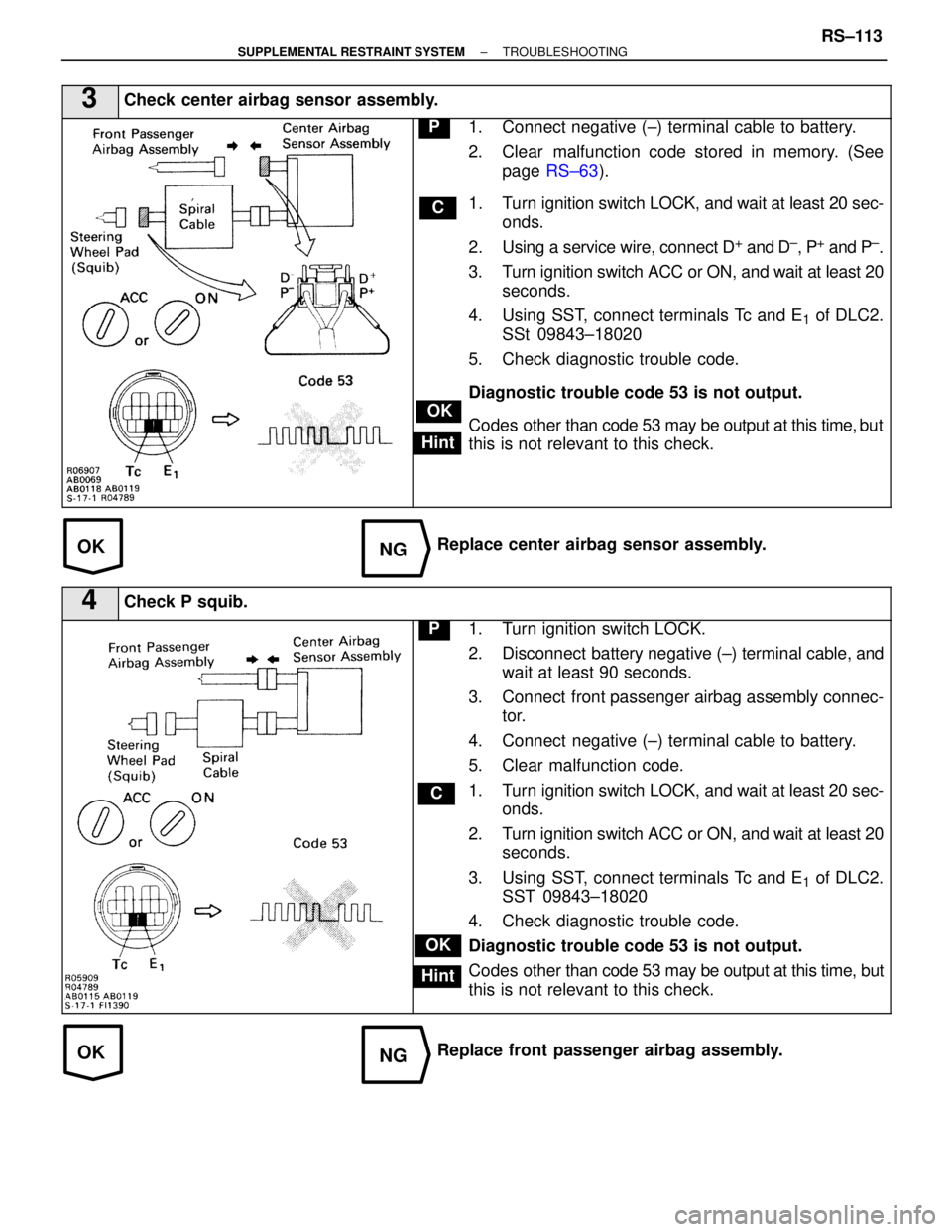
3Check center airbag sensor assembly.
C
OK
Hint
P1. Connect negative (±) terminal cable to battery.
2. Clear malfunction code stored in memory. (Seepage RS±63 ).
1. Turn ignition switch LOCK, and wait at least 20 sec- onds.
2. Using a service wire, connect D
+ and D±, P+ and P±.
3. Turn ignition switch ACC or ON, and wait at least 20 seconds.
4. Using SST, connect terminals Tc and E
1 of DLC2.
SSt 09843±18020
5. Check diagnostic trouble code.
Diagnostic trouble code 53 is not output.
Codes other t han code 53 may be output at this time, but
this is not relevant to this check.
Replace center airbag sensor assembly.
4Check P squib.
C
OK
Hint
P1. Turn ignition switch LOCK.
2. Disconnect battery negative (±) terminal cable, and
wait at least 90 seconds.
3. Connect front passenger airbag assembly connec- tor.
4. Connect negative (±) terminal cable to battery.
5. Clear malfunction code.
1. Turn ignition switch LOCK, and wait at least 20 sec- onds.
2. Turn ignition switch ACC or ON, and wait at least 20 seconds.
3. Using SST, connect terminals Tc and E
1 of DLC2.
SST 09843±18020
4. Check diagnostic trouble code.
Diagnostic trouble code 53 is not output.
Codes other t han code 53 may be output at this time, but
this is not relevant to this check.
Replace front passenger airbag assembly.
±
SUPPLEMENTAL RESTRAINT SYSTEM TROUBLESHOOTINGRS±113
WhereEverybodyKnowsYourName
Page 3093 of 4087
DTC54Open in P Squib Circuit
CIRCUIT DESCRIPTION
The squib circuit consists of the center airbag sensor assembly and front p\
assenger airbag assembly. It causes
the SRS to deploy when the SRS deployment conditions are satisfied. For det\
ails of the function of each compo-
nent, see FUNCTION OF COMPONENTS on page RS±10.
Diagnostic trouble code 54 is recorded when an open is detected in the s\
quib circuit.
DTC No.Diagnosis
54
� Open circuit in P+ wire harness and P± wire harness of squib.
� Squib malfunction.
� Center airbag sensor malfunction.
±
SUPPLEMENTAL RESTRAINT SYSTEM TROUBLESHOOTINGRS±115
WhereEverybodyKnowsYourName