Page 90 of 136
Fuse Replacement
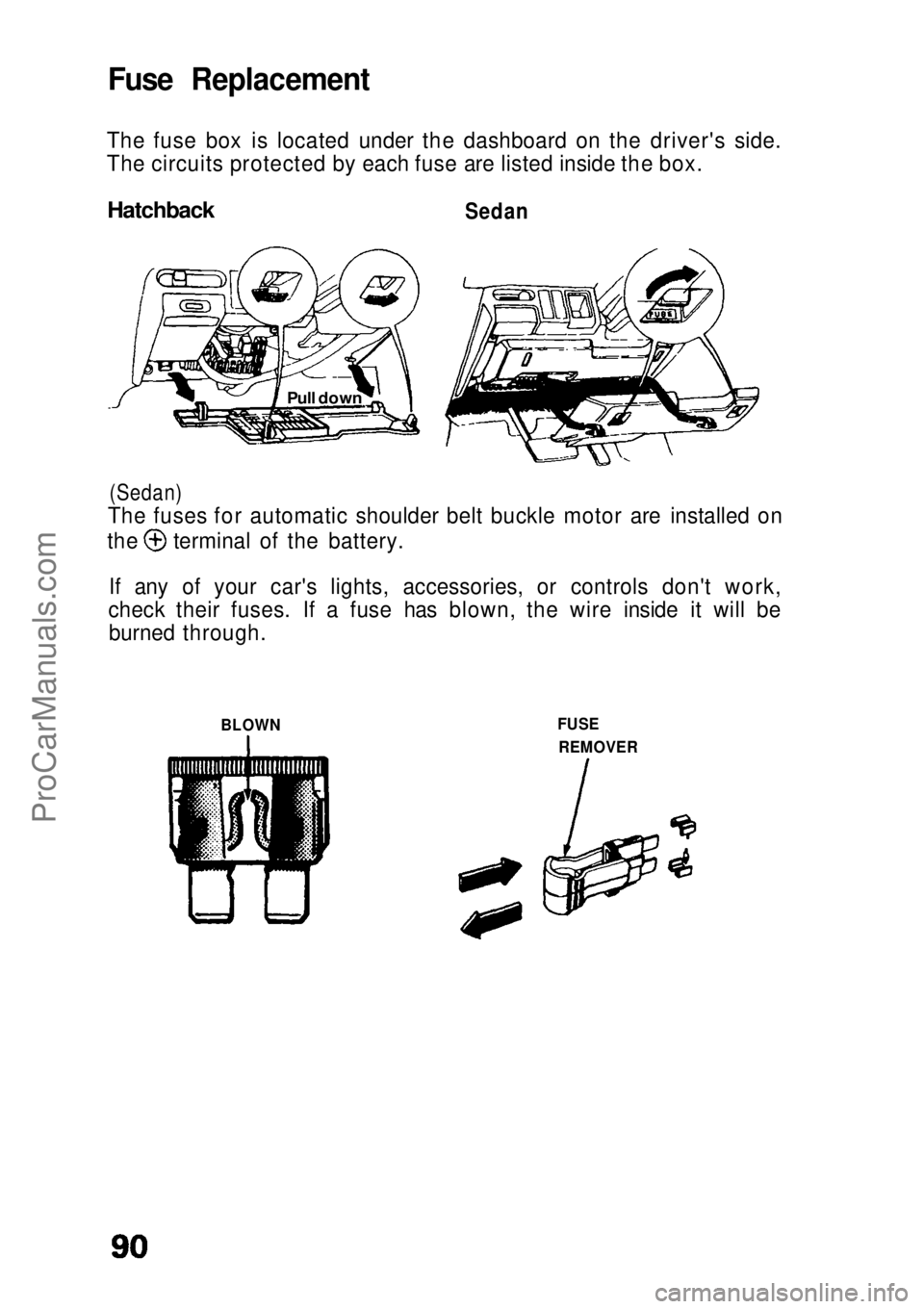
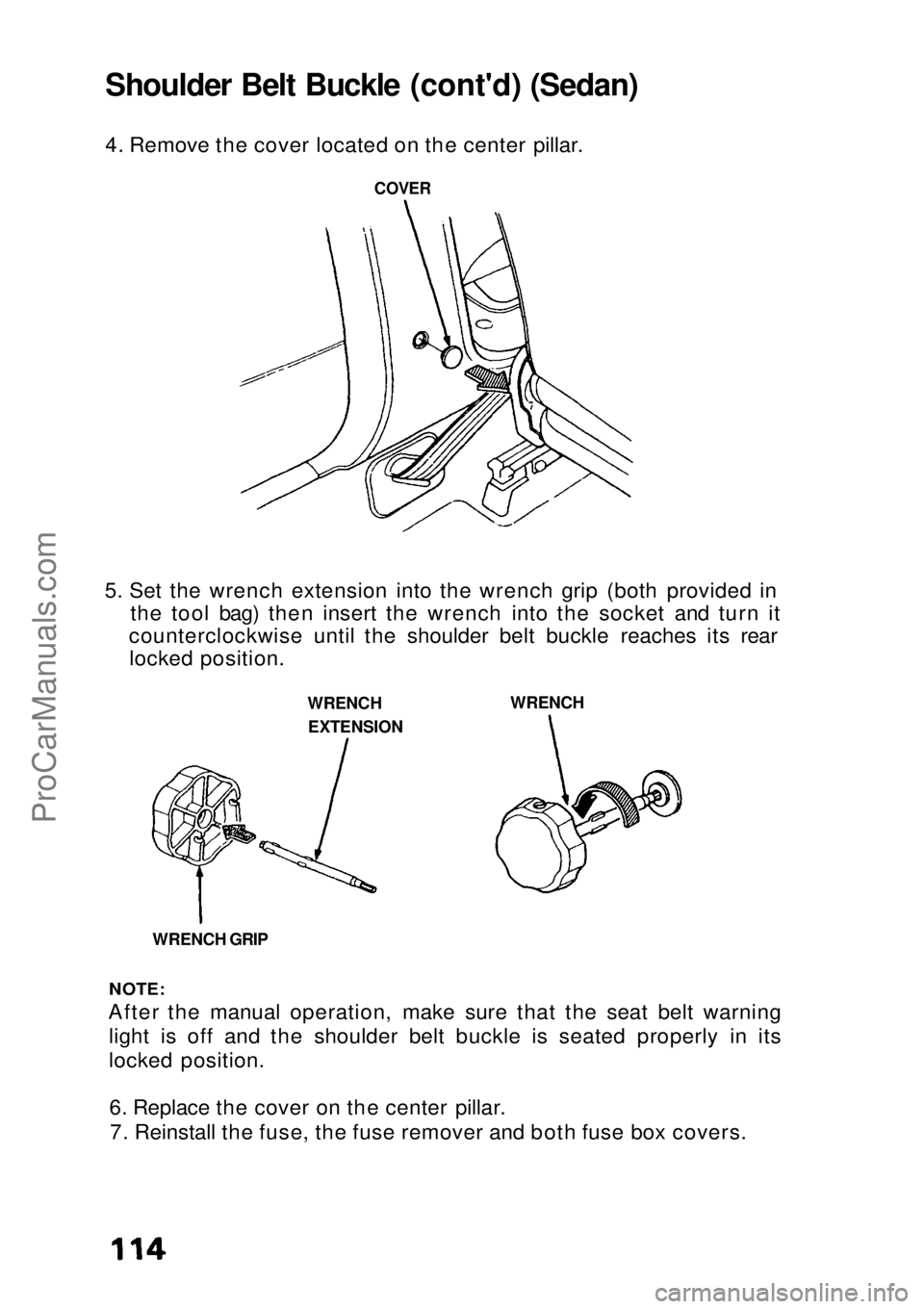
The fuse box is located under the dashboard on the driver's side.
The circuits protected by each fuse are listed inside the box.
Hatchback
Sedan
(Sedan)
The fuses for automatic shoulder belt buckle motor are installed on the terminal of the battery.
If any of your car's lights, accessories, or controls don't work,
check their fuses. If a fuse has blown, the wire inside it will be burned through.
BLOWN FUSE
REMOVER
Pull downProCarManuals.comMain Menu s t
Page 91 of 136
Checking the fuses:
1 .Turn off the ignition and all other switches.
2. If you find a blown or possibly faulty fuse, use the fuse remover, stored beside the spare fuse to pull the blown fuse out of its clips.
3. Check all other fuses as well as the one you suspect.
4. Push in a new fuse of the same rating, and make sure it fits tightly in the clips. If it fits loosely, have your dealer fix it.If you don't have a spare, take a fuse of the same rating (or lower)
out of a circuit you may not need, like the radio or cigarette lighter.
Remember to replace the borrowed fuse and the missing spares.
CAUTION:
A blown fuse may be just a symptom of some other problem. If a new fuse blows right away, the cause should be diagnosed and
corrected by a qualified Honda technician. Never replace a fuse with anything but another fuse of the same or lower rating. A
higher capacity fuse could cause damage and even start a fire.
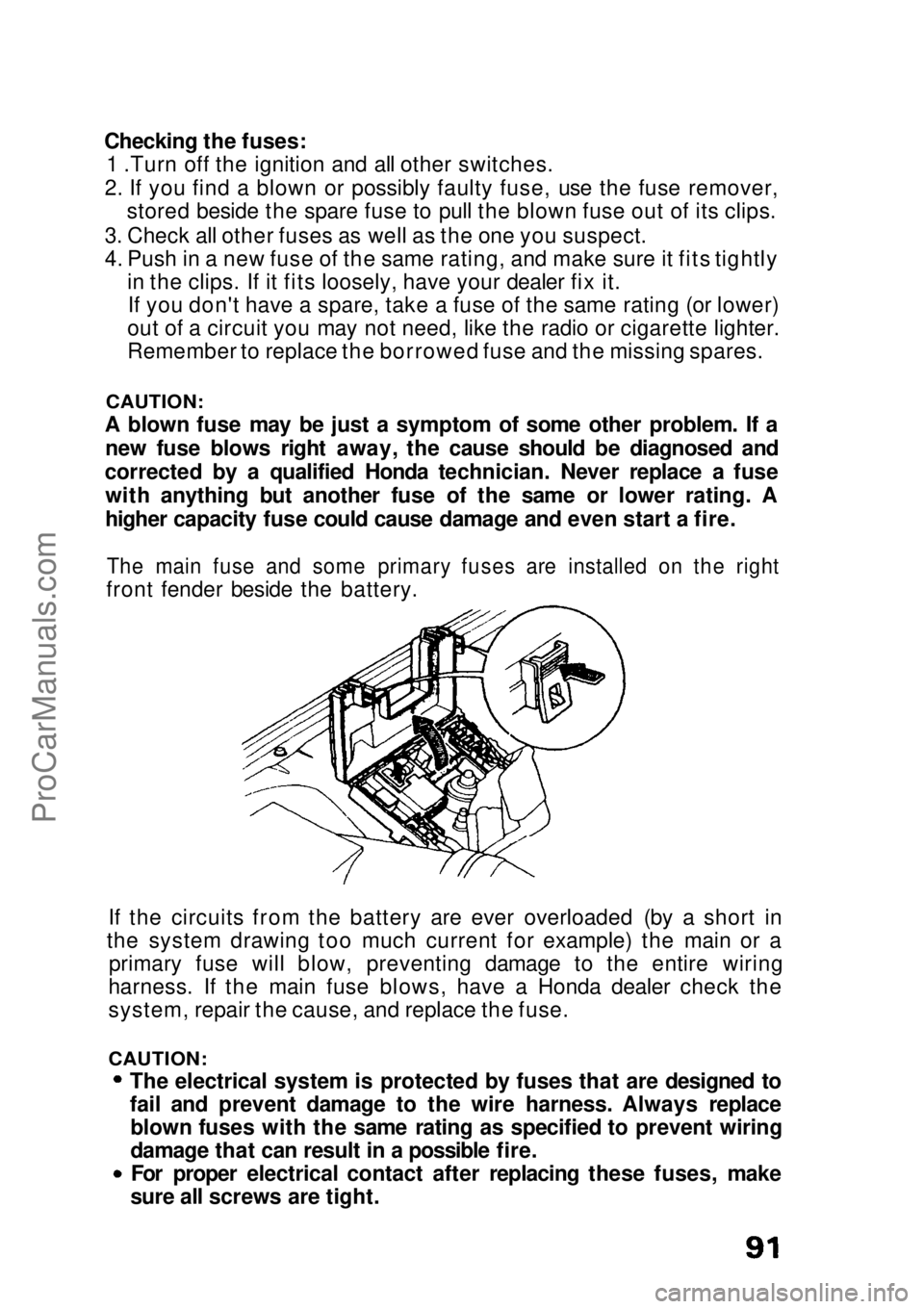
The main fuse and some primary fuses are installed on the right
front fender beside the battery.
If the circuits from the battery are ever overloaded (by a short in
the system drawing too much current for example) the main or a primary fuse will blow, preventing damage to the entire wiring
harness. If the main fuse blows, have a Honda dealer check the
system, repair the cause, and replace the fuse.
CAUTION:
The electrical system is protected by fuses that are designed to
fail and prevent damage to the wire harness. Always replaceblown fuses with the same rating as specified to prevent wiring
damage that can result in a possible fire.For proper electrical contact after replacing these fuses, make
sure all screws are tight.ProCarManuals.comMain Menu s t
Page 92 of 136
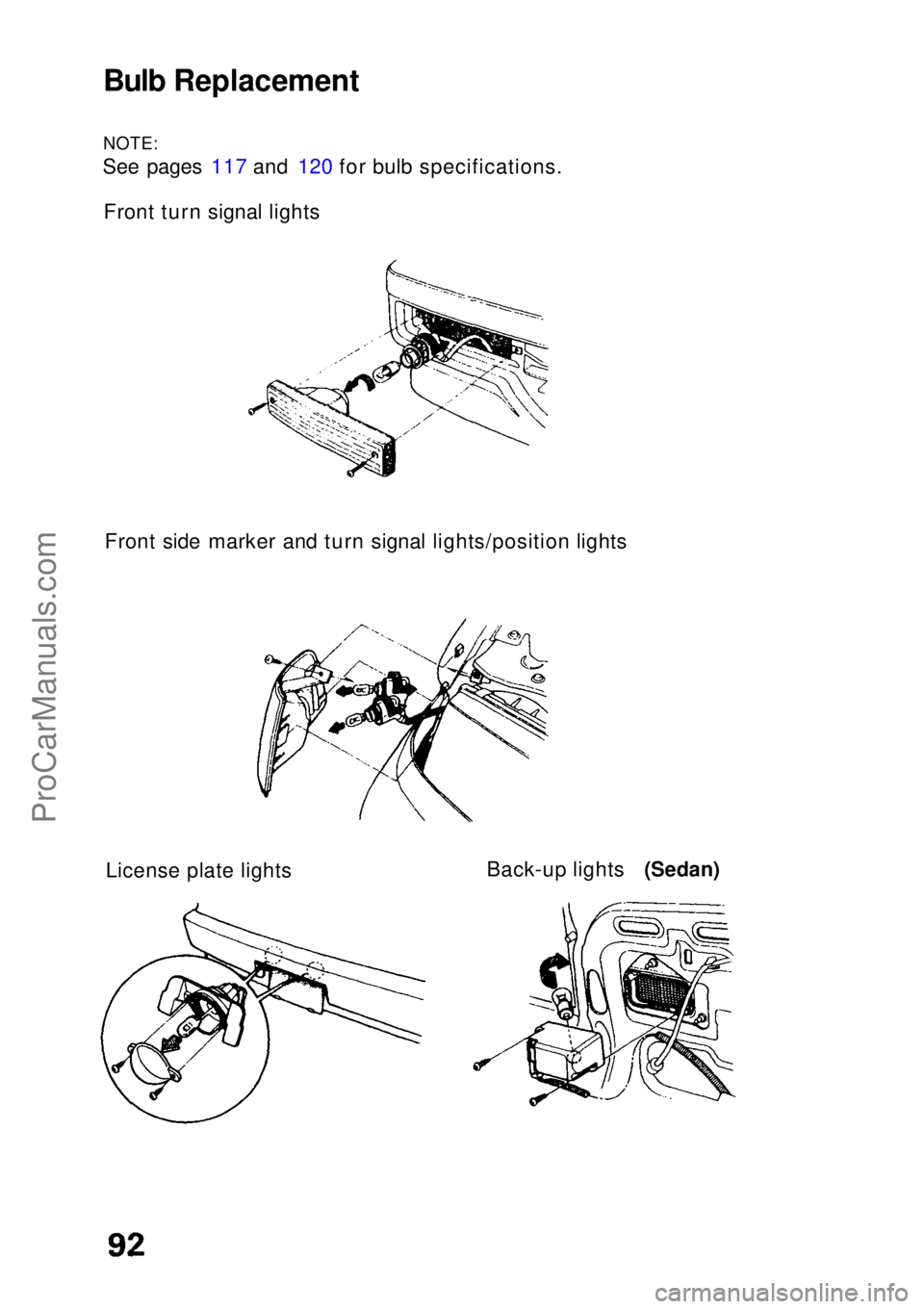
Bulb Replacement
NOTE:
See pages 117 and 120 for bulb specifications.
Front turn signal lights
Front side marker and turn signal lights/position lightsLicense plate lights Back-up lights (Sedan)ProCarManuals.comMain Menu s t
Page 93 of 136
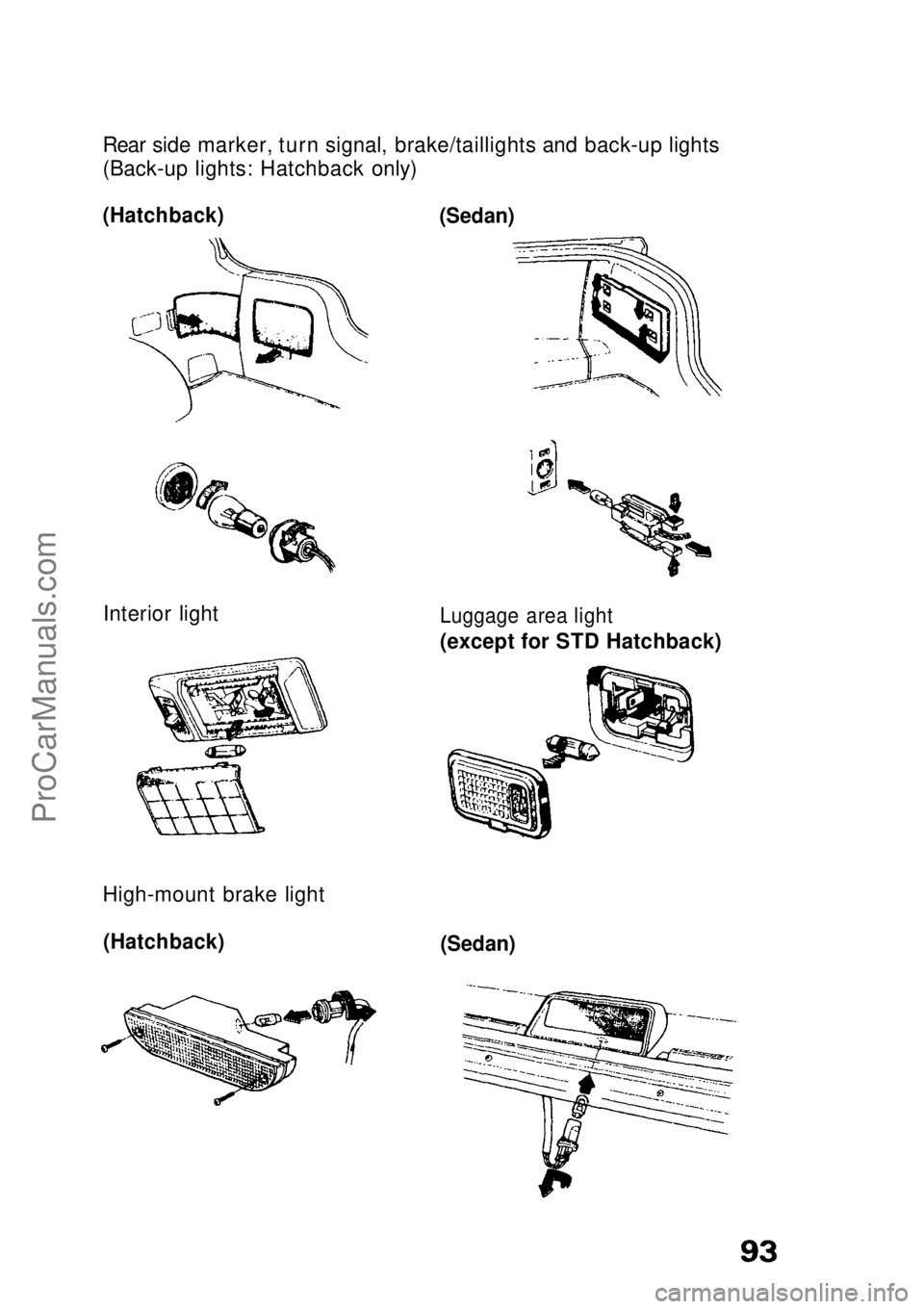
Rear side marker, turn signal, brake/taillights and back-up lights
(Back-up lights: Hatchback only)
(Hatchback)
(Sedan)
Interior light
Luggage area light
(except for STD Hatchback)
(Hatchback)
(Sedan)
High-mount brake lightProCarManuals.comMain Menu s t
Page 107 of 136
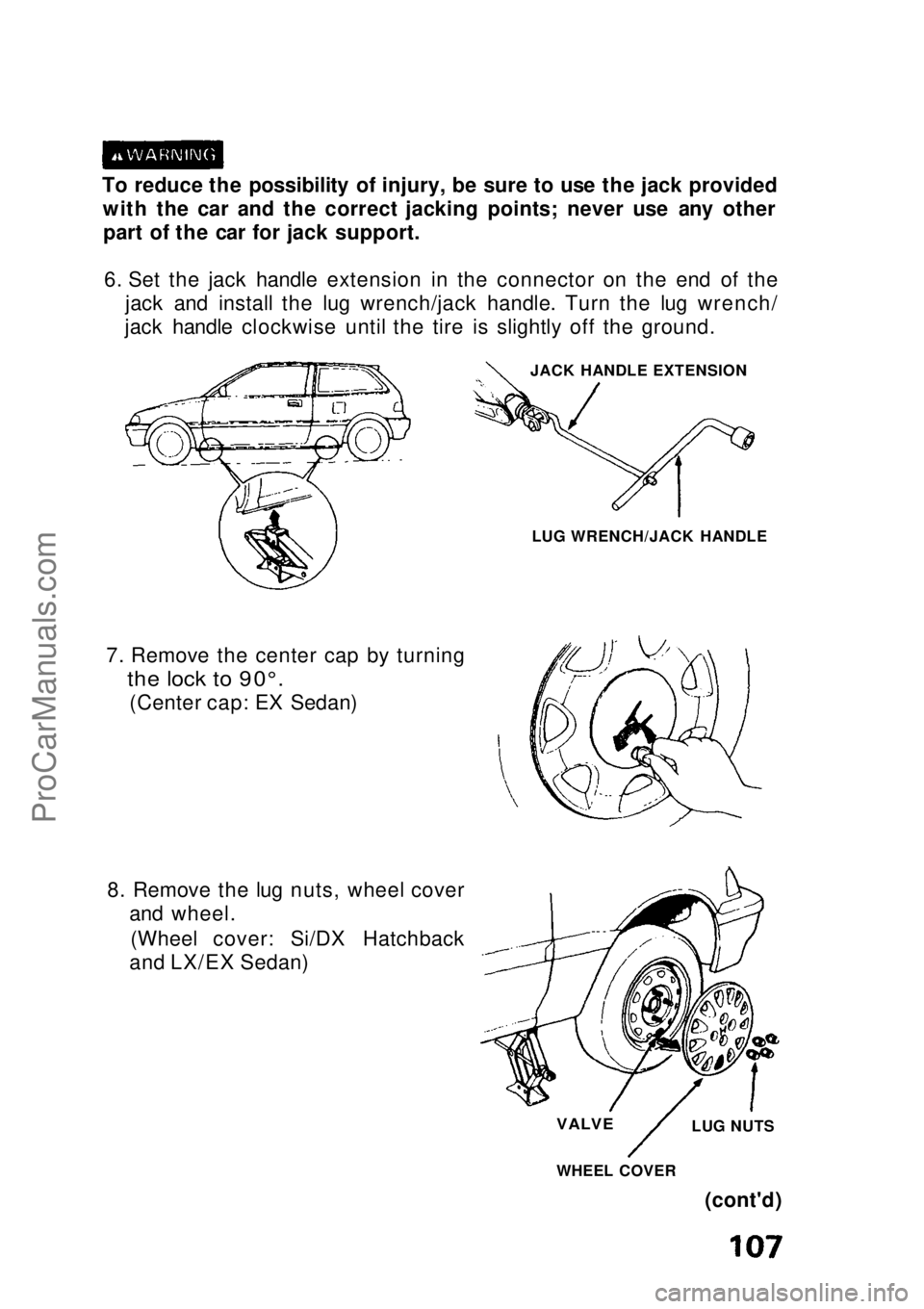
To reduce the possibility of injury, be sure to use the jack provided
with the car and the correct jacking points; never use any otherpart of the car for jack support.
6. Set the jack handle extension in the connector on the end of the jack and install the lug wrench/jack handle. Turn the lug wrench/
jack handle clockwise until the tire is slightly off the ground.
JACK HANDLE EXTENSION
LUG WRENCH/JACK HANDLE
7. Remove the center cap by turning
the lock to 90°.
(Center cap: EX Sedan)
8. Remove the lug nuts, wheel cover and wheel.
(Wheel cover: Si/DX Hatchback
and LX/EX Sedan)
(cont'd)
VALVE
LUG NUTS
WHEEL COVERProCarManuals.comMain Menu s t
Page 110 of 136
Jump Starting
To start a car with a dead battery, use another battery of the samevoltage, and the proper jumper cables.
Procedures other than those below could cause injury or
damage from battery acid spray, explosion or charging system
overload.
Never connect the jumper cable directly to the negative post of
the "dead" battery.
Never allow the two cars to touch each other. Never allow the jumper cable clamps to touch each other.
Never lean over the battery when making connections.
Never attempt to jump start a vehicle with a frozen battery. The
battery could rupture and explode. If you suspect a frozenbattery, remove the vent caps and check the fluid. If there
seems to be no fluid, or if you see ice, do not attempt a jump
start until the fluid thaws.
CAUTION:
If jumper cables are connected backwards, the car's main fuse
may blow.
1.Turn off all lights, heater and other electrical loads, set parking brake, and shift the transmission to Neutral or Park.
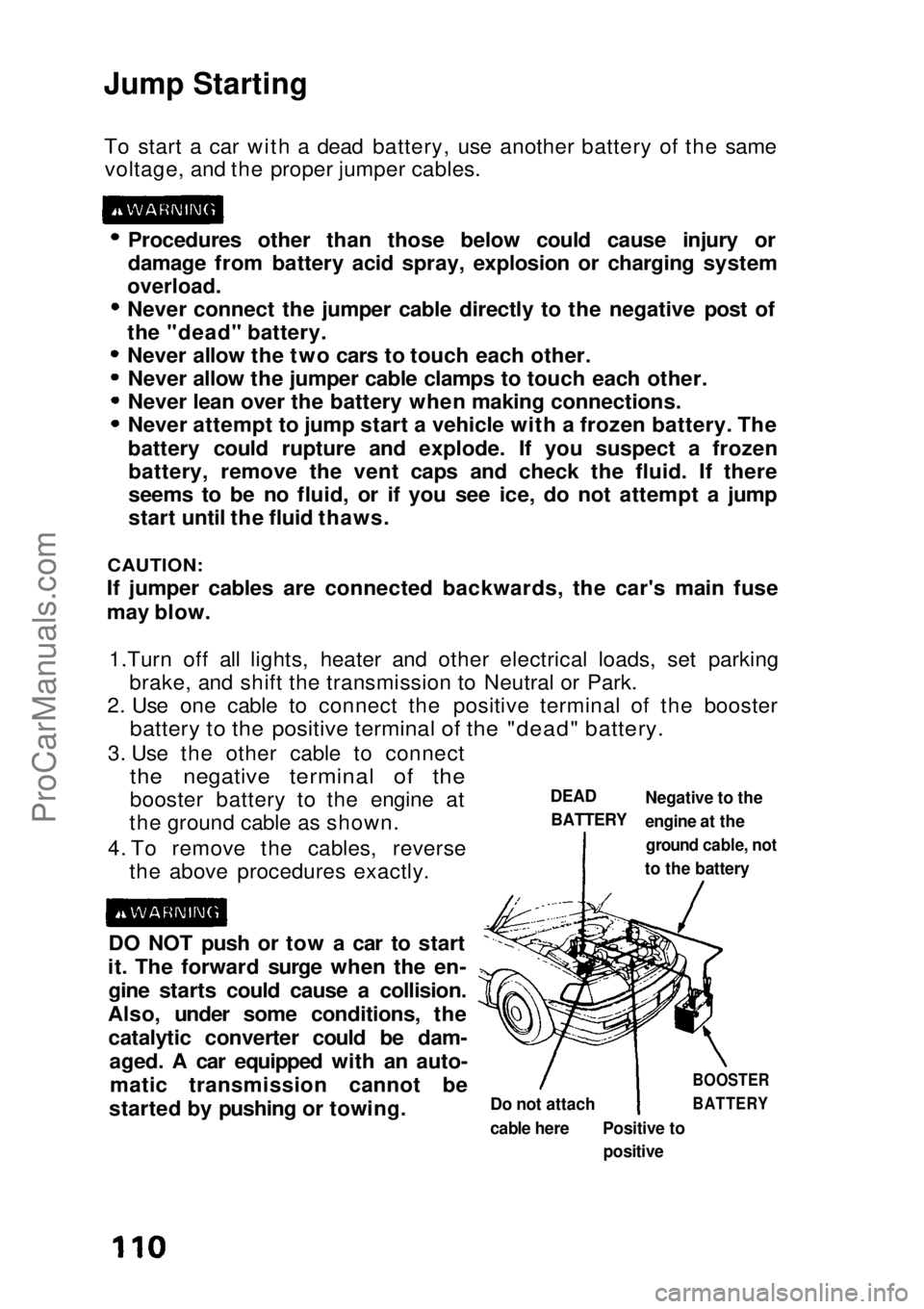
2. Use one cable to connect the positive terminal of the booster
battery to the positive terminal of the "dead" battery.
3. Use the other cable to connect
the negative terminal of the
booster battery to the engine at
the ground cable as shown.
4. To remove the cables, reverse the above procedures exactly.
DO NOT push or tow a car to start
it. The forward surge when the en- gine starts could cause a collision.
Also, under some conditions, the catalytic converter could be dam- aged. A car equipped with an auto-matic transmission cannot be
started by pushing or towing.
DEAD
BATTERY
Negative to the
engine at the
ground cable, not
to the battery
Do not attach
cable here
Positive to
positive
BOOSTER
BATTERYProCarManuals.comMain Menu s t
Page 114 of 136
5. Set the wrench extension into the wrench grip (both provided in
the tool bag) then insert the wrench into the socket and turn it
counterclockwise until the shoulder belt buckle reaches its rear locked position.
WRENCHEXTENSION WRENCH
NOTE:
After the manual operation, make sure that the seat belt warning light is off and the shoulder belt buckle is seated properly in its
locked position.
6. Replace the cover on the center pillar.7. Reinstall the fuse, the fuse remover and both fuse box covers.
Shoulder Belt Buckle (cont'd) (Sedan)
4. Remove the cover located on the center pillar.
COVER
WRENCH GRIPProCarManuals.comMain Menu s t
Page 124 of 136
Emission Controls
Sources of Emissions
The combustion process produces carbon monoxide, oxides of nitrogen and hydrocarbons. The evaporation of fuel in the fuel tank
also produces hydrocarbons. Control of oxides of nitrogen andhydrocarbons is very important since, under certain conditions,
when subjected to sunlight, they react to form photochemical smog. Carbon monoxide does not react to form smog, but it is toxic.Honda Motor Co., Ltd. has developed a number of systems which
are highly effective in reducing carbon monoxide, oxides of nitrogen
and hydrocarbons.
The Clean Air Act The Clean Air Act requires all vehicle manufacturers to explain in
writing, the operation and maintenance of their emission control
systems.
Maintenance instructions are included on pages 68 — 73 ; the
operation of each system is explained on the following.
Replacement Parts
The emission control systems on your new Honda were designed, built and certified to conform with the Federal regulations
implementing the Clean Air Act. Honda recommends only the use of
new, genuine Honda parts or their equivalent. The use of otherreplacement parts which are not of equivalent quality may impair
the effectiveness of your car's emission control systems.
Crankcase Emission Control System
To prevent crankcase emissions, your car is equipped with a Positive Crankcase Ventilation (PCV) System which routes blowby
gases from the crankcase, through the PCV valve and intakemanifold, into the combustion chamber.ProCarManuals.comMain Menu s t