1991 FORD FESTIVA light
[x] Cancel search: lightPage 229 of 454
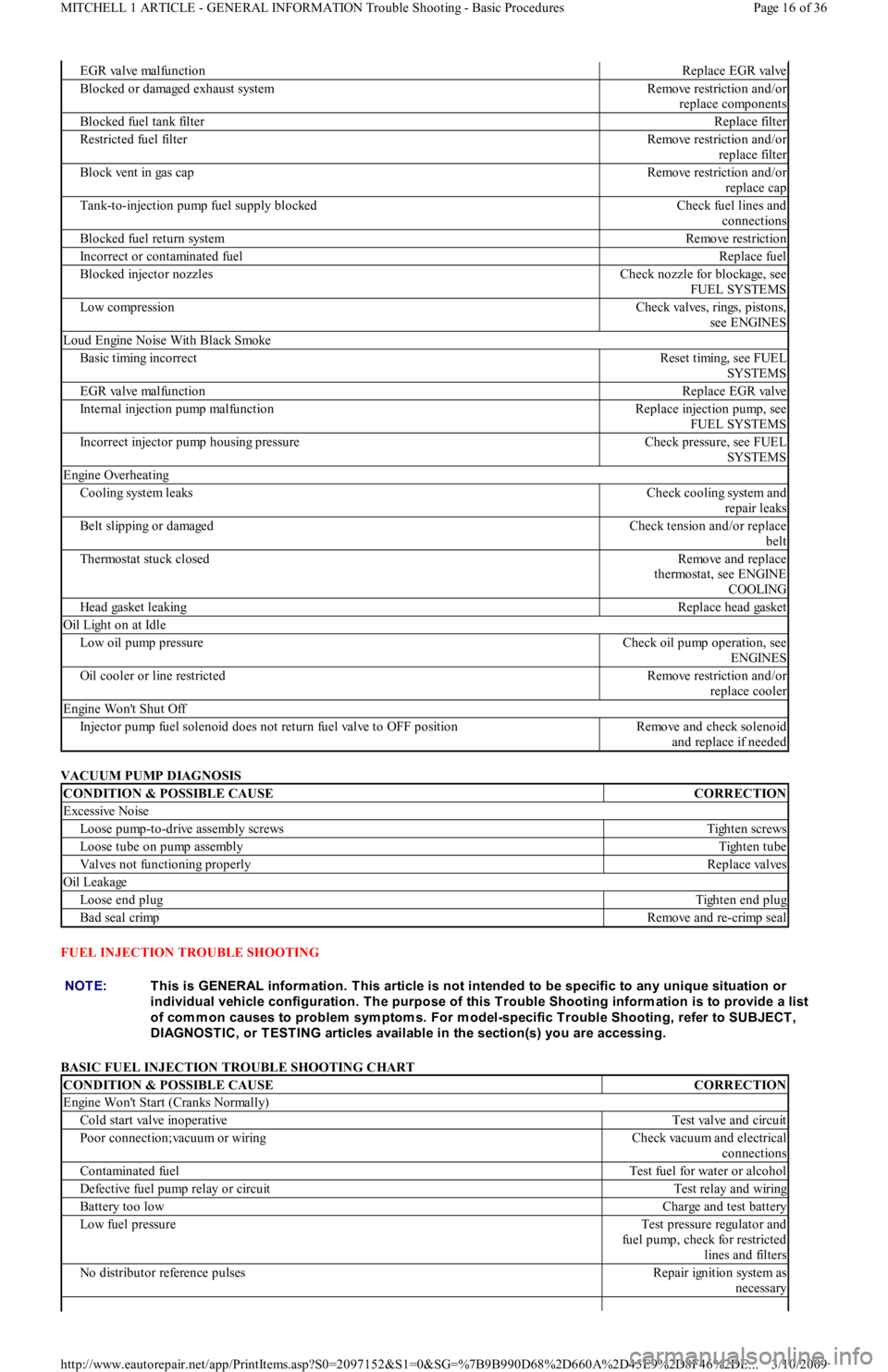
VACUUM PUMP DIAGNOSIS
FUEL INJECTION TROUBLE SHOOTING
BASIC FUEL INJECTION TROUBLE SHOOTING CHART
EGR valve malfunctionReplace EGR valve
Blocked or damaged exhaust systemRemove restriction and/or
replace components
Blocked fuel tank filterReplace filter
Restricted fuel filterRemove restriction and/or
replace filter
Block vent in gas capRemove restriction and/or
replace cap
Tank-to-injection pump fuel supply blockedCheck fuel lines and
connections
Blocked fuel return systemRemove restriction
Incorrect or contaminated fuelReplace fuel
Blocked injector nozzlesCheck nozzle for blockage, see
FUEL SYSTEMS
Low compressionCheck valves, rings, pistons,
see ENGINES
Loud Engine Noise With Black Smoke
Basic timing incorrectReset timing, see FUEL
SYSTEMS
EGR valve malfunctionReplace EGR valve
Internal injection pump malfunctionReplace injection pump, see
FUEL SYSTEMS
Incorrect injector pump housing pressureCheck pressure, see FUEL
SYSTEMS
Engine Overheating
Cooling system leaksCheck cooling system and
repair leaks
Belt slipping or damagedCheck tension and/or replace
belt
Thermostat stuck closedRemove and replace
thermostat, see ENGINE
COOLING
Head gasket leakingReplace head gasket
Oil Light on at Idle
Low oil pump pressureCheck oil pump operation, see
ENGINES
Oil cooler or line restrictedRemove restriction and/or
replace cooler
Engine Won't Shut Off
Injector pump fuel solenoid does not return fuel valve to OFF positionRemove and check solenoid
and replace if needed
CONDITION & POSSIBLE CAUSECORRECTION
Excessive Noise
Loose pump-to-drive assembly screwsTighten screws
Loose tube on pump assemblyTighten tube
Valves not functioning properlyReplace valves
Oil Leakage
Loose end plugTighten end plug
Bad seal crimpRemove and re-crimp seal
NOTE:This is GENERAL inform ation. This article is not intended to be specific to any unique situation or
individual vehicle configuration. T he purpose of this T rouble Shooting inform ation is to provide a list
of com m on causes to problem sym ptom s. For m odel-specific T rouble Shooting, refer to SUBJECT ,
DIAGNOST IC, or T EST ING articles available in the section(s) you are accessing.
CONDITION & POSSIBLE CAUSECORRECTION
Engine Won't Start (Cranks Normally)
Cold start valve inoperativeTest valve and circuit
Poor connection;vacuum or wiringCheck vacuum and electrical
connections
Contaminated fuelTest fuel for water or alcohol
Defective fuel pump relay or circuitTest relay and wiring
Battery too lowCharge and test battery
Low fuel pressureTest pressure regulator and
fuel pump, check for restricted
lines and filters
No distributor reference pulsesRepair ignition system as
necessary
Page 16 of 36 MITCHELL 1 ARTICLE - GENERAL INFORMATION Trouble Shooting - Basic Procedures
3/10/2009 http://www.eautorepair.net/app/PrintItems.asp?S0=2097152&S1=0&SG=%7B9B990D68%2D660A%2D45E9%2D8F46%2DE
...
Page 232 of 454
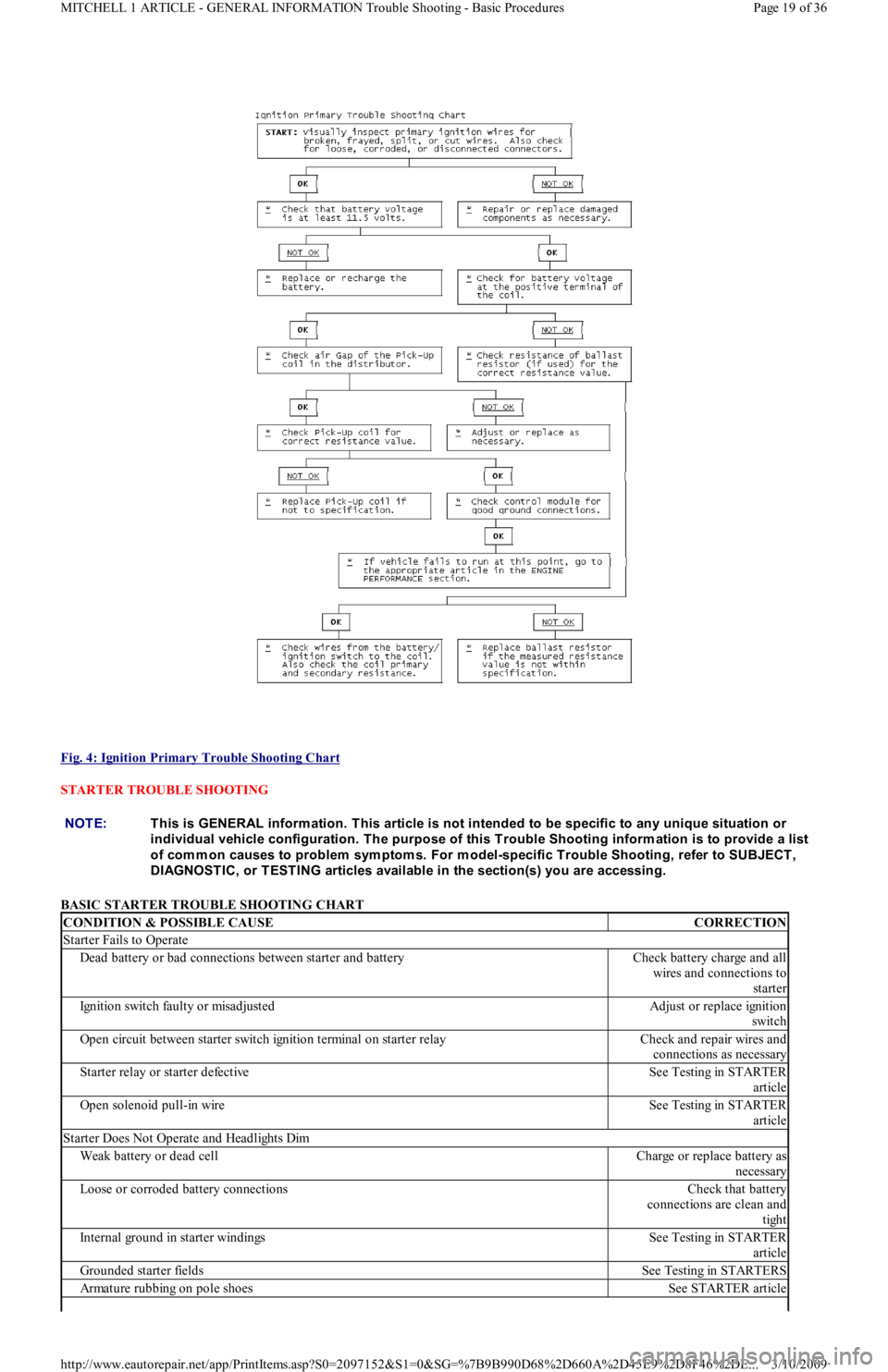
Fig. 4: Ignition Primary Trouble Shooting Chart
STARTER TROUBLE SHOOTING
BASIC STARTER TROUBLE SHOOTING CHART
NOTE:This is GENERAL inform ation. This article is not intended to be specific to any unique situation or
individual vehicle configuration. T he purpose of this T rouble Shooting inform ation is to provide a list
of com m on causes to problem sym ptom s. For m odel-specific T rouble Shooting, refer to SUBJECT ,
DIAGNOST IC, or T EST ING articles available in the section(s) you are accessing.
CONDITION & POSSIBLE CAUSECORRECTION
Starter Fails to Operate
Dead battery or bad connections between starter and batteryCheck battery charge and all
wires and connections to
starter
Ignition switch faulty or misadjustedAdjust or replace ignition
switch
Open circuit between starter switch ignition terminal on starter relayCheck and repair wires and
connections as necessary
Starter relay or starter defectiveSee Testing in STARTER
article
Open solenoid pull-in wireSee Testing in STARTER
article
Starter Does Not Operate and Headlights Dim
Weak battery or dead cellCharge or replace battery as
necessary
Loose or corroded battery connectionsCheck that battery
connections are clean and
tight
Internal ground in starter windingsSee Testing in STARTER
article
Grounded starter fieldsSee Testing in STARTERS
Armature rubbing on pole shoesSee STARTER article
Page 19 of 36 MITCHELL 1 ARTICLE - GENERAL INFORMATION Trouble Shooting - Basic Procedures
3/10/2009 http://www.eautorepair.net/app/PrintItems.asp?S0=2097152&S1=0&SG=%7B9B990D68%2D660A%2D45E9%2D8F46%2DE
...
Page 234 of 454
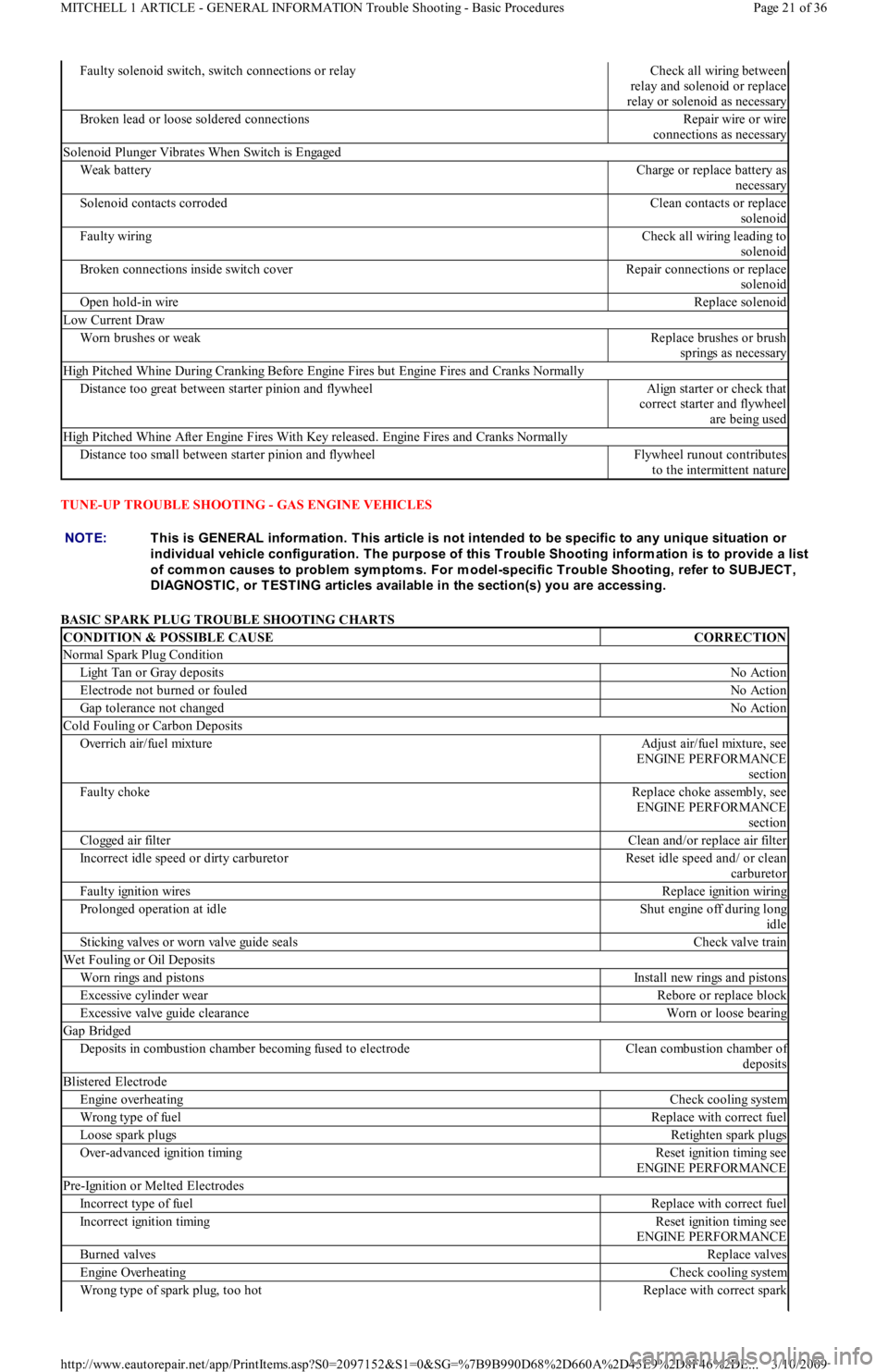
TUNE-UP TROUBLE SHOOTING - GAS ENGINE VEHICLES
BASIC SPARK PLUG TROUBLE SHOOTING CHARTS
Faulty solenoid switch, switch connections or relayCheck all wiring between
relay and solenoid or replace
relay or solenoid as necessary
Broken lead or loose soldered connectionsRepair wire or wire
connections as necessary
Solenoid Plunger Vibrates When Switch is Engaged
Weak batteryCharge or replace battery as
necessary
Solenoid contacts corrodedClean contacts or replace
solenoid
Faulty wiringCheck all wiring leading to
solenoid
Broken connections inside switch coverRepair connections or replace
solenoid
Open hold-in wireReplace solenoid
Low Current Draw
Worn brushes or weakReplace brushes or brush
springs as necessary
High Pitched Whine During Cranking Before Engine Fires but Engine Fires and Cranks Normally
Distance too great between starter pinion and flywheelAlign starter or check that
correct starter and flywheel
are being used
High Pitched Whine After Engine Fires With Key released. Engine Fires and Cranks Normally
Distance too small between starter pinion and flywheelFlywheel runout contributes
to the intermittent nature
NOTE:This is GENERAL inform ation. This article is not intended to be specific to any unique situation or
individual vehicle configuration. T he purpose of this T rouble Shooting inform ation is to provide a list
of com m on causes to problem sym ptom s. For m odel-specific T rouble Shooting, refer to SUBJECT ,
DIAGNOST IC, or T EST ING articles available in the section(s) you are accessing.
CONDITION & POSSIBLE CAUSECORRECTION
Normal Spark Plug Condition
Light Tan or Gray depositsNo Action
Electrode not burned or fouledNo Action
Gap tolerance not changedNo Action
Cold Fouling or Carbon Deposits
Overrich air/fuel mixtureAdjust air/fuel mixture, see
ENGINE PERFORMANCE
section
Faulty chokeReplace choke assembly, see
ENGINE PERFORMANCE
section
Clogged air filterClean and/or replace air filter
Incorrect idle speed or dirty carburetorReset idle speed and/ or clean
carburetor
Faulty ignition wiresReplace ignition wiring
Prolonged operation at idleShut engine off during long
idle
Sticking valves or worn valve guide sealsCheck valve train
Wet Fouling or Oil Deposits
Worn rings and pistonsInstall new rings and pistons
Excessive cylinder wearRebore or replace block
Excessive valve guide clearanceWorn or loose bearing
Gap Bridged
Deposits in combustion chamber becoming fused to electrodeClean combustion chamber of
deposits
Blistered Electrode
Engine overheatingCheck cooling system
Wrong type of fuelReplace with correct fuel
Loose spark plugsRetighten spark plugs
Over-advanced ignition timingReset ignition timing see
ENGINE PERFORMANCE
Pre-Ignition or Melted Electrodes
Incorrect type of fuelReplace with correct fuel
Incorrect ignition timingReset ignition timing see
ENGINE PERFORMANCE
Burned valvesReplace valves
Engine OverheatingCheck cooling system
Wrong type of spark plug, too hotReplace with correct spark
Page 21 of 36 MITCHELL 1 ARTICLE - GENERAL INFORMATION Trouble Shooting - Basic Procedures
3/10/2009 http://www.eautorepair.net/app/PrintItems.asp?S0=2097152&S1=0&SG=%7B9B990D68%2D660A%2D45E9%2D8F46%2DE
...
Page 252 of 454
Back To Article
GENERAL INFORMATION
Com puter Relearn Procedures
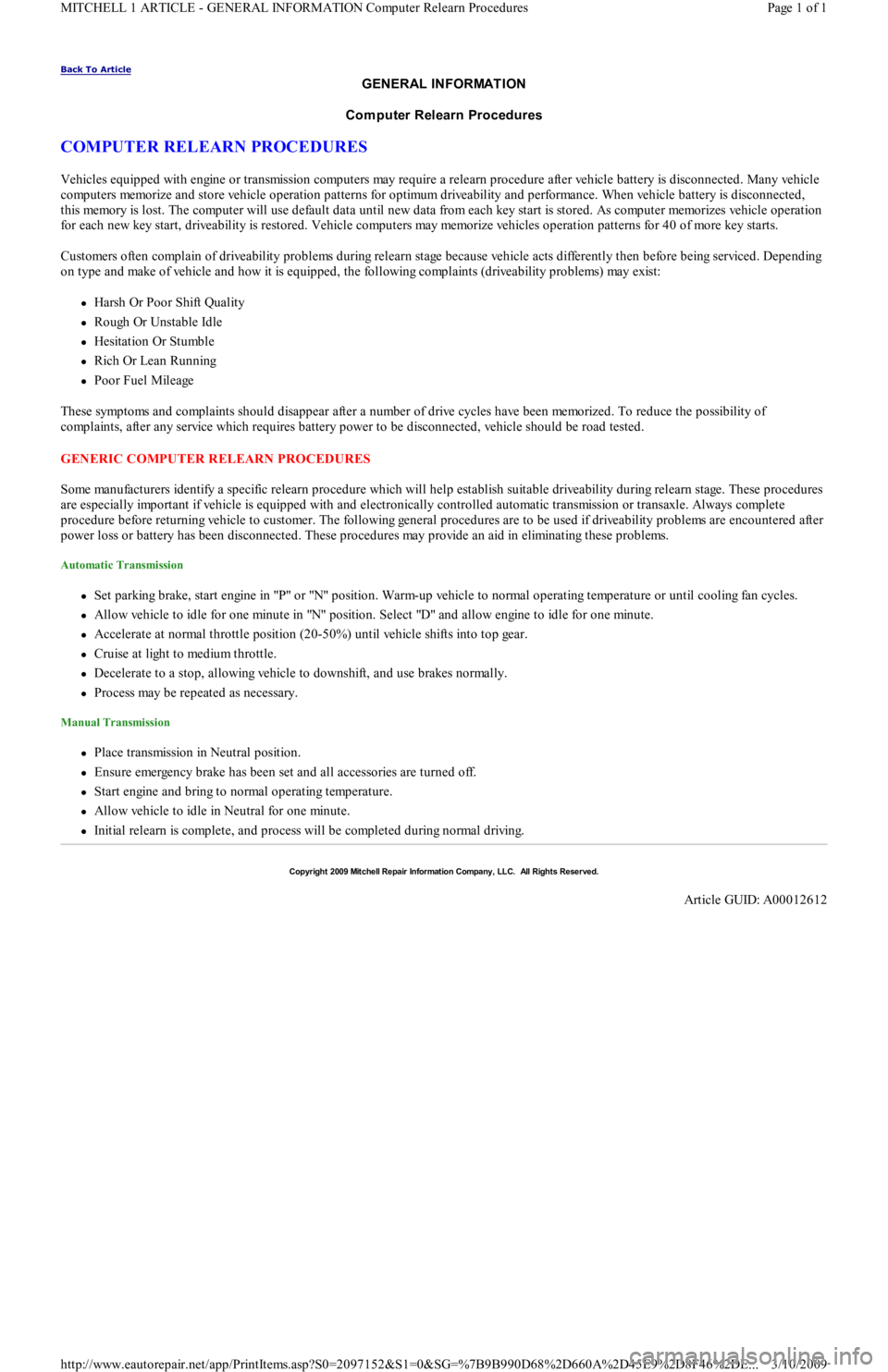
COMPUTER RELEARN PROCEDURES
Vehicles equipped with engine or transmission computers may require a relearn procedure after vehicle battery is disconnected. Many vehicle
computers memorize and store vehicle operation patterns for optimum driveability and performance. When vehicle battery is disconnected,
this memory is lost. The computer will use default data until new data from each key start is stored. As computer memorizes vehicle operation
for each new key start, driveability is restored. Vehicle computers may memorize vehicles operation patterns for 40 of more key starts.
Customers often complain of driveability problems during relearn stage because vehicle acts differently then before being serviced. Depending
on type and make of vehicle and how it is equipped, the following complaints (driveability problems) may exist:
Harsh Or Poor Shift Quality
Rough Or Unstable Idle
Hesitation Or Stumble
Rich Or Lean Running
Poor Fuel Mileage
These symptoms and complaints should disappear after a number of drive cycles have been memorized. To reduce the possibility of
complaints, after any service which requires battery power to be disconnected, vehicle should be road tested.
GENERIC COMPUTER RELEARN PROCEDURES
Some manufacturers identify a specific relearn procedure which will help establish suitable driveability during relearn stage. These procedures
are especially important if vehicle is equipped with and electronically controlled automatic transmission or transaxle. Always complete
procedure before returning vehicle to customer. The following general procedures are to be used if driveability problems are encountered after
power loss or battery has been disconnected. These procedures may provide an aid in eliminating these problems.
Automatic Transmission
Set parking brake, start engine in "P" or "N" position. Warm-up vehicle to normal operating temperature or until cooling fan cycles.
Allow vehicle to idle for one minute in "N" position. Select "D" and allow engine to idle for one minute.
Accelerate at normal throttle position (20-50%) until vehicle shifts into top gear.
Cruise at light to medium throttle.
Decelerate to a stop, allowing vehicle to downshift, and use brakes normally.
Process may be repeated as necessary.
Manual Transmission
Place transmission in Neutral position.
Ensure emergency brake has been set and all accessories are turned off.
Start engine and bring to normal operating temperature.
Allow vehicle to idle in Neutral for one minute.
Initial relearn is complete, and process will be completed during normal driving.
Copyr ight 2009 Mitchell Repair Information Company, LLC. All Rights Reserved.
Article GUID: A00012612
Page 1 of 1 MITCHELL 1 ARTICLE - GENERAL INFORMATION Computer Relearn Procedures
3/10/2009 http://www.eautorepair.net/app/PrintItems.asp?S0=2097152&S1=0&SG=%7B9B990D68%2D660A%2D45E9%2D8F46%2DE
...
Page 255 of 454
Back To Article
GENERAL INFORMATION
Gear T ooth Contact Patterns
* PLEASE READ THIS FIRST *
INSPECTION
Wipe lubricant from internal parts. Rotate gears and inspect for wear or damage. Mount dial indicator to housing and check backlash at several
points around ring gear. Backlash must be within specification at all points. If no defects are found, check gear tooth pattern contact.
GEAR TOOTH CONTACT PATTERN
1. Paint ring gear teeth with marking compound. Wrap cloth or rope around drive pinion flange to act as brake. Rotate gear until clear
contact pattern is obtained.
2. Contact pattern will indicate whether correct pinion bearing mounting shim has been installed and if drive gear backlash has been set
properly. Backlash between drive gear pinion must be maintained within specified limits until correct tooth pattern is obtained.
ADJUSTMENTS
GEAR BACKLASH & PINION SHIM CHANGES
1. With no change in backlash, moving pinion further from ring gear moves drive pattern toward heel and top of tooth, and moves coast
pattern toward toe and top of tooth.
2. With no change in backlash, moving pinion closer to ring gear moves drive pattern toward toe and bottom of tooth, and moves coast
pattern toward heel and bottom of tooth.
3. With no change in pinion shim thickness, an increase in backlash moves ring gear further from pinion. Both drive and coast patterns
move toward heel and top of tooth.
4. With no change in pinion shim thickness, a decrease in backlash moves ring gear closer to pinion gear. Both drive and coast patterns
move toward toe and bottom of tooth. NOTE:This is GENERAL inform ation. This article is not intended to be specific to any unique situation or
individual vehicle configuration. For m odel-specific inform ation see appropriate articles where
available.
NOTE:This is GENERAL inform ation. This article is not intended to be specific to any unique situation or
individual vehicle configuration. For m odel-specific inform ation see appropriate articles where
available.
NOTE:Drive pattern should be well centered on ring gear teeth. Coast pattern should be centered, but m ay be
slightly toward toe of ring gear teeth.
NOTE:This is GENERAL inform ation. This article is not intended to be specific to any unique situation or
individual vehicle configuration. For m odel-specific inform ation see appropriate articles where
available.
NOTE:This is GENERAL inform ation. This article is not intended to be specific to any unique situation or
individual vehicle configuration. For m odel-specific inform ation see appropriate articles where
available.
NOTE:This is GENERAL inform ation. This article is not intended to be specific to any unique situation or
individual vehicle configuration. For m odel-specific inform ation see appropriate articles where
available.
Page 1 of 2 MITCHELL 1 ARTICLE - GENERAL INFORMATION Gear Tooth Contact Patterns
3/10/2009 http://www.eautorepair.net/app/PrintItems.asp?S0=2097152&S1=0&SG=%7B9B990D68%2D660A%2D45E9%2D8F46%2DE
...
Page 272 of 454
carburetor. As the exhaust gas quickly warms the intake mixture, distribution is improved. This results in better cold engine driveability,
shorter choke periods and lower emissions.
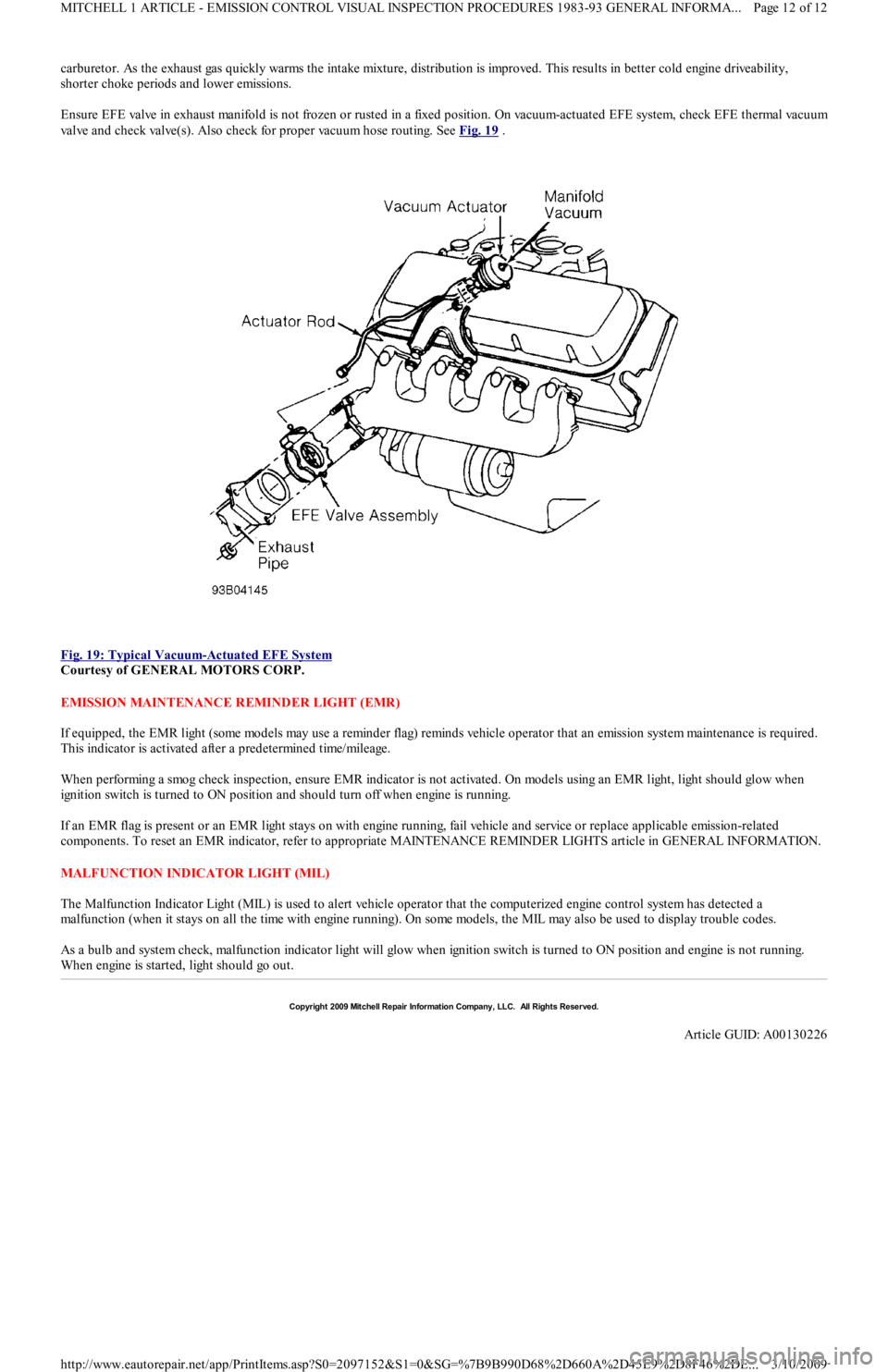
Ensure EFE valve in exhaust manifold is not frozen or rusted in a fixed position. On vacuum-actuated EFE system, check EFE thermal vacuu
m
valve and check valve(s). Also check for proper vacuum hose routing. See Fig. 19
.
Fig. 19: Typical Vacuum
-Actuated EFE System
Courtesy of GENERAL MOTORS CORP.
EMISSION MAINTENANCE REMINDER LIGHT (EMR)
If equipped, the EMR light (some models may use a reminder flag) reminds vehicle operator that an emission system maintenance is required.
This indicator is activated after a predetermined time/mileage.
When performing a smog check inspection, ensure EMR indicator is not activated. On models using an EMR light, light should glow when
ignition switch is turned to ON position and should turn off when engine is running.
If an EMR flag is present or an EMR light stays on with engine running, fail vehicle and service or replace applicable emission-related
components. To reset an EMR indicator, refer to appropriate MAINTENANCE REMINDER LIGHTS article in GENERAL INFORMATION.
MALFUNCTION INDICATOR LIGHT (MIL)
The Malfunction Indicator Light (MIL) is used to alert vehicle operator that the computerized engine control system has detected a
malfunction (when it stays on all the time with engine running). On some models, the MIL may also be used to display trouble codes.
As a bulb and system check, malfunction indicator light will glow when ignition switch is turned to ON position and engine is not running.
When engine is started, light should go out.
Copyr ight 2009 Mitchell Repair Information Company, LLC. All Rights Reserved.
Article GUID: A00130226
Page 12 of 12 MITCHELL 1 ARTICLE - EMISSION CONTROL VISUAL INSPECTION PROCEDURES 1983-93 GENERAL INFORMA...
3/10/2009 http://www.eautorepair.net/app/PrintItems.asp?S0=2097152&S1=0&SG=%7B9B990D68%2D660A%2D45E9%2D8F46%2DE
...
Page 275 of 454

Back To Article
GENERAL INFORMATION
How To Use The Engine Perform ance Section - 1989 & Newer Models
* PLEASE READ THIS FIRST *
HOW TO USE THE ENGINE PERFORMANCE SECTION
Congratulations, you have purchased the most advanced automotive repair and service information available. This information can help you, as
a professional automotive technician, to maintain top vehicle performance, and correct driveability problems on today's high-tech vehicles.
For your convenience and ease in use, all of our engine performance service and repair information is consistently organized by manufacturer,
using a progressive diagnostic/workflow approach. Due to the differences in how each manufacturer approaches diagnosis and repair, once
started and inside of an article, that manufacturer may drive the workflow in a direction other than what is outlined here.
The progressive diagnostic/workflow of our data is as follows:
APPLICATION to identify vehicle and system usage.
EMISSION APPLICATION to identify emission system usage.
SPECIFICATIONS to quickly find an engine performance service specification.
ADJUSTMENTS to perform engine performance related routine adjustments.
THEORY & OPERATION to familiarize yourself with new systems and technologies.
BASIC DIAGNOSTIC PROCEDURES located under TESTING & DIAGNOSTICS, also referred to as BASIC TESTING, is used for
performing a basic vehicle inspection and is also the starting point for diagnosis of a "no-start" condition.
SELF-DIAGNOSTICS located under TESTING & DIAGNOSTICS, also referred to as TESTS W/CODES, is where manufacturer
specific procedures for retrieving, identifying and diagnosing DTCs (trouble codes) retained in a control modules memory are located.
TROUBLE SHOOTING - NO CODES located under TESTING & DIAGNOSTICS, also referred to as TESTS W/O CODES, is where
an engine performance problem that does not set a DTC can be potentially isolated through either a SYMPTOM or INTERMITTENTS
duplication procedure.
SYSTEM & COMPONENT TESTING located under TESTING & DIAGNOSTICS, also referred to as SYSTEM/COMPONENT
TESTS, once directed to this article, specific system and component tests can be performed to help isolate faulty component/system
prior to replacement.
PIN VOLTAGE CHARTS provide supplemental information to help determine correct control module input and output signals. Pin
charts may also be referred to as PID charts by some manufacturers.
SENSOR RANGE CHARTS help determine if a sensor is out of calibration. In some cases an out-of-calibration sensor will not set a
DTC (trouble code), resulting in difficult to diagnose driveability symptoms.
VACUUM DIAGRAMS help determine correct routing of vacuum hoses when reinstalling components or performing emission
inspections.
REMOVE, OVERHAUL & INSTALL provides procedures necessary for removing and installing engine performance related
components.
WIRING DIAGRAMS can be used to identify circuits, terminals, wire colors and components referenced in testing procedures. NEW
COLOR WIRING DIAGRAMS (system diagrams) provide an easy method of identifying and tracing circuits.
APPLICATION
INTRODUCTION/ENGINE/VIN ID
Here you will find out how to identify an engine by its Vehicle Identification Number (VIN). The manufacturer's MODEL COVERAGE chart
lists each model and engine option, the fuel system, ignition system and engine code. Engine serial number locations are also shown here, as
well as the VIN code breakdown. Using model lookup in conjunction with VIN and engine ID will identify application information necessary
for servicing vehicle and ordering parts.
EMISSION APPLICATIONS
EMISSION APPLICATION TABLES
Here you will find a chart listing what emission control devices apply to each model. This can be helpful when performing government-
required emissions inspections. For quick reference, major emission systems and devices are listed in bold type in the emission table. Sub
components are listed in light type.
SPECIFICATIONS
NOTE:T his article is generic in nature and all inform ation does not apply to all vehicles. For vehicle specific
inform ation, see the appropriate articles in the ENGINE PERFORMANCE category.
NOTE:T his article is generic in nature and all inform ation does not apply to all vehicles. For vehicle specific
inform ation, see the appropriate articles in the ENGINE PERFORMANCE category.
NOTE:T his article is generic in nature and all inform ation does not apply to all vehicles. For vehicle specific
inform ation, see the appropriate articles in the ENGINE PERFORMANCE category.
NOTE:T his article is generic in nature and all inform ation does not apply to all vehicles. For vehicle specific
inform ation, see the appropriate articles in the ENGINE PERFORMANCE category.
Page 1 of 3 MITCHELL 1 ARTICLE - GENERAL INFORMATION How To Use The Engine Performance Section - 1989 & Newer Models
3/10/2009 http://www.eautorepair.net/app/PrintItems.asp?S0=2097152&S1=0&SG=%7B9B990D68%2D660A%2D45E9%2D8F46%2DE
...
Page 278 of 454
Back To Article
GENERAL INFORMATION
Parasitic Load Explanation & T est Procedures
* PLEASE READ THIS FIRST *
GENERAL INFORMATION
The term Parasitic Load refers to electrical devices that continue to use or draw current after the ignition switch is turned to OFF position. This
small amount of continuous battery draw is expressed in milliamps (mA). On Chrysler vehicles, a typical Parasitic Load should be no more
than 30 milliamps (0.030 amps). On Ford Motor Co. and General Motors vehicles produced after 1980, a typical Parasitic Load should be no
more than 50 milliamps (0.050 amps).
Vehicles produced since 1980 have memory devices that draw current with ignition off for as long as 20 minutes before shutting down the
Parasitic Drain. When Parasitic Load exceeds normal specifications, the vehicle may exhibit dead battery and no-start condition.
Follow test procedure for checking Parasitic Loads to completion. A brief overview of a suggested test procedure is included along with some
typical Parasitic Load specifications. Refer to GENERAL MOTORS PARASITIC LOAD TABLE chart.
TESTING FOR PARASITIC LOAD
The battery circuit must be opened to connect test switch (shunt) and ammeter into the circuit. When a battery cable is removed, timer circuits
within the vehicle computer are interrupted and immediately begin to discharge. If in doubt about the condition of the ammeter fuse, test it
with an ohmmeter prior to beginning test. An open fuse will show the same reading (00.00) as no parasitic drain. Begin test sequence with the
meter installed and on the 10-amp scale. Select lower scale to read parasitic draw.
CHRYSLER IGNITION OFF DRAW (IOD) TEST
To test for excessive IOD, verify that all electrical accessories are OFF. Turn off all lights, remove ignition key, and close all doors and decklid.
If the vehicle is equipped with electronic accessories (illuminated entry, automatic load leveler, body computer, or high line radio), allow the
system to automatically shut off (time out), up to 3 minutes.
1. Raise the hood and disconnect both battery cables, negative first.
2. Reconnect the negative cable and connect a typical 12-volt test light (low wattage bulb) between the positive cable clamp and the
positive battery post. Remove the engine compartment lamp bulb. If the test light does not light, proceed to step 3
. If the test light does
light, proceed to step, 4
. The test light will indicate IOD greater than 3 amps. After higher amperage IOD has been corrected, proceed to
step 3
.
3. ith 12-volt test light still connected (not lit), connect an ammeter (milliampere scale) between the positive cable clamp and the positive
battery post, disconnect test light, refer to instructions provided with ammeter being used. A reading of 30 milliamperes or less indicates
normal electrical draw. If ammeter reads more than 30 milliamperes, excessive IOD must be corrected.
4. Locate the fuse panel and remove fuses or circuit breakers one at a time, and observe ammeter after each fuse or circuit breaker is
removed. If test light goes out and the reading drops below 30 milliamperes when a certain fuse or circuit breaker is removed, that circuit
may have a defect.
5. If IOD is detected after all fuses and circuit breakers have been removed, disconnect the 60-way connector at the Single Module Engine
Control (SMEC), located outboard of the battery.
6. If excessive IOD is detected after all fused circuits and SMEC have been verified, disconnect the B+ terminal from the alternat o r. If
reading drops below 30 milliamperes, reinstall all fuses and circuit breakers, reconnect B+ terminal at alternator, reconnect battery, and
perform alternator diagnostics.
7. Install engine compartment lamp bulb.
TEST PROCEDURE USING TEST SWITCH
1. Turn ignition off. Remove negative battery terminal cable. Install Disconnect Tool (J-38758) test switch male end to negative battery
cable. Turn test switch knob to OFF position (current through meter). Install negative battery cable to the female end of test switch. NOTE:This is GENERAL inform ation. This article is not intended to be specific to any unique situation or
individual vehicle configuration. For m odel-specific inform ation see appropriate articles where
available.
NOTE:This is GENERAL inform ation. This article is not intended to be specific to any unique situation or
individual vehicle configuration. For m odel-specific inform ation see appropriate articles where
available.
NOTE:This is GENERAL inform ation. This article is not intended to be specific to any unique situation or
individual vehicle configuration. For m odel-specific inform ation see appropriate articles where
available.
CAUT ION: Always turn ignition off when connecting or disconnecting battery cables, battery chargers or jum per
cables. DO NOT turn test switch to OFF position (which causes current to run through am m eter or
vehicle electrical system ).
NOTE:Mem ory functions of various accessories m ust be reset after the battery is reconnected.
CAUT ION: IOD greater than 3 am ps m ay dam age m illam pm eter.
Page 1 of 4 MITCHELL 1 ARTICLE - GENERAL INFORMATION Parasitic Load Explanation & Test Procedures
3/10/2009 http://www.eautorepair.net/app/PrintItems.asp?S0=2097152&S1=0&SG=%7B9B990D68%2D660A%2D45E9%2D8F46%2DE
...