1991 FORD FESTIVA clutch
[x] Cancel search: clutchPage 171 of 454
CLEARING CODES
Clearing Codes Procedure
Disconnect negative battery cable. Press brake pedal for 5-10 seconds. Turn off VOM or Super Star II tester. Reconnect battery.
ECA LOCATION
ECA is located on center console behind kick panel on Capri, and under instrument panel on driver side of Festiva.
QUICK TESTS
KEY ON, ENGINE OFF (KOEO) SELF-TEST
KOEO
1. This is a test of electronic engine control system, conducted with power (voltage) applied and engine not running. Activate self-test, and
record all codes displayed.
2. Erase codes, and repeat self-test. Diagnose only codes occurring during repeat self-test. See TROUBLE CODE DEFINITION
table. If
no codes are present, proceed to KEY ON, ENGINE RUNNING (KOER) SELF
-TEST .
KEY ON, ENGINE RUNNING (KOER) SELF-TEST
KOER
1. Deactivate self-test. Start and run engine at 2000 RPM for 2 minutes to warm up EGO sensor. Turn off engine and wait 10 seconds.
2. Restart engine, and activate self-test. Record all service codes displayed. See TROUBLE CODE DEFINITION
table. If no codes are
present, proceed to SWITCH MONITOR TEST
.
SWITCH MONITOR TEST
This test procedure checks input signals received by ECA from individual switches. Use following procedure to perform switch monitor test:
Turn engine off and allow it to cool.
Ensure all accessories are turned off.
Deactivate self-test.
Ensure transmission is in Neutral or Park.
Turn ignition on.
SUPER STAR II Tester
Connect Super Star II tester adapter cable. Turn on tester. Latch center button. Operate each switch listed in SWITCH MONITOR TEST
table. Note output of LED on adapter cable as each switch operates. Record test results.
VOM
1. Ground STI connector. Connect VOM positive lead to SML terminal on self-test connector. Connect negative lead to ground. See Fig.
1 .
2. Operate each switch listed in SWITCH MONITOR TEST
table. Note output on VOM as each switch is operated. Go to specified
PINPOINT TEST if any switch does not meet specification.
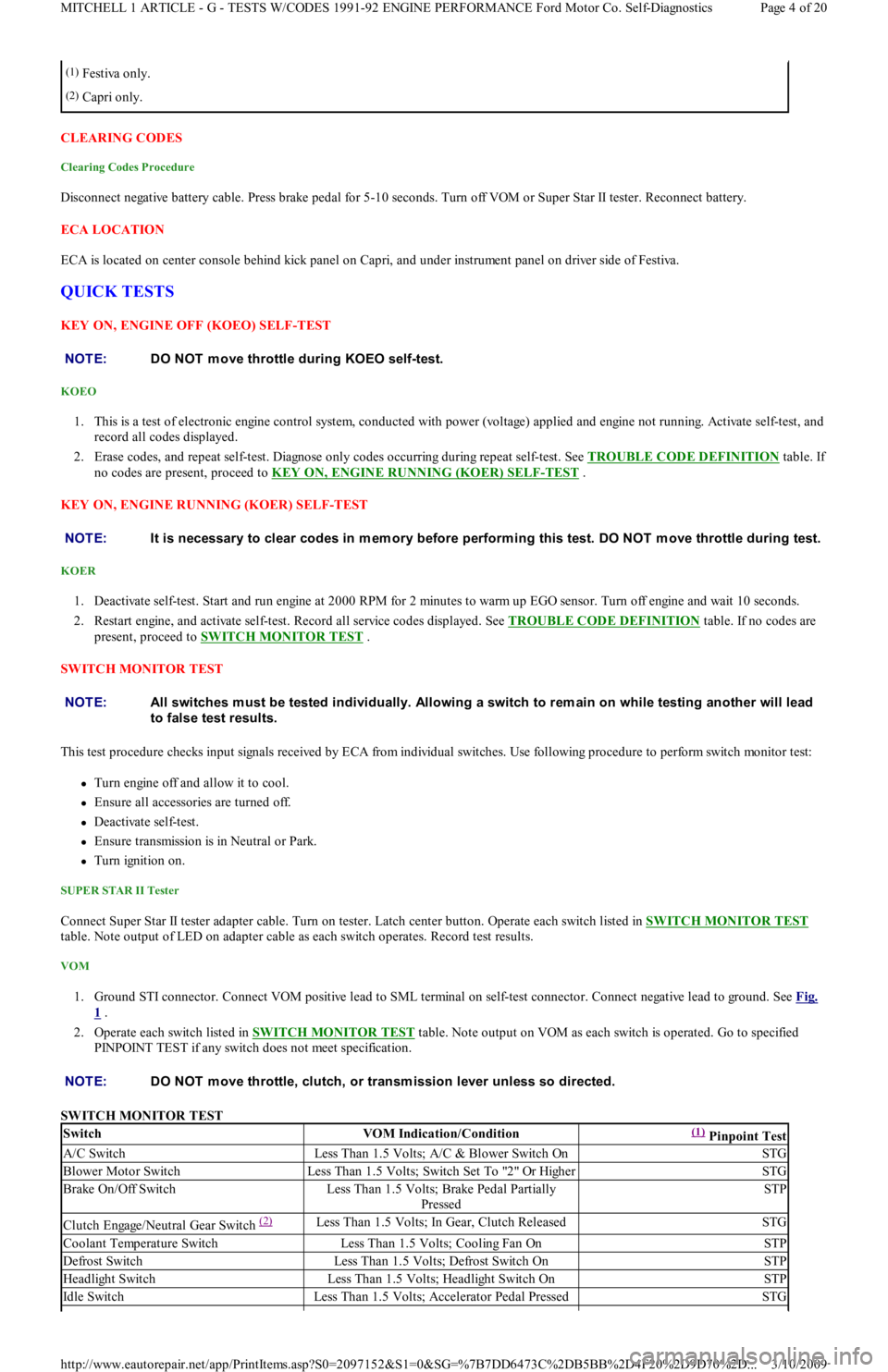
SWITCH MONITOR TEST
(1)Festiva only.
(2)Capri only.
NOTE:DO NOT m ove throttle during KOEO self-test.
NOTE:It is necessary to clear codes in m em ory before perform ing this test. DO NOT m ove throttle during test.
NOTE:All switches m ust be tested individually. Allowing a switch to rem ain on while testing another will lead
to false test results.
NOTE:DO NOT m ove throttle, clutch, or transm ission lever unless so directed.
SwitchVOM Indication/Condition(1) Pinpoint Test
A/C SwitchLess Than 1.5 Volts; A/C & Blower Switch OnSTG
Blower Motor SwitchLess Than 1.5 Volts; Switch Set To "2" Or HigherSTG
Brake On/Off SwitchLess Than 1.5 Volts; Brake Pedal Partially
PressedSTP
Clutch Engage/Neutral Gear Switch (2) Less Than 1.5 Volts; In Gear, Clutch ReleasedSTG
Coolant Temperature SwitchLess Than 1.5 Volts; Cooling Fan OnSTP
Defrost SwitchLess Than 1.5 Volts; Defrost Switch OnSTP
Headlight SwitchLess Than 1.5 Volts; Headlight Switch OnSTP
Id l e Swit chLess Than 1.5 Volts; Accelerator Pedal PressedSTG
Page 4 of 20 MITCHELL 1 ARTICLE - G - TESTS W/CODES 1991-92 ENGINE PERFORMANCE Ford Motor Co. Self-Diagnostics
3/10/2009 http://www.eautorepair.net/app/PrintItems.asp?S0=2097152&S1=0&SG=%7B7DD6473C%2DB5BB%2D4F20%2D9D70%2D
...
Page 189 of 454

Check vane airflow meter.
Check idle speed control solenoid.
Check pressure regulator control solenoid.
Check heated exhaust gas oxygen sensor.
Check engine coolant temperature sensor.
Check A/C load control solenoid.
STUMBLE/HESITATION DURING ACCELERATION
Check throttle position switch.
Check vane airflow meter.
Check canister purge solenoid.
Check heated exhaust gas oxygen sensor.
Check wide open throttle A/C (WAC) relay.
Check A/C thermostatic switch.
MISSES/SURGES
Check exhaust gas oxygen sensor.
Check throttle position switch.
Check vane airflow meter.
Check wide open throttle vacuum switch.
Check A/C load control solenoid.
Check engine coolant temperature sensor.
IDLE IS FAST/SLOW RETURN TO IDLE
Check idle speed control solenoid.
Check by-pass air control valve.
Check engine coolant temperature sensor.
Check A/C load control solenoid.
IDLE IS ROUGH
Check idle speed control solenoid.
Check A/C load control solenoid.
Check by-pass air control valve.
Check throttle position switch.
Check vane airflow meter.
Check vane air temperature sensor.
Check canister purge solenoid.
Check engine cooling fan.
Check headlight switch.
Check blower control switch.
Check A/C thermostatic switch.
Check neutral safety switch.
Check neutral gear switch or clutch engage switch.
Check heated exhaust gas oxygen sensor.
ENGINE SPEEDS UP
Check idle speed control solenoid.
Check heated exhaust gas oxygen sensor.
Check by-pass air control valve.
CRANKS NORMALLY/NO START
Verify secondary ignition spark is present.
Verify fuel pressure is within specification.
Check vane airflow meter.
Check engine coolant temperature sensor.
CRANKS NORMALLY/SLOW TO START
Check ignition module.
Check engine coolant temperature sensor.
Check vane airflow meter.
Check evaporative emission control components.
Page 2 of 3 MITCHELL 1 ARTICLE - H - TESTS W/O CODES 1991-92 ENGINE PERFORMANCE Ford Motor Co. Trouble Shooting -
...
3/10/2009 http://www.eautorepair.net/app/PrintItems.asp?S0=2097152&S1=0&SG=%7B7DD6473C%2DB5BB%2D4F20%2D9D70%2D
...
Page 192 of 454

CLUTCH ENGAGE SWITCH (CES)
This switch is located on the manual transaxle and informs the ECA of transmission operating conditions. The ECA uses this data fo r id l e
speed control and canister purge valve operation.
CRANKSHAFT POSITION SENSOR (CPS) (FESTIVA)
This sensor is located in the distributor and sends engine RPM and crankshaft position data to the ECA. The ECA uses this data in calculating
fuel metering, ignition timing, idle speed control and canister purge valve operation.
CYLINDER IDENTIFICATION SENSOR (CID) (CAPRI)
This sensor is located in the distributor and provides crankshaft position data to the ECA. The ECA uses this data in calculating fuel metering
and ignition timing.
ELECTRICAL LOAD SWITCHES
Blower control, cooling fan, rear window defroster, air conditioning and headlight switches all send signals to the ECA. The ECA uses these
signals for idle speed control.
ENGINE COOLANT TEMPERATURE (ECT) SENSOR
This sensor is located in the intake manifold and sends coolant temperature data to the ECA. The ECA uses this data in calculating fuel
metering, idle speed control and canister purge valve operation.
EXHAUST GAS OXYGEN (EGO) SENSOR
This sensor is located in the exhaust manifold and senses oxygen concentration in the exhaust gas. The ECA uses this data in calculating fuel
metering, idle speed control and canister purge valve operation.
NEUTRAL SAFETY SWITCH (A/T)
This switch is located on the automatic transaxle and sends a signal to the ECA whenever the transaxle is in Neutral or Park ranges. The ECA
uses this signal in calculating fuel metering, idle speed control and canister purge valve operation.
POWER STEERING PRESSURE SWITCH (PSPS)
This switch is located on the power steering pump and sends data about power steering operation to the ECA. The ECA uses this data for idle
speed control.
THROTTLE POSITION SENSOR (TP)
This device is located on the throttle body and contains 2 switches. The Wide Open Throttle (WOT) Switch sends a signal to the ECA when
throttle valve opening is more than 70 degrees. The ECA uses this signal in calculating fuel metering.
The Idle Switch (IDL) sends a signal to the ECA when throttle valve opening is less than 1.5 degrees. The ECA uses this signal for idle speed
control and canister purge valve operation.
VANE AIRFLOW (VAF) METER
This sensor is located in the air cleaner housing and sends intake airflow data to the ECA. The ECA uses this data in calculating fuel metering.
VANE AIR TEMPERATURE (VAT) SENSOR
This sensor is located inside the vane airflow sensor and senses intake air temperature. The ECA uses this data in calculating fu el met erin g,
idle speed control and canister purge valve operation.
CEC OUTPUT SIGNALS
CANISTER PURGE (CANP) SOLENOID
See EMISSION SYSTEMS.
CHECK ENGINE LIGHT
See SELF-DIAGNOSTIC SYSTEM.
FUEL INJECTORS
See FUEL CONTROL.
IDLE SPEED CONTROL BY-PASS AIR (ISC-BPA) VALVE
See IDLE SPEED. NOTE:Vehicles are equipped with different com binations of com puter-controlled com ponents. Not all
com ponents listed below are used on every vehicle. For theory and operation of each output
com ponent, refer to indicated system .
Page 2 of 6 MITCHELL 1 ARTICLE - E - THEORY/OPERATION 1991 ENGINE PERFORMANCE Ford/Mercury Theory & Operation
3/10/2009 http://www.eautorepair.net/app/PrintItems.asp?S0=2097152&S1=0&SG=%7B7DD6473C%2DB5BB%2D4F20%2D9D70%2D
...
Page 201 of 454

Barometric and Manifold Absolute Pressure Sensor
BOO
Brake On-Off Switch
B/P
Backpressure
BPS
Barometric Pressure Sensor
BPT
Backpressure Transducer
BTDC
Before Top Dead Center
BTU
British Thermal Unit
BVSV
Bimetallic Vacuum Switching Valve
"C"
° C
Celsius (Degrees)
Calif.
California
CANP
Canister Purge
CARB
California Air Resources Board
CAT
Catalytic Converter
CB
Circuit Breaker
CBD
Closed Bowl Distributor
cc
cubic centimeter
CCC
Computer Command Control
CCD
Computer Controlled Dwell
CCOT
Cycling Clutch Orifice Tube
CCW
Counterclockwise
Page 3 of 15 MITCHELL 1 ARTICLE - GENERAL INFORMATION Commonly Used Abbreviations
3/10/2009 http://www.eautorepair.net/app/PrintItems.asp?S0=2097152&S1=0&SG=%7B9B990D68%2D660A%2D45E9%2D8F46%2DE
...
Page 212 of 454

Throttle Actuator Module
TAD
Thermactor Air Diverter
TBC
Body Control Module
TBI
Throttle Body Injection
TCC
Torque Converter Clutch
TDC
Top Dead Center
Temp.
Temperature
TFI
Thick Film Ignition
THERMAC
Thermostatic Air Cleaner
TPM
Tire Pressure Monitor
TPMS
Tire Pressure Monitor System
TPS
Throttle Position Sensor/Switch
TS
Temperature Sensor
TV
Thermovalve
TWC
Three-Way Catalyst
"V"
V
Valve
Vac.
Vacuum
VAF
Vane Airflow
VAPS
Variable Assist Power Steering
VCC
Viscous Converter Clutch
Page 14 of 15 MITCHELL 1 ARTICLE - GENERAL INFORMATION Commonly Used Abbreviations
3/10/2009 http://www.eautorepair.net/app/PrintItems.asp?S0=2097152&S1=0&SG=%7B9B990D68%2D660A%2D45E9%2D8F46%2DE
...
Page 217 of 454
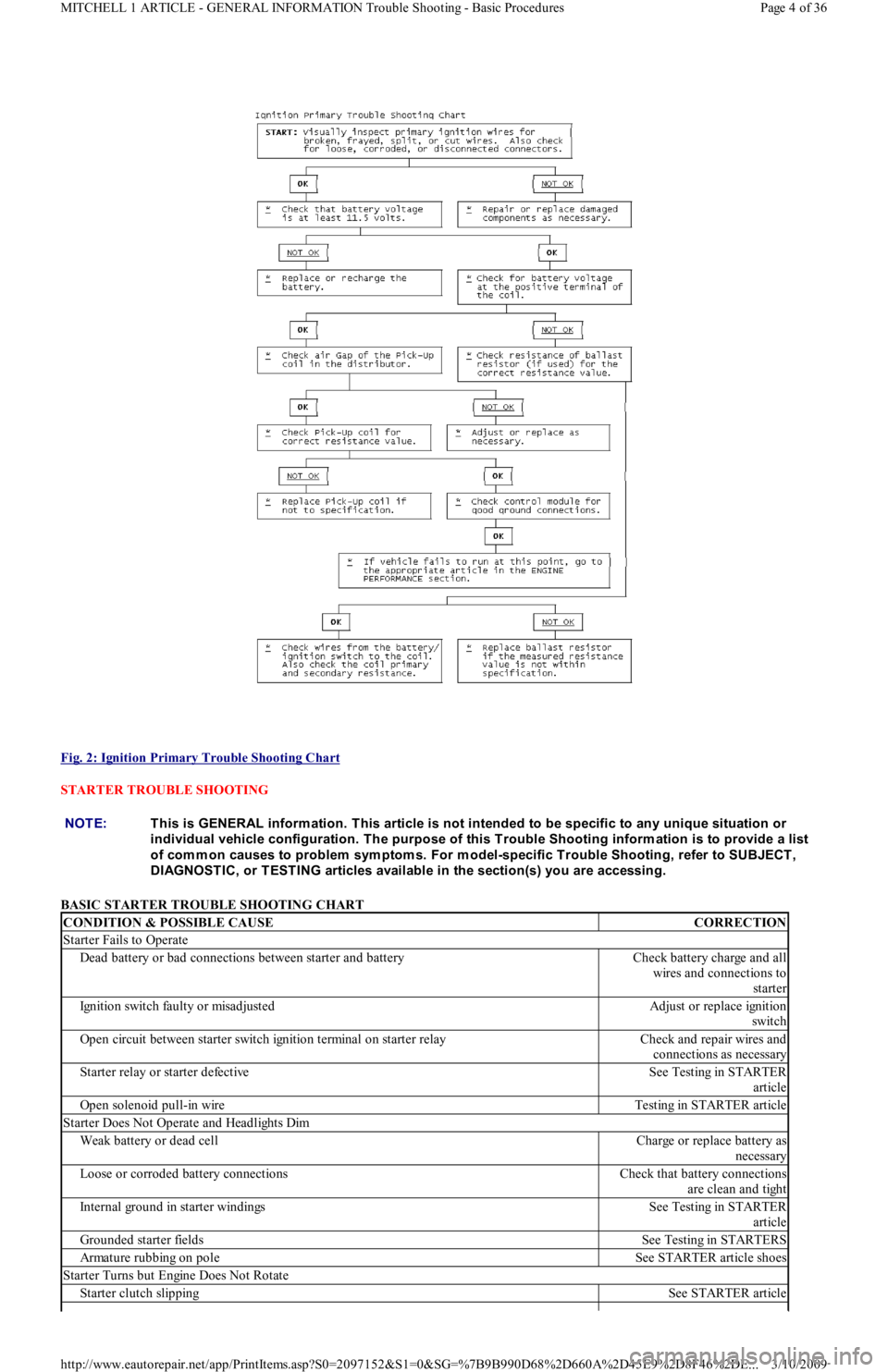
Fig. 2: Ignition Primary Trouble Shooting Chart
STARTER TROUBLE SHOOTING
BASIC STARTER TROUBLE SHOOTING CHART
NOTE:This is GENERAL inform ation. This article is not intended to be specific to any unique situation or
individual vehicle configuration. T he purpose of this T rouble Shooting inform ation is to provide a list
of com m on causes to problem sym ptom s. For m odel-specific T rouble Shooting, refer to SUBJECT ,
DIAGNOST IC, or T EST ING articles available in the section(s) you are accessing.
CONDITION & POSSIBLE CAUSECORRECTION
Starter Fails to Operate
Dead battery or bad connections between starter and batteryCheck battery charge and all
wires and connections to
starter
Ignition switch faulty or misadjustedAdjust or replace ignition
switch
Open circuit between starter switch ignition terminal on starter relayCheck and repair wires and
connections as necessary
Starter relay or starter defectiveSee Testing in STARTER
article
Open solenoid pull-in wireTesting in STARTER article
Starter Does Not Operate and Headlights Dim
Weak battery or dead cellCharge or replace battery as
necessary
Loose or corroded battery connectionsCheck that battery connections
are clean and tight
Internal ground in starter windingsSee Testing in STARTER
article
Grounded starter fieldsSee Testing in STARTERS
Armature rubbing on poleSee STARTER article shoes
Starter Turns but Engine Does Not Rotate
Starter clutch slippingSee STARTER article
Page 4 of 36 MITCHELL 1 ARTICLE - GENERAL INFORMATION Trouble Shooting - Basic Procedures
3/10/2009 http://www.eautorepair.net/app/PrintItems.asp?S0=2097152&S1=0&SG=%7B9B990D68%2D660A%2D45E9%2D8F46%2DE
...
Page 218 of 454
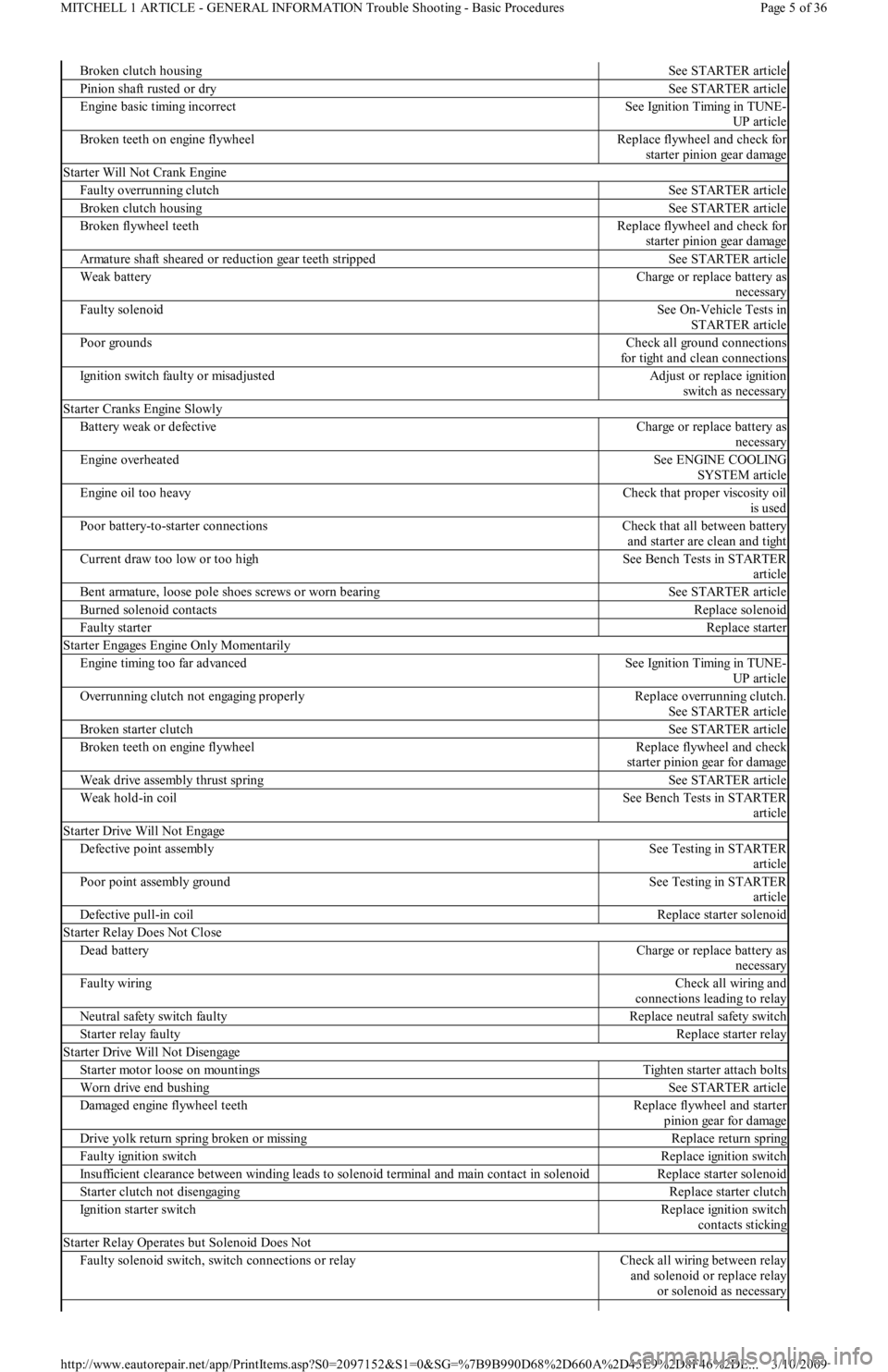
Broken clutch housingSee STARTER article
Pinion shaft rusted or drySee STARTER article
Engine basic timing incorrectSee Ignition Timing in TUNE-
UP article
Broken teeth on engine flywheelReplace flywheel and check for
starter pinion gear damage
Starter Will Not Crank Engine
Faulty overrunning clutchSee STARTER article
Broken clutch housingSee STARTER article
Broken flywheel teethReplace flywheel and check for
starter pinion gear damage
Armature shaft sheared or reduction gear teeth strippedSee STARTER article
Weak batteryCharge or replace battery as
necessary
Faulty solenoidSee On-Vehicle Tests in
STARTER article
Poor groundsCheck all ground connections
for tight and clean connections
Ignition switch faulty or misadjustedAdjust or replace ignition
switch as necessary
Starter Cranks Engine Slowly
Battery weak or defectiveCharge or replace battery as
necessary
Engine overheatedSee ENGINE COOLING
SYSTEM article
Engine oil too heavyCheck that proper viscosity oil
is used
Poor battery-to-starter connectionsCheck that all between battery
and starter are clean and tight
Current draw too low or too highSee Bench Tests in STARTER
article
Bent armature, loose pole shoes screws or worn bearingSee STARTER article
Burned solenoid contactsReplace solenoid
Faulty starterReplace starter
S t a r t e r E n ga ge s E n gin e On l y M o me n t a r il y
Engine timing too far advancedSee Ignition Timing in TUNE-
UP article
Overrunning clutch not engaging properlyReplace overrunning clutch.
See STARTER article
Broken starter clutchSee STARTER article
Broken teeth on engine flywheelReplace flywheel and check
starter pinion gear for damage
Weak drive assembly thrust springSee STARTER article
Weak hold-in coilSee Bench Tests in STARTER
article
Starter Drive Will Not Engage
Defective point assemblySee Testing in STARTER
article
Poor point assembly groundSee Testing in STARTER
article
Defective pull-in coilReplace starter solenoid
Starter Relay Does Not Close
Dead batteryCharge or replace battery as
necessary
Faulty wiringCheck all wiring and
connections leading to relay
Neutral safety switch faultyReplace neutral safety switch
Starter relay faultyReplace starter relay
Starter Drive Will Not Disengage
Starter motor loose on mountingsTighten starter attach bolts
Worn drive end bushingSee STARTER article
Damaged engine flywheel teethReplace flywheel and starter
pinion gear for damage
Drive yolk return spring broken or missingReplace return spring
Faulty ignition switchReplace ignition switch
Insufficient clearance between winding leads to solenoid terminal and main contact in solenoidReplace starter solenoid
Starter clutch not disengagingReplace starter clutch
Ignition starter switchReplace ignition switch
contacts sticking
Starter Relay Operates but Solenoid Does Not
Faulty solenoid switch, switch connections or relayCheck all wiring between relay
and solenoid or replace relay
or solenoid as necessary
Page 5 of 36 MITCHELL 1 ARTICLE - GENERAL INFORMATION Trouble Shooting - Basic Procedures
3/10/2009 http://www.eautorepair.net/app/PrintItems.asp?S0=2097152&S1=0&SG=%7B9B990D68%2D660A%2D45E9%2D8F46%2DE
...
Page 219 of 454
AIR CONDITIONING & HEAT
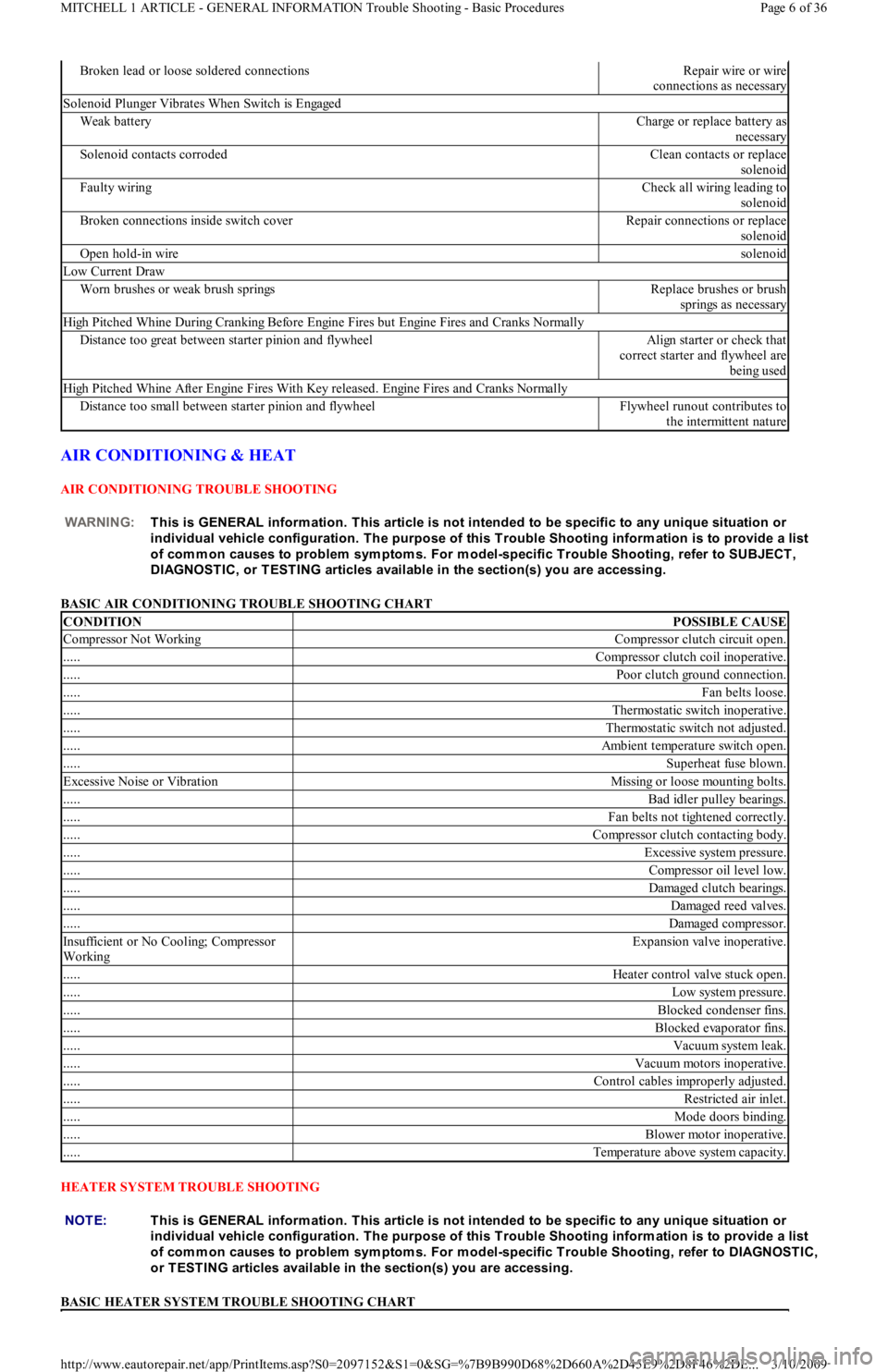
AIR CONDITIONING TROUBLE SHOOTING
BASIC AIR CONDITIONING TROUBLE SHOOTING CHART
HEATER SYSTEM TROUBLE SHOOTING
BASIC HEATER SYSTEM TROUBLE SHOOTING CHART
Broken lead or loose soldered connectionsRepair wire or wire
connections as necessary
Solenoid Plunger Vibrates When Switch is Engaged
Weak batteryCharge or replace battery as
necessary
Solenoid contacts corrodedClean contacts or replace
solenoid
Faulty wiringCheck all wiring leading to
solenoid
Broken connections inside switch coverRepair connections or replace
solenoid
Open hold-in wiresolenoid
Low Current Draw
Worn brushes or weak brush springsReplace brushes or brush
springs as necessary
High Pitched Whine During Cranking Before Engine Fires but Engine Fires and Cranks Normally
Distance too great between starter pinion and flywheelAlign starter or check that
correct starter and flywheel are
being used
High Pitched Whine After Engine Fires With Key released. Engine Fires and Cranks Normally
Distance too small between starter pinion and flywheelFlywheel runout contributes to
the intermittent nature
WARNING:This is GENERAL inform ation. This article is not intended to be specific to any unique situation or
individual vehicle configuration. T he purpose of this T rouble Shooting inform ation is to provide a list
of com m on causes to problem sym ptom s. For m odel-specific T rouble Shooting, refer to SUBJECT ,
DIAGNOST IC, or T EST ING articles available in the section(s) you are accessing.
CONDITIONPOSSIBLE CAUSE
Compressor Not WorkingCompressor clutch circuit open.
.....Compressor clutch coil inoperative.
.....Poor clutch ground connection.
.....Fan belts loose.
.....Thermostatic switch inoperative.
.....Thermostatic switch not adjusted.
.....Ambient temperature switch open.
.....Superheat fuse blown.
Excessive Noise or VibrationMissing or loose mounting bolts.
.....Bad idler pulley bearings.
.....Fan belts not tightened correctly.
.....Compressor clutch contacting body.
.....Excessive system pressure.
.....Compressor oil level low.
.....Damaged clutch bearings.
.....Damaged reed valves.
.....Damaged compressor.
In su fficien t o r No Co o l in g; Co mp resso r
WorkingExpansion valve inoperative.
.....Heater control valve stuck open.
.....Low system pressure.
.....Blocked condenser fins.
.....Blocked evaporator fins.
.....Vacuum system leak.
.....Vacuum motors inoperative.
.....Control cables improperly adjusted.
.....Restricted air inlet.
.....Mode doors binding.
.....Blower motor inoperative.
.....Temperature above system capacity.
NOTE:This is GENERAL inform ation. This article is not intended to be specific to any unique situation or
individual vehicle configuration. T he purpose of this T rouble Shooting inform ation is to provide a list
of com m on causes to problem sym ptom s. For m odel-specific T rouble Shooting, refer to DIAGNOST IC,
or T EST ING articles available in the section(s) you are accessing.
Page 6 of 36 MITCHELL 1 ARTICLE - GENERAL INFORMATION Trouble Shooting - Basic Procedures
3/10/2009 http://www.eautorepair.net/app/PrintItems.asp?S0=2097152&S1=0&SG=%7B9B990D68%2D660A%2D45E9%2D8F46%2DE
...