1991 FORD FESTIVA ECU
[x] Cancel search: ECUPage 196 of 454

gases into harmless substances.
PCV VALVE
The Positive Crankcase Ventilation (PCV) valve, located in the valve cover, controls the flow of blow-by gas from the crankcase to the intake
man ifo l d .
SELF-DIAGNOSTIC SYSTEM
The ECA monitors its inputs and outputs. When it detects a malfunction, it sets a code in the ECA and sends a signal to the CHECK ENGINE
warning light. The light remains on until the malfunction is repaired. Trouble codes may be accessed at the Self-Test Output (STO) and Self-
Test Input (STI) connectors, near the battery.
If a sensor fails, the ECA will use a substitute value in its calculations to permit continued engine operation. In this condition, the vehicle will
run, but driveability may be poor. Intermittent failures may result in the CHECK ENGINE warning light flickering or going out after the fault
goes away. The corresponding trouble code, however, will be stored in the ECA. If fault does not recur, the related code will be erased from
ECA memory.
CHECK ENGINE LIGHT
Hard failures cause the CHECK ENGINE warning light to come on and remain on until the malfunction is repaired. If the warning light comes
on and stays on during vehicle operation, determine and correct the cause of the malfunction. NOTE:For additional inform ation and operating procedures for the self-diagnostic system , refer to T EST S
W/CODES article in the ENGINE PERFORMANCE Section.
Copyr ight 2009 Mitchell Repair Information Company, LLC. All Rights Reserved.
Article GUID: A00022697
Page 6 of 6 MITCHELL 1 ARTICLE - E - THEORY/OPERATION 1991 ENGINE PERFORMANCE Ford/Mercury Theory & Operation
3/10/2009 http://www.eautorepair.net/app/PrintItems.asp?S0=2097152&S1=0&SG=%7B7DD6473C%2DB5BB%2D4F20%2D9D70%2D
...
Page 274 of 454
Back To Article
GENERAL INFORMATION
Engine Perform ance Safety Precautions
Always refer to Emission Decal in engine compartment before servicing vehicle. If manual and decal differ, always use decal
specifications.
Do not allow or create a condition of misfire in more than one cylinder for an extended period of time. Damage to converter may occur
due to loading converter with unburned air/fuel mixture.
Always turn ignition off and disconnect negative battery cable BEFORE disconnecting or connecting computer or other electrical
components.
DO NOT drop or shock electrical components such as computer, airflow meter, etc.
DO NOT use fuel system cleaning compounds that are not recommended by the manufacturer. Damage to gaskets, diaphragm materials
and catalytic converter may result.
Before performing a compression test or cranking engine using a remote starter switch, disconnect coil wire from distributor and secure it
to a good engine ground, or disable ignition.
Before disconnecting any fuel system component, ensure fuel system pressure is released.
Use a shop towel to absorb any spilled fuel to prevent fire.
DO NOT create sparks or have an open flame near battery.
If any fuel system components such as hoses or clamps are replaced, ensure they are replaced with components designed for fuel system
use.
Always reassemble throttle body components with new gaskets, "O" rings and seals.
If equipped with an inertia switch, DO NOT reset switch until fuel system has been inspected for leaks.
We a r sa fe t y go ggl e s wh e n d r il l in g o r gr in d in g.
Wear proper clothing which protects against chemicals and other hazards.
Copyr ight 2009 Mitchell Repair Information Company, LLC. All Rights Reserved.
Article GUID: A00002342
Page 1 of 1 MITCHELL 1 ARTICLE - GENERAL INFORMATION Engine Performance Safety Precautions
3/10/2009 http://www.eautorepair.net/app/PrintItems.asp?S0=2097152&S1=0&SG=%7B9B990D68%2D660A%2D45E9%2D8F46%2DE
...
Page 286 of 454
The voltage controlled driver inside the computer operates much like a simple switch because it does not need to worry about limiting current
flow. Recall, this driver typically requires injector circuits with a total leg resistance of 12 or more ohms.
The driver is either ON, closing/completing the circuit (eliminating the voltage-drop), or OFF, opening the circuit (causing a total voltage
drop).
Some manufacturers call it a "saturated switch" driver. This is because when switched ON, the driver allows the magnetic field in the injector
to build to saturation. This is the same "saturation" property that you are familiar with for an ignition coil.
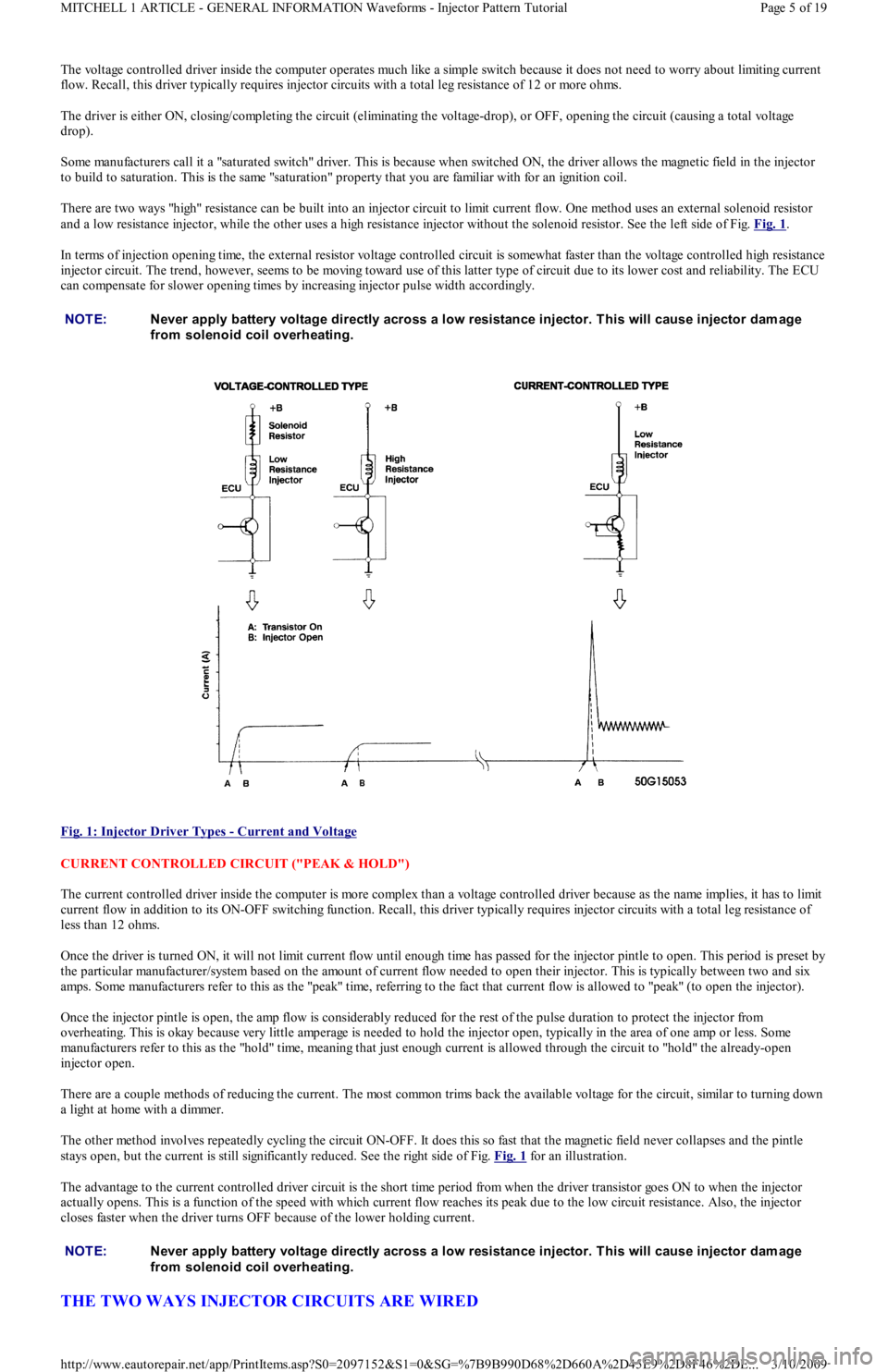
There are two ways "high" resistance can be built into an injector circuit to limit current flow. One method uses an external solenoid resistor
and a low resistance injector, while the other uses a high resistance injector without the solenoid resistor. See the left side of Fig. Fig. 1
.
In terms of injection opening time, the external resistor voltage controlled circuit is somewhat faster than the voltage controlled high resistance
injector circuit. The trend, however, seems to be moving toward use of this latter type of circuit due to its lower cost and reliability. The ECU
can compensate for slower opening times by increasing injector pulse width accordingly.
Fig. 1: Injector Driver Types
- Current and Voltage
CURRENT CONTROLLED CIRCUIT ("PEAK & HOLD")
The current controlled driver inside the computer is more complex than a voltage controlled driver because as the name implies, it has to limit
current flow in addition to its ON-OFF switching function. Recall, this driver typically requires injector circuits with a total leg resistance of
less than 12 ohms.
Once the driver is turned ON, it will not limit current flow until enough time has passed for the injector pintle to open. This period is preset by
the particular manufacturer/system based on the amount of current flow needed to open their injector. This is typically between two and six
amps. Some manufacturers refer to this as the "peak" time, referring to the fact that current flow is allowed to "peak" (to open the injector).
Once the injector pintle is open, the amp flow is considerably reduced for the rest of the pulse duration to protect the injector from
overheating. This is okay because very little amperage is needed to hold the injector open, typically in the area of one amp or less. Some
manufacturers refer to this as the "hold" time, meaning that just enough current is allowed through the circuit to "hold" the already-open
injector open.
There are a couple methods of reducing the current. The most common trims back the available voltage for the circuit, similar to turning down
a light at home with a dimmer.
The other method involves repeatedly cycling the circuit ON-OFF. It does this so fast that the magnetic field never collapses and the pintle
stays open, but the current is still significantly reduced. See the right side of Fig. Fig. 1
for an illustration.
The advantage to the current controlled driver circuit is the short time period from when the driver transistor goes ON to when the injector
actually opens. This is a function of the speed with which current flow reaches its peak due to the low circuit resistance. Also, the injector
closes faster when the driver turns OFF because of the lower holding current.
THE TWO WAYS INJECTOR CIRCUITS ARE WIRED
NOTE:Never apply battery voltage directly across a low resistance injector. T his will cause injector dam age
from solenoid coil overheating.
NOTE:Never apply battery voltage directly across a low resistance injector. T his will cause injector dam age
from solenoid coil overheating.
Page 5 of 19 MITCHELL 1 ARTICLE - GENERAL INFORMATION Waveforms - Injector Pattern Tutorial
3/10/2009 http://www.eautorepair.net/app/PrintItems.asp?S0=2097152&S1=0&SG=%7B9B990D68%2D660A%2D45E9%2D8F46%2DE
...
Page 318 of 454
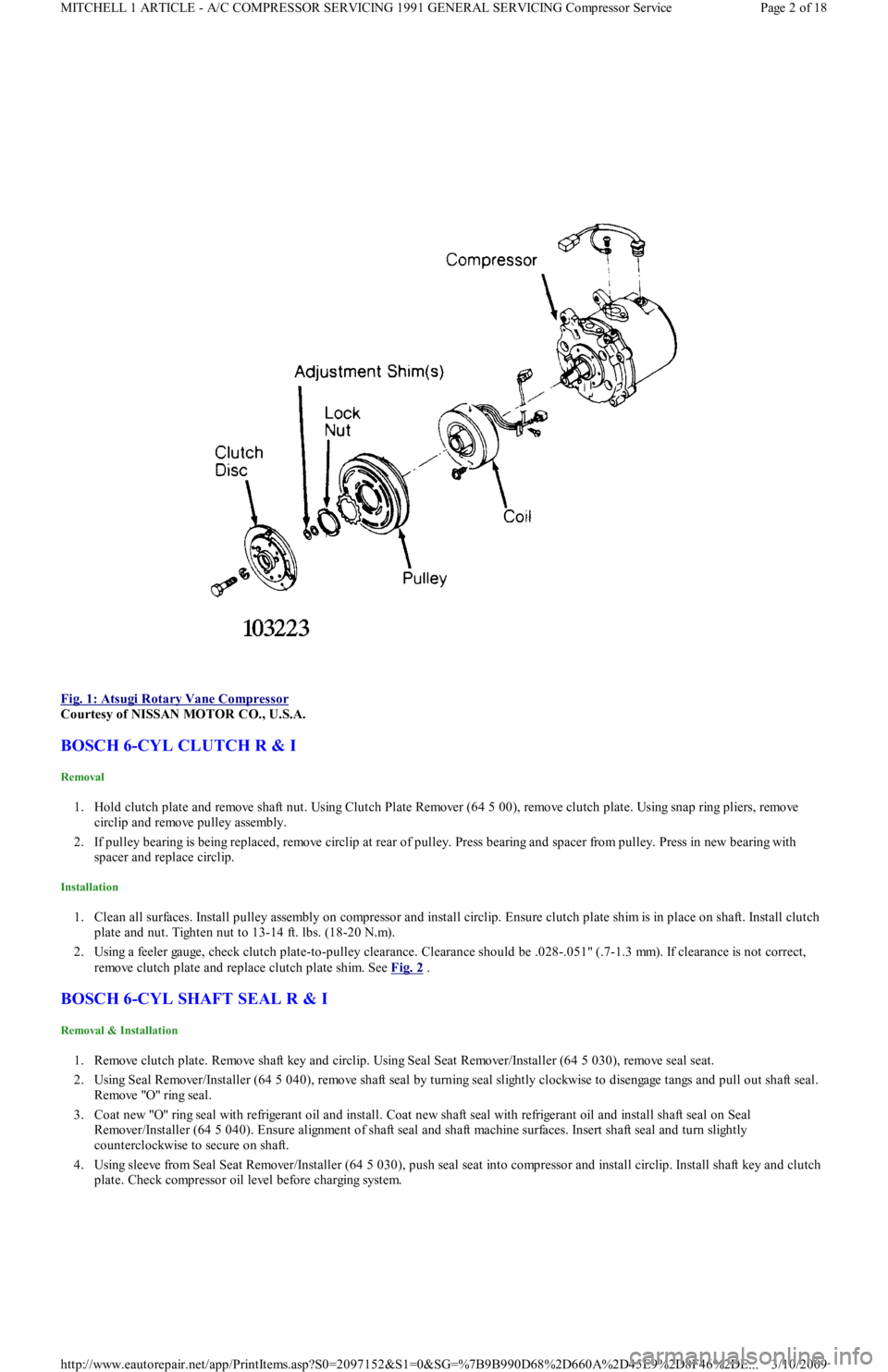
Fig. 1: Atsugi Rotary Vane Compressor
Courtesy of NISSAN MOTOR CO., U.S.A.
BOSCH 6-CYL CLUTCH R & I
Removal
1. Hold clutch plate and remove shaft nut. Using Clutch Plate Remover (64 5 00), remove clutch plate. Using snap ring pliers, remo ve
circlip and remove pulley assembly.
2. If pulley bearing is being replaced, remove circlip at rear of pulley. Press bearing and spacer from pulley. Press in new bearing with
spacer and replace circlip.
Installation
1. Clean all surfaces. Install pulley assembly on compressor and install circlip. Ensure clutch plate shim is in place on shaft. Install clutch
plate and nut. Tighten nut to 13-14 ft. lbs. (18-20 N.m).
2. Using a feeler gauge, check clutch plate-to-pulley clearance. Clearance should be .028-.051" (.7-1.3 mm). If clearance is not correct,
remove clutch plate and replace clutch plate shim. See Fig. 2
.
BOSCH 6-CYL SHAFT SEAL R & I
Removal & Installation
1. Remove clutch plate. Remove shaft key and circlip. Using Seal Seat Remover/Installer (64 5 030), remove seal seat.
2. Using Seal Remover/Installer (64 5 040), remove shaft seal by turning seal slightly clockwise to disengage tangs and pull out shaft seal.
Remo ve "O" rin g seal .
3. Coat new "O" ring seal with refrigerant oil and install. Coat new shaft seal with refrigerant oil and install shaft seal on Seal
Remover/Installer (64 5 040). Ensure alignment of shaft seal and shaft machine surfaces. Insert shaft seal and turn slightly
counterclockwise to secure on shaft.
4. Using sleeve from Seal Seat Remover/Installer (64 5 030), push seal seat into compressor and install circlip. Install shaft key and clutch
plate. Check compressor oil level before charging system.
Page 2 of 18 MITCHELL 1 ARTICLE - A/C COMPRESSOR SERVICING 1991 GENERAL SERVICING Compressor Service
3/10/2009 http://www.eautorepair.net/app/PrintItems.asp?S0=2097152&S1=0&SG=%7B9B990D68%2D660A%2D45E9%2D8F46%2DE
...
Page 319 of 454
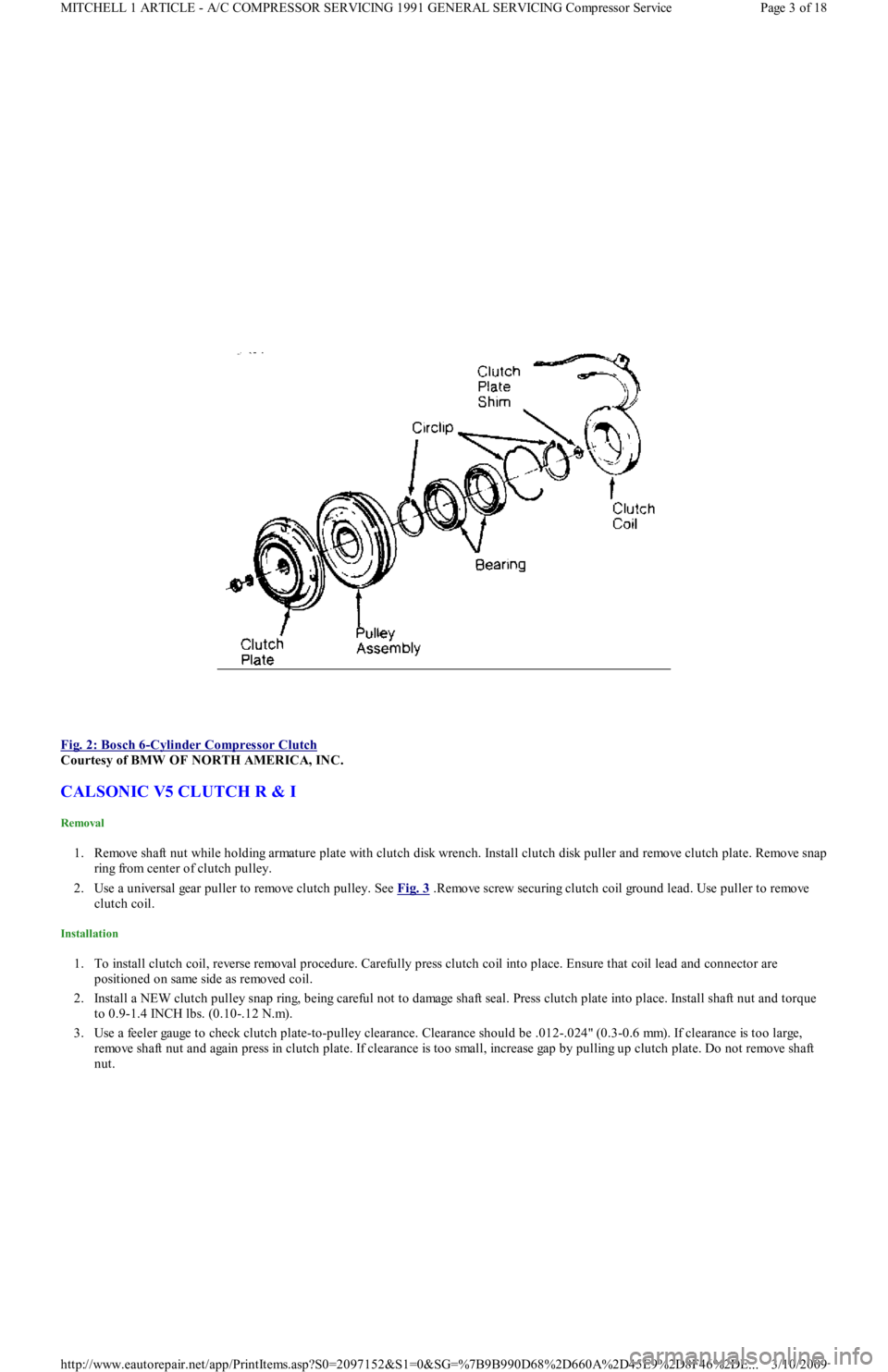
Fig. 2: Bosch 6
-Cylinder Compressor Clutch
Courtesy of BMW OF NORTH AMERICA, INC.
CALSONIC V5 CLUTCH R & I
Removal
1. Remove shaft nut while holding armature plate with clutch disk wrench. Install clutch disk puller and remove clutch plate. Remo ve sn ap
ring from center of clutch pulley.
2. Use a universal gear puller to remove clutch pulley. See Fig. 3
.Remove screw securing clutch coil ground lead. Use puller to remove
clutch coil.
Installation
1. To install clutch coil, reverse removal procedure. Carefully press clutch coil into place. Ensure that coil lead and connector are
positioned on same side as removed coil.
2. Install a NEW clutch pulley snap ring, being careful not to damage shaft seal. Press clutch plate into place. Install shaft nut and torque
to 0.9-1.4 INCH lbs. (0.10-.12 N.m).
3. Use a feeler gauge to check clutch plate-to-pulley clearance. Clearance should be .012-.024" (0.3-0.6 mm). If clearance is too large,
remove shaft nut and again press in clutch plate. If clearance is too small, increase gap by pulling up clutch plate. Do not remo ve sh aft
nut.
Page 3 of 18 MITCHELL 1 ARTICLE - A/C COMPRESSOR SERVICING 1991 GENERAL SERVICING Compressor Service
3/10/2009 http://www.eautorepair.net/app/PrintItems.asp?S0=2097152&S1=0&SG=%7B9B990D68%2D660A%2D45E9%2D8F46%2DE
...
Page 323 of 454
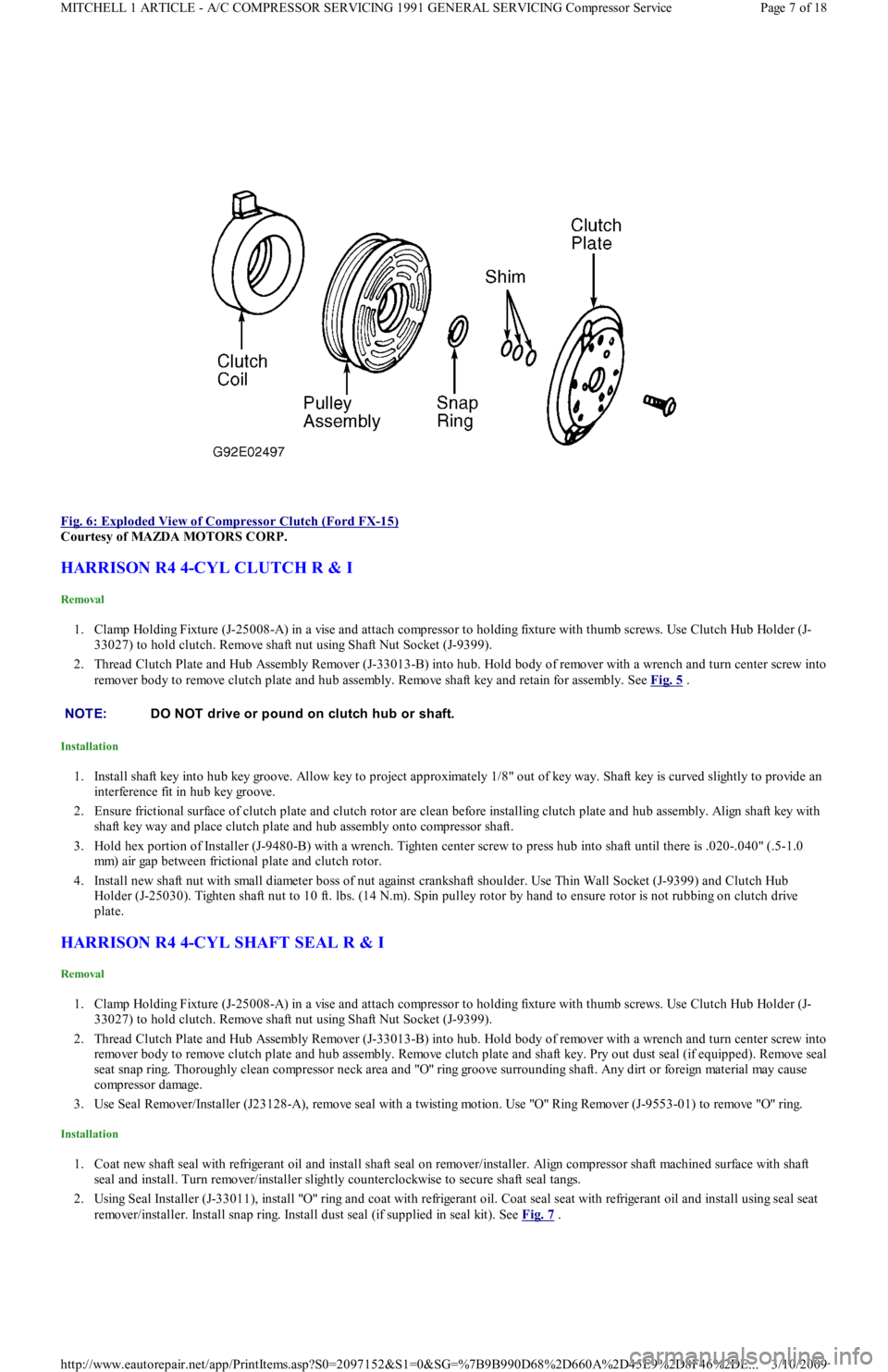
Fig. 6: Exploded View of Compressor Clutch (Ford FX
-15)
Courtesy of MAZDA MOTORS CORP.
HARRISON R4 4-CYL CLUTCH R & I
Removal
1. Clamp Holding Fixture (J-25008-A) in a vise and attach compressor to holding fixture with thumb screws. Use Clutch Hub Holder (J-
33027) to hold clutch. Remove shaft nut using Shaft Nut Socket (J-9399).
2. Thread Clutch Plate and Hub Assembly Remover (J-33013-B) into hub. Hold body of remover with a wrench and turn center screw into
remover body to remove clutch plate and hub assembly. Remove shaft key and retain for assembly. See Fig. 5
.
Installation
1. Install shaft key into hub key groove. Allow key to project approximately 1/8" out of key way. Shaft key is curved slightly to provide an
interference fit in hub key groove.
2. Ensure frictional surface of clutch plate and clutch rotor are clean before installing clutch plate and hub assembly. Align shaft key with
shaft key way and place clutch plate and hub assembly onto compressor shaft.
3. Hold hex portion of Installer (J-9480-B) with a wrench. Tighten center screw to press hub into shaft until there is .020-.040" (.5-1.0
mm) air gap between frictional plate and clutch rotor.
4. Install new shaft nut with small diameter boss of nut against crankshaft shoulder. Use Thin Wall Socket (J-9399) and Clutch Hub
Holder (J-25030). Tighten shaft nut to 10 ft. lbs. (14 N.m). Spin pulley rotor by hand to ensure rotor is not rubbing on clutch drive
plate.
HARRISON R4 4-CYL SHAFT SEAL R & I
Removal
1. Clamp Holding Fixture (J-25008-A) in a vise and attach compressor to holding fixture with thumb screws. Use Clutch Hub Holder (J-
33027) to hold clutch. Remove shaft nut using Shaft Nut Socket (J-9399).
2. Thread Clutch Plate and Hub Assembly Remover (J-33013-B) into hub. Hold body of remover with a wrench and turn center screw into
remover body to remove clutch plate and hub assembly. Remove clutch plate and shaft key. Pry out dust seal (if equipped). Remove seal
seat snap ring. Thoroughly clean compressor neck area and "O" ring groove surrounding shaft. Any dirt or foreign material may cause
compressor damage.
3. Use Seal Remover/Installer (J23128-A), remove seal with a twisting motion. Use "O" Ring Remover (J-9553-01) to remove "O" ring.
Installation
1. Coat new shaft seal with refrigerant oil and install shaft seal on remover/installer. Align compressor shaft machined surface with shaft
seal and install. Turn remover/installer slightly counterclockwise to secure shaft seal tangs.
2. Using Seal Installer (J-33011), install "O" ring and coat with refrigerant oil. Coat seal seat with refrigerant oil and install using seal seat
remover/installer. Install snap ring. Install dust seal (if supplied in seal kit). See Fig. 7
.
NOTE:DO NOT drive or pound on clutch hub or shaft.
Page 7 of 18 MITCHELL 1 ARTICLE - A/C COMPRESSOR SERVICING 1991 GENERAL SERVICING Compressor Service
3/10/2009 http://www.eautorepair.net/app/PrintItems.asp?S0=2097152&S1=0&SG=%7B9B990D68%2D660A%2D45E9%2D8F46%2DE
...
Page 325 of 454
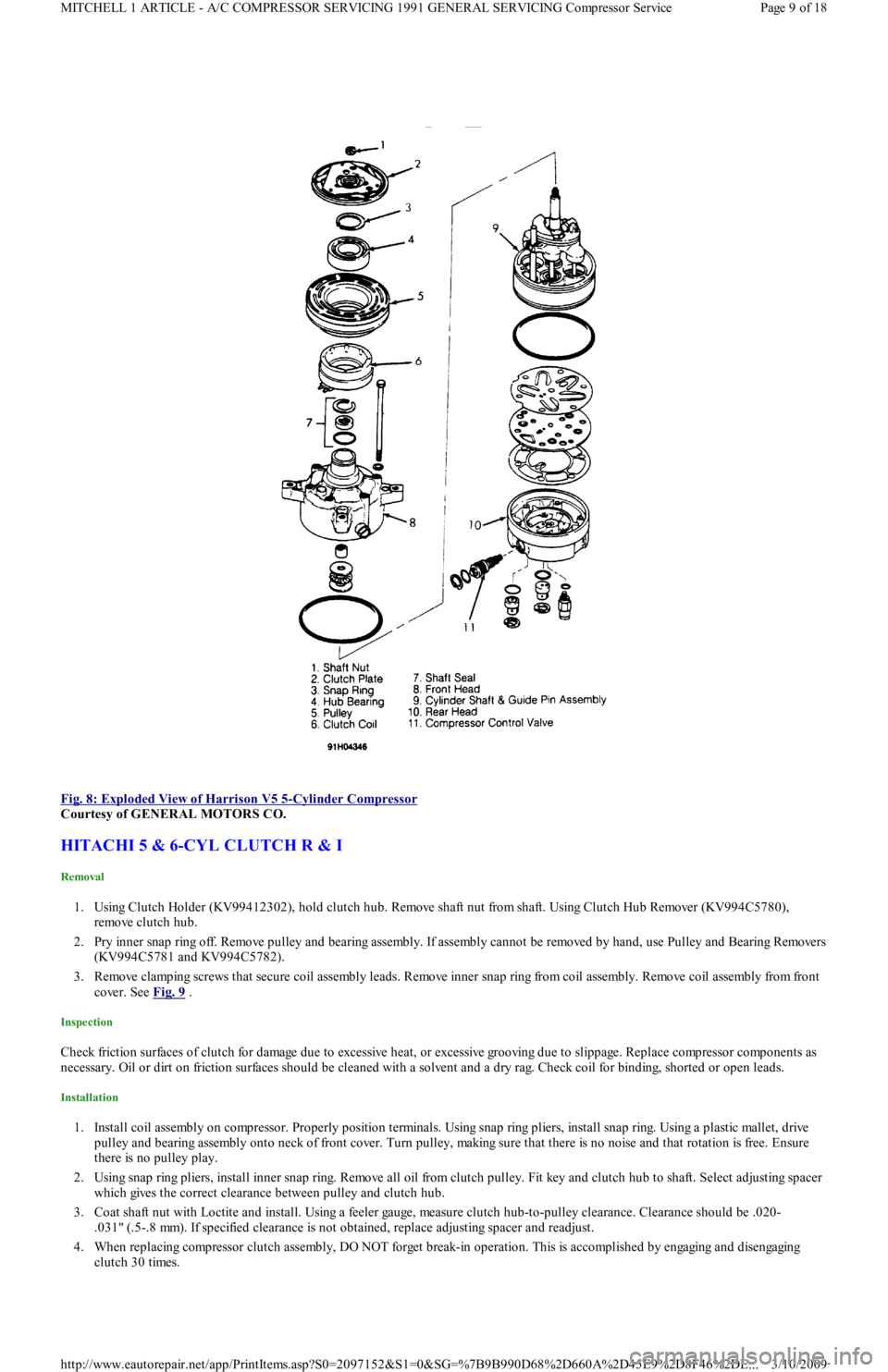
Fig. 8: Exploded View of Harrison V5 5
-Cylinder Compressor
Courtesy of GENERAL MOTORS CO.
HITACHI 5 & 6-CYL CLUTCH R & I
Removal
1. Using Clutch Holder (KV99412302), hold clutch hub. Remove shaft nut from shaft. Using Clutch Hub Remover (KV994C5780),
remove clutch hub.
2. Pry inner snap ring off. Remove pulley and bearing assembly. If assembly cannot be removed by hand, use Pulley and Bearing Remo vers
(KV994C5781 and KV994C5782).
3. Remove clamping screws that secure coil assembly leads. Remove inner snap ring from coil assembly. Remove coil assembly from fro n t
cover. See Fig. 9
.
Inspection
Check friction surfaces of clutch for damage due to excessive heat, or excessive grooving due to slippage. Replace compressor components as
necessary. Oil or dirt on friction surfaces should be cleaned with a solvent and a dry rag. Check coil for binding, shorted or open leads.
Installation
1. Install coil assembly on compressor. Properly position terminals. Using snap ring pliers, install snap ring. Using a plastic mallet, drive
pulley and bearing assembly onto neck of front cover. Turn pulley, making sure that there is no noise and that rotation is free. Ensure
there is no pulley play.
2. Using snap ring pliers, install inner snap ring. Remove all oil from clutch pulley. Fit key and clutch hub to shaft. Select adjusting spacer
which gives the correct clearance between pulley and clutch hub.
3. Coat shaft nut with Loctite and install. Using a feeler gauge, measure clutch hub-to-pulley clearance. Clearance should be .020-
.031" (.5-.8 mm). If specified clearance is not obtained, replace adjusting spacer and readjust.
4. When replacing compressor clutch assembly, DO NOT forget break-in operation. This is accomplished by engaging and disengaging
clutch 30 times.
Page 9 of 18 MITCHELL 1 ARTICLE - A/C COMPRESSOR SERVICING 1991 GENERAL SERVICING Compressor Service
3/10/2009 http://www.eautorepair.net/app/PrintItems.asp?S0=2097152&S1=0&SG=%7B9B990D68%2D660A%2D45E9%2D8F46%2DE
...
Page 332 of 454
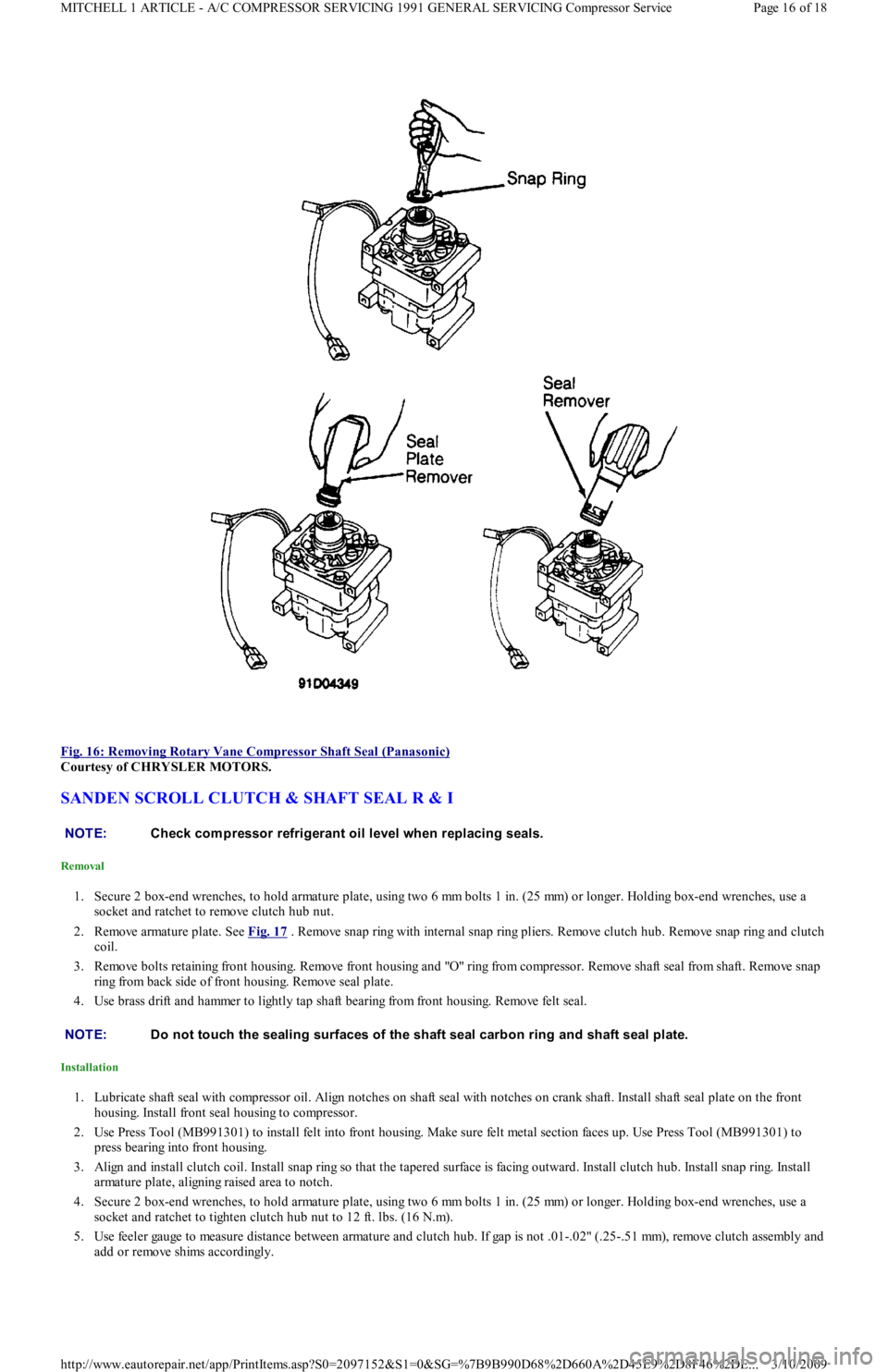
Fig. 16: Removing Rotary Vane Compressor Shaft Seal (Panasonic)
Courtesy of CHRYSLER MOTORS.
SANDEN SCROLL CLUTCH & SHAFT SEAL R & I
Removal
1. Secure 2 box-end wrenches, to hold armature plate, using two 6 mm bolts 1 in. (25 mm) or longer. Holding box-end wrenches, use a
socket and ratchet to remove clutch hub nut.
2. Remove armature plate. See Fig. 17
. Remove snap ring with internal snap ring pliers. Remove clutch hub. Remove snap ring and clutch
coil.
3. Remove bolts retaining front housing. Remove front housing and "O" ring from compressor. Remove shaft seal from shaft. Remove snap
ring from back side of front housing. Remove seal plate.
4. Use brass drift and hammer to lightly tap shaft bearing from front housing. Remove felt seal.
Installation
1. Lubricate shaft seal with compressor oil. Align notches on shaft seal with notches on crank shaft. Install shaft seal plate on the front
housing. Install front seal housing to compressor.
2. Use Press Tool (MB991301) to install felt into front housing. Make sure felt metal section faces up. Use Press Tool (MB991301) to
press bearing into front housing.
3. Align and install clutch coil. Install snap ring so that the tapered surface is facing outward. Install clutch hub. Install snap ring. Install
armature plate, aligning raised area to notch.
4. Secure 2 box-end wrenches, to hold armature plate, using two 6 mm bolts 1 in. (25 mm) or longer. Holding box-end wrenches, use a
socket and ratchet to tighten clutch hub nut to 12 ft. lbs. (16 N.m).
5. Use feeler gauge to measure distance between armature and clutch hub. If gap is not .01-.02" (.25-.51 mm), remove clutch assemb l y an d
add or remove shims accordingly.
NOTE:Check com pressor refrigerant oil level when replacing seals.
NOTE:Do not touch the sealing surfaces of the shaft seal carbon ring and shaft seal plate.
Page 16 of 18 MITCHELL 1 ARTICLE - A/C COMPRESSOR SERVICING 1991 GENERAL SERVICING Compressor Service
3/10/2009 http://www.eautorepair.net/app/PrintItems.asp?S0=2097152&S1=0&SG=%7B9B990D68%2D660A%2D45E9%2D8F46%2DE
...