1991 FORD FESTIVA automatic transmission
[x] Cancel search: automatic transmissionPage 252 of 454
Back To Article
GENERAL INFORMATION
Com puter Relearn Procedures
COMPUTER RELEARN PROCEDURES
Vehicles equipped with engine or transmission computers may require a relearn procedure after vehicle battery is disconnected. Many vehicle
computers memorize and store vehicle operation patterns for optimum driveability and performance. When vehicle battery is disconnected,
this memory is lost. The computer will use default data until new data from each key start is stored. As computer memorizes vehicle operation
for each new key start, driveability is restored. Vehicle computers may memorize vehicles operation patterns for 40 of more key starts.
Customers often complain of driveability problems during relearn stage because vehicle acts differently then before being serviced. Depending
on type and make of vehicle and how it is equipped, the following complaints (driveability problems) may exist:
Harsh Or Poor Shift Quality
Rough Or Unstable Idle
Hesitation Or Stumble
Rich Or Lean Running
Poor Fuel Mileage
These symptoms and complaints should disappear after a number of drive cycles have been memorized. To reduce the possibility of
complaints, after any service which requires battery power to be disconnected, vehicle should be road tested.
GENERIC COMPUTER RELEARN PROCEDURES
Some manufacturers identify a specific relearn procedure which will help establish suitable driveability during relearn stage. These procedures
are especially important if vehicle is equipped with and electronically controlled automatic transmission or transaxle. Always complete
procedure before returning vehicle to customer. The following general procedures are to be used if driveability problems are encountered after
power loss or battery has been disconnected. These procedures may provide an aid in eliminating these problems.
Automatic Transmission
Set parking brake, start engine in "P" or "N" position. Warm-up vehicle to normal operating temperature or until cooling fan cycles.
Allow vehicle to idle for one minute in "N" position. Select "D" and allow engine to idle for one minute.
Accelerate at normal throttle position (20-50%) until vehicle shifts into top gear.
Cruise at light to medium throttle.
Decelerate to a stop, allowing vehicle to downshift, and use brakes normally.
Process may be repeated as necessary.
Manual Transmission
Place transmission in Neutral position.
Ensure emergency brake has been set and all accessories are turned off.
Start engine and bring to normal operating temperature.
Allow vehicle to idle in Neutral for one minute.
Initial relearn is complete, and process will be completed during normal driving.
Copyr ight 2009 Mitchell Repair Information Company, LLC. All Rights Reserved.
Article GUID: A00012612
Page 1 of 1 MITCHELL 1 ARTICLE - GENERAL INFORMATION Computer Relearn Procedures
3/10/2009 http://www.eautorepair.net/app/PrintItems.asp?S0=2097152&S1=0&SG=%7B9B990D68%2D660A%2D45E9%2D8F46%2DE
...
Page 254 of 454
CLUNK
Clunk is a metallic noise heard when an automatic transmission is engaged in Reverse or Drive, or when throttle is applied or released. It is
caused by backlash somewhere in the driveline, but not necessarily in the axle. To determine whether driveline clunk is caused by the axle,
check the total axle backlash as follows:
1. Raise vehicle on a frame or twinpost hoist so that drive wheels are free. Clamp a bar between axle companion flange and a part of the
frame or body so that flange cannot move.
2. On conventional drive axles, lock the left wheel to keep it from turning. On all models, turn the right wheel slowly until it is felt to be in
drive condition. Hold a chalk marker on side of tire about 12" from center of wheel. Turn wheel in the opposite direction until it is again
felt to be in drive condition.
3. Measure the length of the chalk mark, which is the total axle backlash. If backlash is one inch or less, clunk will not be eliminated by
overhauling drive axle.
BEARING WHINE
Bearing whine is a high-pitched sound similar to a whistle. It is usually caused by malfunctioning pinion bearings. Pinion bearings operate at
driveshaft speed. Roller wheel bearings may whine in a similar manner if they run completely dry of lubricant. Bearing noise will occur at all
driving speeds. This distinguishes it from gear whine, which usually comes and goes as speed changes.
BEARING RUMBLE
Bearing rumble sounds like marbles being tumbled. It is usually caused by a malfunctioning wheel bearing. The lower pitch is because the
wheel bearing turns at only about 1/3 of driveshaft speed.
CHATTER ON TURNS
This is a condition where the whole front or rear vibrates when vehicle is moving. The vibration is easily felt and heard. Extra differential
thrust washers installed during axle repair can cause a condition of partial lock-up that creates the chatter.
AXLE SHAFT NOISE
Axle shaft noise is similar to gear noise and pinion bearing whine. Axle shaft bearing noise will normally distinguish itself from gear noise by
occurring in all driving modes. Noise will persist with transmission in neutral while vehicle is moving at problem speed.
If vehicle displays this noise condition, remove suspect axle shafts and replace axle bearings. Re-evaluate vehicle for noise before removing
any internal components.
VIB R AT ION
Vibration is a high-frequency trembling, shaking or grinding condition (felt or heard) that may be constant or variable in level and con occur
during the total operating speed range of the vehicle.
The types of vibrations that can be felt in the vehicle can be divided into 3 main groups:
Vibrations of various unbalanced rotating parts of the vehicle.
Resonance vibrations of the body and frame structures caused by rotating of unbalance parts.
Tip-in moans of resonance vibrations from stressed engine or exhaust system mounts or driveline flexing modes. NOTE:This is GENERAL inform ation. This article is not intended to be specific to any unique situation or
individual vehicle configuration. For m odel-specific inform ation see appropriate articles where
available.
NOTE:This is GENERAL inform ation. This article is not intended to be specific to any unique situation or
individual vehicle configuration. For m odel-specific inform ation see appropriate articles where
available.
NOTE:This is GENERAL inform ation. This article is not intended to be specific to any unique situation or
individual vehicle configuration. For m odel-specific inform ation see appropriate articles where
available.
NOTE:This is GENERAL inform ation. This article is not intended to be specific to any unique situation or
individual vehicle configuration. For m odel-specific inform ation see appropriate articles where
available.
NOTE:This is GENERAL inform ation. This article is not intended to be specific to any unique situation or
individual vehicle configuration. For m odel-specific inform ation see appropriate articles where
available.
NOTE:This is GENERAL inform ation. This article is not intended to be specific to any unique situation or
individual vehicle configuration. For m odel-specific inform ation see appropriate articles where
available.
Copyr ight 2009 Mitchell Repair Information Company, LLC. All Rights Reserved.
Article GUID: A00002193
Page 2 of 2 MITCHELL 1 ARTICLE - GENERAL INFORMATION Drive Axle Noise Diagnosis
3/10/2009 http://www.eautorepair.net/app/PrintItems.asp?S0=2097152&S1=0&SG=%7B9B990D68%2D660A%2D45E9%2D8F46%2DE
...
Page 409 of 454
Back To Article
1988-94 AUT OMAT IC T RANSMISSIONS
Ford ATX Overhaul
APPLICATION
APPLICATION
DESCRIPTION
The transaxle consists of 3 main units: automatic transaxle, torque converter and differential assembly. The automatic transaxle consists of
front and rear clutches, one-way clutch, low-reverse brake assembly, oil pump and hydraulic controls (valve body and servo piston
assemblies). The valve body is controlled by the governor valve, vacuum throttle valve diaphragm (modulator) and kickdown solenoid. The
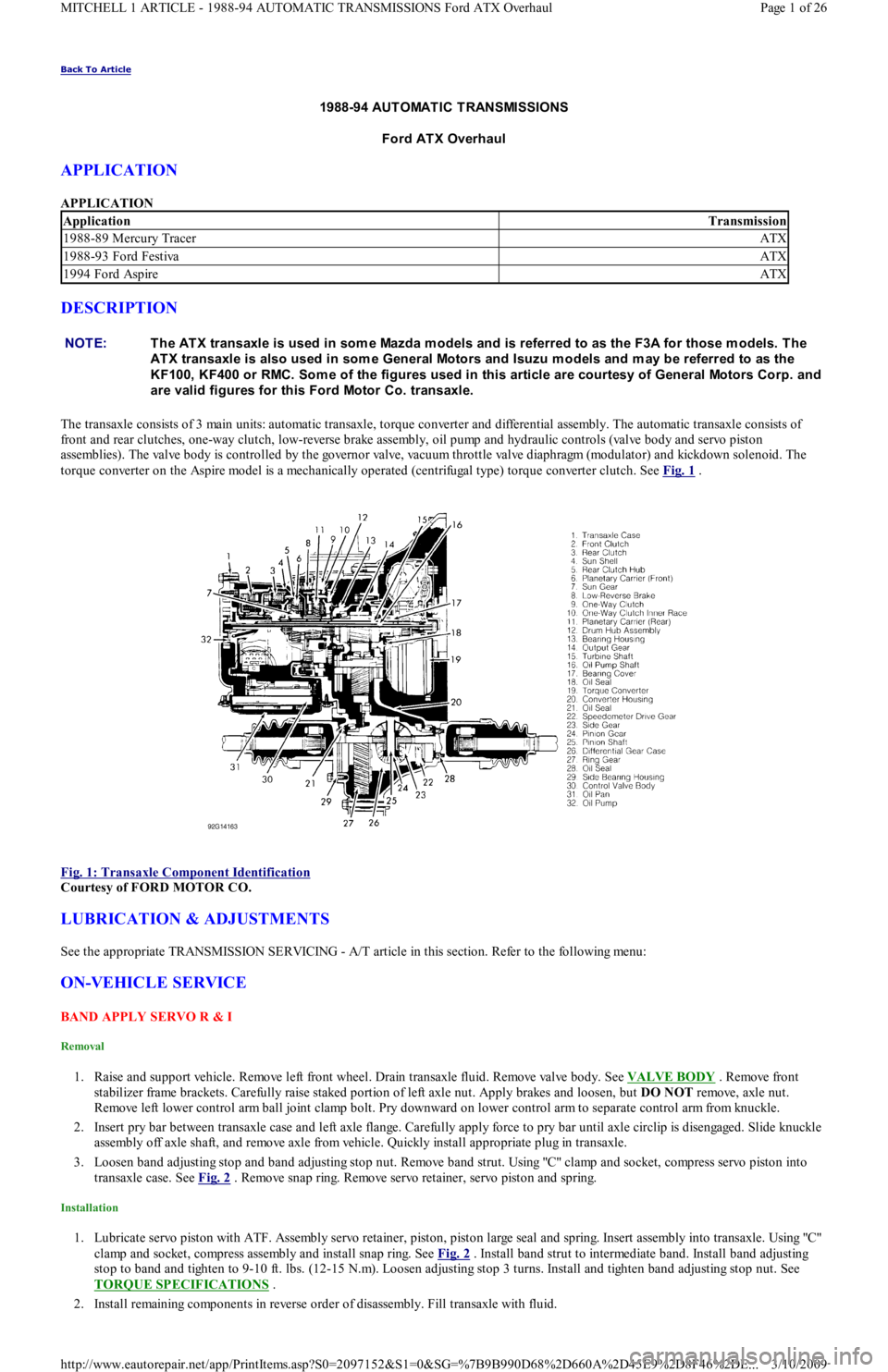
torque converter on the Aspire model is a mechanically operated (centrifugal type) torque converter clutch. See Fig. 1
.
Fig. 1: Transaxle Component Identification
Courtesy of FORD MOTOR CO.
LUBRICATION & ADJUSTMENTS
See the appropriate TRANSMISSION SERVICING - A/T article in this section. Refer to the following menu:
ON-VEHICLE SERVICE
BAND APPLY SERVO R & I
Removal
1. Raise and support vehicle. Remove left front wheel. Drain transaxle fluid. Remove valve body. See VALVE BODY . Remove front
stabilizer frame brackets. Carefully raise staked portion of left axle nut. Apply brakes and loosen, but DO NOT remove, axle nut.
Remove left lower control arm ball joint clamp bolt. Pry downward on lower control arm to separate control arm from knuckle.
2. Insert pry bar between transaxle case and left axle flange. Carefully apply force to pry bar until axle circlip is disengaged. Slide knuckle
assembly off axle shaft, and remove axle from vehicle. Quickly install appropriate plug in transaxle.
3. Loosen band adjusting stop and band adjusting stop nut. Remove band strut. Using "C" clamp and socket, compress servo piston into
transaxle case. See Fig. 2
. Remove snap ring. Remove servo retainer, servo piston and spring.
Installation
1. Lubricate servo piston with ATF. Assembly servo retainer, piston, piston large seal and spring. Insert assembly into transaxle. Usin g "C"
clamp and socket, compress assembly and install snap ring. See Fig. 2
. Install band strut to intermediate band. Install band adjusting
stop to band and tighten to 9-10 ft. lbs. (12-15 N.m). Loosen adjusting stop 3 turns. Install and tighten band adjusting stop nut. See
TORQUE SPECIFICATIONS
.
2. Install remaining components in reverse order of disassembly. Fill transaxle with fluid.
ApplicationTransmission
1988-89 Mercury TracerATX
1988-93 Ford FestivaATX
1994 Ford AspireATX
NOTE:T he AT X transaxle is used in som e Mazda m odels and is referred to as the F3A for those m odels. T he
AT X transaxle is also used in som e General Motors and Isuzu m odels and m ay be referred to as the
KF100, KF400 or RMC. Som e of the figures used in this article are courtesy of General Motors Corp. and
are valid figures for this Ford Motor Co. transaxle.
Page 1 of 26 MITCHELL 1 ARTICLE - 1988-94 AUTOMATIC TRANSMISSIONS Ford ATX Overhaul
3/10/2009 http://www.eautorepair.net/app/PrintItems.asp?S0=2097152&S1=0&SG=%7B9B990D68%2D660A%2D45E9%2D8F46%2DE
...
Page 410 of 454
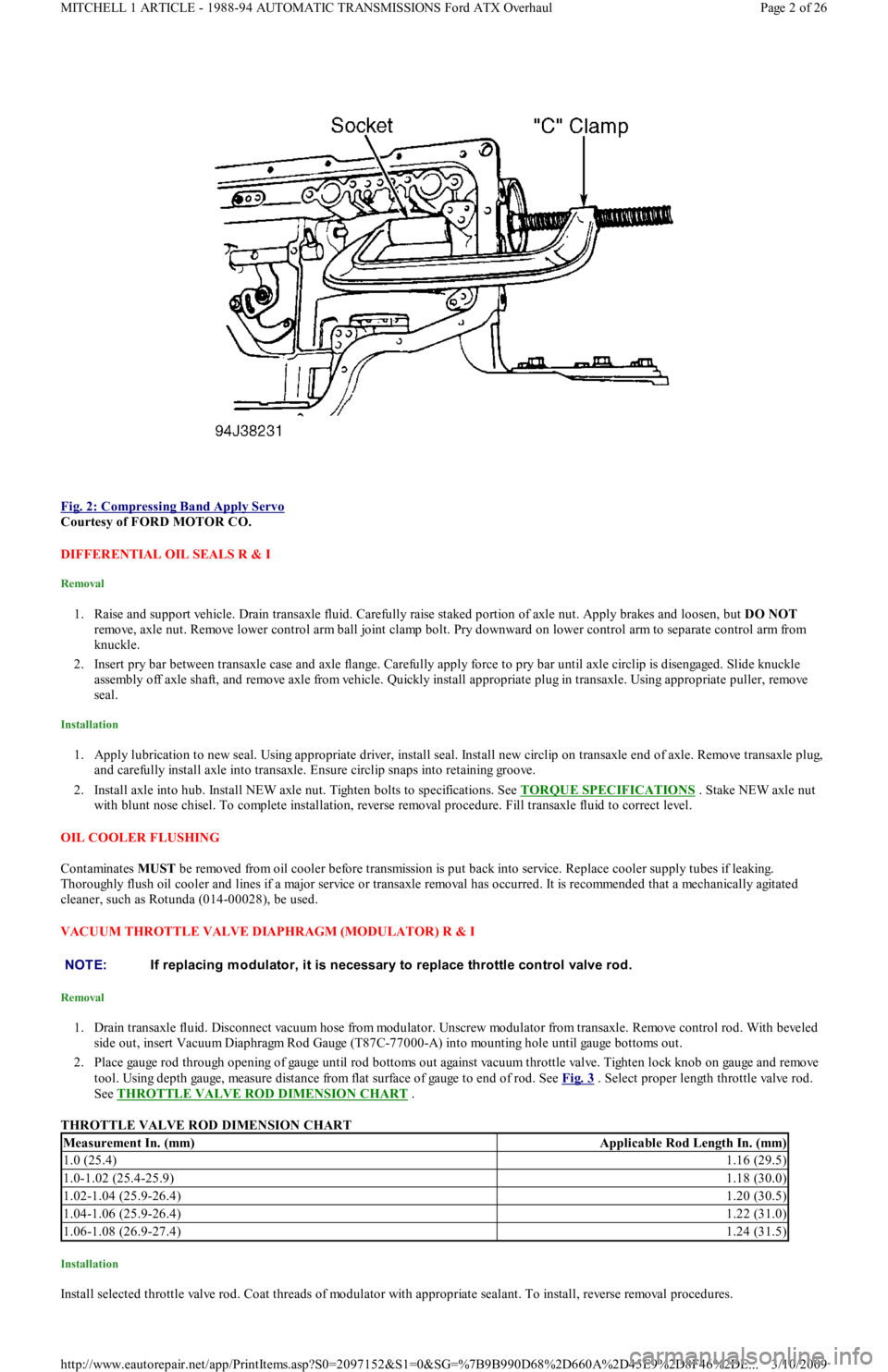
Fig. 2: Compressing Band Apply Servo
Courtesy of FORD MOTOR CO.
DIFFERENTIAL OIL SEALS R & I
Removal
1. Raise and support vehicle. Drain transaxle fluid. Carefully raise staked portion of axle nut. Apply brakes and loosen, but DO NOT
remove, axle nut. Remove lower control arm ball joint clamp bolt. Pry downward on lower control arm to separate control arm from
knuckle.
2. Insert pry bar between transaxle case and axle flange. Carefully apply force to pry bar until axle circlip is disengaged. Slide knuckle
assembly off axle shaft, and remove axle from vehicle. Quickly install appropriate plug in transaxle. Using appropriate puller, remove
seal.
Installation
1. Apply lubrication to new seal. Using appropriate driver, install seal. Install new circlip on transaxle end of axle. Remove transaxle plug,
and carefully install axle into transaxle. Ensure circlip snaps into retaining groove.
2. Install axle into hub. Install NEW axle nut. Tighten bolts to specifications. See TORQUE SPECIFICATIONS
. Stake NEW axle nut
with blunt nose chisel. To complete installation, reverse removal procedure. Fill transaxle fluid to correct level.
OIL COOLER FLUSHING
Contaminates MUST be removed from oil cooler before transmission is put back into service. Replace cooler supply tubes if leaking.
Thoroughly flush oil cooler and lines if a major service or transaxle removal has occurred. It is recommended that a mechanically agitated
cleaner, such as Rotunda (014-00028), be used.
VACUUM THROTTLE VALVE DIAPHRAGM (MODULATOR) R & I
Removal
1. Drain transaxle fluid. Disconnect vacuum hose from modulator. Unscrew modulator from transaxle. Remove control rod. With beveled
side out, insert Vacuum Diaphragm Rod Gauge (T87C-77000-A) into mounting hole until gauge bottoms out.
2. Place gauge rod through opening of gauge until rod bottoms out against vacuum throttle valve. Tighten lock knob on gauge and remove
tool. Using depth gauge, measure distance from flat surface of gauge to end of rod. See Fig. 3
. Select proper length throttle valve rod.
See THROTTLE VALVE ROD DIMENSION CHART
.
THROTTLE VALVE ROD DIMENSION CHART
Installation
Install selected throttle valve rod. Coat threads of modulator with appropriate sealant. To install, reverse removal procedures.
NOTE:If replacing m odulator, it is necessary to replace throttle control valve rod.
Measurement In. (mm)Applicable Rod Length In. (mm)
1.0 (25.4)1.16 (29.5)
1.0-1.02 (25.4-25.9)1.18 (30.0)
1.02-1.04 (25.9-26.4)1.20 (30.5)
1.04-1.06 (25.9-26.4)1.22 (31.0)
1.06-1.08 (26.9-27.4)1.24 (31.5)
Page 2 of 26 MITCHELL 1 ARTICLE - 1988-94 AUTOMATIC TRANSMISSIONS Ford ATX Overhaul
3/10/2009 http://www.eautorepair.net/app/PrintItems.asp?S0=2097152&S1=0&SG=%7B9B990D68%2D660A%2D45E9%2D8F46%2DE
...
Page 411 of 454
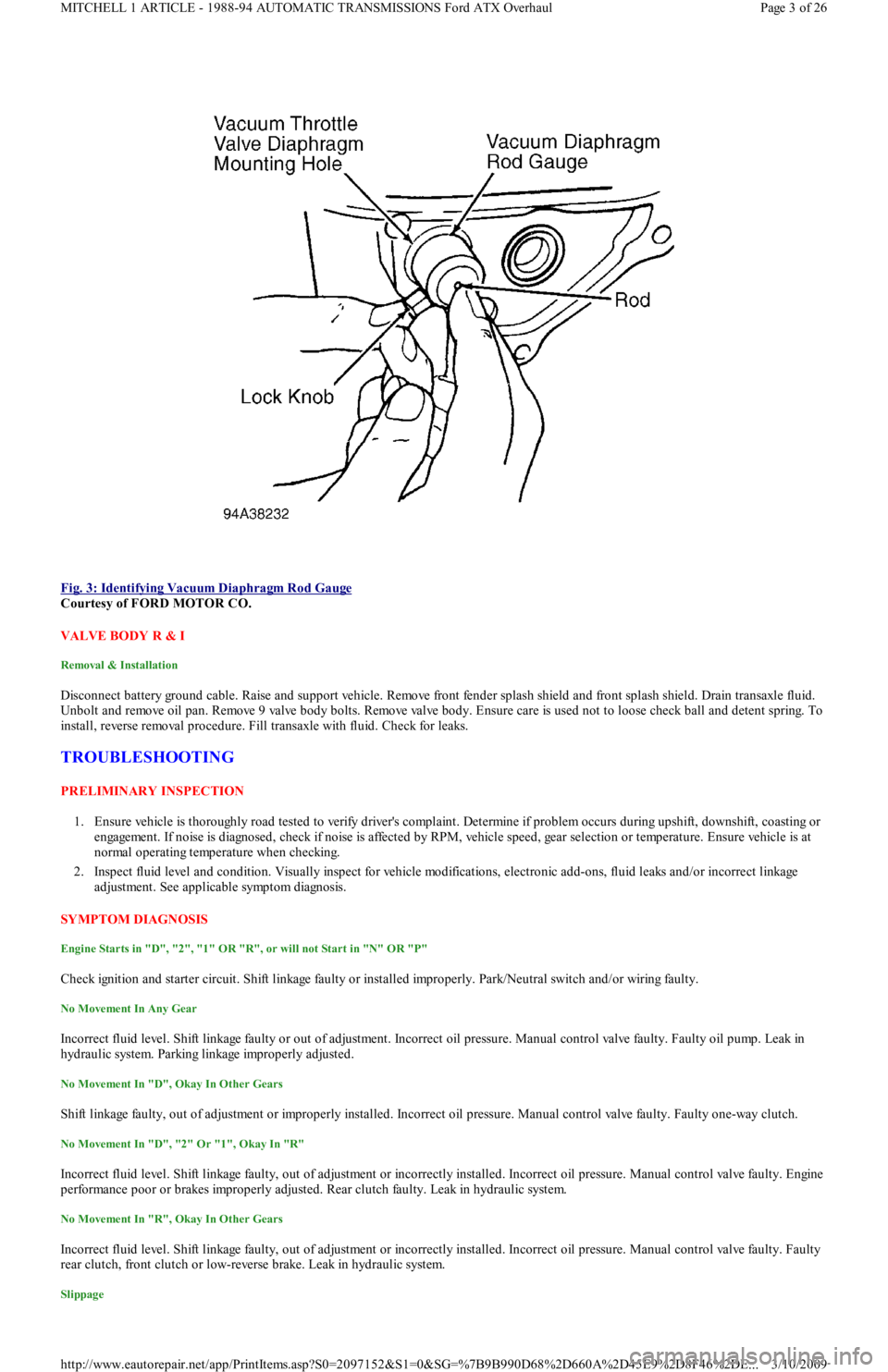
Fig. 3: Identifying Vacuum Diaphragm Rod Gauge
Courtesy of FORD MOTOR CO.
VALVE BODY R & I
Removal & Installation
Disconnect battery ground cable. Raise and support vehicle. Remove front fender splash shield and front splash shield. Drain transaxle fluid.
Unbolt and remove oil pan. Remove 9 valve body bolts. Remove valve body. Ensure care is used not to loose check ball and detent spring. To
install, reverse removal procedure. Fill transaxle with fluid. Check for leaks.
TROUBLESHOOTING
PRELIMINARY INSPECTION
1. Ensure vehicle is thoroughly road tested to verify driver's complaint. Determine if problem occurs during upshift, downshift, coasting or
engagement. If noise is diagnosed, check if noise is affected by RPM, vehicle speed, gear selection or temperature. Ensure vehicle is at
normal operating temperature when checking.
2. Inspect fluid level and condition. Visually inspect for vehicle modifications, electronic add-ons, fluid leaks and/or incorrect linkage
adjustment. See applicable symptom diagnosis.
SYMPTOM DIAGNOSIS
Engine Starts in "D", "2", "1" OR "R", or will not Start in "N" OR "P"
Check ignition and starter circuit. Shift linkage faulty or installed improperly. Park/Neutral switch and/or wiring faulty.
No Movement In Any Gear
Incorrect fluid level. Shift linkage faulty or out of adjustment. Incorrect oil pressure. Manual control valve faulty. Faulty oil pump. Leak in
hydraulic system. Parking linkage improperly adjusted.
No Movement In "D", Okay In Other Gears
Shift linkage faulty, out of adjustment or improperly installed. Incorrect oil pressure. Manual control valve faulty. Faulty one-way clutch.
No Movement In "D", "2" Or "1", Okay In "R"
Incorrect fluid level. Shift linkage faulty, out of adjustment or incorrectly installed. Incorrect oil pressure. Manual control valve faulty. Engine
performance poor or brakes improperly adjusted. Rear clutch faulty. Leak in hydraulic system.
No Movement In "R", Okay In Other Gears
Incorrect fluid level. Shift linkage faulty, out of adjustment or incorrectly installed. Incorrect oil pressure. Manual control valve faulty. Faulty
rear clutch, front clutch or low-reverse brake. Leak in hydraulic system.
Slippage
Page 3 of 26 MITCHELL 1 ARTICLE - 1988-94 AUTOMATIC TRANSMISSIONS Ford ATX Overhaul
3/10/2009 http://www.eautorepair.net/app/PrintItems.asp?S0=2097152&S1=0&SG=%7B9B990D68%2D660A%2D45E9%2D8F46%2DE
...
Page 412 of 454
ATF level incorrect or contaminated. Manual valve out of adjustment. Vacuum modulator faulty or leak in vacuum circuit. Fluid pressures
incorrect. Oil pump faulty. Leak in hydraulic circuit.
Vehicle Creeps In "N" Position
Shift linkage faulty, out of adjustment or incorrectly installed. Manual control valve faulty. Contaminated fluid. Faulty rear clutch.
Vehicle Creeps Excessively
Engine idle speed too high.
Vehicle Will Not Creep
Fluid level incorrect or fluid contaminated. Shift linkage faulty, out of adjustment or incorrectly installed. Engine idle too low. Manual
control valve faulty. Faulty oil pump. Leak in hydraulic system. Faulty front or rear clutch.
Low Maximum Speed & Poor Acceleration
Incorrect ATF level or contaminated fluid. Selector linkage out of adjustment. Engine stall speed incorrect. Poor engine performance. Brake
band faulty or out of adjustment. Faulty low-reverse brake, front clutch, rear clutch or hydraulic circuit.
Harsh "N" To "D" Engagement
Engine idle too high. Leak in vacuum circuit. Incorrect oil pressure. Manual control valve faulty. Faulty rear clutch. Low fluid level.
Harsh 1-2 Shift
Leak in vacuum circuit. Engine stall speed incorrect. Contaminated fluid. Manual control valve faulty. Band servo faulty. Brake band damaged
or out of adjustment.
Harsh 2-3 Shift
Leak in vacuum circuit. Incorrect oil pressure. Manual control valve faulty. Band servo or front clutch faulty. Brake band faulty.
Shift Shock Felt On Kickdown Downshift
Shift linkage damaged, out of adjustment or incorrectly installed. Leak in vacuum circuit. Kickdown solenoid, switch or wiring fau l t y.
Incorrect oil pressure. Manual control valve or governor valve faulty. Leak in hydraulic system.
2-1 Shift Shock With Lever In "1" Position
Leak in vacuum circuit. Engine stall speed incorrect. Manual control valve faulty. Contaminated fluid. Low-reverse brake faulty. Line pressure
high.
Shift Shock On Deceleration
Range selector out of adjustment. Vacuum diaphragm or piping faulty. Kickdown solenoid out of adjustment or faulty. Excessive line pressure.
M a n u a l va l ve fa u l t y. Go ve r n o r va l ve fa u l t y.
Vehicle Brakes In "R" Position
Band servo faulty. Contaminated fluid. Faulty rear clutch. Brake band damaged or out of adjustment. Parking linkage damaged or improperly
adjusted.
Vehicle Brakes On 1-2 Shift
Manual control valve faulty. Contaminated fluid. Front clutch or low-reverse brake faulty. One-way clutch faulty.
Vehicle Brakes On 2-3 Shift
Manual control valve faulty. Band servo faulty. Contaminated fluid. Brake band out of adjustment or damaged.
No Engine Braking In "1" Position
Shift linkage damaged, out of adjustment or installed incorrectly. Incorrect oil pressure. Manual control valve faulty. Contaminated fluid.
Low-reverse brake faulty. Leak in hydraulic system.
No Shift Shock; Slippage On 1-2 Shift
Incorrect fluid level. Shift linkage damaged, out of adjustment or incorrectly installed. Leak in vacuum circuit. Oil pressure incorrect. Manual
control valve faulty. Band servo faulty. Contaminated fluid. Brake band faulty. Leakage in hydraulic system.
No Shift Shock; Slippage When Manually Shifted From "1" To "2" Position
Incorrect fluid level. Shift linkage damaged, out of adjustment or installed incorrectly. Leak in vacuum circuit. Engine idle speed incorrect.
Engine stall speed incorrect. Manual control valve faulty. Contaminated fluid. Brake band out of adjustment or damaged. Oil pump faulty.
No Shift Shock; Slippage On 2-3 Shift
ATF contaminated or level incorrect. Shift linkage faulty. Vacuum modulator faulty or leak in vacuum circuit. Line pressure not correct. Band
servo faulty. Front clutch faulty. Leak in hydraulic system.
Slippage On 3-2 Kickdown
Page 4 of 26 MITCHELL 1 ARTICLE - 1988-94 AUTOMATIC TRANSMISSIONS Ford ATX Overhaul
3/10/2009 http://www.eautorepair.net/app/PrintItems.asp?S0=2097152&S1=0&SG=%7B9B990D68%2D660A%2D45E9%2D8F46%2DE
...
Page 413 of 454
Leak in vacuum circuit. Oil pressure incorrect. Manual valve faulty. Band servo faulty. Contaminated fluid. Front clutch faulty. Brake band
out of adjustment or damaged. Leak in hydraulic system.
Transaxle Slips In 1st Gear
Incorrect fluid level. Shift linkage faulty, out of adjustment or incorrectly installed. Incorrect oil pressure. Manual control valve faulty.
Contaminated fluid. Incorrect idle speed. Faulty kickdown solenoid, switch or wiring.
No 1-2 Shift
Shift linkage defective, out of adjustment or incorrectly installed. Leak in vacuum circuit. Faulty kickdown solenoid, switch or wiring.
Contaminated fluid. Manual control valve faulty. Governor valve faulty. Band servo faulty. Brake band out of adjustment. Leak in hydraulic
system. Rear clutch faulty.
No 2-3 Shift
Shift linkage defective, out of adjustment or incorrectly installed. Leak in vacuum circuit. Faulty kickdown solenoid, switch or wiring.
Contaminated fluid. Manual control valve, governor valve or band servo faulty. Leak in hydraulic system. Front clutch faulty.
No Lock-Up
Faulty torque converter, wiring or solenoid.
1-3 Shift; Skips 2nd
Contaminated fluid. Brake band out of adjustment or damaged. Leak in hydraulic system.
No 3-2 Downshift
Leak in vacuum circuit. Manual control valve, governor valve or band servo faulty. Contaminated fluid. Faulty front clutch. Brake band out of
adjustment of damaged. Leak in hydraulic system.
No 2-1 or 3-1 Downshift
Leak in vacuum circuit. Manual control valve, governor valve or band servo faulty. Contaminated fluid. Brake band out of adjustmen t o r
damaged. One-way clutch faulty.
Slippage When Accelerating In 3rd Gear Above Kickdown Speed
Shift linkage damaged, out of adjustment or installed incorrectly. Leak in vacuum circuit. Oil pressure incorrect. Manual control valve or
governor valve faulty. Contaminated fluid. Front clutch faulty. Leak in hydraulic system.
No Kickdown At Normal Speeds In 3rd Gear
Leak in vacuum circuit. Kickdown solenoid, switch or wiring faulty. Manual control valve or governor valve faulty. Contaminated fluid. Brake
band out of adjustment or damaged. Leak in hydraulic system.
1-2 & 2-3 Shift Points Too High
ATF contaminated or level incorrect. Vacuum modulator faulty or leak in vacuum circuit. Line pressures incorrect. Manual valve out of
adjustment. Governor valve faulty. Hydraulic circuit leaking.
3-2 & 2-1 Shift Points Too High
Shift linkage damaged, out of adjustment or incorrectly installed. Kickdown solenoid, switch or wiring faulty. Leak in vacuum circuit.
Incorrect oil pressure. Manual control valve or governor valve faulty. Leak in hydraulic system.
1-2 Or 2-3 Shifts With Shift Lever In "1" Position
Shift linkage damaged, out of adjustment or installed incorrectly. Manual control valve faulty. Leak in hydraulic system.
2-1 or 2-3 Shifts With Shift Lever In "2" Position
Shift linkage damaged, out of adjustment or installed incorrectly. Incorrect oil pressure. Manual control valve faulty.
Vehicle Moves In "P" Or Parking Gear Remains Engaged When
Shifted Out Of "P" Position
Shift linkage damaged, out of adjustment or incorrectly installed. Parking linkage out of adjustment or damaged.
Transaxle Noisy In "P" Or "N" Position
Incorrect fluid level. Incorrect oil pressure. Faulty rear clutch, oil pump, one-way clutch or planetary gear.
Transaxle Noisy In "D", "1", "2" or "R"
Oil pressure incorrect. Rear clutch, oil pump, one-way clutch or planetary gears faulty.
Transmission Overheats
ATF level incorrect. Engine stall speed and/or line pressure incorrect. Faulty band servo, front clutch, rear clutch, brake band, low-reverse
brake, oil pump, torque converter or planetary gear. Leak in hydraulic circuit.
Page 5 of 26 MITCHELL 1 ARTICLE - 1988-94 AUTOMATIC TRANSMISSIONS Ford ATX Overhaul
3/10/2009 http://www.eautorepair.net/app/PrintItems.asp?S0=2097152&S1=0&SG=%7B9B990D68%2D660A%2D45E9%2D8F46%2DE
...
Page 414 of 454
Differential Noise
ATF contaminated or level incorrect. Bearings worn or has excessive preload. Teeth on gears worn or damaged or has excessive backlash.
TESTING
PARK/NEUTRAL SWITCH TEST
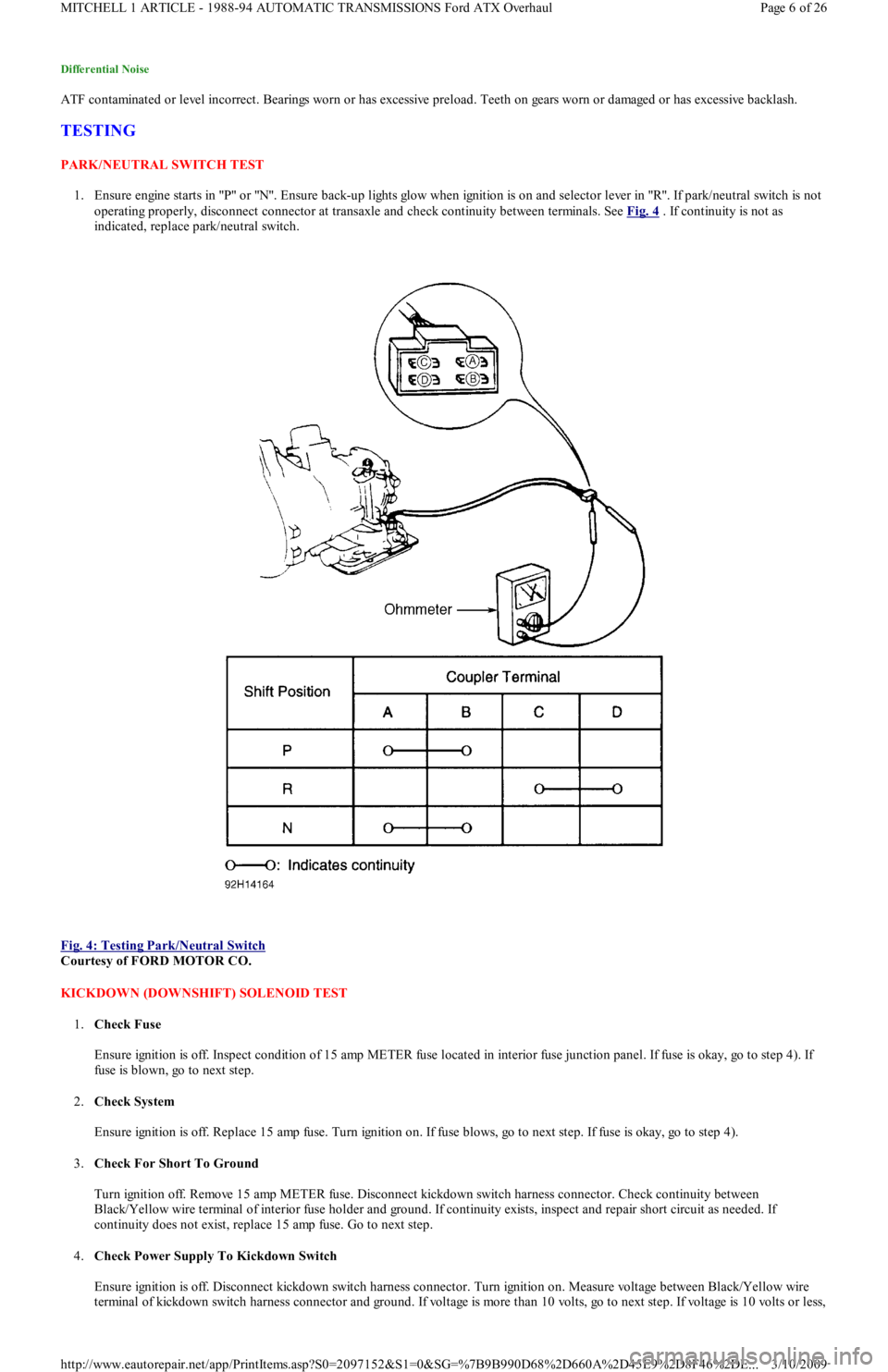
1. Ensure engine starts in "P" or "N". Ensure back-up lights glow when ignition is on and selector lever in "R". If park/neutral switch is not
operating properly, disconnect connector at transaxle and check continuity between terminals. See Fig. 4
. If continuity is not as
indicated, replace park/neutral switch.
Fig. 4: Testing Park/Neutral Switch
Courtesy of FORD MOTOR CO.
KICKDOWN (DOWNSHIFT) SOLENOID TEST
1.Check Fuse
Ensure ignition is off. Inspect condition of 15 amp METER fuse located in interior fuse junction panel. If fuse is okay, go to step 4). If
fuse is blown, go to next step.
2.Check System
Ensure ignition is off. Replace 15 amp fuse. Turn ignition on. If fuse blows, go to next step. If fuse is okay, go to step 4).
3.Check For Short To Ground
Turn ignition off. Remove 15 amp METER fuse. Disconnect kickdown switch harness connector. Check continuity between
Black/Yellow wire terminal of interior fuse holder and ground. If continuity exists, inspect and repair short circuit as needed. If
continuity does not exist, replace 15 amp fuse. Go to next step.
4.Check Power Supply To Kickdown Switch
Ensure ignition is off. Disconnect kickdown switch harness connector. Turn ignition on. Measure voltage between Black/Yellow wire
terminal of kickdown switch harness connector and ground. If voltage is more than 10 volts, go to next step. If voltage is 10 volts or less,
Page 6 of 26 MITCHELL 1 ARTICLE - 1988-94 AUTOMATIC TRANSMISSIONS Ford ATX Overhaul
3/10/2009 http://www.eautorepair.net/app/PrintItems.asp?S0=2097152&S1=0&SG=%7B9B990D68%2D660A%2D45E9%2D8F46%2DE
...