1990 VOLVO 240 low oil pressure
[x] Cancel search: low oil pressurePage 8 of 143

Volvo 1990 240 Model
A Clock
B Direction indicator (green)
C Speedometer
In kilometers and miles per hour (U.S. models)
In kilometers per hour (Canadian models)
D Odometer
Total reading in miles (U.S. models)
Total reading in kilometers (Canadian models)
E Temperature gauge
The gauge pointer should remain inside the black range during normal \
operation.
If the pointer enters the red range repeatedly, check coolant level a\
nd fan belt tension. (See sections
titled "Cooling system and coolant") Warning: allow engine to cool before adding
fluid.
Do not continue to drive the car with the pointer in the red zone.
F Fuel gauge
The fuel tank capacity is approx 60 liters = 15.8 US gals. See "Fuel \
requirements".
G Clock reset knob
H Service reminder light
I Check engine (red)
J Alternator warning light (red)
K Oil pressure warning light (red)
Do not drive the car with this light on.
L SRS (Supplemental Restraint System)
M Trip odometer reset knob Push in to reset
file:///K|/ownersdocs/1990/1990_240/90240_01.htm (4 of 5)12/30/2006 8:\
25:01 AM
Page 10 of 143

Volvo 1990 240 Model
pg. 11 Warning lights
The warning lights described on this page should never be on when drivin\
g
When the ignition is turned on, and before the engine starts, all of the\
warning lights should be on to test
the function of the bulbs. Should a light not go off after the engine ha\
s started, the system indicated
should be inspected. (However, the parking brake reminder light will no\
t go off until the parking brake
is fully released.)
Alternator warning light (red)
If the light comes on while the engine is running,
check the tension of the alternator drive belt as soon
as possible. (See section titled "Cooling system".)
NOTE: This warning light is illuminated if the
alternator is not charging. However, alternator,
parking brake, brake failure, and bulb failure will
be illuminated at the same time due to the design
of the system
Parking brake reminder light (red)
This light will be on when the parking brake
(hand brake) is applied. The parking brake lever
is situated between the front seats. Canadian
models are equipped with this warning light:
Bulb failure warning light (yellow)
The light will come on if any of the following bulbs
are defective:
one of the lower beams
one of the tail lights
one of the brake lights (when the brake pedal is
depressed).
See section on "Replacing Bulbs."
Oil pressure warning light (red)
If the light comes on during driving, the oil
pressure is too low. Stop the engine immediately
and check the engine oil level. See section titled
"Engine Oil". Do not continue to drive the car
with this light on.
After hard driving, the light will come on
occasionally when the engine is idling. This is
normal, provided it goes off when the engine
speed is increased.
file:///K|/ownersdocs/1990/1990_240/90240_02.htm (1 of 4)12/30/2006 8:\
25:02 AM
Page 53 of 143
, transmission in neutral, applyin\
g the parking brake")
Volvo 1990 240 Model
To obtain best parking brake performance, the brake linings should be br\
oken in.
Stop 5-7 times from 30 mph (50 km/h), transmission in neutral, applyin\
g the parking brake with the
release button pressed in during the stop. The force must not lock the r\
ear wheels. If this happens,
release the brake enough to let the wheels rotate. Drive a mile between \
each stop to cool the brakes.
Check for proper parking brake operation.
Note: The brake lights are not illuminated when applying the parking bra\
ke. To warn traffic from
behind it is therefore advisable to depress the brake pedal slightly to \
illuminate the brake lights.
600 - 1,200 mile maintenance service
To ensure proper operation the car should be taken to a Volvo dealer bet\
ween the first 600 - 1,200 miles
(1,000 - 2,000 km) for a maintenance service. The oil in the engine, m\
anual transmission and rear axle
will then be changed. This is very important since the oil rapidly colle\
cts impurities during the break-in
period.
pg. 43 Driving economy, Shift indicator light
Economical driving does not necessarily mean driving slowly
Better driving economy may be obtained by thinking ahead, avoiding rapid\
starts and stops and
adjusting the speed of your vehicle to immediate traffic conditions. Obs\
erve the following rules:
l Bring the engine to normal operating temperature as soon as possible by \
driving with a light foot on
the accelerator pedal instead of allowing the engine to idle for a prolo\
nged period. A cold engine uses
more fuel and is subject to increased wear.
l When possible avoid using the car for driving short distances. This does\
not allow the engine to reach
normal operating temperature.
l Drive carefully and avoid rapid acceleration and hard braking.
l Do not exceed speed limit.
l Avoid carrying unnecessary items (extra load) in the car.
l Check tire pressures regularly (cold tires).
l Remove snow tires when threat of snow or ice has ended.
l Note that roof racks, ski racks, etc., increase air resistance and there\
by fuel consumption.
file:///K|/ownersdocs/1990/1990_240/90240_09.htm (3 of 6)12/30/2006 8:\
25:05 AM
Page 54 of 143

Volvo 1990 240 Model
l Avoid using automatic transmission kick-down feature unless necessary.
Other factors which decrease gas mileage are:
l Worn or dirty spark plugs
l Incorrect spark plug gap
l Dirty air filter
l Incorrect valve clearance
l Incorrect idle speed
l Dirty engine oil and clogged oil filter
l Dragging brakes
l Incorrect front end alignment
l Low tire pressure
Shift indicator light
(manual transmission models only)
The Volvo shift indicator light (S.I.L.) is a device designed to help \
you get even better gas mileage from
your Volvo car. Studies have shown that the best fuel economy is obtaine\
d by shifting gears at low
engine rpm and high relative engine load. The Volvo S.I.L. is calibrated\
to show you when to shift for
improved mileage without sacrificing smooth acceleration .
Use of the S.I.L. is simple. Shift to next higher gear as soon as the li\
ght comes on. You may find after
using the S.I.L. for some time that your natural shifting rhythm will ad\
apt to the S.I.L.'s suggestion.
Some drivers may even shift before the light comes on.
Obviously, there will be times when you need to shift later than the lig\
ht would indicate (for example,
when climbing hills or trailer towing). Using the light regularly, howe\
ver, should result in a mileage
improvement of six percent or more, depending on how you normally drive.\
Programming instructions for shift indicator
If the current supply to the control unit is cut (battery disconnected)\
, the control unit will have to be re-
programmed as the control unit memory will be erased.
Drive the car in each gear (first gear not necessary) for approximatel\
y 8 seconds.
The gear change indicator light will flicker once (0.5 seconds), as ea\
ch gear is programmed.
file:///K|/ownersdocs/1990/1990_240/90240_09.htm (4 of 6)12/30/2006 8:\
25:05 AM
Page 67 of 143

Volvo 1990 240 Model
The power assist to the brakes functions only when the engine is running\
. When the car is moving
without the engine running the brake pedal pressure required to stop the\
car is increased 3- 4 times.
The brake pedal feels stiff and hard.
Disc brake noise: A slight-to-moderate amount of disc brake "squeal" is \
considered normal.
Air dam (front spoiler)
A non-factory air dam can negatively influence the normal flow of coolin\
g air to the front wheel brakes.
(See section titled "Wheels and Tires").
If one of the brake circuits should malfunction the red warning light wi\
ll come on
(See section titled "Warning Lights".)
The pedal stroke increases slightly and the pedal feels softer but the p\
edal pressure required does not
increase noticeably.
If the light comes on while driving and the brake pedal can be depressed\
further than normal, it is an
indication that one of the brake circuits is not functioning. Stop immed\
iately, open engine hood and
check brake fluid level.
Reservoir empty: do NOT drive. Tow car to shop for check/repair of brake\
system. Reservoir not empty:
proceed immediately and with caution to a Volvo dealer for an inspection\
of the brake system.
Severe strain on the brake system
The brakes will be subject to severe strain when driving in mountains or\
hilly areas. The speed is usually
low which means that the cooling of the brake is less efficient than whe\
n driving on level roads.
To reduce the strain on the brakes it is advisable not to use the brakes\
excessively.
Instead, shift into a lower gear and let the engine help with the brakin\
g. A good rule is to use the same
gear downhill as would be used ascending the same grade. For vehicles wi\
th automatic transmission use
position 2, or in some cases, 1.
file:///K|/ownersdocs/1990/1990_240/90240_11.htm (4 of 6)12/30/2006 8:\
25:06 AM
Page 77 of 143
Volvo 1990 240 Model
pg. 58 Servicing Engine
The following items should be checked weekly Description
by the owner. (This only takes a few moments.) on page
Engine oil level 61
Brake fluid 72
Radiator coolant level 74
Tire pressures (including spare) 82, 103
Operation of all lights -
Horns -
Windshield wipers -
Level of windshield fluid -
The following should also be carried out at Description
regular intervals on page
Washing 87
Polishing 87
Cleaning 87
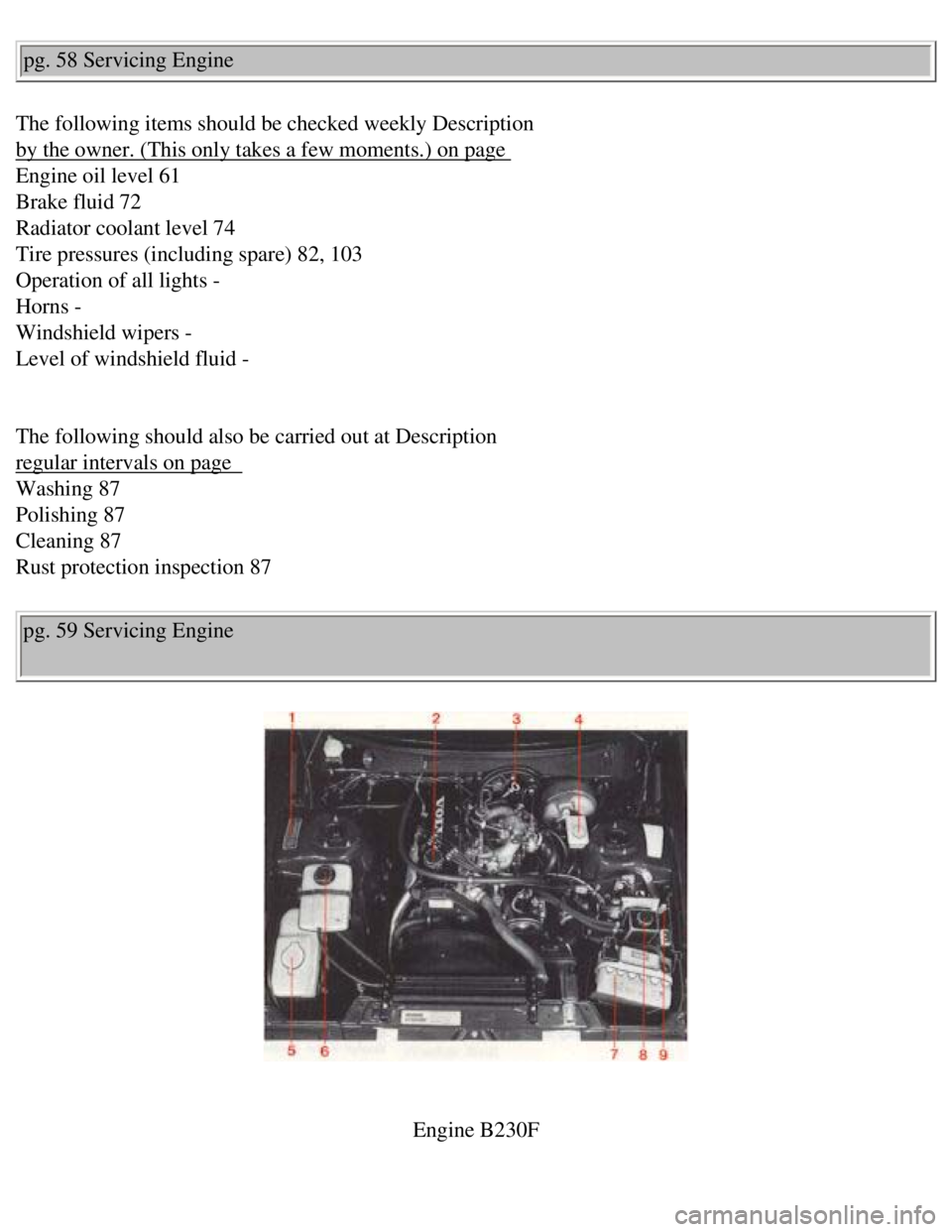
Rust protection inspection 87 pg. 59 Servicing Engine
Engine B230F
file:///K|/ownersdocs/1990/1990_240/90240_13.htm (1 of 9)12/30/2006 8:\
25:08 AM
Page 99 of 143

Volvo 1990 240 Model
Check coolant level
The cooling system must be filled with coolant and not leak to operate a\
t maximum efficiency. Check
the coolant level whenever you refuel. The level should be between the "\
Max"' and "Min" marks on the
expansion tank. The check should be made with particular thoroughness wh\
en the engine is new or the
cooling system has been drained.
Do not remove the filler cap other than for topping up with coolant. Fre\
quent removal may prevent
coolant circulation between the engine and the expansion tank during eng\
ine warm up and cooling.
CAUTION
The cooling system must always be kept filled to the correct level.
If it is not kept filled, there can be high local temperatures in the en\
gine which could result in
damage.
Top up with coolant
Top up with coolant by filling the expansion tank when level is at the "\
Min" mark. Use a mixture of 50
percent Volvo Type C coolant and 50 percent water all the year round. To\
p up to the "Max" mark.
If the engine is warm, and you are going to add coolant, unscrew the cap\
slowly in order to allow any
excess pressure to escape.
Note: Do not add water only. Water by itself reduces the rust protective\
and anti-freeze qualities of the
coolant and has a lower boiling point. It can also cause damage to the c\
ooling system if it should
freeze.
See 'Specifications' section of the manual for type of coolant recommend\
ed.
file:///K|/ownersdocs/1990/1990_240/90240_15.htm (7 of 10)12/30/2006 8\
:25:09 AM