Page 5 of 143
Volvo 1990 240 Model
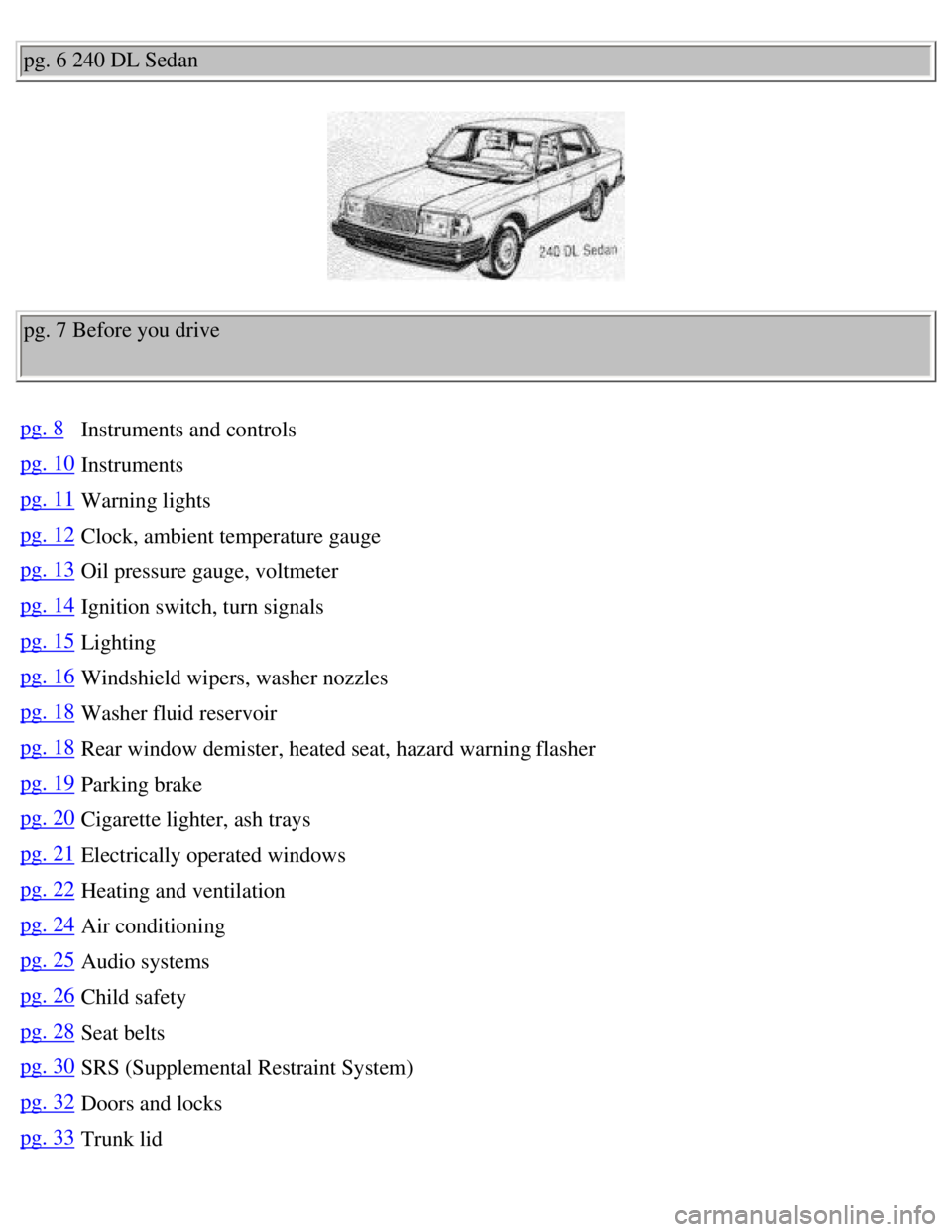
pg. 6 240 DL Sedan
pg. 7 Before you drive
pg. 8Instruments and controls
pg. 10Instruments
pg. 11Warning lights
pg. 12Clock, ambient temperature gauge
pg. 13Oil pressure gauge, voltmeter
pg. 14Ignition switch, turn signals
pg. 15Lighting
pg. 16Windshield wipers, washer nozzles
pg. 18Washer fluid reservoir
pg. 18Rear window demister, heated seat, hazard warning flasher
pg. 19Parking brake
pg. 20Cigarette lighter, ash trays
pg. 21Electrically operated windows
pg. 22Heating and ventilation
pg. 24Air conditioning
pg. 25Audio systems
pg. 26Child safety
pg. 28Seat belts
pg. 30SRS (Supplemental Restraint System)
pg. 32Doors and locks
pg. 33Trunk lid
file:///K|/ownersdocs/1990/1990_240/90240_01.htm (1 of 5)12/30/2006 8:\
25:01 AM
Page 11 of 143

Volvo 1990 240 Model
Brake failure warning light (red)
If the light comes on while driving and the brake
pedal can be depressed further than normal, it is an
indication that one of the brake circuits is not
functioning. Stop immediately, open engine hood
and check brake fluid level (see section "Brake fluid,
power steering").
Reservoir empty: do NOT drive. Tow car to shop for
check/repair of brake system. Reservoir not empty:
proceed immediately and with caution to a Volvo
dealer for an inspection of the brake system.
Canadian models are equipped with this warning
light:
pg. 12 Service reminder light, Clock, Ambient temperature gauge
Supplemental Restraint System (SRS)
If the light comes on (or stays on after the vehicle has started), the\
SRS diagnostic system has detected a
fault. Take the car to an authorized Volvo dealer for an inspection of t\
he system. See the SRS section for
more information.
Service reminder light
This light will come on at 5,000 mile (8,000 km) intervals. It is a re\
minder to the driver that the 5,000
mile (8,000 km) service interval has been exceeded. The light will sta\
y on 2 minutes after start until
reset by the servicing dealer.
Check Engine warning light
file:///K|/ownersdocs/1990/1990_240/90240_02.htm (2 of 4)12/30/2006 8:\
25:02 AM
Page 67 of 143

Volvo 1990 240 Model
The power assist to the brakes functions only when the engine is running\
. When the car is moving
without the engine running the brake pedal pressure required to stop the\
car is increased 3- 4 times.
The brake pedal feels stiff and hard.
Disc brake noise: A slight-to-moderate amount of disc brake "squeal" is \
considered normal.
Air dam (front spoiler)
A non-factory air dam can negatively influence the normal flow of coolin\
g air to the front wheel brakes.
(See section titled "Wheels and Tires").
If one of the brake circuits should malfunction the red warning light wi\
ll come on
(See section titled "Warning Lights".)
The pedal stroke increases slightly and the pedal feels softer but the p\
edal pressure required does not
increase noticeably.
If the light comes on while driving and the brake pedal can be depressed\
further than normal, it is an
indication that one of the brake circuits is not functioning. Stop immed\
iately, open engine hood and
check brake fluid level.
Reservoir empty: do NOT drive. Tow car to shop for check/repair of brake\
system. Reservoir not empty:
proceed immediately and with caution to a Volvo dealer for an inspection\
of the brake system.
Severe strain on the brake system
The brakes will be subject to severe strain when driving in mountains or\
hilly areas. The speed is usually
low which means that the cooling of the brake is less efficient than whe\
n driving on level roads.
To reduce the strain on the brakes it is advisable not to use the brakes\
excessively.
Instead, shift into a lower gear and let the engine help with the brakin\
g. A good rule is to use the same
gear downhill as would be used ascending the same grade. For vehicles wi\
th automatic transmission use
position 2, or in some cases, 1.
file:///K|/ownersdocs/1990/1990_240/90240_11.htm (4 of 6)12/30/2006 8:\
25:06 AM
Page 70 of 143
Volvo 1990 240 Model
pg. 53 Service and maintenance
55Maintenance services
56Service requirements
59Engine B230F
60Fuel requirements
61Engine fluids
62Engine oil, Oil/oil filter change interval
63Cooling system
65Servicing
70Transmission oil
72Rear axle, power steering, brake fluid
73Lubrication
74Coolant
75Alternator, jump starting
76Replacing bulbs
81Fuses
82Wheels and tires
84Wheel changing
86Replacing wiper blades
87Washing, cleaning
87Cleaning, anti-rust treatment
88Paint touch-up
90What causes rust
91Long distance trips, cold weather
92Service diagnosis
96Label information
file:///K|/ownersdocs/1990/1990_240/90240_12.htm (1 of 7)12/30/2006 8:\
25:07 AM
Page 75 of 143
Volvo 1990 240 Model
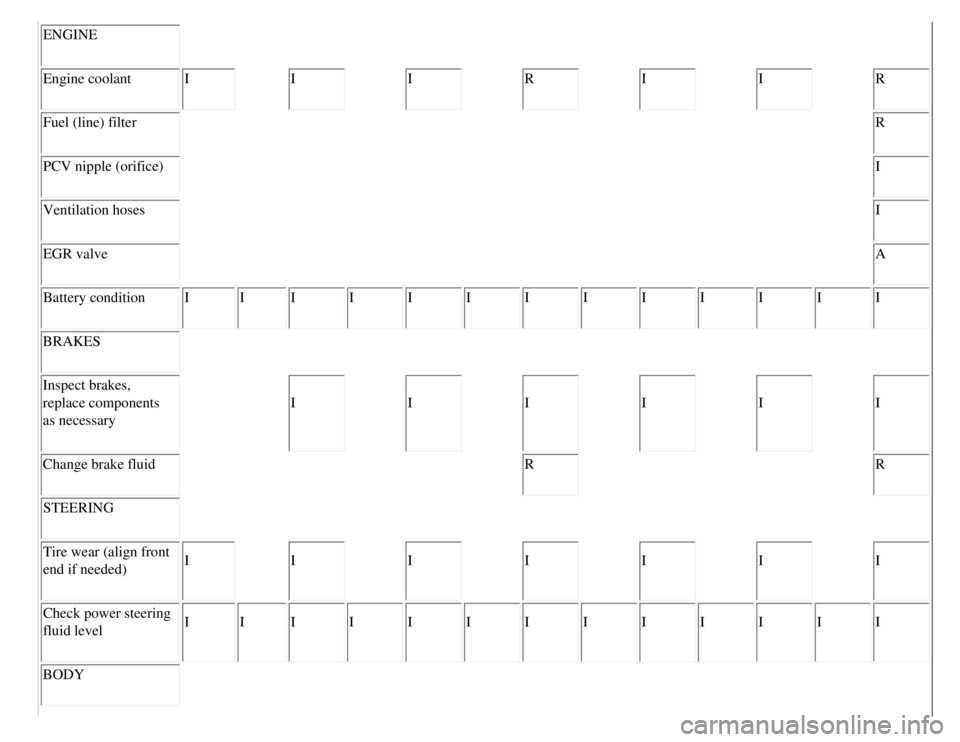
ENGINE
Engine coolant I I I R I I R
Fuel (line) filter R
PCV nipple (orifice) I
Ventilation hoses I
EGR valve A
Battery condition I I I I I I I I I I I I I
BRAKES
Inspect brakes,
replace components
as necessary I
I I I I I
Change brake fluid R R
STEERING
Tire wear (align front
end if needed) I
I I I I I I
Check power steering
fluid level I
I I I I I I I I I I I I
BODY
file:///K|/ownersdocs/1990/1990_240/90240_12.htm (6 of 7)12/30/2006 8:\
25:07 AM
Page 77 of 143
Volvo 1990 240 Model
pg. 58 Servicing Engine
The following items should be checked weekly Description
by the owner. (This only takes a few moments.) on page
Engine oil level 61
Brake fluid 72
Radiator coolant level 74
Tire pressures (including spare) 82, 103
Operation of all lights -
Horns -
Windshield wipers -
Level of windshield fluid -
The following should also be carried out at Description
regular intervals on page
Washing 87
Polishing 87
Cleaning 87
Rust protection inspection 87 pg. 59 Servicing Engine
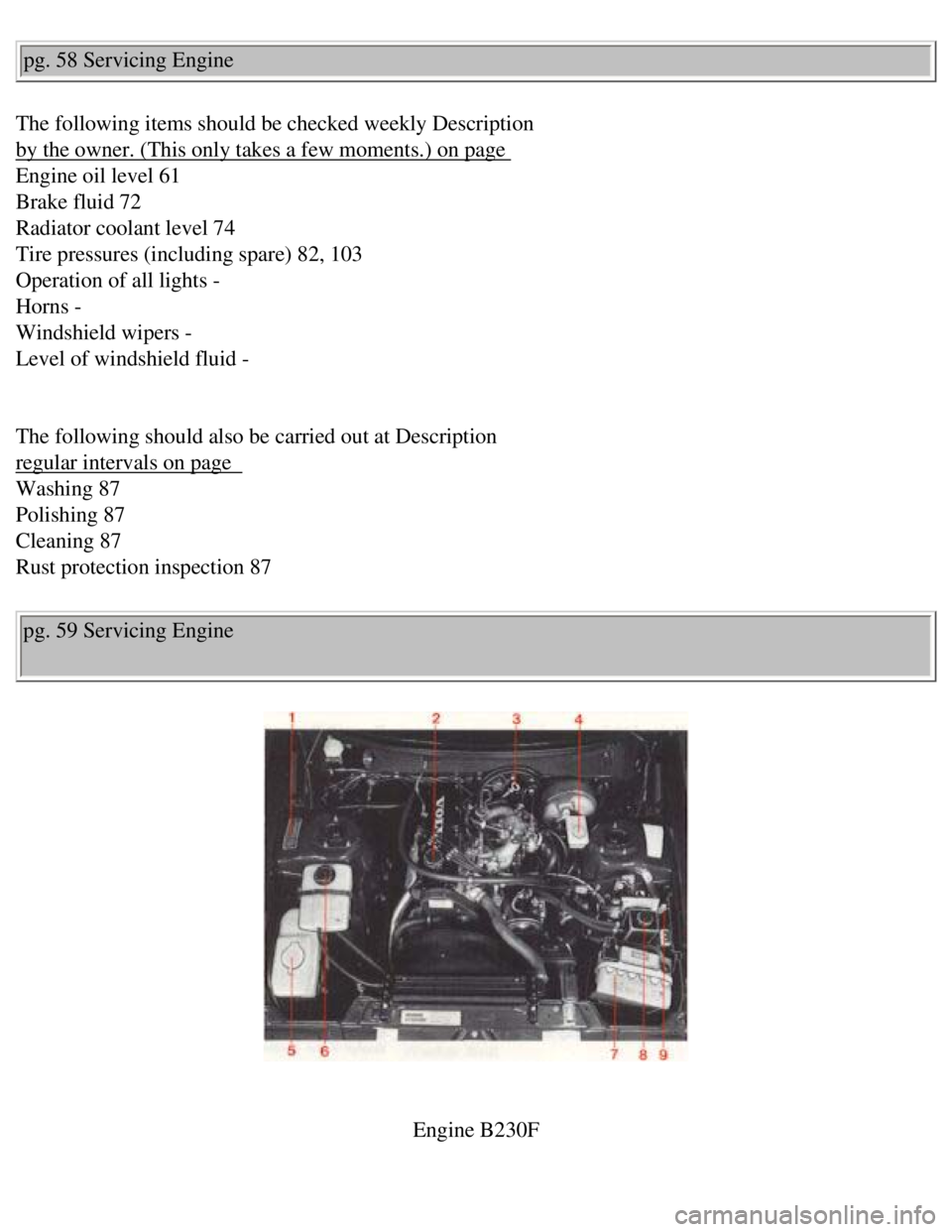
Engine B230F
file:///K|/ownersdocs/1990/1990_240/90240_13.htm (1 of 9)12/30/2006 8:\
25:08 AM
Page 78 of 143
Volvo 1990 240 Model
1 Data plate
2 Oil filler cap, engine
3 Oil dipstick, engine
4 Brake fluid reservoir
5 Washer fluid reservoir
6 Expansion tank, coolant
7 Battery
8 Oil reservoir, power steering
9 Fuse, engine control pg. 60 Fuel requirements
Unleaded Fuel
Each Volvo has a catalytic converter and must use only unleaded gasoline\
(as specified on the
instrument panel and by a label near the filter inlet). U.S. and Canadi\
an regulations require that pumps
delivering unleaded gasoline be labeled "UNLEADED". Only these pumps hav\
e nozzles which fit your
car's filler inlet. It is unlawful to dispense leaded fuel into a vehicl\
e labelled "unleaded gasoline only".
Leaded gasoline damages the catalytic converter and the oxygen sensor sy\
stem. Repeated use of leaded
gasoline will lessen the effectiveness of the emission control system an\
d could result in loss of emission
warranty coverage. State and local vehicle inspection programs will make\
detection of misfueling easier,
possibly resulting in emission test failure for misfueled vehicles.
Octane Rating
Volvo recommends the use of premium unleaded gasoline with an (R+M)/2 \
rating of 91. This is
generally equivalent to a Research Octane Number (RON) of 95 or higher\
.
Deposit Control Gasolines
Volvo recommends the use of gasolines that contain "Deposit Control" add\
itives. These additives are
specially formulated to prevent the build up of certain injector and int\
ake system deposits. Fuels
containing "Deposit Control" additives are usually advertised as contain\
ing them and may have
additional claims to "clean injectors and intake valves" or similar word\
ing.
file:///K|/ownersdocs/1990/1990_240/90240_13.htm (2 of 9)12/30/2006 8:\
25:08 AM
Page 81 of 143
Volvo 1990 240 Model
Brake fluid
Without removing the cap, check that the level is above the MIN mark. Br\
ake fluid DOT 4. See "Brake
fluid" section.
Battery
Check level in conjunction with normal service or once a year. Electroly\
te level 1/4" - 3/8"(5-10 mm)
above plates. Use distilled water. Never add acid.
Warning:
Battery gases are explosive if brought in contact with open flame or
sparks.
Washer fluid Coolant reservoir
Washer fluid
Washer fluid reservoir. Water and solvent (in wintertime, use windshiel\
d washer anti-freeze). See
"Washer fluid reservoir" section.
file:///K|/ownersdocs/1990/1990_240/90240_13.htm (5 of 9)12/30/2006 8:\
25:08 AM