Page 29 of 143

Volvo 1990 240 Model
How to use the air conditioner:
1
Fan
Position 4 for rapid cooling.
2 AIR COND
Start the air conditioning compressor by turning the control knob clockw\
ise toward MAX.
For rapid cooling, position the knob into the orange range beyond MAX. A\
fter desired temperature is
reached re-position the control knob into the blue range.
At cruising speeds, the knob should be kept within the blue range. If it\
remains in the orange range, icing
may occur resulting in decreased cooling capacity.
3
Recirculation
Push in for rapid cooling and during high humidity conditions.
4 TEMP
When using the air conditioner for cooling, the TEMP control should be s\
et to COOL position, fully left.
Use the AIR COND control to regulate the temperature.
To obtain rapid cooling, all windows must be closed and buttons
and out. Cool air will then be
discharged through the four dash outlets which should be fully open.
Note: For rapid removal of condensation from inside glass surfaces, the \
air conditioner can be
switched on even when not required for interior cooling. The air conditi\
oner will dehumidify the air
inside the vehicle.
Have your Volvo dealer check the system for correct operation yearly. Th\
e air conditioning system
should be operated periodically to ensure trouble-free performance year \
round.
pg. 25 Audio systems
Operating instructions
file:///K|/ownersdocs/1990/1990_240/90240_05.htm (4 of 6)12/30/2006 8:\
25:03 AM
Page 33 of 143
 you
should use the rear seat with the standard seat belt fastened. The best")
Volvo 1990 240 Model
When a child has outgrown the child safety seat (approximately 4-5 year\
s of age, depending on size) you
should use the rear seat with the standard seat belt fastened. The best \
way to protect the child here is to
place the child on a cushion so that the seat lap belt is as far down on\
the hips as possible.
A specially designed and tested safety cushion for this purpose can be o\
btained from your Volvo dealer.
If necessary, an extra seat is available for use in the luggage compartm\
ent of station wagon models. This
seat is designed for two children, each up to 80 lbs. in weight and up t\
o 53 inches in height. pg. 27 Child safety
Child Restraint Anchorages
Volvo cars are fitted with child restraint top tether anchorages in the \
rear seat.
There are three anchorages under the rear section of the car's rear wind\
ow shelf on sedans and in the
back of the rear seat in wagons. When the car is delivered, the holes fo\
r these anchorages are covered by
plastic screws. In cars designated for Canada, one top tether anchorage \
set will be in the glove box. The
top tether anchorage set includes the top tether anchorage plate, an M8 \
bolt (30 mm long) and a plastic
trim cover. If another set is needed, consult your Volvo dealer.
Installing the top tether
Remove the plastic screw covering the anchorage point you want to use. T\
his can be done with a
suitable coin. The screw is removed counterclockwise.
file:///K|/ownersdocs/1990/1990_240/90240_06.htm (2 of 9)12/30/2006 8:\
25:04 AM
Page 35 of 143
 key is turned to driving
position. One light is located in the instrument cluster and one in the \")
Volvo 1990 240 Model
Two lights will be illuminated for 4-8 seconds after the starting (igni\
tion) key is turned to driving
position. One light is located in the instrument cluster and one in the \
console between the front seats.
A chime will sound at the same time if the driver has not fastened his s\
eat belt. The front and rear
outboard seats are provided with self-retracting inertia-reel belts.
To buckle:
Pull the belt out from the retractor far enough to insert the latch plat\
e into the buckle until a distinct
snapping sound is heard. The belt should not be twisted or turned.
Note: The lap belt should sit low and tight under
abdomen.
To unfasten, depress red push-button in buckle and let the belts rewind \
into their retractors.
Before exiting the car, check that the seat belt retracts fully after be\
ing unbuckled. If necessary, guide
the belt back into its retractor slot.
The seat belt retractors are normally "unlocked",. The retractors will l\
ock up as follows:
l if belt is pulled out rapidly
l during braking and acceleration
l if the vehicle is leaning excessively
l when driving in turns
Check seat belt mechanism function as follows:
1. Attach the seat belt. Pull rapidly on the strap.
2. WARNING! Check other traffic before performing this
check.
Brake firmly from approximately 30 mph (50 km/h) or turn in a tight ci\
rcle while pulling on the belt.
In all the above checks you should not be able to pull the belt out.
file:///K|/ownersdocs/1990/1990_240/90240_06.htm (4 of 9)12/30/2006 8:\
25:04 AM
Page 41 of 143
Volvo 1990 240 Model
pg. 32 Doors and locks, Child safety lock
Unlocking front doors
Both front doors can be unlocked by using the starting (ignition) key.\
Turning the key 1/4 turn counter-
clockwise (right door: clockwise) lifts the lock buttons on the window\
ledge and the door can be opened
by pulling the handle.
To open a door from inside, the lock button must first be pulled up.
Central lock
The vehicle is equipped with a central lock system. This means the lock \
on the driver's door
automatically controls the locks on the other doors (including the trun\
k on Sedan models and the tailgate
on the wagon model).
If the drivers door is locked or unlocked, the other doors will automati\
cally be locked or unlocked.
Locking doors
Both front doors can be locked by using the key. Turning the key 1/4 tur\
n clockwise (left door) or
counter-clockwise (right door) locks the door.
file:///K|/ownersdocs/1990/1990_240/90240_07.htm (1 of 6)12/30/2006 8:\
25:04 AM
Page 42 of 143
Volvo 1990 240 Model
NOTE: The driver's door can only be locked using the
key.
The lock buttons should not be In the down (locked) position during dr\
iving. In case of an accident, this
may hinder rapid access to the occupants of the vehicle.
Child safety locks
The buttons are located on the rear door jambs.
A The lock functions normally.
B The door cannot be opened from the inside.
WARNING: In the event of an accident, the rear seat passengers cannot op\
en the doors from the inside
with the buttons in position B.
Wagon model contains child safety lock on tailgate. The lock differs fro\
m that shown above. See section
titled "Wagon, tailgate".
pg. 33 Trunk lid/light
file:///K|/ownersdocs/1990/1990_240/90240_07.htm (2 of 6)12/30/2006 8:\
25:04 AM
Page 43 of 143
Volvo 1990 240 Model
Trunk lid
The trunk lock is incorporated in the central locking system. This means\
that you can either lock or
unlock the trunk by means of the drivers door lock.
You can also operate the trunk lock directly with the owner's key even i\
f the vehicle is centrally locked.
Unlocking Locking
Withdraw key in vertical position
The trunk lock can also be disconnected from the central locking system \
by turning the key
counterclockwise as shown below:
Withdraw key in horizontal position
The trunk is now always locked.
This option can be used if for example, you lend your car to somebody. I\
f you give only the service key
to the driver it will not be possible to open the trunk.
file:///K|/ownersdocs/1990/1990_240/90240_07.htm (3 of 6)12/30/2006 8:\
25:04 AM
Page 44 of 143
Volvo 1990 240 Model
To reconnect the lock to the central locking system:
Withdraw key in vertical position
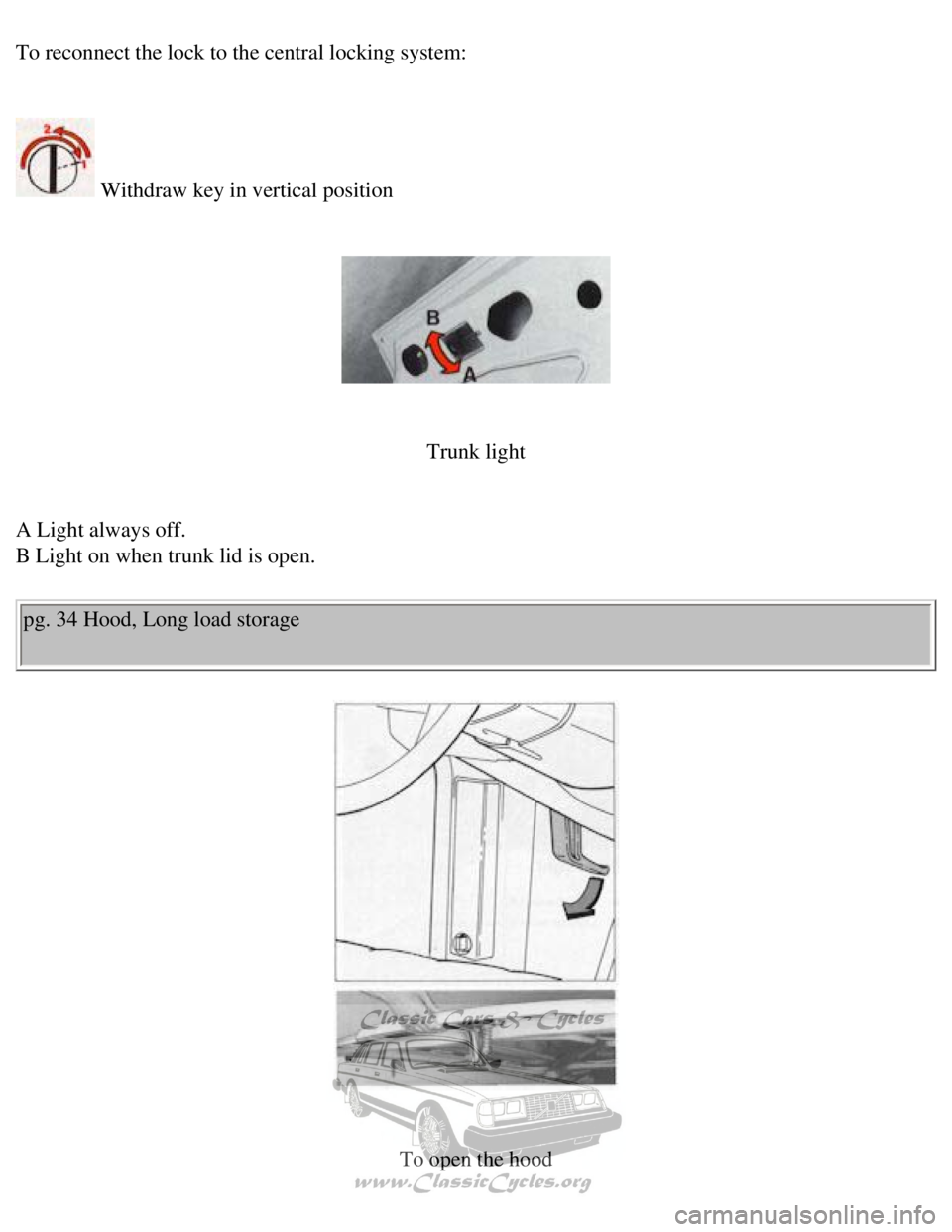
Trunk light
A Light always off.
B Light on when trunk lid is open.
pg. 34 Hood, Long load storage
To open the hood
file:///K|/ownersdocs/1990/1990_240/90240_07.htm (4 of 6)12/30/2006 8:\
25:04 AM
Page 45 of 143
.
Lift the hood slightly, insert a hand under the center line of the hood \
and depress the safety catch hand")
Volvo 1990 240 Model
Pull the release handle (located under the left side of the dash).
Lift the hood slightly, insert a hand under the center line of the hood \
and depress the safety catch handle.
Open the hood.
Check that the hood locks properly when closing.
Long load storage (except wagon)
A flap in the rear seat makes it possible to carry "long loads" such as \
skis, etc.
WARNING!
When braking rapidly the load could be displaced and cause injury to occ\
upants. Sharp edges on the
load should be covered for protection. It is essential that the "load" b\
e secured safely. Use belts locked
around the folded down armrest (see illustration).
WARNING!
Do no place heavy objects on the rear window shelf. These objects can be\
come dangerous projectiles
in the event of sudden braking. Always secure large or heavy objects wit\
h the seat belts.
An optional, specially designed, storage bag should also be used to avoi\
d soiling or tearing the
upholstery. Please note that the flap in the rear seat is intended only \
for light loads such as skis, wood
etc.
file:///K|/ownersdocs/1990/1990_240/90240_07.htm (5 of 6)12/30/2006 8:\
25:04 AM
 key.\
Turning the key 1/4 turn counter-")
 position during dr\
iving. In case of an accident, this
may hin")