1990 VOLKSWAGEN TRANSPORTER differential
[x] Cancel search: differentialPage 4 of 165

Downloaded from www.Manualslib.com manuals search engine
1
INSTRUMENT PANEL
Illustration instruments and controls
Warning and indicator light symbols
CONTROLS AND EQUIPMENT
Keys,
central locking system .... 7, 8
Doors 9
Rear lid 11
Windows, mirrors 12, 13 Safety belts, head restraints . . . .14,19
Seats 20 Luggage compartment, pedals . 28,29
Brakes, Transmission 29, 32 Differential lock 33
Automatic-transmission 35 Steering lock/ignition/starter switch . 38
Starting procedures 39 Instrument cluster 40
Warning/indicator lights 43 Switches 46 Emergency flasher 46
Light switch, turn signals .... 46,48
Cruise control 49
Windshield wipers 50 Ventilation/Heating 51
Air conditioning 54
Heater 57
Sliding roof 62
Roof-rack 68 VEHICLE OPERATION
Break-in period - and afterwards . . 69
Operate your vehicle safety 70
Operate your vehicle economically
and minimize pollution 72
Trailer towing 73 Driving with the all-wheel drive ... 75
VEHICLE CARE
Fuel tank, fuel supply 85,86
Vehicle care (exterior/interior) . . 90, 93 Maintenance, inspection intervals . . 95 Engine compartment lid,
engine compartment 97 Lubricants, engine oil 98,99
Engine oil filter 101
Transmission oil 102
Power steering 103
Cooling system 104 Brake fluid 108
Battery 109
Windshield washers/wipers . . . 112,113
Tires/wheels 114 Difficult operating conditions .... 120
Winter driving 121
Accessories 122
DO-IT-YOURSELF SERVICE
Jack and tools 123 Spare wheel 124
Changing a wheel 125 Fuses, bulbs 128, 130 Adjusting headlights
134
Installing,
replacing the radio . . . . 135
Emergency starting 136
Emergency towing 138
Lifting vehicle . . 140
TECHNICAL DESCRIPTION
Engine, transmission 142
Steering,
suspension, brakes,
body, chassis 143 Emission-control-system 144
TECHNICAL DATA
Engine, spark plugs .
V-belts capacities . . Dimensions
Weights
Vehicle identification 146
147
148
150 151
CONSUMER INFORMATION
Service manuals 152
GAS STATION INFORMATION
Location of servicing points 156
ALPHABETICAL INDEX 158
www.westfaliaT3.info - a useful website for owners and enthusiasts of VW Westfalia T25 / T3 Campervans
Page 34 of 165
Downloaded from www.Manualslib.com manuals search engine
CONTROLS AND
EQUIPMENT
THE
DIFFERENTIAL
LOCK*
(SYNCRO)
When driving around a curve, the outside
.vheels
turn
more than the inside wheels.
A
gear set, part of the transmission, called :he differential, compensates for the differ
ence.
If, however, one wheel gets on a slip pery surface and starts to spin, the
differential will not transmit power to the
ether wheel. The car will be stuck. The
dif
ferential lock will allow power to be trans
mitted
to both wheels to help get the vehi-
:!e
moving again. Because the differential
5
then unable to compensate for corner-
~.g, vehicle handling and maneuverability
.'.ill
be reduced. Therefore the differential zck may only be used under limited condi-
:ons.
WARNING
Locked
differential
cannot
compensate
for
cornering
and
therefore
increases
tire
wear,
reduces
vehicle
maneuvera
bility,
driveability
and can
impair
vehi
cle
handling
performance.
See
detailed
instructions
on
next
page.
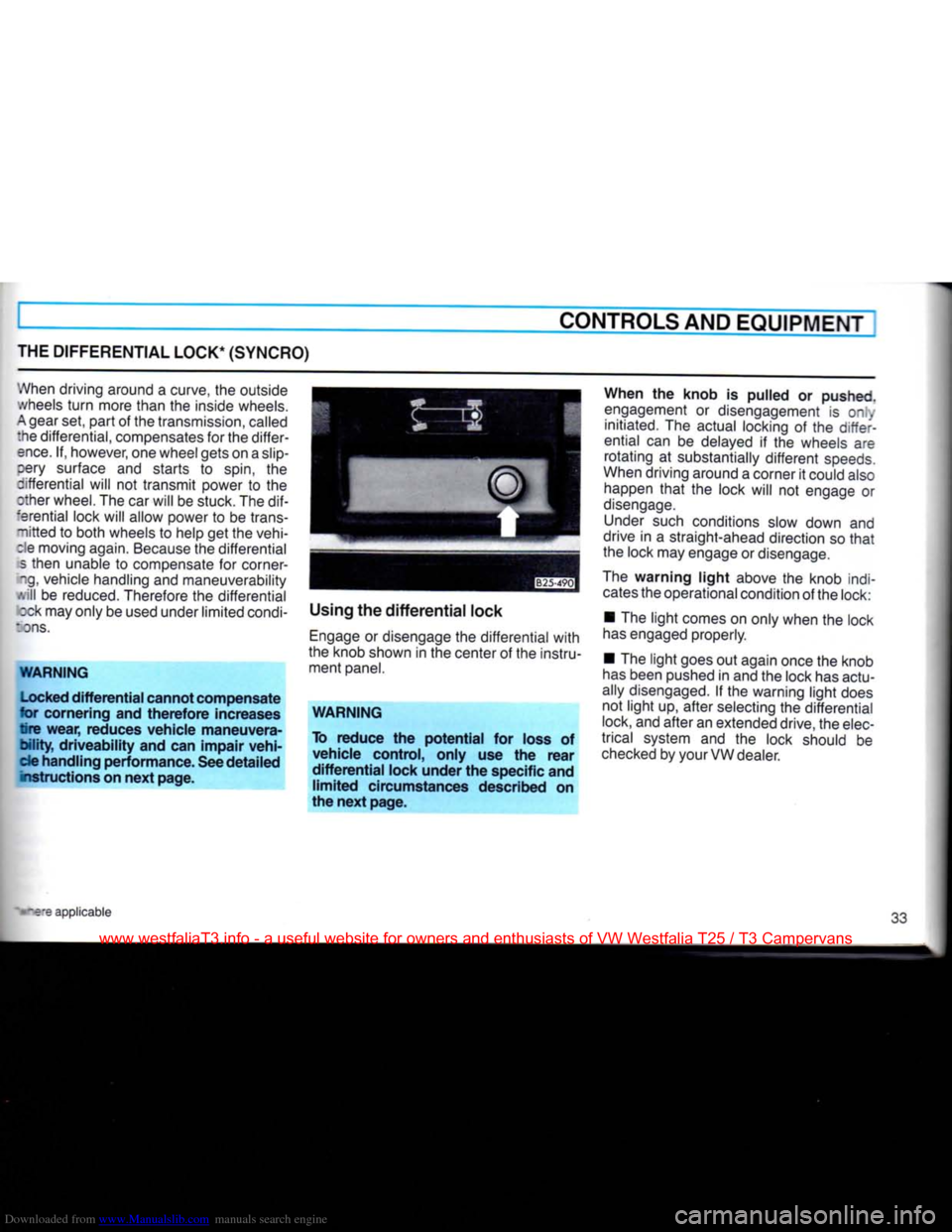
Using the
differential
lock
Engage
or disengage the differential
with
the knob shown in the center of the instru ment panel.
WARNING
To
reduce
the
potential
for loss of
vehicle
control,
only
use the
rear
differential
lock
under
the specific and
limited
circumstances described on
the
next
page.
When
the
knob
is
pulled
or pushed.
engagement or disengagement is ony initiated. The actual locking of the differ
ential can be delayed if the wheels are rotating at substantially different speeds.
When driving around a corner it could also happen
that
the lock will not engage or
disengage.
Under
such conditions slow down and
drive in a straight-ahead direction so
that
the lock may engage or disengage.
The
warning
light
above the knob indi
cates
the operational condition of the lock:
• The
light
comes on only when the lock
has
engaged properly.
• The
light
goes out again once the knob
has
been pushed in and the lock has actu
ally disengaged. If the warning
light
does not
light
up, after selecting the differential
lock, and after an extended drive, the elec
trical system and the lock should be
checked
by your VW dealer.
e applicable
www.westfaliaT3.info - a useful website for owners and enthusiasts of VW Westfalia T25 / T3 Campervans
Page 35 of 165
Downloaded from www.Manualslib.com manuals search engine
CONTROLS
AND
EQUIPMENT
WARNING
Never
lock the differential when...
•
driving on paved roads. When the
differential
is locked, the rigid connec
tion between the rear wheels has
a
rub
bing
effect on the tire when cornering.
This
leads to increased tires wear and
also
to "jerking motion" when the
vehicle is being steered. The differ
ential
lock*
for the rear axle must only be used when the vehicle is stuck or is in immediate danger of becoming
stuck;
•
one wheel is spinning. First bring
the spinning wheel to a
standstill,
and only then engage the
differential.
This
prevents damage to the drive train or
uncontrollable acceleration leading to
loss
of control and personal
injury.
See
"Driving Tips" on pages
79-84
also.
•
The vehicle is being towed - see page
139
also.
•
Testing the vehicle on a dynamome-
*where applicable 1) further information is given on page 84.
www.westfaliaT3.info - a useful website for owners and enthusiasts of VW Westfalia T25 / T3 Campervans
Page 79 of 165
Downloaded from www.Manualslib.com manuals search engine
VEHICLE OPERATION
Advantages off the all-wheel drive
The Vanagon/Transporter Syncro
all-
wheel drive system
has the
following
ad
vantages over
a
two-wheel drive vehicle:
Driving Power
Driving Power
is
greatly increased
by the
continual all-wheel drive especially
on
snow
and
slippery surfaces, when starting
off from
a
standstill,
and
when driving
on
rough roads.
Within reason, your Vanagon/Transporter Syncro
can go
places where other
vehi
cles
may
likely
get
stuck.
It is
easier
to
stop
on slippery hills
and get
going again.
Moving Force
As
the
driving force applied
to the
road goes
to
four wheels instead
of two, the
amount
of
slip
is
considerably reduced.
This improves
the
traction between tire and road surface
and
thereby,
the
drive-
ability
on
slippery road surfaces. On vehicles with two-wheel drive,
the
driv
ing wheels
can
spin
on
slippery surfaces
if
too much acceleration
is
applied. This
greatly reduces tire grip
and can
result
in
loss
of
vehicle control.
By distributing
the
driving forces
to
four
in
stead
of two
wheels,
the
wheels
of the
Va nagon/Transporter Syncro
are
less likely
to spin under
the
same conditions.
Snow tires
With
the
all-wheel drive system
the
Vana gon/Transporter Syncro
is
good
for
winter
driving even with standard tires. However,
we recommend
the use of all
season tires
or radial snow tires (M
+
S) with
or
without
studs*,
on all
wheels,
for
better driving,
cornering
and
braking,
in
winter weather.
Details under "Snow tires"
on
page
118
also apply.
Snow chains
Snow chains can improve both road traction
and braking when driving
in
severe winter
weather. Therefore,
use
snow chains
on
your all-wheel drive vehicle when required. For additional information,
see
page
119.
Operation
In contrast
to
conventional all-wheel drive
systems that require transmissions
to be
manually engaged when needed,
the Va
nagon/Transporter Syncro all-wheel drive
system
is
always engaged. Only
the
amount
of
power being transmitted
to the
front
and
rear wheels changes automati cally
as the
road surface demands.
The
Syncro driver
is
therefore able
to
fully
con
centrate
on the
road and traffic conditions.
The differential lock*
for the
rear axle must only
be
used when
the
vehicle
is
stuck
or
in immediate danger
of
becoming stuck. For further information
on the
differential
lock,
see
page
33.
78 "Check with your local Motor Vehicle Bureau
for
possible restrictions.
'where applicable
www.westfaliaT3.info - a useful website for owners and enthusiasts of VW Westfalia T25 / T3 Campervans
Page 80 of 165
Downloaded from www.Manualslib.com manuals search engine
-
VEHICLE
OPERATION
Driving on dry roads
Attention
"his
is an
all-wheel drive multipurpose
rassenger
vehicle which
will
handle
and
maneuver
differently
from
an ordinary
pas
senger
car in driving conditions which may
occur
on
streets
and
highways
and off-
'oad.
As
with
other vehicles
of
this type,
if
you make sharp turns
or
abrupt maneu
vers,
the
vehicle
may
roll over
or
may
go
kit
of
control and
crash.
You should read
:he driving guidelines
and
instructions
in
the Owner's
Manual.
The
driver
and all
oassengers
should wear safety belts
at all
times.
Do
not
engage
the
differential lock on nor
mal
dry
roads
as it
will
not
provide any ad
vantage. Under these circumstances,
an
engaged differential lock
will
impair the ve-
nicle's
maneuverability and
will
cause
ex
cessive
tire
wear.
Driving on wet, slippery roads
Due
to the
all-wheel drive,
the
engine
power
is
transmitted evenly
to a
moder
ately slippery road surface.
On
wet surface
As
with
any
other vehicle, excessive driv ing speed on very wet roads can cause hy
droplaning
and
loss
of
vehicle control.
Therefore, slow down.
The
differential lock* must
not be
engaged.
Important
instructions
on
the
differential
locks
are to be found on page
33/34.
On
slippery surfaces
On
slippery surfaces the rear axle differen
tial
lock may only be engaged when
start
ing
from
a
standstill
or at
very low
speeds.
When
the
road surface has improved
the
lock should
be
disengaged again. On
snow covered surfaces
On
a
snow covered road, maintain traction by making gradual changes
in
speed
or
di
rection. Avoid sudden maneuvers. Be alert
to problems other drivers around you may be having which could create
a
hazardous
situation
for
you.
In heavy snow, maintaining reasonable
momentum
is
important
for
safe vehicle
operation. Try
to
keep moving
by
using
the
L-gear and
a
steady accelerator pedal
at
low
speed.
WARNING
•
Always
maintain
a safe driving
speed,
especially
when
road and
weather
conditions are poor.
•
Excessive
driving speed on very wet
roads can cause hydroplaning and
loss
of vehicle control.
•
Always avoid forceful and
abrupt
braking action.
You
could block all four
wheels simultaneously and lose
con
trol
of the vehicle.
•
The braking capability of your Vana-
gon/Transporter Syncro is
greatly
de
pendent on the
traction
of your tires.
'where applicable 79
www.westfaliaT3.info - a useful website for owners and enthusiasts of VW Westfalia T25 / T3 Campervans
Page 81 of 165
Downloaded from www.Manualslib.com manuals search engine
VEHICLE
OPERATION
WARNING continued
•
The permanently engaged allwheel-
drive
will
provide
good
performance on relatively wet or slippery
roads.
Be
sure
to use these features and advantages
wisely. Do not let the excellent traction
which your VW
SYNCRO
offers lead
you
to underestimate the difficulties
and risks involved in negotiating wet or
slippery
roads. Always drive defen
sively
and adapt vehicle operation and
driving speed to road and
traffic
condi
tions.
Driving Off-Road
WARNING
The Vanagon/Transporter
Syncro
is not an off-road or all
terrain
vehicle. Use of
this or any other vehicle under off-road
conditions
requires special skills and knowledge. The off-road operation of
this or any other
vehicle
can
lead
to per
sonal
injury.
•
Driver and all
passengers
must
wear
safety belts at all times.
•
Keep your thumbs and fingers on
the outside of the steering wheel.
Potholes
or rocks can
jerk
the
wheel
from your grip; it really hurts if a spoke
catches
you on the way around.
Off-Road
Driving
Driving off-road places extra demands
on
your vehicle and on you, the driver.
If
under
exceptional
circumstances
you
judge
it
safe
and
appropriate
to
leave
the
paved highway,
first
make sure
that
your vehicle
is
in top
mechanical condition. Make cer
tain
that
all
vehicle systems
are
function ing normally,
in
particular,
for
example,
that
the engine, especially the cooling
sys
tem,
is
operating properly and
that
trans
mission,
brakes and steering are function ing normally. Tires must have adequate
tread,
be
free
of
damage
and be
adequately inflated.
Before
driving over
difficult
terrain, such as
mud,
sand,
water, snow
or
steep
slopes,
we recommend engaging
the
differentia lock*
at low
speed.
Important
information
regarding
the
differential lock
is on
page
33/34.
Whenever
you
operate your
car you
should
be
well
and fit, but
your physical
and
mental condition
are
especially
im
portant
when driving
off
the road.
As
a
general rule
you
should
go
only where others have gone before.
Always
obey applicable
Federal,
State
and
local regulations
and
above
all re
spect
and protect the environment. Do
not
scar
the
land, avoid unnecessary wheel
spinning and other driving behavior which
will
create
ruts
and destroy vegetation.
Be
careful when parking and when standing
with
a hot
engine. The catalytic converter
with
which your vehicle
is
equipped devel
ops
very high temperatures which can set
dry grass and brush
on
fire. Respect
the
wildlife, leave animals
to
themselves
and
do not destroy their areas
of
refuge. Above
all,
be
considerate and operate your vehi
cle
sensibly and safely. Nature
is a
natural
resource
which belongs
to
all
of
us.
'where applicable
www.westfaliaT3.info - a useful website for owners and enthusiasts of VW Westfalia T25 / T3 Campervans
Page 89 of 165
Downloaded from www.Manualslib.com manuals search engine
VEHICLE OPERATION
After driving over
difficult
terrain,
espe
cially through water or mud, the following
is
important:
• Disengage the differential lock*.
• After long drives through deep mud, the
brakes must be checked and cleaned if
they are
dirty.
This will prevent damage to
the brakes and premature wear.
• After driving through deep water, take
out oil dipstick and check to see whether
there are drops of water on the dipstick or if the oil level has risen. In
that
case,
the oil
must be changed immediately.
• If during an off-road drive the vehicle
has
become stuck (dug its way
into
the
ground) or the underside was stuck by
rocks
or similar, check undercarriage,
brake lines and oil pan for damage. • The engine compartment and vehicle
underbody must be cleaned if they are
very
dirty
so
that
the function of all mova ble and electrical/electronic parts is main
tained.
•
Clean
heavy soil from wheels and tires,
check
tires for damage or foreign objects in treads.
•
Clean
turn
signals, lights and license
plate.
• Dry brake system by driving a short dis
tance
with
brake pedal slightly depressed.
This
will help regaining normal braking ac
tion
and help prevent the possibility of the
vehicle pulling to one side while braking.
Performance
testing
If the
Vanagon/Transporter
Syncro re
quires
testing
on a
dynamometer
(en
gine
output
analysis and
brake
test)
the
transaxle
drive
shaft
must
be discon nected.
The
differential
lock
must
not be en gaged.
84 "where applicable
www.westfaliaT3.info - a useful website for owners and enthusiasts of VW Westfalia T25 / T3 Campervans
Page 103 of 165
Downloaded from www.Manualslib.com manuals search engine
[
VEHICLE
CARE
LUBRICANTS I
Climate Tropical
40'
30-
20- 10-
0-
10'
20
30'
Single grade oil
Multi grade oil
Gasoline Engines
|B25-565/21
Engine
Your engine was factory filled with an all- season high quality engine oil. If you need
to add oil between oil changes use any high quality petroleum or synthetic based
oil with correct specifications.
The following term must appear on the oil container singly or in combination with
other designations: "API Service SF or
SG".
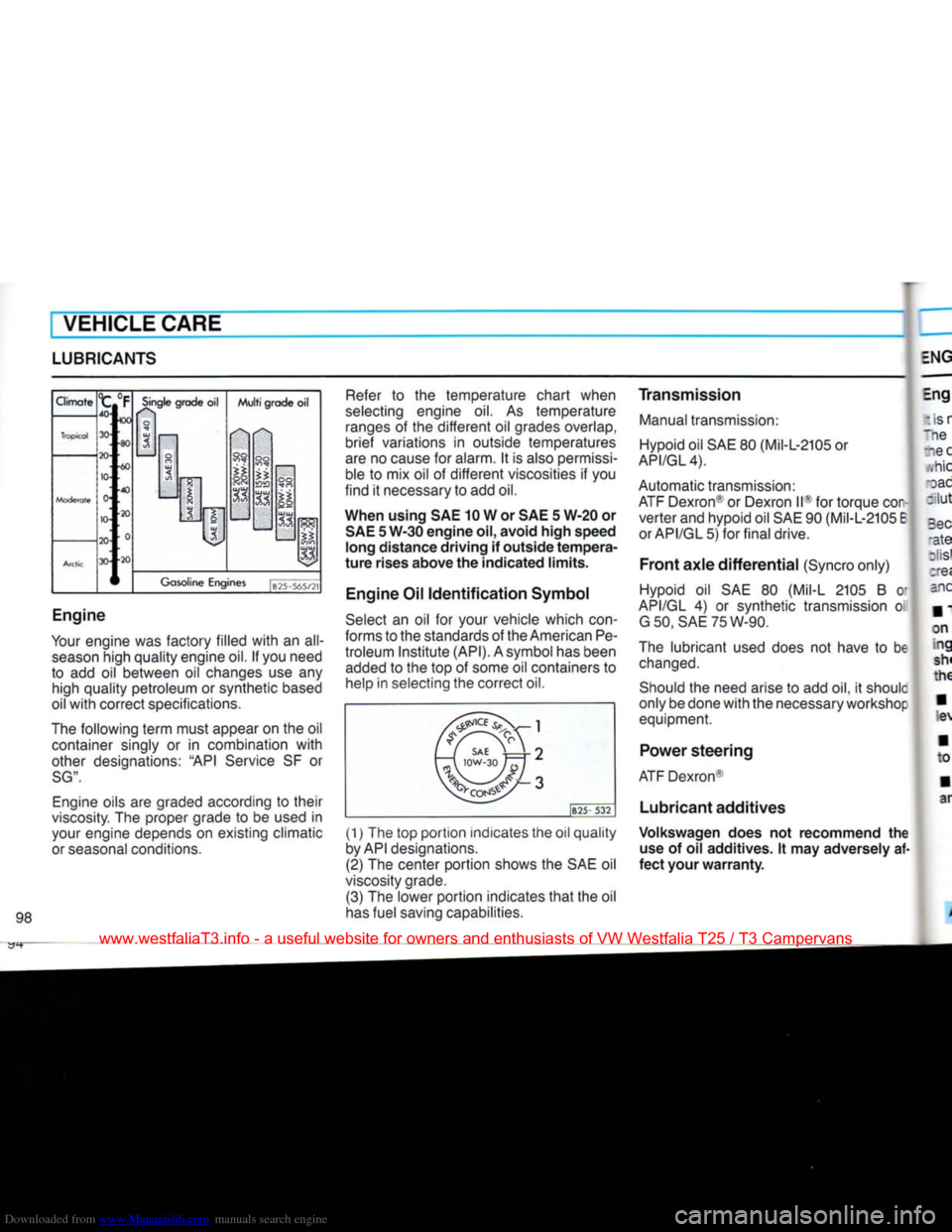
Engine oils are graded according to their
viscosity. The proper grade to be used in your engine depends on existing climatic
or seasonal conditions. Refer to the temperature chart when
selecting engine oil. As temperature ranges of the different oil grades overlap,
brief variations in outside temperatures
are no cause for alarm. It is also permissi ble to mix oil of different viscosities if you
find it necessary to add oil.
When using SAE 10 W or SAE 5 W-20 or SAE 5 W-30 engine oil, avoid high speed
long distance driving if outside tempera
ture rises above the indicated limits.
Engine Oil Identification Symbol
Select an oil for your vehicle which
con
forms to the standards of the American Pe
troleum Institute (API). A symbol has been added to the top of some oil containers to help in selecting the correct oil.
-l -l
/ / SAE '. j -2
t—i iow-3o jji -3
1B25-
532
98 (1) The top portion indicates the oil quality
by API designations.
(2) The center portion shows the SAE oil
viscosity grade.
(3) The lower portion indicates that the oil
has fuel saving capabilities. Transmission
Manual transmission: Hypoid oil SAE 80 (Mil-L-2105 or
API/GL4).
Automatic transmission:
ATF Dexron® or Dexron II® for torque cor
verter and hypoid oil SAE 90 (Mil-L-2105
E
orAPI/GL5) for final drive.
Front axle differential (Syncro only)
Hypoid oil SAE 80 (Mil-L 2105 B M
API/GL 4) or synthetic transmission oi
G50,
SAE75W-90.
The lubricant used does not have to be
changed.
Should the need arise to add oil, it shoulc
only be done with the necessary workshop equipment.
Power steering
ATF Dexron®
Lubricant additives
Volkswagen does not recommend the use of oil additives. It may adversely af
fect your warranty.
www.westfaliaT3.info - a useful website for owners and enthusiasts of VW Westfalia T25 / T3 Campervans