1990 MITSUBISHI ECLIPSE oil
[x] Cancel search: oilPage 222 of 391

POWER STEERING - Oil Pump
PERFORMANCE OF THE OIL PUMP
(1)
19-11 i
P-Qf characteristic (pump pressure vs. discharge quantity)
At pump rotation of 600 rpm and fluid temperature of
50-6O”C (122-l 40°F):4.4
litmin. (268.5 cu.in./min.), or more at pump pressure of
4,000
kPa (569 psi)
N-Qf Characteristic (pump rpm vs. discharge quantity)
At pump pressureof 2,000
kPa (285 psi) and fluid
temperature of
50-60X (122-140°F):
6.58
lit./min. (396.7-488.2 cu.in./min.) at pump rotation of
1,500 rpm.
3.8-6 lit./min. (231.9-366.1 cu.in./min.) at pump rotation of
3,000 rpm.
2.5-3.5 Mnin. (152.6-213.6 cu.in./min.) at pump rotation
of 4,500 rpm.
OPERATION OF THE FLUID
FLOW-
r7NTROL SYSTEM
I t 13 plunger and flow-control valve are activated bythe oil pump, thus regulating the amount of fluid
the hydraulic pressure of the fluid discharged fromflow to the gear box.
Pl;lgRelief ipring\
Relief valve13POO37
Page 223 of 391

19-12POWER STEERING - Oil Pump
WHEN OIL PUMP OPERATES AT LOW SPEED
(70&l ,000 RPM)
A part of the fluid discharged from the oil pumpvariable orifices. As a result of this action the fluid
passes through the pilot port and hydraulic pressurepasses through the variable and fixed orifices, and is
is applied to the rear surface of the plunger, but,sent, by way of the plunger, to the gear box. The
because this hydraulic pressure is weak, the plungeramount of discharge to the gear box at this time is
is pushed toward the left as a result of the forcealmost maximum, with the result that an extremely
applied by the plunger’s spring, thus opening thelow steering effort is required.
PlungerVariable orificeFixed,orificeFioycontrol valve
/ I
From oil pump
To oil pumpVariable orifice
13POO38-.
Pilot portFixed orifice
.WHEN OIL PUMP OPERATES AT MEDIUM
SPEED
(1 ,OOm,OOO RPM)
When the engine speed increases and the pump’ssame time, the flow-control valve also is pressed
speed also increases, the hydraulic pressure of thetoward the
right, the bypass port opens more, and
fluid discharged from the pump becomes higher,the surplus fluid is returned back to the oil pump. In
overcoming the plunger spring’s force, and causingthis way, the amount of discharge flow to the gear
the plunger to move toward the right. As a result ofbox is reduced, thus resulting in a somewhat
this action, one of the variable orifices closes. At the“heavier” steering effort.
Variable orifice
PlungerFlow-control valve
\\Fixed yrifice/
Variable &iflceBypass ‘LrllJPOO59
Page 224 of 391

i t-7POWER STEERING
- Oil Pump19-13WHEN OIL PUMP OPERATES AT HIGH SPEED
(? -70 RPM OR MORE)
VII, ,dn the pump operation becomes high speed. thethe gear box then is supplied only from the fixed
plunger is pushed further toward the
right than fororifice, with the result that the amount of discharge
medium speed, and both variable orifices close.flow
is reduced to minimum, and, as a result, theFurthermore. the flow-control valve also moves, and
steering effort becomes moderately “heavy”, thus
the bypass port opens wider. The fluid flowing to
providing excellent handling stability at high speed.
Fixed orifice13POO40
OPERATION OF THE RELIEF VALVE
When the A chamber pressure increases when theAs a result of this action, the pressure of the
Bsteering wheel is turned while the vehicle ischamber decreases, and the relief valve closes once
stopped, the
B chamber pressure also increases.again. This action takes place in a moment, and in
and, when the pressure exceeds the relief springthis way, by maintaining the correct balance, the
set load of 8,000 kPa (1,138 psi), the relief valve panmaximum pressure is controlled.
which is closed by a steel ball opens and the fluid
passes through the bypass port and is returned to
the pump’s intake port.
Steel ballRelief sprtngTo steering gear box
/Bypass pan
WPOO41
Page 230 of 391

MANUAL TRANSAXLE <4WD> - General Information
MANUAL TRANSAXLE <4WD>
GENERAL INFORMATION
W5M33 transaxle is a transaxle for 4WD, having
center differential mounted on the output shaft ofwheels. Using the viscous coupling as a device for
the conventional front
wheeledrive type transaxle solimiting differential of the center differential, this
as to distribute drive power to the front and reartransaxle is a full time 4WD type and provides
improved traction and easy drive.
SPECIFICATIONS
Item
Transaxle model
We
Gear ratio
1 St
2nd
3rd4th5th
Reverse
Primary reduction ratio
(number of gear teeth)
Front differential gear ratio
(number of teeth)Specifications
W5M33-2-NPZS
5-speed constant-mesh cable controlled type3.083
1.684
7.1150.833
0.666
3.166
1.275 (37/29).
3.866 (58/l
51
Transfer gear ratio(number of teeth)1.090 (24/22)
Speedometer gear ratio
Oil quantity
liter (qts.)
Transaxle
Transfer
Dry weight ic kg (Ibs.)
29 I36
2.3 (2.43)0.6
(0.63)
64.0(141)
Page 237 of 391
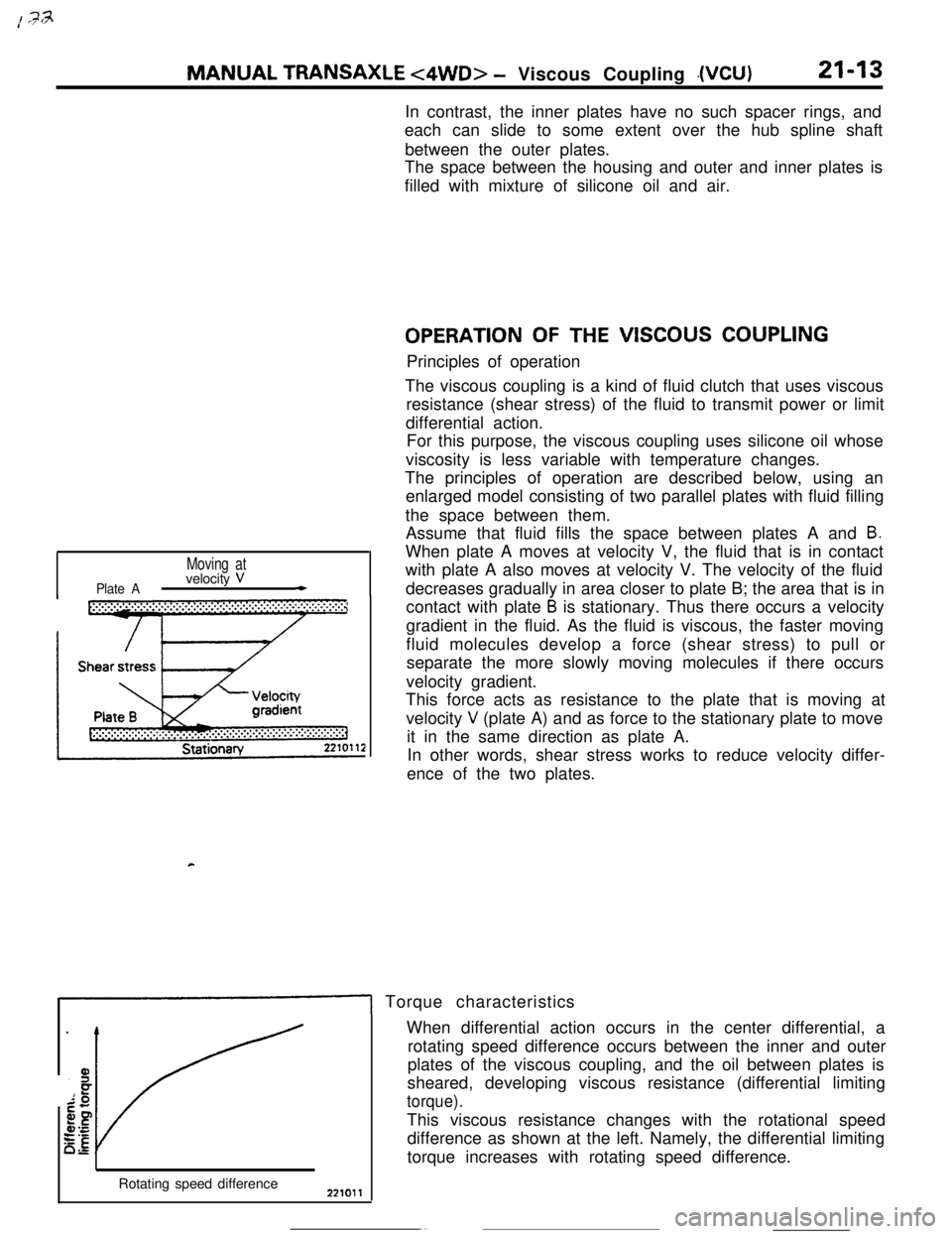
MANUAL TRANSAXLE <4WD> - Viscous Coupling .(VClJ)21-13In contrast, the inner plates have no such spacer rings, and
each can slide to some extent over the hub spline shaft
between the outer plates.
The space between the housing and outer and inner plates is
filled with mixture of silicone oil and air.
Plate A
Moving atvelocity V*
OPERATION OF THE VISCOUS COUPLINGPrinciples of operation
The viscous coupling is a kind of fluid clutch that uses viscous
resistance (shear stress) of the fluid to transmit power or limit
differential action.
For this purpose, the viscous coupling uses silicone oil whose
viscosity is less variable with temperature changes.
The principles of operation are described below, using an
enlarged model consisting of two parallel plates with fluid filling
the space between them.
Assume that fluid fills the space between plates A and
B.When plate A moves at velocity V, the fluid that is in contact
with plate A also moves at velocity V. The velocity of the fluid
decreases gradually in area closer to plate B; the area that is in
contact with plate
B is stationary. Thus there occurs a velocity
gradient in the fluid. As the fluid is viscous, the faster moving
fluid molecules develop a force (shear stress) to pull or
separate the more slowly moving molecules if there occurs
velocity gradient.
This force acts as resistance to the plate that is moving at
velocity
V (plate A) and as force to the stationary plate to move
it in the same direction as plate A.
In other words, shear stress works to reduce velocity differ-
ence of the two plates.
1 Torque characteristics
Rotating speed differenceWhen differential action occurs in the center differential, a
rotating speed difference occurs between the inner and outer
plates of the viscous coupling, and the oil between plates is
sheared, developing viscous resistance (differential limiting
torque).This viscous resistance changes with the rotational speed
difference as shown at the left. Namely, the differential limiting
torque increases with rotating speed difference.
Page 238 of 391

21-14MANUAL TRANSAXLE t4WD> - Viscous Coupling (VCU)
Rotating speed difference
Transmitted
torque
TemperatureII I
t
/
IIc
P&e surface‘II I
preTYl-LLL
Hump mode2210llrHump phenomenon specific to viscous couplings
Hump is a phenomenon specific to viscous couplings
althob,, Iit does not occur under normal operating conditions.
This phenomenon occurs when the silicone oil temperature has
risen due to sustained differential action. Normally silicone oil
fills the space between the inner and outer plates, preventing
their direct coupling. When silicone oil expands at a high
temperature to such a degree as to develop abnormally high
pressure between the plates (normal thermal expansion is
absorbed by compression of air mixed in silicone oil), silicone oilescapes from between the plates. As a result, the plates
couple directly, causing abrupt torque transmission. When the
viscous coupling is directly coupled in this way, a rotating
speed difference does not exist, and then silicone oil tempera-
ture drops and normal function is restored.
Hump mode2210115
Page 240 of 391

_-
21-16AUTOMATIC TRANSAXLE - General InformationAUTOMATIC
TRANSAXLE
GENERAL INFQRMATIONRzlBBACF4A22 automatic transaxles with different shift pattern are introduced to match engine output characteristics.
These F4A22 automatic transaxles are transaxles of KM1 70 Type II series and each is a two-mode
electronically controlled automatic transaxle with shift patterns of two modes.
SPECIFICATIONS
Items
Transaxle modelTorque convertor
Me
Stall torque ratio
TransaxleType
Gear ratio
1 St
2nd
3rd4th
ReversePrimary reduction ratio
Differential gear ratio
Friction elements
Number of front clutch discs
Number of rear clutch discs
Number of end clutch discs
Number of low/reverse brake discs
Number of
kickdown brake bandControl system
Manual control system
Shift pattern type
Solenoid yalve operationShift control
(2)
Pressure control
Damper clutch controlDiagnosis
Indication method
Number of diagnosis items
Speedometer gear ratio
ATFOil quantityliter
(qts.)
Specifications-4A22-2-MPAl3element, 1 -stage,
2-phase with damper clutch
2.17l-speed forward, l-speed reverse
2.846
1.581
1
.ooo
3.685
2.176
1.125
3.611V&N-D-2-L (lever type) with overdrive switch
Two-mode electronic-hydraulic control type
ON-OFF controlDuty control
Duty control
Indication with
LEDs
24
29136
MOPAR ATF PLUS (AUTOMATIC TRANSMISSIOI
FLUID TYPE 7176VAutomatic Transmission Fluid“DEXRON” or “DEXRON II”
\I6.1
(6.4)J
Page 246 of 391

AUTOMATIC TRANSAXLE - Torque Converter
TORQUE CONVERTER
Lock
ring
I
Damper
F
clutch-
B-.Turbine
.AA
/:ront cover
h,Impeller
AStartorWhen damper clutch is
I\When damper
aInput shaftactivated
clutch isactivated
175202The torque-converter is composed of the impeller
(rear cover), turbine,
stator, damper clutch, one-way
clutch, front cover, etc.Furthermore. the torque-converter cannot be dis-
assembled because the outer circumference of the
shell
(front cover and rear cover) is sealed by
welding.
Because the torque-converter is coupled to the
engine’s crankshaft (via the drive plate). the shell
(front cover and impeller) always turns in the same
way when the engine is running.
As a result, the oil pump is also caused to rotate (by
the hub welded to the center part of the rear of the
shell) at the same speed as the engine.
The boss at the front part of the shell is inserted in
the hole at the rear part of the crankshaft. thus
providing support of the torque-converter.
A facing like that attached to the transaxle’s clutch
disc is attached to the damper clutch, and the
damper clutch and the turbine are connected by the
tabs (of the lock ring on the outer circumference of
the turbine shell) that fit into the groove on the outer
circumference of the damper clutch.
The torque-converter actuation hydraulic pressure,at the damper clutch activation area, passes be-
tween the torque-converter’s hub and the reaction
shaft, and enters the torque-converter.
When this happens, the hydraulic pressure acts
upon the A part (between the damper clutch and the
turbine), with the result that the damper clutch is
pressed against the front cover, and the damper
clutch, with a slight slip (as described later) becom-
es connected.
In this manner, the amount of slippage of the
torque-convener is reduced, without a damper
spring, to far below at even the low-speed level,
thus making a practical improvement of fuel con-
sumption.
At the damper clutch non-activation area, because
the torque-converter actuation hydraulic pressure
passes through the input shaft oil passage
-1enters the torque-converter from the
B part &-tween the damper clutch and the front cover). the
damper clutch moves away from the front
cover,thus releasing the damper clutch.
In this condition, operation is as an ordinary torque-
converter.