Page 68 of 143

Operating Tips
For smoother operation, apply the brakes when shifting from
Neutral or Park to a forward or reverse gear.
When parking: bring the car to a stop with the foot brake, hold the brake on and shift into Park, set the hand brake and then turn off
the engine.
NOTE:
Your 4 speed automatic transmission is equipped with a torque
converter lock-up clutch. Because of this, you may notice what
feels like an extra shift as the clutch engages.
CAUTION: Shift into P only after the car has come to a complete stop.
Shift into or out of R only after the car has come to a complete
stop.
Do not "rev-up" the engine when the brake is on and the shift
lever is in D, S, 2 or R.
When stopped on a hill, use the brakes to hold your position, not the accelerator pedal.Do not shift from N or P into D, S, 2 or R when the engine is
above idle speed. Before shifting into gear, make sure your foot
is firmly on the brake pedal. Do not rest your hand on the shift lever or push the shift button
while driving.
Driving Technique
D-4th
Use the D range for normal in-town and highway driving. The car
will start off in 1st and shift automatically to 2nd, 3rd, and 4th. The
further down you push the accelerator, the later the transmission will shift and the faster the car will accelerate.
S3/S4
The "S" shift selector range changes the shift points under part
throttle acceleration, allowing the transmission to stay in each lower
gear for a longer period before automatically upshifting. With the shift selector in the "S" range, the "S3" indicator light in the dashpanel will come on and the transmission will shift from 1st to 2nd
and 3rd but not 4th. This is especially useful when climbing or
descending grades. While driving in the "S" range, the car's performance is improved but fuel economy is reduced.
Shifting the Automatic (cont'd)ProCarManuals.comMain Menu t s
Page 112 of 143
Appearance Care (cont'd)
Rust Prevention
Rusting is likely to occur in parts of the car where water is trapped
or where there is continual dampness. Water will collect inside doors and body panels if drain holes
become clogged.
Water which seeps under or soaks floor mats will subject floor sections to prolonged wetness or dampness. Road dirt or sand, which collects and fills recesses on the
underside of the car, retains moisture long after the rest of the
car has dried.
The removal of paint and undercoating by stones, gravel, and minor accidents immediately exposes metal to air and moisture.Rusting is increased by high humidity and by the presence of
corrosive substances in the air or on the roads.
Salt used for road de-icing will coat the bottom of the ear and
hasten rusting.Localities with high humidity have greater potential for rust
problems, especially where salt is also present on the road or in
moist sea air.
Industrial pollution will accelerate the deterioration of paint
finishes and promote rusting.
Preventive Service Check all drain holes in doors and body panels for clogging and clear
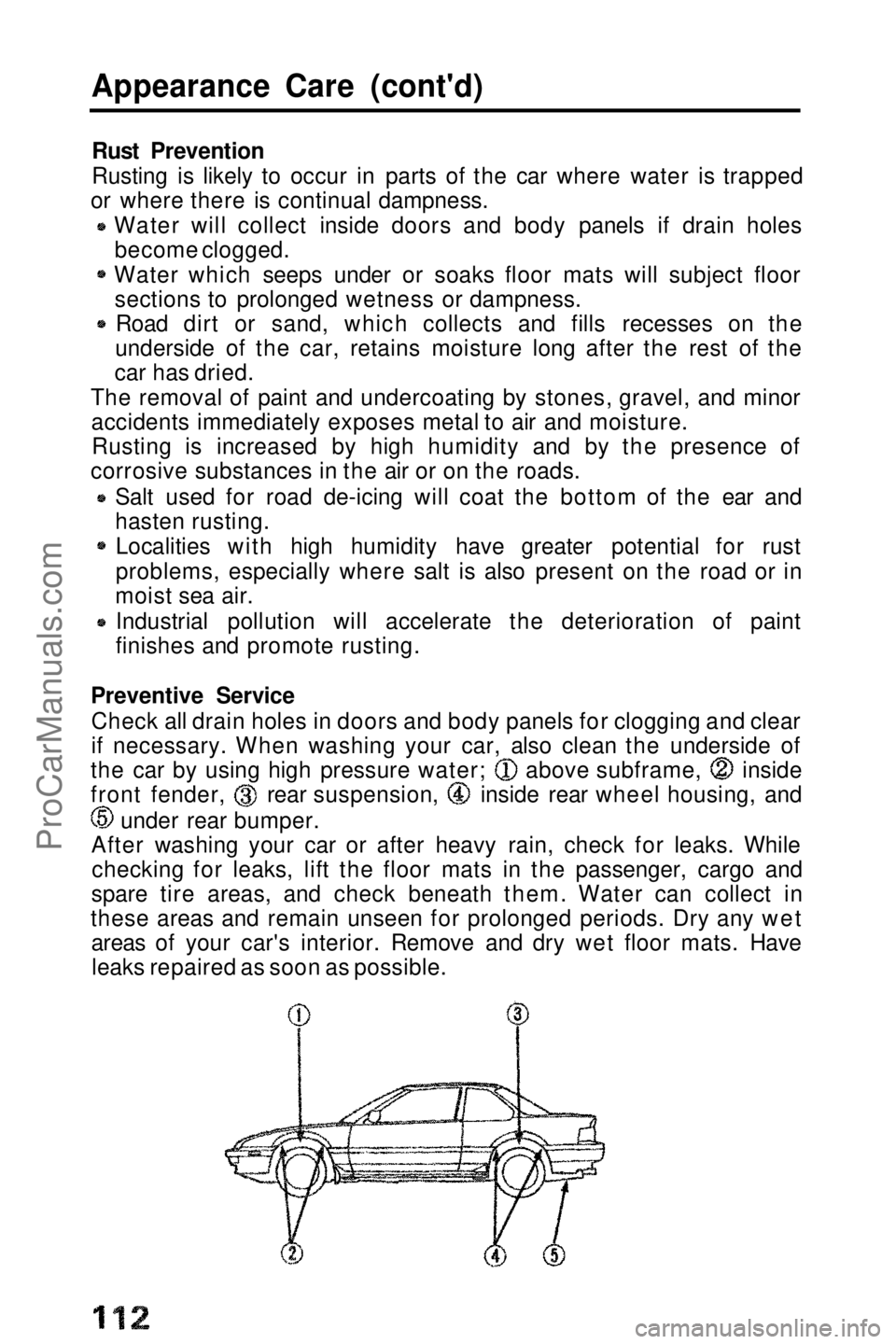
if necessary. When washing your car, also clean the underside of the car by using high pressure water; above subframe, inside
front fender, rear suspension, inside rear wheel housing, and
under rear bumper.
After washing your car or after heavy rain, check for leaks. While checking for leaks, lift the floor mats in the passenger, cargo and
spare tire areas, and check beneath them. Water can collect in
these areas and remain unseen for prolonged periods. Dry any wet areas of your car's interior. Remove and dry wet floor mats. Haveleaks repaired as soon as possible.ProCarManuals.comMain Menu t s
Page 115 of 143
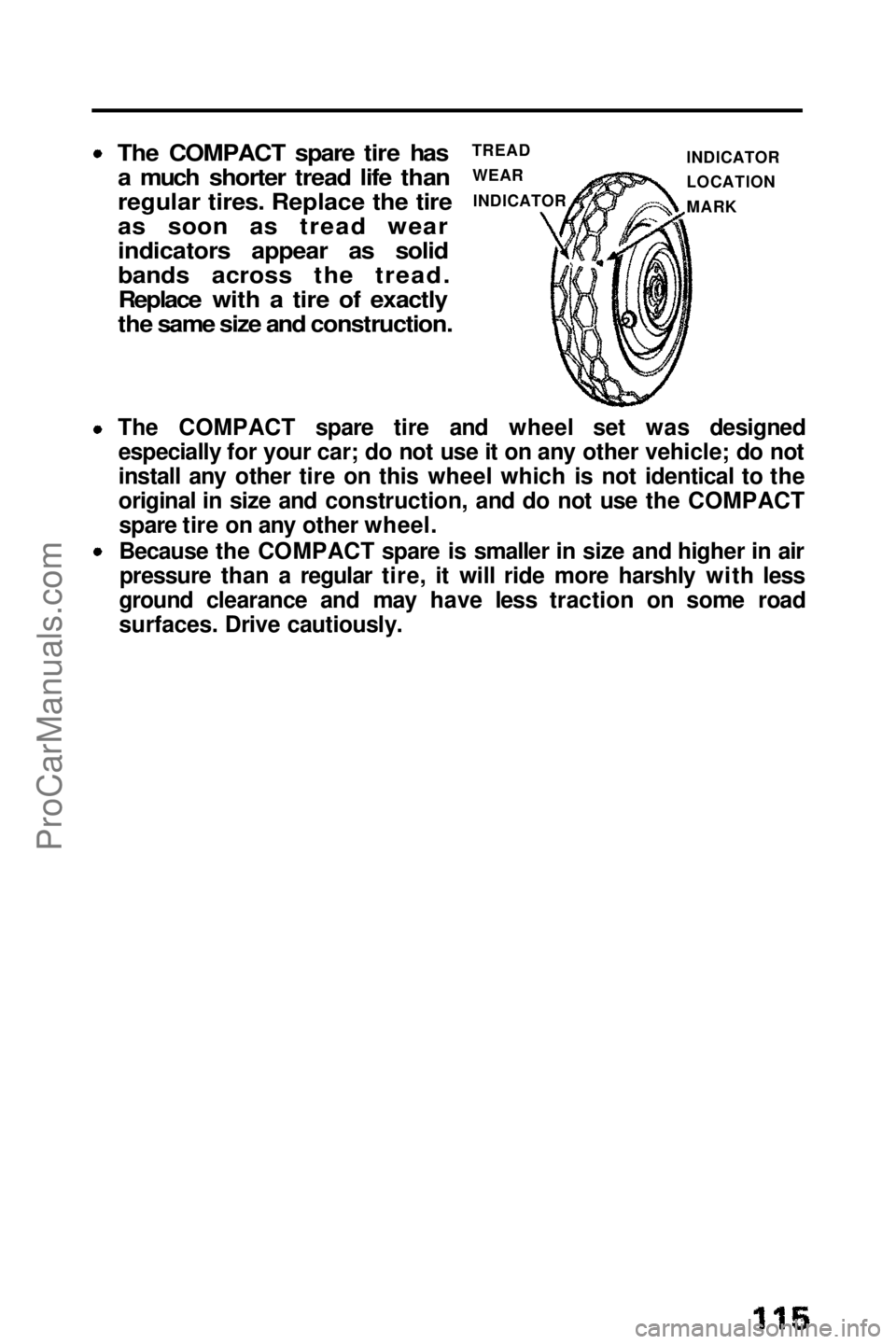
The COMPACT spare tire has
a much shorter tread life than
regular tires. Replace the tire
as soon as tread wear
indicators appear as solid
bands across the tread.Replace with a tire of exactly
the same size and construction.
The COMPACT spare tire and wheel set was designed especially for your car; do not use it on any other vehicle; do not
install any other tire on this wheel which is not identical to the
original in size and construction, and do not use the COMPACTspare tire on any other wheel.
Because the COMPACT spare is smaller in size and higher in airpressure than a regular tire, it will ride more harshly with less
ground clearance and may have less traction on some road
surfaces. Drive cautiously. INDICATOR
LOCATION
MARK
TREAD
WEAR
INDICATORProCarManuals.comMain Menu t s
Page 118 of 143

Changing a Flat Tire (cont'd)
7. Set the jack handle extension in the connector on the end of the jack and install the lug wrench/jack handle. Turn the lug wrench/jack handle clockwise until the tire is slightly off the ground.
8. Remove the lug nuts, wheel cover and wheel.
(Wheel cover is not equipped
with 4WS or ALB models)
9. Install the spare tire; and install the lug nuts hand tight.
10. Lower the car, remove the jack,
then tighten the lug nuts
securely in an "X" pattern as
shown.11. Tighten the lug nuts securely.
The recommended torque is:
110 N .
m(11 kg-m,80 Ib-ft)
If a torque wrench was not
used, ask an authorized Honda
dealer to verify the torque as
soon as possible.
12. Repai
r or replace the damaged tire as soon as you can, then
reinstall it in its original position on the car, and put the spare back
in the car.
CAUTION:
Always stow the jack, tools and tire securely to prevent them
from becoming dangerous projectiles in an accident.
NOTE:
Secure the tire and the spacer as shown in the illustration.
COMPACT SPARE
DAMAGED TIRESPACER
SPACER TIGHTENING TORQUE
110 N.m (11 kg-m, 80 Ib-ft)
VALVE
NUT
WHEEL COVER
LUG WRENCH/JACK HANDLE JACK HANDLE EXTENSIONProCarManuals.comMain Menu t s
Page 129 of 143
Temperature
The temperature grades are A (the highest), B and C representing
the tire's resistance to the generation of heat and its ability to
dissipate heat when tested under controlled conditions on aspecified indoor laboratory test wheel. Sustained high temperature
can cause the material of the tire to degenerate and reduce tire life, and excessive temperature can lead to sudden tire failure. The grade
C corresponds to a level of performance which all passenger car
tires must meet under the Federal Motor Vehicle Safety Standard No. 109. Grades B and A represent higher levels of performance on
the laboratory test wheel than the minimum required by law.
The tire temperature grade is established for a tire that is properly
inflated and not overloaded. Excessive speed, underinflation, or
excessive loading, either separately or in combination, can cause
heat buildup and possible tire failure.ProCarManuals.comMain Menu t s
Page 133 of 143
Air Supply System (2.0 S)
A secondary air supply system helps improve emission
performance by promoting more complete combustion during
deceleration.
Air injection with Feedback System (2.0 S)
This system maintains the proper air/fuel ratio for the most
efficient use of the three way catalytic converter by controlling
the amount of air injection in response to the oxygen concentration in the exhaust manifold.ProCarManuals.comMain Menu t s