Page 77 of 143
Check the following items at each fuel stop:
1. Engine oil level.
2. Radiator coolant level.
Check the following items periodically: 1. Brakes: for braking efficiency, brake pedal travel and hydraulic fluid level.
2. Lights: for operation of headlights, taillights, side marker lights, stoplights, turn signals and back-up lights.
3. Tires: for correct pressures (including spare); inspect for cuts and uneven or excessive wear. Rotate every 7,500 miles (12,000 km)
in the pattern shown on page 107.
4. Steering: for excessive play or vibration while driving. 5. Exhaust system: for leaks or loose mounts.
6. Wipers: for operation of windshield wipers and washer, and condition of wiper blades.
7. Seat belts: for condition of fabric and buckles, and operation of the restraint mechanism.
8. Battery condition.
(cont'd)ProCarManuals.comMain Menu t s
Page 105 of 143
The factory-installed tires on your car were selected to provide the
best performance for normal driving.
Inflation Pressures
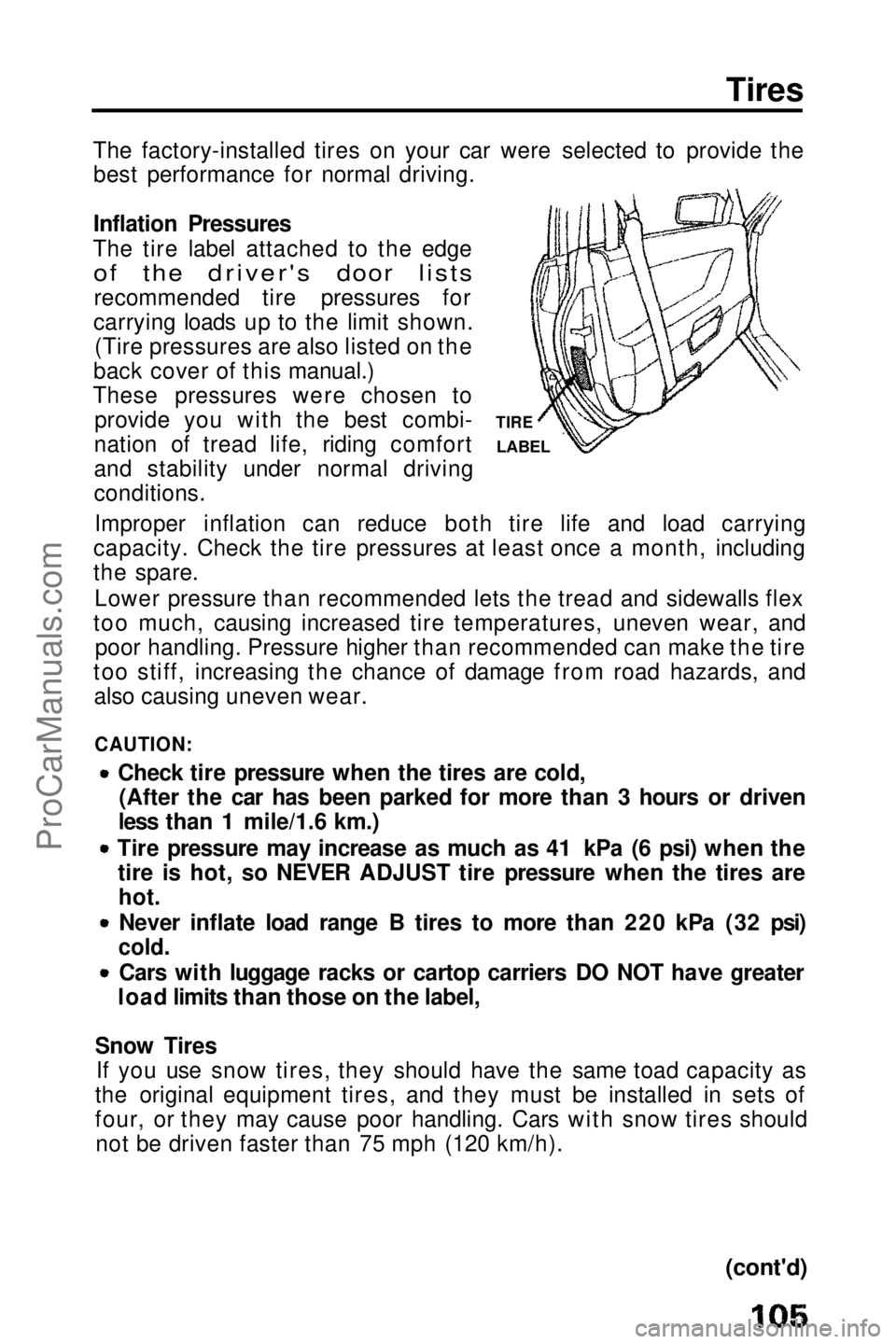
The tire label attached to the edge
of the driver's door lists
recommended tire pressures for
carrying loads up to the limit shown. (Tire pressures are also listed on the
back cover of this manual.)
These pressures were chosen to provide you with the best combi-
nation of tread life, riding comfort
and stability under normal driving
conditions.
Improper inflation can reduce both tire life and load carrying
capacity. Check the tire pressures at least once a month, including
the spare.
Lower pressure than recommended lets the tread and sidewalls flex
too much, causing increased tire temperatures, uneven wear, and poor handling. Pressure higher than recommended can make the tire
too stiff, increasing the chance of damage from road hazards, and also causing uneven wear.
CAUTION: Check tire pressure when the tires are cold,(After the car has been parked for more than 3 hours or driven
less than 1 mile/1.6 km.) Tire pressure may increase as much as 41 kPa (6 psi) when the
tire is hot, so NEVER ADJUST tire pressure when the tires arehot.
Never inflate load range B tires to more than 220 kPa (32 psi)
cold.
Cars with luggage racks or cartop carriers DO NOT have greater
load limits than those on the label,
Snow Tires If you use snow tires, they should have the same toad capacity as
the original equipment tires, and they must be installed in sets of
four, or they may cause poor handling. Cars with snow tires should not be driven faster than 75 mph (120 km/h).
(cont'd)Tires
TIRE
LABELProCarManuals.comMain Menu t s
Page 106 of 143

Tires (cont'd)
Tire Chains
When required, tire chains should be installed on the front wheels. If
you are using metal type chains, make sure they are designated SAEClass "S". You may also use plastic or cable type "chains". Use
only the correct size chains recommended for your tire size andmake sure they are installed following the chain manufacturer's
instructions.
Once tire chains are installed, drive at less than 19 mph (30km/h) on
roads covered with snow or ice. To minimize tire and chain wear,
avoid driving on cleared roads with chains installed.
CAUTION:
Improper installation or loose tire chains may damage your car's
chassis and fenders.
NOTE:
Keep the manufacturer's installation instructions in your glove box
for future reference.
Tire Balancing
Unbalanced tires may affect handling and tire wear. A tire should
always be rebalanced after it has been dismounted from the wheel.
Your original tires were properly balanced before the car left the
factory, but may need rebalancing at some time during the life of the
tire. Tire balancing for the COMPACT spare is not necessary.
CAUTION:
Use only genuine Honda aluminum wheel weights if your car is
equipped with aluminum wheels. Non-genuine Honda wheel
weights may corrode and damage the aluminum wheel.
Tire Rotation Tires may wear unevenly when used for a long time at the same position on the car. To avoid this, rotate the tires every 7,500 miles
(12,000 km). If abnormal or uneven wear develops between
rotations, the cause should be found and corrected as soon as
possible. The illustration shows how the tires can be rotated. The
COMPACT spare tire must not be included in tire rotation.ProCarManuals.comMain Menu t s
Page 112 of 143
Appearance Care (cont'd)
Rust Prevention
Rusting is likely to occur in parts of the car where water is trapped
or where there is continual dampness. Water will collect inside doors and body panels if drain holes
become clogged.
Water which seeps under or soaks floor mats will subject floor sections to prolonged wetness or dampness. Road dirt or sand, which collects and fills recesses on the
underside of the car, retains moisture long after the rest of the
car has dried.
The removal of paint and undercoating by stones, gravel, and minor accidents immediately exposes metal to air and moisture.Rusting is increased by high humidity and by the presence of
corrosive substances in the air or on the roads.
Salt used for road de-icing will coat the bottom of the ear and
hasten rusting.Localities with high humidity have greater potential for rust
problems, especially where salt is also present on the road or in
moist sea air.
Industrial pollution will accelerate the deterioration of paint
finishes and promote rusting.
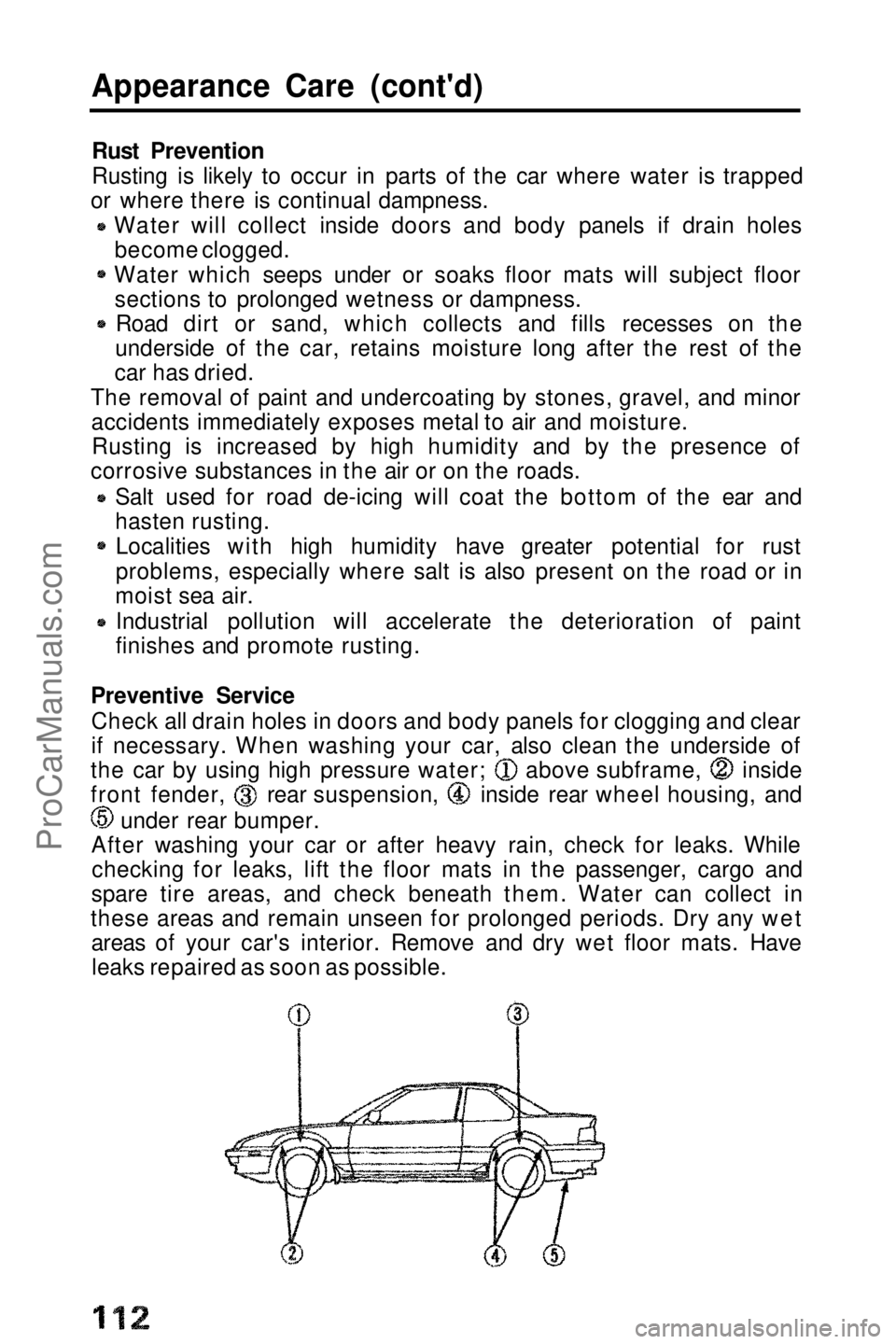
Preventive Service Check all drain holes in doors and body panels for clogging and clear
if necessary. When washing your car, also clean the underside of the car by using high pressure water; above subframe, inside
front fender, rear suspension, inside rear wheel housing, and
under rear bumper.
After washing your car or after heavy rain, check for leaks. While checking for leaks, lift the floor mats in the passenger, cargo and
spare tire areas, and check beneath them. Water can collect in
these areas and remain unseen for prolonged periods. Dry any wet areas of your car's interior. Remove and dry wet floor mats. Haveleaks repaired as soon as possible.ProCarManuals.comMain Menu t s
Page 114 of 143
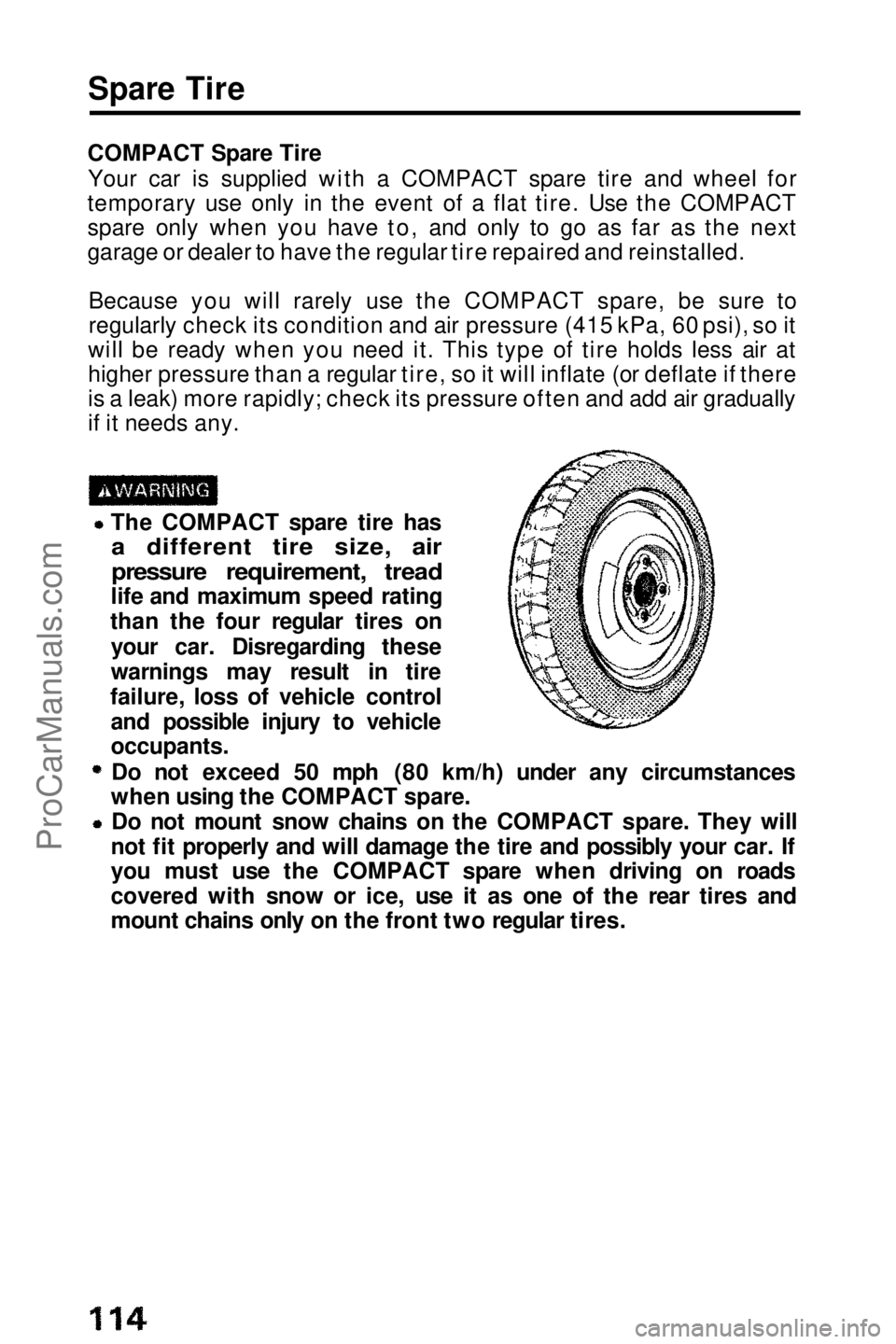
Spare Tire
COMPACT Spare Tire Your car is supplied with a COMPACT spare tire and wheel for
temporary use only in the event of a flat tire. Use the COMPACT
spare only when you have to, and only to go as far as the next
garage or dealer to have the regular tire repaired and reinstalled.
Because you will rarely use the COMPACT spare, be sure to
regularly check its condition and air pressure (415 kPa, 60 psi), so it
will be ready when you need it. This type of tire holds less air at
higher pressure than a regular tire, so it will inflate (or deflate if there
is a leak) more rapidly; check its pressure often and add air gradually
if it needs any. The COMPACT spare tire has
a different tire size, air
pressure requirement, tread
life and maximum speed rating
than the four regular tires on
your car. Disregarding these
warnings may result in tire
failure, loss of vehicle control and possible injury to vehicle
occupants.
Do not exceed 50 mph (80 km/h) under any circumstances
when using the COMPACT spare. Do not mount snow chains on the COMPACT spare. They will
not fit properly and will damage the tire and possibly your car. If
you must use the COMPACT spare when driving on roads
covered with snow or ice, use it as one of the rear tires and
mount chains only on the front two regular tires.ProCarManuals.comMain Menu t s
Page 115 of 143
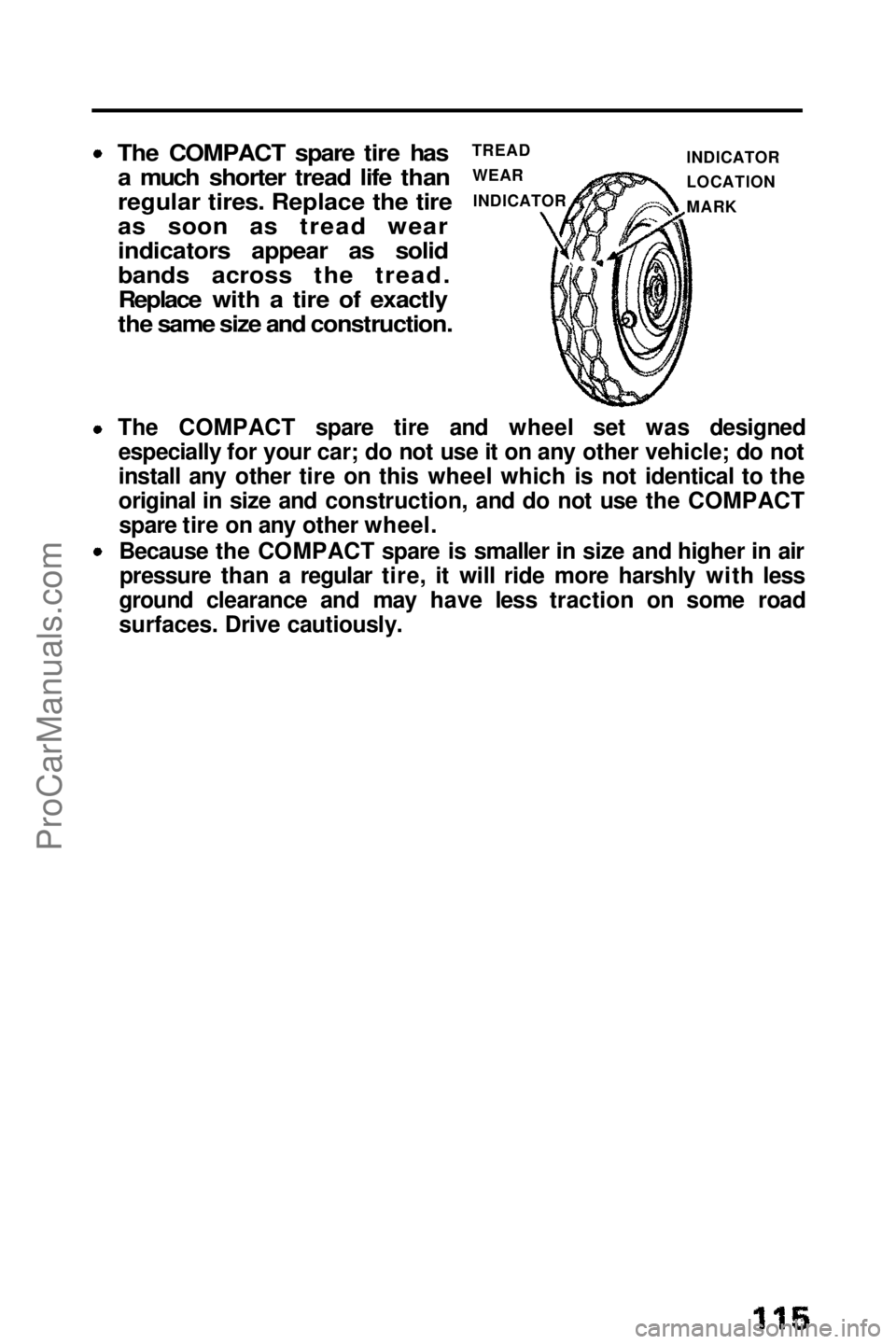
The COMPACT spare tire has
a much shorter tread life than
regular tires. Replace the tire
as soon as tread wear
indicators appear as solid
bands across the tread.Replace with a tire of exactly
the same size and construction.
The COMPACT spare tire and wheel set was designed especially for your car; do not use it on any other vehicle; do not
install any other tire on this wheel which is not identical to the
original in size and construction, and do not use the COMPACTspare tire on any other wheel.
Because the COMPACT spare is smaller in size and higher in airpressure than a regular tire, it will ride more harshly with less
ground clearance and may have less traction on some road
surfaces. Drive cautiously. INDICATOR
LOCATION
MARK
TREAD
WEAR
INDICATORProCarManuals.comMain Menu t s
Page 116 of 143
Changing a Flat Tire
Do not attempt to change a tire unless the car is on firm, level
ground and well out of the flow of traffic.
Park the car on a firm, level surface, apply the parking brake, turn
on the hazard warning switch and put the transmission in gear (Park
for automatic).
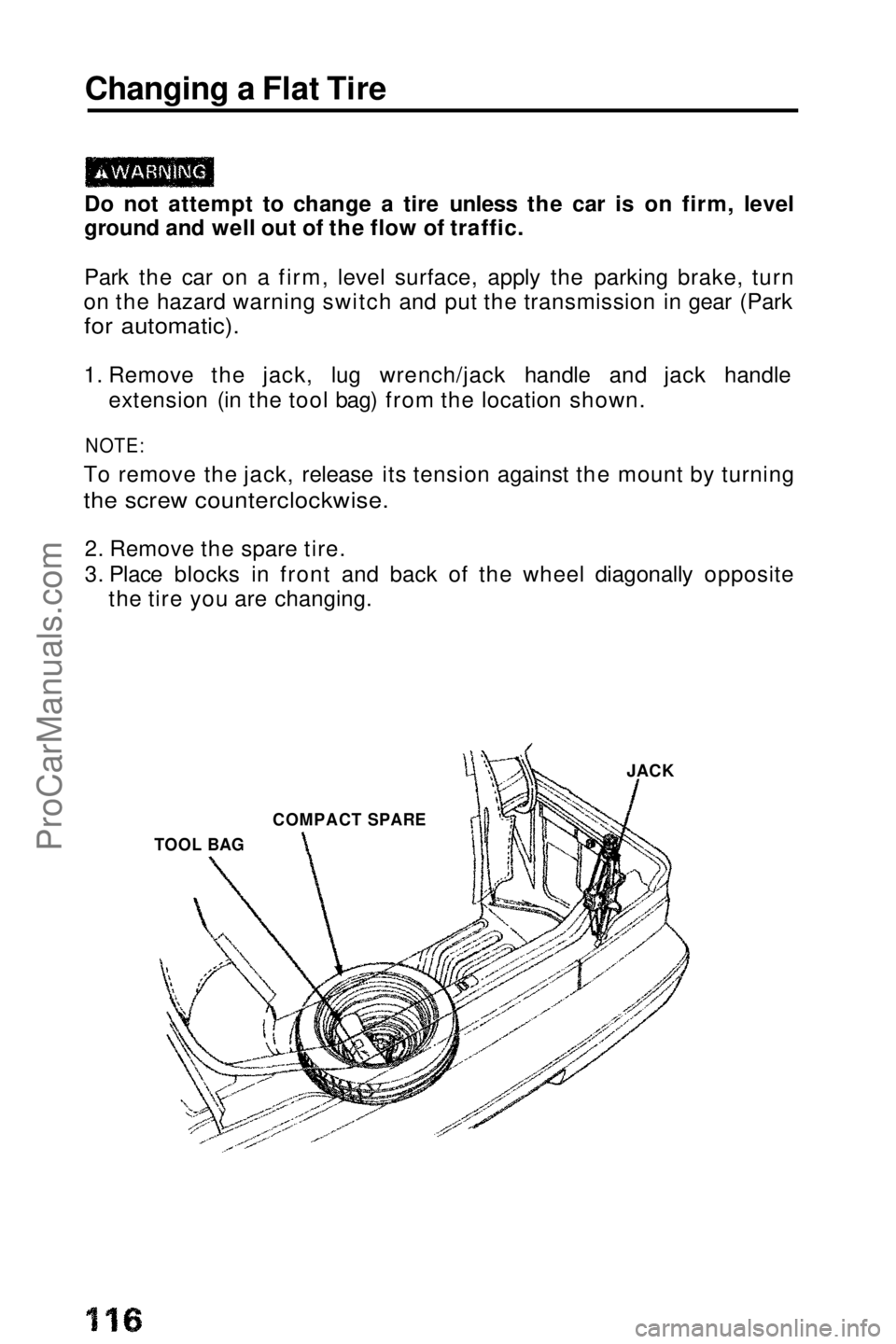
1. Remove the jack, lug wrench/jack handle and jack handle extension (in the tool bag) from the location shown.
NOTE:
To remove the jack, release its tension against the mount by turning
the screw counterclockwise.
2. Remove the spare tire.
3. Place blocks in front and back of the wheel diagonally opposite the tire you are changing.
JACK
COMPACT SPARE
TOOL BAGProCarManuals.comMain Menu t s
Page 118 of 143

Changing a Flat Tire (cont'd)
7. Set the jack handle extension in the connector on the end of the jack and install the lug wrench/jack handle. Turn the lug wrench/jack handle clockwise until the tire is slightly off the ground.
8. Remove the lug nuts, wheel cover and wheel.
(Wheel cover is not equipped
with 4WS or ALB models)
9. Install the spare tire; and install the lug nuts hand tight.
10. Lower the car, remove the jack,
then tighten the lug nuts
securely in an "X" pattern as
shown.11. Tighten the lug nuts securely.
The recommended torque is:
110 N .
m(11 kg-m,80 Ib-ft)
If a torque wrench was not
used, ask an authorized Honda
dealer to verify the torque as
soon as possible.
12. Repai
r or replace the damaged tire as soon as you can, then
reinstall it in its original position on the car, and put the spare back
in the car.
CAUTION:
Always stow the jack, tools and tire securely to prevent them
from becoming dangerous projectiles in an accident.
NOTE:
Secure the tire and the spacer as shown in the illustration.
COMPACT SPARE
DAMAGED TIRESPACER
SPACER TIGHTENING TORQUE
110 N.m (11 kg-m, 80 Ib-ft)
VALVE
NUT
WHEEL COVER
LUG WRENCH/JACK HANDLE JACK HANDLE EXTENSIONProCarManuals.comMain Menu t s