1988 CITROEN CX Adjust
[x] Cancel search: AdjustPage 259 of 648
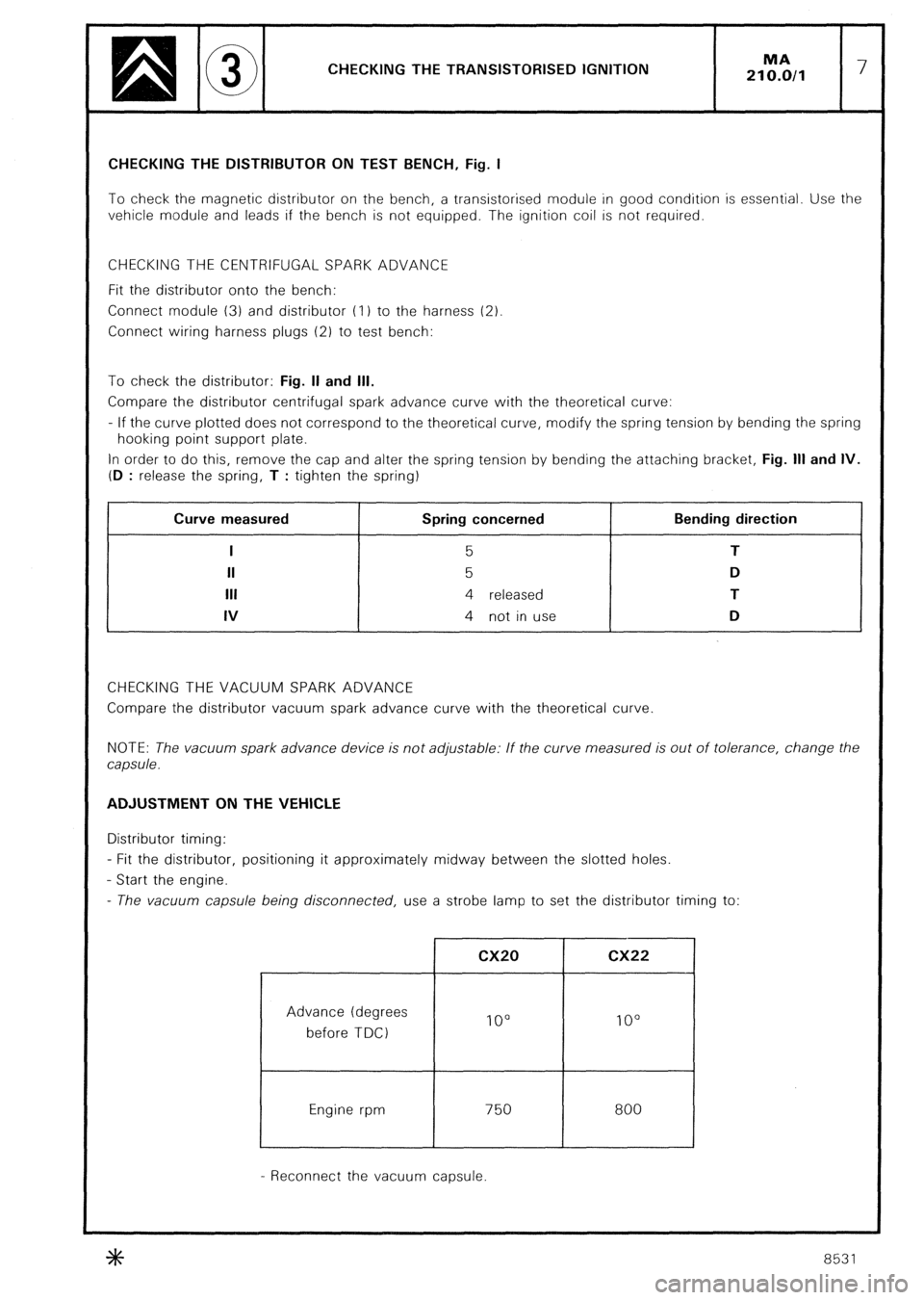
CHECKING THE TRANSISTORISED IGNITION MA
210.0/l 7 CHECKING THE DISTRIBUTOR ON TEST BENCH, Fig. I
To check the magnetic distributor on the bench, a transistorised module in good condition is essential. Use the
vehicle module and leads if the bench is not equipped. The ignition coil is not required.
CHECKING THE CENTRIFUGAL SPARK ADVANCE
Fit the distributor onto the bench:
Connect module (3) and distributor (I 1 to the harness (2)
Connect wiring harness plugs (2) to test bench:
To check the distributor: Fig. II and Ill.
Compare the distributor centrifugal spark advance curve with the theoretical curve:
- If the curve plotted does not correspond to the theoretical curve, modify the spring tension by bending the spring
hooking point support plate.
In order to do this, remove the cap and alter the spring tension by bending the attaching bracket, Fig. Ill and IV.
(D
: release the spring, T : tighten the spring) , Curve measured
I
II
Ill
IV Spring concerned
5
5
4 released
4 not in use Bending direction
T
D
T
D
CHECKING THE VACUUM SPARK ADVANCE
Compare the distributor vacuum spark advance curve with the theoretical curve
NOTE: The vacuum spark advance device is not adjustable: If the curve measured is out of tolerance, change the
capsule. ADJUSTMENT ON THE VEHICLE
Distributor timing:
- Fit the distributor, positioning it approximately midway between the slotted holes.
- Start the engine.
- The vacuum capsule being disconnected, use a strobe lamp to set the distributor timing to:
Advance (degrees
before TDC)
Engine rpm cx20 cx22
IO0 lo0
750
I 800
- Reconnect the vacuum capsule.
8531
Page 278 of 648

2 IVIA
422.1/l OVING AND REFITTING A REAR AXLE ARM
REMOVAL
Raise the rear of the vehicle and support it on stands,
wheels free.
Remove the road wheel.
Release the pressure in the hydraulic systems.
Remove protection plate (I 1, Fig. I.
Vehicle having the A.B.S. fitted, Fig. II :
Withdraw sensor (3) and push aside the metal panel
and sensor, liberating the electrical harness from the
retaining clips.
Remove suspension cylinder (5), Fig. Ill.
(As explained in @ MA 433. l/2/.
Take off fixing lug (41, Fig. Ill.
Uncouple:
- brake hose (21, Fig. I,
- the anti-roll bar, Fig. Ill. In order to do so, extract
screws (6) and (7) and keep adjustment shims and
washers c(a)) and ccbal.
Take off nut (8) 24 mm A/F, Fig. IV.
Free the shaft and remove the arm. REFITTING
Position the axle arm (the thinner thrust cup (9) :
9.34 mm thick at CCCH facing the interior of the
vehicle, -+ l/87), Fig. V).
l/87 -+ the thrust cups are identical and the adjust-
ment is effected by means of shims facing the exte-
rior of the vehicle.
Return the shaft to its original location.
Place nut (8), new NYSLTOP nul, Fig. IV.
Tighten to 13 mdaN.
Recouple the anti-roll bar, Fig. Ill. Add the screws (6)
and (7) together with the adjustment shims and
washers found at c(a)) and c(b)) on dismantling.
Tighten screws (7) to 6 mdaN and (6) to 10 mdaN.
Reconnect brake hose (2) Fig. I, fitted with a NEW
sleeve seal. Tighten it.
Refit fixing lug (41, Fig. Ill.
Locate suspension cylinder (51, Fig. IV.
(See @ MA 433. l/2/.
ABS vehicle, Fig. II :
Refit sensor (31, (grease the outside of the sensor with
MOBIL TEMP No. I).
Tighten the screw to 1 mdaN.
Reassemble:
- protection plate (I 1, Fig. I,
- the road wheel.
Lower the vehicle to the ground.
Page 287 of 648

REMOVING AND REFITTING
AN UPPER WHEEL ARM
REMOVAL
Raise and support the front of the vehicle on stands
6602-T.
Depressurize the hydraulic circuit.
Set the height control lever to the (( low )) position
Remove, Fig. I :
- the wheel,
- the suspension cylinder pivot retaining pin (I 1,
- the anti-roll bar link rod nut (2).
Uncouple ball-joint (3) from the anti-roll bar link rod
using puller 6320-T. Fig. II.
Screw up the tool nut in the ball-joint stem. Fit the
tool cross piece and pin.
Extract, Fig. Ill,
- the nut from upper ball-joint (4).
Disconnect the upper ball-joint.
NOTE:
If the vehicle is fitted with the ABS, the removal of
the upper ball-joint nut requires pushing back the
transmission.
Remove:
- the pin, C
- the nut lock,
- the drive-shaft nut.
Fig. IV
- nut (51,
Fig. V
- the spindle with extractor 6303-T.
Remark: An adjustment shim may be found between
the arm and the front face of the subframe. REFITTING
The LH wheel arm is different from the RH one. Boss
u a )a should be directed towards the rear of the
vehicle when the wheel arm has been fitted.
Reinstall, Fig. V :
- the arm fitted with its thrust cups (7)
frhe thinner cup facing rearwardsl,
- the adjustment shim (6) found on dismantling, facing
forward.
Engage the spindle ; place a new NYLSTOP nut.
Tighten to 12.5 mdaN
Recouple the upper ball-joint.
Tighten the new NYLSTOP nut to 7 mdaN
Reconnect the anti-roll bar link rod (wipe the ball-joint
fixing but do nor use solventl.
Tighten the new NYLSTOP nut to 4.7 mdaN
Refit the suspension cylinder pivot and pin.
Vehicles equipped with the ABS:
Fit the drive-shaft nut (with the faces and threads
lubricated).
Tighten to 37.5 mdaN.
Replace:
- the nut lock,
- the pin,
- the road wheel
Page 290 of 648

REMOVING AND REFITTING
REMOVAL
Support the front of the vehicle on stands 6602-T.
Release the pressure in the hydraulic system.
Set the height control lever to the (( low )) position.
Withdraw:
- the road wheel,
- the brake pad wear warning lamp harness holding
clips,
- the lower ball-joint nut.
Uncouple the lower ball-joint from the arm using puller
3312-T or 6323-T, Fig. I
Take off:
- the plastic trim cover,
- nut (I 1, Fig. II,
- spindle (2) with the help of inertia extractor
1671-T and adaptor 6306-T, Fig. Ill.
Mark adjustment shims (3) and (4) location, Fig. IV.
Remove the wheel arm. REFITTING
Note: the RH and LH arms are not alike.
If the wheel arm has been removed following an
impact, it will be necessary to readjust the caster
angle.
Place the expander of tool 6312-T in the wheel arm,
with screw A pointing rearwards, Fig V.
Bring tubes (5) and (6) into contact, Fig. V. In order
to do so:
Fig. VI :
- Grip the arm in a vice,
- Tighten the expandable element by means of
spanner B from tool 6312-T.
Page 293 of 648

REMOVING AND REFITTING
A LOWER WHEEL ARM
Refit
Insert
Loosen
Drift out
Tighten
Reconnect
Tighten
Reinstall Fig. I
the arm together with its adjustment shims
(7 1 and (2) placed in the position they were
found on dismanting.
spindle (31, Fig. II
expander A with tool 6312-T spanner B.
the assembly via shaft (3)
the new NYLSTOP nut (4) to 14.5 mdaN,
Fig Ill.
the lower ball-joint to the arm hvipe the
ball-joint fixing but do not use solvent).
the new NYLSTOP nut to 6 mdaN.
- the brake pad wear warning lamp harness
securing clips,
- the road wheel.
Lower the vehicle to the ground
Jfc 8531-8532
Page 311 of 648

REMOVING AND REFITTING A SWIVEL
REFITTING Replace, Fig. IV:
Wipe the ball-joint fixings and location, do not use - flexible pipe (I I) into its fixing bracket,
solvent. - washer (I 0).
Recouple the upper ball-joint with the swivel. Tighten nut (9) to 2.2 mdaN.
Refit, Fig. I: Recouple:
- washer (I),
- Fig. IV, connection (I 2) provided with a new sea/.
- nut (2).
- Fig. V, the steering ball-joint.
Tighten to 7 mdaN (New NYLSTOP nut).
Refit:
Introduce the drive-shaft end into the wheel hub - washer (I 31,
(lubricate the hub seal lips). - nut (14) (New NYLSTOP one).
Couple up the lower ball-joint. Tighten to 6 mdaN.
Tighten to 6 mdaN the new NYLSTOP nut. Reconnect:
-cup (171,
Reconnect the brake pad wear warning lamp harness. - spring (I 61,
-cable (15).
Refit, Fig. II and Ill:
Adjust the handbrake (as indicated in @ 454.011).
- electrical harness fixing bracket (4).
- earth lead (5).
- screw (3). Put the drive-shaft nut into place.
- metal panel (6). (Faces and threads lubricated).
Lock the hub, utilizing tool 6310-T Fig. VI.
ABS vehicles, Fig. Ill:
Tighten to 37.5 mdaN.
Reinstall sensor (7) (spread MOB/L TEMP No. 1
grease over the outside of the sensor.
Bleed the front brakes (see @ 453.0/l/.
Tighten screw (8) to 1 mdaN.
Fit the wheel.
Lower the vehicle to the ground.
8531-8532
Page 326 of 648
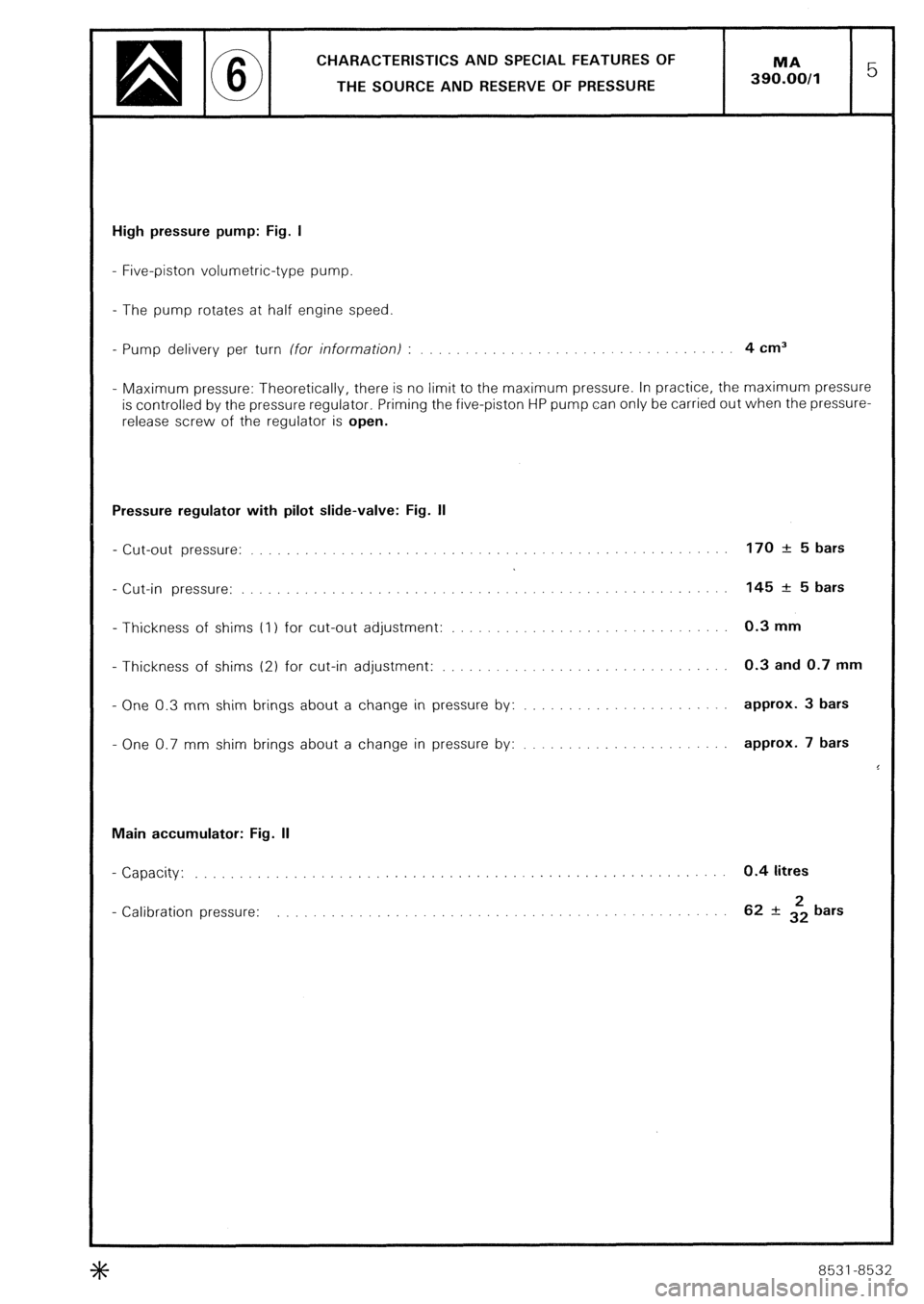
CHARACTERISTICS AND SPECIAL FEATURES OF
THE SOURCE AND RESERVE OF PRESSURE
High pressure pump: Fig. I
- Five-piston volumetric-type pump.
- The pump rotates at half engine speed
- Pump delivery per turn (for information) : 4 cm3
- Maximum pressure: Theoretically, there is no limit to the maximum pressure. In practice, the maximum pressure
is controlled by the pressure regulator. Priming the five-piston HP pump can only be carried out when the pressure-
release screw of the regulator is open.
Pressure regulator with pilot slide-valve: Fig. II
- Cut-out pressure:
- Cut-in pressure:
- Thickness of shims (I ) for cut-out adjustment:
- Thickness of shims (2) for cut-in adjustment:
- One 0.3 mm shim brings about a change in pressure by:
- One 0.7 mm shim brings about a change in pressure by: 170 + 5 bars
145 +: 5 bars
0.3 mm
0.3 and 0.7 mm
approx. 3 bars
approx. 7 bars
Main accumulator: Fig. II
- Capacity: 0.4 litres
- Calibration pressure: 62 rt 322 bars *
8531-8532
Page 327 of 648

SPECIFICATION AND PARTICULAR FEATURES OF
THE SOURCE AND RESERVE OF PRESSURE
Security valve: Fig. I
Calibration pressures for slide valve return spring:
- Pressure for isolation (no supply to suspension at A and D) :
- Pressure for supply to suspension (delivery at A and D) : 110 bars min.
130 bars min.
Key to diagram:
A : Feed to front height corrector.
B : Feed to steering rack and control unit.
C : H.P. inlet
D : Feed to rear height corrector.
E : Leakage return.
(1) : Adjusting shims for the calibration of slide valve return spring.
Shim thickness
(2) : Slide valve.
(3) : Fault detector (mechanically operated through shifting of slide-valve (2) 1.
Brake accumulator: Fig. II
-Capacity: . . . . . . . .._.._..~..._~._............_..........._.....
- Calibration pressure: 0.9 mm
0.4 litres
2
62 f 32 bars
F : HP inlet.
G : Centrifugal regulator, security valve
H: Brake control valve.