1988 CITROEN CX Adjust
[x] Cancel search: AdjustPage 163 of 648

CARBURETTOR SPECIFICATION
Engine type 829.A5
MAKE : SOLEX
Type : 34 CICF Ref. CIT 214 and 214-I
Choke flap in primary barrel
Dual choke carburettor of the compound type
Fuel return pipe to tank located on the carburettor top cover
DESCRIPTION
Venturi
Main jet
Air compensator jet
Emulsion tube
Idling jet
Idling air correction jet
By-pass jet
By-pass air jet
Accelerator pump injector
Econostat - Petrol jet
Air jet
Polyamide fuel float
Ball type needle valve
Positive opening of
1st choke butterfly
Opening of the strangler flap
with 400 mm Mg (530 mb)
Mixture control screw
Idle cut off solenoid 1st choke
23
127.5
205
VA
55
60 Ref. No. @
(under Ref. No. 0)
Ref. No. @
(under Ref. No. @)
Ref. No. @
Ref. No. @
Ref. No. @ 26
115
140
ZA
60
90
145
80 2nd choke
Ref. No. @ 12 I!I 2g
Ref. No. @ 1.8
1.25 k 0.05 mm
4.4 + 0.5 mm
Ref. No. @
Ref. No. @
Adjustments carried out on CCL’POLLUH test bench: Ref. No. @
(under Ref. No. 0
Ref. No. @
[under Ref No. @
Ref. No. @
Ref. No. @
Ref. No. @
Ref. No. @
OPENING OF THE THROTTLE BUTTERFLY 1 INITIAL SETTING OF IDLING SPEED
I
1st choke
W mixture screw closed 2nd choke 1st choke
W mixture screw open 2nd choke
I
Positive opening
1st choke
N 195 K 205 N 240 K 205
Page 169 of 648

CARBURETTOR SPECIFICATION
Engine type J6R A 500
1 MAKE : WEBER
Type 34 DMTR 120/100 Ref. w 149-50
Choke flap in primary barrel
Idle cut off solenoid
Dual choke compound carburettor
Fuel return pipe to tank located on the carburettor top cover
Throttle closing dashpot
Anti-oollution device
DESCRIPTION 1st choke 2nd choke
Venturi
Main jet
Air compensator jet
Emulsion tube
Idling jet
Idling air correction jet
Ball type needle valve
Float setting
Petrol enrichment jet
Air enrichment jet
Accelerator pump jet
Air regulating screw
Mixture control screw
Idle shut off solenoid
Throttle opening device
Positive opening full choke
Opening of the strangler flap
with 400 m Mg (530 mb)
Mechanical opening 24 Ref. No. @ 26 Ref. No. @
110 Ref. No. @ 125 Under Ref. No. @
180 Ref. No. @ 240 Ref. No. @
F45 Ref. No. @ F25 Under Ref. No. @
52 Ref. No. @ 50 Ref. No. @
155 70
1.75 Ref. No. @)
7 mm & 0.25
115 Under Ref. No. @
115 Under Ref. No. @
50 Ref. No. @
Ref. No. @
Ref. No. @
Ref. No. @
Ref. No. @
1.20 mm f 0.5
4 mm f 0.25
8 t- 0.5 mm
specifications: MA 142.0013 p.3
Refer to: checks and adjustments: MA 142.013
anti-pollution devices: MA 143.011
Page 208 of 648

RECOMMENDED TOOLS
2437-T.
3089-T.F.
3089-T.H.
4026-T-bis.
4059-T.
5008-T.C.
6027-T.
6030-T.
Dial-gauge.
Dial-gauge.
Feeler.
Injector test bench.
Right angled lever for dial-gauge.
Dial-gauge mounting fixing screw
Set of 3 tools.
Dial-gauge mounting. CHECKING AND ADJUSTING
THE FUEL INJECTION SYSTEM
8531
Page 209 of 648
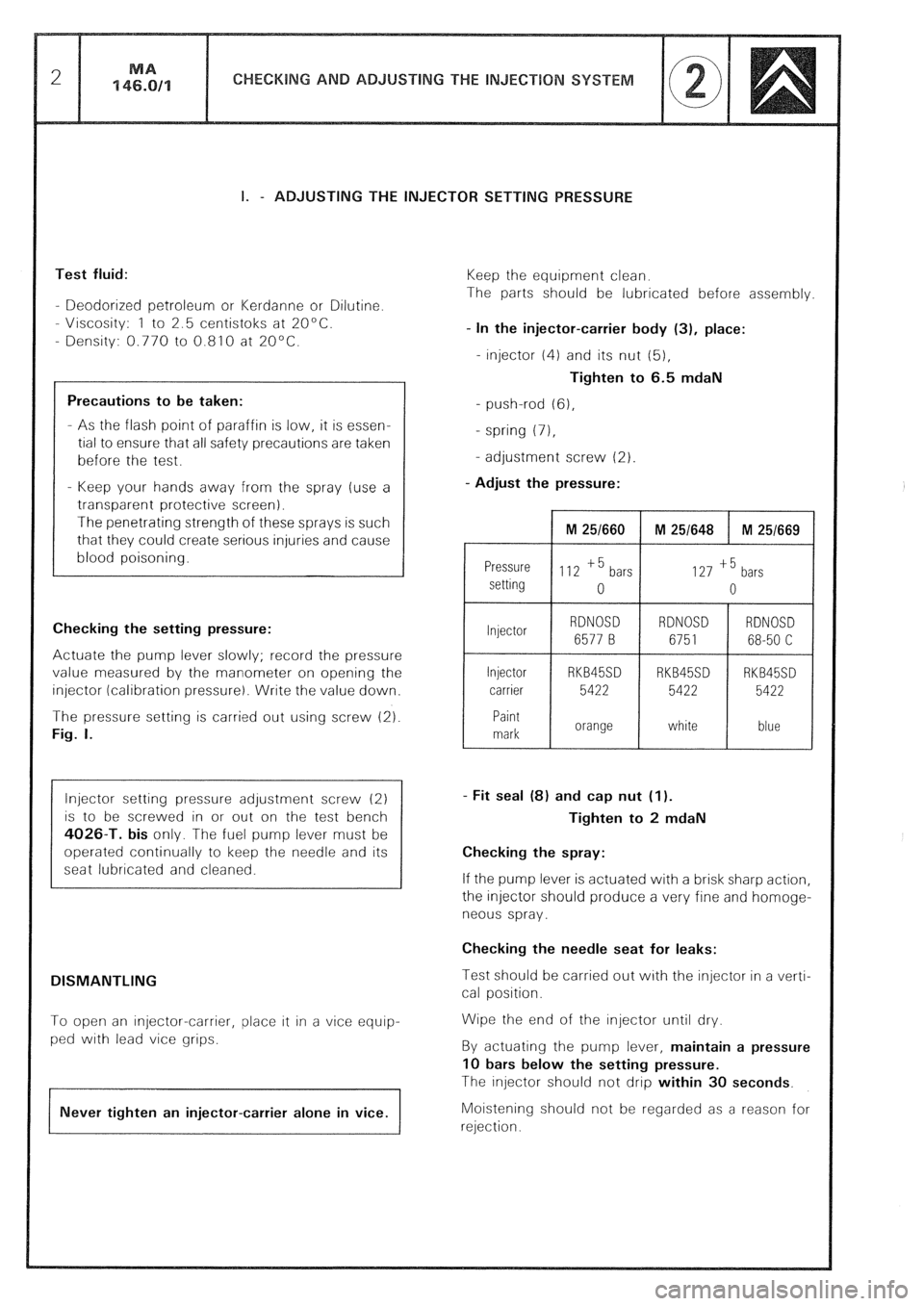
I. - ADJUSTING THE INJECTOR SETTING PRESSURE
Test fluid: Keep the equipment clean.
- Deodorized petroleum or Kerdanne or Dilutine. The parts should be lubricated before assembly.
- Viscosity: 1 to 2.5 centistoks at 2O’C.
- Density: 0.770 to 0.810 at 2O’C. - In the injector-carrier body (31, place:
- injector (4) and its nut (5),
Tighten to 6.5 mdaN
Precautions to be taken:
- push-rod (6),
- As the flash point of paraffin is low, it is essen-
- spring (7),
tial to ensure that all safety precautions are taken
before the test. - adjustment screw (2).
- Keep your hands away from the spray (use a - Adjust the pressure:
transparent protective screen).
The penetrating strength of these sprays is such
that they could create serious injuries and cause M 251660 M 251648 M 25/669
blood poisoning.
Pressure
112 t5 bars 127 t5 bars
setting
0 0
Checking the setting pressure: Injector RDNOSD RDNOSD RDNOSD
6577 B 6751 68-50 C
Actuate the pump lever slowly; record the pressure
value measured by the manometer on opening the Injector RKB45SD RKB45SD RKB45SD
Injector (calibration pressure). Write the value down. carrier 5422 5422 5422
The pressure setting is carried out using screw (2). Paint
Fig. I. mark orange white blue
Injector setting pressure adjustment screw (2)
is to be screwed in or out on the test bench
operated continually to keep the needle and its
If the pump lever is actuated with a brisk sharp action,
the injector should produce a very fine and homoge-
neous spray.
Checking the needle seat for leaks:
DISMANTLING Test should be carried out with the injector in a verti-
cal position.
To open an injector-carrier, place it in a vice equip- Wipe the end of the injector until dry.
ped with lead vice grips.
By actuating the pump lever, maintain a pressure
10 bars below the setting pressure.
The injector should not drip within 30 seconds,
Never tighten an injector-carrier alone in vice. Moistening should not be regarded as a reason for
rejection.
Page 212 of 648
CHECKING AND ADJUSTING
THE INJECTION SYSTEM
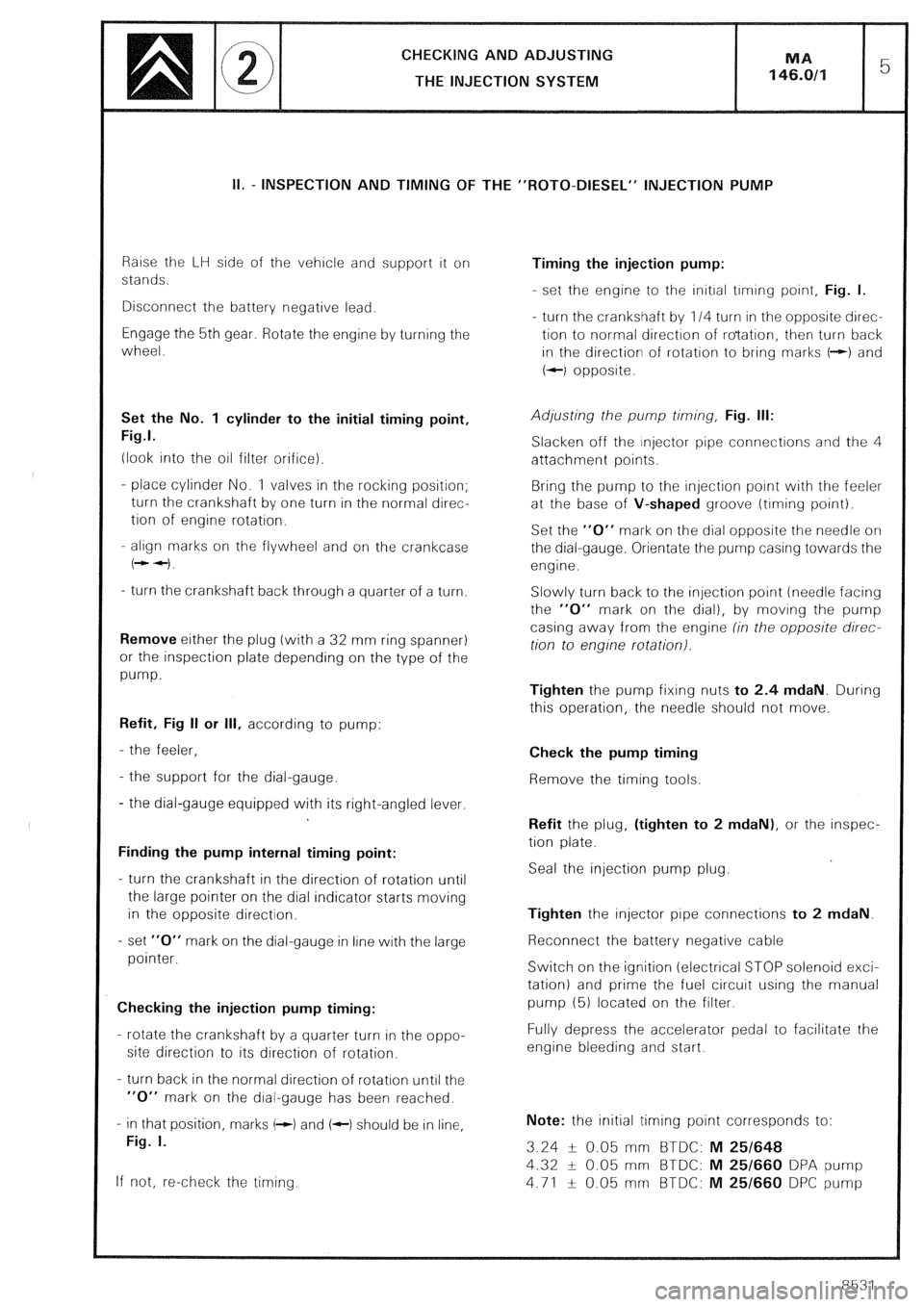
II. - INSPECTION AND TIMING OF THE “ROT0-DIESEL” INJECTION PUMP
Raise the LH side of the vehicle and support it on
stands.
Disconnect the battery negative lead.
Engage the 5th gear. Rotate the engine by turning the
wheel.
Set the No. 1 cylinder to the initial timing point,
Fig.1.
(look into the oil filter orifice).
- place cylinder No. 1 valves in the rocking position;
turn the crankshaft by one turn in the normal direc-
tion of engine rotation.
- align marks on the flywheel and on the crankcase
(++I.
- turn the crankshaft back through a quarter of a turn.
Remove either the plug (with a 32 mm ring spanner)
or the inspection plate depending on the type of the
pump.
Refit, Fig II or Ill, according to pump:
- the feeler,
- the support for the dial-gauge.
- the dial-gauge equipped with its right-angled lever.
Finding the pump internal timing point:
- turn the crankshaft in the direction of rotation until
the large pointer on the dial indicator starts moving
in the opposite direction.
- set “0” mark on the dial-gauge in line with the large
pointer.
Checking the injection pump timing:
- rotate the crankshaft by a quarter turn in the oppo-
site direction to its direction of rotation.
- turn back in the normal direction of rotation until the
“0” mark on the dial-gauge has been reached.
- in that position, marks (-1 and (c) should be in line,
Fig. I.
If not, re-check the timing. Timing the injection pump:
- set the engine to the initial trming point, Fig. I.
- turn the crankshaft by 114 turn in the opposite direc-
tion to normal direction of ro’tatron, then turn back
in the direction of rotation to bring marks t-+) and
+-I opposite.
Adjusting the pump timing, Fig. Ill:
Slacken off the injector pipe connections and the 4
attachment points.
Bring the pump to the injection point with the feeler
at the base of V-shaped groove (timing point).
Set the “0” mark on the dial opposite the needle on
the dial-gauge. Orientate the pump casing towards the
engine.
Slowly turn back to the injection point (needle facing
the “0” mark on the dial), by moving the pump
casing away from the engine (in the opposite direc-
tion to engine rotation).
Tighten the pump fixing nuts to 2.4 mdaN. During
this operation, the needle should not move.
Check the pump timing
Remove the timing tools.
Refit the plug, (tighten to 2 mdaN), or the inspec-
tion plate.
Seal the injection pump plug.
Tighten the injector pipe connections to 2 mdaN.
Reconnect the battery negative cable
Switch on the ignition (electrical STOP solenoid exci-
tation) and prime the fuel circuit using the manual
pump (5) located on the filter.
Fully depress the accelerator pedal to facilitate the
engine bleeding and start.
Note: the initial timing point corresponds to:
3.24 -L- 0.05 mm BTDC: M 25/648
4.32 + 0.05 mm BTDC: M 25/660 DPA pump
4.71 f 0.05 mm BTDC: M 25/660 DPC pump
8531
Page 213 of 648
CHECKING AND ADJUSTING
THE INJECTION SYSTEM
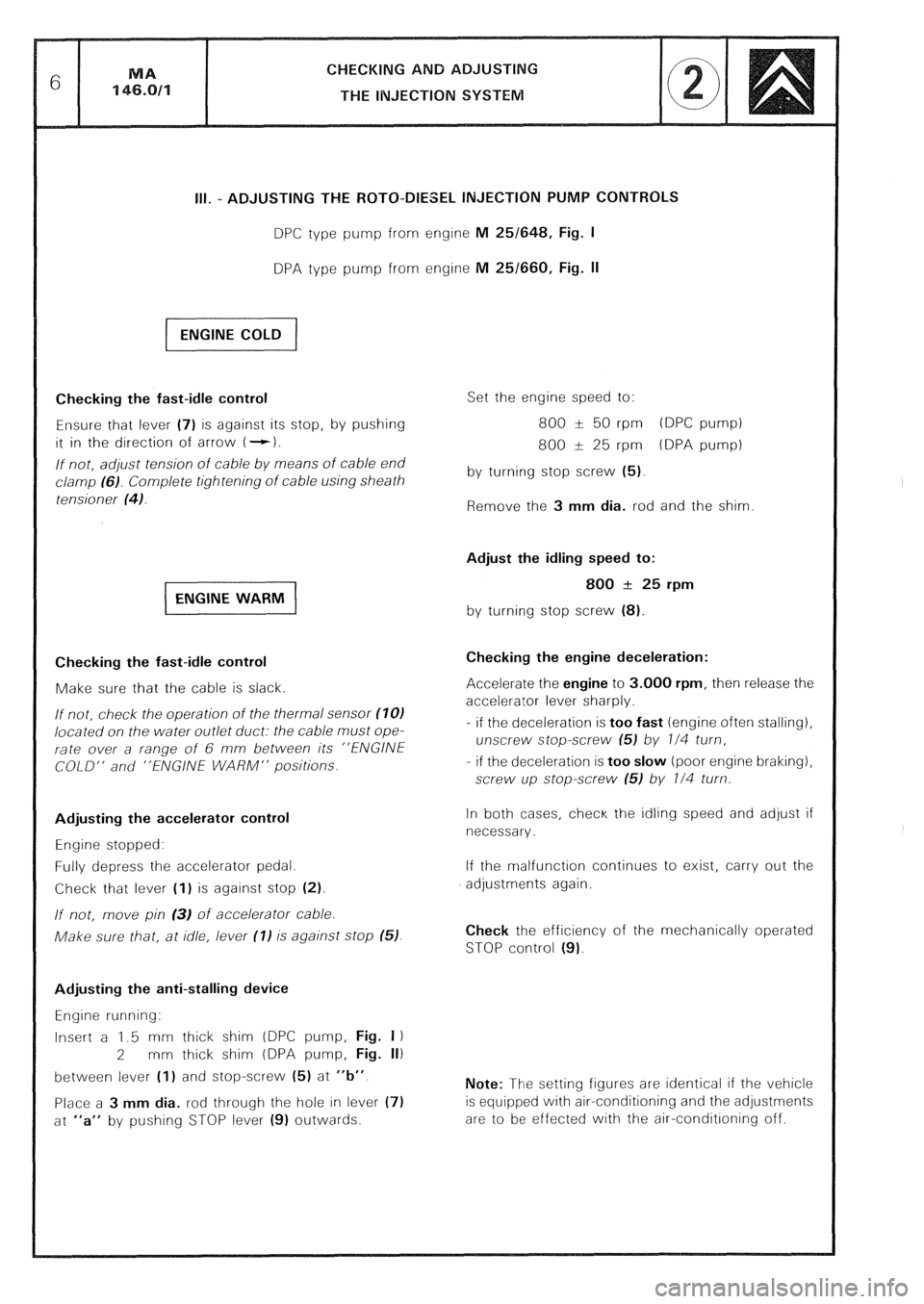
III. - ADJUSTING THE ROTO-DIESEL INJECTION PUMP CONTROLS
DPC type pump from engine M 25/648, Fig. I
DPA type pump from engine M 25/660, Fig. II
Checking the fast-idle control
Ensure that lever (7) is against its stop, by pushing
it in the direction of arrow (-).
If not, adjust tension of cab/e by means of cable end
clamp (6). Complete tightening of cable using sheath
tensioner (41.
Checking the fast-idle control
Make sure that the cable is slack.
If not, check the operation of the thermal sensor (101
located on the water outlet duct: the cable must ope-
rate over a range of 6 mm between its “ENGINE
COLD” and “ENGINE WARM” positions.
Adjusting the accelerator control
Engine stopped:
Fully depress the accelerator pedal.
Check that lever (I) is against stop (2).
If not, move pin (3) of accelerator cable.
Make sure that, at idle, lever (I) is against stop (5).
Adjusting the anti-stalling device
Engine running:
Insert a 1.5 mm thick shim (DPC pump, Fig. I)
2 mm thick shim (DPA pump, Fig. II)
between lever (I) and stop-screw (5) at “b”.
Place a 3 mm dia. rod through the hole in lever (7)
at “a” by pushing STOP lever (9) outwards. Set the engine speed to:
800 t 50 rpm (DPC pump)
800 f 25 rpm (DPA pump)
by turning stop screw (5).
Remove the 3 mm dia. rod and the shim
Adjust the idling speed to:
800 + 25 rpm
by turning stop screw (8).
Checking the engine deceleration:
Accelerate the engine to 3.000 rpm, then release the
accelerator lever sharply.
- if the deceleration is too fast (engine often stalling),
unscrew stop-screw (5) by 114 turn,
- if the deceleration is too slow (poor engine braking),
screw up stop-screw (51 by l/4 turn.
In both cases, check the idling speed and adjust if
necessary.
If the malfunction continues to exist, carry out the
adjustments again.
Check the efficiency of the mechanically operated
STOP control (9).
Note: The setting figures are identical if the vehicle
is equipped with air-conditioning and the adjustments
are to be effected with the air-conditioning off.
Page 218 of 648
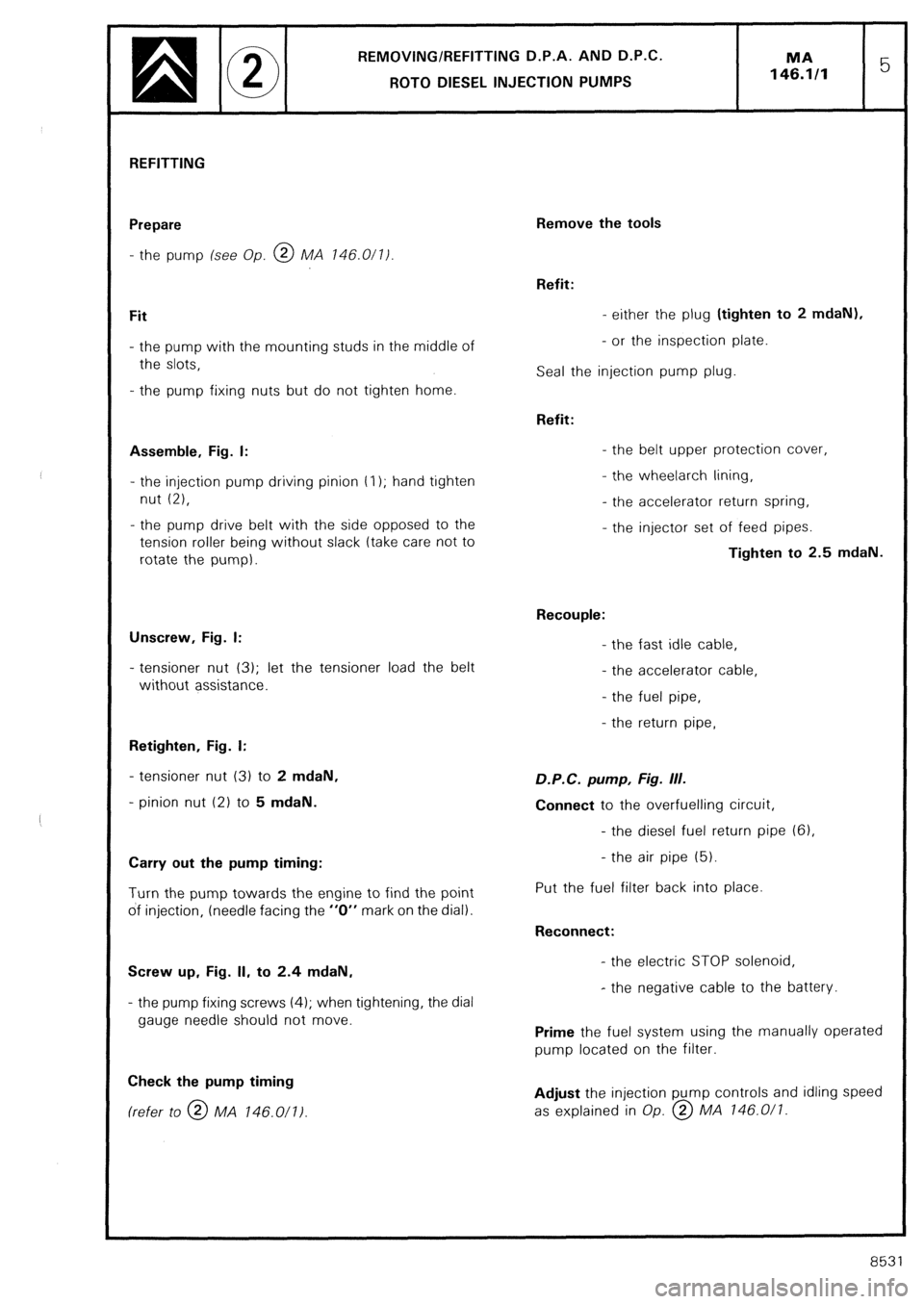
REMOVING/REFITTING D.P.A. AND D.P.C.
ROT0 DIESEL INJECTION PUMPS MA
146.1/l 5
REFITTING
Prepare
- the pump (see Op. @ MA 146.0/l/
Fit
- the pump with the mounting studs in the middle of
the slots,
- the pump fixing nuts but do not tighten home.
Assemble, Fig. I:
- the injection pump driving pinion t I); hand tighten
nut (2),
- the pump drive belt with the side opposed to the
tension roller being without slack (take care not to
rotate the pump).
Unscrew, Fig. I:
- tensioner nut (3); let the tensioner load the belt
without assistance.
Retighten, Fig. I:
- tensioner nut (3) to 2 mdaN,
- pinion nut (2) to 5 mdaN.
Carry out the pump timing:
Turn the pump towards the engine to find the point
of injection, (needle facing the “0” mark on the dial).
Screw up, Fig. II, to 2.4 mdaN,
- the pump fixing screws (4); when tightening, the dial
gauge needle should not move.
Check the pump timing (refer to @ MA 146.011)
Remove the tools
Refit:
- either the plug (tighten to 2 mdaN),
- or the inspection plate.
Seal the injection pump plug.
Refit:
- the belt upper protection cover,
- the wheelarch lining,
- the accelerator return spring,
- the injector set of feed pipes.
Tighten to 2.5 mdaN.
Recouple:
- the fast idle cable,
- the accelerator cable,
- the fuel pipe,
- the return pipe, D.P.C. pump, Fig. III.
Connect to the overfuelling circuit,
- the diesel fuel return pipe (61,
- the air pipe (5).
Put the fuel filter back into place.
Reconnect:
- the electric STOP solenoid,
- the negative cable to the battery.
Prime the fuel system using the manually operated
pump located on the filter.
Adjust the injection pump controls and idling speed
as explained in Op. @ MA 146.0/l.
8531
Page 233 of 648
GENERAL FEATURES
OF THE TRANSISTORISED IGNITION SYSTEM
TRANSISTORISED IGNITION
PRINCIPLE OF OPERATION
The plug spark is triggered by distributor (1) which comprises a coil located inside the field of a magnetic circuit
permanent magnet. The magnetic circuit has four fixed branches and four movable branches driven by the distribu-
tor shaft.
When the movable branches, in their rotation, come opposite the fixed ones, a variation of the magnetic field is
brought and current is induced into the sensor winding.
This current, in turn, triggers electronic module (2)
which builds up the current in ignition coil (3) primary winding
and then cuts it off, thus creating a high tension current in the coil secondary winding and triggering a spark from
the plug selected by the distributor rotor arm. IGNITION DISTRIBUTOR (I!
The advance curves are specific for each engine type
N: Distributor rpm
D = Vacuum Dl, in m.bars A:
Distributor degrees 02, in mm.hg
Pick-up coil resistance: 1100 Q sr 10% (990 to 1210 02)
Setting the distributor static timing on the engine is impossible owing to design.
A revolution of the distributor is required to create a variation of the magnetic field which will send a signal to the
module. Consequently, when fitting a distributor, place it in mid-slot; start the engine and adjust the distributor
by means of a timing light or a diagnosis console.
The duration and amplitude of the signal depend on the speed, therefore the DWELL ratio
is not significant.
The air gap between the branches is non-adjustable and it cannot be measured ELECTRONIC MODULE (2)
Intended to operate with the magnetically-triggered distributor.
Do not carry out a check with an ohmmeter since the results would not be significant.
Do not operate the module without cooling (aluminium plate heat sink and heat conductor grease).
The operation of the ignition system is possible with the engine stopped: - connect an earthed sparking plug to
the coil HT lead; short ” + 12 volts” pulses on module red lead (path 5) (with all leads connected, cap lifted) will
generate a spark from the plug: simulation of a signal from the distributor pick up).
Do not operate the module and coil without a plug and HT lead, (It could result in the module being destroyed). IGNITION COIL (3)
The coil must not be kept alive under 12 volts without its module (overheating).
The coil current flow is generated by the module which then reduces it, prior to cutting it off when the engine
ignition timing occurs.
Only use a rev. counter with a UT induction clip.