1987 TOYOTA CELICA engine
[x] Cancel search: enginePage 51 of 346
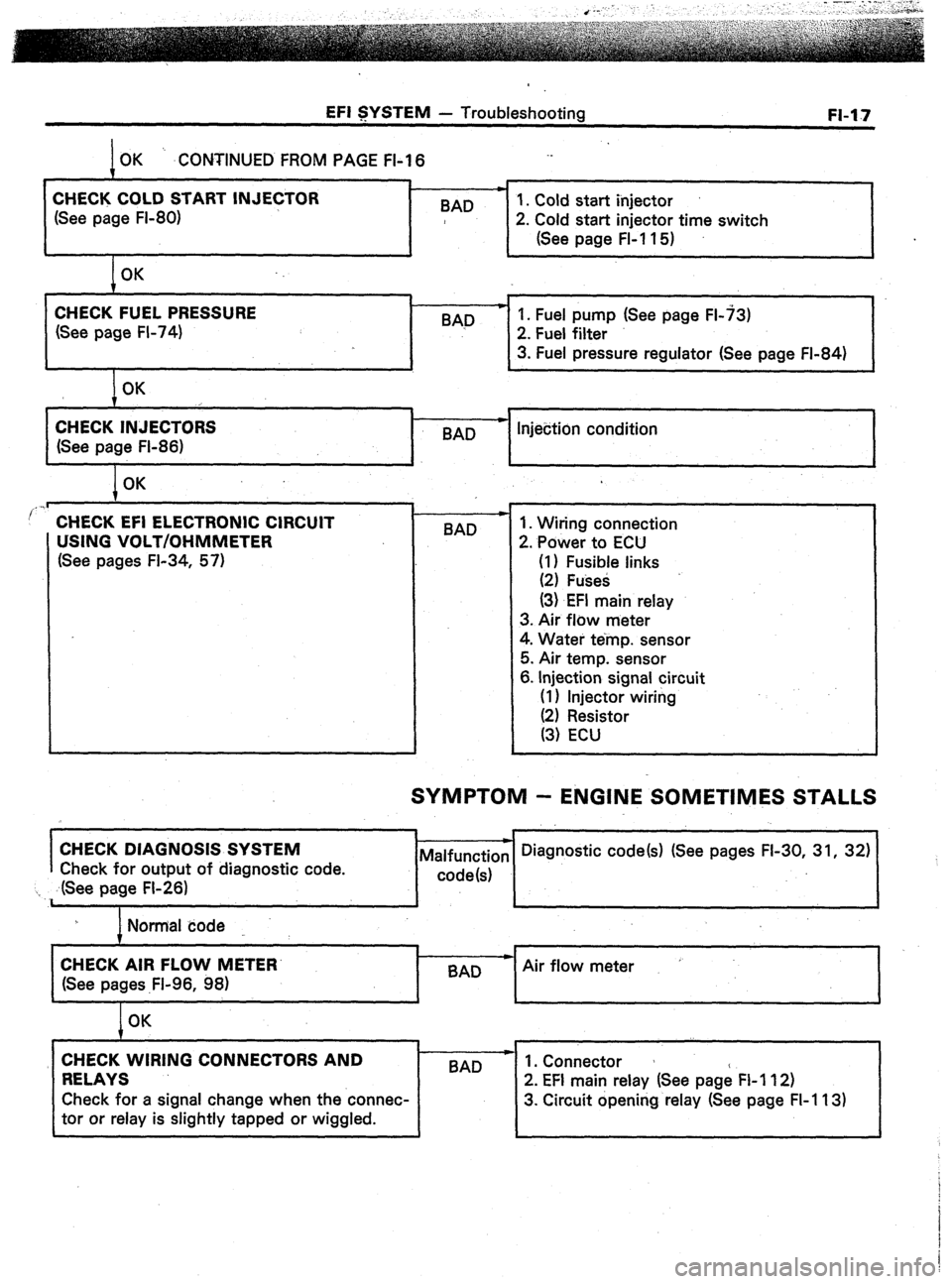
EFI SYSTEM - Troubleshooting
OK ‘. .CONTINUED FROM PAGE FI-I 6
m
CHECK COLD START INJECTOR
1. Cold start injector
(See page FI-80) BAD
2. Cold start injector time switch
(See page FL11 5)
OK FI-17
CHECK FUEL PRESSURE
(See page FI-74) BAD p 1. Fuel pump (See page FL73)
2. Fuel filter
3. Fuel pressure regulator (See page FI-84)
OK
CHECK INJECTORS
(See page FI-86) c
-
BAD Injection condition
I OK
..I
’ CHECK EFI ELECTRONIC CIRCUIT
USING VOLT/OHMMETER
(See pages FI-34, 57) BAD 1. Wiring connection
2. Power to ECU
(I) Fusible links
(2) Fuses
(3) EFI main relay
3. Air flow meter
4. Water temp. sensor
5. Air temp. sensor
6. Injection signal circuit
(I 1 Injector wiring
SYMPTOM - ENGINE SOMETIMES STALLS
I
CHECK DIAGNOSIS SYSTEM
Check for output of diagnostic code.
‘I ,. ,dSee page FI-26)
I Normal code
I
CHECK AIR FLOW METER’
Air flow meter
(See pages .Fl-96, 98)
I
OK
CHECK WIRING CONNECTORS AND
RELAYS 1 BAD --
2’ EFI main relay (See page FI 112)
Check for a signal change when the connec- 3. Circuit opening relay (See page FI-113)
tor or relay is slightly tapped or wiggled.
Page 54 of 346
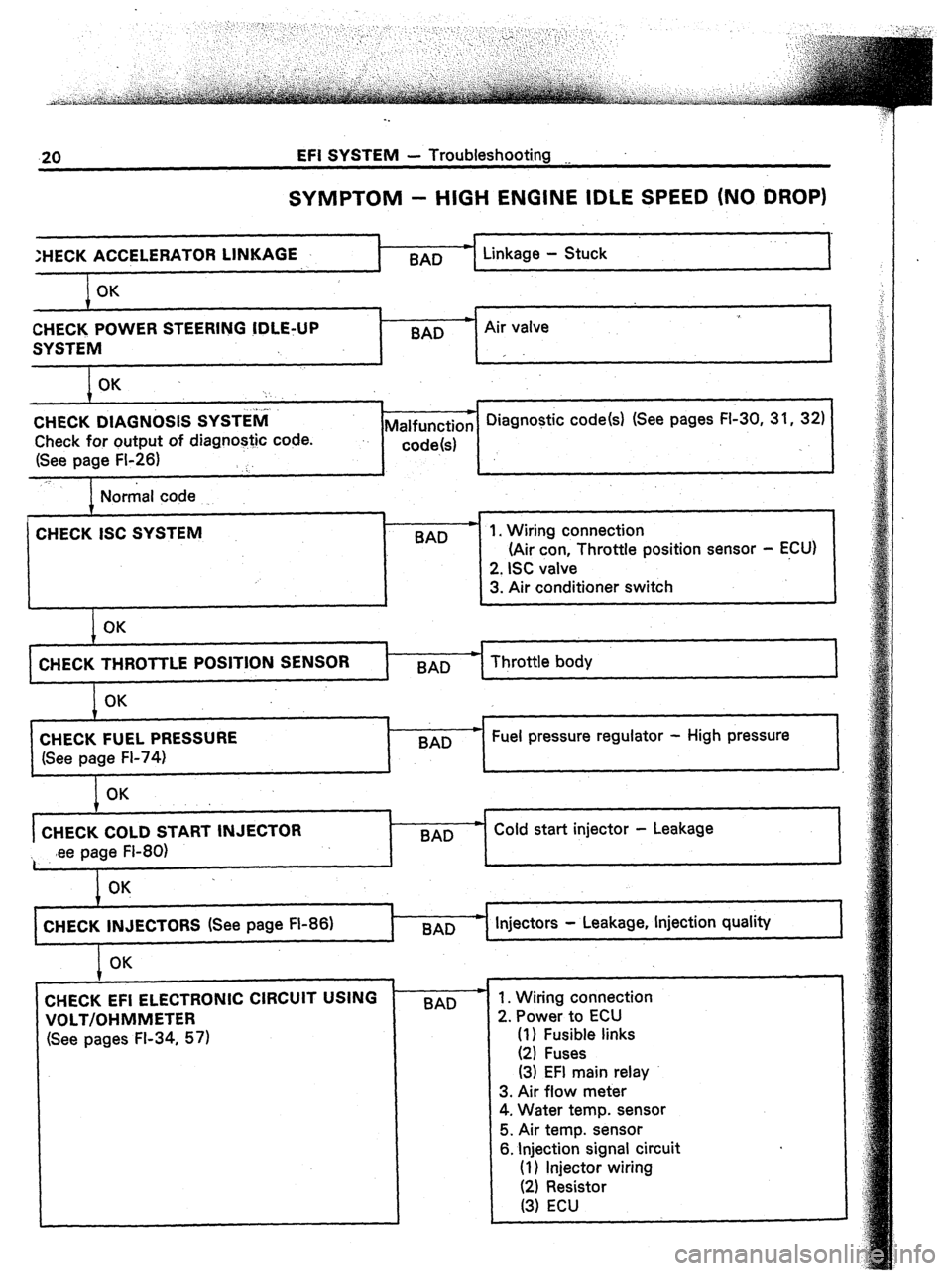
.20 EFI SYSTEM - Troubleshooting __
SYMPTOM - HIGH ENGINE IDLE SPEED (NO DROP)
:HECK ACCELERA
OK
CHECK POWER STEERING !DLE+JP
SYSTEM
OK .
‘:
j..l.
CHECK DIAGNOSIS SYSTEM
Check for output of diagnostic code.
(See page FI-26) ‘:.
_T I Linkage - Stuck
I
9
BAD * Air valve
I
r
* Diagnostic code(s) (See pages FI-30, 31, 32)
Malfunction
..
code!s)
Normal code
.
CHECK ISC SYSTEM
BAD
I
OK
71
(Air con Throttle posrtron sensor - ECU)
1 CHECK THROTTLE POSITION SENSOR
t-x- Throttle body
OK
CHECK FUEL PRESSURE
(See page FI-74) 7
BAD w Fuel pressure regulator - High pressure
OK
CHECK COLD START INJECTOR
~ .ee page FI-80) BAD w Cold start injector - Leakage
CHECK INJECTORS (See page FI-86)
I Injectors - Leakage, Injection quality
I OK
CHECK EFI ELECTRONIC CIRCUIT USING
VOLT/OHMMETER
(See pages FI-34, 57) BAD - 1. Wiring connection
2. Power to ECU
(1) Fusible links
(2) Fuses
(3) EFI main relay
3. Air flow meter
4. Water temp. sensor
5. Air temp. sensor
6. Injection signal circuit
(1) Injector wiring
(2) Resistor
(3) ECU
Page 55 of 346
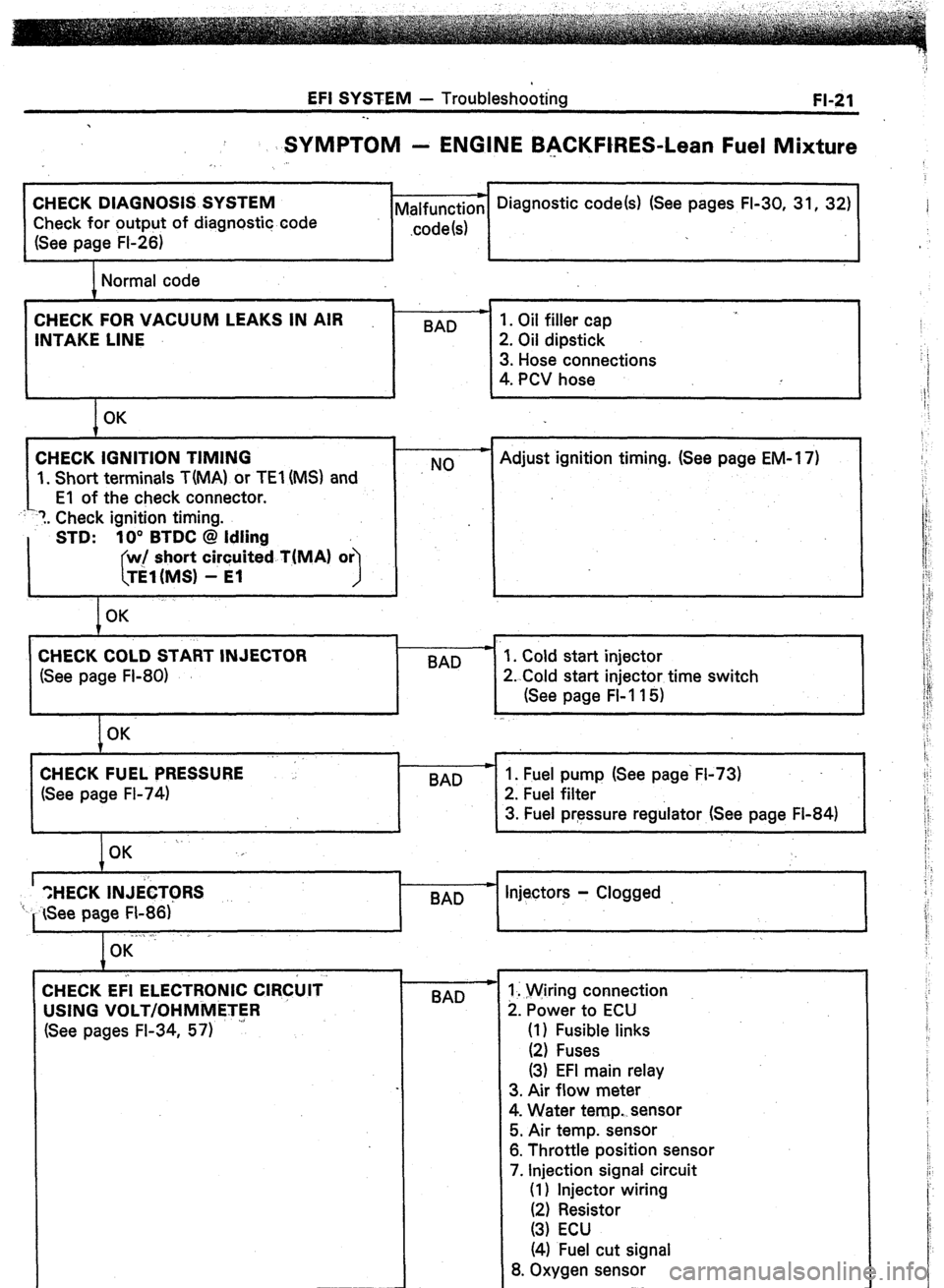
EFI SYSTEM - Troubleshooting
FI-21
-.
SYMPTOM - ENGINE BACKFtRES-Lean Fuel Mixture
CHECK DIAGNOSIS SYSTEM
Check for output of diagnostic code
(See page FI-26) Malfunction --) Diagnostic code(s) (See pages FI-30, 31, 32)
.code 1s) j
,
Normal code
CHECK FOR VACUUM LEAKS IN AIR
INTAKE LINE
1. Short terminals T(MA) or TEl (MS) and BAD -
NO 1. Oil filler cap
2. Oil dipstick
3. Hose connections
4. PCV hose
Adjust ignition timing. (See page EM-1 7)
1. Cold start injector
2. Cold start injector time switch
(See page FI-115)
CHECK FUEL PRESSURE
(See page FI-74)
I
I
BAD 1. Fuel pump (See page‘ FI-73)
2. Fuel filter
3. Fuel pressure regulator (See page Fl-84)
I
’ “,HECK INJib
‘I- See page FI-86)’ - Injectors - Clogged
BAD
. ., .l
I OK
CHECK Eii ELECTRONIC ClR&lT
USING VOLT/OHMMETER
(See pages FI-34, 57)
4
BAD 1. Wiring connection
2. Power to ECU
(1) Fusible links
(2) Fuses
(3) EFI main relay
3. Air flow meter
4. Water temp. sensor
5. Air temp. sensor
6. Throttle position sensor
7. Injection signal circuit
(1) Injector wiring
Ii, zesstor
(4) Fuel cut signal
8. Oxygen sensor
Page 57 of 346
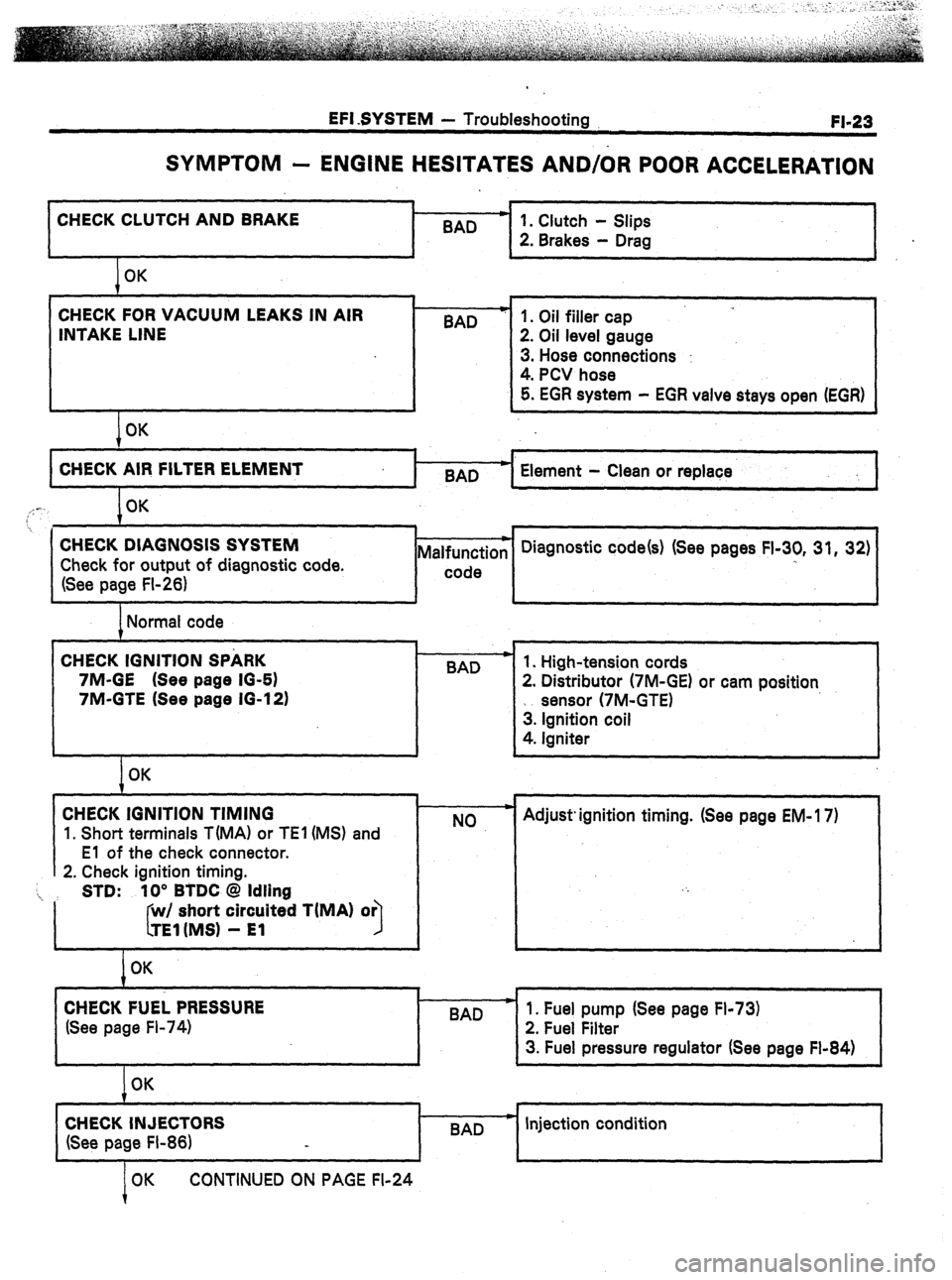
EFI SYSTEM - Troubleshooting
FI-23
SYMPTOM - ENGINE HESITATES AND/OR POOR ACCELERATION
CHECK CLUTCH AND BRAKE .
BAD
I
I 1
1 OK
CHECK FOR VACUUM LEAKS IN AIR
INTAKE LINE
I OK BAD
I-
1. Clutch - Slips
2. Brakes - Drag
1. Oil filler cap
2. Oil level gauge
3. Hose connections :
4. PCV hose
5. EGR system - EGR valve stays open (EGR)
4
CHECK AIR FILTER ELEMENT
BAD Element - Clean or replace
I
,,: -. OK
7
. . 1 i , 1
CHECK DIAGNOSIS SYSTEM
Check for output of diagnostic code.
(See page FI-26) Malfunction
I-- code Diagnostic code(s) (See pages FI-30, 31, 32)
I
I I I J
1 Normal code
CHECK IGNITION SPARK
7M-GE (See page IO-61
7M-GTE (See page 16-12) .
BAD
I
I OK
CHECK IGNITION TIMING
1. Short terminals T(MA1 or TEl (MS) and
El of the check connector.
2. Check ignition timing.
‘i, STD: 10” BTDC @ Idling
I short circuited TiMA) or
I
I OK
CHECK FUEL PRESSURE
(See page Fl-74) 1. High-tension cords
2. Distributor (7M-GE) or cam position
sensor (7M-GTE)
3. Ignition coil
4. Igniter
NO Adjust. ignition timing. (See page EM- 17)
I
I
BAD
I
1. Fuel pump (See page Fl-73)
2. Fuel Filter
3. Fuel pressure regulator (See page Fl-84)
1
OK
CHECK INJECTORS
(See page FI-86) BAD c Injection condition
OK CONTINUED ON PAGE FI-24
Page 59 of 346
EFI SYSTEM - Diagnosis System
. .
DIAGNOSIS SYSTEM
__ --
FL25
(MA)
The ECU contains a built-in self-diagnosis system by which
troubles with the engine signal network are detected and a
“CHECK ENGINE” warning light on the instrument panel
flashes,
By analyzing various signals as shown in the later table (See
pages Fl-30, 31) the Electronic Control Unit (ECU) detects
system malfunctions which are related to the various operating
parameter sensors or to the actuator. The ECU stores the
failure until the diagnosis system is cleared by removing the EFI
fuse with the ignition switch off.
A “CHECK ENGINE” warning light on the instrument panel
informs the driver that a malfunction has been detected.
The light goes out automatically when the malfunction has
been cleared.
The diagnostic code can be read by the number of the blinks of
the “CHECK ENGINE” warning light when T and El are short-
circuit.
(MS)
The ECU contains a built-in self-diagnosis system by which
troubles with the engine signal network are detected and a
“CHECK ENGINE” warning light on the instrument panel
flashes.
By analyzing various signals as shown in the later table (See
page FI-32) the Electronic Control Unit (ECU) detects system
malfunctions which are related to the various operating
parameter sensors or to the actuator. The ECU stores the
failure until the diagnosis system is cleared by removing the EFI
fuse with the ignition switch off.
In the ECU, a test mode function has been added to the func-
tions of the self-diagnosis system of the previous diagnosis
mode (normal mode) for the purpose of detecting malfunctions
such as poor contact which are difficult to detect in the normal
mode. This function fills up the self-diagnosis system. The test
mode can be implemented by the technician to follow the pro-
cedures of appropriate check terminal connection and opera-
tion described in later (See page FI-28).
In the normal mode, the self-diagnosis system monitors 14
items, indicated by the codes except for code No. 51 as shown
in FI-32. A “CHECK ENGINE” warning light on the instrument
panel informs the driver that a malfunction has been detected.
The light goes out automatically when the malfunction has
been cleared.
The diagnostic code can be read by the number of the blinks of
the “CHECK ENGINE” warning light when TEl and El are
short-circuited.
Page 60 of 346
FI-26 EFI SYSTEM - Diagnosis System
-.
i
“CHECK ENGINE” Warning Light In the test mode, seven items, indicated by code
24, 41, 42, 43, and 5 1, as shown in FI-32 are m
malfunction is detected in any one of the systems
code Nos. 13, 22, 24, and 41 the ECU lights the “CHECK
ENGINE” warning light to warm the technician that the mal-
function has been detected. In this case, TE2 and El terminals
on the check connector should be connected as shown later
(See page FI-28)
In the test mode, for all seven conditions shown above in code
Nos. 13 - 51, even if the malfunction is corrected, the mal-
function is stored in the ECU memory while the ignition switch
remains on. Also, when a malfunction occurs for-the four con-
ditions from code Nos. 13 - 41, the “CHECK ENGINE” warning
light remains on. However, once the ignition switch is turned to
OFF, the ECU erases all of the malfunctions in the memory. The
diagnostic mode (normal or test) and the output of the “CHECK
ENGINE” warning light can be selected by the TEl , TE2 and El
terminal connections on the check connector, as shown in the
later.
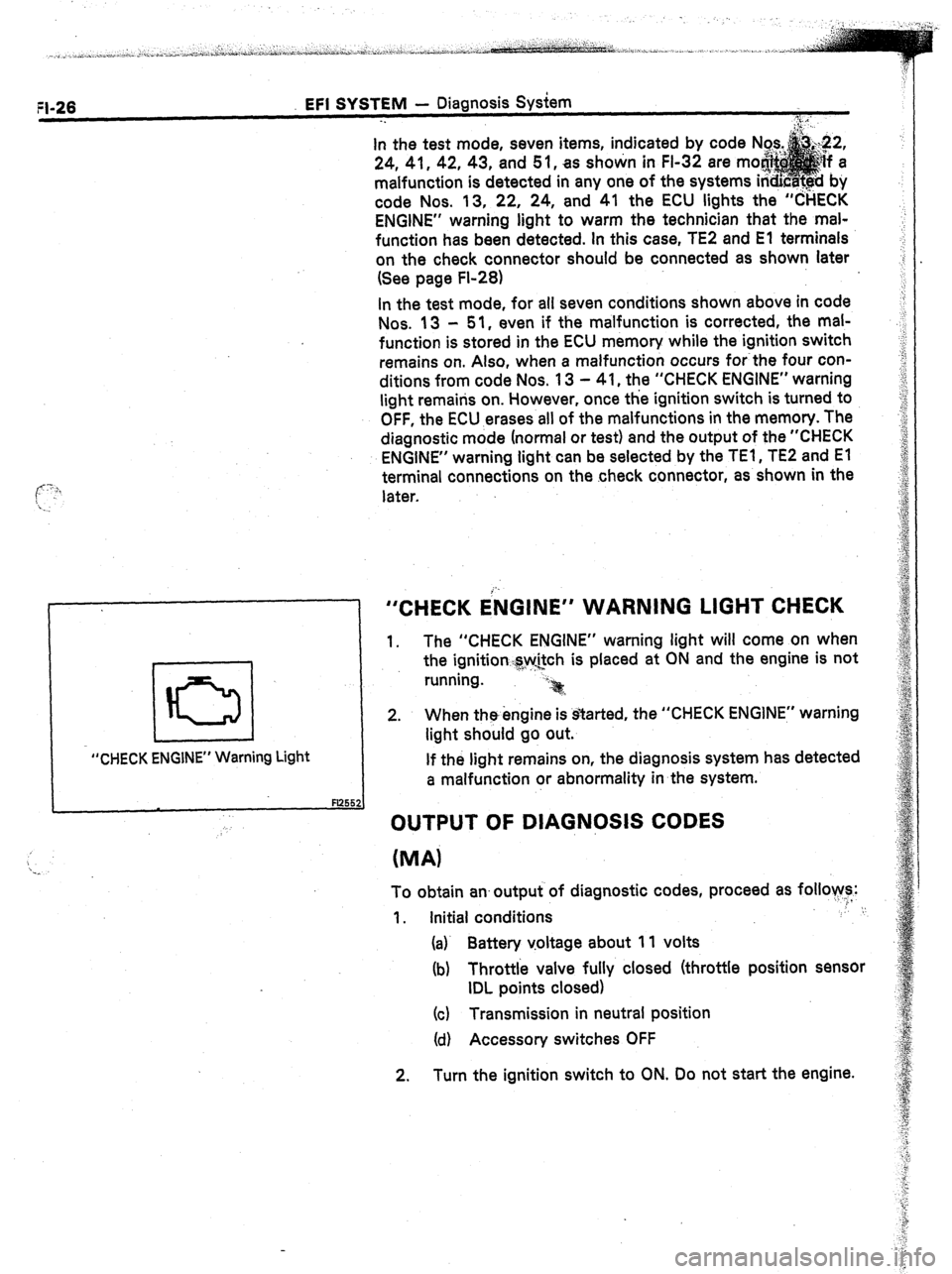
“CHECK ENGINE” WARNING LIGHT CHECK
1. The “CHECK ENGINE” warning light will come on when
the ignitiorqw:@ch is placed at ON and the engine is not
running. -y.
2. When the engine is started, the “CHECK ENGINE” warning
light should go out.
If the light remains on, the diagnosis system has detected
a malfunction or abnormality in the system.
OUTPUT OF DIAGNOSIS CODES
(MA)
To obtain an output of diagnostic codes, proceed as follows:
1. Initial conditions ,’
(a)’ Battery voltage about 11 volts
(b) Throttle valve fully closed (throttle position sensor
IDL points closed)
(cl Transmission in neutral position
(d) Accessory switches OFF
2. Turn the ignition switch to ON. Do not start the engine.
Page 61 of 346
Osc db-5 hus 4J -7.
EFI SYSTEM w
-. - Diagnosis System
FI-27
“CHECK ENGINE” Warning Light FlO29
Code No. 13 Code No. 32
(Seconds)
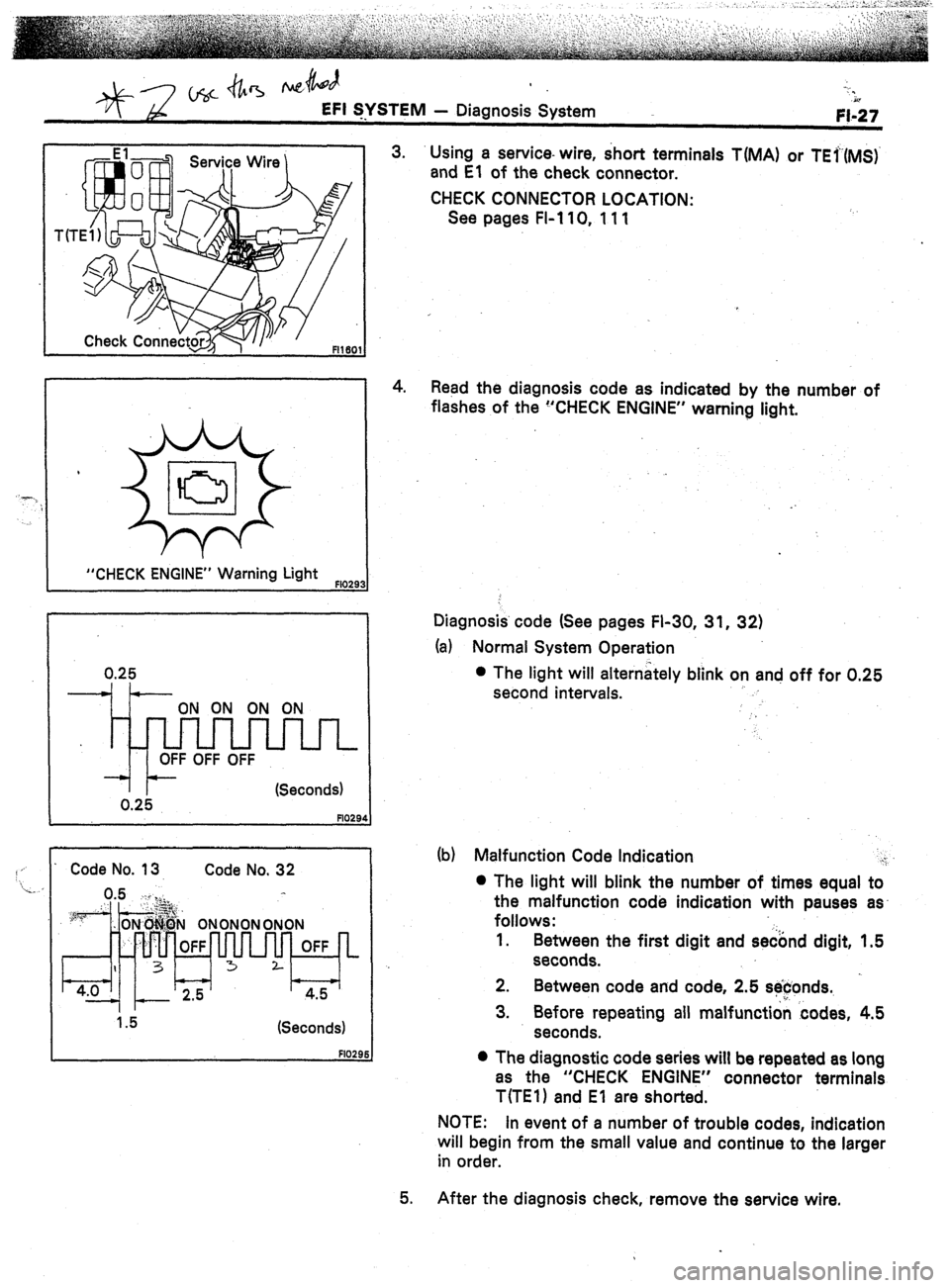
3. Using a service- wire, short terminals T(MA) or TEr(MS)
and El of the check connector.
CHECK CONNECTOR LOCATION:
See pages FI-110, 111
4. Read the diagnosis code as indicated by the number of
flashes of the “CHECK ENGINE” warning light.
Diagnosis. code (See pages FI-30, 31, 32)
(a) Normal System Operation
l The light will alternately blink on and off for 0.25
second intervals.
.)
(b) Malfunction Code Indication i
l The light will blink the number of times equal to
the malfunction code indication with pauses as-
follows:
1.
Between the first digit and se&d digit, 1.5
seconds.
2.
Between code and code, 2.5 se$onds.
3. Before repeating all malfunction codes, 4.5
seconds.
0 The diagnostic code series will be repeated as long
as the “CHECK ENGINE” connector terminals
T(TE1) and El are shorted.
NOTE: In event of a number of trouble codes, indication
will begin from the small value and continue to the larger
in
order.
After the diagnosis check, remove the service wire.
Page 62 of 346
EFI SYSTEM; Diagnosis System
S)
------) -.
I Fl281
Test mode
i
To obtain an output of diagnostic codes, proceed as follows:
1. Initial conditions
(a) Battery voltage about 1 1 volts
(b) Throttle valve fully closed (throttle position sensor
IDL points closed)
(c) Transmission in neutral position
(d) Accessory switches OFF
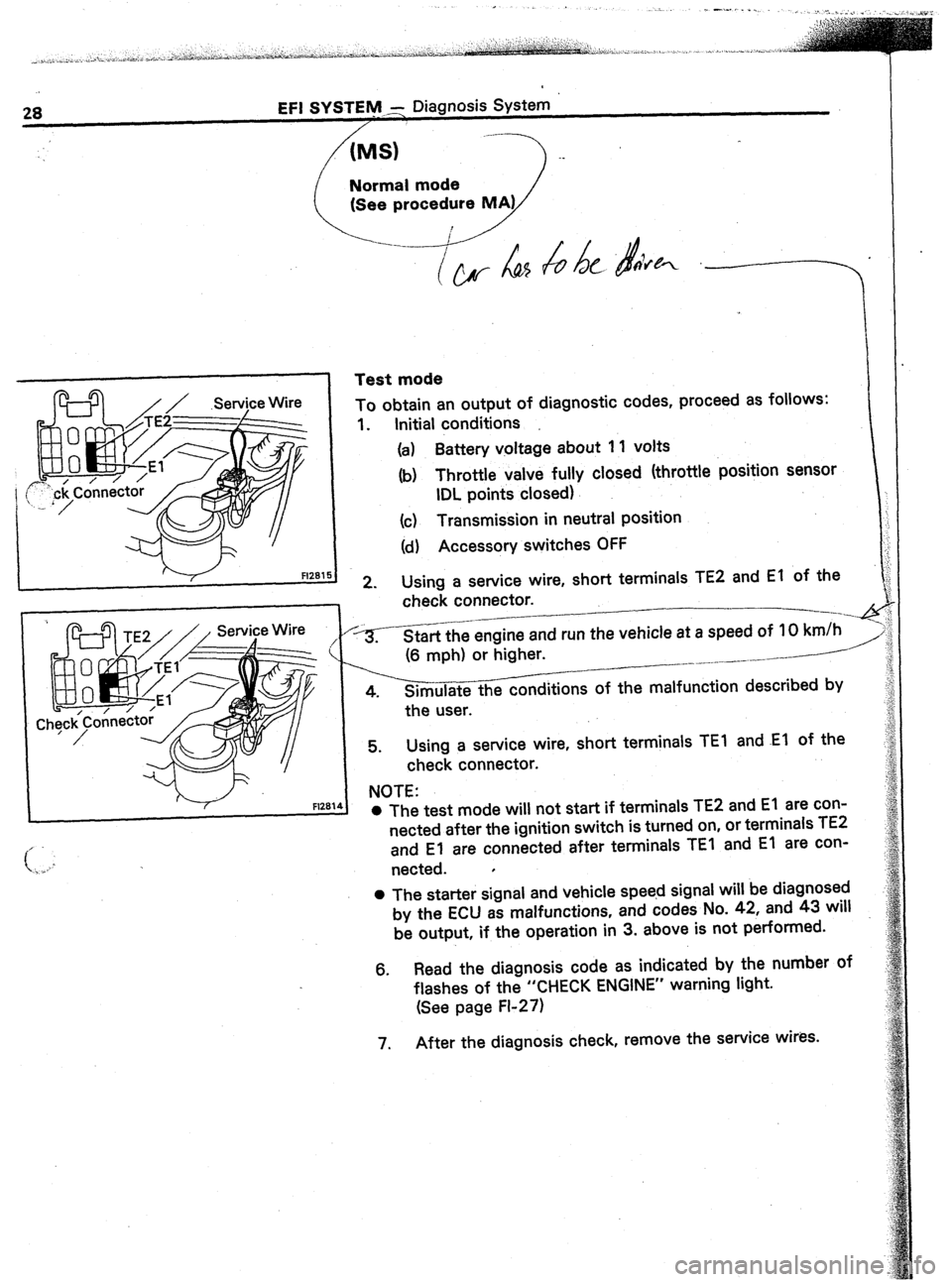
2. Using a service wire, short terminals TE2 and El of the j
check connector.
-----.-q
*-heengine and run the vehicle at a speed of IO km/h I
(6 mph) or higher. __-- /---’
_ ___ _.--.--.
4. Simulate the conditions of the malfunction described by
the user.
5. Using a service wire, short terminals TEl and .El of the
check connector.
NOTE:
l The test mode will not start if terminals TE2 and El are con-
nected after the ignition switch is turned on, or terminals TE2
and El are connected after terminals TEI and El are con-
nected.
l
0 The starter signal and vehicle speed signal will be diagnosed
by the ECU as malfunctions, and codes No. 42, and 43 will
be output, if the operation in 3. above is not performed.
6. Read the diagnosis code as indicated by the number of
flashes of the “CHECK ENGINE” warning light.
(See page FI-27)
7. After the diagnosis check, remove the service wires.