1987 TOYOTA CELICA speed sensor
[x] Cancel search: speed sensorPage 70 of 346
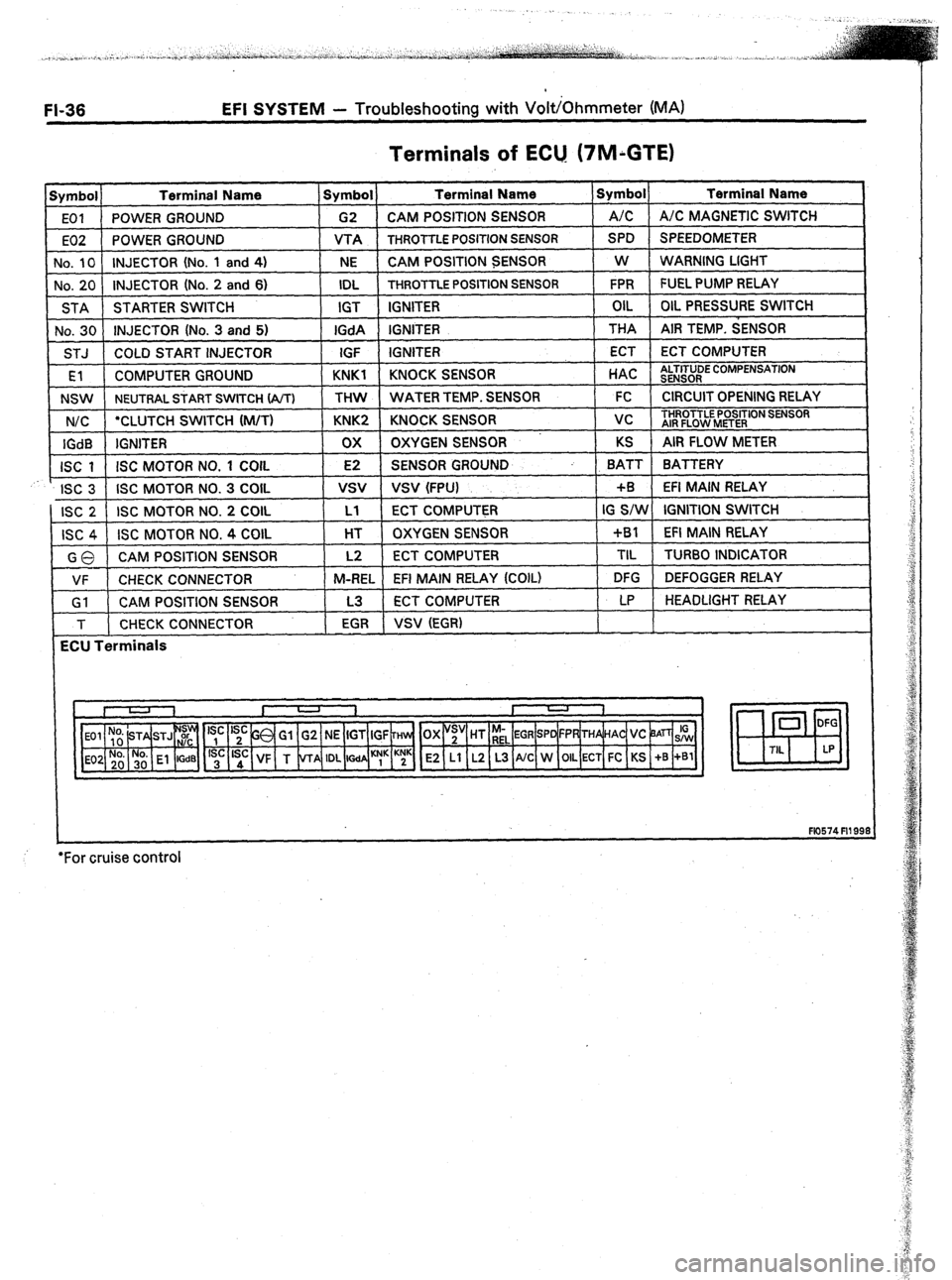
FI-36 EFI SYSTEM - Troubleshooting with VoltjOhmmeter (MA)
Terminals of ECU. (7M;GTE)
Symbol Terminal Name Symbol Terminal Name Symbol Terminal Name
EOI POWER GROUND G2 CAM POSITION SENSOR A/C A/C MAGNETIC SWITCH
E02 POWER GROUND VTA
THROTTLE POSITION SENSOR SPD SPEEDOMETER
No, 10 INJECTOR (No. 1 and 4)
NE CAM POSITION SENSOR W
WARNING LIGHT
No. 20 INJECTOR (No. 2 and 6) IDL
THROTTLE POSITION SENSOR FPR FUEL PUMP RELAY
STA STARTER SWITCH IGT IGNITER OIL OIL PRESSURE SWITCH
No. 30 INJECTOR (No. 3 and 5) IGdA IGNITER THA AIR TEMP. SENSOR
STJ COLD START INJECTOR
IGF IGNITER ECT ECT COMPUTER
rEl COMPUTER GROUND KNKl KNOCK SENSOR
t HAC 1 tl
NSW
NEUTRAL START SWITCH (A/T) THW WATER TEMP. S
N/C ‘CLUTCH SWITCH (M/T) KNK2 KNOCK SENSOR 1 vc ) THROTTLE
AIR
FLOW I
LTITUDE COMPENSATION
, .xNSOR
ENSOR 1 FC 1 CIRCUITOPENING RELAY I
IGdB IGNITER ox OXYGEN SENSOR KS AIR FLOW METER
ISC 1 ISC MOTOR NO. 1 COIL E2 SENSOR GROUND BATT BATTERY
r
ISC 3 ISC MOTOR NO. 3 COIL
vsv VSV (FPU) +B EFI MAIN RELAY
ISC 2 ISC MOTOR NO. 2 COIL Ll ECT COMPUTER IG S/W IGNITION SWITCH
ISC 4 ISC MOTOR NO. 4 COIL HT OXYGEN SENSOR +Bl EFI MAIN RELAY
GO CAM POSITION SENSOR L2 ECT COMPUTER TIL
TURBO INDICATOR
VF CHECK CONNECTOR M-REL
EFI MAIN RELAY (COIL) DFG DEFOGGER RELAY
Gl CAM POSITION SENSOR L3 ECT COMPUTER LP HEADLIGHT RELAY
T CHECK CONNECTOR
EGR VSV (EGR)
ECU Terminals
E2 Ll L2 L3 A/C W OIL ECT FC KS +B +Bl
+
F10574 Fll 99:
*For cruise control
Page 92 of 346
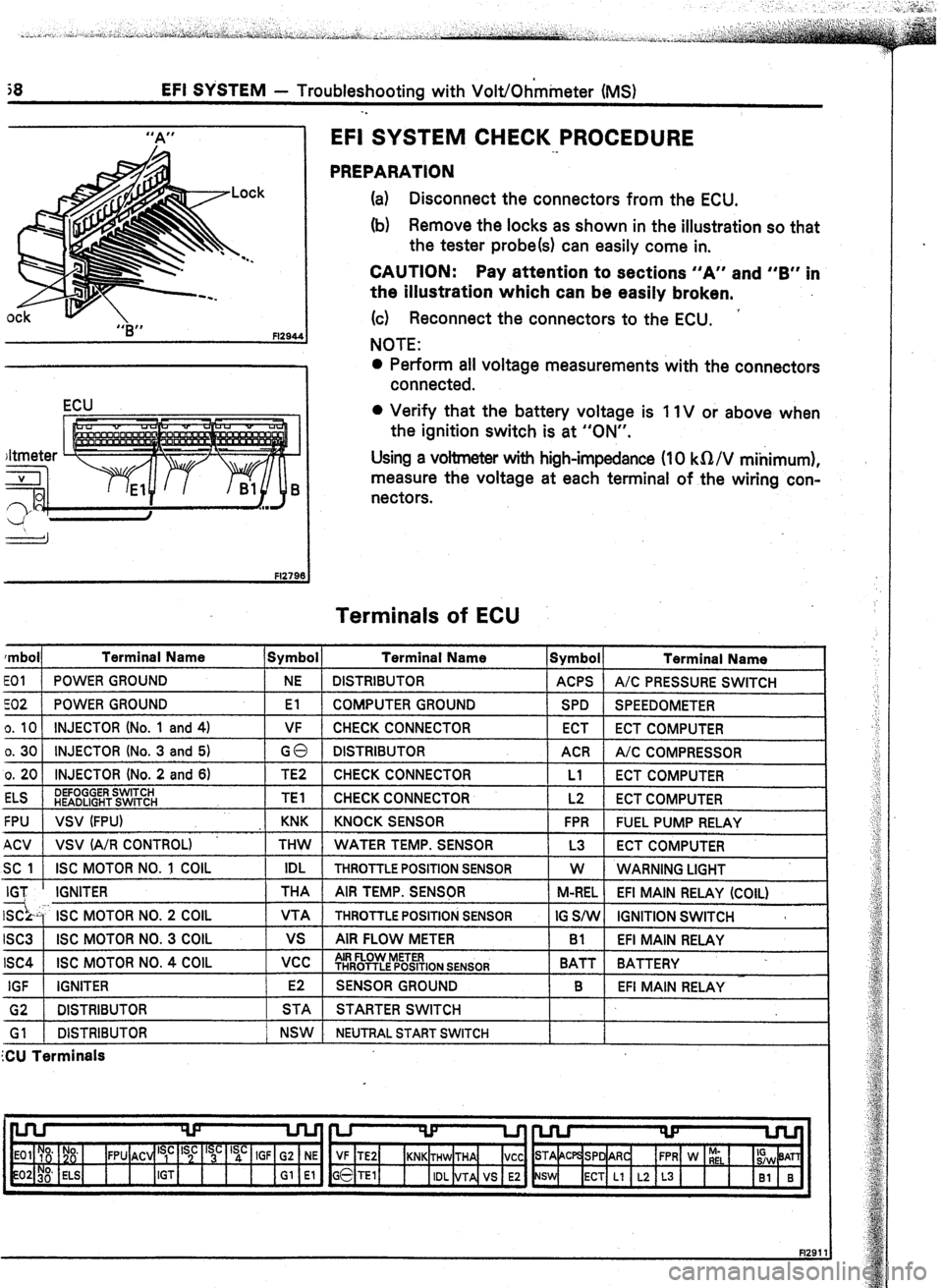
jS EFI SYSTEM - Troubleshooting with Volt/Ohmmeter (MS)
-.
0
“B”
Fl294.
ECU
EFI SYSTEM CHECK PROCEDURE
._
PREPARATION
(a) Disconnect the connectors from the ECU.
(b) Remove the locks as shown in the illustration so that
the tester probe(s) can easily come in.
CAUTION: Pay attention to sections “A” and “B” in
the illustration which can be easily broken,
(c) Reconnect the connectors to the ECU.
’
NOTE:
0 Perform ail voltage measurements with the connectors
connected.
0 Verify that the battery voltage is 1 IV or above when
the ignition switch is at “ON”.
Using a voltmeter with high-impedance (10 kQ/V mihimum),
measure the voltage at each terminal of the wiring con-
nectors.
Terminals of ECU
rmbol Terminal Name Symbol Terminal Name
Symbol Terminal Name
EOI POWER GROUND NE DISTRIBUTOR ACPS A/C PRESSURE SWITCH
co2 POWER GROUND El COMPUTER GROUND SPD SPEEDOMETER
o. 10 INJECTOR (No. 1 and 4) VF CHECK CONNECTOR ECT ECT COMPUTER
o. 30 INJECTOR (No. 3 and 5)
GO DISTRIBUTOR ACR A/C COMPRESSOR
o. 20 INJECTOR (No. 2 and 6) TE2 CHECK CONNECTOR Ll
ECT COMPUTER
ELS DEFOGGER SWITCH
HEADLIGHT SWITCH TEl CHECK CONNECTOR L2
ECT COMPUTER
FPU VSV (FPU) KNK KNOCK SENSOR FPR FUEL PUMP RELAY
ACV VSV (A/R CONTROL) THW WATER TEMP. SENSOR L3 ECT COMPUTER
SC 1 ISC MOTOR NO. 1 COIL IDL
THROTTLE POSITION SENSOR W
WARNING LIGHT
IGT IGNITER THA AIR TEMP. SENSQR
M-REL EFI MAIN RELAY (COIL)
SC- ISC MOTOR NO. 2 COIL VTA THROlTLE POSITION SENSOR IG SiW IGNITION SWITCH 3
ISC3 ISC MOTOR NO. 3 COIL vs AIR FLOW METER Bl EFI MAIN RELAY
ISC4 ISC MOTOR NO. 4 COIL vcc AIR FLOW METER
THROTTLE POSITION SENSOR BATT BATTERY
IGF IGNITER E2
SENSOR GROUND B
EFI MAIN RELAY
G2 1 DISTRIBUTOR 1 STA 1 STARTER SWITCH
Gl 1 DISTRIBUTOR 1 NSW 1 NEUTRALSTARTSWITCH
ZU Terminals
Page 156 of 346
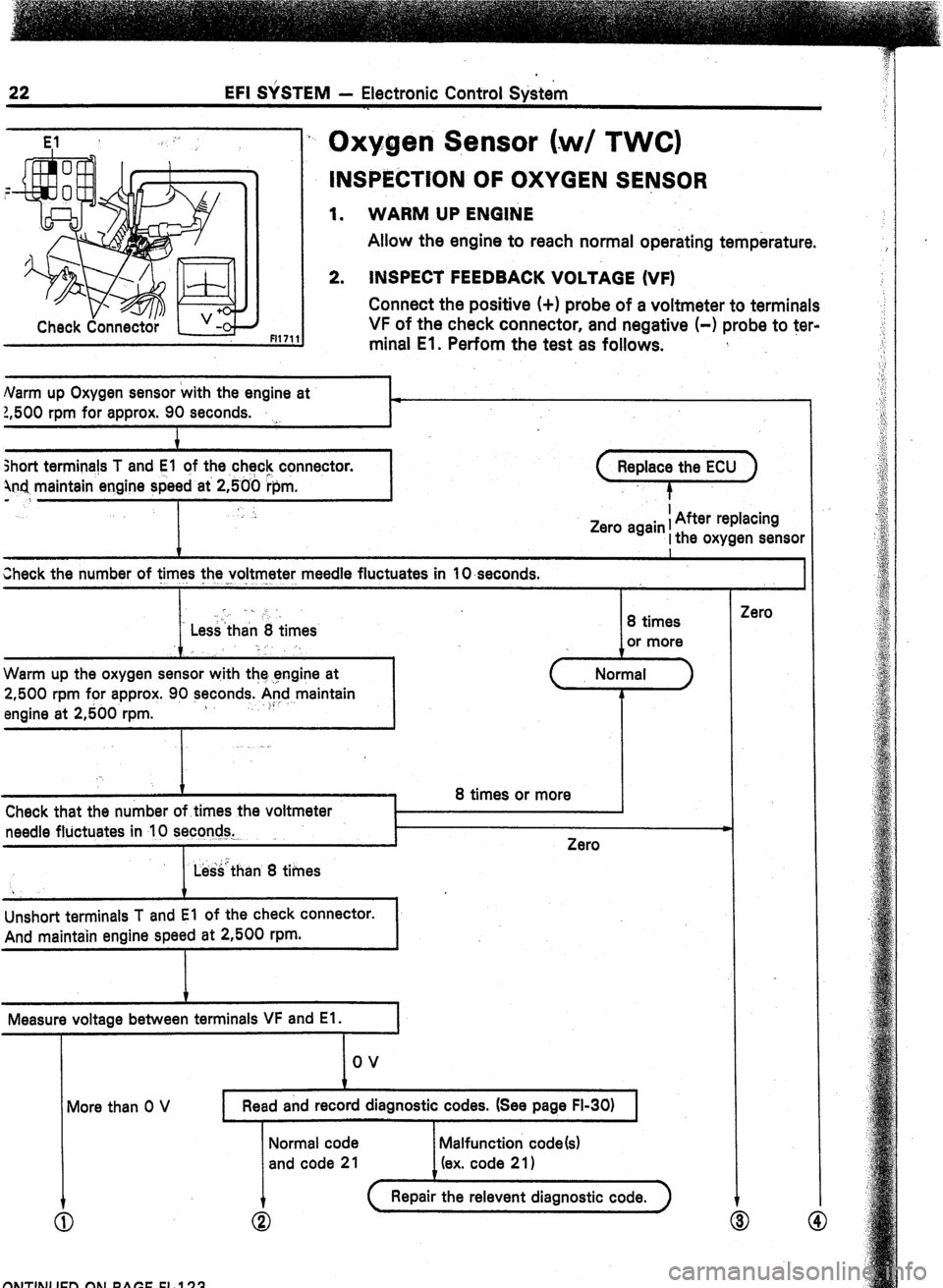
22 EFI &STEM - Electronic Control S&m
El 7 Oxygen S,ensor (-WI TWC)
INSPECTrON OF OXYGEN SENSOR
1. WARM UP ENGINE
Allow the engine to reach normal operating temperature.
2. INSPECT FEEDBACK VOLTiGE (VFI
Connect the positive (+I probe of a voltmeter to terminals
n1711 VF of the check connector, and negative (-1 probe to ter-
minal El. Perfom the test as follows.
Narm up Oxygen sensor ‘with the engine at
!,500 rpm for approx. 90 seconds.
I
1
short termina!s T and El of the check connector.
4nd maintain engine speed at 2,560 ‘i-pm.
- / (,,,;,,.,,,,
i .
Check the number of times the voltmeter meedle fluctuates in 1 Oseconds. Zero again 1 After replacing
I the oxygen sensor
i ,. ., ;
: . .
Less than 8 times
t. ., .,
Warm up the oxygen sensor with the engine at
,,I
2,500 rpm for approx. 90 seconds. And maintain
engine at 2,500 rpm.
’
I
c
Check that the number of times the voltmeter
needle fluctuates in 10 seconds,
;- 8 times or more
Zero
Leis’~than 8 times
c
Unshort terminals T and El of the check connector.
And maintain engine speed at 2,500 rpm.
Measure voltaae between terminals VF and El.
I
More than 0 V t
Read and record diagnostic codes. (See page FI-30)
I I
Normal code
and code 21 Malfunction code(s)
(ex. code 21)
Repair the relevent diagnostic code.
ONTINUED ON PAGE FI-123 !ero
Page 157 of 346
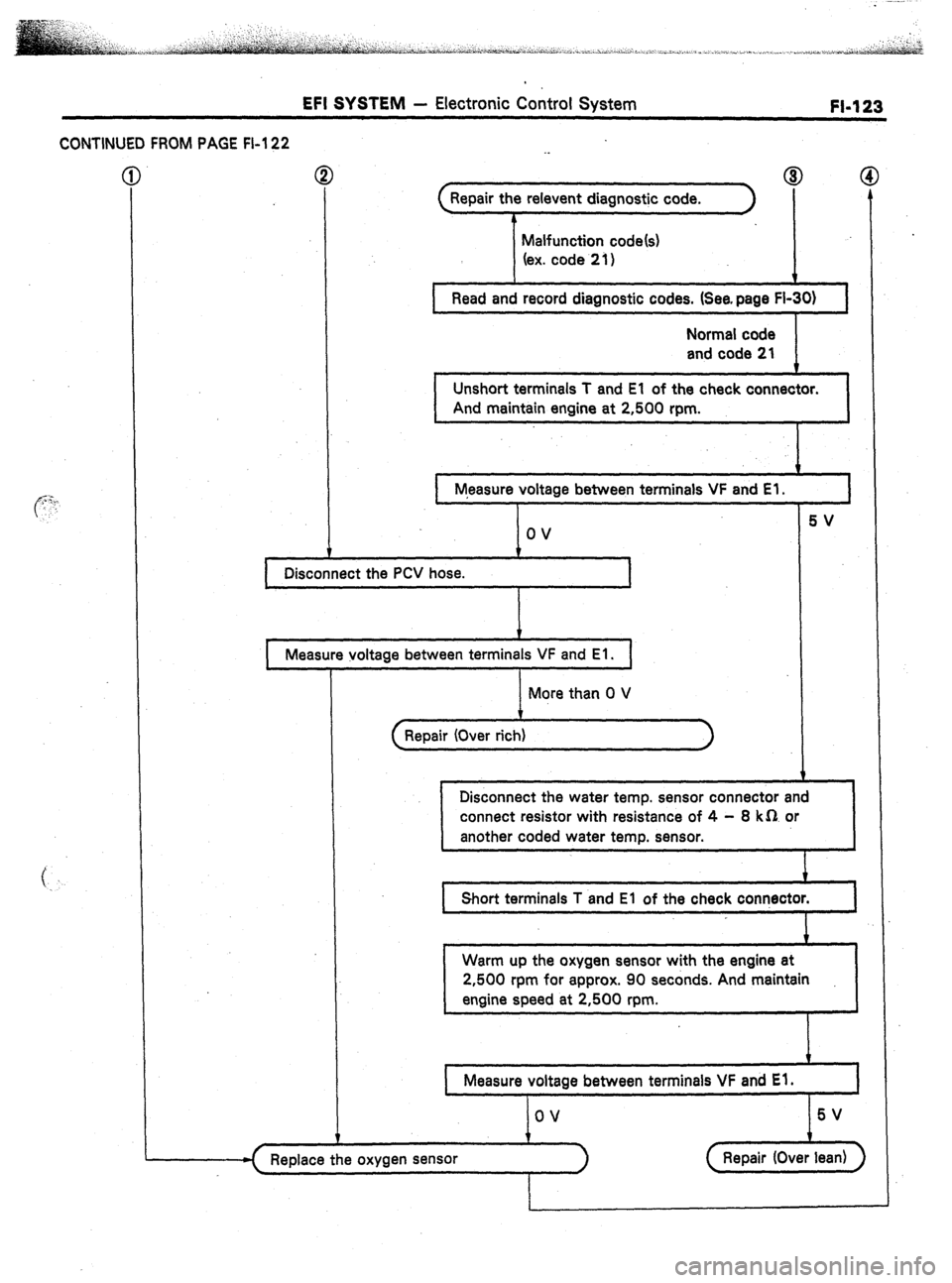
EFI SYSTEM - Electronic Control System FI-123
CONTINUED FROM PAGE FI-122
. .
t
8 (
epair the relevent diagnostic code.
Malfunction code(s)
(ex. code 21)
Read and record diagnostic codes. (See.page FL30)
Normal code
and code 21
t
Unshort terminals T and El of the check connector.
And maintain engine at 2,500 rpm.
I
I
M,easure voltage between terminals VF and El.
ov
t
1
Disconnect the PCV hose.
.
1 Measure voltage between terminals VF and El. 1
t
Replace the oxygen sensor Repair (Over lean) 5V
Disconnect the water temp. sensor connector and
connect resistor with resistance of 4 - 8 kS1 or
another coded water temp. sensor.
1
Short terminals T and El of the check connector.
I
I
Warm up the oxygen sensor with the engine at
I
1 2,500 rpm for approx. 90 seconds. And maintain 1
engine speed at 2,500 rpm.
Measure voltage between terminals VF and El.
I
I 5V
Page 166 of 346
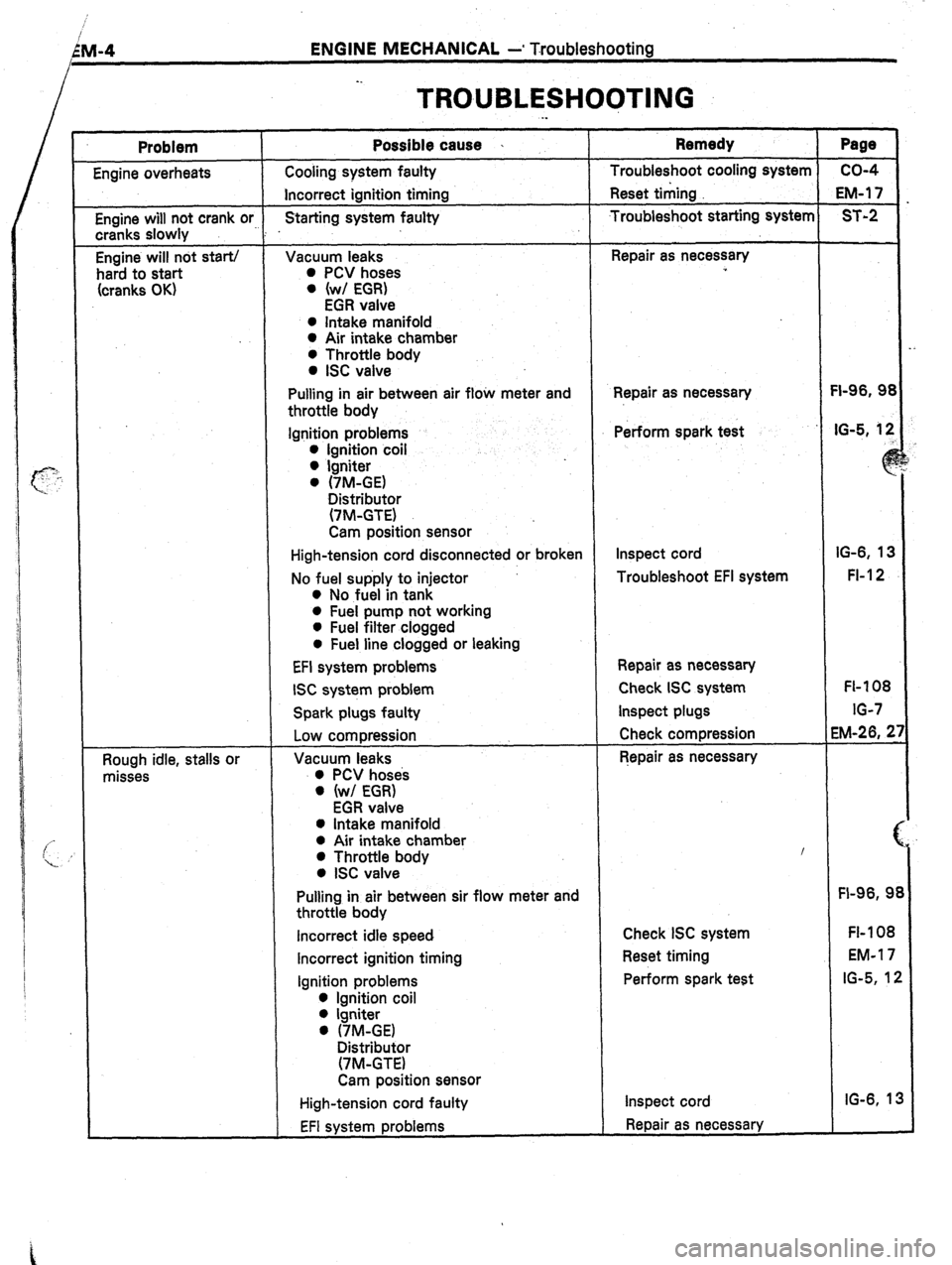
LM-4
I ENGINE MECHANICAL -* Troubleshooting
_.
TROUBLESHOOTING
Problem Possible cause I Remedy Page
Engine overheats Cooling system faulty Troubleshoot cooling system co-4
Incorrect ignition timing Reset timing EM-1 7
Engine will not crank or Starting system faulty Troubleshoot starting system ST-2
cranks slowly : .
Engine will not start/ Vacuum leaks Repair as necessary
hard to start 0 PCV hoses ”
(cranks OK) 0 (w/ EGR)
EGR valve
0 Intake manifold
0 Air intake chamber
0 Throttle body
0 ISC valve
Pulling in air between air flow meter and Repair as necessary FI-96, 93
throttle body
Ignition problems Perform spark test IG-5, 12
0 Ignition coil
0 Igniter
0 (7M-GE)
Distributor
(7M-GTE)
Cam position sensor
High-tension cord disconnected or broken Inspect cord IG-6, 13
No fuel supply to injector Troubleshoot EFI system FI-I 2
l No fuel in tank
0 Fuel pump not working
l Fuel filter clogged
0 Fuel line clogged or leaking
EFI system problems Repair as necessary
ISC system problem Check ISC system FL- 108
Spark plugs faulty Inspect plugs IG-7
Low compression Check compression EM-26, 2
Rough idle, stalls or Vacuum leaks Repair as necessary
misses 0 PCV hoses
0 (w/ EGR)
EGR valve
0 Intake manifold
0 Air intake chamber
0 Throttle body I
0 ISC valve
Pulling in air between sir flow meter and FI-96, 9
throttle body
Incorrect idle speed Check ISC system FI- 108
Incorrect ignition timing Reset timing EM-1 7
Ignition problems Perform spark test IG-5, 12
0 Ignition coil
0 Igniter
0 (-/M-GE)
Distributor
(-/M-GTE)
Cam position sensor
High-tension cord faulty Inspect cord IG-6, 13
EFI system problems Repair as necessary
Page 179 of 346
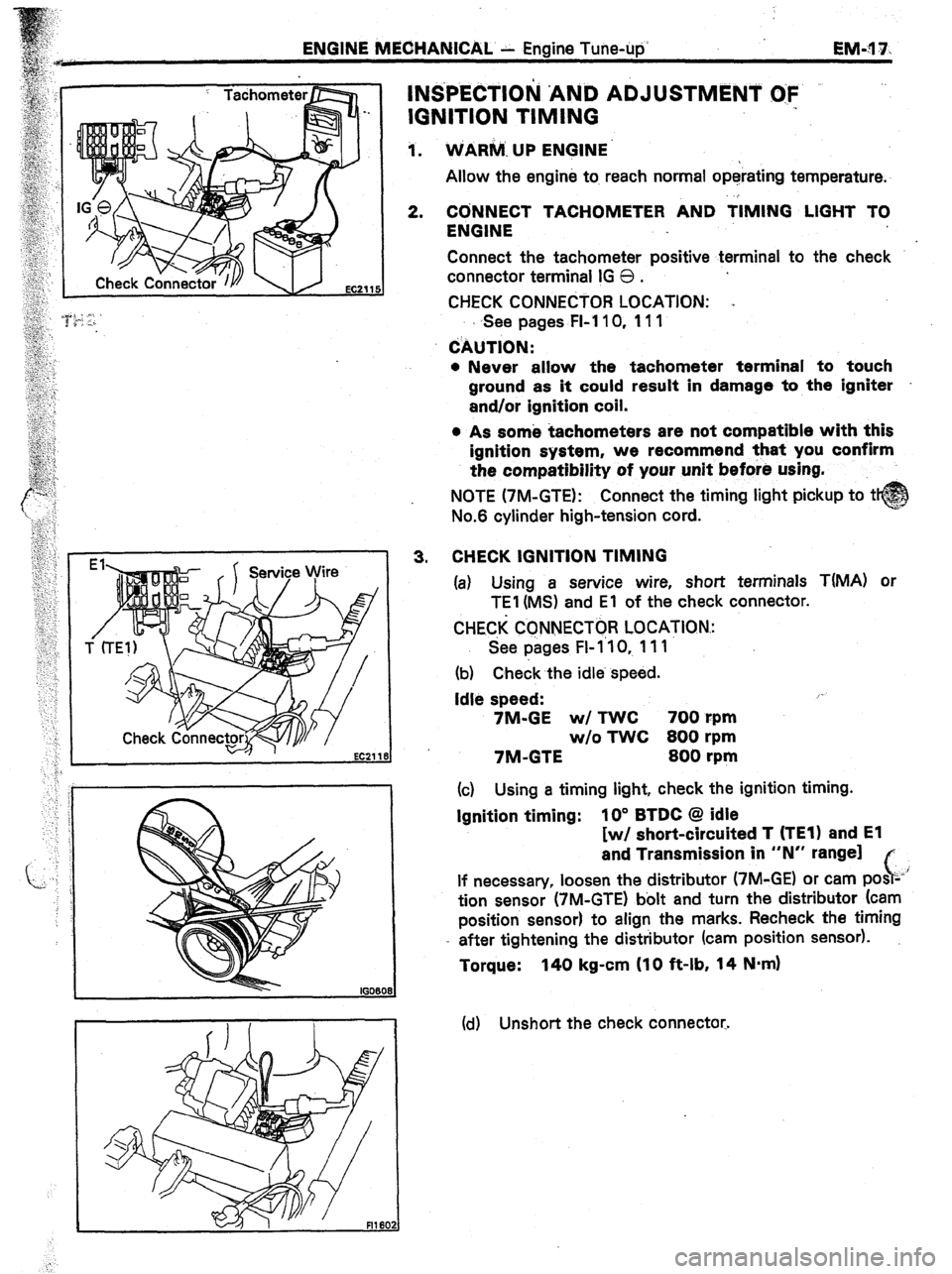
ENGINE MECHANICAL. - Engine Tune-up
EM-?1 7.
INS’PECTIOlil ‘AhiD ADJUSTMENT O:F .-
IGNITION TIMING
1. VriARiiA. UP ENGINE.
Allow the engine to. reach normal operating temperature.
2.
CbNNECT TACHOMETER AND TIMING LIGHT TO
ENGINE
Connect the tachometer positive terminal to the check
connector terminal IG 0 .
CHECK CONNECTOR LOCATION: .,
s See pages FI-110, 111
CAUTION:
l Never allow the tachometer terminal to touch
ground as it could result in damage to the igniter
and/or ignition coil.
, 4% 3.
EC21 18
s As some tachometers are not compatible with this
ignition system, we recommend that you confirm
the compatibility of your unit before using.
NOTE (7M-GTE): Connect the timing light pickup to t
No.6 cylinder high-tension cord.
CHECK IGNITION TIMING
(a) Using a service wire, short terminals T(MA) or
TEI (MS) and El of the check connector.
CHEC,K CCNNECTOR LOCATION.:
See pages FI- 1’10, 111
(b) Check the idle. speed.
Idle speed: /-
7M-GE w/ TWC 700 rpm
w/o TWC 800 rpm
7M-GTE 800 rpm
(c) Using a timing light, check the ignition timing.
Ignition timing: IO” BTDC @ idle
[w/ short-circuited T (TEl) and El
and Transmission in “N” range]
c,
If necessary, loosen the distributor (7M-GE) or cam posz-’
tion sensor (7M-GTE) bolt and turn the distributor (cam
position sensor) to align the marks. Recheck the timing
- after tightening the distributor (cam position sensor).
Torque: 140 kg-cm (10 ft-lb, 14 N-m)
(cl) Unshort the check connector.
Page 184 of 346
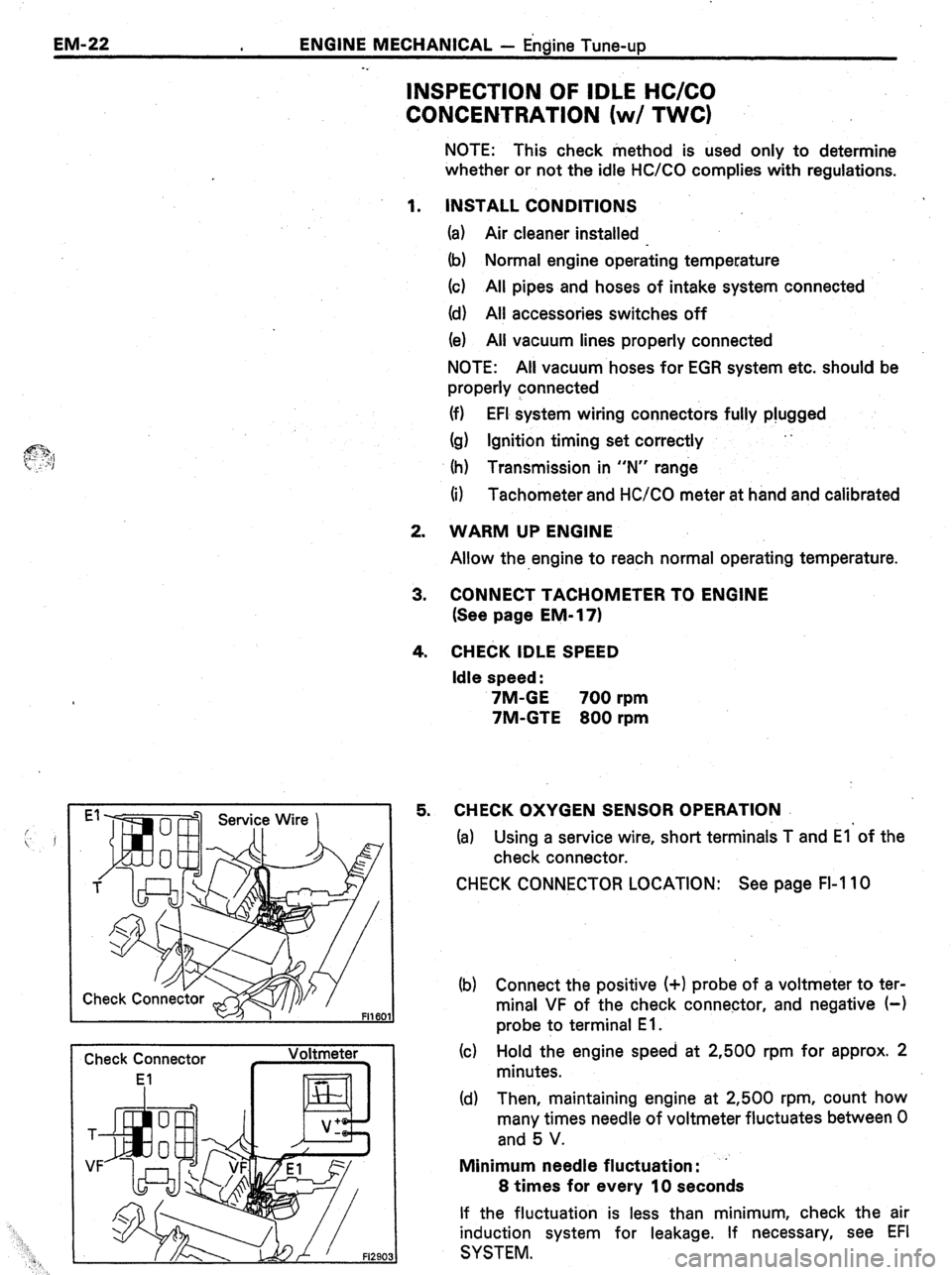
EM-22 ENGINE MECHANICAL - Engine Tune-up
INSPECTION OF IDLE HC/CO
CONCENTRATION (w/ TWC)
NOTE: This check method is used only to determine
whether or not the idle HWCO complies with regulations.
1. INSTALL CONDITIONS
(a) Air cleaner installed
(b) Normal engine operating temperature
(c) All pipes and hoses of intake system connected
(d) All accessories switches off
(e) All vacuum lines properly connected
NOTE: All vacuum hoses for EGR system etc. should be
properly connected
(f) EFI system wiring connectors fully p!ugged
(g) Ignition timing set correctly ‘.
(h) Transmission in “N” range
6) Tachometer and HWCO meter at hand and calibrated
2. WARM UP ENGINE
Allow the engine to reach normal operating temperature.
3. CONNECT TACHOMETER TO ENGINE
(See page EM- 17)
w ‘I” FI16C
4. CHECK IDLE SPEED
Idle speed :
7M-GE 700 rpm
7M-GTE 800 rpm
5. CHECK OXYGEN SENSOR OPERATION
(a) Using a service wire, short terminals T and El’of the
check connector.
CHECK CONNECTOR LOCATION: See page FI-I 10
(b) Connect the positive (+I probe of a voltmeter to ter-
minal VF of the check connector, and negative (-1
probe to terminal E 1.
(c) Hold the engine speed at 2,500 rpm for approx. 2
minutes.
(d) Then, maintaining engine at 2,500 rpm, count how
many times needle of voltmeter fluctuates between 0
and 5 V.
Minimum needle fluctuation : ’
8 times for every 10 seconds
If the fluctuation is less than minimum, check the air
induction system for leakage, If necessary, see EFI
SYSTEM.
Page 330 of 346
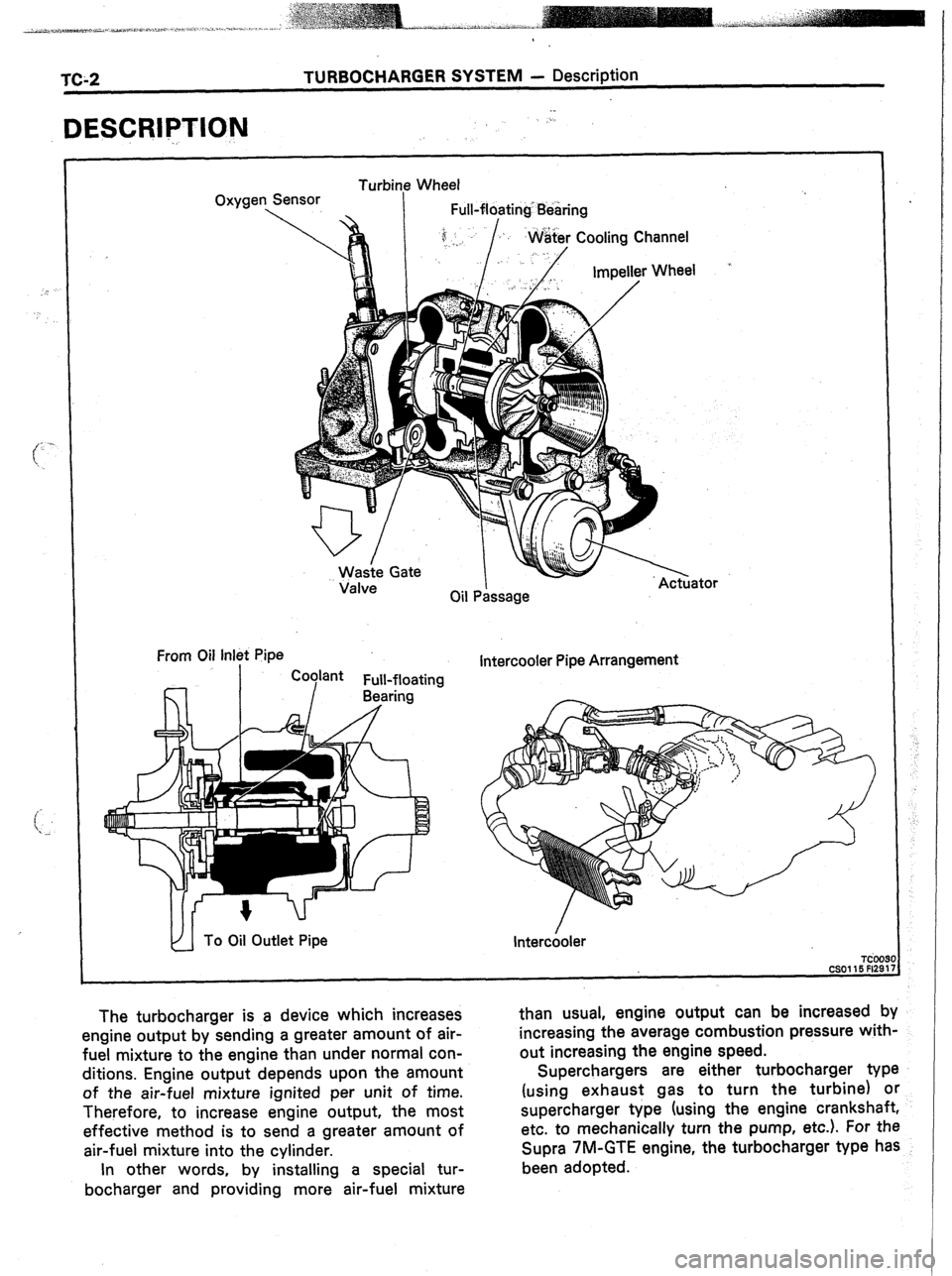
x-2 TURBOCHARGER SYSTEM - Description
.
DESCRIPTION
-.
“
Oxygen
. Turbine Wheel
Sensor
.
I Full-floating Bearing
Valve
Oil P&sage
From Oil Inlet Pipe
Intercooler Pipe Arrangement
TdO
CSOll5 Fl2
The turbocharger is a device which increases
engine output by sending a greater amount of air-
fuel mixture to the engine than under normal con-
ditions. Engine output depends upon the amount
of the air-fuel mixture ignited per unit of time.
Therefore, to increase engine output, the most
effective method is to send a greater amount of
air-fuel mixture into the cylinder. than usual, engine output can be increased by
.
increasing the average combustion pressure with-
out increasing the engine speed.
Superchargers are either turbocharger type
(using exhaust gas to turn the turbine) or
supercharger type (using the engine crankshaft,
etc. to mechanically turn the pump, etc.). For the
Supra 7M-GTE engine, the turbocharger type has
been adopted.
In other words, by installing a special tur-
bocharger and providing more air-fuel mixture