Page 123 of 284
STARTING SYSTEM -Starter Motor 8-103
E i&l
-Limit line
1ELOlI
New brush
Soidered
(Make sure that
there is no excess
solder on brush
surface)
Surface marked If
1ELM
6EL082
1FL 108
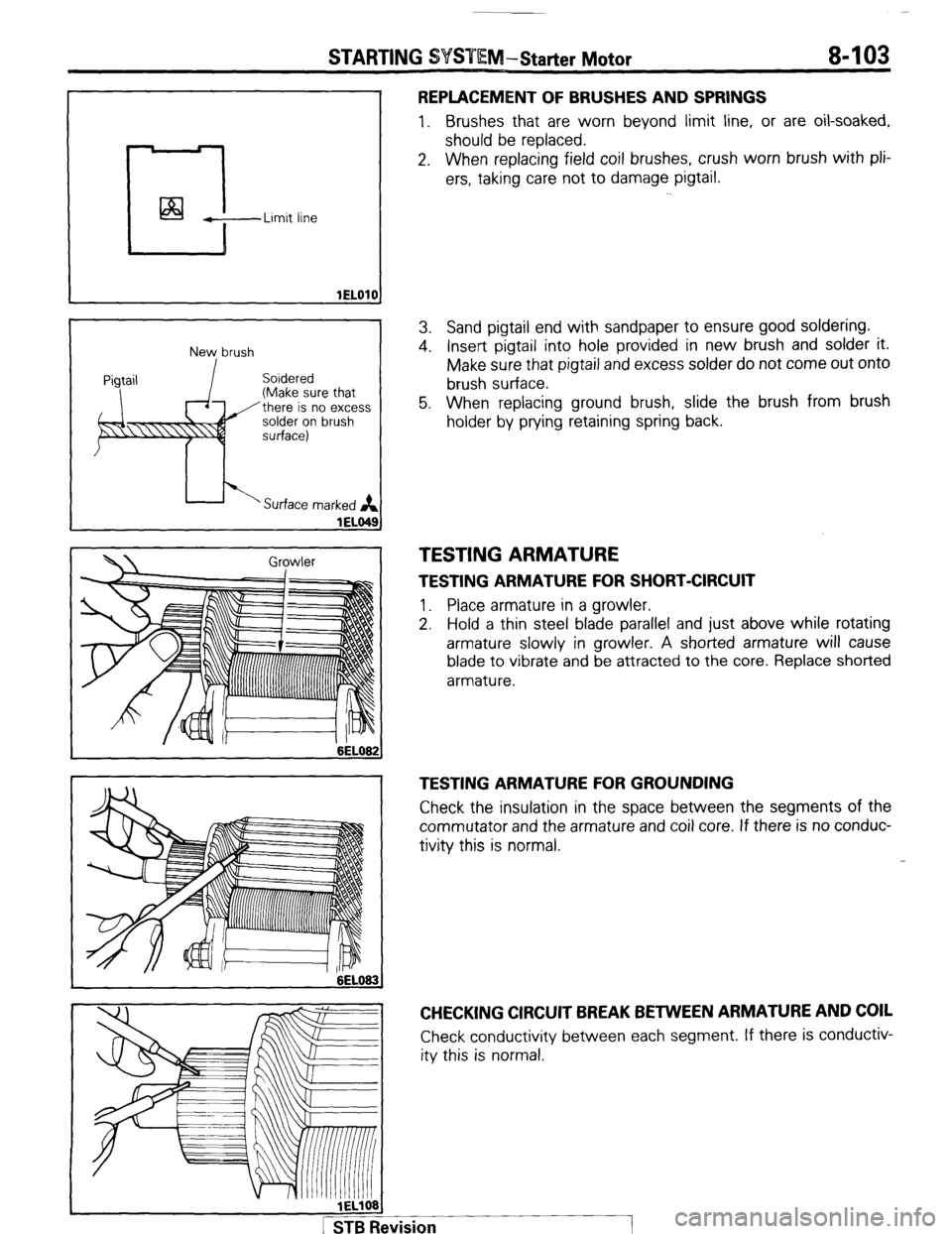
REPLACEMENT OF BRUSHES AND SPRINGS
1. Brushes that are worn beyond limit line, or are oil-soaked,
should be replaced.
2. When replacing field coil brushes, crush worn brush with pli-
ers, taking care not to damage pigtail.
3. Sand pigtail end with sandpaper to ensure good soldering.
4. Insert pigtail into hole provided in new brush and solder it.
Make sure that pigtail and excess solder do not come out onto
brush surface.
5. When replacing ground brush, slide the brush from brush
holder by prying retaining spring back.
TESTING ARMATURE
TESTING ARMATURE FOR SHORT-CIRCUIT
1. Place armature in a growler.
2. Hold a thin steel blade parallel and just above while rotating
armature slowly in growler. A shorted armature will cause
blade to vibrate and be attracted to the core. Replace shorted
armature.
TESTING ARMATURE FOR GROUNDING
Check the insulation in the space between the segments of the
commutator and the armature and coil core. If there is no conduc-
tivity this is normal.
CHECKING CIRCUIT BREAK BETWEEN ARMATURE AND COIL
Check conductivity between each segment. If there is conductiv-
ity this is normal.
1 STB Revision
Page 130 of 284
8-110 IGNITION SYSTEM - Circuit Diagram
2 IGNITDN CIRCUIT
Sub fusible link
A-23
(IGN - SW) Ignition switch
5-wn5-w-
0.5-G 1
u
63- Z-W
I
IAT
Main 1
fusible
Rnttprv link
m
ze 3 cj _-’ A:“p m
N CL
I 64-b I I I m
I
Ei
I
L Disi
To combination meter d A-an b
(TACHO)
[Refer to P.8-52.1
I I Ignition coil
37 w009
Remaik
-‘For information concerning the ground points (example: q ),
refer to P.8-7.
Wiring color code’ c
B: Black Br: Brown G: Green Gr: Gray L: Blue Lg: Light green
LI: Light blue 0: Orange P: Pink R: Red Y: Yellow V/: White
1 STB Revision 1
Page 132 of 284

8-112 IGNITION SYSTEM - Service Adjustment Procedures
CHECKING NEGATIVE PRESSURE ADVANCE EQUIPMENT
1. Set the timing light.
2. Start the engine and allow it to idle.
3. Pull out the vacuum hose from vacuum controller and attach
vacuum pump to nipple.
4. Check the advance while slowly applying negative pressure to
the vacuum pump. If the advance is smooth when accompa-
nying the increase in negative pressure, this is normal.
Secondary cable
~~
Primaw 6-8 mm
Cylinder
block
cable ’ (.24-.31 in.) 5ELO45 1
Spark plug
5ELO46
Iefective insula
5ELO47
/
Symptom
Excessive advances
Sudden advance rise
Insufficient advance or large
hysteresis
No advance Assumed causes
Weakness of vacuum controller
spring
Broken spring
Impaired movement of breaker
base
Broken diaphragm
5. If the malfunction indicators above are confirmed, dismantle
and check the distributor.
6. Allow the engine to idle and then turn the ignition switch to
OFF.
7. Remove the vacuum pump and attach the vacuum hose to the
vacuum controller nipple.
8. Remove the timing light.
SPARK PLUG CABLE TEST NWGIGB
Hold the spark plug cable about 6-8 mm (.24-.31 in.) away from
engine proper (grounding portion such as cylinder block) and crank
engine to verify that sparks are produced.
SPARK PLUG TIEST NOUGIHB
Connect the spark plug to the high tension cable, ground outer
electrode (main body), and crank engine. In the atmosphere, only
short sparks are produced because of small discharge gap. If the
spark plug is good, however, sparks will occur in discharge gap
(between electrodes). In a defective spark plug, no sparks will
occur because of leak of insulation puncture.
fvision
I
Page 139 of 284
IGNITION SYSTEM - Distributor
DISTRIBUTOR
DISASSEMBLY AND REASSEMBLY
8-119
Disassembly steps
1. Breather
2. Distributor cap
3. Packing
4. Contact carbon
5. Rotor
6. Vacuum control
7. Ground wire
8. Lead wire
l + Adjustment of air gap
9. Igniter
4* 10. Rotor shaft
+*** 11. Signal rotor
l * 12. Breaker plate
4* 13. Spring retainer
4* 14. Governor spring
15. Governor weight
16. Lock pin
- Vehicles for
California
Vehicles except
for California
8
4**+ 17. Driven gear
18. Washer
19. “0” ring
20. Distributor shaft
21. Washer
22. Oil seal
23. Distributor housing
NOTE
(1) Reverse the disassembly procedures to reassemble.
(2) +e : Refer to “Service Points of Disassembly”.
(3) Hw: Refer to “Service Points of Reassembly”.
(4)
q : Non-reusable parts
lEL104 1 STB Revision
Page 144 of 284

8-124
BUZZER METERS AND
GAUGES - Specifications
Items
Range of voltage used V
While buzzing (Terminal voltage at 13 V)
Sound pressure dB
Fundamental frequency Hz IO-16
53-7
goo* 150 Specifications
SERVICE SPECIFICATIONS
Items Specifications
Standard values
Speedometer indication error
Meter with “km/h” indication km/h
20 km/h f4
-1
40 km/h +4
0
80 km/h +5
0
120 km/h +5.5
+0.5
Meter with “mph” indication
mph
10 mph +- 1.5
25 mph + 1.5
50 mph +I.5
75 mph k 1.5
Tachometer indication error r/min
1,000 r/min *IO0
3,000 r/min +150
5,000 r/min f 250
Fuel gauge resistance value R
Between terminals 1 (power supply) and 2 (fuel gauge unit) 23-27
Between terminals 2 (fuel gauge unit) and 3 (ground) 122-l 48
Between terminals 1 (power supply) and 3 (ground) 100-l 20
Fule gauge unit resistance value R
Float point “F” 14.9-19.1
Float point “E” 113.5-l 26.5
Fuel gauge unit float position mm (in.)
Float point “F” 29.7-34.7 (1.169-l .366)
Float point “E” 183.8-185.8(7.236-7.315)
Water temperature gauge resistance value R
Between terminals 1 (power supply) and 2 (water 50-60
temperature gauge unit)
Water temperature gauge unit 90.5-I 17.5
resistance value R [at 70°C (158”F)l
Oil pressure gauge resistance value 1R 45-55
Voltage meter indication error V
IOV to.5
16V k 0.5
( ST6 Revision
-7
Page 149 of 284
METERS AND GAUGES - Circuit Diagram 8-129
011 pressure
switch YB
H I
>
A-52
Oil pressure
gauge unit
(
A-52
UY
>
-0.85-B
r.., !
YB
A-20 A-06 A-03
YR mYR YR,RL RL 4WD El B indicator switch
-- L7 I I 1 8-23
I I I I I
I 1 !
Fuel 1 1 gauge
unit
L
WL/B
YL
g-- y
1
I
I I I I I I LY)T~ OD OFF switch
1 1 I
I ' ; [Refer to P.8-431 I I
I . . I
'4 8.
Combination gauge
Wiring color code
6: Black Br: Brown G: Green Gr: Gray
LI: Light blue 0: Orange P: Pink
R: Red
Y Water
temperature
gauge unit
Remarks
(I) The broken line indicates vehicles with com-
bination gauge.
(2) The dash and dot line (-.-) indicates vehicles
with automatic free-wheeling hub indicator.
(3) For information concerning the ground points
(example: 0 ). refer to P.8-7.
(4) The symbols @I,@, etc. indicate that the wiring
is connected (using the same numerical
symbol) to the facing page.
(In other words, 0 on the right page is
connected to 0 on the left page.)
L: Blue
Y: Yellow Lg: Light green
W: White
/ STB Revision
Page 150 of 284

8430 METERS AND GAUGES - Service Adjustment Procedures.
SERVICE BJUSTMENT. PROCEDURES
SPEEDOMETER INSPECTION NOSHIAA
I. Adjust tire inflation pressure to the standard value. (Refer
to’GROUP 22 WHEELS AND TIRES-General Specifications)
2. Use speedometer tester to make sure that the speedome-
ter indication error is within the standard value.
Standard value :
Meter with “km/h” indication km/h
20 km/h +4
-1
40 km/h +4
0
80 km/h +5
0
120 km/h + 5.5
+0.5
Meter with “mph” indication
mph
10 mph
25 mph
50 mph
75 mph +I.5
21.5
+I.5
&I.5
Caution
1 When using a speedometer tester to inspect the
speedometer, be sure to chock the non-drive wheels
to prevent the vehicle from moving. Also be sure to
set the transfer shift lever to “2H”.
2 If there is a special regulation for speedometer
indication error in the area where the ‘vehicle is
operated, be sure to meet the requirement of the
regulation.
TACHOMETER INSPECTION NOBHIBA
Connect a tach-dwell meter, and then compare the meter
readings at various engine speeds with the values indicated on
the tachometer.
Standard value:
1,000 r/min
3,000 r/min
5,000 r/min f 100 r/min
2150 r/min
&250 r/min
Tgch-dwell meter Caution
The tachometer is the negative-ground type, and therefore
should not be connected in reverse polarity to the battery.
If the tachometer is connected in reverse polarity, the
transistors and diodes will be damaged.
evision
Page 151 of 284

METERS AND GAUGES - Service Adiustment Procedures 8-131
r
(harness side) 16W834
Stopper (upper)
FUEL GAUGE SIMPLE TEST NOEHICE
(1) Disconnect, from below the vehicle, the wiring connector
from the fuel gauge unit.
(2) Ground the connector at the harness through a test light.
(3) Turn the ignition key to the ON position.
(4) Check to be
sure that the test light flashes and the fuel
gauge indicator moves.
(5) If both the test light and gauge operate, the circuit to the
gauge unit is normal and the gauge unit itself is faulty.
If the test light flashes but the gauge does not operate, the
gauge is faulty.
If neither the test light nor the gauge operates, the fuel
gauge circuit is faulty.
FUEL GAUGE UNIT INSPECTION NOEHIIF
To check the fuel gauge unit, first remove it from the fuel tank.
For detailed information concerning installation of the fuel
gauge unit, refer to GROUP 4, FUEL SYSTEM - Fuel Tank.
FUEL GAUGE UNIT FLOAT POSITION CHECK
Check to be sure that the height of the fuel gauge float
(relative to the center part of the fuel gauge unit) is within the
standard value range when the float is at the “F” position
(upper limit) and “E” position (lower limit).
Standard value:
A 29.7-34.7 mm (1.170-I .366 in.)
B 183.8-185.8 mm (7.236-7.315 in.)
FUEL GA&E UNIT RESISTANCE CHECK
Confirm that the resistances when the float of the fuel gauge
unit is at the “F” position (top) and the “E” position (bottom)
are within the standard value ranges.
Standard value:
Float position “F” point 14.9-19.1 IR c
Float position “E” point 113.5-126.5 IR’
WATER TEMPERATURE GAUGE SIMPLE T,5$2
(1) Disconnect the wiring connector from the water tempera-
ture gauge unit inside the engine compartment.
(2) Ground the connector at the harness through a test light.
(3) Turn the ignition key to the ON position.
(4) Check to be sure that the test light flashes and the water
temperature gauge indicator moves. ,
1 STB Revision


