Page 93 of 284

CHARGING SYSTEM -Specifications
SPECIFICATIONS
GENERAL SPECIFICATIONS
ALTERNATOR NOOEB-B
Type
Model No.
Part No.
Rated output
VIA
Voltage regulator Items Specifications
~--
Battery voltage sensing
A2T03477
MD1 10318
12150
Electronic built-in type
BAlTERY
Items
Type
1
Ampere hours (5 HR) Ah
Cranking rating [at - 178°C (O”F)] A
Reserve capacity min. Specifications
55824R (S)-MF
36
420
75
NOTES
1. CRANKING RATING is the current a battery can deliver for 30 seconds and maintain a terminal voltage of 7.2 or
greater at a specified temperature.
2. RESERVE CAPACITY RATING is the amount of time a battery can deliver 25 A and maintain a minimum terminal
voltage of 10.5 at 26.7”C (80°F).
SERVICE SPECIFICATIONS NOBEC-
Items
Standard values
Regulated voltage V
Ambient temp. at voltage regulator
- 20°C ( - 4°F)
20°C (68°F)
60°C (140°F)
80°C (176°F)
Slip ring O.D. mm (in.)
Field coil resistance R
Limit
Output current A
Slip ring O.D. mm (in.) 14.2-15.4
13.9-14.9
13.4-14.6
13.1-14.5
23 (.906)
3.1
Min. 35
22.2 (.874) Specifications
[ STB Revision
Page 107 of 284
CHARGING SYSTEM-Alternator 8-87
6ELllt
SERVICE POINTS OF DISASSEMBLY
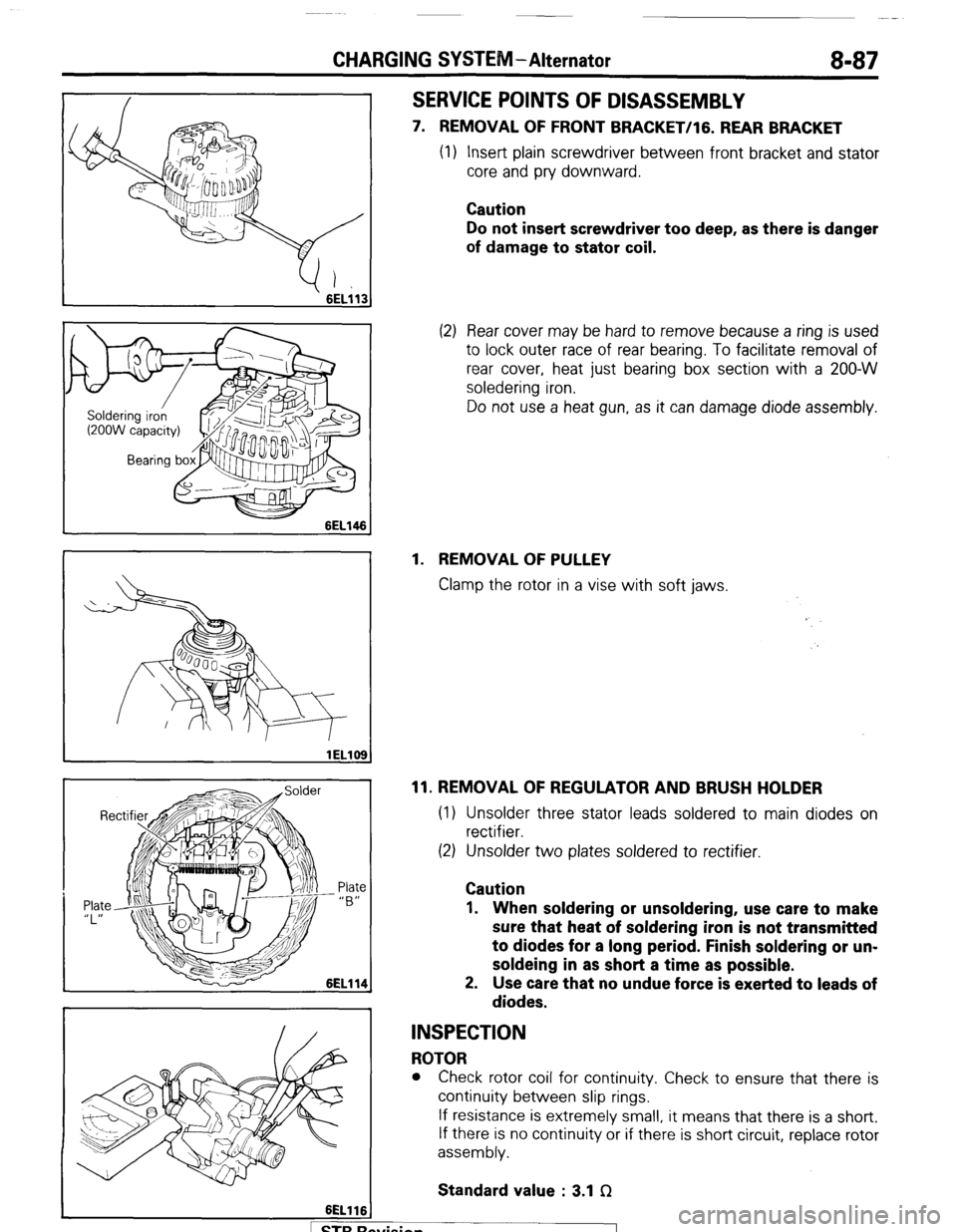
7. REMOVAL OF FRONT BRACKET/lG. REAR BRACKET
(1) Insert plain screwdriver between front bracket and stator
core and pry downward.
Caution
Do not insert screwdriver too deep, as there is danger
of damage to stator coil.
(2) Rear cover may be hard to remove because a ring is used
to lock outer race of rear bearing. To facilitate removal of
rear cover, heat just bearing box section with a 200-W
soledering iron.
Do not use a heat gun, as it can damage diode assembly.
1. REMOVAL OF PULLEY
Clamp the rotor in a vise with soft jaws.
11. REMOVAL OF REGULATOR AND BRUSH HOLDER
(1) Unsolder three stator leads soldered to main diodes on
rectifier.
(2) Unsolder two plates soldered to rectifier.
Caution
1. When soldering or unsoldering, use care to make
sure that heat of soldering iron is not transmitted
to diodes for a long period. Finish soldering or un-
soldeing in as short a time as possible.
2. Use care that no undue force is exerted to leads of
diodes.
INSPECTION
ROTOR
l Check rotor coil for continuity. Check to ensure that there is
continuity between slip rings.
If resistance is extremely small, it means that there is a short.
If there is no continuity or if there is short circuit, replace rotor
assembly.
Standard value : 3.1 f2
. . .
I 1 STB hewsion
Page 108 of 284
8-88 CHARGING SYSTEM-Alternator
6EL115
3ELOlO
lELll0
lELll1
A
) STBRc
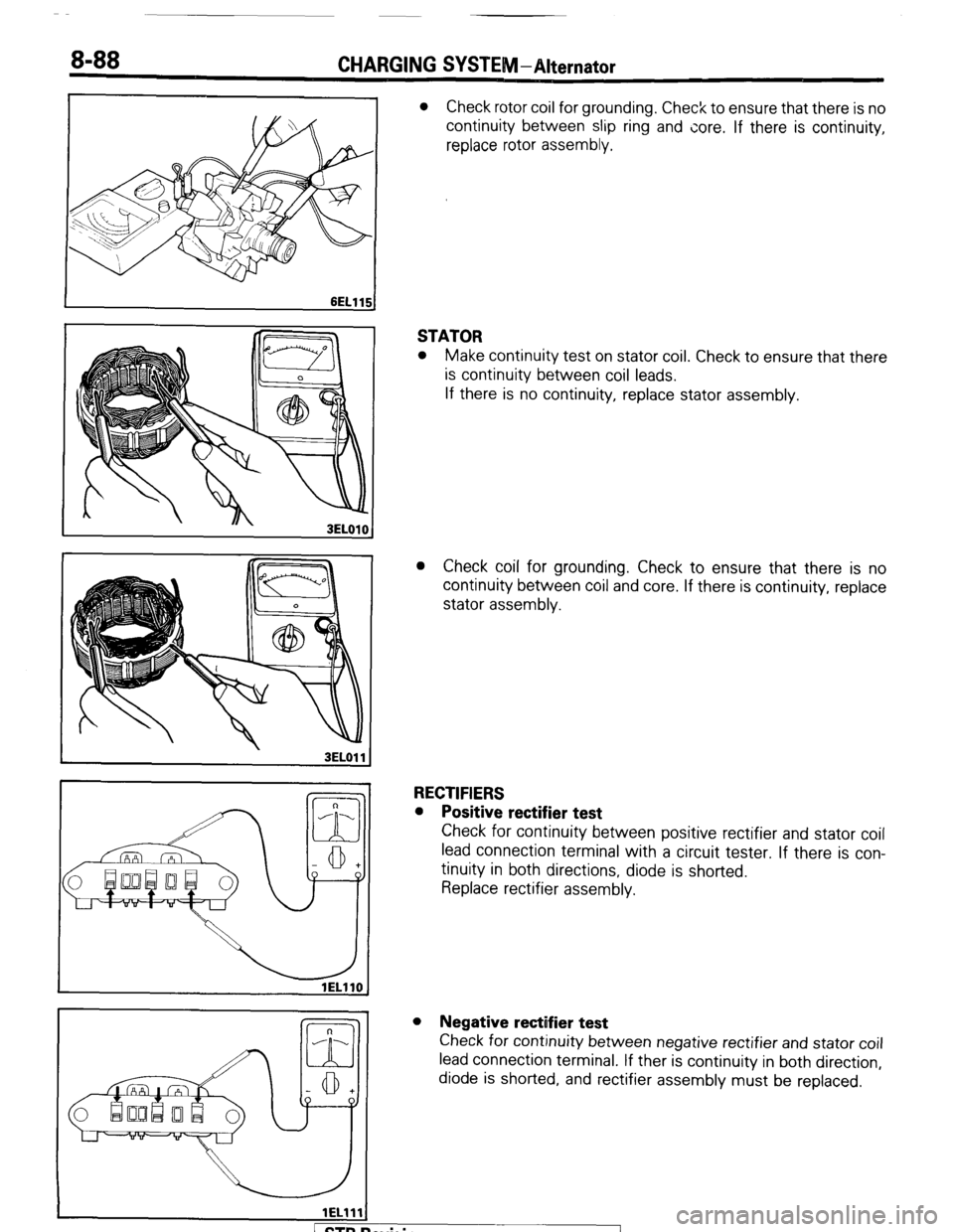
l Check rotor coil for grounding. Check to ensure that there is no
continuity between slip ring and core. If there is continuity,
replace rotor assembly.
STATOR
l Make continuity test on stator coil. Check to ensure that there
is continuity between coil leads.
If there is no continuity, replace stator assembly.
l Check coil for grounding. Check to ensure that there is no
continuity between coil and core. If there is continuity, replace
stator assembly.
RECTIFIERS
l Positive rectifier test
Check for continuity between positive rectifier and stator coil
lead connection terminal with a circuit tester. If there is con-
tinuity in both directions, diode is shorted.
Replace rectifier assembly.
l Negative rectifier test
Check for continuity between negative rectifier and stator coil
lead connection terminal. If ther is continuity in both direction,
diode is shorted, and rectifier assembly must be replaced.
evision
-7
Page 111 of 284

STARTING SYSTEM-General Information 8-91
STARTING SYSTEM
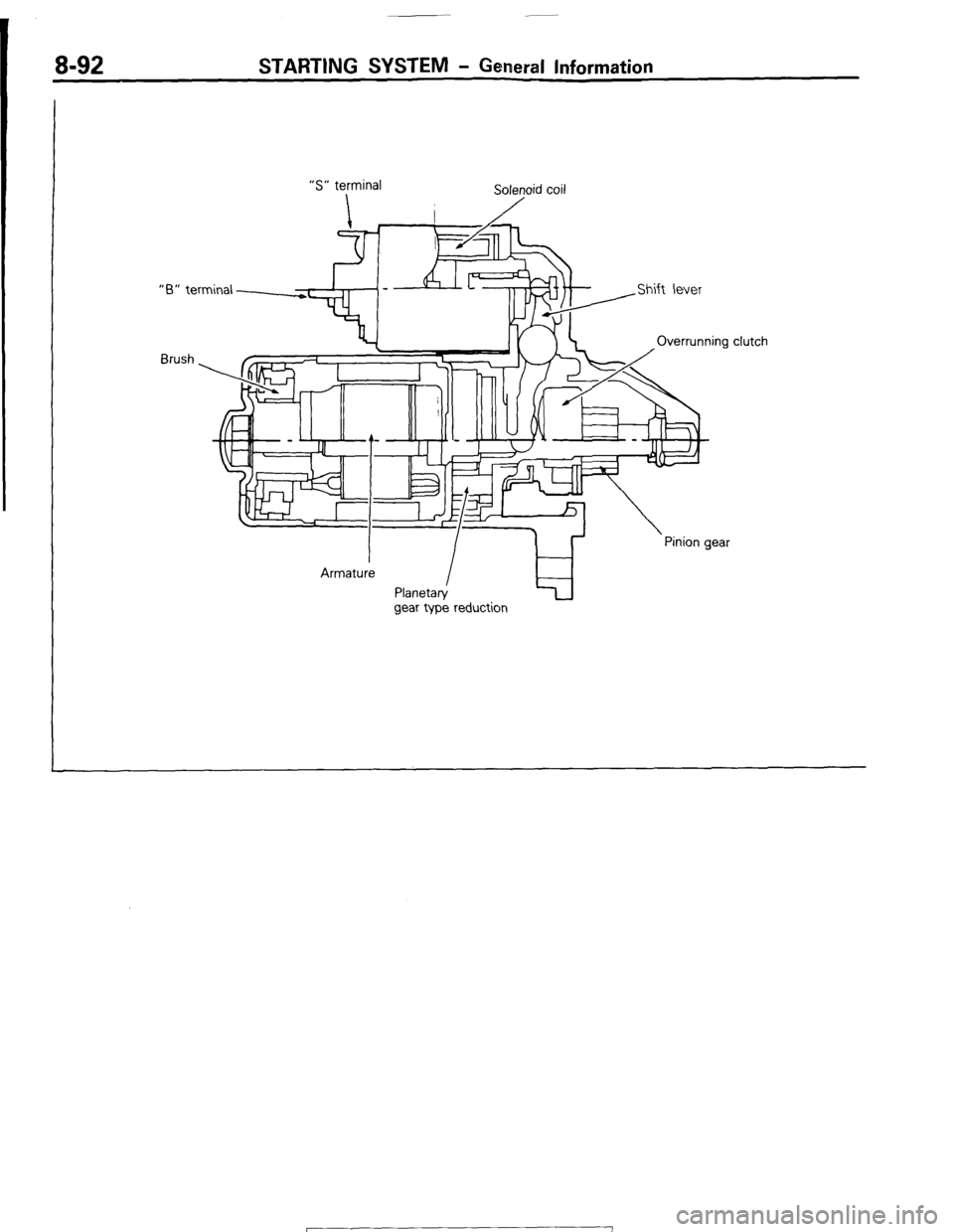
GENERAL INFORMATION
NOBFAAJ
The electrical circuit of the starter system consists of battery, starter motor, solenoid switch, ignition switch,
inhibitor switch, connecting wire and battery cable.
In the starter system and electrical circuit, electricity flows to activate the coils of the starter motor solenoid when
the ignition switch is turned to the start position. In so doing, the solenoid plunger and clutch shift lever move, the
clutch pinion engages with the ring gear and then the solenoid contacts shut and the starter motor cranks.
As soon as the engine begins to run and, in order to prevent damage due to over-revolution by the armature starter,
the running clutch pinion gear over-rides, Thus in order not to cause damage to the starter motor once the engine
is running, the ignition switch must be immediately turned back to the ON position.
The starter motor is the reduction-drive type, and is compact and lightweight.
Inhibiter switch
-
I lEL151
1 STB Revision
Page 112 of 284
8-92 STARTING SYSTEM - General Information
“S” terminal
Sole;oid coil
“6” terminal -
clutch
Brush
gear type reduction
1 ST6 Revision
Page 117 of 284
STARTING WSTEM - Starter Motor 8-97
STARTER MOTOR
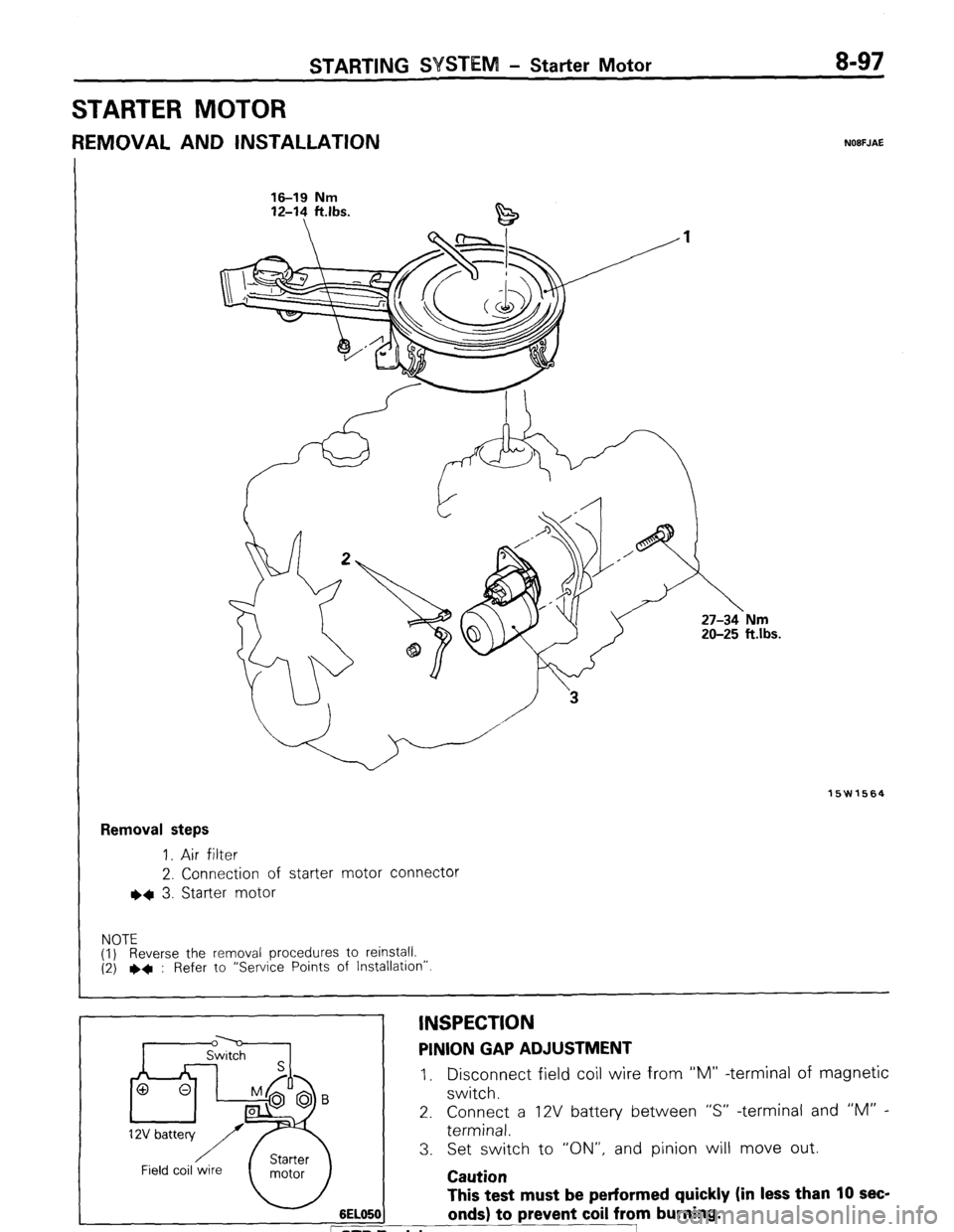
REMOVAL AND INSTALLATION NOBFJAE
16-19 Nm 16-19 Nm
12-l? ft.lbs. 12-14 ft.lbs.
15W1564
Removal steps
1. Air filter
2. Connection of starter motor connector
l * 3. Starter motor
NOTE
(1) Reverse the removal procedures to reinstall.
(2) ++ : Refer to “Service Points of Installation”
6EL05( This test must be performed quickly (in less than 10 sec-
onds) to prevent coil from burning. D Revision
INSPECTION PINION GAP ADJUSTMENT
I, Disconnect field coil wire from “M” -terminal of magnetic
switch.
2. Connect a 12V battery between “S” -terminal and “M” -
terminal.
3. Set switch to “ON”, and pinion will move out.
Caution
Page 118 of 284

8-98 STARTING SYSTEM -Starter Motor
Pinion
6EL003
lEL113
/ Field coil wire
Field coil wire
4. Check pinion to stopper clearance (pinion gap) with a feeler
gauge.
Standard value : 0.5-2.0 mm (.020-.079 in.)
5. If pinion gap is out of specification, adjust by adding or remov-
ing gaskets between magnetic switch and front bracket.
PULL-IN TEST OF MAGNETIC SWITCH
1. Disconnect field coil wire from M-terminal of magnetic switch.
2. Connect a 12V battery between S-terminal and M-terminal.
Caution
This test must be performed quickly (in less than 10 sec-
onds) to prevent coil from burning.
3. If pinion moves out, then pull-in coil is good. If it doesn’t,
replace magnetic switch.
HOLD-IN TEST OF MAGNETIC SWITCH
1.
2. Disconnect field coil wire from M-terminal of in;ignetic switch.
Connect a 12V battery between S-terminal and body.
Caution
This test must be performed quickly (in less than 10 sec-
onds) to prevent coil from burning.
3. If pinion remains out, everything is in order. If pinion moves in,
hold-in circuit is open. Replace magnetic switch.
1 ST6 Revision
Page 119 of 284
WEEM -Starter Motor 8-99
I-
Carbon-pile rheostat
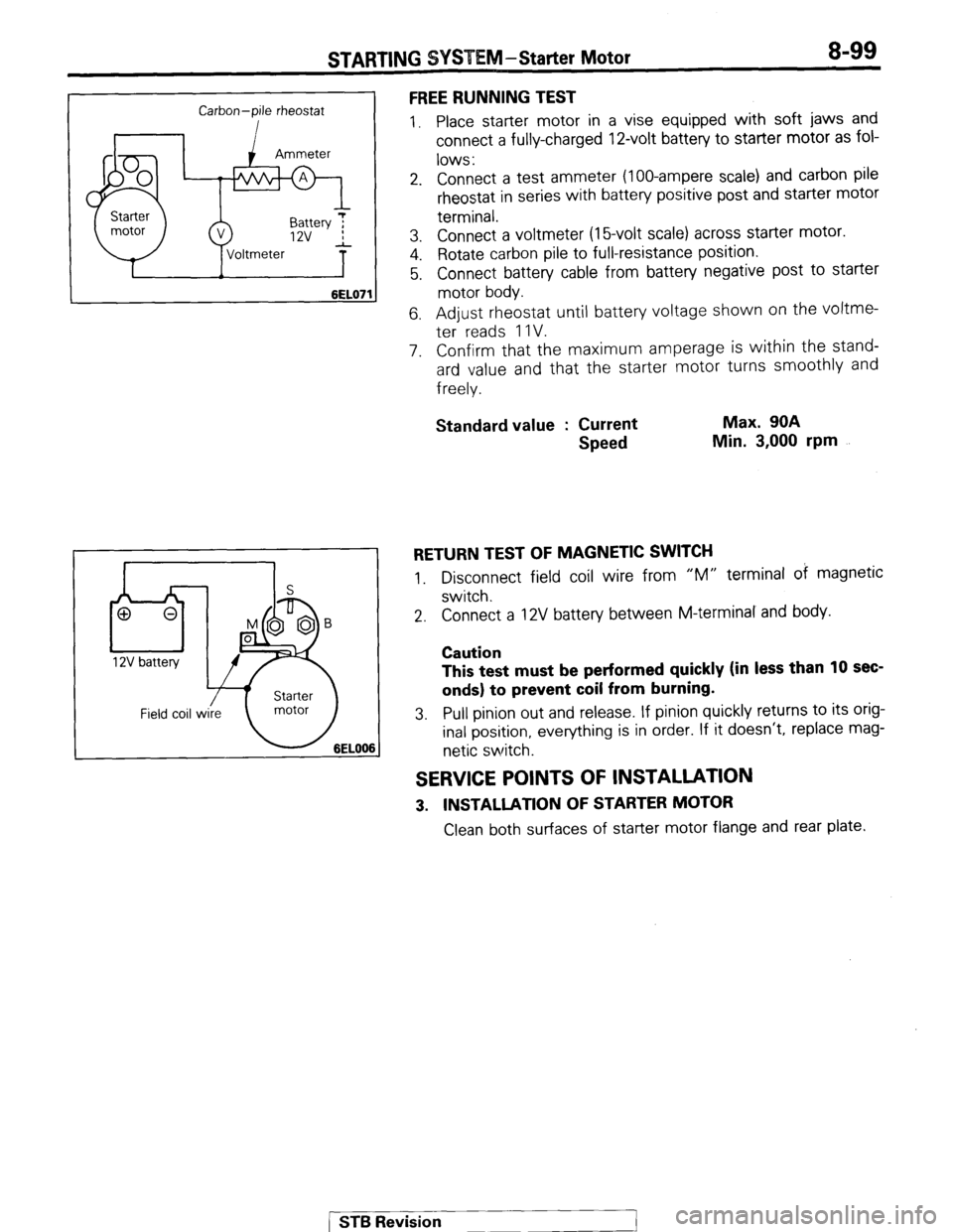
6EL07’ FREE RUNNING TEST
1. Place starter motor in a vise equipped with soft jaws and
connect a fully-charged 12-volt battery to starter motor as fol-
lows :
2. Connect a test ammeter (loo-ampere scale) and carbon pile
rheostat in series with battery positive post and starter motor
terminal.
3. Connect a voltmeter (16volt scale) across starter motor.
4. Rotate carbon pile to full-resistance position.
5. Connect battery cable from battery negative post to starter
motor body.
6. Adjust rheostat until battery voltage shown on the voltme-
ter reads 1 IV.
7. Confirm that the maximum amperage is within the stand-
ard value and that the starter motor turns smoothly and
freely.
Standard value : Current
Speed Max. 90A
Min. 3,000 rpm
RETURN TEST OF MAGNETIC SWITCH
1. Disconnect field coil wire from “M” terminal of magnetic
switch.
2. Connect a 12V battery between M-terminal and body.
Caution
This test must be performed quickly (in less than 10 sec-
onds) to prevent coil from burning.
3. Pull pinion out and release. If pinion quickly returns to its orig-
inal position, everything is in order. If it doesn’t, replace mag-
netic switch.
SERVICE POINTS OF INSTALLATION
3. INSTALLATlON OF STARTER MOTOR
Clean both surfaces of starter motor flange and rear plate.
[ ST6 Revision
1