Page 133 of 284

IGNITION SYSTEM-Service Adjustment Procedures 8-113
SPARK TEST - ENGINE CANNOT BE CRANKED
If spark test is performed by cranking while the catalyst is hot,
unburned gas will be supplied to the catalyst, and this is not de-
sirable to the catalyst.
For this reason, use the following methods which allow spark test
to be performed without cranking.
1. Remove the distributor cap.
2. Check signal rotor position in relation to the pick-up. If it is not
the position shown in the illustration, turn the crankshaft man-
ually so that the projection of the signal rotor is moved away
from the center part of the pick-up. In order words, the signal
rotor should be positioned so that current can flow to the
ignition coil.
3. Disconnect the high tension cable from the center tower of
the distributor cap, and hold the end of the cable about 5 - 10
mm (.2 - .4 in.) away from the cylinder block of the engine.
4. Turn the ignition switch to “ON”. Then, when a piece of metal
(the tip of a screwdriver for instance) is inserted into the de-
tection coil of the pick-up and then moved away, a spak can be
generated.
+
!:’
Secondary cable 5-10 km
(.2-.4 in.)
5EL0
1 STB Revision
Page 134 of 284
8-114 IGNITION SYSTEM - Ignition System
IGNITION SYSTEM
REMOVAL AND INSTALLATION NOEGJAE
20-30
Nm
Spark plug removal steps
+e l
+ 1. Spark plug cable No. 1
~~ ~~ 2. Spark plug cable No. 2
+e e+ 3. Spark plug cable No. 3
*e e+ 4. Spark plug cable No. 4
5. Spark plug
Distributor removal steps
16W1563
~~ l + 1-4. Spark plug cables
6. Connection of distributor connector
+* 7. High tension cable
8. Connection of vacuum hose
de l
q 9. Distributor
Ignition coil removal steps
7. High tension cable NOTE
10. Connection of ignition coil connector (1) Reverse the removal procedures to reinstall.
(2) +e : Refer to “Service Points of Removal”. 11. Ignition coil (3) l + : Refer to “Service Points of Installation”
I
1 STB Revision
Page 136 of 284
8-116 IGNITION SYSTEM-Ignition System
Plug
cleaner
OlUOO89
Plug gap
gauge NIPPON
termine
rl
direction
High voltage
terminal
01R0234
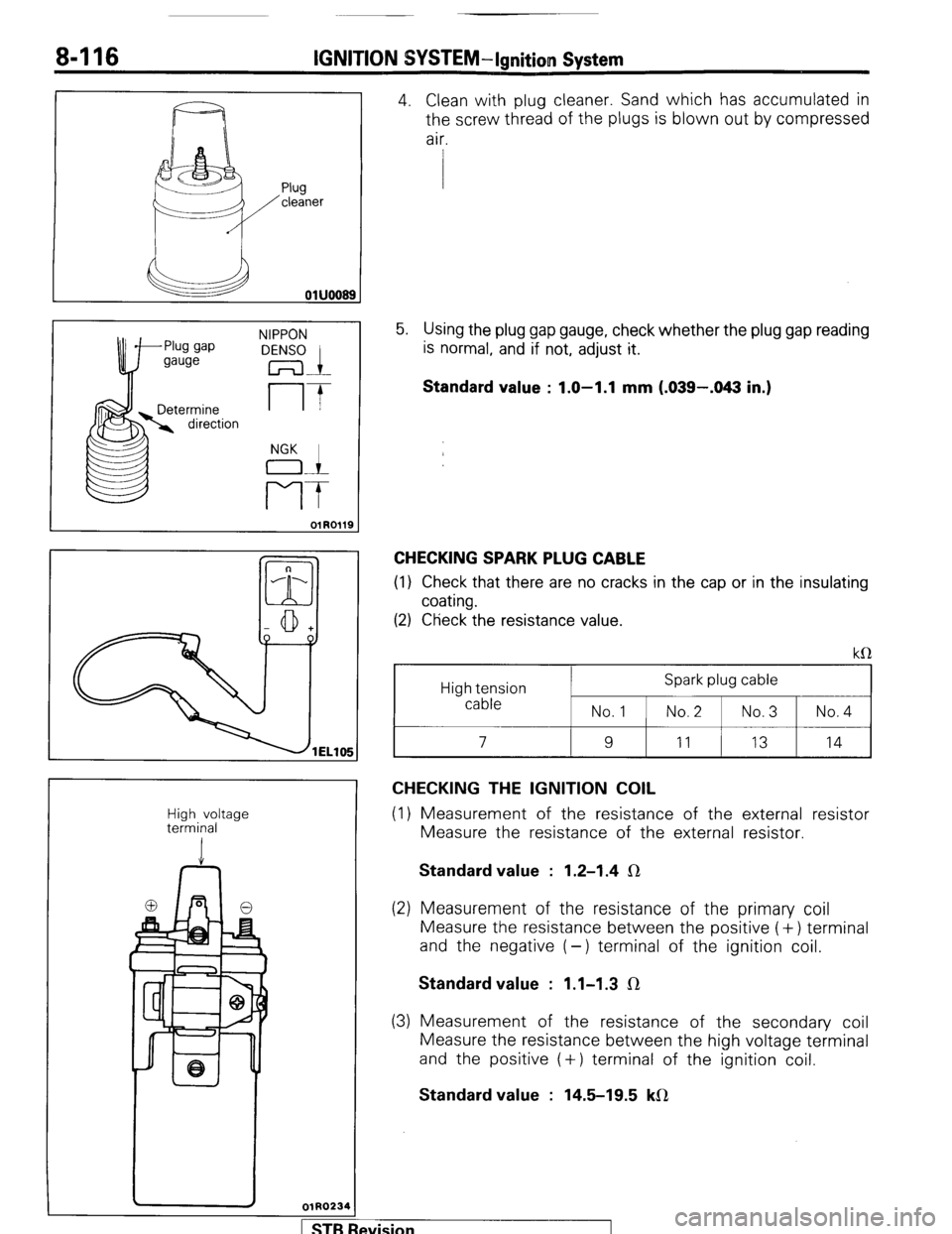
4. Clean with plug cleaner. Sand which has accumulated in
the screw thread of the plugs is blown out by compressed
air.
5. Using the plug gap gauge, check whether the plug gap reading
is normal, and if not, adjust it.
Standard value : 1.0-1.1 mm (.039-.043 in.)
CHECKING SPARK PLUG CABLE
(1) Check that there are no cracks in the cap or in the insulating
coating.
(2) Ctieck the resistance value.
High tension
cable Spark plug cable
No.1 1 No.2 1 No.3 1 No.4
I 9
I
11
I 13 I 14
CHECKING THE IGNITION COIL
(1) Measurement of the resistance of the external resistor
Measure the resistance of the external resistor. Standard value : 1.2-1.4 IR
(2) Measurement of the resistance of the primary coil
Measure the resistance between the positive (+) terminal
and the negative (-) terminal of the ignition coil. Standard value : 1.1-1.3 IR
(3) Measurement of the resistance of the secondary coil
Measure the resistance between the high voltage terminal
and the positive (+) terminal of the ignition coil. Standard value : 14.5-19.5 kfl
wision I
Page 139 of 284
IGNITION SYSTEM - Distributor
DISTRIBUTOR
DISASSEMBLY AND REASSEMBLY
8-119
Disassembly steps
1. Breather
2. Distributor cap
3. Packing
4. Contact carbon
5. Rotor
6. Vacuum control
7. Ground wire
8. Lead wire
l + Adjustment of air gap
9. Igniter
4* 10. Rotor shaft
+*** 11. Signal rotor
l * 12. Breaker plate
4* 13. Spring retainer
4* 14. Governor spring
15. Governor weight
16. Lock pin
- Vehicles for
California
Vehicles except
for California
8
4**+ 17. Driven gear
18. Washer
19. “0” ring
20. Distributor shaft
21. Washer
22. Oil seal
23. Distributor housing
NOTE
(1) Reverse the disassembly procedures to reassemble.
(2) +e : Refer to “Service Points of Disassembly”.
(3) Hw: Refer to “Service Points of Reassembly”.
(4)
q : Non-reusable parts
lEL104 1 STB Revision
Page 143 of 284

METERS AND GAUGES-Specifications
METERS AND GAUGES
8-123
SPECIFICATIONS
GENERAL SPECIFICATIONS
METERS AND GAUGES NOEHB-
Items
Speedometer
Type
Tachometer
Type
Detection source
Fuel gauge
Type
Fuel gauge unit
Type
Water temperature gauge
Type
Water temperature gauge unit
Type
Oil pressure gauge
Type
Oil pressure gauge unit
Type
Inclinometer
Type
Damping system
Voltage meter
Type Specifications
Electromagnetic type
Pulse type
Ignition coil
Bimetal type (constant-voltage relay incorporated for 7V)
Variable resistance type
Bimetal type (7V operation)
Thermistor type
Bimetal type
Bimetal type
Gravity type
Oil-filled system
Bimetal type
INDICATOR AND WARNING LIGHTS
NOEHC-B
Items Specifications
Turn signal indicator lights
W 1.4 (74)
High beam indicator light W 1.4 (74)
Door-ajar warning light W 1.4 (74)
Fasten seat belt indicator light W 1.4 (74)
Brake warning light W 1.4 (74)
Charging warning light W 1.4 (74)
4WD indicator light W 1.4 (74)
EGR warning light W 1.4 (74)
Oil pressure warning light W 1.4 (74)
A/T oil temperature warning light
W 1.4 (74)
Overdrive indicator light
W 1.4 (74)
Free-wheeling hub indicator light W 1.4 (74)
NOTE
The values in parentheses denote SAE grade numbers.
1 STB Revision ”
Page 144 of 284

8-124
BUZZER METERS AND
GAUGES - Specifications
Items
Range of voltage used V
While buzzing (Terminal voltage at 13 V)
Sound pressure dB
Fundamental frequency Hz IO-16
53-7
goo* 150 Specifications
SERVICE SPECIFICATIONS
Items Specifications
Standard values
Speedometer indication error
Meter with “km/h” indication km/h
20 km/h f4
-1
40 km/h +4
0
80 km/h +5
0
120 km/h +5.5
+0.5
Meter with “mph” indication
mph
10 mph +- 1.5
25 mph + 1.5
50 mph +I.5
75 mph k 1.5
Tachometer indication error r/min
1,000 r/min *IO0
3,000 r/min +150
5,000 r/min f 250
Fuel gauge resistance value R
Between terminals 1 (power supply) and 2 (fuel gauge unit) 23-27
Between terminals 2 (fuel gauge unit) and 3 (ground) 122-l 48
Between terminals 1 (power supply) and 3 (ground) 100-l 20
Fule gauge unit resistance value R
Float point “F” 14.9-19.1
Float point “E” 113.5-l 26.5
Fuel gauge unit float position mm (in.)
Float point “F” 29.7-34.7 (1.169-l .366)
Float point “E” 183.8-185.8(7.236-7.315)
Water temperature gauge resistance value R
Between terminals 1 (power supply) and 2 (water 50-60
temperature gauge unit)
Water temperature gauge unit 90.5-I 17.5
resistance value R [at 70°C (158”F)l
Oil pressure gauge resistance value 1R 45-55
Voltage meter indication error V
IOV to.5
16V k 0.5
( ST6 Revision
-7
Page 146 of 284
8-126 METERS AND GAUGES -Troubleshooting
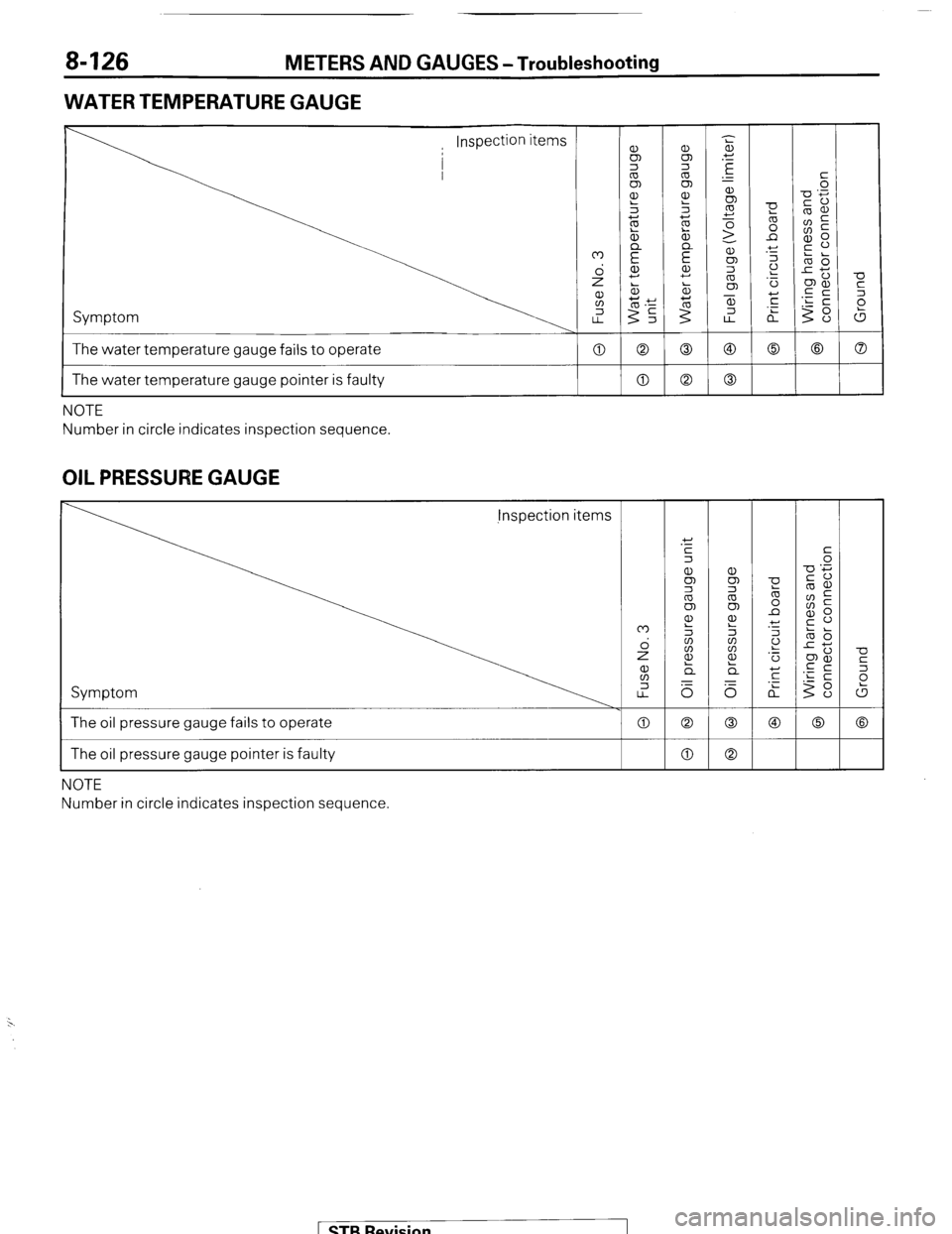
WATER TEMPERATURE GAUGE
Symptom
The water temperature gauge fails to operate
-0
c
2
(5
a 0 0
0 a
I The water temperature gauge pointer is faulty a NOTE
Number in circle indicates inspection sequence.
OIL PRESSURE GAUGE jnspection items
Symptom
0
0
a The oil pressure gauge fails to operate
The oil pressure gauge pointer is faulty
NOTE
Number in circle indicates inspection sequence
( STB Revision
-IIII
Page 149 of 284
METERS AND GAUGES - Circuit Diagram 8-129
011 pressure
switch YB
H I
>
A-52
Oil pressure
gauge unit
(
A-52
UY
>
-0.85-B
r.., !
YB
A-20 A-06 A-03
YR mYR YR,RL RL 4WD El B indicator switch
-- L7 I I 1 8-23
I I I I I
I 1 !
Fuel 1 1 gauge
unit
L
WL/B
YL
g-- y
1
I
I I I I I I LY)T~ OD OFF switch
1 1 I
I ' ; [Refer to P.8-431 I I
I . . I
'4 8.
Combination gauge
Wiring color code
6: Black Br: Brown G: Green Gr: Gray
LI: Light blue 0: Orange P: Pink
R: Red
Y Water
temperature
gauge unit
Remarks
(I) The broken line indicates vehicles with com-
bination gauge.
(2) The dash and dot line (-.-) indicates vehicles
with automatic free-wheeling hub indicator.
(3) For information concerning the ground points
(example: 0 ). refer to P.8-7.
(4) The symbols @I,@, etc. indicate that the wiring
is connected (using the same numerical
symbol) to the facing page.
(In other words, 0 on the right page is
connected to 0 on the left page.)
L: Blue
Y: Yellow Lg: Light green
W: White
/ STB Revision