15 INTRODUCTION
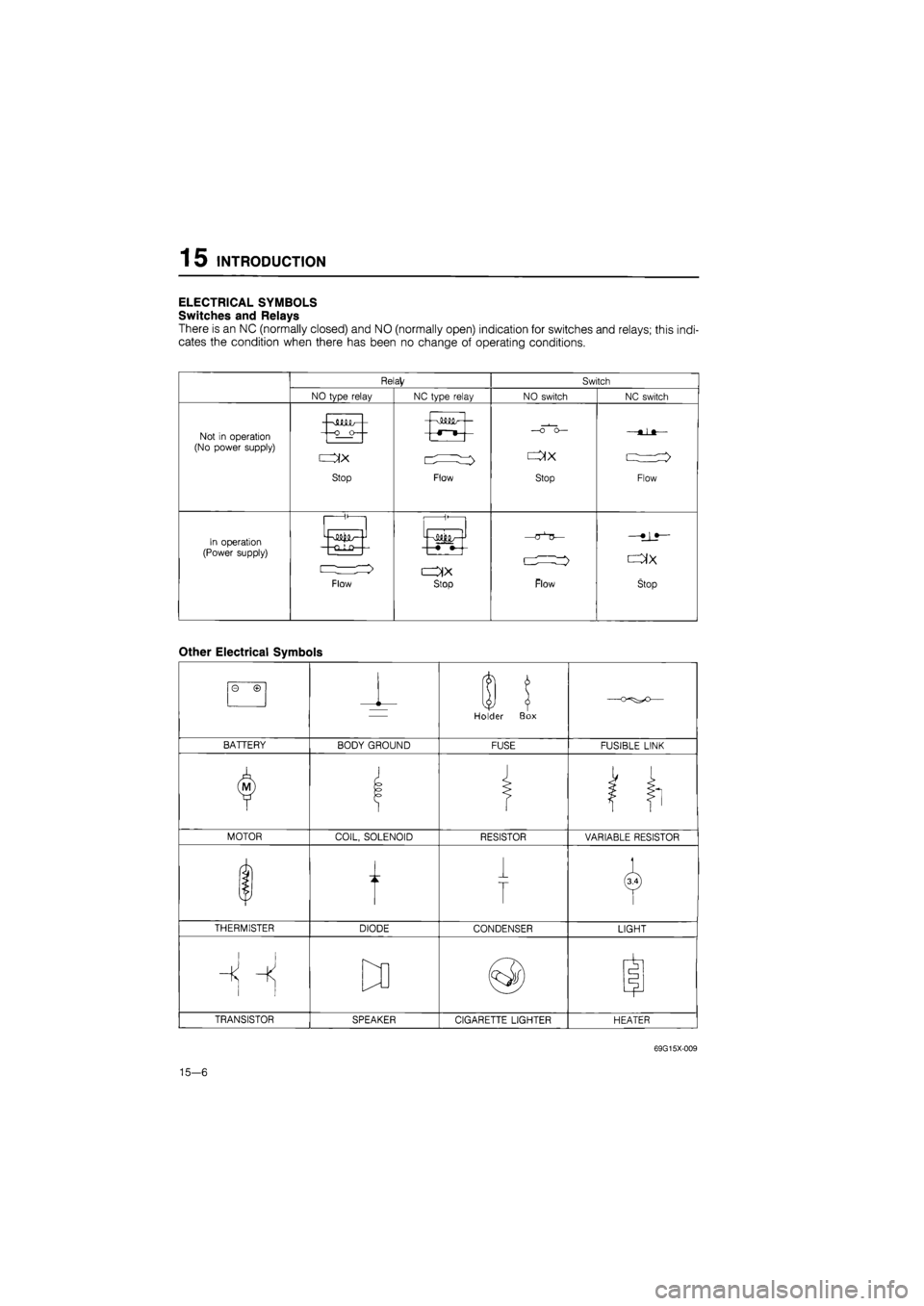
ELECTRICAL SYMBOLS
Switches and Relays
There is an NC (normally closed) and NO (normally open) indication for switches and relays; this indi-
cates the condition when there has been no change of operating conditions.
Relay
NO type relay NC type relay
Switch
NO switch NC switch
Not
in
operation (No power supply)
—Jtfiifij —o o—
Flow Stop Flow
In operation (Power supply)
^
^aijuiy—'
Flow
l=3X
Stop
Flow
Stop
Other Electrical Symbols
Holder
Box —
© ©
Holder
Box —
Holder
Box —
BATTERY BODY GROUND FUSE FUSIBLE LINK
(£)
* 1 fc
MOTOR COIL, SOLENOID RESISTOR VARIABLE RESISTOR
1
ii
-L ©
THERMISTER DIODE CONDENSER LIGHT
1
TRANSISTOR SPEAKER CIGARETTE LIGHTER HEATER
69G15X-009
15—6
OUTLINE 16
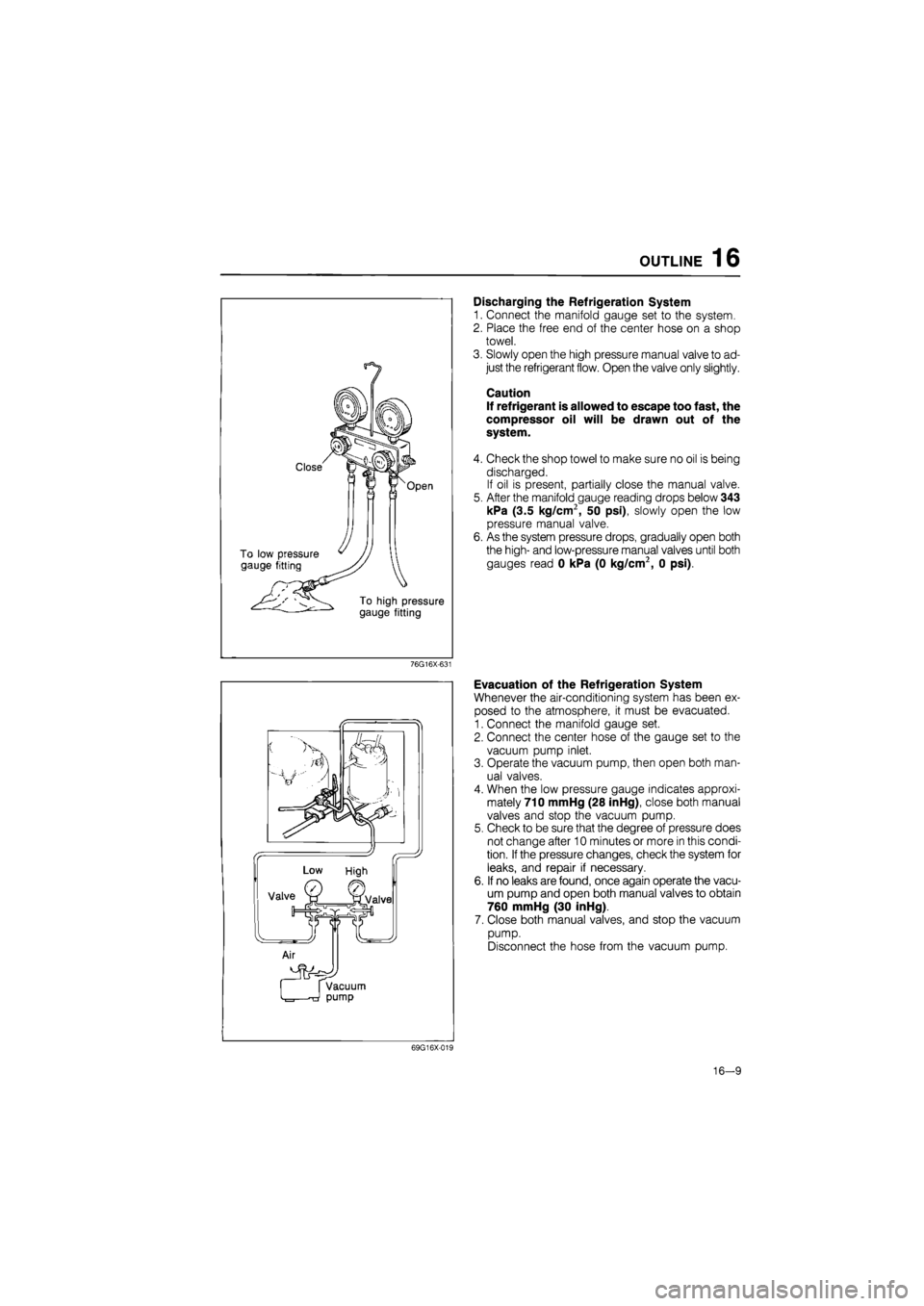
Discharging the Refrigeration System
1. Connect the manifold gauge set to the system.
2. Place the free end of the center hose on a shop
towel.
3. Slowly open the high pressure manual valve to ad-
just the refrigerant flow. Open the valve only slightly.
Caution
If refrigerant is allowed to escape too fast, the
compressor oil will be drawn out of the
system.
4. Check the shop towel to make sure no oil is being
discharged.
If oil is present, partially close the manual valve.
5. After the manifold gauge reading drops below 343
kPa (3.5 kg/cm2, 50 psi), slowly open the low
pressure manual valve.
6. As the system pressure drops, gradually open both
the high- and low-pressure manual valves until both
gauges read 0 kPa (0 kg/cm2, 0 psi).
76G16X-631
Evacuation of the Refrigeration System
Whenever the air-conditioning system has been ex-
posed to the atmosphere, it must be evacuated.
1. Connect the manifold gauge set.
2. Connect the center hose of the gauge set to the
vacuum pump inlet.
3. Operate the vacuum pump, then open both man-
ual valves.
4. When the low pressure gauge indicates approxi-
mately 710 mmHg (28 inHg), close both manual
valves and stop the vacuum pump.
5. Check to be sure that the degree of pressure does
not change after 10 minutes or more in this condi-
tion.
If
the pressure changes, check the system for
leaks, and repair if necessary.
6. If no leaks are found, once again operate the vacu-
um pump and open both manual valves to obtain
760 mmHg (30 inHg).
7. Close both manual valves, and stop the vacuum
pump.
Disconnect the hose from the vacuum pump.
69G16X-019
16-9
16 COMPRESSOR
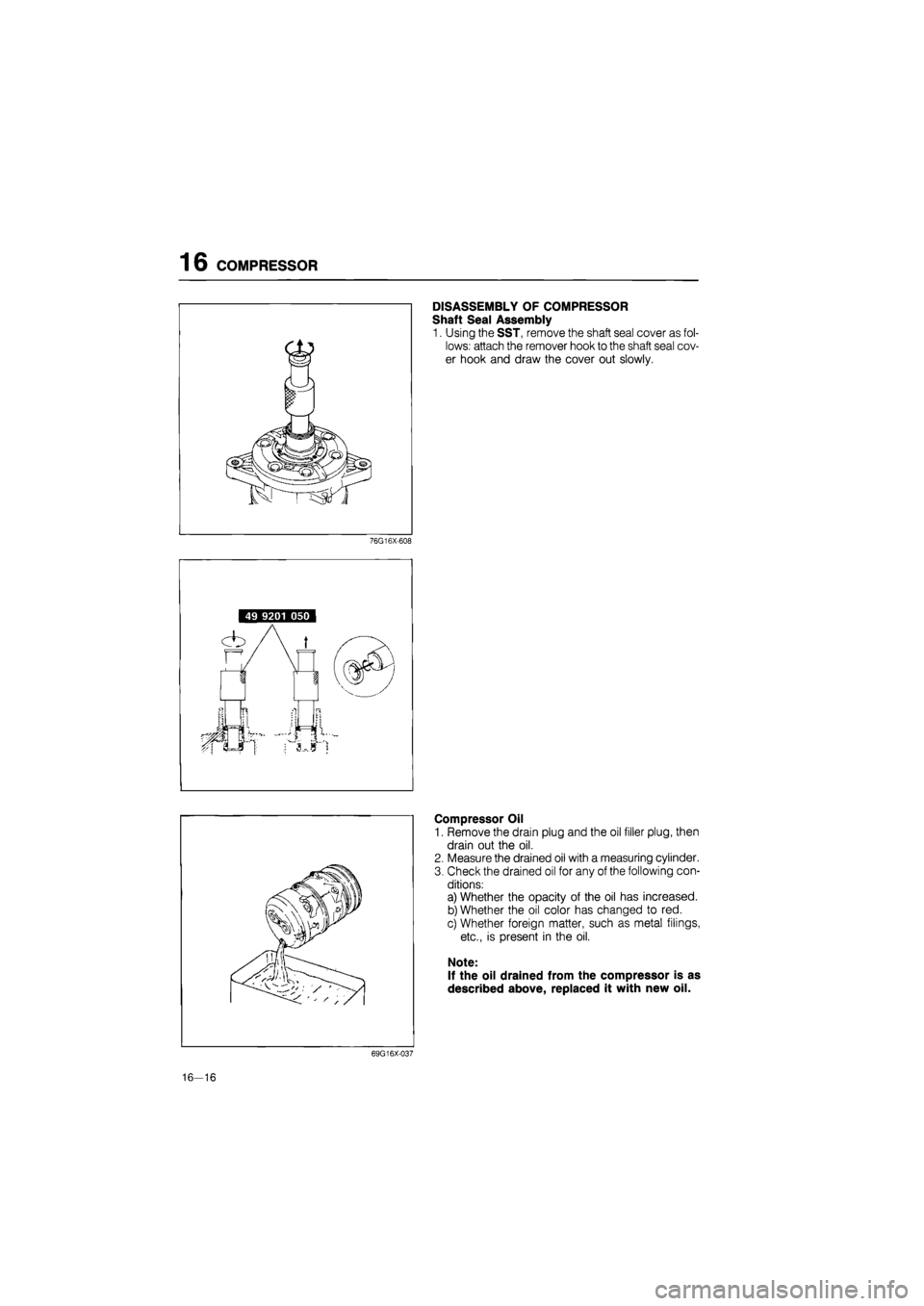
DISASSEMBLY OF COMPRESSOR
Shaft Seal Assembly
1. Using the SST, remove the shaft seal cover as fol-
lows: attach the remover hook to the shaft seal cov-
er hook and draw the cover out slowly.
76G16X-608
Compressor Oil
1. Remove the drain plug and the oil filler plug, then
drain out the oil.
2. Measure the drained oil with a measuring cylinder.
3. Check the drained oil for any of the following con-
ditions:
a) Whether the opacity of the oil has increased.
b) Whether the oil color has changed to red.
c) Whether foreign matter, such as metal filings,
etc., is present in the oil.
Note:
If the oil drained from the compressor is as
described above, replaced it with new oil.
69G16X-037
16—16