Page 406 of 1865
AUTO-RETURN CHOKE SYSTEM 4A
Choke Magnet
1. Remove the under dash cover.
2. Disconnect the choke magnet connector.
3. Turn the ignition switch on and check the resistance
using an ohmmeter.
Resistance: Approx. 3512
4. If it is not within the specification, the choke mag-
net is malfunction.
76G04A-069
76G04A-070
Water thermo switch
1. Remove the switch from the intake manifold.
2. Place the switch in a container of water with a ther-
mometer.
3. Connect an ohmmeter to the switch.
4. Heat the water slowly and check that the switch
has continuity at 67°C (152°F).
5. Replace if necessary.
Note
a) Apply sealing tape to the threads of the
switch.
b) After installing, check the coolant level and
check for leaks.
4A—41
Page 460 of 1865

CONTROL SYSTEM 4A
WATER THERMO SWITCH (RADIATOR)
Inspection
1. Remove the switch from the radiator.
2. Place the switch in water with a thermometer and
gradually heat the water.
3. Check for continuity of the switch with an
ohmmeter.
Coolant temp. Continuity
More than approx.
17°C (63°F)
Yes
Less than approx.
17°C (63°F)
No
76G04A-183
4. If not as specified, replace the water thermo switch.
Note
a) Apply sealing tape to the threads of the
switch before installing it.
b) After installation, check the coolant level
and check for leaks.
76g04a-184
WATER THERMO SWITCH (INTAKE MANIFOLD)
Inspection
1. Remove the switch from the intake manifold.
2. Place the switch in water with a thermometer and
gradually heat the water.
3. Check for continuity of the switch with an
ohmmeter.
Coolant temp. Continuity
More than approx.
72°C (162°F)
Yes
Less than approx.
72°C (162°F)
No
76G04A-185 4. If not as specified, replace the water thermo switch.
Note
a) Apply sealing tape to the threads of the
switch before installing it.
b)
After installation, check the coolant level
and check for leaks.
76G04A-186
4A-95
Page 551 of 1865

CONTROL SYSTEM 4B
Terminal Input Output Connection to Voltage (After warming-up) Remarks Terminal Input Output Connection to IGN: ON Idle Remarks
1P — — — — —
1Q — — — — —
1R — — — — —
1S o Air bypass solenoid valve (Idle-up C) and P/S pressure switch
Battery voltage While solenoid ON (Refer to page 4B—35): below 1.5V
1T — — — — —
1U — — — — —
1V 0 MTX
Neutral and clutch switch
In-gear condition Clutch pedal depressed: battery voltage Clutch pedal released: below 1,5V
Neutral: constant battery voltage
1W O Test connector Test connector grounded: below 1,5V Test connector not grounded: battery voltage Green connector, 1-pin
1X — — — — —
2A o V ref 4.5—5.5V
2B 0 Air flow meter (Vc) 6-10V
2C — — Ground (E2) Approx. OV
2D o Oxygen sensor OV 0-1.OV • Cold engine: 0V at idle • After warming-up: Increase engine speed: 0.5—1.0V Deceleration: 0—0.4V
2E 0 Air flow meter (Vs) Approx. 1.7V Approx. 3—5V Increase engine speed:
voltage increases
2F — -— — —
2G 0 Throttle sensor Accelerator pedal released:
0.4—0.6 V
2H 0 Atmospheric pres-sure sensor At sea level: approx. 4.0V
21 0 Water thermo sensor 0.3—0.6 V Engine coolant temp. 20°C (68°F): approx. 2.5V
2J o Air flow meter (In-
take air thermo
sensor)
Approx. 2.3V at 20°C (68°F)
2K o Solenoid valve (Pres-
sure regulator
control)
For 120 sec. after ignition switch OFF - ON: below 1.5V
For 120 sec. after
starting: below 1.5V
Hot condition: Cool-ant temp, above 70°C (158°F) Intake air temp, above 10°C (50°F)
2K o Solenoid valve (Pres-
sure regulator
control)
Battery voltage Other conditions
2L — — — — —
2M — — —
4B-89
Page 611 of 1865

4C FUEL SYSTEM
COMPONENT DESCRIPTION
Component Function Remark
Air flow sensor Detects amount of intake air;
sends signal to engine control unit
Clutch switch Detects in-gear condition; sends signal to engine control unit Switch ON when clutch pedal released
Engine control unit Detects signals from input sensors and switches; controls injector and fuel pump operations
Fuel filter Filters fuel
Fuel pump Provides fuel to injectors • Operates while engine running
• Installed in fuel tank
Fuel pump control unit (4WS) Monitors fuel level in left section; controls transfer pump operation
G signal pick-up Detects No.1 cylinder TDC; sends signal to engine control unit Installed in distributor
Idle switch Detects when throttle valve fully closed; sends signal to engine control unit Installed on throttle body
Ignition switch (ST position) Sends engine cranking signal to engine control unit
Injector Injects fuel into intake port • Controlled by signals from engine control unit • High-ohmic injector
Intake air thermo sensor Detects intake air temperature; send signal to engine control unit
Control relay Supplies electric current to injectors fuel pump and engine control unit
Ne signal pick-up Detects crank angle at 180° intervals; sends signal to engine control unit Installed in distributor
Neutral switch Detects in-gear condition; sends signal to engine control unit
Switch ON when in gear
Oxygen sensor (Unleaded fuel) Detects oxygen concentration; sends signal to engine control unit
• Zirconia ceramic and platinum coating • Integrated heater coil
Pressure regulator Adjusts fuel pressure supplied to injectors
Pulsation damper Absorbs fuel pulsation
Throttle sensor Detects throttle valve opening angle;
sends signal to engine control unit
Installed on throttle body
Transfer pump (4WS) Pumps fuel from the left to the right side Controlled by fuel pump control unit
Transfer pump switch (4WS) Detects fuel level in left section;
sends signal to control unit
Water thermo sensor Detects coolant temperature; sends signal to engine control unit
Water thermo switch (Unleaded fuel) Detects radiator coolant temperature; sends signal to engine control unit ON: above 17°C (63°F)
76G04C-088
4C-50
Page 893 of 1865
TROUBLESHOOTING (G4A-EL) 7B
STEP 4 (STALL TEST)
This step is performed to determine if there is slippage of the friction elements or malfunction of the
hydraulic components.
Preparation
Check the following items prior to testing:
1. Engine coolant, engine oil and ATF levels.
2. Warm the engine thoroughly to raise the ATF temperature to operating level (50—80°C, 122—176°F).
3. Engage the parking brake and use wheel chocks at the front and rear wheels.
Pull the parking brake Water temperature
ATF
79G07C-084
7B-27
Page 915 of 1865
TROUBLESHOOTING (G4A-HL) 7B
STEP 3 (STALL TEST)
This step is performed to determine if there is slippage of the friction elements or malfunction of the
hydraulic components.
Preparation
Check the following items prior to testing:
1. Engine coolant, engine oil and ATF levels.
2. Warm the engine thoroughly to raise the ATF temperature to operating level (50—80°C, 122—176°F).
3. Engage the parking brake and use wheel chocks at the front and rear wheels.
Pull the parking brake Water temperature
ATF
83U07B-038
7B—49
Page 1128 of 1865
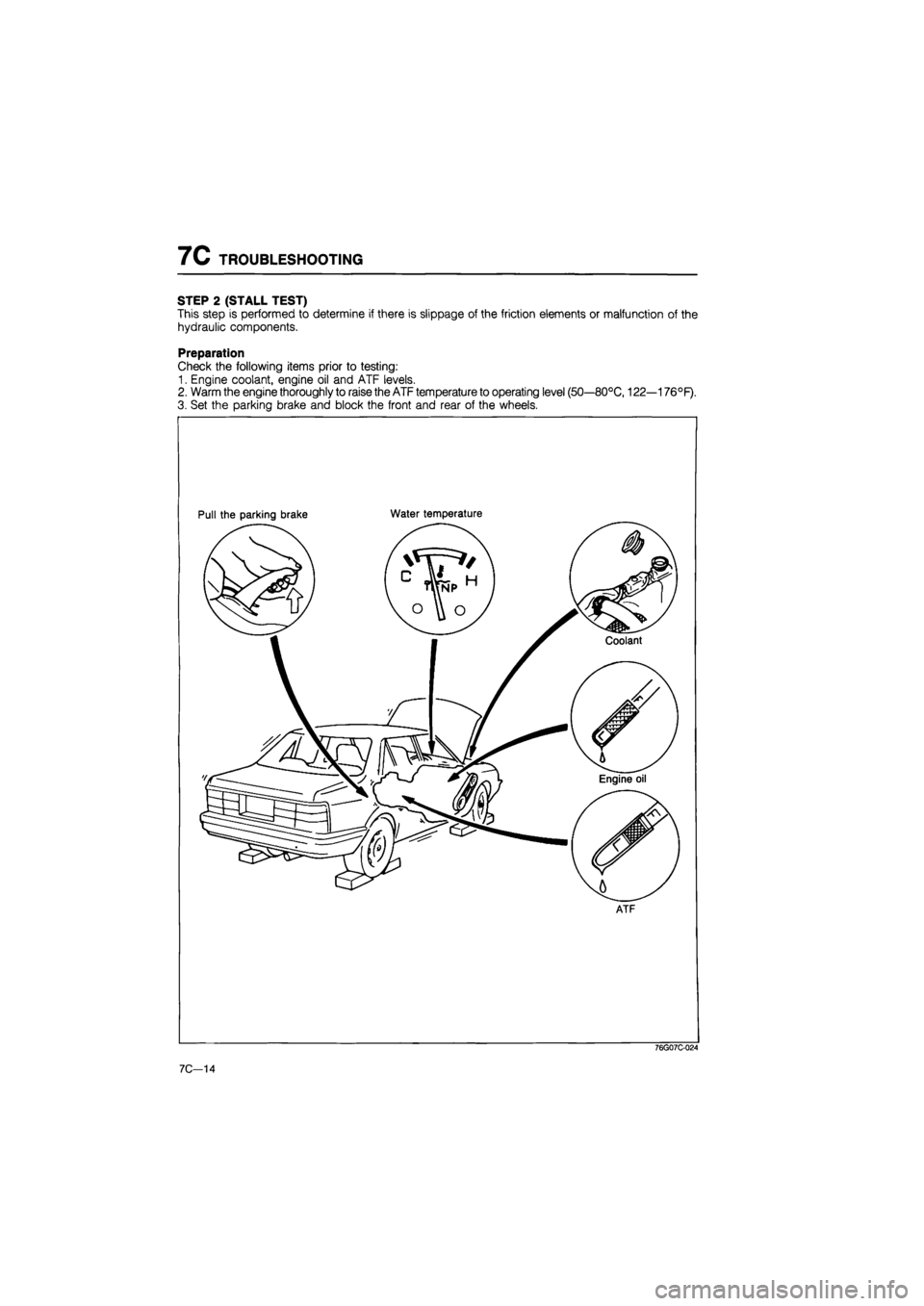
7C TROUBLESHOOTING
STEP 2 (STALL TEST)
This step is performed to determine if there is slippage of the friction elements or malfunction of the
hydraulic components.
Preparation
Check the following items prior to testing:
1. Engine coolant, engine oil and ATF levels.
2. Warm the engine thoroughly to raise the ATF temperature to operating level (50—80°C, 122—176°F).
3. Set the parking brake and block the front and rear of the wheels.
Pull the parking brake Water temperature
ATF
7C—14
76G07C-024
Page 1694 of 1865
WARNING AND SENDER 15
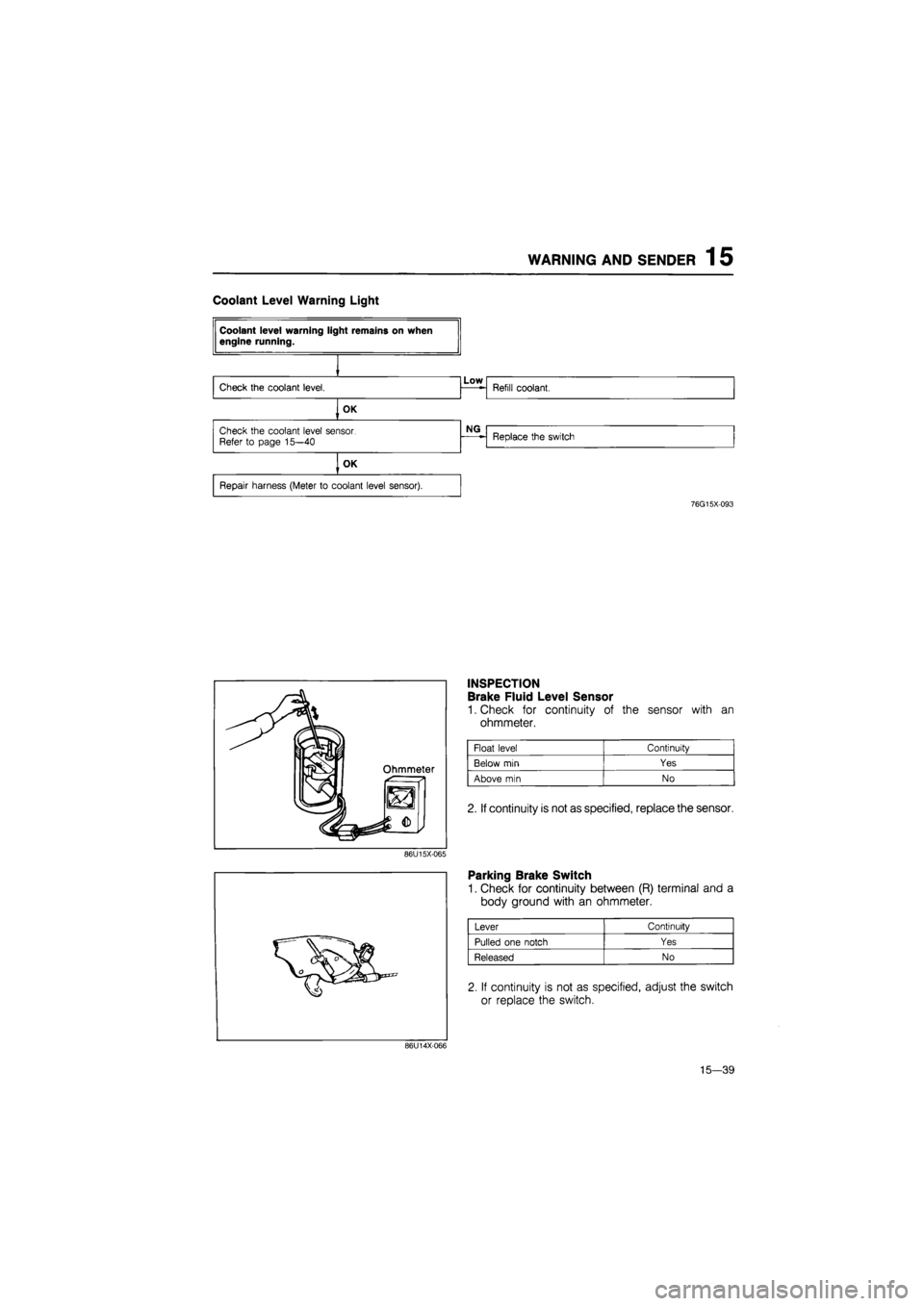
Coolant Level Warning Light
OK
Repair harness (Meter
to
coolant level sensor).
76G15X093
INSPECTION
Brake Fluid Level Sensor
1. Check for continuity of the sensor with an
ohmmeter.
Float level Continuity
Below
min
Yes
Above
min
No
2. If continuity is not as specified, replace the sensor.
86U15X-065
86U14X-066
Parking Brake Switch
1. Check for continuity between (R) terminal and a
body ground with an ohmmeter.
Lever Continuity
Pulled one notch Yes
Released No
2. If continuity is not as specified, adjust the switch
or replace the switch.
15—39