1986 CHEVROLET CORVAIR ESP
[x] Cancel search: ESPPage 10 of 56
Downloaded from www.Manualslib.com manuals search engine OPERATING INSTRUCTIONS
I
YOUR CORVAIR'S FIRST FEW HUNDRED MILES OF DRIVING
Sound design and precision manufacturing methods
will permit you to operate your new Corvair without
adhering to a formal "break-in" schedule. However,
during the first few hundred miles of driving you can,
by observing a few simple precautions, odd to the future
performance and economy of your cor.
It is recommended that your speed during the first
500 miles be confined to a maximum of 60 MPH, but
do not drive for extended periods at anyone constant
speed,
either fast or slow. During this period, ovoid full
throttle starts and unnecessary, quick abrupt stops .
Gentle braking during the first few hundred miles of
operation will result in longer broke life and better
future performance. Avoid unnecessary, hard stops espe
cially during the first 200 miles of operation since broke
misuse during this period will destroy much future broke
efficiency.
Always drive at a moderate speed until the engine
has completely warmed up.
DRIVING FOR ECONOMY
Proper maintenance and wise operation will com
bine to help you achieve maximum fuel economy with
your Corvair. Your Authorized Chevrolet Dealer can
properly tune and maintain your car but wise operation
is your responsibility. Give the cor sufficient warm-up
time, do not make "Full Throttle" storts or unnecessary
severe stops,
and drive at reasonable speeds and as
steady as traffic permits to gain the benefits of all the
economy built into your Corvair.
CAUTION: Avoid inhaling exhaust gases especially in an enclosed area such as a garage. Exhaust gases
contain
a percentage of carbon monoxide which is a potentially lethal gas that, by itself, is tasteless, color
less, and odorless. The exhaust system should be inspected for proper mounting, leaks and missing or damaged
parts each time the vehicle is raised for lubrication or oil change service.
7
Page 12 of 56
Downloaded from www.Manualslib.com manuals search engine WARM-UP
Never race engine or drive at high speeds until
engine has
had a chance to warm up. Driving with
moderate accelerator pedal application will prevent
stalling
and hesitation, especially during cold weather.
Failure
to allow sufficient warm up time can cause un
necessary wear to engine, axle or transmission parts
because of inadequate lubrication.
DRIVING WITH THE
MANUAL TRANSMISSIONS
The three-speed and optional four-speed trans
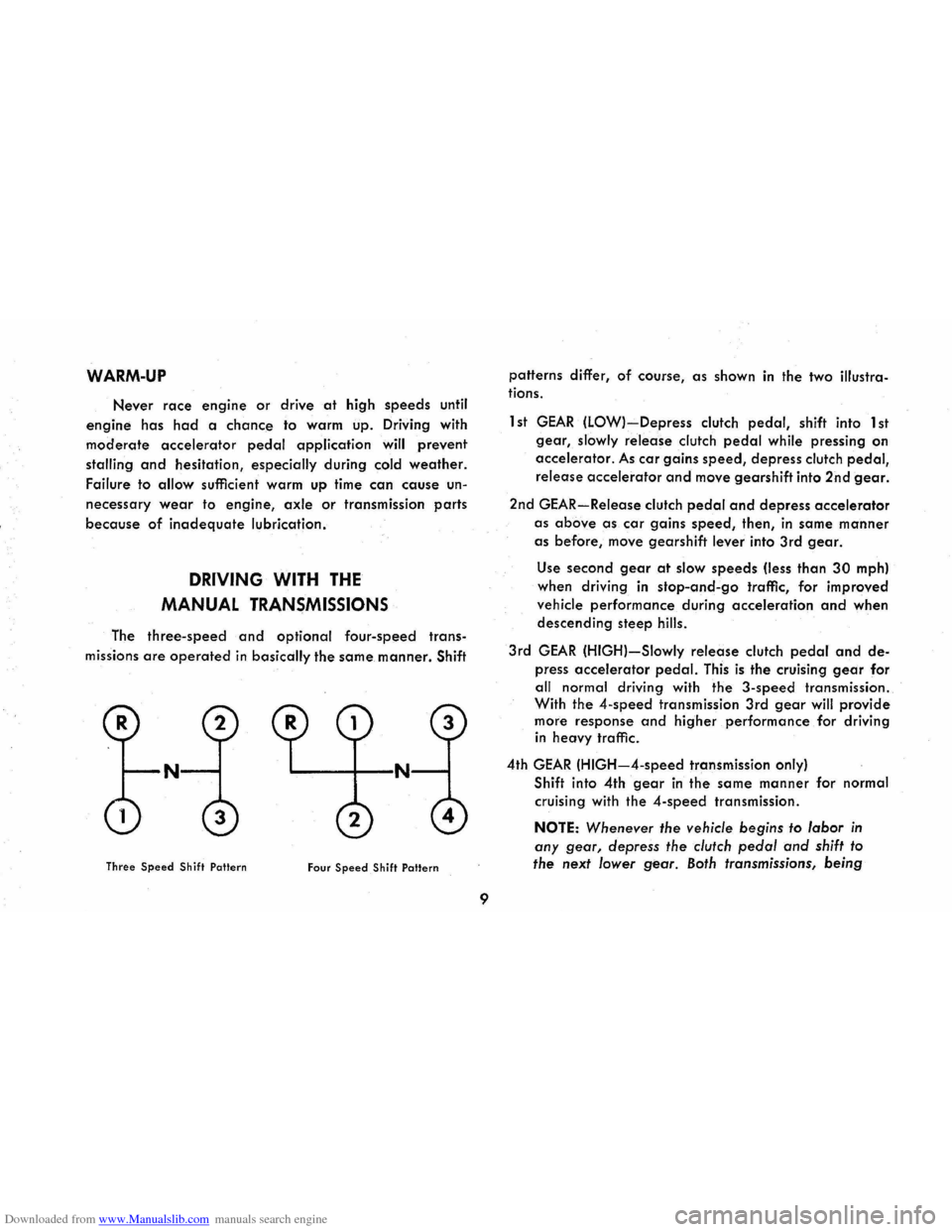
missions are operated in basically the same manner. Shift
N "'-----+--N
Three Speed Shift Pallern Four Speed Shift Pattern
9
patterns differ, of course, as shown in the two illustra
tions.
1 st
GEAR (LOW)-Depress clutch pedal, shift into 1 st
gear, slowly release clutch pedal while pressing on
accelerator.
As car gains speed, depress clutch pedal,
release accelerator and move gearshift into 2nd gear.
2nd GEAR-Release clutch pedaI and depress accelerator
as above as car gains speed, then, in same manner
as before, move gearshift lever into 3rd gear.
Use second gear at slow speeds (less than 30 mph)
when driving
in stop-and-go traffic, for improved
vehicle performance during acceleration
and when
descending steep hills.
3rd
GEAR (HIGH)-Slowly release clutch pedal and de
press accelerator pedal. This is the cruising gear for
all normal driving with the
3-speed transmission.
With the
4-speed transmission 3rd gear will provide
more response
and higher performance for driving
in heavy traffic.
4th
GEAR (HIGH-4-speed transmission only)
Shift into 4th
gear in the same manner for normal
cruising with the
4-speed transmission.
NOTE: Whenever the vehicle begins to labor in
any gear, depress the clutch pedal and shift to
the next lower
gear. Both transmissions, being
Page 18 of 56
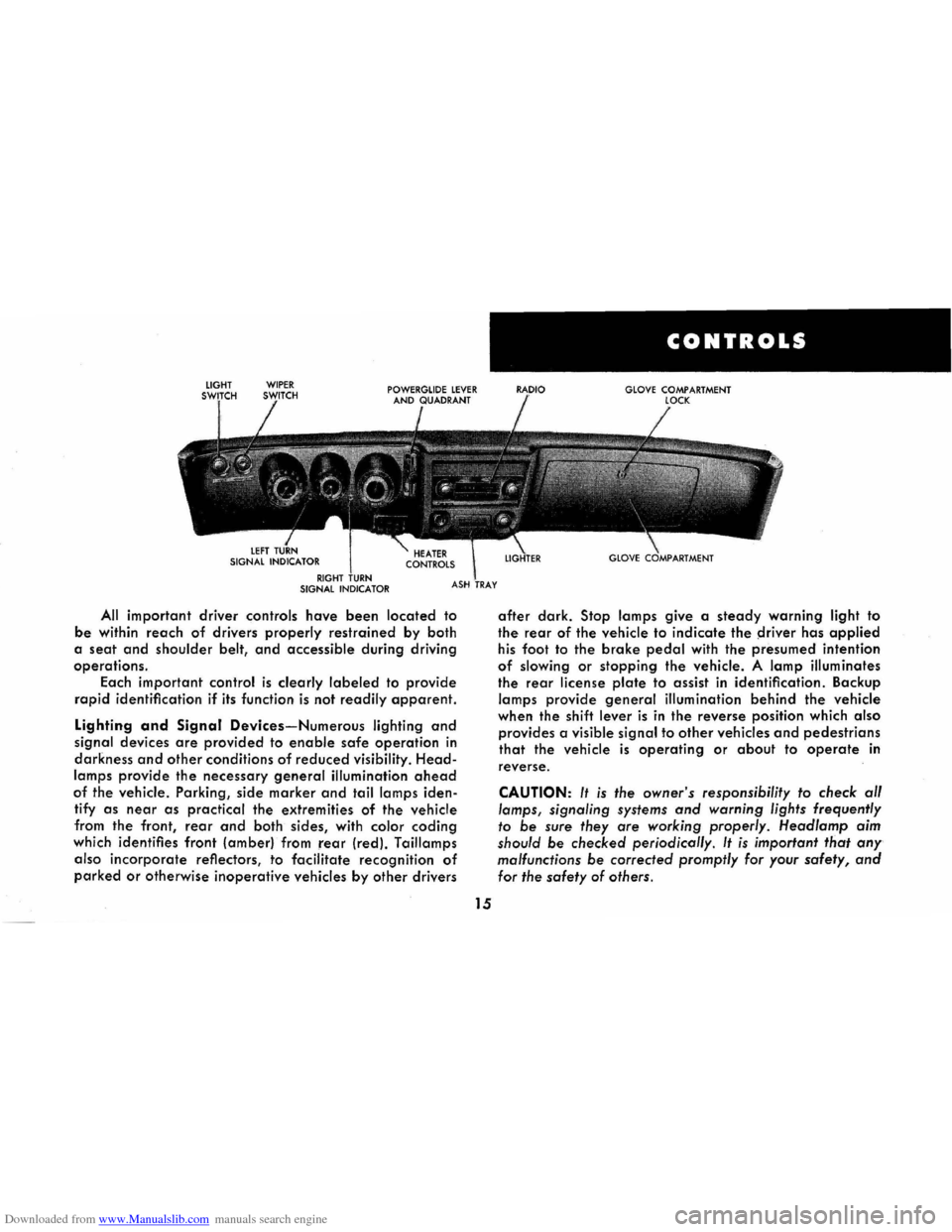
Downloaded from www.Manualslib.com manuals search engine All important driver controls have been located to
be within reach of drivers properly restrained by both
a
seat and shoulder belt, and accessible during driving
operations.
Each important
control is clearly labeled to provide
rapid identification if its function is not readily apparent.
Lighting and Signal Devices-Numerous lighting and
signal devices are provided to enable safe operation in
darkness and other conditions of reduced visibility. Head
lamps provide the necessary general illumination ahead
of the vehicle. Parking, side marker and tail lamps iden
tify
as near as practical the extremities of the vehicle
from the front,
rear and both sides, with color coding
which identifies front (amber) from rear (red). Taillamps
also
incorporate reflectors, to facilitate recognition of
parked or otherwise inoperative vehicles by other drivers
15
CONTROLS
GLOVE COMPARTMENT
after dark. Stop lamps give a steady warning light to
the rear of the vehicle to indicate the ~river has applied
his foot to the brake pedal with the presumed intention
of slowing or stopping the vehicle. A lamp illuminates
the rear license plate to assist in identification. Backup
lamps provide general illumination behind the vehicle
when the shift
lever is in the reverse position which also
provides a visible signal to other vehicles and pedestrians
that the vehicle is operating or about to operate in
reverse.
CAUTION: It is the owner's responsibility to check al/
lamps, signaling systems and warning lights frequently
to be sure they are working properly. Head/amp aim
should
be checked periodicol/y. It is important that any
malfunctions be corrected promptly for your safety, and
for the safety of others.
Page 35 of 56
Downloaded from www.Manualslib.com manuals search engine MAINTENANCE AND LUBRICATION
FUEL REQUIREMENTS
Your Corvair is designed to operate efficiently on
"Regular" or "Premium" grade fuels, commonly sold in
the United States and Canada, depending on the engine
installed in your car. The table below indicates the fuel
grade requirements for various Corvair engines.
ENGINE
95 H.P. TURBO-AIR
110 H.P. TURBO-AIR
140 H.P. TURBO-AIR
FUEL GRADE
Regular
Premium
Premium
Use
of a fuel which is too low in anti-knock quality
will result in "spark knock." Since the anti-knock quality
of all regular grade or of all premium grade gasolines
is not the same and factors such as altitude, terrain and
air temperature affect operating efficiency, knocking may
result even though you are using the grade of fuel rec
ommended for your engine. If persistent knocking is en
countered, it may be necessary to change to a higher
grade of gasoline and, If knocking continues, consult
your authorized Chevrolet Dealer.
In any case, continuous or excessive knocking may
result in engine damage and constitutes misuse of the en
gine for which the Chevrolet Motor Division is not re
sponsible under terms of the Manufacturer's New Vehicle
Warranty.
32
Operation in a Foreign Country
If you plan to operate your Corvair outside the con
tinental limits of the United States or Canada, there is
a possibility that the best fuels available are so low in
anti-knock quality that excessive knocking and serious
engine damage may result from their use. To minimize
this possibility,
write to Chevrolet Motor Division, Gen
eral Motors Corporation, Owner Relations Department,
Detroit,
Michigan 48202, giving: (1) The compression
ratio of your engine (see page 44 or obtain from your
dealer); (2) The vehicle identification number (see page
44); (3) The country or countries in which you plan to
travel.
You
will be furnished details of adjustments or
modifications which should be made to your engine by
your Chevrolet Dealer prior to your departure.
Failure to make the necessary changes in your car and
subsequent operation under conditions of continuous or
excessive knocking is considered misuse of the engine for
which the Chevrolet Motor Division is not responsible un
der terms of the Manufacturer's New Vehicle Warranty.
After arriving in a foreign country, contact the near
est authorized General Motors Dealer for brand names
of the best fuels available and advice as to where they
may be purchased.
Page 43 of 56
Downloaded from www.Manualslib.com manuals search engine TRANSMISSION CONTROL LlNKAGE-
3 AND 4-SPEED
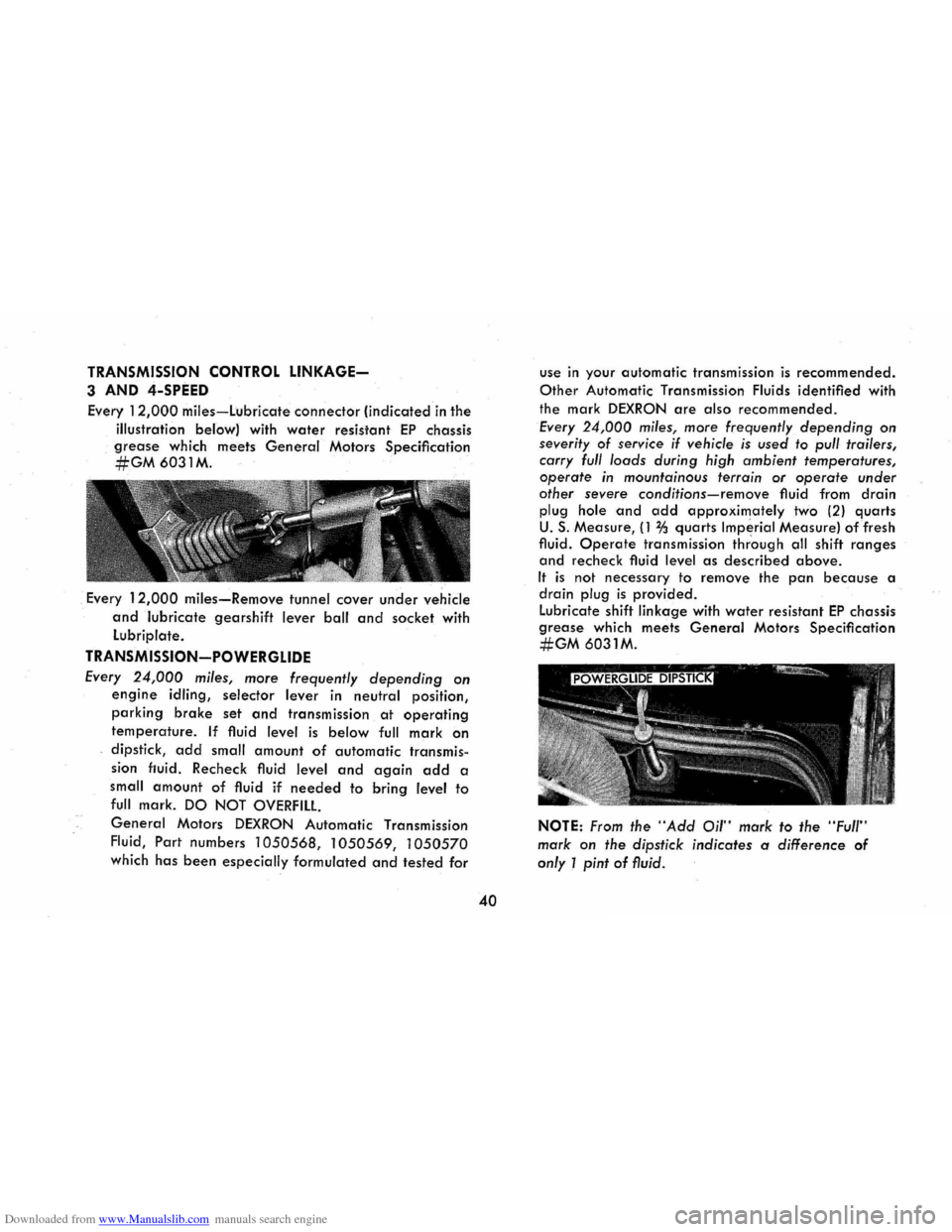
Every 12,000 miles-Lubricate connector (indicated in the
illustration below) with
water resistant EP chassis
grease which meets General Motors Specification
#GM6031M.
. Every 12,000 miles-Remove tunnel cover under vehicle
and lubricate gearshift lever ball and socket with
Lubriplate.
TRANSMISSION-POWERGLIDE
Every 24,000 miles, more frequently depending on
engine idling, selector lever in neutral position,
parking brake set and transmission at operating
temperature. If fluid level is below full mark on
dipstick, add small amount of automatic transmis
sion fluid. Recheck fluid level and again add a
small
amount of fluid if needed to bring level to
full mark. DO NOT OVERFILL
General Motors DEXRON Automatic Transmission
Fluid,
Part numbers 1050568, 1050569, 1050570
which has been especially formulated and tested for
40
use in your automatic transmission is recommended.
Other Automatic Transmission Fluids identified with
the mark
DEXRON are also recommended.
Every 24,000 miles, more frequently depending on
severity of service if vehicle is used to pull trailers,
carry full loads during high ambient temperatures,
operate in mountainous terrain or operate under
other severe
conditions-remove fluid from drain
plug hole and add approximately two (2) quarts
U. S. Measure, (1 % quarts Imperial Measure) of fresh
fluid.
Operate transmission thr'ough all shift ranges
and recheck fluid level as described above.
It is not necessary to remove the pan because a
drain plug is provided .
Lubricate shift linkage with
water resistant EP chassis
grease which meets General Motors Specification
#GM 6031M.
NOTE: From the "Add Oil" mark to the "Full"
mark on the dipstick indicates a difference of
only 1 pint of fluid.
Page 50 of 56
Downloaded from www.Manualslib.com manuals search engine MINOR TROUBLE SHOOTING PROCEDURES
The chart on the previous page, and the information on the pages
which follow, contains information designed to aid the average
driver to discover, and possibly correct, conditions resulting in minor
mechanical
difficulties in his car. The chart, designed to point out
possible solutions to
several of the most common automotive mal
functions
and point out a logical checking sequence, will lead step
by step to the most likely causes and corrective procedures. If, after
making the checks and adjustments suggested, the source of the
trouble
has not been found and corrected, it is strongly recom
mended
that an Authorized Chevrolet Dealer inspect the vehicle and
make whatever repairs or adjustments are necessary.
FUEL SYSTEM AND ENGINE
If the ignition switch will cause the engine to "turn over" or
"crank" but the car will not start, check Steps A through D below.
NOTE:
If continual "flooding" of the carburetor is evidenced by a
carburetor wet with fuel or black exhaust smoke, perform the
operation
suggested in paragraph 0 only .
(A) The first and most obvious,
and one of the most frequently
overlooked, items to check when
you
have- difficulty in starting your
car is the amount of fuel in the
tank.
Make it a habit to check the
FUEL GAUGE regularly and most
especially
at a time when the en
gine will "turn over" but will not
start.
(8)
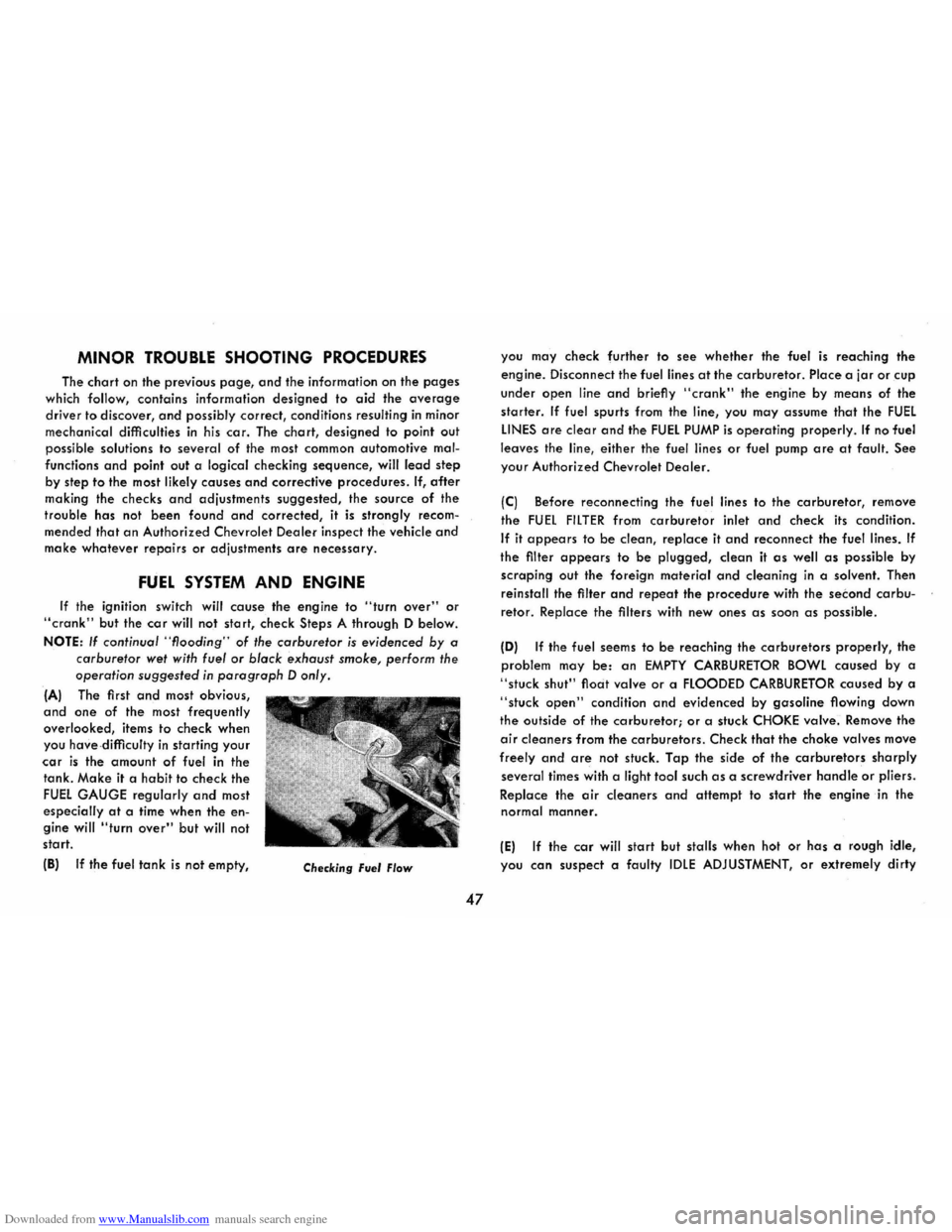
If the fuel tank is not empty, Checking Fuel Flow
47
you may check further to see whether the fuel is reaching the
engine. Disconnect the fuel lines
at the carburetor. Place a jar or cup
under open line and briefly "crank" the engine by means of the
starter. If fuel spurts from the line, you may assume that the FUEL
LINES are clear and the FUEL PUMP is operating properly. If no fuel
leaves the line, either the fuel lines
or fuel pump are at fault. See
your Authorized Chevrolet Dealer.
(C) Before reconnecting the fuel lines to the carburetor, remove
the
FUel FilTER from carburetor inlet and check its condition.
If it appears to be clean, replace it and reconnect the fuel lines. If
the filter appears to be plugged, clean it as well as possible by
scraping out the foreign material and cleaning in a solvent. Then
reinstall the filter
and repeat the procedure with the second carbu
retor. Replace the filters with new ones as soon as possible .
(0) If the fuel seems to be reaching the carburetors properly, the
problem may
be: an EMPTY CARBURETOR BOWL caused by a
"stuck shut" float valve or a flOODED CARBURETOR caused by a
"stuck open" condition and evidenced by gasoline flowing down
the outside
of the carburetor; or a stuck CHOKE valve. Remove the
air cleaners from the carburetors. Check that the choke valves move
freely and are not stuck. Tap the side of the carburetors sharply
several times with a light tool such as a screwdriver handle or pliers.
Replace the
air deaners and attempt to start the engine in the
normal manner.
(E) If the car will start but stalls when hot or has a rough idle,
you
can suspect a faulty IDLE ADJUSTMENT, or extremely dirty
Page 51 of 56
Downloaded from www.Manualslib.com manuals search engine and blocked AIR CLEANER ELEMENTS. Replace the air cleaner ele
ments
if necessary. Idle adjustment should be performed by your
Chevrolet Dealer.
If the above Fuel System checks and the checks suggested under
the Electrical System following do not correct the malfunction, it is
recommended that you turn to your Authorized Chevrolet Dealer
for further checks, adjustments
or repairs.
ELECTRICAL SYSTEM
If, when the ignition key is turned to START, the engine will not
turn over, you have
good reason to suspect electrical trouble.
(F) When there is no response at all to attempts to start the car,
check the obvious-your AUTOMATIC TRANSMISSION SELECTOR
LEVER must be in neutral position before the engine can be started.
Turning the IGNITION SWITCH rapidly back and forth several
times
will sometimes correct a poor internal switch contact.
(G) The BATTERY may be discharged. If so, lights will be dim and
the horn will have a poor tone if it will blow at all.
Usually
a garage recharge will be necessary to return the battery
to operotion. Occasionally, however, a long drive will recharge
the battery.
NOTE:
If the battery is determined to be dead, and for no apparent
reason, have
your Authorized Chevrolet Dealer check the
battery, the GENERATOR and the
VOLTAGE REGULATOR.
GENERATOR trouble should already have been indicated
by
the indicator on the instrument panel. Never remove generator
"BAT" lead without first disconnecting battery ground cable.
48
POOR BATTERY CONNECTIONS may be suspected if the car has operated properly a short time before and now not even the horn
will operate. Check both ends of both battery cables. If the con
nections are corroded, a car may sometimes be restored to operation by removing all cable ends, scraping all contacting surfaces
clean with a pen knife, and reassembling. If the cables are broken,
they must be replaced. The power supply should now be restored
unless the battery is dead.
(H) If, however, the lights and horn work properly but the starter will still not turn over, check the STARTER connections. A "click" from the starter solenoid indicates that the wiring to the starter is properly installed. If the wiring seems to be clean and tightly installed, the trouble is probably in the starter itself and should be referred to your Authorized Chevrolet Dealer.
When the engine will "turn over" but will not start, the following
items may be checked along with Fuel System Checks listed previously.
(I) With a clean dry cloth wipe the ceramic portions of the spark plugs dry. In particularly damp or rainy weather dampness may be the cause of not sta rting, especially when the engine is cold.
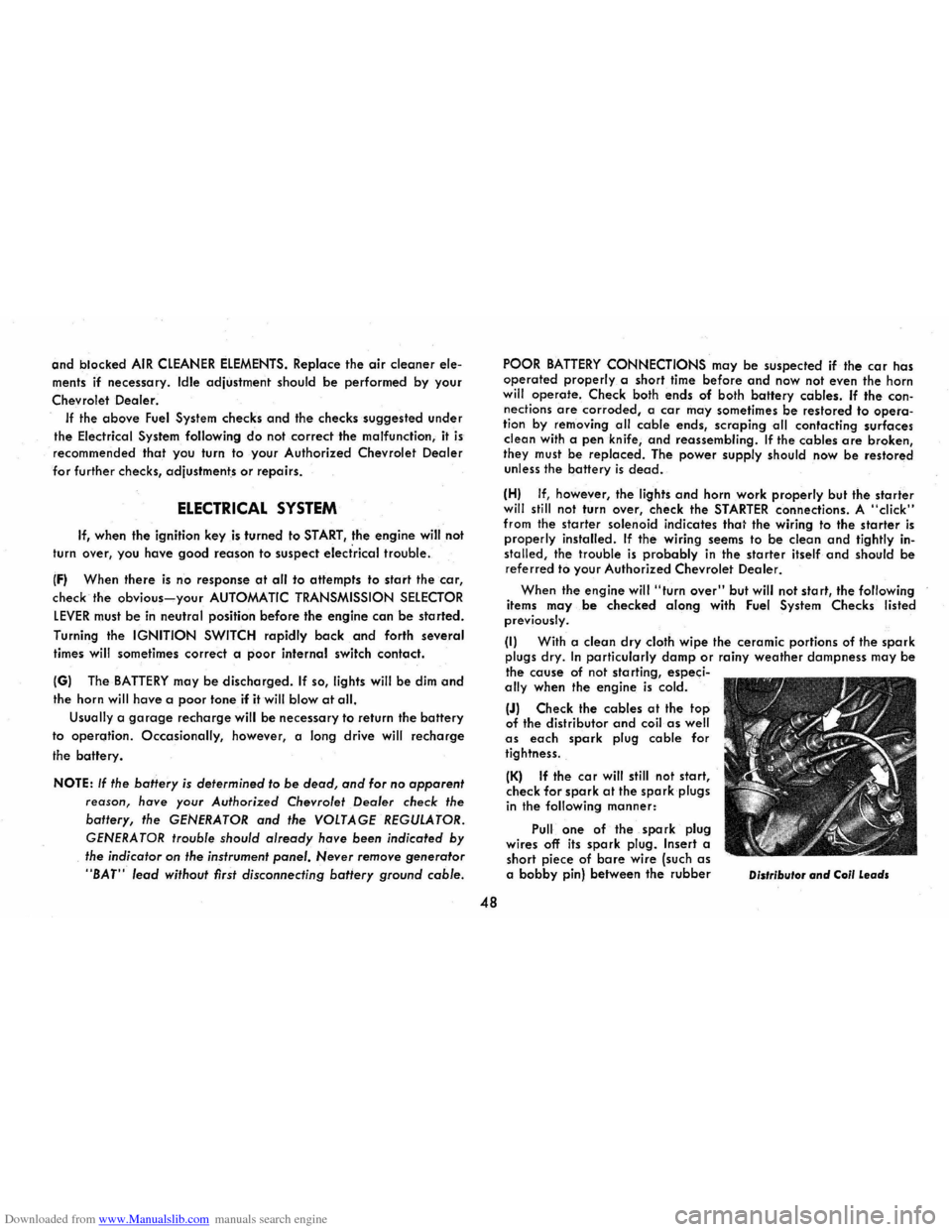
(J) Check the cables at the top of the distributor and coil as well as each spark plug cable for
tightness.
(K) If the car will still not start, check for spark at the spark plugs in the following manner:
Pull one of the spark plug
wires off its spark plug. Insert a
short piece of bare wire (such as a bobby pin) between the rubber Distributor and Coil Leads