1985 FORD GRANADA torque
[x] Cancel search: torquePage 28 of 255
The cylinder head is of crossflow design
with the inlet manifold mounted on the left-
hand side and the exhaust manifold mounted
on the right-hand side.
Lubrication is by means of a bi-rotor pump
which draws oil through a strainer located
inside the sump, and forces it through a full-
flow filter into the engine oil galleries where it
is distributed to the crankshaft, camshaft and
auxiliary shaft. The big-end bearings are
supplied with oil via internal drillings in the
crankshaft.The undersides of the pistons are
supplied with oil from drillings in the big-ends.
The distributor shaft is intermittently supplied
with oil from the drilled auxiliary shaft. The
camshaft and cam followers are supplied with
oil via a drilled spray tube from the centre
camshaft bearing.
A semi-closed crankcase ventilation system
is employed whereby piston blow-by gases
are drawn into the inlet manifold via an oil
separator and on carburettor models a control
valve.
The following operations can be carried out
without removing the engine, although the
work may be easier and quicker with the
engine removed:
a)Removal and refitting of the cylinder head
b)Removal and refitting of the camshaft
(after removing the cylinder head)
c)Removal and refitting of the timing belt
and sprockets
d)Removal and refitting of the sump and oil
pump
e)Removal and refitting of the pistons,
connecting rods and big-end bearings
f)Renewal of the engine mountings
g)Renewal of the crankshaft oil seals
h)Removal and refitting of the auxiliary shaft
j)Removal and refitting of the flywheel
The engine must be removed from the
vehicle for the following operations:
a)Renewal of the crankshaft main bearings
b)Removal and refitting of the crankshaft
The engine may be lifted out either on its
own or together with the gearbox. Unless work
is also necessary on the gearbox it is
recommended that the engine is removed on
its own. Where automatic transmission is
fitted, the engine should be removed on its
own owing to the additional weight. If the
engine and gearbox are removed together,
they will have to be tilted at a very steep angle;
make sure that the range of the lifting tackle is
adequate.1Disconnect the battery negative lead.
2Remove the bonnet.
3On carburettor models, remove the air
cleaner. On fuel-injection models, remove the
air cleaner cover, vane airflow meter and air
inlet trunking.
4If a splash guard is fitted, remove it.
5Release the securing clips and bolts and
remove the upper half of the fan shroud. On
carburettor models remove the lower half of
the shroud too.
6Drain the cooling system.
7Disconnect the radiator top and bottom
hoses from the thermostat housing and water
pump. Disconnect the top hose spur from the
expansion tank and unclip it.
8Disconnect the heater hoses from the water
pump and from the inlet manifold or automatic
choke housing. Unclip the hoses.
9On models with power steering, remove the
steering pump.
10Disconnect the vacuum pipe(s) from the
inlet manifold, labelling them if there is any
possibility of confusion.
11Disconnect the following wiring, as
applicable:
a)Alternator
b)Temperature gauge sender
c)Engine management temperature sensor
d)Distributor
e)Oil pressure switch
f)Automatic choke and thermo-switch
g)Carburettor stepper motor
h)Fuel-injection system sub-harness
j)Inlet manifold heater
12Disconnect the HT lead from the coil.
13If an oil level sensor is fitted, remove it
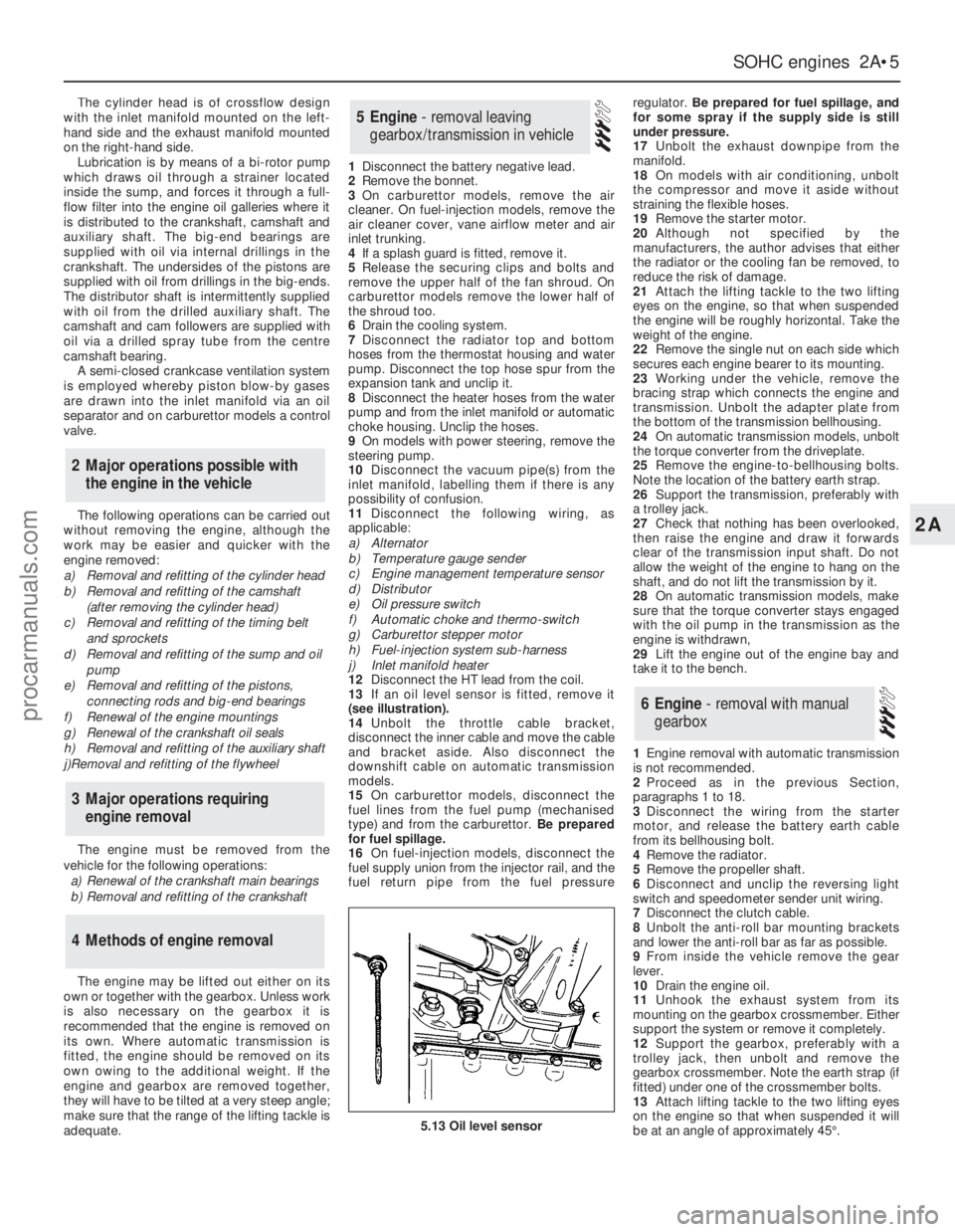
(see illustration).
14Unbolt the throttle cable bracket,
disconnect the inner cable and move the cable
and bracket aside. Also disconnect the
downshift cable on automatic transmission
models.
15On carburettor models, disconnect the
fuel lines from the fuel pump (mechanised
type) and from the carburettor. Be prepared
for fuel spillage.
16On fuel-injection models, disconnect the
fuel supply union from the injector rail, and the
fuel return pipe from the fuel pressureregulator. Be prepared for fuel spillage, and
for some spray if the supply side is still
under pressure.
17Unbolt the exhaust downpipe from the
manifold.
18On models with air conditioning, unbolt
the compressor and move it aside without
straining the flexible hoses.
19Remove the starter motor.
20Although not specified by the
manufacturers, the author advises that either
the radiator or the cooling fan be removed, to
reduce the risk of damage.
21Attach the lifting tackle to the two lifting
eyes on the engine, so that when suspended
the engine will be roughly horizontal. Take the
weight of the engine.
22Remove the single nut on each side which
secures each engine bearer to its mounting.
23Working under the vehicle, remove the
bracing strap which connects the engine and
transmission. Unbolt the adapter plate from
the bottom of the transmission bellhousing.
24On automatic transmission models, unbolt
the torque converter from the driveplate.
25Remove the engine-to-bellhousing bolts.
Note the location of the battery earth strap.
26Support the transmission, preferably with
a trolley jack.
27Check that nothing has been overlooked,
then raise the engine and draw it forwards
clear of the transmission input shaft. Do not
allow the weight of the engine to hang on the
shaft, and do not lift the transmission by it.
28On automatic transmission models, make
sure that the torque converter stays engaged
with the oil pump in the transmission as the
engine is withdrawn,
29Lift the engine out of the engine bay and
take it to the bench.
1Engine removal with automatic transmission
is not recommended.
2Proceed as in the previous Section,
paragraphs 1 to 18.
3Disconnect the wiring from the starter
motor, and release the battery earth cable
from its bellhousing bolt.
4Remove the radiator.
5Remove the propeller shaft.
6Disconnect and unclip the reversing light
switch and speedometer sender unit wiring.
7Disconnect the clutch cable.
8Unbolt the anti-roll bar mounting brackets
and lower the anti-roll bar as far as possible.
9From inside the vehicle remove the gear
lever.
10Drain the engine oil.
11Unhook the exhaust system from its
mounting on the gearbox crossmember. Either
support the system or remove it completely.
12Support the gearbox, preferably with a
trolley jack, then unbolt and remove the
gearbox crossmember. Note the earth strap (if
fitted) under one of the crossmember bolts.
13Attach lifting tackle to the two lifting eyes
on the engine so that when suspended it will
be at an angle of approximately 45°.
6Engine - removal with manual
gearbox
5Engine - removal leaving
gearbox/transmission in vehicle
4Methods of engine removal
3Major operations requiring
engine removal
2Major operations possible with
the engine in the vehicle
SOHCengines 2A•5
2A
5.13 Oil level sensor
procarmanuals.com
Page 36 of 255
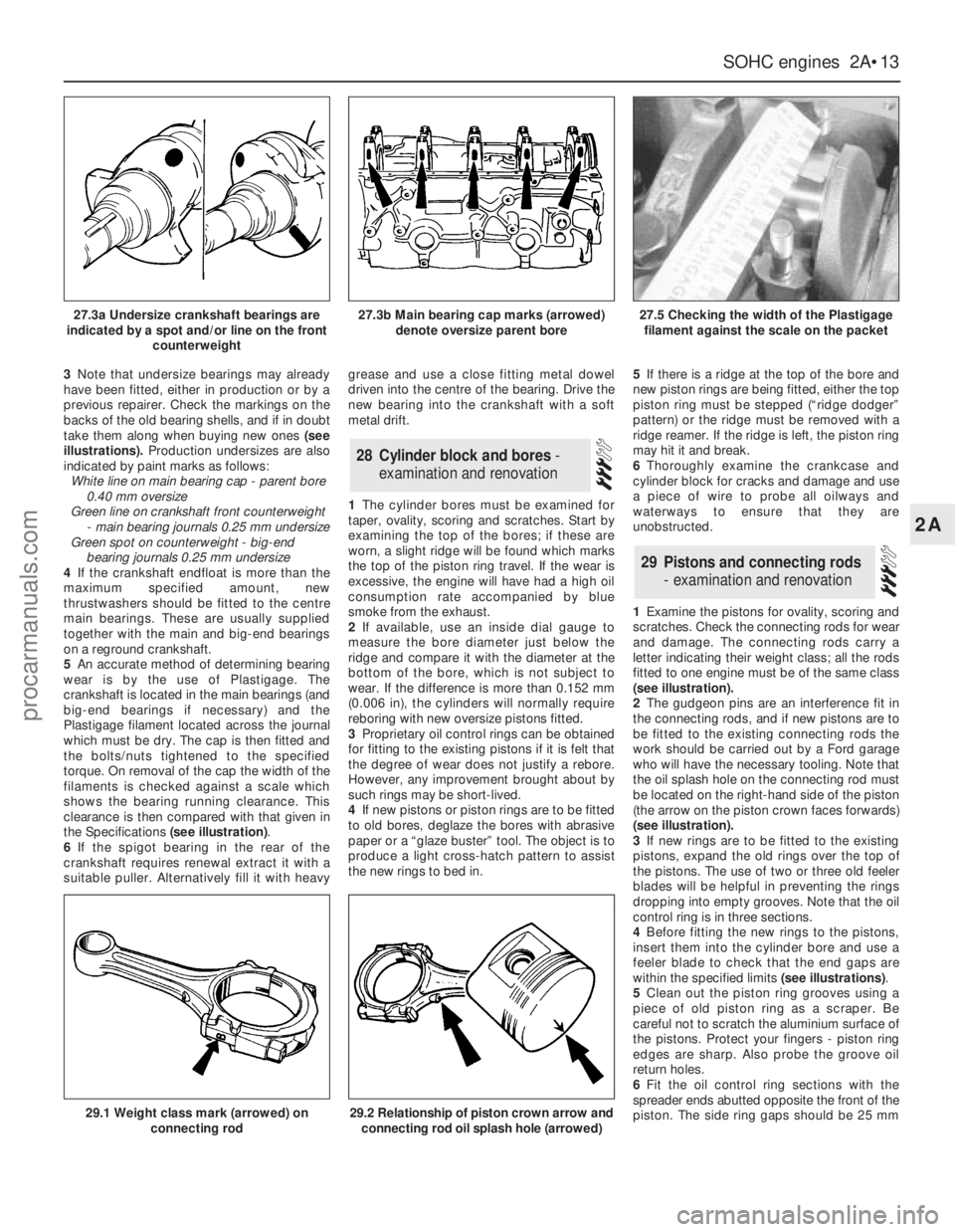
3Note that undersize bearings may already
have been fitted, either in production or by a
previous repairer. Check the markings on the
backs of the old bearing shells, and if in doubt
take them along when buying new ones(see
illustrations).Production undersizes are also
indicated by paint marks as follows:
White line on main bearing cap - parent bore
0.40 mm oversize
Green line on crankshaft front counterweight
- main bearing journals 0.25 mm undersize
Green spot on counterweight - big-end
bearing journals 0.25 mm undersize
4If the crankshaft endfloat is more than the
maximum specified amount, new
thrustwashers should be fitted to the centre
main bearings. These are usually supplied
together with the main and big-end bearings
on a reground crankshaft.
5An accurate method of determining bearing
wear is by the use of Plastigage. The
crankshaft is located in the main bearings (and
big-end bearings if necessary) and the
Plastigage filament located across the journal
which must be dry. The cap is then fitted and
the bolts/nuts tightened to the specified
torque. On removal of the cap the width of the
filaments is checked against a scale which
shows the bearing running clearance. This
clearance is then compared with that given in
the Specifications (see illustration).
6If the spigot bearing in the rear of the
crankshaft requires renewal extract it with a
suitable puller. Alternatively fill it with heavygrease and use a close fitting metal dowel
driven into the centre of the bearing. Drive the
new bearing into the crankshaft with a soft
metal drift.
1The cylinder bores must be examined for
taper, ovality, scoring and scratches. Start by
examining the top of the bores; if these are
worn, a slight ridge will be found which marks
the top of the piston ring travel. If the wear is
excessive, the engine will have had a high oil
consumption rate accompanied by blue
smoke from the exhaust.
2If available, use an inside dial gauge to
measure the bore diameter just below the
ridge and compare it with the diameter at the
bottom of the bore, which is not subject to
wear. If the difference is more than 0.152 mm
(0.006 in), the cylinders will normally require
reboring with new oversize pistons fitted.
3Proprietary oil control rings can be obtained
for fitting to the existing pistons if it is felt that
the degree of wear does not justify a rebore.
However, any improvement brought about by
such rings may be short-lived.
4If new pistons or piston rings are to be fitted
to old bores, deglaze the bores with abrasive
paper or a “glaze buster” tool. The object is to
produce a light cross-hatch pattern to assist
the new rings to bed in. 5If there is a ridge at the top of the bore and
new piston rings are being fitted, either the top
piston ring must be stepped (“ridge dodger”
pattern) or the ridge must be removed with a
ridge reamer. If the ridge is left, the piston ring
may hit it and break.
6Thoroughly examine the crankcase and
cylinder block for cracks and damage and use
a piece of wire to probe all oilways and
waterways to ensure that they are
unobstructed.
1Examine the pistons for ovality, scoring and
scratches. Check the connecting rods for wear
and damage. The connecting rods carry a
letter indicating their weight class; all the rods
fitted to one engine must be of the same class
(see illustration).
2The gudgeon pins are an interference fit in
the connecting rods, and if new pistons are to
be fitted to the existing connecting rods the
work should be carried out by a Ford garage
who will have the necessary tooling. Note that
the oil splash hole on the connecting rod must
be located on the right-hand side of the piston
(the arrow on the piston crown faces forwards)
(see illustration).
3If new rings are to be fitted to the existing
pistons, expand the old rings over the top of
the pistons. The use of two or three old feeler
blades will be helpful in preventing the rings
dropping into empty grooves. Note that the oil
control ring is in three sections.
4Before fitting the new rings to the pistons,
insert them into the cylinder bore and use a
feeler blade to check that the end gaps are
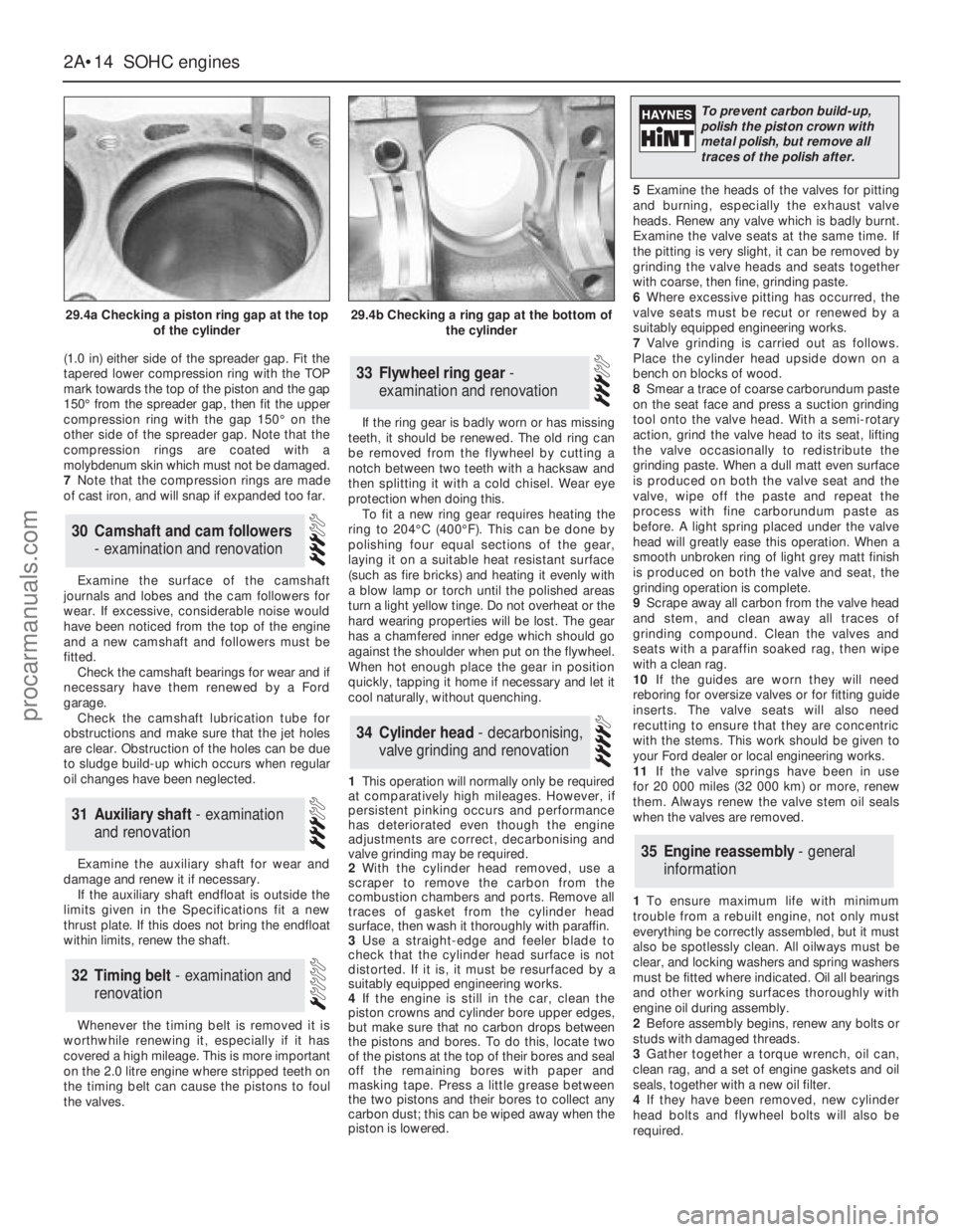
within the specified limits (see illustrations).
5Clean out the piston ring grooves using a
piece of old piston ring as a scraper. Be
careful not to scratch the aluminium surface of
the pistons. Protect your fingers - piston ring
edges are sharp. Also probe the groove oil
return holes.
6Fit the oil control ring sections with the
spreader ends abutted opposite the front of the
piston. The side ring gaps should be 25 mm
29Pistons and connecting rods
- examination and renovation
28Cylinder block and bores -
examination and renovation
SOHCengines 2A•13
2A
27.3a Undersize crankshaft bearings are
indicated by a spot and/or line on the front
counterweight27.3b Main bearing cap marks (arrowed)
denote oversize parent bore27.5 Checking the width of the Plastigage
filament against the scale on the packet
29.1 Weight class mark (arrowed) on
connecting rod29.2 Relationship of piston crown arrow and
connecting rod oil splash hole (arrowed)
procarmanuals.com
Page 37 of 255
(1.0 in) either side of the spreader gap. Fit the
tapered lower compression ring with the TOP
mark towards the top of the piston and the gap
150°from the spreader gap, then fit the upper
compression ring with the gap 150°on the
other side of the spreader gap. Note that the
compression rings are coated with a
molybdenum skin which must not be damaged.
7Note that the compression rings are made
of cast iron, and will snap if expanded too far.
Examine the surface of the camshaft
journals and lobes and the cam followers for
wear. If excessive, considerable noise would
have been noticed from the top of the engine
and a new camshaft and followers must be
fitted.
Check the camshaft bearings for wear and if
necessary have them renewed by a Ford
garage.
Check the camshaft lubrication tube for
obstructions and make sure that the jet holes
are clear. Obstruction of the holes can be due
to sludge build-up which occurs when regular
oil changes have been neglected.
Examine the auxiliary shaft for wear and
damage and renew it if necessary.
If the auxiliary shaft endfloat is outside the
limits given in the Specifications fit a new
thrust plate. If this does not bring the endfloat
within limits, renew the shaft.
Whenever the timing belt is removed it is
worthwhile renewing it, especially if it has
covered a high mileage. This is more important
on the 2.0 litre engine where stripped teeth on
the timing belt can cause the pistons to foul
the valves.If the ring gear is badly worn or has missing
teeth, it should be renewed. The old ring can
be removed from the flywheel by cutting a
notch between two teeth with a hacksaw and
then splitting it with a cold chisel. Wear eye
protection when doing this.
To fit a new ring gear requires heating the
ring to 204°C (400°F). This can be done by
polishing four equal sections of the gear,
laying it on a suitable heat resistant surface
(such as fire bricks) and heating it evenly with
a blow lamp or torch until the polished areas
turn a light yellow tinge. Do not overheat or the
hard wearing properties will be lost. The gear
has a chamfered inner edge which should go
against the shoulder when put on the flywheel.
When hot enough place the gear in position
quickly, tapping it home if necessary and let it
cool naturally, without quenching.
1This operation will normally only be required
at comparatively high mileages. However, if
persistent pinking occurs and performance
has deteriorated even though the engine
adjustments are correct, decarbonising and
valve grinding may be required.
2With the cylinder head removed, use a
scraper to remove the carbon from the
combustion chambers and ports. Remove all
traces of gasket from the cylinder head
surface, then wash it thoroughly with paraffin.
3Use a straight-edge and feeler blade to
check that the cylinder head surface is not
distorted. If it is, it must be resurfaced by a
suitably equipped engineering works.
4If the engine is still in the car, clean the
piston crowns and cylinder bore upper edges,
but make sure that no carbon drops between
the pistons and bores. To do this, locate two
of the pistons at the top of their bores and seal
off the remaining bores with paper and
masking tape. Press a little grease between
the two pistons and their bores to collect any
carbon dust; this can be wiped away when the
piston is lowered.5Examine the heads of the valves for pitting
and burning, especially the exhaust valve
heads. Renew any valve which is badly burnt.
Examine the valve seats at the same time. If
the pitting is very slight, it can be removed by
grinding the valve heads and seats together
with coarse, then fine, grinding paste.
6Where excessive pitting has occurred, the
valve seats must be recut or renewed by a
suitably equipped engineering works.
7Valve grinding is carried out as follows.
Place the cylinder head upside down on a
bench on blocks of wood.
8Smear a trace of coarse carborundum paste
on the seat face and press a suction grinding
tool onto the valve head. With a semi-rotary
action, grind the valve head to its seat, lifting
the valve occasionally to redistribute the
grinding paste. When a dull matt even surface
is produced on both the valve seat and the
valve, wipe off the paste and repeat the
process with fine carborundum paste as
before. A light spring placed under the valve
head will greatly ease this operation. When a
smooth unbroken ring of light grey matt finish
is produced on both the valve and seat, the
grinding operation is complete.
9Scrape away all carbon from the valve head
and stem, and clean away all traces of
grinding compound. Clean the valves and
seats with a paraffin soaked rag, then wipe
with a clean rag.
10If the guides are worn they will need
reboring for oversize valves or for fitting guide
inserts. The valve seats will also need
recutting to ensure that they are concentric
with the stems. This work should be given to
your Ford dealer or local engineering works.
11If the valve springs have been in use
for 20 000 miles (32 000 km) or more, renew
them. Always renew the valve stem oil seals
when the valves are removed.
1To ensure maximum life with minimum
trouble from a rebuilt engine, not only must
everything be correctly assembled, but it must
also be spotlessly clean. All oilways must be
clear, and locking washers and spring washers
must be fitted where indicated. Oil all bearings
and other working surfaces thoroughly with
engine oil during assembly.
2Before assembly begins, renew any bolts or
studs with damaged threads.
3Gather together a torque wrench, oil can,
clean rag, and a set of engine gaskets and oil
seals, together with a new oil filter.
4If they have been removed, new cylinder
head bolts and flywheel bolts will also be
required.
35Engine reassembly - general
information
34Cylinder head - decarbonising,
valve grinding and renovation
33Flywheel ring gear -
examination and renovation
32Timing belt - examination and
renovation
31Auxiliary shaft - examination
and renovation
30Camshaft and cam followers
- examination and renovation
2A•14SOHCengines
29.4a Checking a piston ring gap at the top
of the cylinder29.4b Checking a ring gap at the bottom of
the cylinder
To prevent carbon build-up,
polish the piston crown with
metal polish, but remove all
traces of the polish after.
procarmanuals.com
Page 38 of 255
1Wipe the bearing shell locations in the
crankcase with a soft, non-fluffy rag.
2Wipe the crankshaft journals with a soft,
non-fluffy rag.
3Fit the five upper half main bearing shells to
their locations in the crankcase. If the old
shells are being re-used, make sure they are
refitted to their old locations.
4Identify each main bearing cap and place in
order. The number is cast onto the cap and on
intermediate caps an arrow is also marked
which should point towards front of engine.
5Wipe the cap bearing shell location with a
soft non-fluffy rag.
6Fit the bearing half shell onto each main
bearing cap.
7Apply a little grease to each side of the
centre main bearing so as to retain the
thrustwasher.
8Fit the upper halves of the thrustwashers
into their grooves either side of the main
bearing. The slots must face outwards.
9Lubricate the crankshaft journals and the
upper and lower main bearing shells with
engine oil and locate the rear oil seal (with lip
lubricated) on the rear of the crankshaft.
10Carefully lower the crankshaft into the
crankcase.
11Lubricate the crankshaft main bearing
journals again and then fit No 1 bearing cap. Fit
the two securing bolts but do not tighten yet.12Make sure that the mating faces are clean,
then apply sealant (Loctite 518 or equivalent)
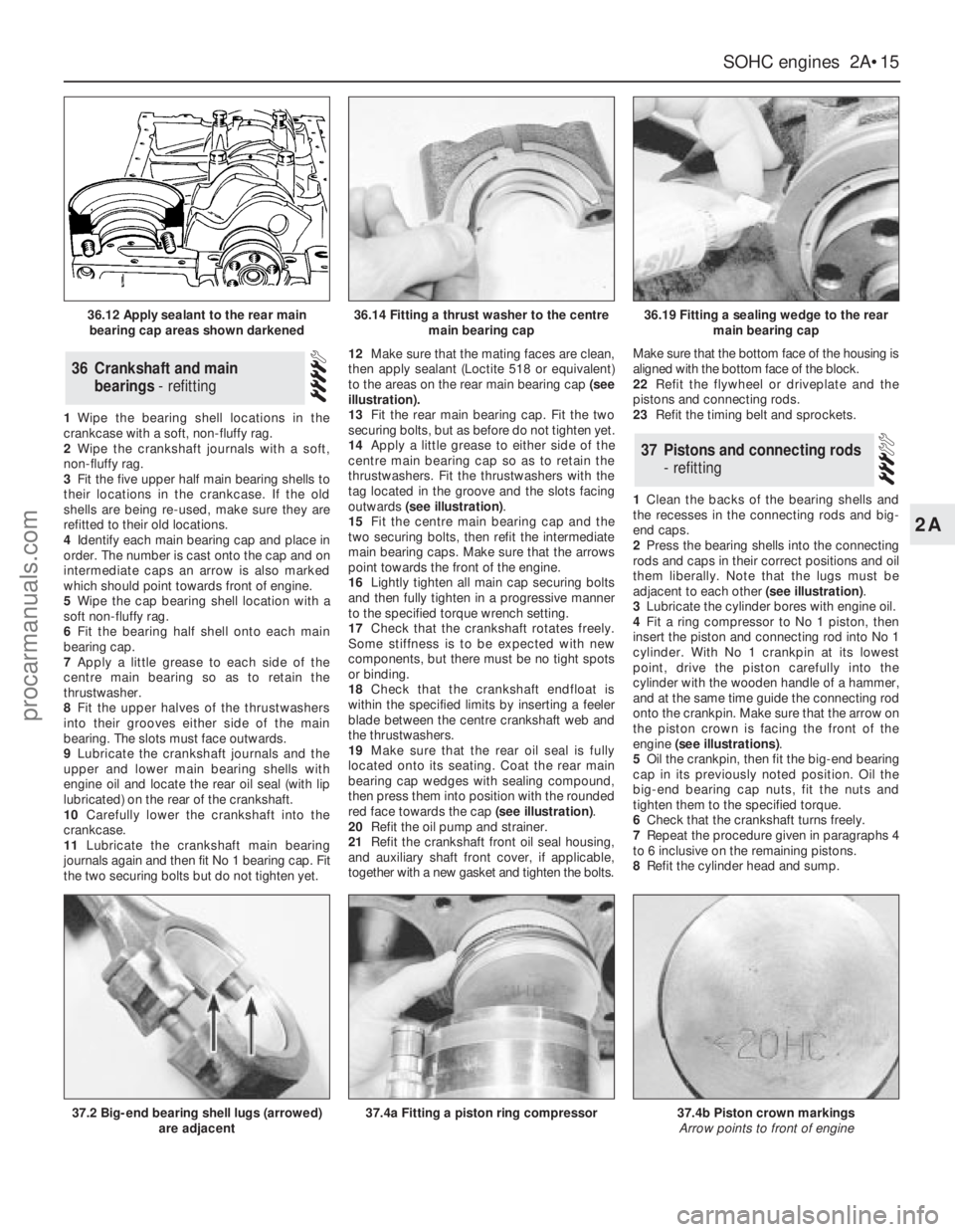
to the areas on the rear main bearing cap (see
illustration).
13Fit the rear main bearing cap. Fit the two
securing bolts, but as before do not tighten yet.
14Apply a little grease to either side of the
centre main bearing cap so as to retain the
thrustwashers. Fit the thrustwashers with the
tag located in the groove and the slots facing
outwards (see illustration).
15Fit the centre main bearing cap and the
two securing bolts, then refit the intermediate
main bearing caps. Make sure that the arrows
point towards the front of the engine.
16Lightly tighten all main cap securing bolts
and then fully tighten in a progressive manner
to the specified torque wrench setting.
17Check that the crankshaft rotates freely.
Some stiffness is to be expected with new
components, but there must be no tight spots
or binding.
18Check that the crankshaft endfloat is
within the specified limits by inserting a feeler
blade between the centre crankshaft web and
the thrustwashers.
19Make sure that the rear oil seal is fully
located onto its seating. Coat the rear main
bearing cap wedges with sealing compound,
then press them into position with the rounded
red face towards the cap (see illustration).
20Refit the oil pump and strainer.
21Refit the crankshaft front oil seal housing,
and auxiliary shaft front cover, if applicable,
together with a new gasket and tighten the bolts.Make sure that the bottom face of the housing is
aligned with the bottom face of the block.
22Refit the flywheel or driveplate and the
pistons and connecting rods.
23Refit the timing belt and sprockets.
1Clean the backs of the bearing shells and
the recesses in the connecting rods and big-
end caps.
2Press the bearing shells into the connecting
rods and caps in their correct positions and oil
them liberally. Note that the lugs must be
adjacent to each other (see illustration).
3Lubricate the cylinder bores with engine oil.
4Fit a ring compressor to No 1 piston, then
insert the piston and connecting rod into No 1
cylinder. With No 1 crankpin at its lowest
point, drive the piston carefully into the
cylinder with the wooden handle of a hammer,
and at the same time guide the connecting rod
onto the crankpin. Make sure that the arrow on
the piston crown is facing the front of the
engine (see illustrations).
5Oil the crankpin, then fit the big-end bearing
cap in its previously noted position. Oil the
big-end bearing cap nuts, fit the nuts and
tighten them to the specified torque.
6Check that the crankshaft turns freely.
7Repeat the procedure given in paragraphs 4
to 6 inclusive on the remaining pistons.
8Refit the cylinder head and sump.
37Pistons and connecting rods
- refitting
36Crankshaft and main
bearings - refitting
SOHCengines 2A•15
2A
36.12 Apply sealant to the rear main
bearing cap areas shown darkened36.14 Fitting a thrust washer to the centre
main bearing cap36.19 Fitting a sealing wedge to the rear
main bearing cap
37.2 Big-end bearing shell lugs (arrowed)
are adjacent37.4a Fitting a piston ring compressor37.4b Piston crown markings
Arrow points to front of engine
procarmanuals.com
Page 39 of 255
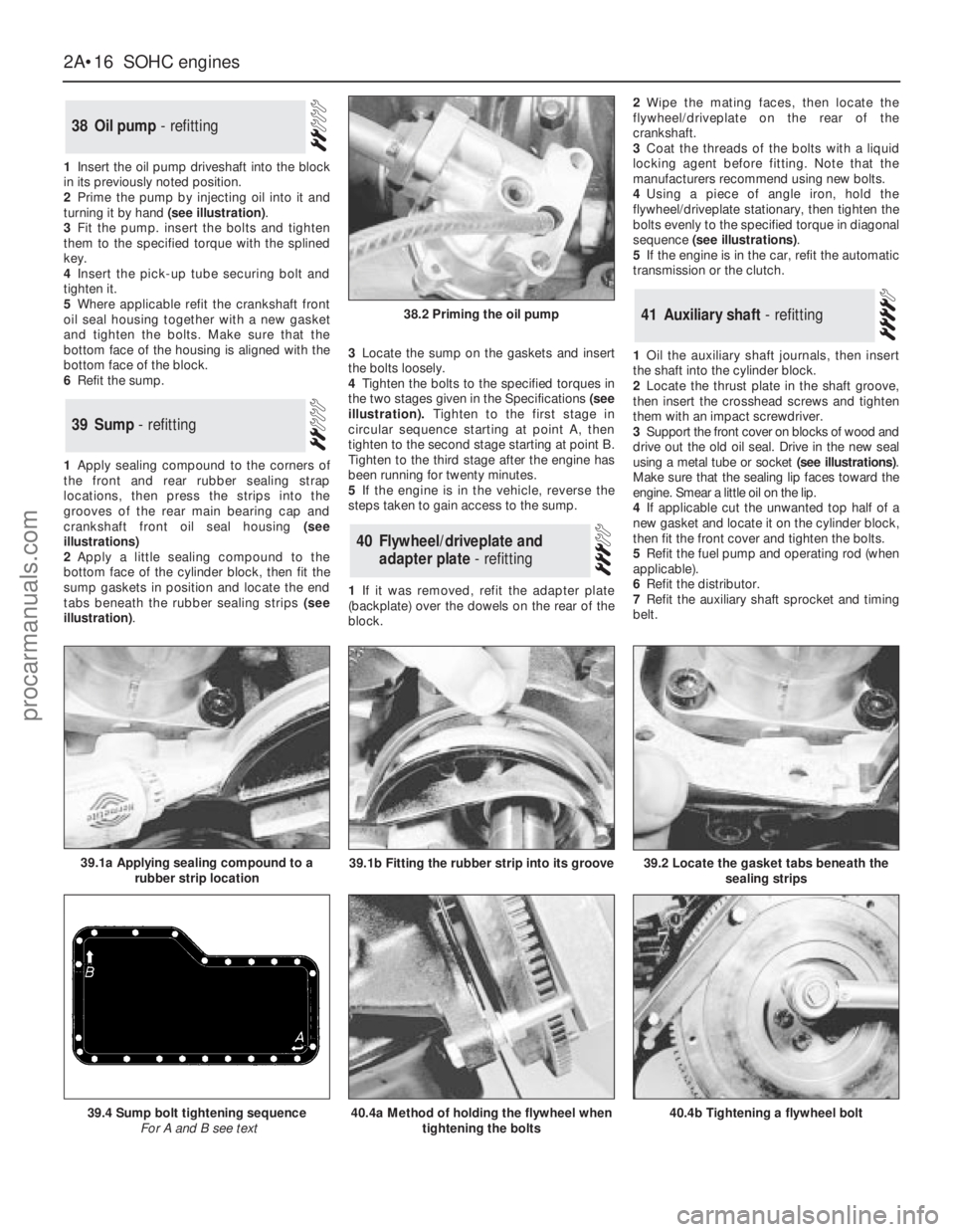
1Insert the oil pump driveshaft into the block
in its previously noted position.
2Prime the pump by injecting oil into it and
turning it by hand (see illustration).
3Fit the pump. insert the bolts and tighten
them to the specified torque with the splined
key.
4Insert the pick-up tube securing bolt and
tighten it.
5Where applicable refit the crankshaft front
oil seal housing together with a new gasket
and tighten the bolts. Make sure that the
bottom face of the housing is aligned with the
bottom face of the block.
6Refit the sump.
1Apply sealing compound to the corners of
the front and rear rubber sealing strap
locations, then press the strips into the
grooves of the rear main bearing cap and
crankshaft front oil seal housing (see
illustrations)
2Apply a little sealing compound to the
bottom face of the cylinder block, then fit the
sump gaskets in position and locate the end
tabs beneath the rubber sealing strips (see
illustration).3Locate the sump on the gaskets and insert
the bolts loosely.
4Tighten the bolts to the specified torques in
the two stages given in the Specifications(see
illustration).Tighten to the first stage in
circular sequence starting at point A, then
tighten to the second stage starting at point B.
Tighten to the third stage after the engine has
been running for twenty minutes.
5If the engine is in the vehicle, reverse the
steps taken to gain access to the sump.
1If it was removed, refit the adapter plate
(backplate) over the dowels on the rear of the
block.2Wipe the mating faces, then locate the
flywheel/driveplate on the rear of the
crankshaft.
3Coat the threads of the bolts with a liquid
locking agent before fitting. Note that the
manufacturers recommend using new bolts.
4Using a piece of angle iron, hold the
flywheel/driveplate stationary, then tighten the
bolts evenly to the specified torque in diagonal
sequence (see illustrations).
5If the engine is in the car, refit the automatic
transmission or the clutch.
1Oil the auxiliary shaft journals, then insert
the shaft into the cylinder block.
2Locate the thrust plate in the shaft groove,
then insert the crosshead screws and tighten
them with an impact screwdriver.
3Support the front cover on blocks of wood and
drive out the old oil seal. Drive in the new seal
using a metal tube or socket (see illustrations).
Make sure that the sealing lip faces toward the
engine. Smear a little oil on the lip.
4If applicable cut the unwanted top half of a
new gasket and locate it on the cylinder block,
then fit the front cover and tighten the bolts.
5Refit the fuel pump and operating rod (when
applicable).
6Refit the distributor.
7Refit the auxiliary shaft sprocket and timing
belt.
41Auxiliary shaft - refitting
40Flywheel/driveplate and
adapter plate - refitting
39Sump - refitting
38Oil pump - refitting
2A•16SOHCengines
38.2 Priming the oil pump
40.4a Method of holding the flywheel when
tightening the bolts39.4 Sump bolt tightening sequence
For A and B see text40.4b Tightening a flywheel bolt
39.2 Locate the gasket tabs beneath the
sealing strips39.1a Applying sealing compound to a
rubber strip location39.1b Fitting the rubber strip into its groove
procarmanuals.com
Page 40 of 255
1Refit the thermostat and housing.
2Refit the timing belt tensioner if it was
removed, but do not tighten the bolts yet.
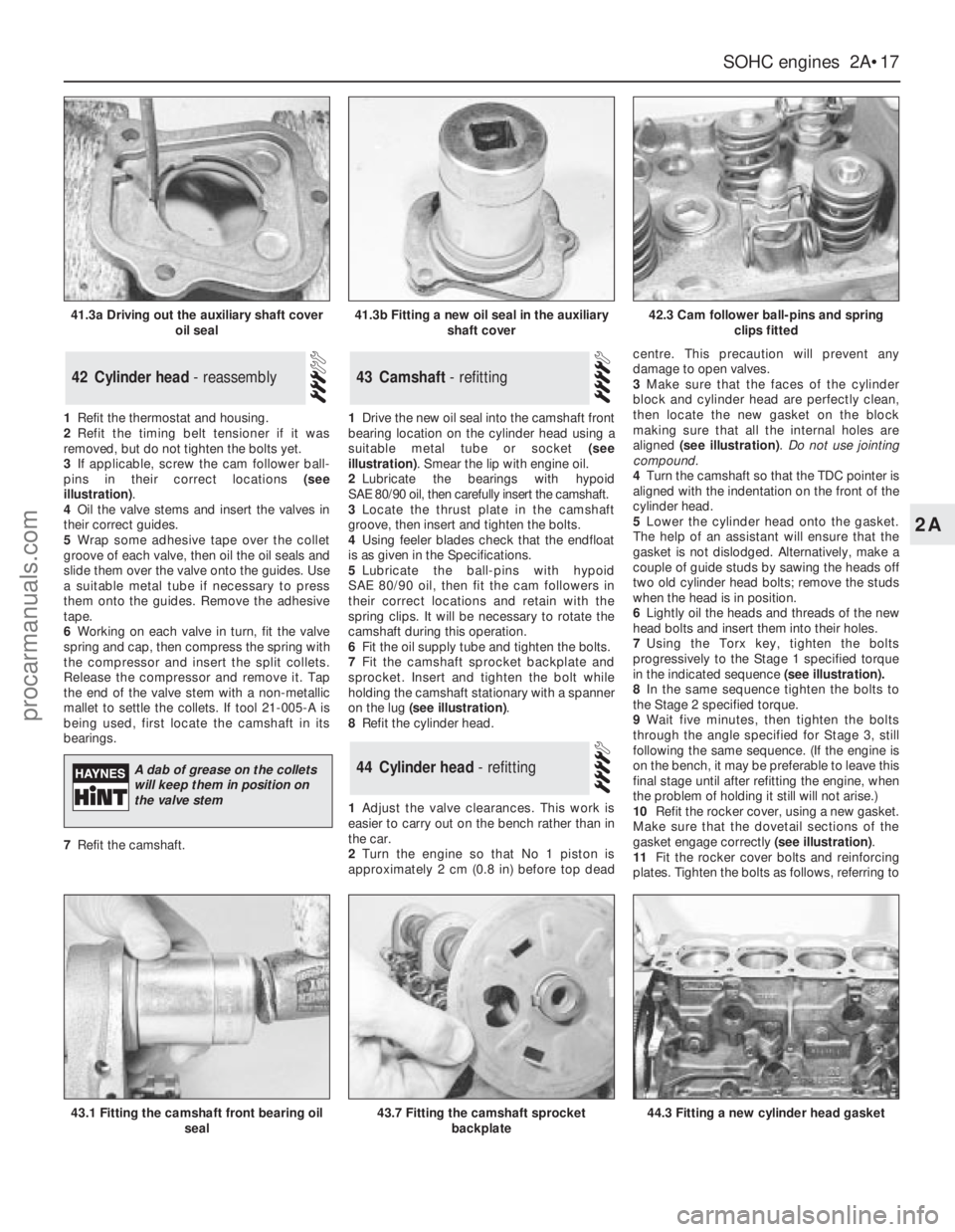
3If applicable, screw the cam follower ball-
pins in their correct locations (see
illustration).
4Oil the valve stems and insert the valves in
their correct guides.
5Wrap some adhesive tape over the collet
groove of each valve, then oil the oil seals and
slide them over the valve onto the guides. Use
a suitable metal tube if necessary to press
them onto the guides. Remove the adhesive
tape.
6Working on each valve in turn, fit the valve
spring and cap, then compress the spring with
the compressor and insert the split collets.
Release the compressor and remove it. Tap
the end of the valve stem with a non-metallic
mallet to settle the collets. If tool 21-005-A is
being used, first locate the camshaft in its
bearings.
7Refit the camshaft.1Drive the new oil seal into the camshaft front
bearing location on the cylinder head using a
suitable metal tube or socket (see
illustration). Smear the lip with engine oil.
2Lubricate the bearings with hypoid
SAE 80/90 oil, then carefully insert the camshaft.
3Locate the thrust plate in the camshaft
groove, then insert and tighten the bolts.
4Using feeler blades check that the endfloat
is as given in the Specifications.
5Lubricate the ball-pins with hypoid
SAE 80/90 oil, then fit the cam followers in
their correct locations and retain with the
spring clips. It will be necessary to rotate the
camshaft during this operation.
6Fit the oil supply tube and tighten the bolts.
7Fit the camshaft sprocket backplate and
sprocket. Insert and tighten the bolt while
holding the camshaft stationary with a spanner
on the lug (see illustration).
8Refit the cylinder head.
1Adjust the valve clearances. This work is
easier to carry out on the bench rather than in
the car.
2Turn the engine so that No 1 piston is
approximately 2 cm (0.8 in) before top deadcentre. This precaution will prevent any
damage to open valves.
3Make sure that the faces of the cylinder
block and cylinder head are perfectly clean,
then locate the new gasket on the block
making sure that all the internal holes are
aligned (see illustration). Do not use jointing
compound.
4Turn the camshaft so that the TDC pointer is
aligned with the indentation on the front of the
cylinder head.
5Lower the cylinder head onto the gasket.
The help of an assistant will ensure that the
gasket is not dislodged. Alternatively, make a
couple of guide studs by sawing the heads off
two old cylinder head bolts; remove the studs
when the head is in position.
6Lightly oil the heads and threads of the new
head bolts and insert them into their holes.
7Using the Torx key, tighten the bolts
progressively to the Stage 1 specified torque
in the indicated sequence(see illustration).
8In the same sequence tighten the bolts to
the Stage 2 specified torque.
9Wait five minutes, then tighten the bolts
through the angle specified for Stage 3, still
following the same sequence. (If the engine is
on the bench, it may be preferable to leave this
final stage until after refitting the engine, when
the problem of holding it still will not arise.)
10Refit the rocker cover, using a new gasket.
Make sure that the dovetail sections of the
gasket engage correctly (see illustration).
11Fit the rocker cover bolts and reinforcing
plates. Tighten the bolts as follows, referring to
44Cylinder head - refitting
43Camshaft - refitting42Cylinder head - reassembly
SOHCengines 2A•17
2A
41.3a Driving out the auxiliary shaft cover
oil seal41.3b Fitting a new oil seal in the auxiliary
shaft cover42.3 Cam follower ball-pins and spring
clips fitted
43.1 Fitting the camshaft front bearing oil
seal43.7 Fitting the camshaft sprocket
backplate44.3 Fitting a new cylinder head gasket
A dab of grease on the collets
will keep them in position on
the valve stem
procarmanuals.com
Page 41 of 255
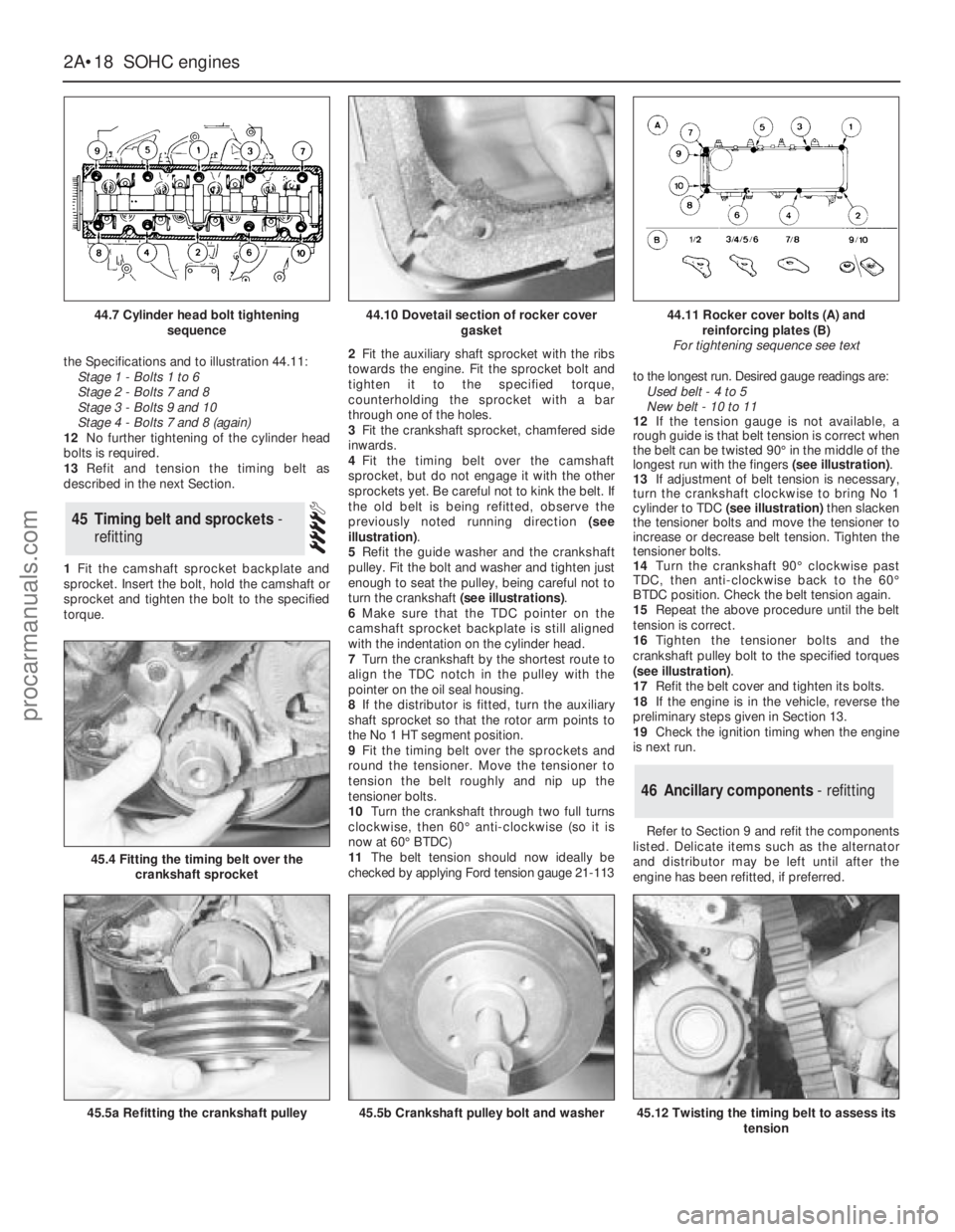
the Specifications and to illustration 44.11:
Stage 1 - Bolts 1 to 6
Stage 2 - Bolts 7 and 8
Stage 3 - Bolts 9 and 10
Stage 4 - Bolts 7 and 8 (again)
12No further tightening of the cylinder head
bolts is required.
13Refit and tension the timing belt as
described in the next Section.
1Fit the camshaft sprocket backplate and
sprocket. Insert the bolt, hold the camshaft or
sprocket and tighten the bolt to the specified
torque. 2Fit the auxiliary shaft sprocket with the ribs
towards the engine. Fit the sprocket bolt and
tighten it to the specified torque,
counterholding the sprocket with a bar
through one of the holes.
3Fit the crankshaft sprocket, chamfered side
inwards.
4Fit the timing belt over the camshaft
sprocket, but do not engage it with the other
sprockets yet. Be careful not to kink the belt. If
the old belt is being refitted, observe the
previously noted running direction (see
illustration).
5Refit the guide washer and the crankshaft
pulley. Fit the bolt and washer and tighten just
enough to seat the pulley, being careful not to
turn the crankshaft (see illustrations).
6Make sure that the TDC pointer on the
camshaft sprocket backplate is still aligned
with the indentation on the cylinder head.
7Turn the crankshaft by the shortest route to
align the TDC notch in the pulley with the
pointer on the oil seal housing.
8If the distributor is fitted, turn the auxiliary
shaft sprocket so that the rotor arm points to
the No 1 HT segment position.
9Fit the timing belt over the sprockets and
round the tensioner. Move the tensioner to
tension the belt roughly and nip up the
tensioner bolts.
10Turn the crankshaft through two full turns
clockwise, then 60°anti-clockwise (so it is
now at 60°BTDC)
11The belt tension should now ideally be
checked by applying Ford tension gauge 21-113to the longest run. Desired gauge readings are:
Used belt - 4 to 5
New belt - 10 to 11
12If the tension gauge is not available, a
rough guide is that belt tension is correct when
the belt can be twisted 90°in the middle of the
longest run with the fingers (see illustration).
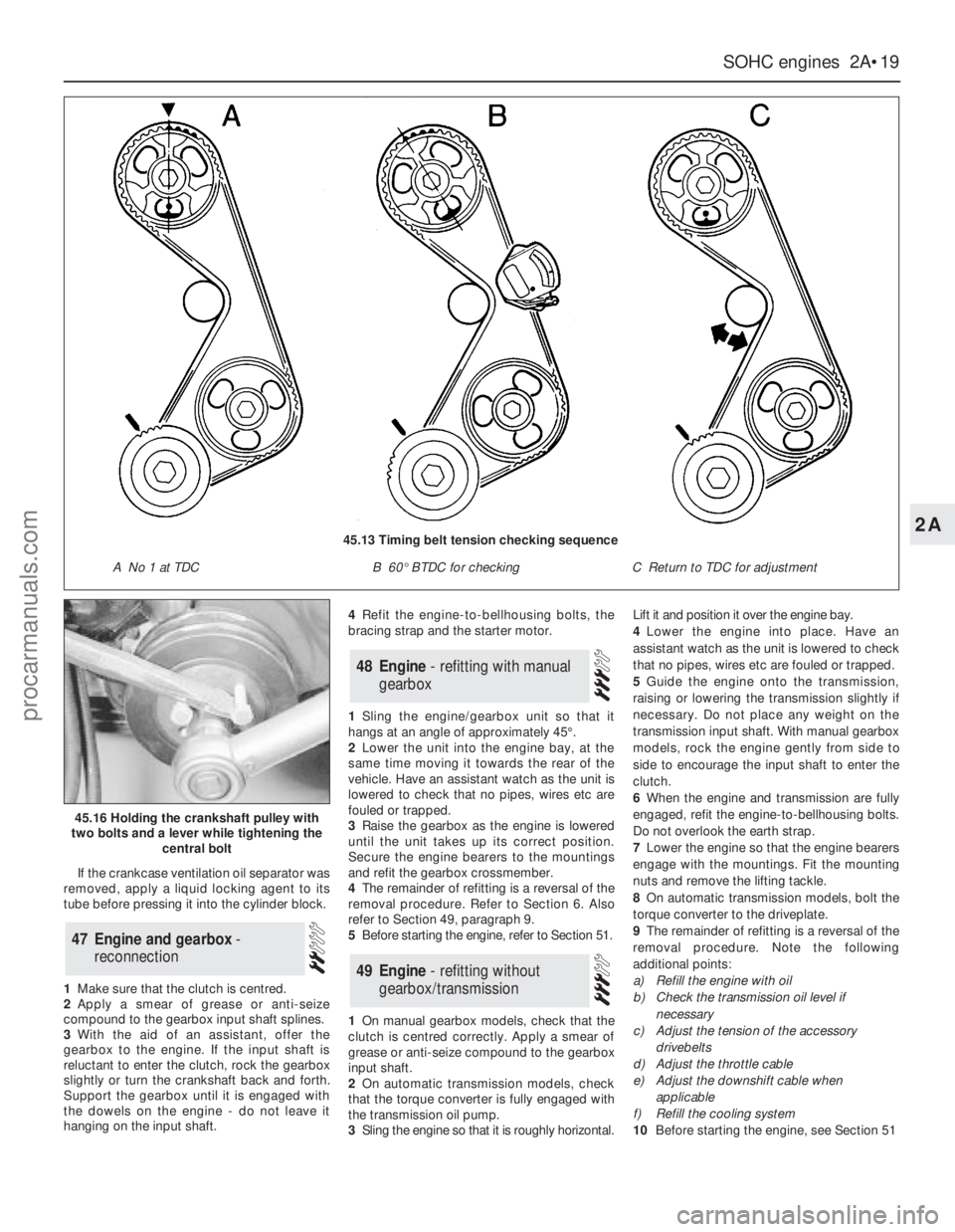
13If adjustment of belt tension is necessary,
turn the crankshaft clockwise to bring No 1
cylinder to TDC(see illustration)then slacken
the tensioner bolts and move the tensioner to
increase or decrease belt tension. Tighten the
tensioner bolts.
14Turn the crankshaft 90°clockwise past
TDC, then anti-clockwise back to the 60°
BTDC position. Check the belt tension again.
15Repeat the above procedure until the belt
tension is correct.
16Tighten the tensioner bolts and the
crankshaft pulley bolt to the specified torques
(see illustration).
17Refit the belt cover and tighten its bolts.
18If the engine is in the vehicle, reverse the
preliminary steps given in Section 13.
19Check the ignition timing when the engine
is next run.
Refer to Section 9 and refit the components
listed. Delicate items such as the alternator
and distributor may be left until after the
engine has been refitted, if preferred.
46Ancillary components - refitting
45Timing belt and sprockets -
refitting
2A•18SOHCengines
44.7 Cylinder head bolt tightening
sequence
45.4 Fitting the timing belt over the
crankshaft sprocket
45.5a Refitting the crankshaft pulley45.5b Crankshaft pulley bolt and washer45.12 Twisting the timing belt to assess its
tension
44.10 Dovetail section of rocker cover
gasket44.11 Rocker cover bolts (A) and
reinforcing plates (B)
For tightening sequence see text
procarmanuals.com
Page 42 of 255
If the crankcase ventilation oil separator was
removed, apply a liquid locking agent to its
tube before pressing it into the cylinder block.
1Make sure that the clutch is centred.
2Apply a smear of grease or anti-seize
compound to the gearbox input shaft splines.
3With the aid of an assistant, offer the
gearbox to the engine. If the input shaft is
reluctant to enter the clutch, rock the gearbox
slightly or turn the crankshaft back and forth.
Support the gearbox until it is engaged with
the dowels on the engine - do not leave it
hanging on the input shaft.4Refit the engine-to-bellhousing bolts, the
bracing strap and the starter motor.
1Sling the engine/gearbox unit so that it
hangs at an angle of approximately 45°.
2Lower the unit into the engine bay, at the
same time moving it towards the rear of the
vehicle. Have an assistant watch as the unit is
lowered to check that no pipes, wires etc are
fouled or trapped.
3Raise the gearbox as the engine is lowered
until the unit takes up its correct position.
Secure the engine bearers to the mountings
and refit the gearbox crossmember.
4The remainder of refitting is a reversal of the
removal procedure. Refer to Section 6. Also
refer to Section 49, paragraph 9.
5Before starting the engine, refer to Section 51.
1On manual gearbox models, check that the
clutch is centred correctly. Apply a smear of
grease or anti-seize compound to the gearbox
input shaft.
2On automatic transmission models, check
that the torque converter is fully engaged with
the transmission oil pump.
3Sling the engine so that it is roughly horizontal.Lift it and position it over the engine bay.
4Lower the engine into place. Have an
assistant watch as the unit is lowered to check
that no pipes, wires etc are fouled or trapped.
5Guide the engine onto the transmission,
raising or lowering the transmission slightly if
necessary. Do not place any weight on the
transmission input shaft. With manual gearbox
models, rock the engine gently from side to
side to encourage the input shaft to enter the
clutch.
6When the engine and transmission are fully
engaged, refit the engine-to-bellhousing bolts.
Do not overlook the earth strap.
7Lower the engine so that the engine bearers
engage with the mountings. Fit the mounting
nuts and remove the lifting tackle.
8On automatic transmission models, bolt the
torque converter to the driveplate.
9The remainder of refitting is a reversal of the
removal procedure. Note the following
additional points:
a)Refill the engine with oil
b)Check the transmission oil level if
necessary
c)Adjust the tension of the accessory
drivebelts
d)Adjust the throttle cable
e)Adjust the downshift cable when
applicable
f)Refill the cooling system
10Before starting the engine, see Section 51
49Engine - refitting without
gearbox/transmission
48Engine - refitting with manual
gearbox
47Engine and gearbox -
reconnection
SOHCengines 2A•19
2A
45.16 Holding the crankshaft pulley with
two bolts and a lever while tightening the
central bolt
45.13 Timing belt tension checking sequence
A No 1 at TDCB 60°BTDC for checkingC Return to TDC for adjustment
procarmanuals.com