1983 FIAT UNO alternator
[x] Cancel search: alternatorPage 166 of 303

thumb and forefinger at the centre of the run
between the auxiliary shaft sprocket and the
camshaft sprocket. Using this method it
should just be possible to twist the belt
through 90º using moderate pressure.
55To adjust the tension, loosen off the
tensioner pulley nut then insert two rods (or
screwdrivers) into position in the pulley holes
and position a lever between them.
56Gently lever the tensioner pulley in the
required direction to set the tension as
described, then initially tighten the pulley nut
to lock the tensioner in the required position.
57Remove the tools from the tensioner,
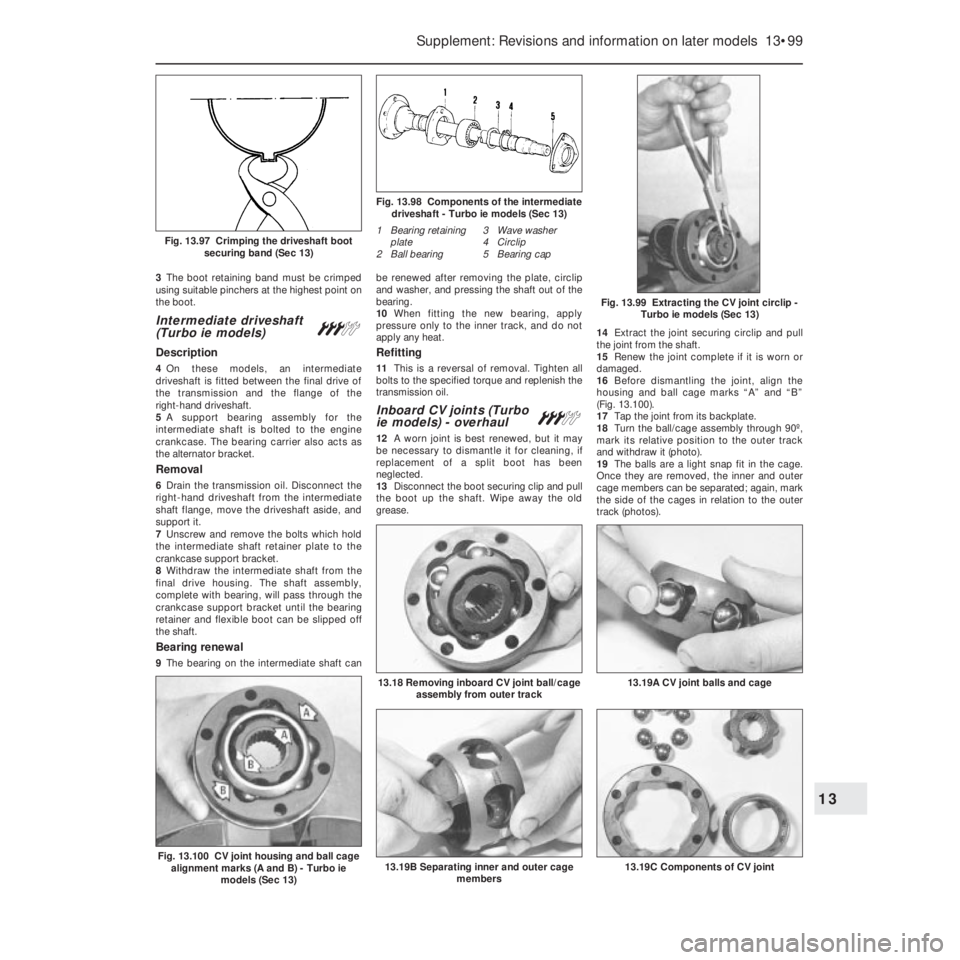
recheck the tension and then tighten the
tensioner pulley nut securely.
58Rotate the crankshaft clockwise through
two complete turns using a socket or spanner
on the crankshaft pulley nut, then recheck the
belt tension. To avoid the possibility of
unscrewing the pulley nut, remove the spark
plugs to enable the engine to be turned over
easier.
59If further adjustment is required, repeat
the previously mentioned procedures. If in
doubt, err on the slightly tight side when
adjusting the tension. If the belt is set too
loose, it may jump off the sprockets resulting
in serious damage.
60Remove the crankshaft pulley retaining
nut, fit the timing belt cover, then refit and
tighten the pulley nut to the specified torque
setting.
61Refit the remaining components in the
reverse order of removal. Tighten the retaining
nuts/bolts to the specified torque settings
where given. Adjust the tension of the
alternator drivebelt as described in Section 8.
Adjustment using FIAT special
tools
62Assemble the special tools and fit them to
the belt tensioner pulley as shown in
Fig. 13.16. When fitted, the tool rod must be
as vertical as possible and it is important to
note that no sliding weights must be attached
to tool No. 1860745100.
63Slacken the tensioner pulley nut, if not
already done. Rotate the crankshaft clockwise
through two complete turns using a socket or
spanner on the crankshaft pulley nut. The
special tool rod may move from the vertical asthe engine is turned over, in which case the
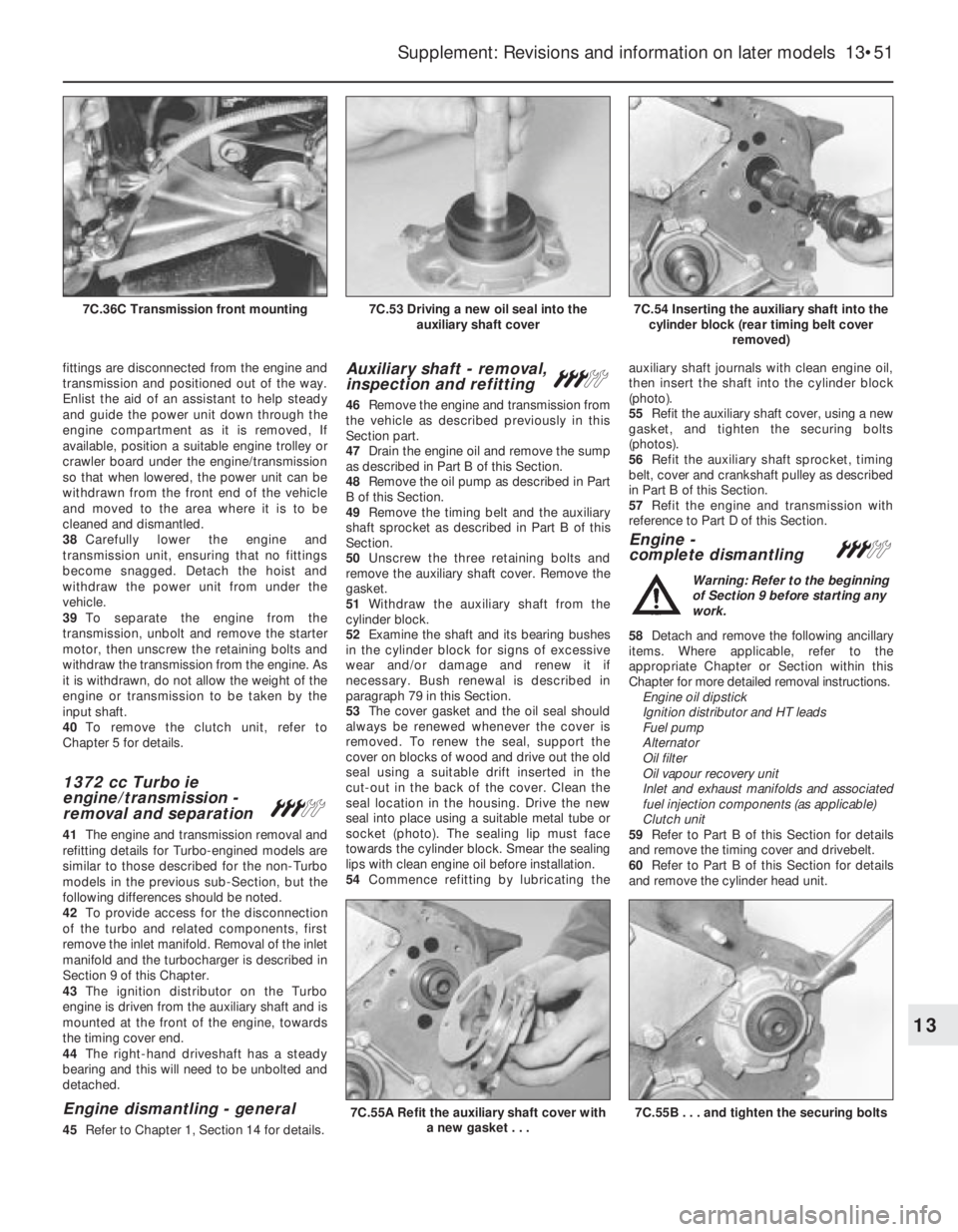
joint will need to be re-adjusted to return the
rod to the vertical and the operation repeated.
64With the two revolutions of the crankshaft
completed, tighten the belt tensioner pulley
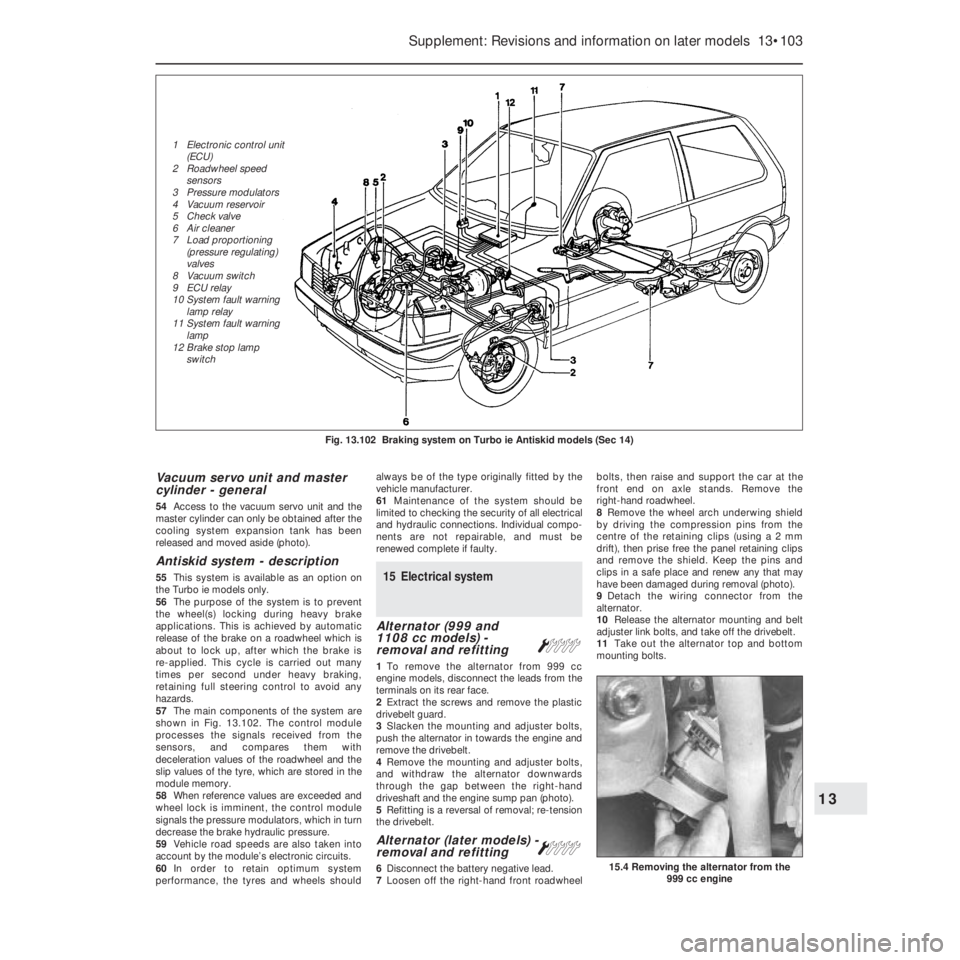
nut securely and remove the special tools.
65Remove the crankshaft pulley retaining
nut, fit the timing belt cover, then refit and
tighten the pulley nut to its specified torque
setting.
66Refit the remaining components in the
reverse order of removal. Tighten the retaining
nuts/bolts to the specified torque settings
where given. Adjust the tension of the
alternator drivebelt as described in Sec-
tion 8.
Camshaft front oil seal -
renewal#
67The camshaft front oil seal may be
renewed with the engine in the vehicle, and
the camshaft in situ, as follows.
68Remove the timing belt and the camshaft
sprocket as described previously in this
Section.
69Punch or drill a small hole in the centre of
the exposed oil seal. Screw in a self-tapping
screw, and pull on the screw with pliers to
extract the seal.
70Clean the oil seal seat with a wooden or
plastic scraper.
71Lubricate the lips of the new seal with
clean engine oil, and drive it into position until
it is flush with the housing, using a suitable
socket or tube. Take care not to damage the
seal lips during fitting. Note that the seal lips
should face inwards.
72Refit the camshaft sprocket and thetiming belt as described previously in this
Section.
Camshaft, housing and
followers -
removal and refitting
#
Note: The engine must be cold when
removing the camshaft housing. Do not
remove the camshaft housing from a hot
engine. New camshaft housing and camshaft
cover gaskets must be used on refitting.
73If the engine is still in the vehicle,
disconnect the battery negative lead.
74Refer to paragraphs 3 to 7 in this part of
this Section for details and remove the
camshaft cover.
75Remove the camshaft sprocket and timing
belt as described previously in this Section.
76Remove the three securing nuts and the
single securing bolt, and withdraw the upper
section of the rear timing belt cover.
77Unscrew the camshaft housing securing
bolts. There are seven bolts which are
accessible from outside the camshaft
housing, and five shorter bolts which are
accessible from inside the housing (these
bolts are normally covered by the camshaft
cover). Note that each bolt is fitted with two
washers (photo).
78Carefully lift the camshaft housing from
the cylinder head. Be prepared for the cam
followers to drop from their bores in the
camshaft housing as the camshaft housing is
lifted, and ensure that the cam followers are
identified for position so that they can be
refitted in their original positions (this can be
achieved by placing each cam follower over
its relevant valve in the cylinder head).
Supplement: Revisions and information on later models 13•41
Fig. 13.16 FIAT special tool No. 1860745100 (A) for timing belt adjustment shown fitted to
the tensioner pulley - 1372 cc ie and Turbo ie engines (Sec 7B)
Use with adapter No. 1860745200 on 1372 cc ie engines and No. 1860745300 on 1372 cc
Turbo ie engines
7B.77 Removing one of the camshaft
housing shorter securing bolts
13
Page 174 of 303

fitting, as during removal. Note that the
compression rings are brittle, and will snap if
expanded too far.
206If new pistons are to be fitted, they must
be selected from the grades available, after
measuring the cylinder bores. Normally, the
appropriate oversize pistons are supplied by
the dealer when the block is rebored.
207Whenever new piston rings are being
installed, the glaze on the original cylinder
bores should be removed using either
abrasive paper or a glaze-removing tool in an
electric drill. If abrasive paper is used, use
strokes at 60º to the bore centre-line, to
create a cross-hatching effect.
Engine/transmission
mountings - renewalÁ
208The engine/gearbox assembly is
suspended in the engine compartment on
three mountings, two of which are attached to
the gearbox, and one to the engine.
Right-hand mounting
209Apply the handbrake, then jack up the
front of the vehicle and support it securely on
axle stands.
210Suitable lifting tackle must now be
attached to the engine in order to support it as
the engine mounting is removed. No lifting
brackets are provided, so care must be taken
when deciding on an engine lifting point. In the
workshop, a right-angled bracket was made up
by bending a suitable piece of steel plate. The
bracket was then bolted to the engine using the
rear right-hand camshaft housing securing bolt
with suitable packing washers.
211Attach the lifting tackle to the bracket on
the engine and just take the weight of the
assembly.
212Working under the vehicle, unbolt the
engine mounting bracket from the cylinder
block, and unbolt the mounting from the
body, then withdraw the bracket/mounting
assembly.
213Unscrew the nut and through-bolt,
counter holding the bolt with a second
spanner or socket, and separate the mounting
from the bracket.
214Fit the new mounting to the bracket, and
tighten the nut to the specified torque, while
counterholding the through-bolt using a
suitable spanner or socket.
215Refit the mounting bracket to the cylinder
block, and tighten the securing bolts to the
specified torque.
216Refit the mounting to the body and
tighten the securing bolts to the specified
torque.
217Disconnect the lifting tackle from the
engine, and remove the engine lifting bracket.
218Lower the vehicle to the ground.
Left-hand mountings
219Apply the handbrake, then jack up the
front of the vehicle and support it securely on
axle stands.
220Suitable lifting tackle must now be
attached to the gearbox lifting bracket inorder to support the weight of the assembly
as the mounting is removed.
221Attach the lifting tackle to the bracket on
the gearbox, and just take the weight of the
assembly.
222Working under the vehicle, unbolt the
mounting bracket from the gearbox, and
unbolt the mounting from the body, then
withdraw the bracket/mounting assembly.
223Proceed as described in paragraphs 213
and 214.
224Refit the mounting bracket to the
gearbox, and tighten the securing bolts to the
specified torque.
225Refit the mounting to the body and
tighten the mounting bolts to the specified
torque.
226Disconnect the lifting tackle from the
engine.
227Lower the vehicle to the ground.
PART C: ENGINE REMOVAL
AND DISMANTLING
Method of removal - general
1The engine (complete with transmission) is
disconnected and lowered downwards
through the engine compartment, then
withdrawn from the front underside of the car.
1372 cc engine/
transmission - removal
and separation
#
Warning: Refer to the beginning
of Section 9 before starting any
work.
2Depressurize the fuel system as described
in Section 9 of this Chapter.
3Disconnect the battery negative lead.
4Mark the position of the hinges on the
underside of the bonnet, then with the aid of
an assistant, unscrew the hinge bolts and lift
the bonnet clear of the car. Store the bonnet
in a safe area.
5Drain the engine coolant.
6Drain the engine and transmission oils.
7Disconnect and remove the air filter.
8Disconnect the coolant hoses from the
engine, including the hose to the inlet
manifold.
9Detach the ignition coil (HT) lead from the
distributor.10Compress the retaining clip and detach
the engine idle speed actuator lead from the
SPi unit (photo).
11Disconnect the brake servo vacuum pipe
from its connector on the inlet manifold.
12Disconnect the throttle cable from the SPi
unit.
13Disconnect the engine speed sensor lead.
14Release and detach the reversing light
lead from the switch on the transmission
(photo).
15Before disconnecting the hydraulic hose
from the clutch slave cylinder, remove the
filler cap from the reservoir and place a piece
of polythene sheet over the filler neck, then
refit the cap; this will help prevent excess fluid
loss. Once disconnected, plug the hose and
its cylinder connection to prevent the ingress
of dirt into the hydraulic system.
16Disconnect the wiring connector from the
alternator.
17Position a clean rag under the fuel supply
and return hose connections to the SPi unit,
then slowly unscrew the hose clips to release
the system pressure; catch fuel leakage in the
rag and dispose of it safely. Detach the hoses
and plug them to prevent ingress of dirt and
any further fuel leakage. Position the hoses
out of the way.
18Detach the wiring connector from the
engine coolant temperature sender unit
(photo).
19Release the retaining clip and detach the
wiring connector from the throttle position
switch. Also detach the associated earth
leads from the cylinder head.
Supplement: Revisions and information on later models 13•49
7C.14 Reversing light switch and lead7C.18 Engine coolant temperature sender
and wiring connector
7C.10 Engine idle speed actuator/SPi unit
lead connection (arrowed)
13
Page 176 of 303
fittings are disconnected from the engine and
transmission and positioned out of the way.
Enlist the aid of an assistant to help steady
and guide the power unit down through the
engine compartment as it is removed, If
available, position a suitable engine trolley or
crawler board under the engine/transmission
so that when lowered, the power unit can be
withdrawn from the front end of the vehicle
and moved to the area where it is to be
cleaned and dismantled.
38Carefully lower the engine and
transmission unit, ensuring that no fittings
become snagged. Detach the hoist and
withdraw the power unit from under the
vehicle.
39To separate the engine from the
transmission, unbolt and remove the starter
motor, then unscrew the retaining bolts and
withdraw the transmission from the engine. As
it is withdrawn, do not allow the weight of the
engine or transmission to be taken by the
input shaft.
40To remove the clutch unit, refer to
Chapter 5 for details.
1372 cc Turbo ie
engine/transmission -
removal and separation
#
41The engine and transmission removal and
refitting details for Turbo-engined models are
similar to those described for the non-Turbo
models in the previous sub-Section, but the
following differences should be noted.
42To provide access for the disconnection
of the turbo and related components, first
remove the inlet manifold. Removal of the inlet
manifold and the turbocharger is described in
Section 9 of this Chapter.
43The ignition distributor on the Turbo
engine is driven from the auxiliary shaft and is
mounted at the front of the engine, towards
the timing cover end.
44The right-hand driveshaft has a steady
bearing and this will need to be unbolted and
detached.
Engine dismantling - general
45Refer to Chapter 1, Section 14 for details.
Auxiliary shaft - removal,
inspection and refitting #
46Remove the engine and transmission from
the vehicle as described previously in this
Section part.
47Drain the engine oil and remove the sump
as described in Part B of this Section.
48Remove the oil pump as described in Part
B of this Section.
49Remove the timing belt and the auxiliary
shaft sprocket as described in Part B of this
Section.
50Unscrew the three retaining bolts and
remove the auxiliary shaft cover. Remove the
gasket.
51Withdraw the auxiliary shaft from the
cylinder block.
52Examine the shaft and its bearing bushes
in the cylinder block for signs of excessive
wear and/or damage and renew it if
necessary. Bush renewal is described in
paragraph 79 in this Section.
53The cover gasket and the oil seal should
always be renewed whenever the cover is
removed. To renew the seal, support the
cover on blocks of wood and drive out the old
seal using a suitable drift inserted in the
cut-out in the back of the cover. Clean the
seal location in the housing. Drive the new
seal into place using a suitable metal tube or
socket (photo). The sealing lip must face
towards the cylinder block. Smear the sealing
lips with clean engine oil before installation.
54Commence refitting by lubricating theauxiliary shaft journals with clean engine oil,
then insert the shaft into the cylinder block
(photo).
55Refit the auxiliary shaft cover, using a new
gasket, and tighten the securing bolts
(photos).
56Refit the auxiliary shaft sprocket, timing
belt, cover and crankshaft pulley as described
in Part B of this Section.
57Refit the engine and transmission with
reference to Part D of this Section.
Engine -
complete dismantling#
Warning: Refer to the beginning
of Section 9 before starting any
work.
58Detach and remove the following ancillary
items. Where applicable, refer to the
appropriate Chapter or Section within this
Chapter for more detailed removal instructions.
Engine oil dipstick
Ignition distributor and HT leads
Fuel pump
Alternator
Oil filter
Oil vapour recovery unit
Inlet and exhaust manifolds and associated
fuel injection components (as applicable)
Clutch unit
59Refer to Part B of this Section for details
and remove the timing cover and drivebelt.
60Refer to Part B of this Section for details
and remove the cylinder head unit.
Supplement: Revisions and information on later models 13•51
7C.54 Inserting the auxiliary shaft into the
cylinder block (rear timing belt cover
removed)7C.53 Driving a new oil seal into the
auxiliary shaft cover7C.36C Transmission front mounting
7C.55B . . . and tighten the securing bolts7C.55A Refit the auxiliary shaft cover with
a new gasket . . .
13
Page 183 of 303

35Clean the mating faces of the thermostat
cover and cylinder head, and use a new
gasket when refitting the cover.
36Refill the cooling system as described
earlier in this Section.
Coolant pump -
removal and refittingÁ
Note: A new coolant pump gasket must be
used on refitting. If the pump is found to be
worn it must be renewed as a complete unit as
dismantling and repair is not possible.
37Disconnect the battery negative lead.
38Drain the cooling system as described
earlier in this Section.
39Remove the coolant/alternator drivebelt
as described in the next sub-Section.
40Unscrew the four coolant pump securing
bolts, noting that two of the bolts also secure
the alternator adjuster bracket, and withdraw
the pump from the housing (photo). Recover
the gasket.
41Refitting is a reversal of removal, bearing
in mind the following points.
42Use a new gasket between the pump and
the housing.
43Refit and tension the coolant
pump/alternator drivebelt as described in the
next sub-Section.
44On completion, refill the cooling system
as described earlier in this Section.
Coolant pump/alternator
drivebelt - checking,
renewal and tensioning
Á
45At the intervals specified in Section 3 or
“Routine maintenance” at the beginning of
this manual (as applicable), the drivebelt
should be checked and if necessary
re-tensioned.
46Access to the drivebelt is made from the
underside of the car on the right-hand side.
Loosen off the front right-hand roadwheel
retaining bolts, then raise and support the car
on axle stands at the front. Remove the front
roadwheel on the right-hand side.
47Remove the underwing shield from the
right-hand wheel arch by drifting the
compression pins out from the retaining
clips. Prise free the clips and remove the
shield.
48Additional, though somewhat restricted,
access can be obtained from above by
removing the air cleaner unit on the non-Turbo
ie-engine (photo).
49Check the full length of the drivebelt for
cracks and deterioration. It will be necessary
to turn the engine in order to check the
portions of the drivebelt in contact with the
pulleys. If a drivebelt is unserviceable, renew it
as follows (photo).
50Loosen the alternator mounting and
adjuster nuts and bolts and pivot the
alternator towards the cylinder block.51Slip the drivebelt from the alternator,
coolant pump and crankshaft pulleys.
52Fit the new drivebelt around the pulleys,
then lever the alternator away from the
cylinder block until the specified belt tension
is achieved. Lever the alternator using a
wooden or plastic lever at the pulley end to
prevent damage. It is helpful to partially
tighten the adjuster nut before tensioning the
drivebelt (photo).
53When the specified tension has been
achieved, tighten the mounting and adjuster
nuts and bolts (photo).
PART D: HEATER UNIT- LATER
MODELS
Heater unit -
removal and refitting
Á
1The heater unit is removed complete with
the facia/control panel. Commence by
draining the cooling system as described
previously in this Section.
2Disconnect the battery negative lead.
3Refer to Section 15 of this Chapter for
details and remove the ashtray/cigar lighter
and the auxiliary control panel.
4Undo the upper screw retaining the heater
unit to the facia (see Fig. 13.31).
5Remove the radio from the central facia.
6Undo the retaining screw on each side at
the front of the gear lever console. Prise free
13•58 Supplement: Revisions and information on later models
Fig. 13.31 Removing the heater unit-to-
facia upper retaining screw (Sec 8D)8C.53 Tightening the alternator adjuster
nut8C.52 Fitting a new coolant
pump/alternator drivebelt around the
pulleys
8C.49 Alternator/water pump drivebelt and
tensioner viewed from the right-hand
wheel arch8C.48 Top side view of water pump,
alternator and drivebelt8C.40 Coolant pump/alternator bracket
bolt removal
Page 207 of 303

protective shield to gain access to the pump
which is located forward of the fuel tank.
60Disconnect the fuel hoses and the wiring
connector, release the retaining clamp and
withdraw the pump unit.
Refitting all components
61Refitting of all components is a reversal of
the removal procedure, but note the following
specific points.
62Ensure that all components are clean prior
to refitting and where applicable, use new
seals and gaskets. Ensure that all connectionsare securely and correctly made.
63Do not reconnect the battery until all the
refitting procedures are complete.
64When the engine is restarted, check
around the fuel injection system for any signs
of leakage from the fuel supply and return
components.
Lambda sensor - general
65The sensor is screwed into the exhaust in
front of the catalytic converter.
66A faulty sensor can damage the converter,
therefore it must be checked regularly (see
Maintenance schedule, Section 3) by a dealer
using special equipment.
67Use of leaded fuel will also damage this
sensor, as well the converter.
PART F:
TURBOCHARGER SYSTEM
Description
1A turbocharger is fitted to certain 1301 and
1372 cc ie engines. The accompanying
photographs are all taken from a 1301 cc
engine, but the system is much the same for
both engine types.
2The turbocharger is basically a shaft with an
exhaust gas-driven turbine at one end, and a
compressor located at the other end which
draws in outside air and forces it into the inlet
manifold. By compressing the incoming air, a
larger charge can be let into each cylinder,
and greater power output is achieved than
with normal aspiration.3Lubrication of the turbocharger shaft
bearings is provided by pressurised engine
oil, and the unit is cooled by the coolant from
the engine cooling system.
4A wastegate valve is incorporated in the
turbocharger to divert excessive exhaust gas
pressure from the turbine into the exhaust
pipe at a predetermined pressure level.
5A maximum air pressure switch is located in
the inlet manifold. Its purpose is to cut the
ignition system off when the turbocharger
system pressure continues to increase
beyond 0.86 bars (12.5 lbf/in
2). This would
otherwise damage the engine, due to high
combustion temperatures and pressures
(photo).
6An intercooler (heat exchanger) is located
between the turbocharger and the inlet
manifold. Its function is to cool the inlet
charge, thus increasing its density, to provide
greater power output.
7A mechanical bypass valve is located
between the low-pressure pipe (downstream)
and the high-pressure pipe (upstream), which
reduces the inherent noise from the
turbocharger when the accelerator pedal is
released (photo).
8None of the components of the
turbocharger system can be repaired and
parts are not available. Any fault will therefore
mean that the turbocharger or associated
assemblies will have to be renewed complete.
Precautions
9The following precautions should be
observed when using a turbocharged vehicle.
a) Never operate the engine without the air
cleaner fitted.
b) Never switch off the engine before its
speed has dropped to idling. If the car
has been driven hard, allow it to idle for a
few minutes before switching off. Failure
to observe these recommendations can
cause damage to the turbocharger due to
lack of lubrication.
10Always keep the fuel injection system
well-maintained and tuned. Operating on a
weak mixture can cause overheating of the
turbocharger.
Turbocharger
(1301 cc ie engine) -
removal and refitting
Á
11Disconnect and remove the airflow meter
as described in Section 9C.
12Disconnect the spiral-wound hose from
the fuel injector cooling duct.
13Remove the turbocharger air hoses from
within the left-hand side of the engine
compartment. Note particularly their routing.
14Remove the throttle housing/inlet
manifold as described in Section 9C, also the
fuel rail, injectors and inlet manifold branch
pipe stubs. Remove the alternator heat shield
(photo).
15Remove the exhaust heat shield.
16Unscrew the turbocharger-to-exhaust
pipe flange nuts (photos).
13•82 Supplement: Revisions and information on later models
9F.16A Turbocharger-to-exhaust flange
nut (arrowed)9F.14 Alternator heat shield
9F.7 Bypass valve9F.5 Maximum air pressure switch
(arrowed)
Fig. 13.63 Fuel pump and sender unit
location on the 1372 cc Turbo ie engine
(Sec 9E)
1 Fuel level gauge sender connector
2 Fuel pump connector
3 Fuel return hose
4 Fuel supply hose
Page 224 of 303
3The boot retaining band must be crimped
using suitable pinchers at the highest point on
the boot.
Intermediate driveshaft
(Turbo ie models) #
Description
4On these models, an intermediate
driveshaft is fitted between the final drive of
the transmission and the flange of the
right-hand driveshaft.
5A support bearing assembly for the
intermediate shaft is bolted to the engine
crankcase. The bearing carrier also acts as
the alternator bracket.
Removal
6Drain the transmission oil. Disconnect the
right-hand driveshaft from the intermediate
shaft flange, move the driveshaft aside, and
support it.
7Unscrew and remove the bolts which hold
the intermediate shaft retainer plate to the
crankcase support bracket.
8Withdraw the intermediate shaft from the
final drive housing. The shaft assembly,
complete with bearing, will pass through the
crankcase support bracket until the bearing
retainer and flexible boot can be slipped off
the shaft.
Bearing renewal
9The bearing on the intermediate shaft canbe renewed after removing the plate, circlip
and washer, and pressing the shaft out of the
bearing.
10When fitting the new bearing, apply
pressure only to the inner track, and do not
apply any heat.
Refitting
11This is a reversal of removal. Tighten all
bolts to the specified torque and replenish the
transmission oil.
Inboard CV joints (Turbo
ie models) - overhaul #
12A worn joint is best renewed, but it may
be necessary to dismantle it for cleaning, if
replacement of a split boot has been
neglected.
13Disconnect the boot securing clip and pull
the boot up the shaft. Wipe away the old
grease. 14Extract the joint securing circlip and pull
the joint from the shaft.
15Renew the joint complete if it is worn or
damaged.
16Before dismantling the joint, align the
housing and ball cage marks “A” and “B”
(Fig. 13.100).
17Tap the joint from its backplate.
18Turn the ball/cage assembly through 90º,
mark its relative position to the outer track
and withdraw it (photo).
19The balls are a light snap fit in the cage.
Once they are removed, the inner and outer
cage members can be separated; again, mark
the side of the cages in relation to the outer
track (photos).
Supplement: Revisions and information on later models 13•99
Fig. 13.99 Extracting the CV joint circlip -
Turbo ie models (Sec 13)
Fig. 13.98 Components of the intermediate
driveshaft - Turbo ie models (Sec 13)
1 Bearing retaining
plate
2 Ball bearing3 Wave washer
4 Circlip
5 Bearing cap
Fig. 13.97 Crimping the driveshaft boot
securing band (Sec 13)
13.19C Components of CV joint13.19B Separating inner and outer cage
members
13.19A CV joint balls and cage13.18 Removing inboard CV joint ball/cage
assembly from outer track
Fig. 13.100 CV joint housing and ball cage
alignment marks (A and B) - Turbo ie
models (Sec 13)
13
Page 228 of 303
Vacuum servo unit and master
cylinder - general
54Access to the vacuum servo unit and the
master cylinder can only be obtained after the
cooling system expansion tank has been
released and moved aside (photo).
Antiskid system - description
55This system is available as an option on
the Turbo ie models only.
56The purpose of the system is to prevent
the wheel(s) locking during heavy brake
applications. This is achieved by automatic
release of the brake on a roadwheel which is
about to lock up, after which the brake is
re-applied. This cycle is carried out many
times per second under heavy braking,
retaining full steering control to avoid any
hazards.
57The main components of the system are
shown in Fig. 13.102. The control module
processes the signals received from the
sensors, and compares them with
deceleration values of the roadwheel and the
slip values of the tyre, which are stored in the
module memory.
58When reference values are exceeded and
wheel lock is imminent, the control module
signals the pressure modulators, which in turn
decrease the brake hydraulic pressure.
59Vehicle road speeds are also taken into
account by the module’s electronic circuits.
60In order to retain optimum system
performance, the tyres and wheels shouldalways be of the type originally fitted by the
vehicle manufacturer.
61Maintenance of the system should be
limited to checking the security of all electrical
and hydraulic connections. Individual compo-
nents are not repairable, and must be
renewed complete if faulty.15 Electrical system
Alternator (999 and
1108 cc models) -
removal and refitting
Á
1To remove the alternator from 999 cc
engine models, disconnect the leads from the
terminals on its rear face.
2Extract the screws and remove the plastic
drivebelt guard.
3Slacken the mounting and adjuster bolts,
push the alternator in towards the engine and
remove the drivebelt.
4Remove the mounting and adjuster bolts,
and withdraw the alternator downwards
through the gap between the right-hand
driveshaft and the engine sump pan (photo).
5Refitting is a reversal of removal; re-tension
the drivebelt.
Alternator (later models) -
removal and refitting Á
6Disconnect the battery negative lead.
7Loosen off the right-hand front roadwheelbolts, then raise and support the car at the
front end on axle stands. Remove the
right-hand roadwheel.
8Remove the wheel arch underwing shield
by driving the compression pins from the
centre of the retaining clips (using a 2 mm
drift), then prise free the panel retaining clips
and remove the shield. Keep the pins and
clips in a safe place and renew any that may
have been damaged during removal (photo).
9Detach the wiring connector from the
alternator.
10Release the alternator mounting and belt
adjuster link bolts, and take off the drivebelt.
11Take out the alternator top and bottom
mounting bolts.
Supplement: Revisions and information on later models 13•103
15.4 Removing the alternator from the
999 cc engine
Fig. 13.102 Braking system on Turbo ie Antiskid models (Sec 14)
13
1 Electronic control unit
(ECU)
2 Roadwheel speed
sensors
3 Pressure modulators
4 Vacuum reservoir
5 Check valve
6 Air cleaner
7 Load proportioning
(pressure regulating)
valves
8 Vacuum switch
9 ECU relay
10 System fault warning
lamp relay
11 System fault warning
lamp
12 Brake stop lamp
switch
Page 229 of 303

15.23A Starter motor removal from the
1301 cc Turbo ie engine15.20 Starter motor removal from the
999 cc engine
12Disconnect the air cooling hose from the
rear cover of the alternator, and then unscrew
the fixing nuts and take off the rear cover with
hose spout. Mark the position of the cover on
the alternator before removing it, so that the
spout will be correctly positioned when
refitted (photos).
13Unbolt the driveshaft bearing
support/alternator bracket from the engine
crankcase, and swivel the support
downwards to provide space for withdrawal of
the alternator (photo).
14Withdraw the alternator from under the
right-hand front wing (photo).
15Refit in the reverse order of removal. Refit
the drivebelt and ensure correct engagement
with the pulleys, then set the drivebelt tension
and tighten the alternator retaining nuts.Alternator brushes -
renewal#
16Depending on model, the brush holder is
secured by two screws, which should be ex-
tracted and the brush holder removed (photos).
17New brushes and the holder are supplied
as an assembly.
Starter motor
(999 cc models) -
removal and refitting
Á
18To remove the starter motor from 999 and
1108 cc models, first disconnect the leads
from the starter motor terminals.
19Release the washer fluid reservoir flexible
bag from the engine compartment rear
bulkhead and move it to the left-hand side.
20Unscrew the starter motor mountingbolts, withdraw the starter from the flywheel
bellhousing, and then lift it out of the left-hand
side of the engine compartment (photo).
21Refitting is a reversal of removal.
Starter motor (1301 cc Turbo ie,
1372 cc ie,
1372 cc Turbo ie) -
removal and refitting
Á
22Disconnect the battery. Working from
under the front end of the car, unscrew the
starter motor mounting bolts and disconnect
the electrical leads.
23Withdraw the starter motor downwards. On
Turbo models, there is just enough clearance, if
the oil cooler hose and the oil pressure switch
lead are deflected carefully aside (photos).
24Refit by reversing the removal operations.
13•104 Supplement: Revisions and information on later models
15.16B Removing the alternator brush
holder
15.16A Extracting the alternator brush
holder screw15.14 Withdrawing the alternator15.13 Driveshaft bracket swivelled
downwards
15.12B Alternator rear cover and fixing nut15.12A Alternator air cooling hose15.8 Remove the wheel arch lower guard
panel for access to the alternator