1983 FIAT UNO alternator
[x] Cancel search: alternatorPage 135 of 303
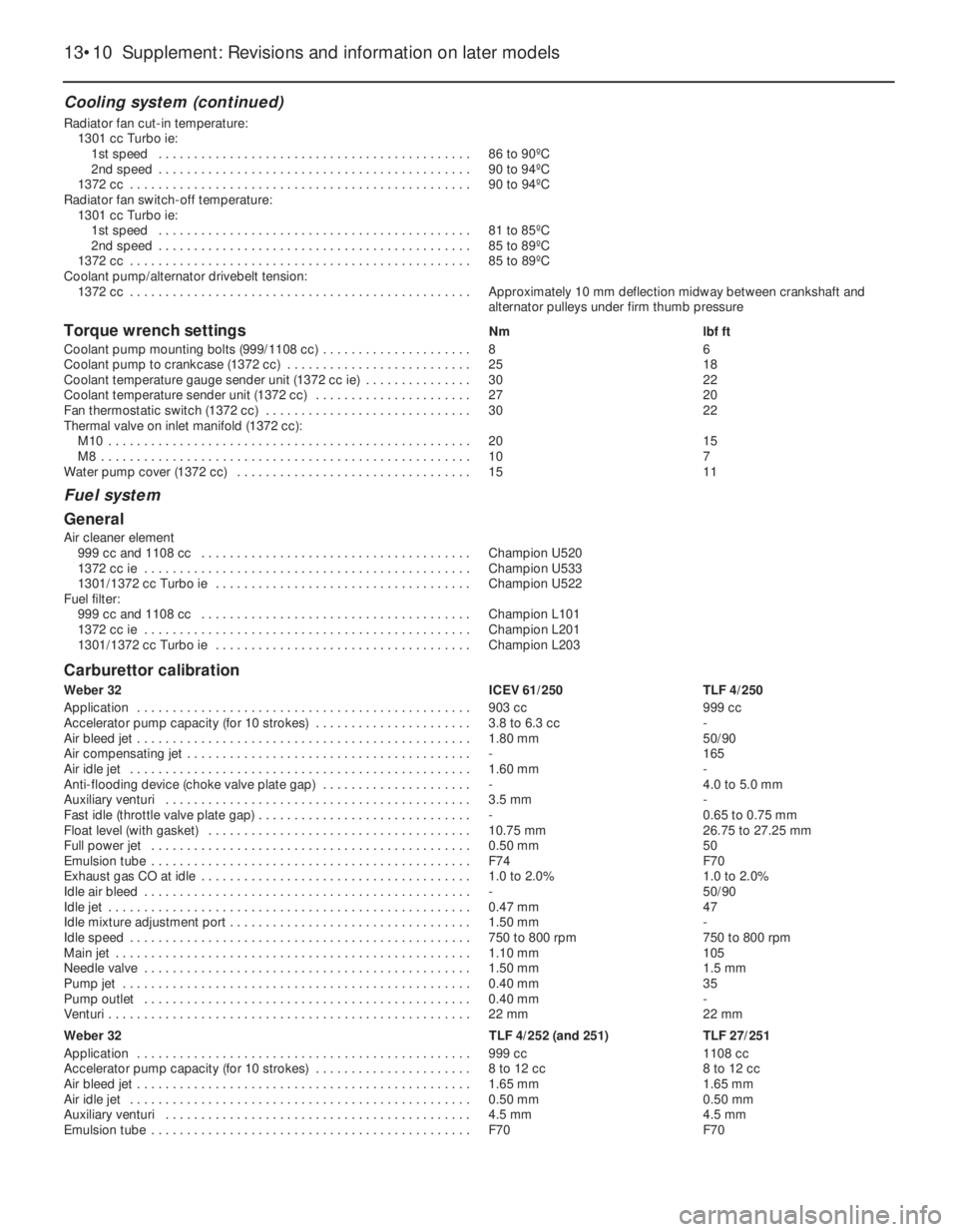
Cooling system (continued)
Radiator fan cut-in temperature:
1301 cc Turbo ie:
1st speed . . . . . . . . . . . . . . . . . . . . . . . . . . . . . . . . . . . . . . . . . . . . 86 to 90ºC
2nd speed . . . . . . . . . . . . . . . . . . . . . . . . . . . . . . . . . . . . . . . . . . . . 90 to 94ºC
1372 cc . . . . . . . . . . . . . . . . . . . . . . . . . . . . . . . . . . . . . . . . . . . . . . . . 90 to 94ºC
Radiator fan switch-off temperature:
1301 cc Turbo ie:
1st speed . . . . . . . . . . . . . . . . . . . . . . . . . . . . . . . . . . . . . . . . . . . . 81 to 85ºC
2nd speed . . . . . . . . . . . . . . . . . . . . . . . . . . . . . . . . . . . . . . . . . . . . 85 to 89ºC
1372 cc . . . . . . . . . . . . . . . . . . . . . . . . . . . . . . . . . . . . . . . . . . . . . . . . 85 to 89ºC
Coolant pump/alternator drivebelt tension:
1372 cc . . . . . . . . . . . . . . . . . . . . . . . . . . . . . . . . . . . . . . . . . . . . . . . . Approximately 10 mm deflection midway between crankshaft and
alternator pulleys under firm thumb pressure
Torque wrench settingsNm lbf ft
Coolant pump mounting bolts (999/1108 cc) . . . . . . . . . . . . . . . . . . . . . 8 6
Coolant pump to crankcase (1372 cc) . . . . . . . . . . . . . . . . . . . . . . . . . . 25 18
Coolant temperature gauge sender unit (1372 cc ie) . . . . . . . . . . . . . . . 30 22
Coolant temperature sender unit (1372 cc) . . . . . . . . . . . . . . . . . . . . . . 27 20
Fan thermostatic switch (1372 cc) . . . . . . . . . . . . . . . . . . . . . . . . . . . . . 30 22
Thermal valve on inlet manifold (1372 cc):
M10 . . . . . . . . . . . . . . . . . . . . . . . . . . . . . . . . . . . . . . . . . . . . . . . . . . . 20 15
M8 . . . . . . . . . . . . . . . . . . . . . . . . . . . . . . . . . . . . . . . . . . . . . . . . . . . . 10 7
Water pump cover (1372 cc) . . . . . . . . . . . . . . . . . . . . . . . . . . . . . . . . . 15 11
Fuel system
General
Air cleaner element
999 cc and 1108 cc . . . . . . . . . . . . . . . . . . . . . . . . . . . . . . . . . . . . . . Champion U520
1372 cc ie . . . . . . . . . . . . . . . . . . . . . . . . . . . . . . . . . . . . . . . . . . . . . . Champion U533
1301/1372 cc Turbo ie . . . . . . . . . . . . . . . . . . . . . . . . . . . . . . . . . . . . Champion U522
Fuel filter:
999 cc and 1108 cc . . . . . . . . . . . . . . . . . . . . . . . . . . . . . . . . . . . . . . Champion L101
1372 cc ie . . . . . . . . . . . . . . . . . . . . . . . . . . . . . . . . . . . . . . . . . . . . . . Champion L201
1301/1372 cc Turbo ie . . . . . . . . . . . . . . . . . . . . . . . . . . . . . . . . . . . . Champion L203
Carburettor calibration
Weber 32 ICEV 61/250 TLF 4/250
Application . . . . . . . . . . . . . . . . . . . . . . . . . . . . . . . . . . . . . . . . . . . . . . . 903 cc 999 cc
Accelerator pump capacity (for 10 strokes) . . . . . . . . . . . . . . . . . . . . . . 3.8 to 6.3 cc -
Air bleed jet . . . . . . . . . . . . . . . . . . . . . . . . . . . . . . . . . . . . . . . . . . . . . . . 1.80 mm 50/90
Air compensating jet . . . . . . . . . . . . . . . . . . . . . . . . . . . . . . . . . . . . . . . . - 165
Air idle jet . . . . . . . . . . . . . . . . . . . . . . . . . . . . . . . . . . . . . . . . . . . . . . . . 1.60 mm -
Anti-flooding device (choke valve plate gap) . . . . . . . . . . . . . . . . . . . . . - 4.0 to 5.0 mm
Auxiliary venturi . . . . . . . . . . . . . . . . . . . . . . . . . . . . . . . . . . . . . . . . . . . 3.5 mm -
Fast idle (throttle valve plate gap) . . . . . . . . . . . . . . . . . . . . . . . . . . . . . . - 0.65 to 0.75 mm
Float level (with gasket) . . . . . . . . . . . . . . . . . . . . . . . . . . . . . . . . . . . . . 10.75 mm 26.75 to 27.25 mm
Full power jet . . . . . . . . . . . . . . . . . . . . . . . . . . . . . . . . . . . . . . . . . . . . . 0.50 mm 50
Emulsion tube . . . . . . . . . . . . . . . . . . . . . . . . . . . . . . . . . . . . . . . . . . . . . F74 F70
Exhaust gas CO at idle . . . . . . . . . . . . . . . . . . . . . . . . . . . . . . . . . . . . . . 1.0 to 2.0% 1.0 to 2.0%
Idle air bleed . . . . . . . . . . . . . . . . . . . . . . . . . . . . . . . . . . . . . . . . . . . . . . - 50/90
Idle jet . . . . . . . . . . . . . . . . . . . . . . . . . . . . . . . . . . . . . . . . . . . . . . . . . . . 0.47 mm 47
Idle mixture adjustment port . . . . . . . . . . . . . . . . . . . . . . . . . . . . . . . . . . 1.50 mm -
Idle speed . . . . . . . . . . . . . . . . . . . . . . . . . . . . . . . . . . . . . . . . . . . . . . . . 750 to 800 rpm 750 to 800 rpm
Main jet . . . . . . . . . . . . . . . . . . . . . . . . . . . . . . . . . . . . . . . . . . . . . . . . . . 1.10 mm 105
Needle valve . . . . . . . . . . . . . . . . . . . . . . . . . . . . . . . . . . . . . . . . . . . . . . 1.50 mm 1.5 mm
Pump jet . . . . . . . . . . . . . . . . . . . . . . . . . . . . . . . . . . . . . . . . . . . . . . . . . 0.40 mm 35
Pump outlet . . . . . . . . . . . . . . . . . . . . . . . . . . . . . . . . . . . . . . . . . . . . . . 0.40 mm -
Venturi . . . . . . . . . . . . . . . . . . . . . . . . . . . . . . . . . . . . . . . . . . . . . . . . . . . 22 mm 22 mm
Weber 32 TLF 4/252 (and 251) TLF 27/251
Application . . . . . . . . . . . . . . . . . . . . . . . . . . . . . . . . . . . . . . . . . . . . . . . 999 cc 1108 cc
Accelerator pump capacity (for 10 strokes) . . . . . . . . . . . . . . . . . . . . . . 8 to 12 cc 8 to 12 cc
Air bleed jet . . . . . . . . . . . . . . . . . . . . . . . . . . . . . . . . . . . . . . . . . . . . . . . 1.65 mm 1.65 mm
Air idle jet . . . . . . . . . . . . . . . . . . . . . . . . . . . . . . . . . . . . . . . . . . . . . . . . 0.50 mm 0.50 mm
Auxiliary venturi . . . . . . . . . . . . . . . . . . . . . . . . . . . . . . . . . . . . . . . . . . . 4.5 mm 4.5 mm
Emulsion tube . . . . . . . . . . . . . . . . . . . . . . . . . . . . . . . . . . . . . . . . . . . . . F70 F70
13•10 Supplement: Revisions and information on later models
Page 145 of 303
mounted on the front end of the crankshaft
and driven by it.
11The flexible toothed timing belt drives thecamshaft and the coolant pump from a
sprocket on the front end of the crankshaft.
The belt is tensioned by an
eccentrically-mounted pulley.
12The distributor and the fuel pump
(carburettor models) are driven from the
flywheel end of the camshaft. The fuel pump
on fuel injection models is an integral unit
combined with the fuel gauge sender unit and
immersed in the fuel tank.
PART B:
OPERATIONS POSSIBLE
WITH ENGINE IN CAR
Valve clearances - adjustment
1The operations are similar to those
described in Chapter 1, Section 26, but note
that the special tools referred to have differentpart numbers for the FlRE engine -
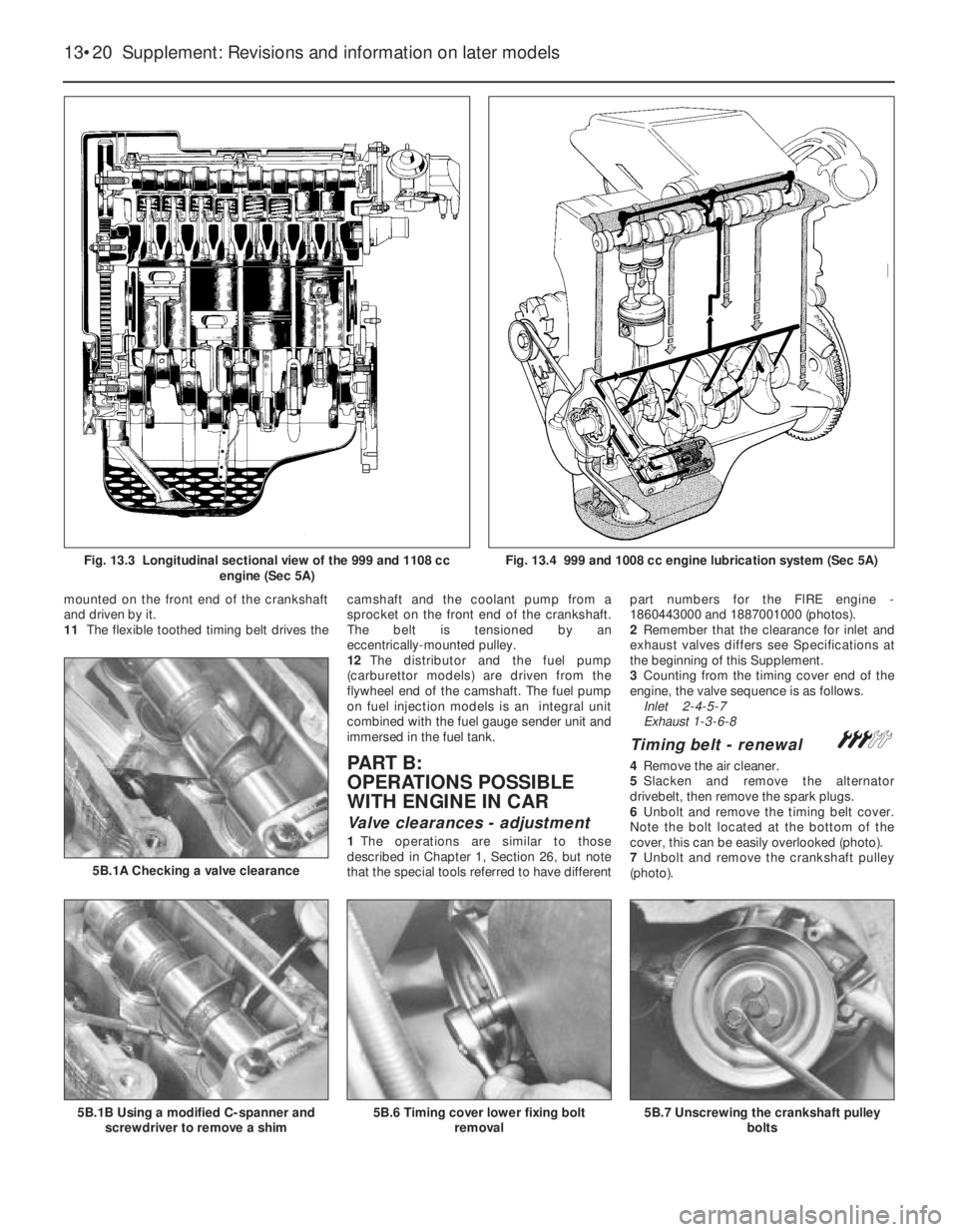
1860443000 and 1887001000 (photos).
2Remember that the clearance for inlet and
exhaust valves differs see Specifications at
the beginning of this Supplement.
3Counting from the timing cover end of the
engine, the valve sequence is as follows.
Inlet 2-4-5-7
Exhaust 1-3-6-8
Timing belt - renewal #
4Remove the air cleaner.
5Slacken and remove the alternator
drivebelt, then remove the spark plugs.
6Unbolt and remove the timing belt cover.
Note the bolt located at the bottom of the
cover, this can be easily overlooked (photo).
7Unbolt and remove the crankshaft pulley
(photo).
13•20 Supplement: Revisions and information on later models
5B.7 Unscrewing the crankshaft pulley
bolts5B.6 Timing cover lower fixing bolt
removal5B.1B Using a modified C-spanner and
screwdriver to remove a shim
5B.1A Checking a valve clearance
Fig. 13.3 Longitudinal sectional view of the 999 and 1108 cc
engine (Sec 5A)Fig. 13.4 999 and 1008 cc engine lubrication system (Sec 5A)
Page 146 of 303
8Turn the crankshaft sprocket bolt, or
engage top gear and raise and turn a front
roadwheel, until the camshaft sprocket TDC
timing mark is aligned with the mark on the
cylinder head and the crankshaft sprocket
timing mark is aligned with the mark on the oil
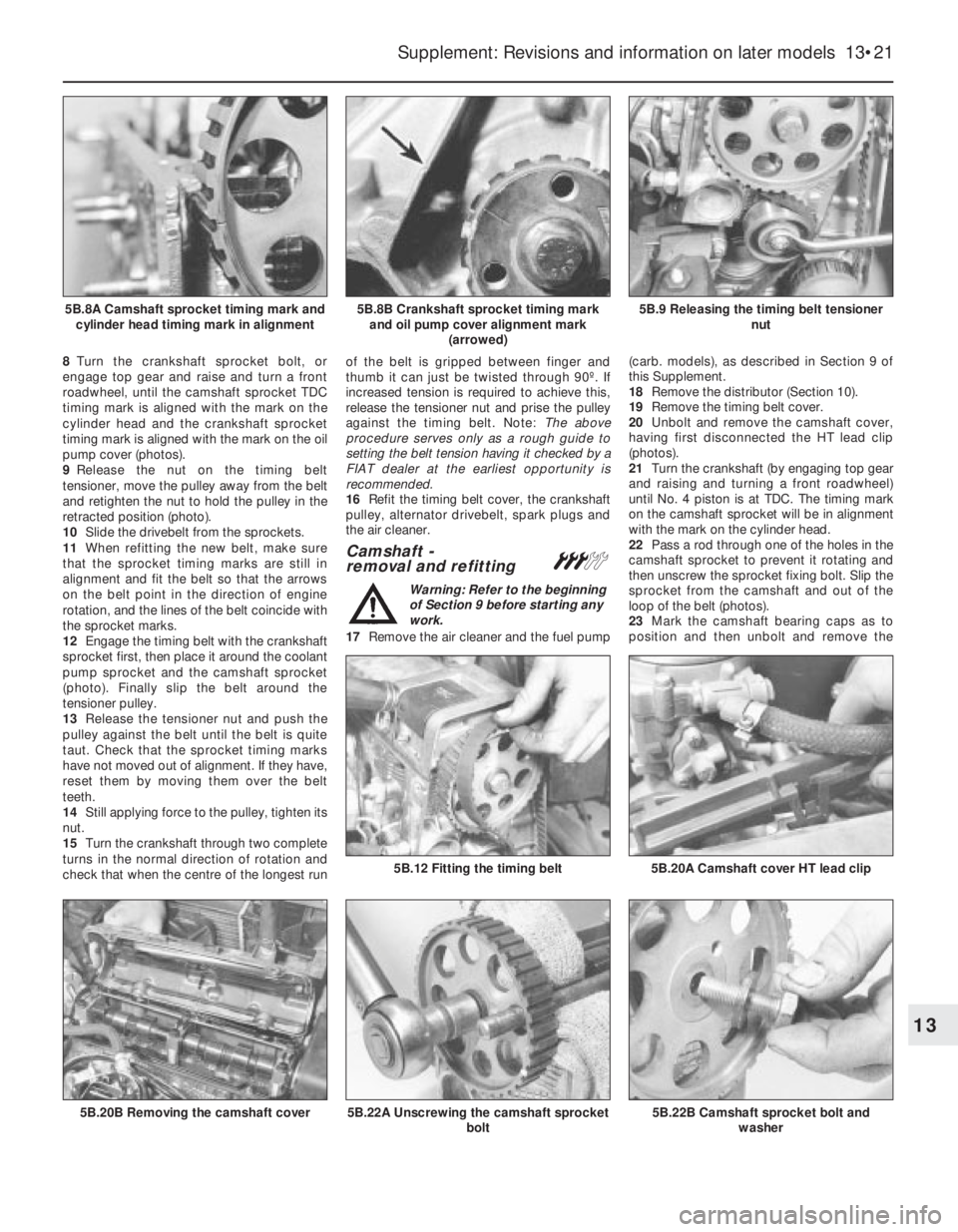
pump cover (photos).
9Release the nut on the timing belt
tensioner, move the pulley away from the belt
and retighten the nut to hold the pulley in the
retracted position (photo).
10Slide the drivebelt from the sprockets.
11When refitting the new belt, make sure
that the sprocket timing marks are still in
alignment and fit the belt so that the arrows
on the belt point in the direction of engine
rotation, and the lines of the belt coincide with
the sprocket marks.
12Engage the timing belt with the crankshaft
sprocket first, then place it around the coolant
pump sprocket and the camshaft sprocket
(photo). Finally slip the belt around the
tensioner pulley.
13Release the tensioner nut and push the
pulley against the belt until the belt is quite
taut. Check that the sprocket timing marks
have not moved out of alignment. If they have,
reset them by moving them over the belt
teeth.
14Still applying force to the pulley, tighten its
nut.
15Turn the crankshaft through two complete
turns in the normal direction of rotation and
check that when the centre of the longest runof the belt is gripped between finger and
thumb it can just be twisted through 90º. If
increased tension is required to achieve this,
release the tensioner nut and prise the pulley
against the timing belt. Note: The above
procedure serves only as a rough guide to
setting the belt tension having it checked by a
FIAT dealer at the earliest opportunity is
recommended.
16Refit the timing belt cover, the crankshaft
pulley, alternator drivebelt, spark plugs and
the air cleaner.
Camshaft -
removal and refitting#
Warning: Refer to the beginning
of Section 9 before starting any
work.
17Remove the air cleaner and the fuel pump(carb. models), as described in Section 9 of
this Supplement.
18Remove the distributor (Section 10).
19Remove the timing belt cover.
20Unbolt and remove the camshaft cover,
having first disconnected the HT lead clip
(photos).
21Turn the crankshaft (by engaging top gear
and raising and turning a front roadwheel)
until No. 4 piston is at TDC. The timing mark
on the camshaft sprocket will be in alignment
with the mark on the cylinder head.
22Pass a rod through one of the holes in the
camshaft sprocket to prevent it rotating and
then unscrew the sprocket fixing bolt. Slip the
sprocket from the camshaft and out of the
loop of the belt (photos).
23Mark the camshaft bearing caps as to
position and then unbolt and remove the
Supplement: Revisions and information on later models 13•21
5B.9 Releasing the timing belt tensioner
nut5B.8B Crankshaft sprocket timing mark
and oil pump cover alignment mark
(arrowed)5B.8A Camshaft sprocket timing mark and
cylinder head timing mark in alignment
5B.22B Camshaft sprocket bolt and
washer5B.22A Unscrewing the camshaft sprocket
bolt
5B.20A Camshaft cover HT lead clip5B.12 Fitting the timing belt
5B.20B Removing the camshaft cover
13
Page 152 of 303
8Disconnect the heater hose from the inlet
manifold.
9On fuel injection models, depressurize the
fuel system (refer to Section 9D). Disconnect
the fuel inlet and return hoses from the fuel
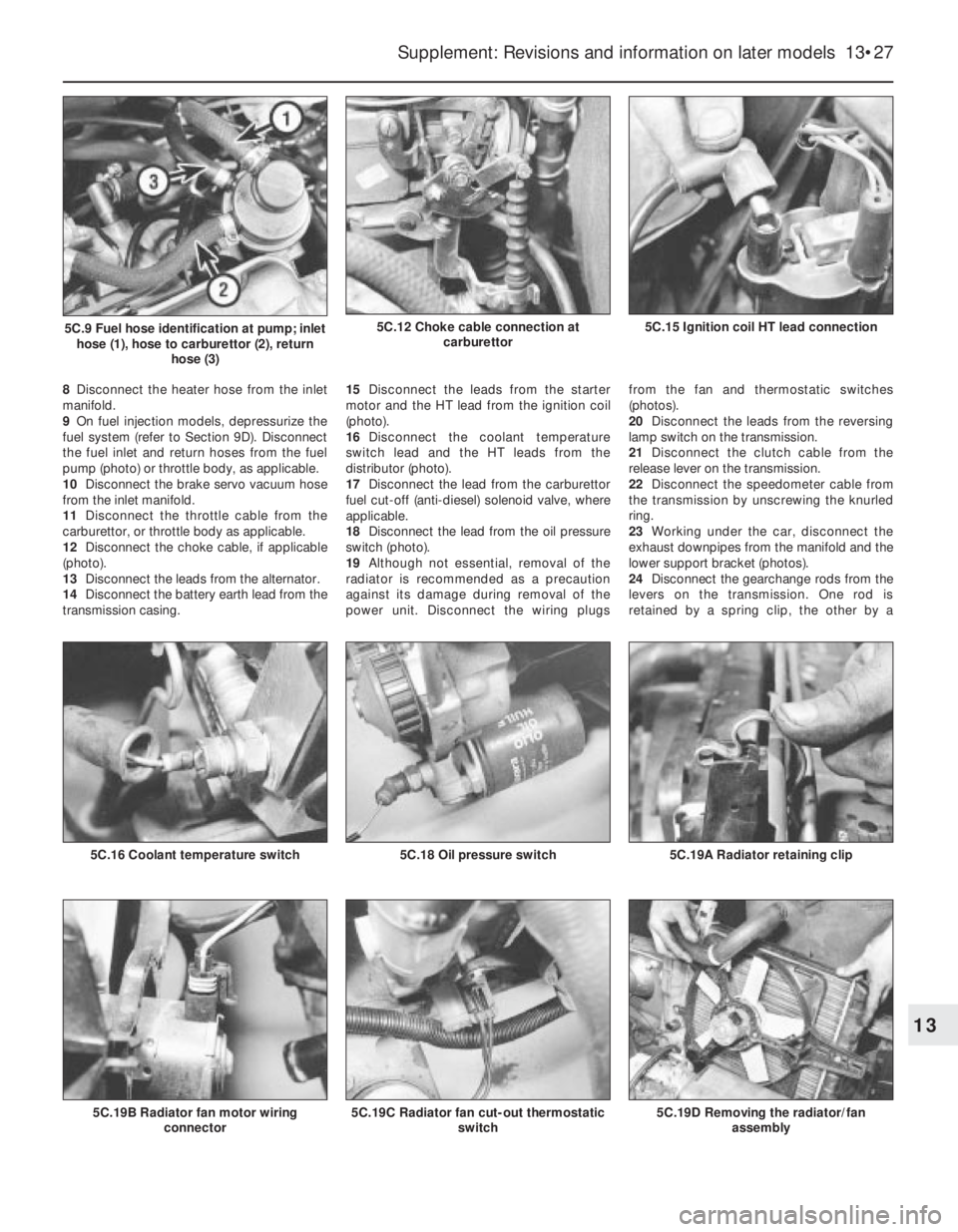
pump (photo) or throttle body, as applicable.
10Disconnect the brake servo vacuum hose
from the inlet manifold.
11Disconnect the throttle cable from the
carburettor, or throttle body as applicable.
12Disconnect the choke cable, if applicable
(photo).
13Disconnect the leads from the alternator.
14Disconnect the battery earth lead from the
transmission casing.15Disconnect the leads from the starter
motor and the HT lead from the ignition coil
(photo).
16Disconnect the coolant temperature
switch lead and the HT leads from the
distributor (photo).
17Disconnect the lead from the carburettor
fuel cut-off (anti-diesel) solenoid valve, where
applicable.
18Disconnect the lead from the oil pressure
switch (photo).
19Although not essential, removal of the
radiator is recommended as a precaution
against its damage during removal of the
power unit. Disconnect the wiring plugs from the fan and thermostatic switches
(photos).
20Disconnect the leads from the reversing
lamp switch on the transmission.
21Disconnect the clutch cable from the
release lever on the transmission.
22Disconnect the speedometer cable from
the transmission by unscrewing the knurled
ring.
23Working under the car, disconnect the
exhaust downpipes from the manifold and the
lower support bracket (photos).
24Disconnect the gearchange rods from the
levers on the transmission. One rod is
retained by a spring clip, the other by a
Supplement: Revisions and information on later models 13•27
5C.15 Ignition coil HT lead connection5C.12 Choke cable connection at
carburettor5C.9 Fuel hose identification at pump; inlet
hose (1), hose to carburettor (2), return
hose (3)
5C.19D Removing the radiator/fan
assembly5C.19C Radiator fan cut-out thermostatic
switch5C.19B Radiator fan motor wiring
connector
5C.19A Radiator retaining clip5C.18 Oil pressure switch5C.16 Coolant temperature switch
13
Page 154 of 303
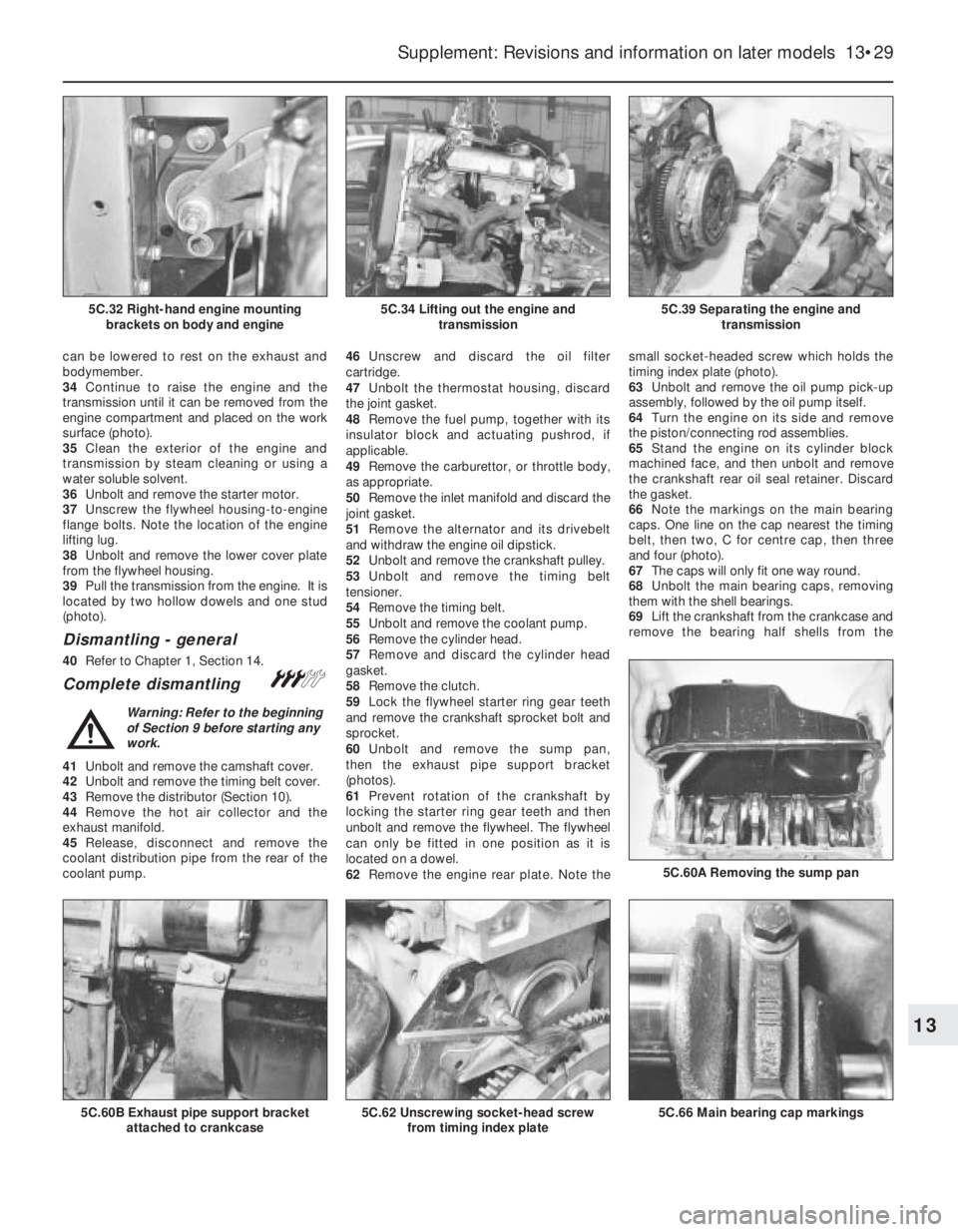
can be lowered to rest on the exhaust and
bodymember.
34Continue to raise the engine and the
transmission until it can be removed from the
engine compartment and placed on the work
surface (photo).
35Clean the exterior of the engine and
transmission by steam cleaning or using a
water soluble solvent.
36Unbolt and remove the starter motor.
37Unscrew the flywheel housing-to-engine
flange bolts. Note the location of the engine
lifting lug.
38Unbolt and remove the lower cover plate
from the flywheel housing.
39Pull the transmission from the engine. It is
located by two hollow dowels and one stud
(photo).
Dismantling - general
40Refer to Chapter 1, Section 14.
Complete dismantling#
Warning: Refer to the beginning
of Section 9 before starting any
work.
41Unbolt and remove the camshaft cover.
42Unbolt and remove the timing belt cover.
43Remove the distributor (Section 10).
44Remove the hot air collector and the
exhaust manifold.
45Release, disconnect and remove the
coolant distribution pipe from the rear of the
coolant pump.46Unscrew and discard the oil filter
cartridge.
47Unbolt the thermostat housing, discard
the joint gasket.
48Remove the fuel pump, together with its
insulator block and actuating pushrod, if
applicable.
49Remove the carburettor, or throttle body,
as appropriate.
50Remove the inlet manifold and discard the
joint gasket.
51Remove the alternator and its drivebelt
and withdraw the engine oil dipstick.
52Unbolt and remove the crankshaft pulley.
53Unbolt and remove the timing belt
tensioner.
54Remove the timing belt.
55Unbolt and remove the coolant pump.
56Remove the cylinder head.
57Remove and discard the cylinder head
gasket.
58Remove the clutch.
59Lock the flywheel starter ring gear teeth
and remove the crankshaft sprocket bolt and
sprocket.
60Unbolt and remove the sump pan,
then the exhaust pipe support bracket
(photos).
61Prevent rotation of the crankshaft by
locking the starter ring gear teeth and then
unbolt and remove the flywheel. The flywheel
can only be fitted in one position as it is
located on a dowel.
62Remove the engine rear plate. Note thesmall socket-headed screw which holds the
timing index plate (photo).
63Unbolt and remove the oil pump pick-up
assembly, followed by the oil pump itself.
64Turn the engine on its side and remove
the piston/connecting rod assemblies.
65Stand the engine on its cylinder block
machined face, and then unbolt and remove
the crankshaft rear oil seal retainer. Discard
the gasket.
66Note the markings on the main bearing
caps. One line on the cap nearest the timing
belt, then two, C for centre cap, then three
and four (photo).
67The caps will only fit one way round.
68Unbolt the main bearing caps, removing
them with the shell bearings.
69Lift the crankshaft from the crankcase and
remove the bearing half shells from the
Supplement: Revisions and information on later models 13•29
5C.39 Separating the engine and
transmission5C.34 Lifting out the engine and
transmission5C.32 Right-hand engine mounting
brackets on body and engine
5C.66 Main bearing cap markings
5C.60A Removing the sump pan
5C.62 Unscrewing socket-head screw
from timing index plate5C.60B Exhaust pipe support bracket
attached to crankcase
13
Page 157 of 303
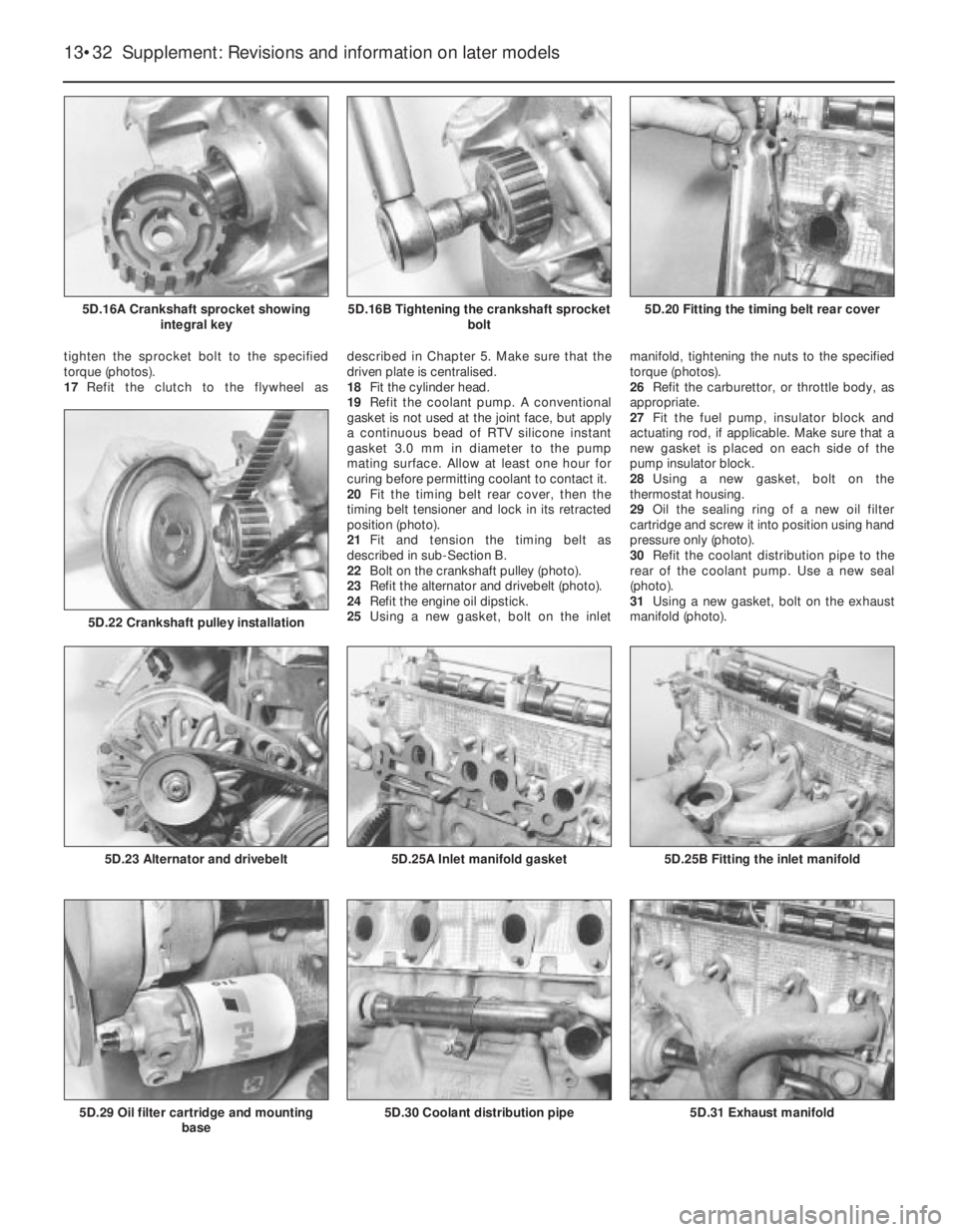
tighten the sprocket bolt to the specified
torque (photos).
17Refit the clutch to the flywheel asdescribed in Chapter 5. Make sure that the
driven plate is centralised.
18Fit the cylinder head.
19Refit the coolant pump. A conventional
gasket is not used at the joint face, but apply
a continuous bead of RTV silicone instant
gasket 3.0 mm in diameter to the pump
mating surface. Allow at least one hour for
curing before permitting coolant to contact it.
20Fit the timing belt rear cover, then the
timing belt tensioner and lock in its retracted
position (photo).
21Fit and tension the timing belt as
described in sub-Section B.
22Bolt on the crankshaft pulley (photo).
23Refit the alternator and drivebelt (photo).
24Refit the engine oil dipstick.
25Using a new gasket, bolt on the inletmanifold, tightening the nuts to the specified
torque (photos).
26Refit the carburettor, or throttle body, as
appropriate.
27Fit the fuel pump, insulator block and
actuating rod, if applicable. Make sure that a
new gasket is placed on each side of the
pump insulator block.
28Using a new gasket, bolt on the
thermostat housing.
29Oil the sealing ring of a new oil filter
cartridge and screw it into position using hand
pressure only (photo).
30Refit the coolant distribution pipe to the
rear of the coolant pump. Use a new seal
(photo).
31Using a new gasket, bolt on the exhaust
manifold (photo).
13•32 Supplement: Revisions and information on later models
5D.31 Exhaust manifold5D.30 Coolant distribution pipe5D.29 Oil filter cartridge and mounting
base
5D.25B Fitting the inlet manifold5D.25A Inlet manifold gasket5D.23 Alternator and drivebelt
5D.22 Crankshaft pulley installation
5D.20 Fitting the timing belt rear cover5D.16B Tightening the crankshaft sprocket
bolt5D.16A Crankshaft sprocket showing
integral key
Page 163 of 303
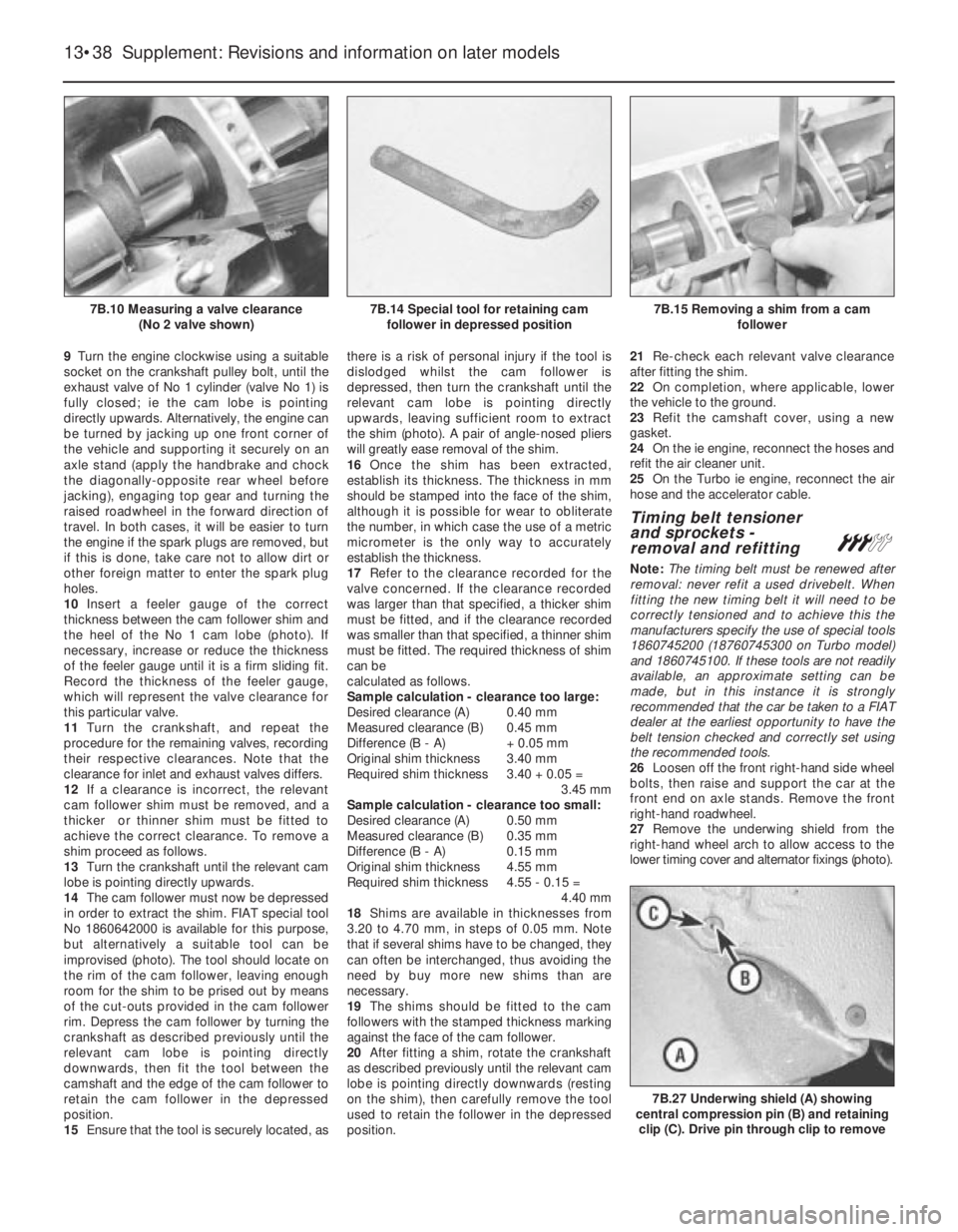
9Turn the engine clockwise using a suitable
socket on the crankshaft pulley bolt, until the
exhaust valve of No 1 cylinder (valve No 1) is
fully closed; ie the cam lobe is pointing
directly upwards. Alternatively, the engine can
be turned by jacking up one front corner of
the vehicle and supporting it securely on an
axle stand (apply the handbrake and chock
the diagonally-opposite rear wheel before
jacking), engaging top gear and turning the
raised roadwheel in the forward direction of
travel. In both cases, it will be easier to turn
the engine if the spark plugs are removed, but
if this is done, take care not to allow dirt or
other foreign matter to enter the spark plug
holes.
10Insert a feeler gauge of the correct
thickness between the cam follower shim and
the heel of the No 1 cam lobe (photo). If
necessary, increase or reduce the thickness
of the feeler gauge until it is a firm sliding fit.
Record the thickness of the feeler gauge,
which will represent the valve clearance for
this particular valve.
11Turn the crankshaft, and repeat the
procedure for the remaining valves, recording
their respective clearances. Note that the
clearance for inlet and exhaust valves differs.
12If a clearance is incorrect, the relevant
cam follower shim must be removed, and a
thicker or thinner shim must be fitted to
achieve the correct clearance. To remove a
shim proceed as follows.
13Turn the crankshaft until the relevant cam
lobe is pointing directly upwards.
14The cam follower must now be depressed
in order to extract the shim. FIAT special tool
No 1860642000 is available for this purpose,
but alternatively a suitable tool can be
improvised (photo). The tool should locate on
the rim of the cam follower, leaving enough
room for the shim to be prised out by means
of the cut-outs provided in the cam follower
rim. Depress the cam follower by turning the
crankshaft as described previously until the
relevant cam lobe is pointing directly
downwards, then fit the tool between the
camshaft and the edge of the cam follower to
retain the cam follower in the depressed
position.
15Ensure that the tool is securely located, asthere is a risk of personal injury if the tool is
dislodged whilst the cam follower is
depressed, then turn the crankshaft until the
relevant cam lobe is pointing directly
upwards, leaving sufficient room to extract
the shim (photo). A pair of angle-nosed pliers
will greatly ease removal of the shim.
16Once the shim has been extracted,
establish its thickness. The thickness in mm
should be stamped into the face of the shim,
although it is possible for wear to obliterate
the number, in which case the use of a metric
micrometer is the only way to accurately
establish the thickness.
17Refer to the clearance recorded for the
valve concerned. If the clearance recorded
was larger than that specified, a thicker shim
must be fitted, and if the clearance recorded
was smaller than that specified, a thinner shim
must be fitted. The required thickness of shim
can be
calculated as follows.
Sample calculation - clearance too large:
Desired clearance (A) 0.40 mm
Measured clearance (B) 0.45 mm
Difference (B - A) + 0.05 mm
Original shim thickness 3.40 mm
Required shim thickness 3.40 + 0.05 =
3.45 mm
Sample calculation - clearance too small:
Desired clearance (A) 0.50 mm
Measured clearance (B) 0.35 mm
Difference (B - A) 0.15 mm
Original shim thickness 4.55 mm
Required shim thickness 4.55 - 0.15 =
4.40 mm
18Shims are available in thicknesses from
3.20 to 4.70 mm, in steps of 0.05 mm. Note
that if several shims have to be changed, they
can often be interchanged, thus avoiding the
need by buy more new shims than are
necessary.
19The shims should be fitted to the cam
followers with the stamped thickness marking
against the face of the cam follower.
20After fitting a shim, rotate the crankshaft
as described previously until the relevant cam
lobe is pointing directly downwards (resting
on the shim), then carefully remove the tool
used to retain the follower in the depressed
position.21Re-check each relevant valve clearance
after fitting the shim.
22On completion, where applicable, lower
the vehicle to the ground.
23Refit the camshaft cover, using a new
gasket.
24On the ie engine, reconnect the hoses and
refit the air cleaner unit.
25On the Turbo ie engine, reconnect the air
hose and the accelerator cable.
Timing belt tensioner
and sprockets -
removal and refitting
#
Note: The timing belt must be renewed after
removal: never refit a used drivebelt. When
fitting the new timing belt it will need to be
correctly tensioned and to achieve this the
manufacturers specify the use of special tools
1860745200 (18760745300 on Turbo model)
and 1860745100. If these tools are not readily
available, an approximate setting can be
made, but in this instance it is strongly
recommended that the car be taken to a FIAT
dealer at the earliest opportunity to have the
belt tension checked and correctly set using
the recommended tools.
26Loosen off the front right-hand side wheel
bolts, then raise and support the car at the
front end on axle stands. Remove the front
right-hand roadwheel.
27Remove the underwing shield from the
right-hand wheel arch to allow access to the
lower timing cover and alternator fixings (photo).
13•38 Supplement: Revisions and information on later models
7B.27 Underwing shield (A) showing
central compression pin (B) and retaining
clip (C). Drive pin through clip to remove
7B.15 Removing a shim from a cam
follower7B.14 Special tool for retaining cam
follower in depressed position7B.10 Measuring a valve clearance
(No 2 valve shown)
Page 164 of 303
28Loosen off the retaining clips and detach
the air intake pipe from the air filter.
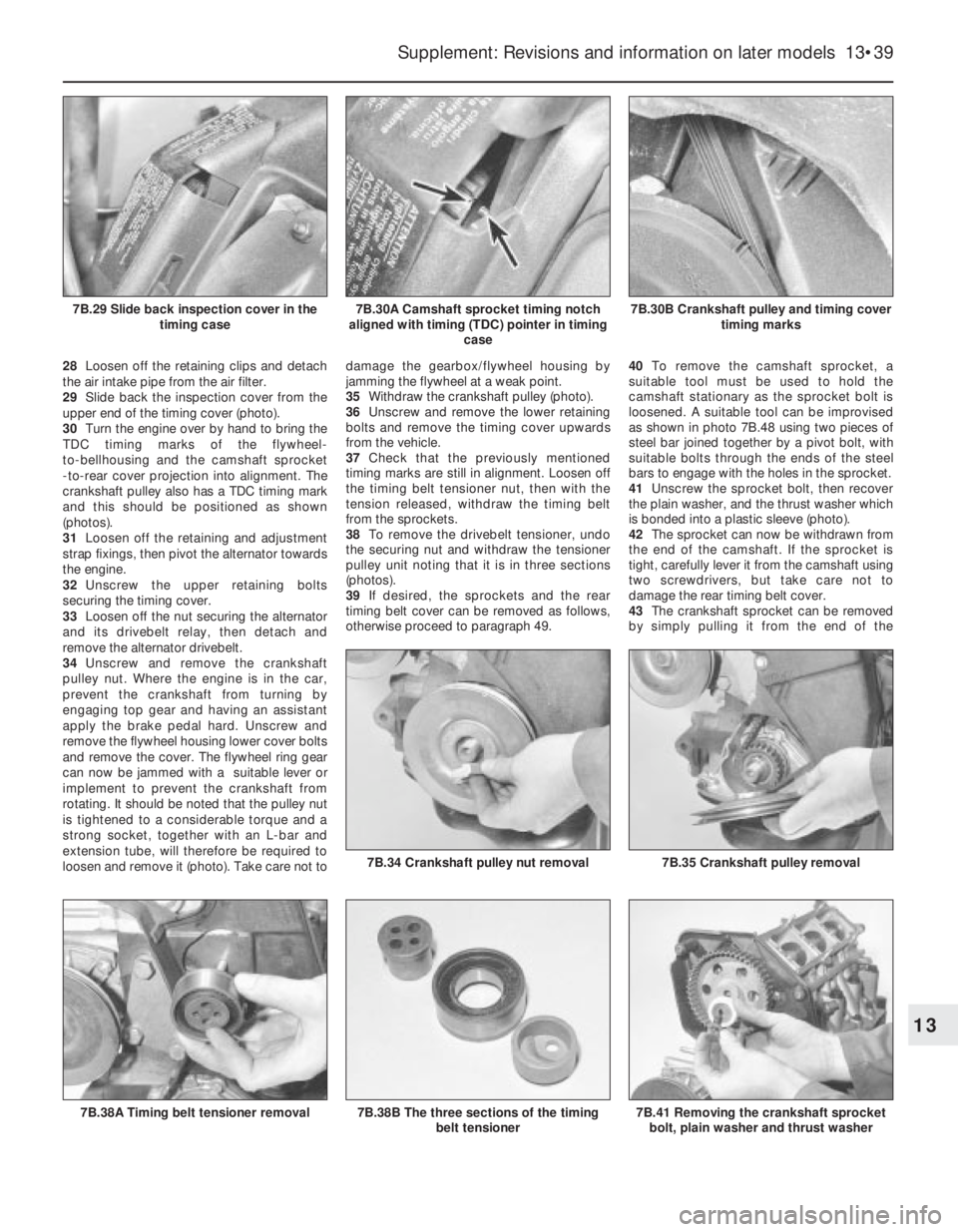
29Slide back the inspection cover from the
upper end of the timing cover (photo).
30Turn the engine over by hand to bring the
TDC timing marks of the flywheel-
to-bellhousing and the camshaft sprocket
-to-rear cover projection into alignment. The
crankshaft pulley also has a TDC timing mark
and this should be positioned as shown
(photos).
31Loosen off the retaining and adjustment
strap fixings, then pivot the alternator towards
the engine.
32Unscrew the upper retaining bolts
securing the timing cover.
33Loosen off the nut securing the alternator
and its drivebelt relay, then detach and
remove the alternator drivebelt.
34Unscrew and remove the crankshaft
pulley nut. Where the engine is in the car,
prevent the crankshaft from turning by
engaging top gear and having an assistant
apply the brake pedal hard. Unscrew and
remove the flywheel housing lower cover bolts
and remove the cover. The flywheel ring gear
can now be jammed with a suitable lever or
implement to prevent the crankshaft from
rotating. It should be noted that the pulley nut
is tightened to a considerable torque and a
strong socket, together with an L-bar and
extension tube, will therefore be required to
loosen and remove it (photo). Take care not todamage the gearbox/flywheel housing by
jamming the flywheel at a weak point.
35Withdraw the crankshaft pulley (photo).
36Unscrew and remove the lower retaining
bolts and remove the timing cover upwards
from the vehicle.
37Check that the previously mentioned
timing marks are still in alignment. Loosen off
the timing belt tensioner nut, then with the
tension released, withdraw the timing belt
from the sprockets.
38To remove the drivebelt tensioner, undo
the securing nut and withdraw the tensioner
pulley unit noting that it is in three sections
(photos).
39If desired, the sprockets and the rear
timing belt cover can be removed as follows,
otherwise proceed to paragraph 49.40To remove the camshaft sprocket, a
suitable tool must be used to hold the
camshaft stationary as the sprocket bolt is
loosened. A suitable tool can be improvised
as shown in photo 7B.48 using two pieces of
steel bar joined together by a pivot bolt, with
suitable bolts through the ends of the steel
bars to engage with the holes in the sprocket.
41Unscrew the sprocket bolt, then recover
the plain washer, and the thrust washer which
is bonded into a plastic sleeve (photo).
42The sprocket can now be withdrawn from
the end of the camshaft. If the sprocket is
tight, carefully lever it from the camshaft using
two screwdrivers, but take care not to
damage the rear timing belt cover.
43The crankshaft sprocket can be removed
by simply pulling it from the end of the
Supplement: Revisions and information on later models 13•39
7B.30B Crankshaft pulley and timing cover
timing marks7B.30A Camshaft sprocket timing notch
aligned with timing (TDC) pointer in timing
case7B.29 Slide back inspection cover in the
timing case
7B.41 Removing the crankshaft sprocket
bolt, plain washer and thrust washer7B.38B The three sections of the timing
belt tensioner
7B.35 Crankshaft pulley removal7B.34 Crankshaft pulley nut removal
7B.38A Timing belt tensioner removal
13