1982 CHEVROLET CAMARO drain bolt
[x] Cancel search: drain boltPage 422 of 875

GM – CAMARO 1982-1992 – Repair Guide (Checked by WxMax) 422
4. Drain the engine oil.
CAUTION
- Be sure that the catalytic c onverter is cool before proceeding.
5. Remove the air injection pipe at t he catalytic converter, if applicable.
6. Remove the catalytic converte r hanger bolts. Disconnect the exhaust
pipe at the manifold.
7. Remove the starter bolts, loosen t he starter brace, then lay the starter
aside.
8. Remove the front engine mount through-bolts.
9. Raise the engine enough to provide sufficient clearance for oil pan
removal.
10. Remove the oil pan bolts.
If the front crankshaft throw prohibits remo val of the pan, turn the crankshaft to
position the throw horizontally.
11. Remove the oil pan from the vehicle.
12. Remove the old RTV sealant or gasket from the oil pan and engine
block.
To install: 13. Run a
1/8 in. (3mm) bead of RTV around the oil pan sealing surface or
install a new gasket. Remember to keep the RTV on the INSIDE of the
bolt holes.
14. Install the pan and pan bolts. Torque the pan bolts to:
• 2.8L & 3.1L V6 (M6 x 1 X 16.0 bolts): 6-9 ft. lbs. (8-12 Nm)
• 2.8L & 3.1L V6 (M8 x 1.25 x 14.0 bolts ): 15-22 ft. lbs. (20-30 Nm)
• 1982-84 V8 engine (5/16-18 bolts): 165 inch lbs. (10 Nm)
• 1982-84 V8 engine (1/4-20 bolts): 80 inch lbs. (8 Nm)
• 1985 V8 engine (5/16-18 x 1.44 studs): minimum of 10 inch lbs.
• 1985 V8 engine (stud nuts): 150- 180 inch lbs. (17-20 Nm)
• 1985 V8 engine (1/4-20 x 0.56 bolts): 72-90 inch lbs. (8-10 Nm)
• 1985 V8 engine (1/4-20 x 0.50 x 0.56 studs): 72-90 inch lbs. (8-10
Nm)
• 1986-92 V8 engine (stud nuts): 150-250 inch lbs. (17-28 Nm)
• 1986-92 V8 engine (1/4-20 x 0.56 bolts): 72-130 inch lbs. (8-14
Nm)
• 1986-92 V8 engine (1/4-20 x 0.50 x 0.56 studs ): 72-130 inch lbs.
(8-14 Nm)
15. Lower the engine and install t he front engine mount through-bolts.
Torque bolts to 48 ft. lbs. (65 Nm).
16. Install the starter and starter brace, then secure using starter bolts.
17. Connect the exhaust pipe at the manifo ld. Install the catalytic converter
hanger bolts.
18. Install the air injection pipe at the catalytic converter.
19. Lower the vehicle.
20. Install the fan shroud assembly . Install the distributor cap.
21. Connect the negative battery cable at the battery and air cleaner.
Page 423 of 875
GM – CAMARO 1982-1992 – Repair Guide (Checked by WxMax) 423
22. Fill the engine with engine oil.
23. Start the engine and
check for leaks.
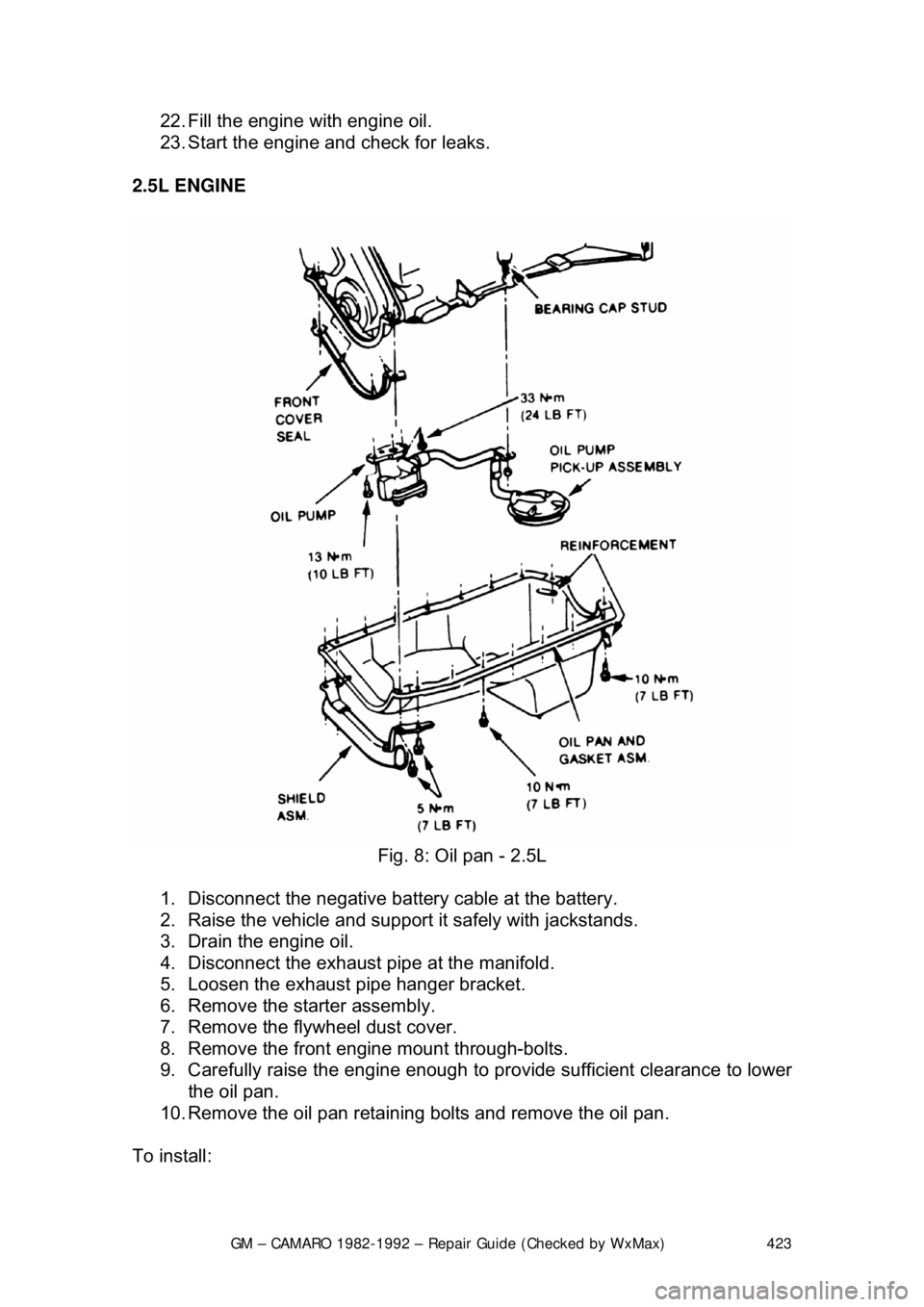
2.5L ENGINE
Fig. 8: Oil pan - 2.5L
1. Disconnect the negative batte ry cable at the battery.
2. Raise the vehicle and support it safely with jackstands.
3. Drain the engine oil.
4. Disconnect the exhaust pipe at the manifold.
5. Loosen the exhaust pipe hanger bracket.
6. Remove the starter assembly.
7. Remove the flywheel dust cover.
8. Remove the front engine mount through-bolts.
9. Carefully raise the engine enough to provide sufficient clearance to lower
the oil pan.
10. Remove the oil pan retaining bolts and remove the oil pan.
To install:
Page 425 of 875

GM – CAMARO 1982-1992 – Repair Guide (Checked by WxMax) 425
1. Drain and remove the oil pan.
CAUTION - The EPA warns that prolonged contact with used engine oil may
cause a number of skin disorders, incl uding cancer! You should make every
effort to minimize your exposure to used engine oil. Pr otective gloves should be
worn when changing the oil. Wash y our hands and any other exposed skin
areas as soon as possible after exposure to used engine oil. Soap and water, or
waterless hand cleaner should be used.
2. Remove the oil pump-to-rear main bearing cap bolt. Remove the pump
and the extension shaft.
3. Remove the cotter pin, spring and pressure regulator valve.
Place your thumb over the pressure r egulators bore before removing the cotter
pin, as the spring is under pressure.
To install: 4. Assemble pump and extension shaft to rear main bearing cap, aligning
slot on top end of extension shaft with drive tang on lower end of
distributor driveshaft.
When assembling the driveshaft extensi on to the driveshaft, the end of the
extension nearest the washers must be inserted into the driveshaft.
5. Insert the driveshaft extension through the opening in the main bearing
cap and block until the shaft mates in to the distributor drive gear.
6. Install the pump onto t he rear main bearing cap and install the attaching
bolts. Torque the bolts to specifications:
• L4 engines: 22 ft lbs. (30 Nm)
• V6 engines: 25-35 ft lbs. (35-47 Nm)
• V8 engines: 65 ft lbs. (88 Nm)
7. Install the oil pan and fill t he crankcase with engine oil.
CRANKSHAFT DAMPER
REMOVAL & INSTALLATION
Page 428 of 875

GM – CAMARO 1982-1992 – Repair Guide (Checked by WxMax) 428
1. Disconnect the battery ground c
able. Drain the cooling system.
2. Remove the fan shroud or the upper radiator support and drive belts.
Remove the fan and pulley from the water pump.
3. Remove the alternator upper and lower brackets, air brace with brackets,
and power steering lower bra cket (move it aside).
4. Remove the radiator lower hose and the heater hose from the water
pump. Remove the water pump bolts and the water pump.
5. If A/C equipped, remove the comp ressor and move aside. Remove the
compressor mounting bracket.
6. Remove the damper pulley retain ing bolt and the damper pulley.
7. Remove the timing gear cover bolts and the timing gear cover.
With the timing gear cover removed, use a large screwdriver to pry the oil seal
from the cover. To install the new oil se al, lubricate it with engine oil and drive it
into place.
To install: 8. Prepare the mating surfaces for reinst allation of the timing gear cover.
Coat the new gasket with RTV sealer.
9. Install the timing gear cover and timing gear cover bolts. Torque the
cover bolts to specifications:
• V6 engines (M8 x 1.25 bolts): 13-22 ft. lbs. (18-30 Nm)
• V6 engines (M10 x 1.5 bolts): 20-35 ft. lbs. (27-48 Nm)
• V8 engines (all bolts): 69-130 inch lbs. (8-14 Nm)
10. Install the damper pulley by pulli ng the damper onto the crankshaft. Use
tool J-23523 or equivalent. Install t he damper pulley retaining bolt and
torque bolts to 67-85 ft lbs. (90-110 Nm).
11. If A/C equipped, install the compressor mounting bracket and
compressor.
12. Install the water pump and the water pump bolts.
13. Install the radiator lower hose and the heater hose to the water pump.
14. Install the alternator upper and lower brackets, air brace with brackets
and the power steering lower bracket.
15. Install the fan and pull ey to the water pump. Inst all the fan shroud or the
upper radiator support and drive belts and adjust.
16. Connect the battery ground cable.
17. Fill the cooling syst em, start the engine and check for leaks.
Page 435 of 875
GM – CAMARO 1982-1992 – Repair Guide (Checked by WxMax) 435
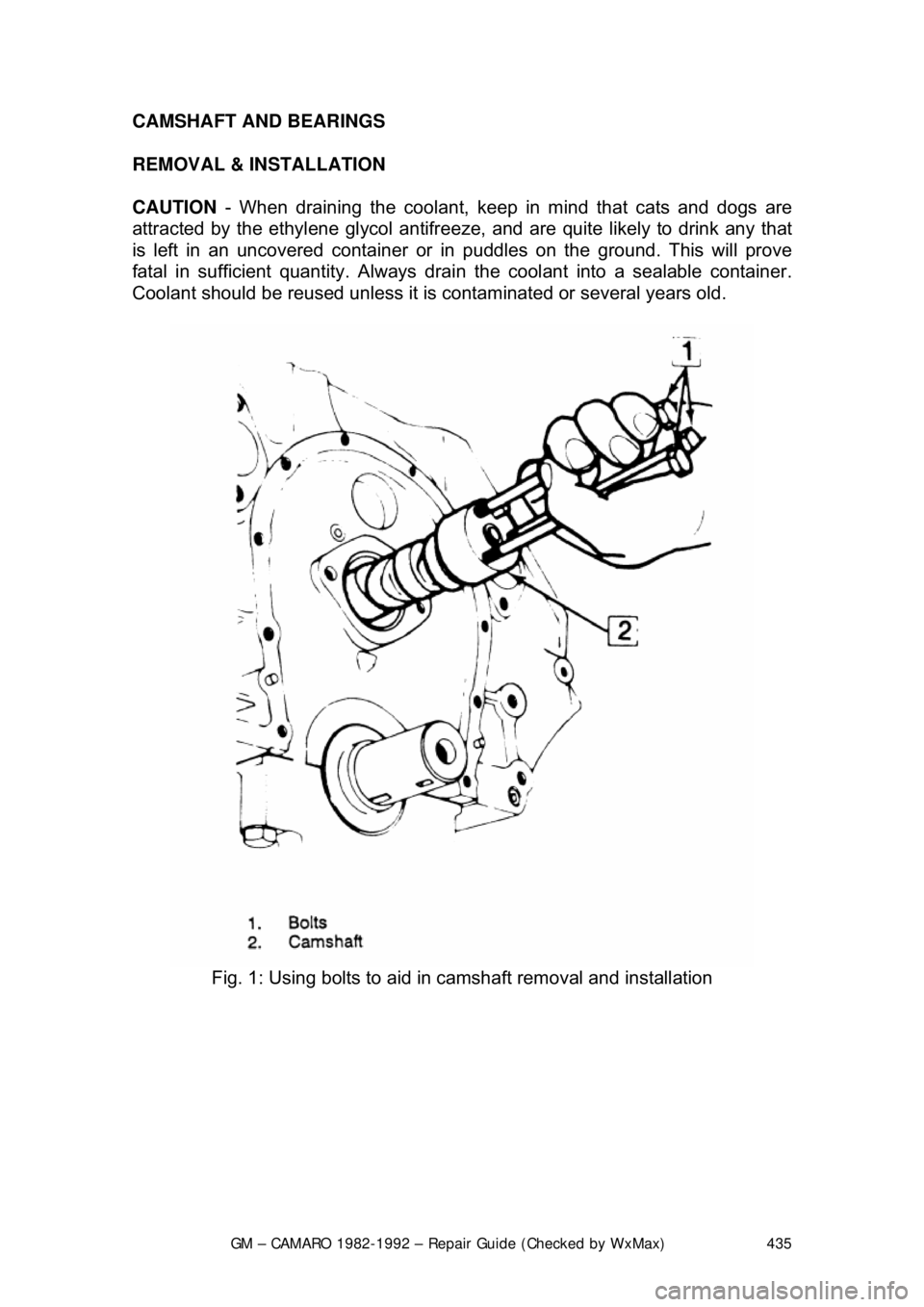
CAMSHAFT AND BEARINGS
REMOVAL & INSTALLATION
CAUTION - When draining the coolant, keep in mind that cats and dogs are
attracted by the ethylene gl ycol antifreeze, and are quite likely to drink any that
is left in an uncovered container or in puddles on the ground. This will prove
fatal in sufficient quantity. Always drai n the coolant into a sealable container.
Coolant should be reused unless it is contaminated or several years old.
Fig. 1: Using bolts to aid in camshaft removal and installation
Page 456 of 875

GM – CAMARO 1982-1992 – Repair Guide (Checked by WxMax) 456
2. Drain the engine oil and remove the oil pan.
3. Remove the rear main bearing cap.
4. Insert packing tool J-29114-2 or equi
valent, against 1 end of the seal in
the cylinder block. Drive the old seal gently into the groove until it is
packed tight. This will vary from
1/4 in. (6mm) to 3/4 in. (19mm) depending
on the amount of pack required.
5. Repeat the procedure on t he other end of the seal.
6. Measure the amount the seal wa s driven up on one side and add
1/16 in.
(1.6mm). Using a suitable cutting tool, cut that length from the old seal
removed from the rear main beari ng cap. Repeat the procedure for the
other side. Use the rear main bear ing cap as a holding fixture when
cutting the seal.
7. Install guide tool J-29114-1 or equi valent, onto the cylinder block.
8. Using the packing tool, work the shor t pieces cut in Step 6 into the guide
tool and then pack into the cylinder block. The guide tool and packing
tool are machined to provide a built in stop. Use this procedure for both
sides. It may help to use oil on the short pieces of the rope seal when \
packing them into the cylinder block.
9. Remove the guide tool.
10. Apply Loctite® 414 or equivalent, to the seal groove in the rear main
bearing cap. Within 1 minute, insert a new seal into the groove and push
into place with tool J-29590 until the seal is flush with the block. Cut the
excess seal material with a sharp cu tting tool at the bearing cap parting
line.
11. Apply a thin film of chassis grease to the rope se al. Apply a thin film of
RTV sealant on the bearing cap mati ng surface around the seal groove.
Use the sealer sparingly.
12. Plastigage® the rear main bea ring cap as outlined in MEASURING
REAR MAIN CLEARANCE in this section and check with specification. If
out of specification, check for fr ying of the rope seal which may be
causing the cap to not seat properly.
13. Install all remaining com ponents and inspect for leaks.
FLYWHEEL AND RING GEAR
REMOVAL & INSTALLATION
The ring gear is an integral part of the flywheel and is not replaceable.
1. Remove the transmission.
2. Remove the six bolts attaching t he flywheel to the crankshaft flange.
Remove the flywheel.
3. Inspect the flywheel for cracks, and inspect the ring gear for burrs or
worn teeth. Replace the flywheel if any damage is apparent. Remove
burrs with a mill file.
4. Install the flywheel. Th e flywheel will only attach to the crankshaft in one
position, as the bolt holes are unevenly spaced. Install the bolts and
torque to specification. Tighten bolts in crisscross pattern.
Page 476 of 875

GM – CAMARO 1982-1992 – Repair Guide (Checked by WxMax) 476
Before attempting to repair a threaded
hole, remove any snapped, broken or
damaged bolts or studs. Penetrating oil ca n be used to free frozen threads. The
offending item can usually be removed with locking pliers or using a screw/stud
extractor. After the hole is clear, the thread can be repaired, as shown in the
series of accompanying illustrations and in the kit manufacturer's instructions.
ENGINE PREPARATION
To properly rebuild an engine, you must fi rst remove it from the vehicle, then
disassemble and diagnose it. Ideally you should place your engine on an engine
stand. This affords you the best access to the engine components. Follow the
manufacturer's directions for using the stand with your particular engine.
Remove the flywheel or fl explate before installing the engine to the stand.
Now that you have the engine on a stand, and assuming that you have drained
the oil and coolant from the engine, it's ti me to strip it of all but the necessary
components. Before you start disassembli ng the engine, you may want to take
a moment to draw some pictures, or fabr icate some labels or containers to mark
the locations of various components and the bolts and/or studs which fasten
them. Modern day engines use a lot of littl e brackets and clips which hold wiring
harnesses and such, and these holders are often mounted on studs and/or bolts
that can be easily mixed up. The manufacturer spent a lot of time and money
designing your vehicle, and they wouldn't have wasted any of it by haphazardly
placing brackets, clips or fasteners on t he vehicle. If it's present when you
disassemble it, put it back when you asse mble, you will regret not remembering
that little bracket which holds a wire har ness out of the path of a rotating part.
You should begin by unbolting any accessories still attached to the engine, such
as the water pump, power steering pump, alternator, etc. Then, unfasten any
manifolds (intake or exhaust) which were not removed during the engine
removal procedure. Finally, remove any covers remaining on the engine such
as the rocker arm, front or timing cove r and oil pan. Some front covers may
require the vibration dam per and/or crank pulley to be removed beforehand.
The idea is to reduce the engine to the bar e necessities (cylinder head(s), valve
train, engine block, crankshaft, pistons and connecting rods), plus any other 'in
block' components such as oil pumps, balance shafts and auxiliary shafts.
Finally, remove the cylinder head(s) from the engine block and carefully place
on a bench. Disassembly instructions fo r each component follow later in this
section.
CYLINDER HEAD
There are two basic types of cylinder heads used on today’s automobiles:
the Overhead Valve (OHV) and the Over head Camshaft (OHC). The latter can
also be broken down into two subgr oups: the Single Overhead Camshaft
(SOHC) and the Dual Overhead Camshaft (DO HC). Generally, if there is only a
single camshaft on a head, it is just referred to as an OHC head. Also, an
engine with a OHV cylinder head is also known as a pushrod engine.
Page 701 of 875

GM – CAMARO 1982-1992 – Repair Guide (Checked by WxMax) 701
Fig. 32: Throttle position sensor adjusting screw location on E4ME/E4MC
carburetors
REMOVAL & INSTALLATION
Always replace all internal gaskets that are removed. Flooding, stumble on
acceleration and other performance comp laints are in many instances, caused
by presence of dirt, water, or other foreign matter in carburetor. To aid in
diagnosis, carburetor should be carefully removed from engine without draining
fuel from bowl. Contents of fuel bowl may then be examined for contamination
as carburetor is disassembl ed. Check the fuel filter.
ROCHESTER E2SE 1. Remove air cleaner and gasket.
2. Disconnect fuel pipe and vacuum lines.
3. Disconnect electrical connectors.
4. Disconnect accelerator linkage.
5. If equipped with automatic transmi ssion, disconnect downshift cable.
6. If equipped with cruise c ontrol, disconnect linkage.
7. Remove carburetor attaching bolts.
8. Remove carburetor and EF E heater/insulator (if used).
9. Inspect EFE heater/insulator for damage. Be certain throttle body and
EFE heater/insulator surfaces are clean.
To install: 10. Install EFE heater/insulator.
11. Install carburetor and tighten nuts alternately to the correct torque.
12. Connect downshift cable, as required.
13. Attach the cruise cont rol cable, as required.
14. Connect accelerator linkage.
15. Connect electrical connections.