1982 CHEVROLET CAMARO oil type
[x] Cancel search: oil typePage 491 of 875

GM – CAMARO 1982-1992 – Repair Guide (Checked by WxMax) 491
The first step for any assembly job is
to have a clean area in which to work.
Next, thoroughly clean all of the parts and components that are to be
assembled. Finally, place all of the co mponents onto a suitable work space and,
if necessary, arrange the parts to their respective positions.
1. Lightly lubricate the valve stems and insert all of the valves into the
cylinder head. If possible, maintain their original locations.
2. If equipped, install any valve spring shims which were removed.
3. If equipped, install the new valve seal s, keeping the following in mind:
• If the valve seal presses over the guide, lightly lubricate the outer
guide surfaces.
• If the seal is an O-ring type, it is installed just after compressing
the spring but before the valve locks.
4. Place the valve spring and retainer over the stem.
5. Position the spring compressor tool and compress the spring.
6. Assemble the valv e locks to the stem.
7. Relieve the spring pressure slowly and insure that neither valve lock
becomes dislodged by the retainer.
8. Remove the spring compressor tool.
9. Repeat Steps 2 through 8 until all of the springs have been installed.
ENGINE BLOCK
GENERAL INFORMATION
A thorough overhaul or rebuild of an engine block would include replacing the
pistons, rings, bearings, timing belt/chai n assembly and oil pump. For OHV
engines also include a new camshaft and lifters. The block would then have the
cylinders bored and honed oversize (or if using removable cylinder sleeves,
new sleeves installed) and the cranksha ft would be cut undersize to provide
new wearing surfaces and per fect clearances. However, your particular engine
may not have everything worn out. What if only the piston rings have worn out
and the clearances on everything else are still within factory specifications?
Well, you could just replace the rings and put it back together, but this would be
a very rare example. Chances are, if one component in your engine is worn,
other components are sure to follow, and soon. At the very least, you should
always replace the rings, bearings and oil pump. This is what is commonly
called a "freshen up".
CYLINDER RIDGE REMOVAL
Because the top piston ring does not travel to the very top of the cylinder, a
ridge is built up between the end of the trav el and the top of the cylinder bore.
Pushing the piston and connecting rod assembly past the ridge can be difficult,
and damage to the piston ring lands could occur. If the ridge is not removed
before installing a new piston or not re moved at all, piston ring breakage and
piston damage may occur.
Page 492 of 875

GM – CAMARO 1982-1992 – Repair Guide (Checked by WxMax) 492
It is always recommended that you remo
ve any cylinder ridges before removing
the piston and connecting rod assemblies . If you know that new pistons are
going to be installed and the engine bl ock will be bored oversize, you may be
able to forego this step. However, some ridges may actually prevent the
assemblies from being remove d, necessitating its removal.
There are several different types of ridge reamers on the market, none of which
are inexpensive. Unless a great deal of engine rebuild ing is anticipated, borrow
or rent a reamer.
1. Turn the crankshaft until the piston is at the bottom of its travel.
2. Cover the head of the piston with a rag.
3. Follow the tool manufacturers in structions and cut away the ridge,
exercising extreme care to avoid cutting too deeply.
4. Remove the ridge reamer, the r ag and as many of the cuttings as
possible. Continue until all of the cylinder ridges have been removed.
DISASSEMBLY
The engine disassembly instructions fo llowing assume that you have the engine
mounted on an engine stand. If not, it is easiest to disassemble the engine on a
bench or the floor with it resting on t he bellhousing or transmission mounting
surface. You must be able to access the connecting rod fasteners and turn the
crankshaft during disassembly. Also, all en gine covers (timing, front, side, oil
pan, whatever) should have already been removed. Engines which are seized
or locked up may not be able to be co mpletely disassembled, and a core
(salvage yard) engine should be purchased.
If not done during the cylinder head removal, remove the pushrods and li\
fters,
keeping them in order for assembly. Remove the timing gears and/or timing
chain assembly, then remove the oil pu mp drive assembly and withdraw the
camshaft from the engine block. Remove the oil pick-up and pump assembly. If
equipped, remove any balanc e or auxiliary shafts. If necessary, remove the
cylinder ridge from the top of the bore. See the cylinder ridge removal
procedure earlier in this section.
Rotate the engine over so that the cr ankshaft is exposed. Use a number punch
or scribe and mark each connecting rod wit h its respective cylinder number. The
cylinder closest to the front of t he engine is always number 1. However,
depending on the engine placemen t, the front of the engine could either be the
flywheel or damper/pulley end. Generally the front of the engine faces the front
of the vehicle. Use a number punch or scribe and also mark the main bearing
caps from front to rear wit h the front most cap being nu mber 1 (if there are five
caps, mark them 1 through 5, front to rear).
Page 500 of 875

GM – CAMARO 1982-1992 – Repair Guide (Checked by WxMax) 500
within specifications, install new bear
ings in the rod and take another
measurement. If the clearance is still out of specifications, and the crankshaft is
not, the rod will need to be reconditioned by a machine shop.
You can also use Plastigage to check the bearing clearances. The assembling
section has complete instructions on its use.
CAMSHAFT
Inspect the camshaft and lifters/followers as described earlier in this section.
BEARINGS
All of the engine bearings should be visua lly inspected for wear and/or damage.
The bearing should look evenly worn a ll around with no deep scores or pits. If
the bearing is severely worn, scored, pi tted or heat blued, then the bearing, and
the components that use it, should be brought to a machine shop for inspection.
Full-circle bearings (used on most camshafts, auxiliary shafts, balance shafts,
etc.) require specialized tools for re moval and installation, and should be
brought to a machine shop for service.
OIL PUMP
The oil pump is responsible for provid ing constant lubrication to the whole
engine and so it is re commended that a new oil pump be installed when
rebuilding the engine.
Completely disassemble the oil pump and thoroughly clean all of the
components. Inspect the oil pump gears and housing for wear and/or damage.
Insure that the pressure relief valve oper ates properly and there is no binding or
sticking due to varnish or debris. If all of the parts are in proper working
condition, lubricate the gears and relie f valve, and assemble the pump.
REFINISHING
Almost all engine block refinishing must be performed by a machine shop. If the
cylinders are not to be rebored, then t he cylinder glaze can be removed with a
ball hone. When removing cylinder glaz e with a ball hone, use a light or
penetrating type oil to lubricate the hone. Do not allow the hone to run dry as
this may cause excessive scoring of t he cylinder bores and wear on the hone. If
new pistons are required, t hey will need to be installed to the connecting rods.
This should be performed by a machine shop as the pistons must be installed in
the correct relationship to the rod or engine damage can occur.
Page 626 of 875

GM – CAMARO 1982-1992 – Repair Guide (Checked by WxMax) 626
ENGINE PERFORMANCE AND TUNE-UP
TUNE-UP PROCEDURES
In order to extract the full measure of performance and economy from your
engine it is essential that it is properly tuned at regul ar intervals. A regular tune-
up will keep your Camaro's engine running smoothly and will prevent the
annoying breakdowns and poor perform ance associated with an untuned
engine.
A complete tune-up should be performed every 30,000 miles (48,000 km). This
interval should be halved if the car is operated under severe conditions such as
trailer towing, prolonged idling, start-and- stop driving, or if starting or running
problems are noticed. It is assumed that the routine maintenance described in
General Information & Maintenance has been kept up, as this will have a
decided effect on the result s of a tune-up. All of the applicable steps of a tune-
up should be followed in order, as the result is a cumulative one.
If the specifications on the underhoo d tune-up sticker in the engine
compartment of your car disagree with th e "Tune-Up Specifications" chart in this
Section, the figures on the sticker must be used. The sticker often reflects
changes made during t he production run.
SPARK PLUGS
A typical spark plug consists of a metal shell surrounding a ceramic insulator. A
metal electrode extends downward through the center of the insulator and
protrudes a small distance. Located at the end of the plug and attached to the
side of the outer metal shell is the side el ectrode. The side electrode bends in at
a 90 angle so that its tip is just pas t and parallel to the tip of the center
electrode. The distance between these two electrodes (measured in
thousandths of an inch or hundredths of a millimeter) is called the spark plug
gap.
The spark plug does not pr oduce a spark, but instead provides a gap across
which the current can arc. The coil produces anywhere from 20,000 to 50,000
volts (depending on the type and application) which travels through the wires to
the spark plugs. The current passes along the center electrode and jumps the
gap to the side electrode, and in doing so, ignites the air/fuel mixture in the
combustion chamber.
Page 638 of 875

GM – CAMARO 1982-1992 – Repair Guide (Checked by WxMax) 638
ELECTRONIC IGNITION SYSTEM
GENERAL INFORMATION
The High Energy Ignition (HEI) system
controls the fuel combustion by
providing a spark to ignite the compress ed air/fuel mixture at the correct time.
To provide improved engine performance, fuel economy, and control of exhaust
emissions, the engine contro l module (ECM) controls distributor spark advance
(timing) with an ignition control system.
The distributor may have an internal, or ex ternal ignition coil. To be certain of
the type coil used for your vehicle, vis ually inspect the ignition system. If the
ignition coil is inside the distributor c ap, it connects through a resistance brush
to the rotor. If your vehicle is equipped with an external ignition coil, it connects
to the rotor through a high tension wire.
Fig. 1: Distributor with exterior ignition coil - 1987 vehicle shown
The distributor contains the ignition c ontrol module, and the magnetic triggering
device. The magnetic pickup assembly contains a permanent magnet, a pole
piece with internal "teeth", and a pickup co il (not to be confused with the ignition
coil).
All spark timing changes are done electr onically by the engine control module
(ECM) which monitors information from various engine sensors. The ECM
computes the desired spark timing and t hen signals the distributor ignition
module to change the timing accordingly. No vacuum or mechanical advance
systems are used.
Page 654 of 875

GM – CAMARO 1982-1992 – Repair Guide (Checked by WxMax) 654
spark plug must fire 5° before each pist
on reaches TDC. This only holds true,
however, when the engine is at idle speed.
As the engine speed increases, the pist ons go faster. The spark plugs have to
ignite the fuel even sooner if it is to be completely ignited when the piston
reaches TDC.
If the ignition is set too far advanced (B TDC), the ignition and expansion of the
fuel in the cylinder will occu r too soon and try to force the piston down while it is
still traveling up. This causes engine ping. If the ignition spark is set too far
retarded, after TDC (ATDC), the pi ston will have already passed TDC and
started on its way down when the fuel is igni ted. This will cause the piston to be
forced down for only a portion of its trav el, resulting in poor engine performance
and lack of power.
When timing the engine, the Number 1 pl ug wire should be used to trigger the
timing light. On engines where timing is adjustable, the notch for the No. 1
cylinder is usually scribed across all th ree edges of the double sheaf pulley.
Another notch located 180° away from t he No. 1 cylinder notch is scribed only
across the center section of the pulley to make it distinguishable from the No. 1
cylinder notch.
There are two basic types of timing light s available. The first type of light
operates from the car's battery. Two al ligator clips connect to the battery
terminals, while a third wire connects to the spark plug with an adapter or to the
spark plug wire with an inductive pickup. This type of light is more expensive,
but the xenon bulb provides a nice bright flash which can even be seen in
sunlight. The second type replaces the battery source with 110-volt house
current. Some timing lights have other func tions built into them, such as dwell
meters, tachometers, or re mote starting switches. These are convenient, in that
they reduce the tangle of wires under t he hood, but may duplicate the functions
of tools you already have.
Because this car uses electronic ignition, you should use a timing light with an
inductive pickup. This pickup simply cl amps around the Number 1 spark plug
wire (in this case, the coil wire), elimin ating the adapter. It is not susceptible to
crossfiring or false triggering, which ma y occur with a conventional light due to
the greater voltages produc ed by these systems.
ADJUSTMENT
When adjusting the timing, refer to the instructions on the emission control
sticker inside the engine compartment. If th e instructions on the label disagree
with the procedure listed below, follo w the instructions on the label.
1982-87 VEHICLES 1. Locate the timing marks on the cran kshaft pulley and the front of the
engine.
Page 669 of 875

GM – CAMARO 1982-1992 – Repair Guide (Checked by WxMax) 669
1. Disconnect the pressure gauge. R
un the fuel line into a graduated
container.
2. Run the engine at idle until one pint of gasoline has been pumped. One
pint should be delivered in 30 seconds or less. There is normally enough
fuel in the carburetor float bowl to perform this test, but refill it if
necessary.
3. If the delivery rate is below the mini mum, check the lines for restrictions
or leaks, then r eplace the pump.
CARBURETORS
The V6 engine is equipped with the Ro chester E2SE carburetor, V8 engines
use the E4ME and E4MC. These carburet ors are of the downdraft design and
are used in conjunction with the CCC system for fuel cont rol. They have special
design features for optimum air/fuel mixt ure control during all ranges of engine
operation.
An electric solenoid in the carburetor controls the air/fu el ratio. The solenoid is
connected to an Electronic Control Module (ECM) which is an on-board
computer. The ECM provides a controllin g signal to the solenoid. The solenoid
controls the metering rod(s) and an id le air bleed valve, thereby closely
controlling the air/fuel ratio throughout the operating range of the engine.
MODEL IDENTIFICATION
General Motors Rochester carburetors ar e identified by their model code. The
first number indicates the number of ba rrels, while one of the last letters
indicates the type of choke used. These are V for the manifold mounted choke
coil, C for the choke coil mounted in the carburetor body, and E for electric
choke, also mounted on the carburetor. Model codes ending in A indicate an
altitude-compensatin g carburetor.
Because of their intricate nature and co mputer controls, the E2SE, E4ME and
E4MC carburetors should only be se rviced by a qualified technician.
PRELIMINARY CHECKS
The following should be observed befor e attempting any adjustments.
1. Thoroughly warm the engine. If the engine is cold, be sure that it reaches
operating temperature.
2. Check the torque of all carburet or mounting nuts and assembly screws.
Also check the intake manifold-to-cyli nder head bolts. If air is leaking at
any of these points, any attempts at adjustment will inevitably lead to
frustration.
3. Check the manifold heat control valve (if used) to be sure that it is free.
4. Check and adjust the choke as necessary.
5. Adjust the idle speed and mixture. If the mixture screws are capped,
don't adjust them unless all other c auses of rough idle have been
eliminated. If any adjustments are per formed that might possibly change
Page 777 of 875
GM – CAMARO 1982-1992 – Repair Guide (Checked by WxMax) 777
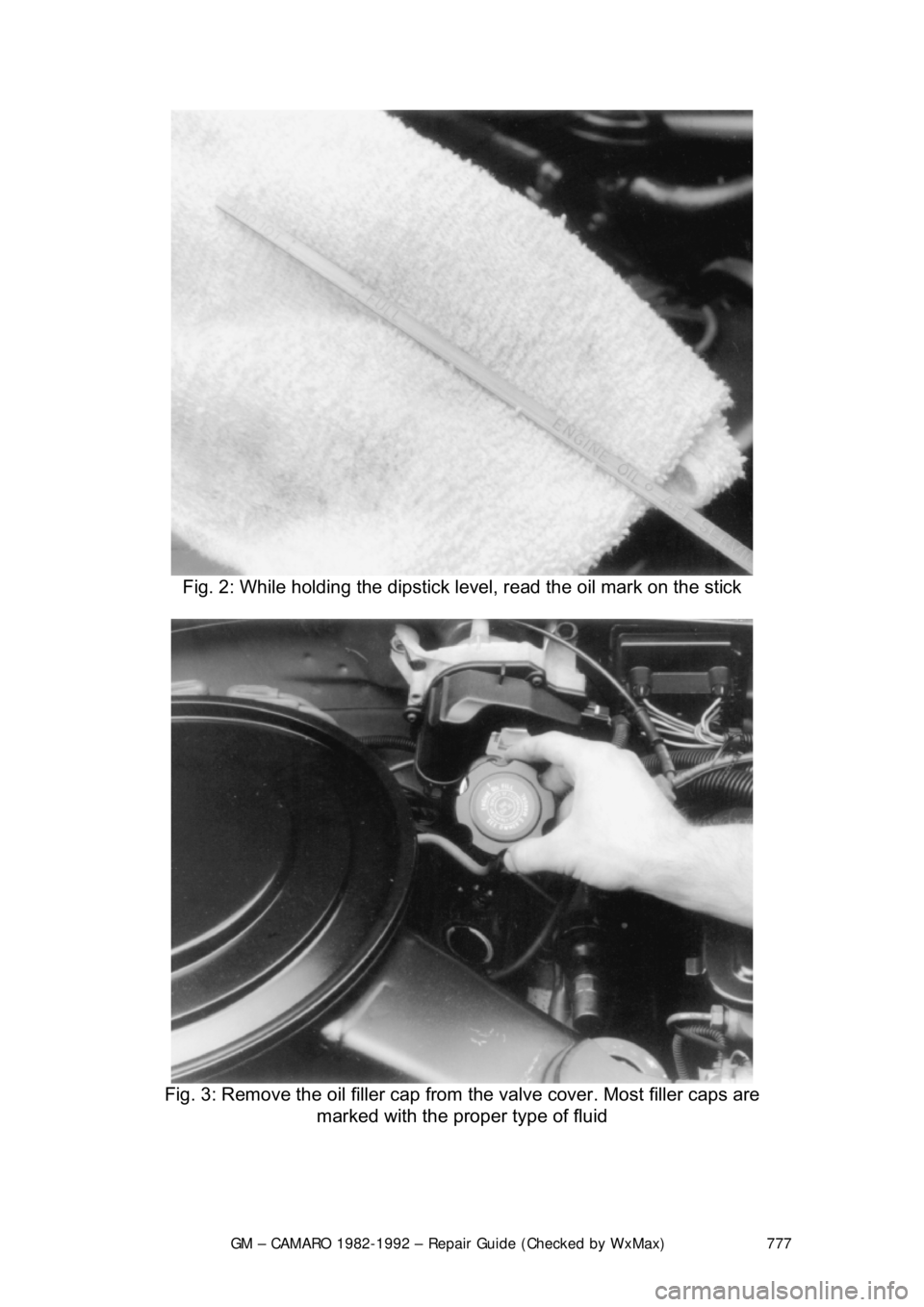
Fig. 2: While holding the dipstick le vel, read the oil mark on the stick
Fig. 3: Remove the oil filler cap from the valve cover. Most filler caps are
marked with the proper type of fluid