1982 CHEVROLET CAMARO length
[x] Cancel search: lengthPage 456 of 875

GM – CAMARO 1982-1992 – Repair Guide (Checked by WxMax) 456
2. Drain the engine oil and remove the oil pan.
3. Remove the rear main bearing cap.
4. Insert packing tool J-29114-2 or equi
valent, against 1 end of the seal in
the cylinder block. Drive the old seal gently into the groove until it is
packed tight. This will vary from
1/4 in. (6mm) to 3/4 in. (19mm) depending
on the amount of pack required.
5. Repeat the procedure on t he other end of the seal.
6. Measure the amount the seal wa s driven up on one side and add
1/16 in.
(1.6mm). Using a suitable cutting tool, cut that length from the old seal
removed from the rear main beari ng cap. Repeat the procedure for the
other side. Use the rear main bear ing cap as a holding fixture when
cutting the seal.
7. Install guide tool J-29114-1 or equi valent, onto the cylinder block.
8. Using the packing tool, work the shor t pieces cut in Step 6 into the guide
tool and then pack into the cylinder block. The guide tool and packing
tool are machined to provide a built in stop. Use this procedure for both
sides. It may help to use oil on the short pieces of the rope seal when \
packing them into the cylinder block.
9. Remove the guide tool.
10. Apply Loctite® 414 or equivalent, to the seal groove in the rear main
bearing cap. Within 1 minute, insert a new seal into the groove and push
into place with tool J-29590 until the seal is flush with the block. Cut the
excess seal material with a sharp cu tting tool at the bearing cap parting
line.
11. Apply a thin film of chassis grease to the rope se al. Apply a thin film of
RTV sealant on the bearing cap mati ng surface around the seal groove.
Use the sealer sparingly.
12. Plastigage® the rear main bea ring cap as outlined in MEASURING
REAR MAIN CLEARANCE in this section and check with specification. If
out of specification, check for fr ying of the rope seal which may be
causing the cap to not seat properly.
13. Install all remaining com ponents and inspect for leaks.
FLYWHEEL AND RING GEAR
REMOVAL & INSTALLATION
The ring gear is an integral part of the flywheel and is not replaceable.
1. Remove the transmission.
2. Remove the six bolts attaching t he flywheel to the crankshaft flange.
Remove the flywheel.
3. Inspect the flywheel for cracks, and inspect the ring gear for burrs or
worn teeth. Replace the flywheel if any damage is apparent. Remove
burrs with a mill file.
4. Install the flywheel. Th e flywheel will only attach to the crankshaft in one
position, as the bolt holes are unevenly spaced. Install the bolts and
torque to specification. Tighten bolts in crisscross pattern.
Page 482 of 875

GM – CAMARO 1982-1992 – Repair Guide (Checked by WxMax) 482
If you do not have access to the proper
tools, you may want to bring the
components to a shop that does.
VALVES
The first thing to inspect are the valve heads. Look closely at the head, margin
and face for any cracks, excessive wear or burning. The margin is the best
place to look for burning. It should have a squared edge with an even width all
around the diameter. When a valve burns, the margin will look melted and the
edges rounded. Also inspect the valve head for any signs of tulipping. This will
show as a lifting of the edges or dishi ng in the center of the head and will
usually not occur to all of the valves. All of the heads should look the same, any
that seem dished more t han others are probably bad. Next, inspect the valve
lock grooves and valve tips. Check fo r any burrs around the lock grooves,
especially if you had to file them to remove the valve. Valve tips should appear
flat, although slight rounding with high mile age engines is normal. Slightly worn
valve tips will need to be machined flat. Last, measure the valve stem diameter
with the micrometer. Measure the area that rides within the guide, especially
towards the tip where most of the wear occurs. Take several measurements
along its length and compare them to each other. Wear should be even along
the length with little to no taper. If no minimum diameter is given in the
specifications, then the stem should not read more than 0.001 in. (0.025mm)
below the specification. Any valves that fail these inspections should be
replaced.
Fig. 7: Valve stems may be rolled on a flat surface to check for bends
Page 483 of 875

GM – CAMARO 1982-1992 – Repair Guide (Checked by WxMax) 483
Fig. 8: Use a micrometer to check the valve stem diameter
SPRINGS, RETAINERS AND VALVE LOCKS
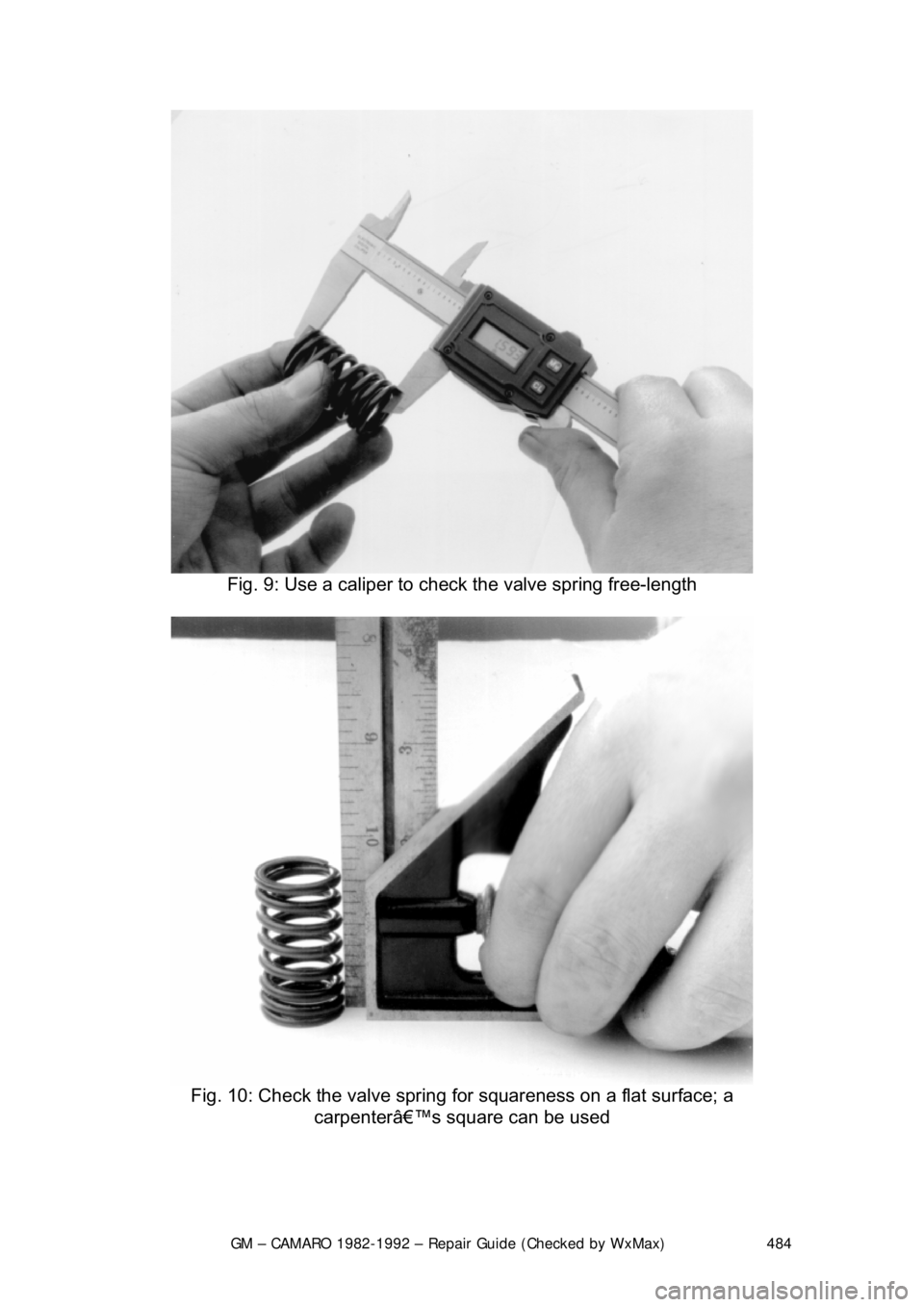
The first thing to check is the most obv ious, broken springs. Next check the free
length and squareness of each spring. If applicable, insure to distinguish
between intake and exhaust springs. Use a ruler and/or carpenters square to
measure the length. A car penters square should be used to check the springs
for squareness. If a spring pressure test gauge is available, check each springs
rating and compare to the specifications chart. Check the readings against the
specifications given. Any springs that fa il these inspections should be replaced.
The spring retainers rarely need replacing, however they should still be checked
as a precaution. Inspect the spring mating surface and the valve lock re\
tention
area for any signs of excessive wear. Also check for any signs of cracking.
Replace any retainers t hat are questionable.
Valve locks should be inspected for exce ssive wear on the outside contact area
as well as on the inner notched surface. Any locks which appear worn or broken
and its respective valve should be replaced.
Page 484 of 875
GM – CAMARO 1982-1992 – Repair Guide (Checked by WxMax) 484
Fig. 9: Use a caliper to che ck the valve spring free-length
Fig. 10: Check the valve spring for squareness on a flat surface; a
carpenter’s square can be used
Page 487 of 875
GM – CAMARO 1982-1992 – Repair Guide (Checked by WxMax) 487
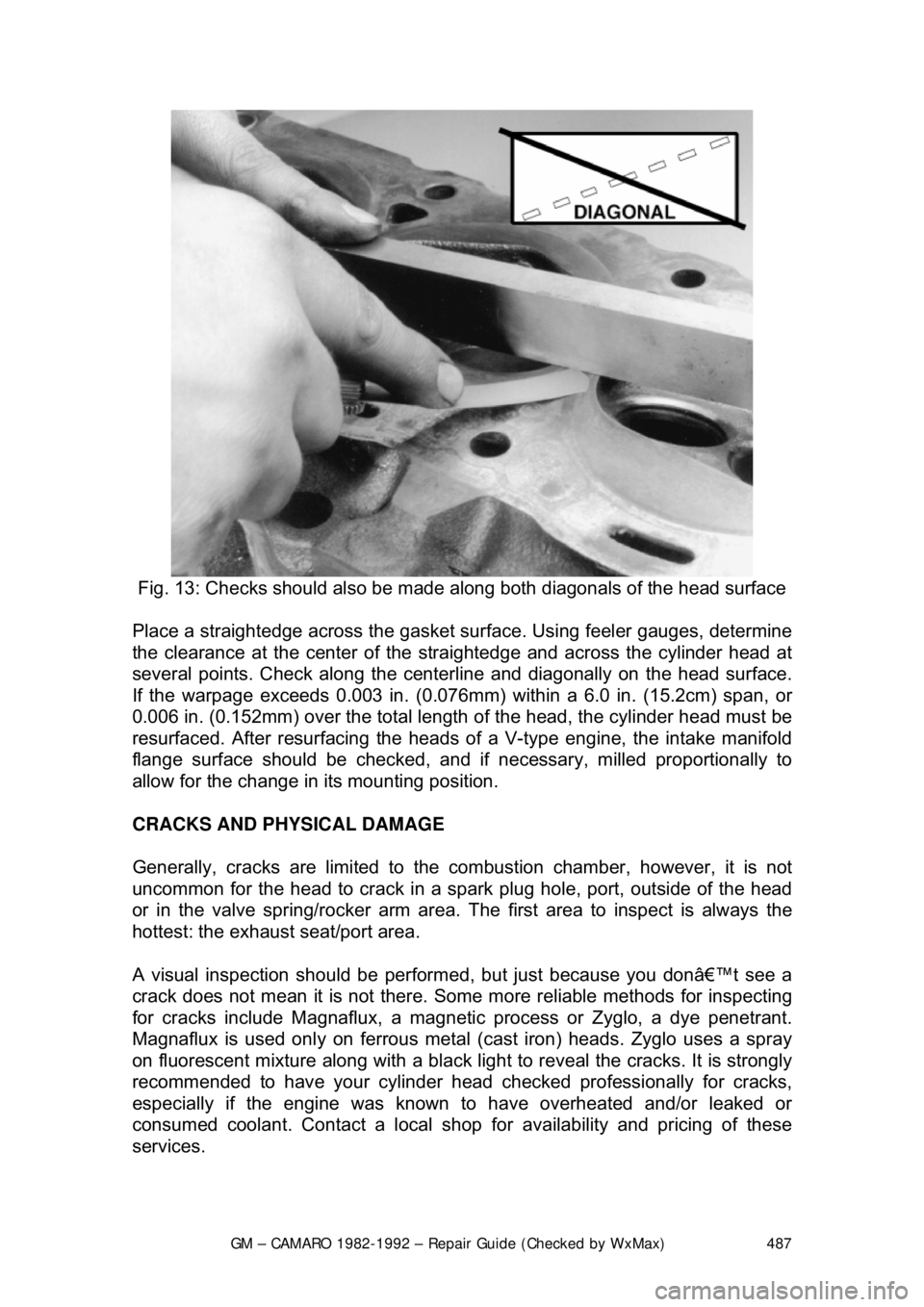
Fig. 13: Checks should also be made al ong both diagonals of the head surface
Place a straightedge across the gasket surf ace. Using feeler gauges, determine
the clearance at the cent er of the straightedge and across the cylinder head at
several points. Check along the centerli ne and diagonally on the head surface.
If the warpage exceeds 0.003 in. (0.076mm) within a 6.0 in. (15.2cm) span, or
0.006 in. (0.152mm) over the total length of the head, the cylinder head must be
resurfaced. After resurfacing the heads of a V-type engine, the intake manifold
flange surface should be checked, and if necessary, milled proportionally to
allow for the change in its mounting position.
CRACKS AND PHYSICAL DAMAGE
Generally, cracks are limited to the comb ustion chamber, however, it is not
uncommon for the head to crack in a s park plug hole, port, outside of the head
or in the valve spring/rocker arm area. The first area to inspect is always the
hottest: the exhaust seat/port area.
A visual inspection should be perform ed, but just because you don’t see a
crack does not mean it is not there. Some more reliable methods for inspecting
for cracks include Magnaflux, a magnetic process or Zyglo, a dye penetrant.
Magnaflux is used onl y on ferrous metal (cast iron) heads. Zyglo uses a spray
on fluorescent mixture along with a black light to reveal the cracks. It is strongly
recommended to have your cylinder head c hecked professionally for cracks,
especially if the engine was known to have overheated and/or leaked or
consumed coolant. Contact a local shop fo r availability and pricing of these
services.
Page 490 of 875

GM – CAMARO 1982-1992 – Repair Guide (Checked by WxMax) 490
To replace cast-in type valve guides, t
hey must be drilled out, then reamed to
accept replacement guides. This must be done on a fixture which will allow
centering and leveling off of the original valve seat or guide, otherwise a serious
guide-to-seat misalignment may occur maki ng it impossible to properly machine
the seat.
Replaceable-type guides are pressed into the cylinder head. A hammer and a
stepped drift or punch may be used to inst all and remove the guides. Before
removing the guides, measure the protrusi on on the spring side of the head and
record it for installation. Use the stepped drift to hammer out the old guide from
the combustion chamber side of the head. When installing, determine whether
or not the guide also seal s a water jacket in the head, and if it does, use the
recommended sealing agent. If there is no water jacket, grease the valve guide
and its bore. Use the stepped drift, and hamme r the new guide into the cylinder
head from the spring side of the cylinder head. A stack of washers the same
thickness as the measured protrusion may help the installation process.
VALVE SEATS
Before any valve seat machining can be performed, the guides must be within
factory recommended specifications.
If any machining or replacements were made to the valve guides, the seats
must be machined.
If the seats are in good condition, the va lves can be lapped to the seats, and the
cylinder head assembled. See the valves in formation for instructions on lapping.
If the valve seats are worn, cracked or damaged, they must be serviced by a
machine shop. The valve seat must be per fectly centered to the valve guide,
which requires very accurate machining.
CYLINDER HEAD SURFACE
If the cylinder head is war ped, it must be machined flat. If the warpage is
extremely severe, the head may need to be replaced. In some instances, it may
be possible to straighten a warped head enough to allow machining. In either
case, contact a professional machine shop for service.
CRACKS AND PHYSICAL DAMAGE
Certain cracks can be repaired in both ca st iron and aluminum heads. For cast
iron, a tapered threaded insert is inst alled along the length of the crack.
Aluminum can also use the tapered inse rts, however welding is the preferred
method. Some physical damage can be repaired through brazing or welding.
Contact a machine shop to get expert advice for your particular dilemma.
ASSEMBLY
Page 495 of 875

GM – CAMARO 1982-1992 – Repair Guide (Checked by WxMax) 495
Again, rotate the engine, this time
to position the number one cylinder bore
(head surface) up. Turn the crankshaft until the number one piston is at the
bottom of its travel, this should allow t he maximum access to its connecting rod.
Remove the number one co nnecting rods fasteners and cap and place two
lengths of rubber hose over the rod bolts/studs to protect the crankshaft from
damage. Using a sturdy wooden dowel and a hammer, push the connecting rod
up about 1 in. (25mm) from the cranks haft and remove the upper bearing insert.
Continue pushing or tapping the connecti ng rod up until the piston rings are out
of the cylinder bore. Remove the piston and rod by hand, put the upper half of
the bearing insert back into the rod, in stall the cap with its bearing insert
installed, and hand-tighten the cap fasteners. If the parts are kept in order in this
manner, they will not get lost and you wil l be able to tell which bearings came
form what cylinder if any problems are discovered and diagnosis is necessary.
Remove all the other piston assemblie s in the same manner. On V-style
engines, remove all of the pistons from one bank, then reposition the engine
with the other cylinder bank head surface up, and remo ve that banks piston
assemblies.
The only remaining component in the engine block should now be the
crankshaft. Loosen the main bearing ca ps evenly until the fasteners can be
turned by hand, then remove them and the caps. Remove the crankshaft fro\
m
the engine block. Thoroughly clea n all of the components.
INSPECTION
Now that the engine block and all of its components ar e clean, it's time to
inspect them for wear and/or damage. To accurately inspect them, you will need
some specialized tools:
• Two or three separate micromet ers to measure the pistons and
crankshaft journals
• A dial indicator
• Telescoping gauges for the cylinder bores
• A rod alignment fixture to check for bent connecting rods
If you do not have access to the proper tools, you may want to bring the
components to a shop that does.
Generally, you shouldn't expect cracks in the engine block or its components
unless it was known to leak, consume or mix engine fluids, it was severely
overheated, or there was ev idence of bad bearings and/or crankshaft damage.
A visual inspection should be performed on all of the components, but just
because you don't see a crack does not mean it is not there. Some more
reliable methods for inspecting for cracks include Magnaflux, a magnetic
process or Zyglo, a dye penetrant. M agnaflux is used only on ferrous metal
(cast iron). Zyglo uses a spray on fluoresce nt mixture along with a black light to
reveal the cracks. It is strongly recommended to have your engine block
checked professionally for cracks, especia lly if the engine was known to have
overheated and/or leaked or consumed coolant. Contact a local shop for
availability and pricing of these services.
Page 496 of 875

GM – CAMARO 1982-1992 – Repair Guide (Checked by WxMax) 496
ENGINE BLOCK
ENGINE BLOCK BEARING ALIGNMENT
Remove the main bearing caps and, if sti
ll installed, the main bearing inserts.
Inspect all of the main bearing saddles and caps for damage, burrs or high
spots. If damage is found, and it is caused from a spun main bearing, the block
will need to be align-bored or, if severe enough, replacement. Any burrs or high
spots should be carefully removed with a metal file.
Place a straightedge on the bearing saddles, in the engine block, along the
centerline of the crankshaft. If any cl earance exists between the straightedge
and the saddles, the block must be align-bored.
Align-boring consists of machining th e main bearing saddles and caps by
means of a flycutter that runs through the bearing saddles.
DECK FLATNESS
The top of the engine blo ck where the cylinder head m ounts is called the deck.
Insure that the deck surface is clean of dirt, carbon deposits and old gasket
material. Place a straightedge across the surface of the deck along its
centerline and, using feeler gauges, check the clearance along several points.
Repeat the checking procedure with th e straightedge placed along both
diagonals of the deck surface. If the reading exceeds 0.003 in. (0.076mm)
within a 6.0 in. (15.2cm) span, or 0.006 in . (0.152mm) over the total length of
the deck, it must be machined.
CYLINDER BORES
The cylinder bores house the pistons and are slightly larger than the pistons
themselves. A common piston-to-bor e clearance is 0.0015-0.0025 in.
(0.0381mm-0.0635mm). Inspect and measur e the cylinder bores. The bore
should be checked for out-of-roundness, t aper and size. The results of this
inspection will determine w hether the cylinder can be us ed in its existing size
and condition, or a rebore to the next oversize is required (or in the case of
removable sleeves, have replacements installed).