1980 CHEVROLET CITATION ESP
[x] Cancel search: ESPPage 65 of 95
Downloaded from www.Manualslib.com manuals search engine USE Tlltst: SAE VISCOSITY GItotoDH
I , , , cl.
*
::0';'~ ,.,..~,: , , , ,
I
lOW , , , ,
,
I I I I , . , " • '" ,~, ." ., , " " " ~ lVitPl .... 1Ul:( lAN<* YOU ElU'EClltfOll( NUT OIl CHANG(
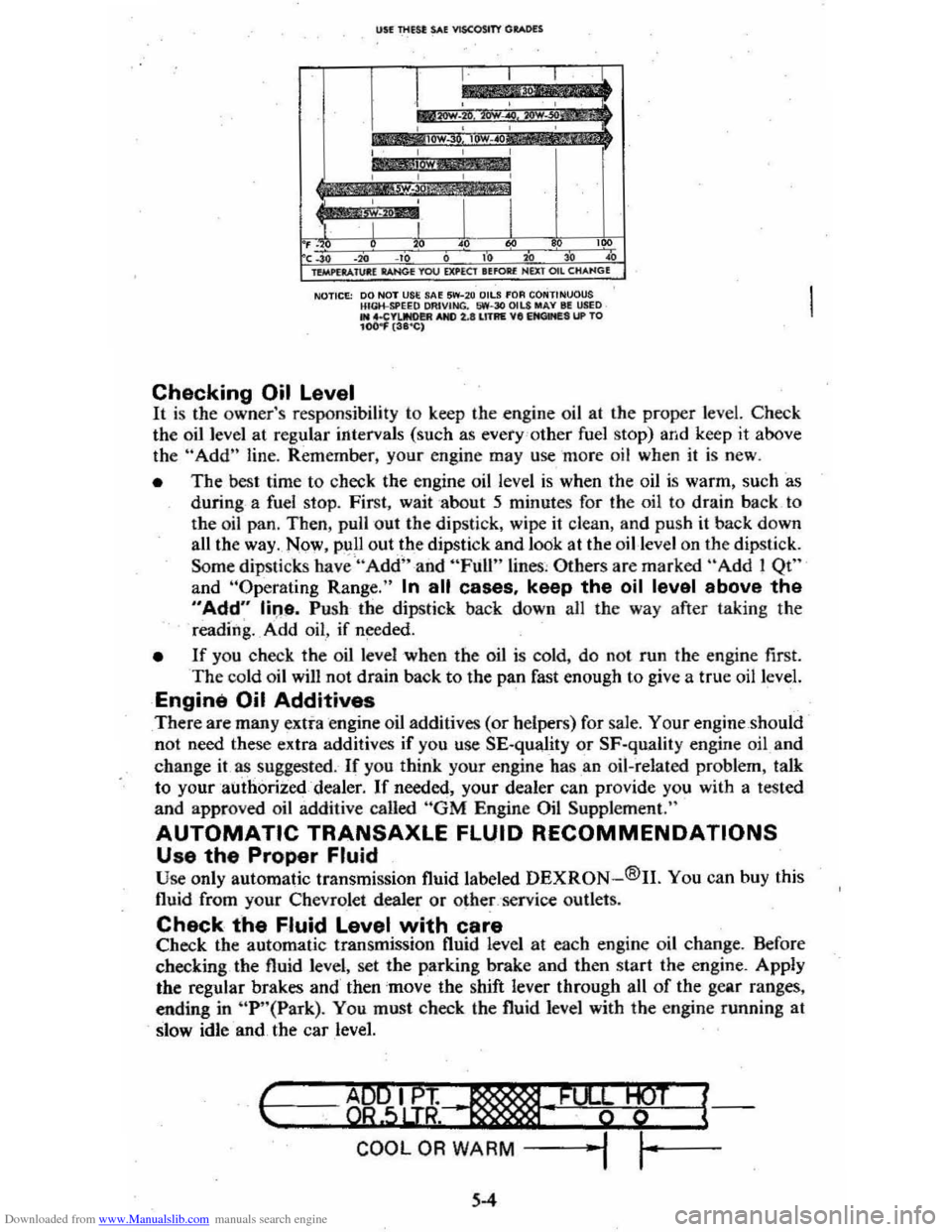
NOTICE: 00 NOT USE SA~ 5W-2 0 OilS fOA CONTINUOUS HIGH-SPEEQ OAIVING. 1,iW-30 OILS MAY III USED .. 4.CYIJNO!!R AND 2.lIll1AE VII EItClMES UP TO 104)
the oil level at regular intervals (such as every 'o ther fuel stop) and keep it above
th e "Add" line. Rem ember, your engine may use more oil when it is new .
• The best time to check the engine oil level is when the oil is warm, such as
during a fuel stop. First, wait about 5 minutes for the oil to drain back to
the oil pan, Then, pull out the dipstick, wipe
it clean, and push it back down
all the way . Now , pull out.th e dipstick and look at the oil-level on the dipstick.
Some
dipSlicks have "Add" and "Full" lines , Others are marked "Add! Qt"
and "Operaling Range." In all cases, keep the oil level above the
"Add" line. Push· the dipstick back down all the way after taking the
reading. _ A ·dd oil , if needed.
• If you check the oil level when the oil is cold, do no t run the engine first. The cold oil wilJ not drain back to the pan fast enough to give a true oil level.
Engine Oil Additives
There are many extra engine oil additives (or helpers) for sale. Your engine should
not need these extra additives if you use SE-quality or SF·quality engine oil and
change
it as suggested. If you think your engine has .an oil-related problem, talk
to your authorized dealer.
If needed, your dealer can provide you with a tested
and approved oil additive called "GM Engine Oil Supplement."
AUTOMATIC TRANSAXLE FLUID RECOMMENDATIONS
Use the Proper Fluid Use only automatic transmission fluid labe led DEXRON-®II. You can buy this
fluid from your Chevrolet dealer or
othe~,'service outlets.
Check the Fluid Level with care Check the automatic transmission fluid level at each engine oil change. Before
checking the fluid level, set the parking brake and then start the engine. AppJy
the regular brakes and then
'mov e the shift lever through all of the gear ranges,
ending in
"P '·(Park). You must check the fluid level with the engine funning at
slow idle and the car level.
I-c ..... --=---=..,~ ..... B9"""5IL.u;~~"-·, __ .........,; ..... _·F_%¥-W+--T -l{
COOL OR WARM -j ""I ,~-
5-4
Page 66 of 95
Downloaded from www.Manualslib.com manuals search engine NOTICE: You cannot read the correct fluid level if you have just driven the car for a long time at high speed, in city traffic in hot weather, or if the car has been pulling a trailer. Wait. until the fluid has cooled down (about 30 minutes).
Remove the dipstick located on the driver's side forward of the cowl. Carefully
touch the wet end of the dipstick to find out if the fluid is cool, warm or hot. Wipe
it clean and push it back in until the cap seats. Pull
out the dipstick and read the
fluid level.
• If it felt cool or warm (about room temperature), the level should be
between the dimples above the "Full" mark.
• If it was too hot to hold. the level should be at or in the hatched area.
Add just enough DEXRON-®n fluid to fill the transaxle. It takes only 0.5 liter
(one pint)to raise the level from "Add" to "Full" with a hot transaxle.
Do not overfill the transaxle. Overfilling can cause foaming and loss of fluid, which
could result in transaxle damage.
Automatic Transaxle Drain Intervals
Change the transmission fluid and change the filter (or clean the screen) as
outlined in Section
A of the Maintenance Schedule folder.
ELECTRIC FAN
CAUTION: Keep hands, tools, and clothing away from the angine cooling fan to help prevent personal injury. This fan is electric and can come on whether or not the engine is running. The fan can start automatically in response to a heat sensor when the ignition is in the "Run" position.
ENGINE COOLING SYSTEM
The coolant recovery system is standard. The coolant in the radiator expands with
heat, and the overflow collects in the recovery tank. When the system cools down,
the coolant
is drawn back into the radiator.
The cooling system was filled at the factory with a quality coolant that meets
GM Specification 1899-M. The cooling system is designed to use coolant (a mixture
of water and ethylene glycol antifreeze) rather than plain water. The coolant
solution should be used year round. It has many advantages, such as:
• provides freezing protection down to _37°C, (-34°P)
•
provides boiling protection up to 128QC, (262°P)
•
protects against rust and corrosion in the cooling system,
• maintains the proper engine temperature for efficient operation and emission
control, and
• allows proper operation of the coolant temperature light (or gage).
See Section A of the Maintenance Schedule folder to find out when the coolant
must
be replaced.
COOLING SYSTEM CARE
Check the cooling system at regular intervals, such as during fuel stops. You
usually do not need to remove the radiator cap to check the coolant level. Lift
the engine hood and look at the "see through" coolant recovery tank. When the
engine
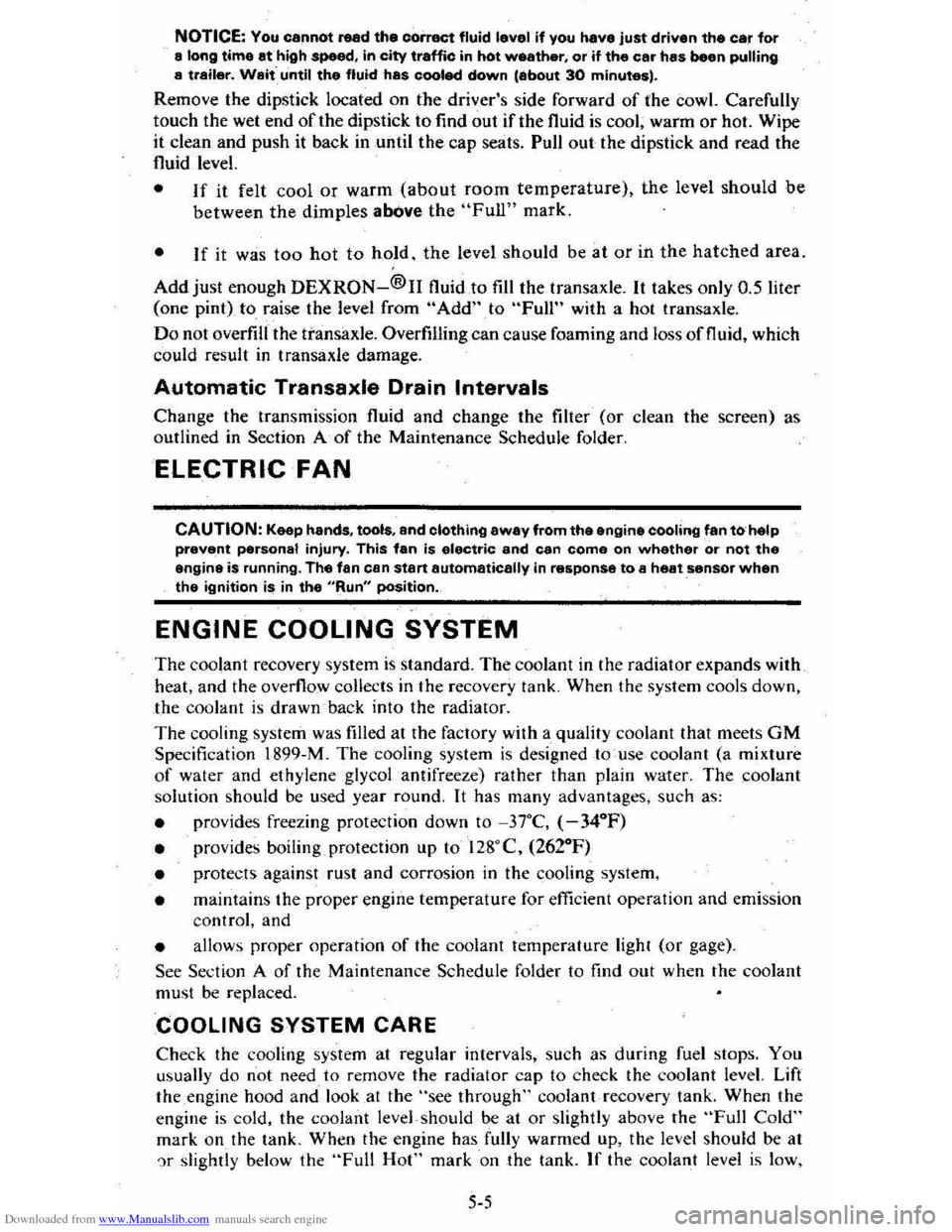
is cold, the coolant level -should be at or slightly above the "Full Cold"
mark on the tank. When the engine has fully warmed up, the level should be at ')r slightly below the "Full Hot" mark on the tank. If the coolant level is low,
5-5
Page 68 of 95
Downloaded from www.Manualslib.com manuals search engine 3. Stop the engine. Open the radiator drain valve to drain the coolant. (Drainage
may be speeded by removing the drain plugs in the block.)
4. Close the drain valve (install block drain plugs, if removed). Add water until
the system is filled and run the engine until the upper radiator hose is hot again.
5. Repeat steps 3 and 4 several times until the drained liquid is nearly colorless.
6. Drain the system and then close the radiator drain valve tightly. (Install block
drain plugs, if removed.)
7. Disconnect all hoses from the coolant recovery tank. Remove the tank and
pour out any fluid. Scrub and clean the inside of the tank with soap and water.
Flush it well with clean water,
then drain it. Reinstall the tank and hoses.
8. Add enough water and ethylene glycol antifreeze (meeting GM Specification
1899-M)to provide the required cooling, freezing, and corrosion protection. Use a solution that is at least 50 percent antifreeze, but no more than 70
percent antifreeze. Fill the radiator to the base of the filler neck and fill the
coolant recovery
tank to the "Full Hot" mark. Put the recovery tank cap back
on.
9. Run the engine, with the radiator cap removed, until the upper radiator hose
is hot.
10. With the engine idling, add coolant to the radiator until it reaches the bottom
of the filler neck. Install the radiator cap, making sure the arrows on the cap line up with the overflow. tube.
It is the owner's responsibility to:
• Maintain cooling system freeze protection at _37°C (_34°F) to ensure
protection against corrosion and loss of coolant from boiling. (A SO/50
mixture of water and ethylene glycol antifreeze will provide freeze protection
to ~ 37°C ore -34°P.) You should do this even if you don't expect freezing
temperatures.
• Add ethylene glycol base antifreeze that meets GM Specification 1899-M
when antifreeze
hasto be added because of coolant loss or for more protection
' against freezing at temperatures lower than _37°C (-·J4°P).
NOTICE: Do not use alcohol or methanol-base antifreeze. or plain water alone. in your vehicle at any time. They will boil at a lower pOint than that at which the hot light indicator (or temperature gage) works. and they do not provide proper protection against corrosion.
Radiator Pressure Cap
The radiator cap, a 105 kPa(15 psi) pressure type, must be installed tightly,
otherwise coolant may be lost and damage to engine may result from overheating.
Radiator pressure caps should be checked periodically for proper operation.
If
replacement is required, an AC cap is recommended.
Thermostat
The engine coolant temperature is controlled by a thermostat. It stops coolant flow
through the radiator until a preset temperature is reached. This thermostat is
installed in
the engine coolant outlet on the engine block. The same thermostat is used in both winter and summer. When a replacement is needed, AC~Delco parts
are recommended.
5-7
Page 73 of 95
Downloaded from www.Manualslib.com manuals search engine STANDARD EXTRA B C o
TIRE LOAD AND INFLATION PRESSURES
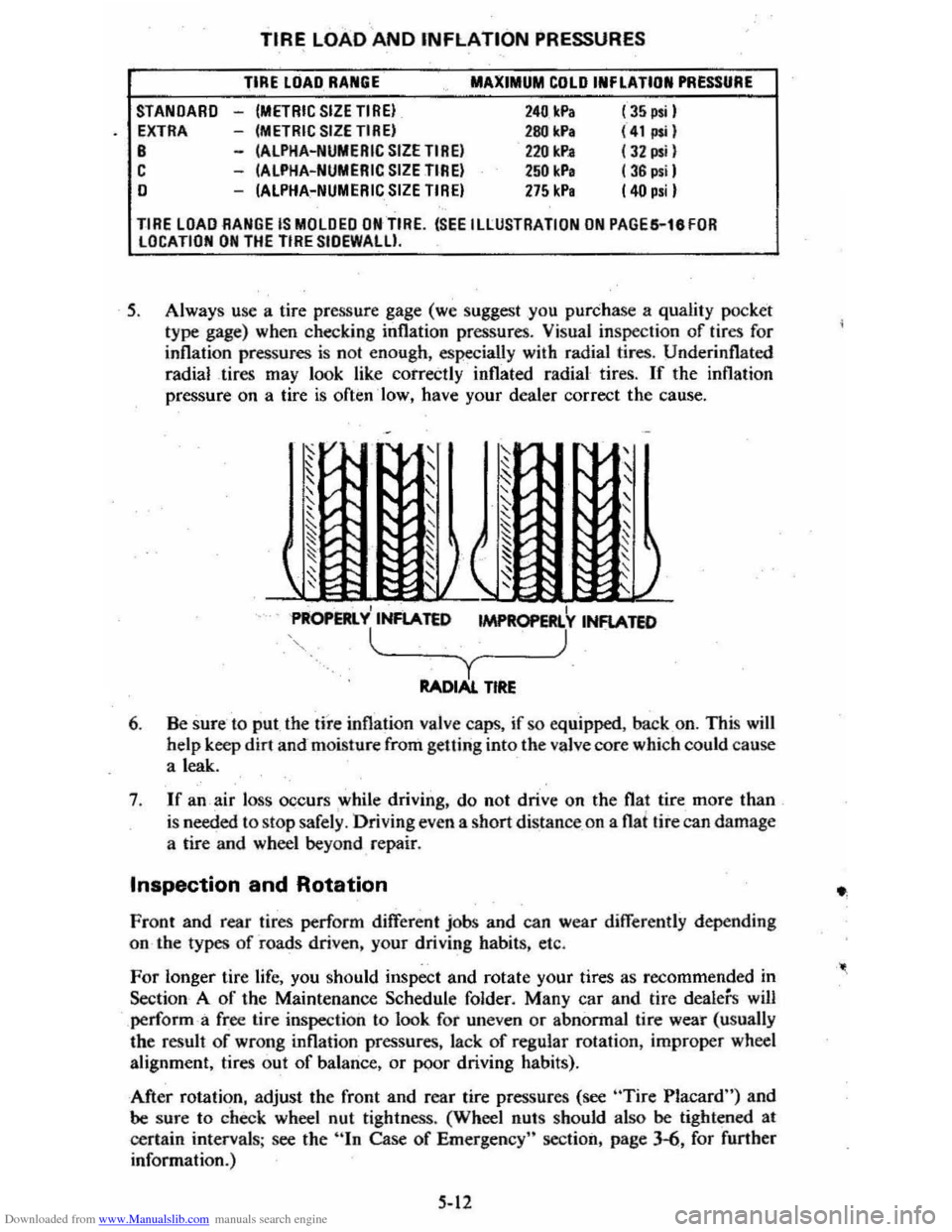
TIRE LOAD RANGE
-(METRIC SIZETIREI -(METRIC SIZETIREI -(ALPHA-NUMERIC SIZE TIREI -(ALPHA-NUMERIC SIZE TIREI -(ALPHA-NUMERIC SIZE TIREI
MAXIMUM COLD INFLATION PRESSURE
240 Ic.Pa 280 kPa 2211 kP. 250 kP, 275 kP,
(35 psi I (41";1 (J2 psil ( 36 psil (40 p.iI
TIRE LOAD RANGE IS MOLDED ON TIRE. (SEE ILLUSTRATION ON PAGES-leFOR LOCATION ON THE TIRE SIOEWALU.
5. Always use a tire pressure gage (we suggest you purchase a quality pocket
type gage) when checking inflation pressures. Visual inspection of tires for
inflation pressures is nol enough, especially with radial tires. Underinflated
radial tires may look like correctly inflated radial tires.
If the inflation
pressure on a tire
is often ·low, have your dealer correct the cause.
, I PROPERlY INFlATED 1MPR0PERl Y INFlATED
l~_~~_~) y RADIAl. TIRE
6. Be sure to put the tire inflation valve caps, if so equipped. back on. This will help keep dirt and-moisture from getting into the valve core which could cause
a leak.
7 .
If an air loss occurs while driving. do not drive on the flat tire more than
is needed to stop safely . Driving even a short distance _on a flat tire can damage
a tire and wheel beyond repair.
Inspection and Rotation
Front and rear tires perform different jobs and can wear differently depending
on the types
of roads driven, your driving habits, etc.
For longer tire life, you should inspect and rotate your tires as recommended in
Section A
of the Maintenance Schedule folder. Many car and tire dealers will perform -a free lire inspection to look for uneven or abnormal tire wear (usually
the result of wrong inflation pressures, lack of regular rotation, improper wheel
alignment, tires out
of balance, or poor driving habits).
After rotation, adjust the front and rear tire pressures (see
"Tire Placard") and be sure to check wheel nut tightness. (Wheel nulS should also be tightened at
certain intervals ; see the
hIn Case of Emergency" section, page 3-6, for further
information.)
5-12
Page 76 of 95
Downloaded from www.Manualslib.com manuals search engine UNIFORM TIRE QUALITY GRADING
The following information· relates to the tire grading system developed by the
National Highway Traffic
Safety Administration which will grade tires by tread wear, traction· and temperature performance:
TREADWEAR
The tread wear grade is a comparative rating based on the wear rate of the tire
when . tested under controlled conditions on a specified government test course.
For example, the tire graded 150 would Wear one and a half(l-1I2) times as well
on the government course as a tire graded 100. The relative performance of tires
depends upon the actual conditions
of their use, however, and may depart
significantly from the norm due to variations in driving habits, service practices
and differences in road characteristics and c1imate.
TRACTION -A. B. C
The. traction grades, from highest to lowest are A, B, and C, and they represent
the tire's ability to stop
on wet pavement as measured under controlled conditions
on
specified government test surfaces of asphalt and concrete. A tire marked C
may have poor traction performance.
Warning: The traction grade assigned to this tire is based on braking
(straight·ahead) traction tests and does not include cornering (turning) traction.
TEMPERATURE -A. B. C
The temperature grades are A (the highest), B, and C representing the tire's
resistance to the generation
of heat and its ability to dissipate heat when tested
under controlled conditions on a specified indoor laboratory teSt wheel. Sustained
high temperature can cause the material
of the tire to degenerate and reduce tire
life, and excessive temperature can lead to sudden tire failure.
The gradeC
corresponds to a level of performance which all passenger car tires must meet
under the Federal Motor Vehicle Safety Standard No. 109. Grades B and A
represent higher. levels
of performance on the laboratory test wheel than the
minimum required by law.
Warning: The temperature grade for this tire. is established for a tire that is
properly inflated and neit overloaded, Excessive speed, underinflation, or excessive
loading, either separately or in combination, can cause heat buildup and possible
tire failure,
At this time your tires mayor may not have a grade. These grades will be molded
on· the sidewal1s of passenger car tires over the next several years according to
a schedule established by the National Highway Traffic Safety Administration and
the tire manufacturers.
While the tires8vailable as standard or optional equipment on
General Motors vehicles may vary with respect to grade. all such tires meet General Motors performance standards and have been
approved for use on General Motors vehicles.
All passenger car tires must conform to Federal safety requirements
in addition to these grades.
You should replace your tires when ...
1. They are worn to a point where 1.6 millimeters (2/32 inch) or less tread
remains,
ot cord or fabric is showing.
5-\5
Page 78 of 95
Downloaded from www.Manualslib.com manuals search engine SECTION 6
OWNER ASSISTANCE
Your satisfaction and goodwill are important to your dealer and to us. Normally,
any problems with the sales transaction or the-operation of your car will be
handled by your dealer's Sales or Service departments. Sometimes, however,
despite the best intentions of all concerned, misunderstandings can occur.
If your
problem has not been handled to your satisfaction, we suggest you follow these
steps:
STEP ONE -Discuss your problem with a member of dealership management. Complaints can often be quickly resolved at that level. If the
problem has already been reviewed with the Sales or Service manager, contact the
owner
of the dealership or t~e General Manager.
STEP TWO -Contact the Chevrolet Zone Office closest to you_ (Zone offices are listed on the following pages.) IIi Canada, contact the General
Motors Zone Office. If your problem cannot be quickly resolved by the dealership
without further help, contact the Zone's Consumer Relations Department, and
provide them with:
• Your name, address and telephone ~umber
• Vehicle Identification Number (This is available from the car registration or title, or the plate attached to the left top of the instrument
panel
and visible through the windshield.)
• Dealer's name and location
• Vehicle's delivery date and present mileage
• Nature of problem
A convenient form for your use
is included in this section.
STEP THREE -Contact the Consumer Relations Representative, Chevrolet Central Office, Chevrolet Motor Division, Detroit,
Michigan 48202 (313-556-S219)_ (In Canada, contact the Customer
Services ~epresentative. General· Motors of Canada Ltd .• Oshawa. Ontario, L1 J SZ6; 416/644-6624)_ The representative will review all the
facts involved. Then, if it is felt some further action can be taken, the zone will
be so instructed. In any case, your contact will be acknowledged providing
Chevrolet's position
in the matter.
When contacting the Zone or Central
Office, please bear in mind that your
problem will likely be resolved in the dealership, using the deaLer's facilities,
equipment and personnel.
So it is suggested that you follow the above steps in
sequence when you have a problem.
Your purchase
of a Chevrolet product is greatly appreciated by both your dealer
and Chevrolet. We want to help you
any way we can to make sure you are
completely satisfied with your car.
6-1