1976 CHEVROLET MONTE CARLO fuel
[x] Cancel search: fuelPage 63 of 102
Downloaded from www.Manualslib.com manuals search engine Gas Cap-The fuel tank filler cap
has a
"Screw-on ratcheting type"
feature for proper gas tank sealing.
To remove:
• Rotate ~ap counterclockwise to
clear
the inside of the filler neck.
This will allow any residual
pres
sure t!J escape.
• To iQstall, reverse this procedure
and . tighten cap securely until a
"ratcheting", . clicking sound is
heard indicating proper cap to
filler neck sealing.
NOTE: If this cap requires a re
placement , only a cap with these
same features should
be used. Fail
ure to use the correct cap can result
in a serious malfunction of the
sys
tem. Correct replacement caps may
be obtained from your authorized
Chevrolet dealer.
ENGINE ITEMS
Engine Oil and Filter
Recommendations
• Use only SE engine oil.
• Change oil each 6 months or
7,500 miles, whichever occurs
first ,
except under the following
conditions:
•
-driving in dusty conditions
-trailer pulling '
-extensive idling
-short-trip operation at freez-
ing
ternperatures( engine not
thoroughly warmed-up).
'Under these conditions, change oil
each 3 month s
or 3,000 miles,
whichever occurs first.
• Operation in dust stOmlS may
require an immediate oil change.
• Replace the oil filter at the first
oil change, and every second oil
change thereafter. AC oil filters
5-2
provide excellent engine pro
tection.
See your Chevrolet dealer for ad
vice on the frequency of' oil and
filter changes under unusual driving
conditions.
The above recommendations
ap
ply to the first change as well as
subsequent oil changes. The oil
change interval for your Chevrolet
engine
is based on the use of SE
oils and quality oil filters. Oil
change intervals longer than those
listed
above will seriously reduce
engine life and may affect
Chevro
let obligation undetthe provisions
of the New Vehicle Warranty.
NOTE: Non-detergent and other
low quality oils are
sgecifically not
recommended .
Only the use of SE
engine oils and proper oil and filter
change intervals assure you of
con
tinued proper lubrication of your
Chevrolet engine.
Page 64 of 102
Downloaded from www.Manualslib.com manuals search engine A high quality SE oil was in
stalled in
your engine at the factory.
It is not necessary to change this
factory-irtstalled oil prior to the
recommended normal chartge pe
riod . However , check the oil level
more frequently during the break
in period since higher oil consump
tion is normal until the piston rings
becom e sea ted.
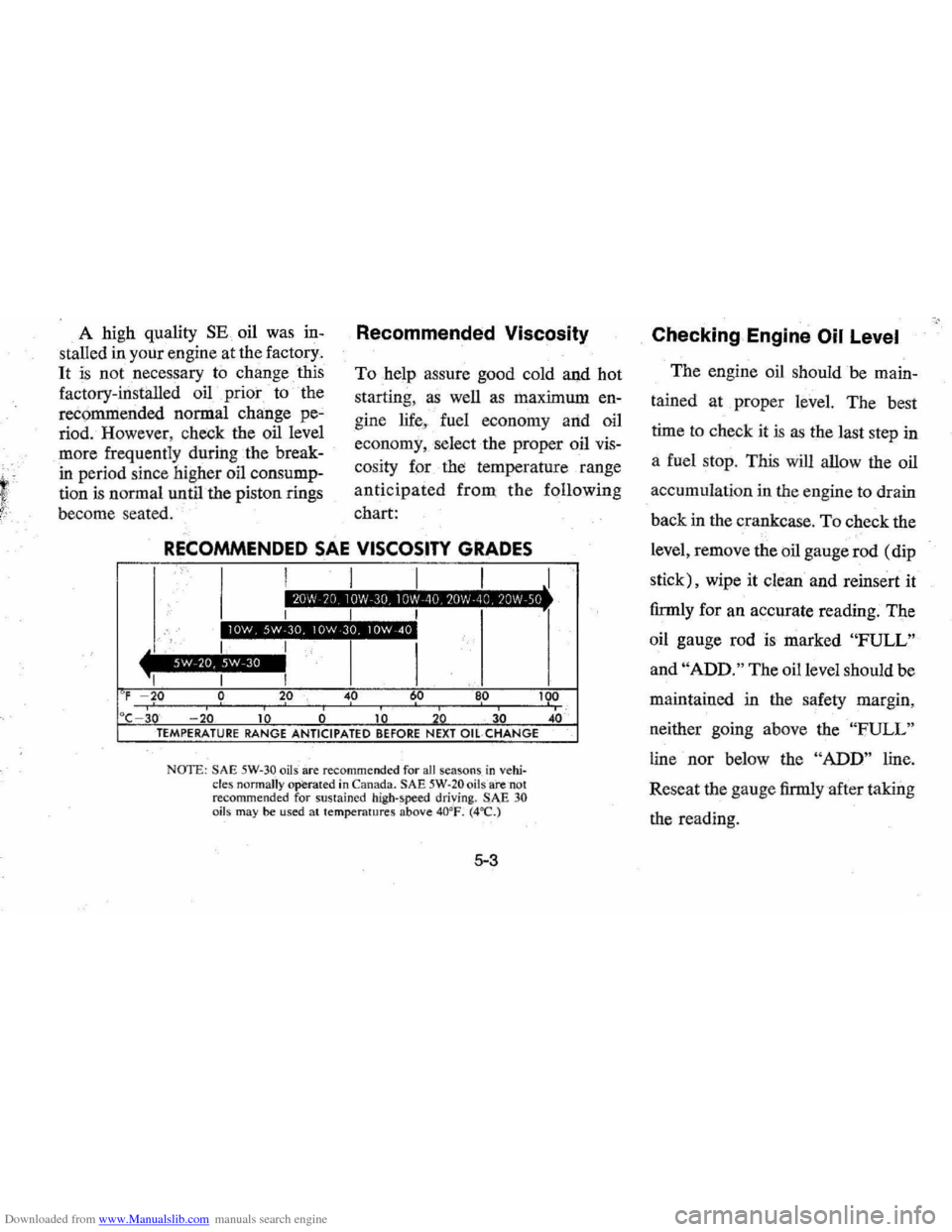
Recommended Viscosity
To help assure good cold and hot
starting, as well as maximum en
gine life, fuel economy and oil
economy , select the proper oil vis
cosity for
the temperature range
anticipated from the following
chart:
RECOMMENDED SAE VISCOSITY GRADES
I I I I 20W 20 lOW 30 lOW 10 7(lV, 10 JOW 50
JOW 5w 30 lOW 30 lOW 40
sw 20 5W 30
F --;fO , ? ,2,0 ,4,0 ~O 8,0 , 1~
°c 30' 20 10 0 1 30 40 TEMPERATURE RANGE ANTICIPATED BEFORE NEXT OIL,CHANGE
NOTE: SAE 5W-30 oils· are rec ommended for all seasons in vehicles normally operated in Canada. SAE 5W-20oi ls are nol recommended fur su stained high-speed driving. SAE 30 oi ls may be used at tempera tures above 4O"F. (4"C.)
5-3
Checking Engine Oil Level
The engine oil should be main
tained
at proper level. The best
time
to check it is as the last step in
a fuel stop. This will allow the oil
accumulation in
the engine to drain
back in the crankcase.
To check the
level, remove the oil gauge rod (dip
stick), wipe it clean and reinsert it
firmly for an accurate reading. The
oil gauge rod is marked
"FULL"
and "ADD." The oil level should be
maintained in the safety margin,
neither going above the
"FULL"
line nor below the "ADD" line.
Re sea t the gauge firmly after taking
the reading.
Page 73 of 102

Downloaded from www.Manualslib.com manuals search engine Accelerator Linkage
Lubricate with engine oil every
15,000 .miles as follows:
1. V-8 Engine-lubricate cable pin
at the carburetor lever.
Hinges
The following points should be
checked and lubricated every 6
months or
7,500 miles, whichever
occurs first: hinges on all doors,
fuel filler door, trunk lid, door lock
striker and door jamb switches.
Hood Latches
Every 6 months or 7,500 miles
whichever occurs first, lubricate
hood latch assembly and hood
hinge assembly
as follows:
1. Wipe off any accumulation of
dirt or contamination on latch
parts.
2. Apply Lubriplate
or equivalent
to latch pilot bolts and latch
locking
plate,
3. Apply light engine oil to all
pivot points in release
mecha
nism, as well as primary and
secondary latch mechanisms.
4. Lubricate hood hinges.
5. Make hood hinge and latch
mechanism functional check to
5-12
asSUre the assembly is working
correctly.
Air Conditioning
Have your Chevrolet Dealer
check your Air Conditioning
sys
tem at some time during the winter
months to be sure there has been
no loss in cooling output. During
the summer, see your Chevrolet
Dealer immediately if you suspect
the system
is nof performing as it
should.
NOTE: Your car's air condition
ing system will not operate be
low ambient temperatures of 300P
( -1°C) regardless of control
position.
Page 74 of 102
Downloaded from www.Manualslib.com manuals search engine UNDERBODY
MAINTENANCE
The effects of salt and other cor
rosive materials used for ice and
snow removal and
dust control can
result
in accelerated rusting and
deterioration of underbody
com~
ponents such as brake and fuel
lines, frame, underbody floor pan,
exhaust system, ·brackets, parking
brake cables, etc. These
corrosive
effects, however, can be reduced
by periodic flushing of the under- .
body with
plait) water;
In geographic areas having 11
heavy concentration of such COr
rosive materials , it is recommended
that the comple te underbody
be
inspected and flushed at least once
each year, preferably after a
win
ter's exposure. Particular atten
tion should be given to cleaning
out underbody members where dirt and
other foreign materials may
have collected.
If desired, your Chevrolet dealer
can perform this service for you.
In addition, he can provide recom
mendations on under coating mate
rials which will help protect your
vehicle from corrosion.
BA TIERY CARE.
5-13
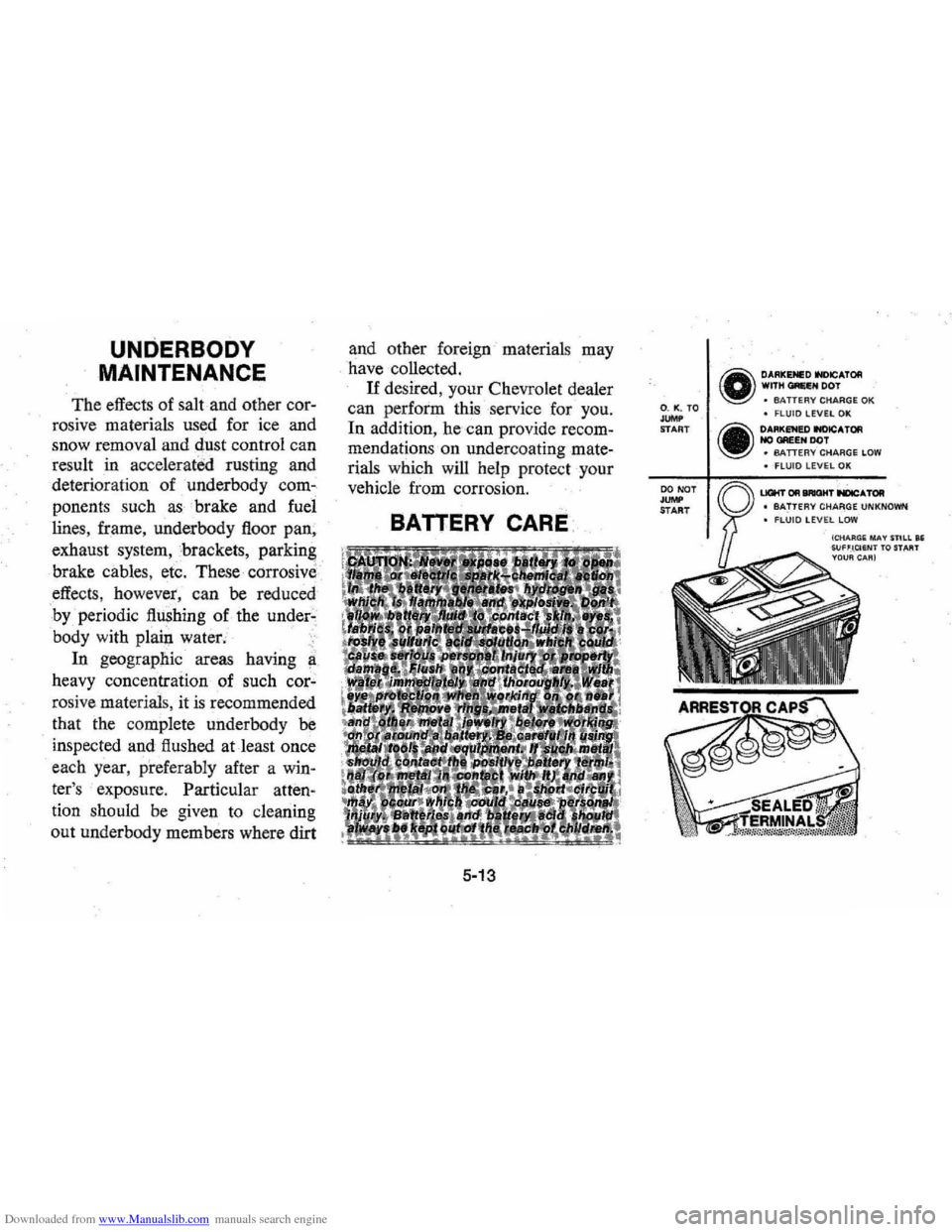
O. K. TO JUMP START
DO NOT JUMP START
~ DARKENED .. DICATOA WITH GREtH DOT -_ - • BATTERY CHARGE OK • FLUID LEVEL OK
~ OARK9I!.D .. DICATOR NO GAEENDOT _ • BATTERY CHARGE LOW • flUID LEVEL OK
• BATTERY CHARGE UNKNOWN • FLUID LEVEL LOW
{CH ARG& MAV STILL IE SUFfICiENT TO START
Page 75 of 102
Downloaded from www.Manualslib.com manuals search engine TIRES
The factory installed tires on
your
vehicl ,e , shown in · the Tire
Usage Ch
per
formance'characteristics
for normal
vehicle
~peration:
• Endu tiLnce '.~"
• Handling . ,'c'
• Noise·'
• Ride; .. /.
• Roaa Hazard ~esistance
• Rol~!1g Re~l$tiLnce
• Traction .'. .. ,
• Tread
Mileage .
This section contains some tips
on
how you can obtain maximum
benefit from these tires and your
investment in them.
Vehicle Loading
When inftiltedas recommended
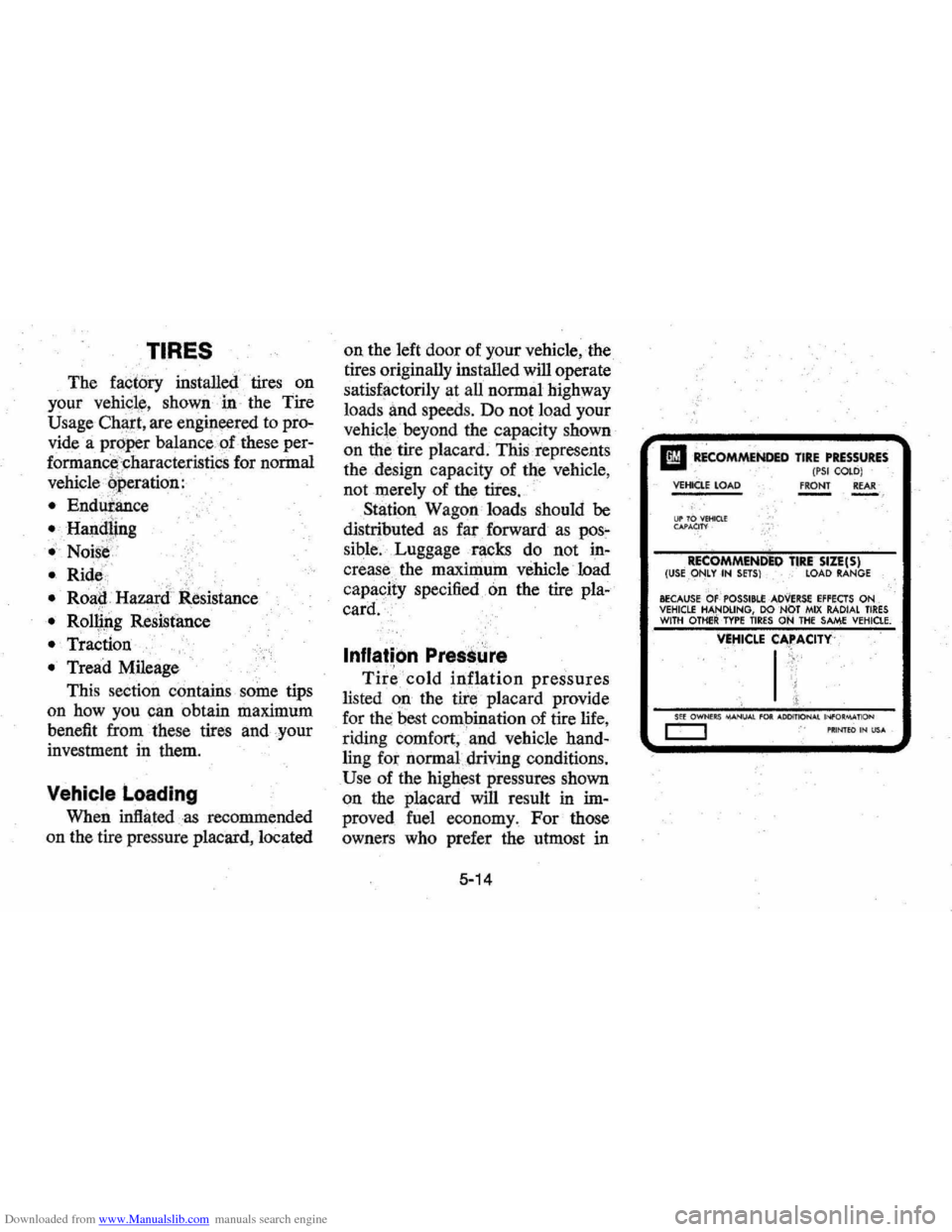
on the tire pressure placard, located on
the left door
of your vehicle , the
tires originally installed will operate
satisfactorily at all normal highway
loads
and s peeds. Do not load your
vehicle beyond the capacity shown
on the tire placard . This represents
the design capacity of the vehicle ,
not merely of the tires .
Station Wagon loads
Should be
distributed as far forward as pos~
sihle . .Luggage racks do not in
crease
the maximum vehicle load
capaciiy specified. on the tire
pla
card.
Inflation Presslire
Tir~' cold inflation pressures
listed ' on the tire placard provide
for
the best combination of tire life,
riding ' comfort , . and vehicle
hand
ling for normal . driving conditions .
Use of the highest pressures shown
on the placard will result
in im
proved fuel economy. For those
owners
who prefer the utmost in
5-14
I
II REcOMMENDED TIRE PRESSURES - (PSI COlO) : YeHKlE LOAD fRONT REAR - ,
ur TO V1:HICI.! ~"m ;,..'
RECOMMENbiO TIRE SIZE(S) (USEQNLY IN SETS) LOAD RANGE .
BECAUSE, :O':'POSSI8LE ·A ,DYERSE EFFECTS ON VEHICLE HANDLING, DO 'NC)T MIX RADIAL TIRES WITH OTHER' TYPE TIRES oN THE SAME VEHICLE.
IIE!iICLE C"'~ACITY ~~,' ; ,',
j
, ~ SU OWNUS ~\) ..... fOft "'DOIflONAl l.'IfOR"'-"TION
c:::J I'I!INTEO IN USA _
Page 76 of 102
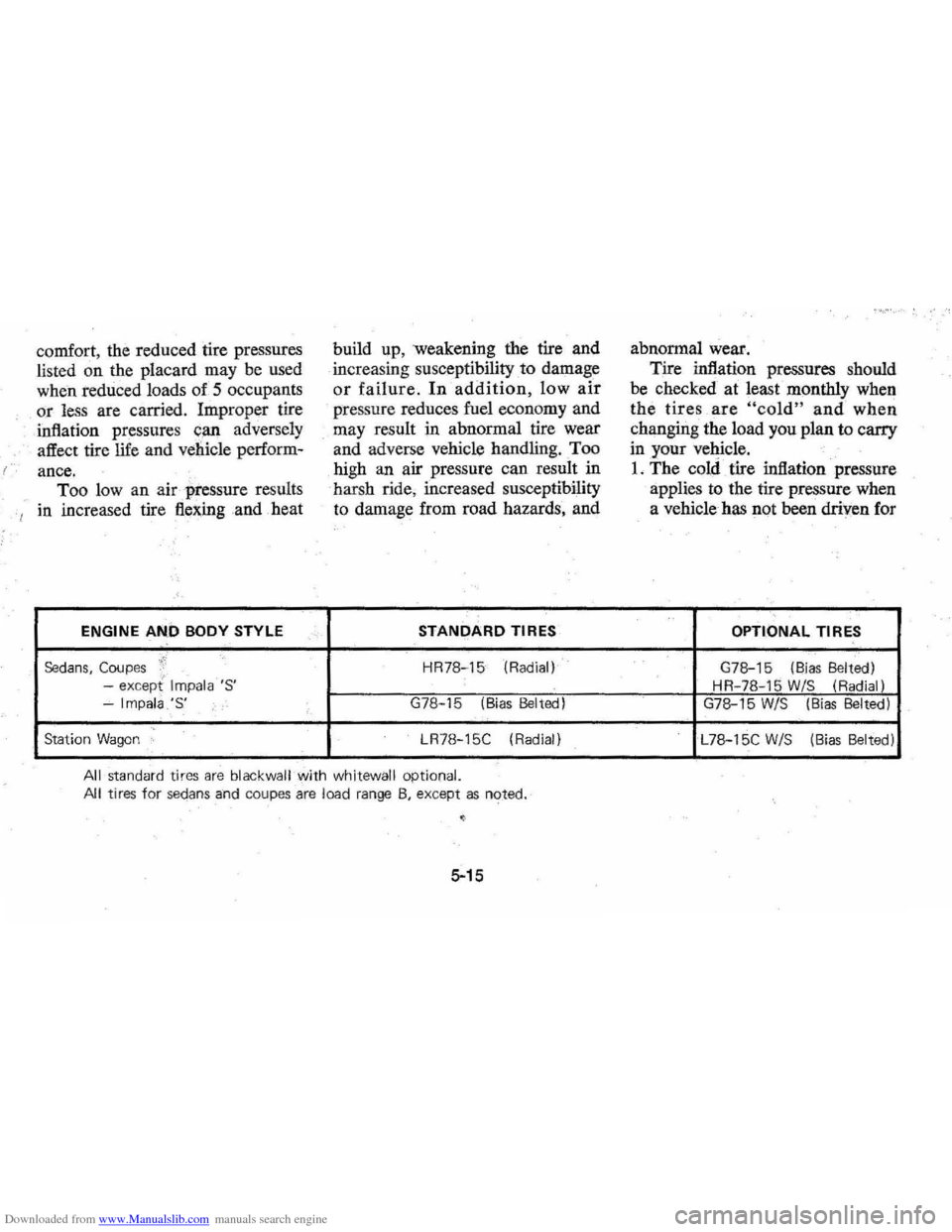
Downloaded from www.Manualslib.com manuals search engine co mfort, the reduced tire pressures
listed on the placard may
be used
when reduced loads of 5 occupants
or
less are carried. Improper tire
inflation pressures
c,an adversely
affect tire life and vehicle perform-
l' ance.
Too Iowan air 'pressure results
I in increased tire flellingand heat
ENGINE AN,D BODY STYLE
4' Sedans, Coupe s ;;' " -except Imp ala 'S '
~ Impala ,'S' ,
Station Wagon
,
.',
build up, weakening the tire and
increasing
sus ceptibility to damage
or failure. In addition, low air
pre ssure reduces fuel economy and
may result in abnormal tire wear
and adverse vehicle handling. Too
high an air pressure can re sult
in
har sh ride , increas ,ed su sceptibility
to dam a
ge fr om road hazards, and
STANDARD TIRES
HR78-15 (R adial)
G78-1 5 (Bias Belted)
LR7
8-1 5C (Radial)
All
sta ndard tires are blackwall With whi tewall optional.
All tires fo r sedan s a-nd co upes are load range 8, except as n ote d.
5-15
abnormal wear.
Tire inflation pressures should
be checked at least monthly when
the
tires , are "cold" and when
changing the load you plan
to carry
in your vehicle .
L The cold tire inflation pressure
applies
to the tire pressure when
a vehicle has not been driven for
OPTIONAL TIRES
G78-15 (Bias Belted)
HR-78-1 5
W/S (Ra dial)
G
78-15 W/S (Bias Belted)
L78-1 5C W/S (Bias Belted)
Page 82 of 102
Downloaded from www.Manualslib.com manuals search engine IMPORTANT FACTS YOU SHOULD KNOW ABOUT GASOLINE MILEAGE
How you drive , where you drive ,
and when you drive
,all have an
effect
on how many miles you can
get from a gallon
of gasoline. The
careful attention you give your car
as far as maintenance and repairs
are concerned will .also contribute
importantly to
fuef economy.
Fuel Selection '
Your vehic1eis designed to op
erate only 011 unleaded gasoline of
at least 87 average octane
num
ber (Research octane plus Motor
octane divided by two). This
gaso
line should have a Research octane
number
· of at least 91, and a.
Motor octane number of at least
83. Onleadedgasoline
is essential
for proper emission co ntrol system
operation, and it will minimize
spark plug fouling. The use of
... AND HOW TO IMPROVE IT
leaded gasoline can damage or
severely reduce the effectiveness of
the emission control system and
re
sult in loss of warranty coverage.
"Jackrabbit" Starts
Gasoline can be conserved (and
engine and tire life prolonged) by
avoiding unnecessarily rapid
accel"
eration away from lights and stop
. signs,
Stop-And-Start · Driving
Frequent stops and starts during
a trip really cut down on your miles
per gallon.
Plan even your short
shopping trips to take advantage of
through streets
to avoid traffic
lights.
Pace your driving like the
professional drivers to avoid
un
necessary stops.
5-21
Excessive Idling
An idling engine uses gasoline,
too.
If you're faced with more than
a
few minutes ' wait and you're not
in traffic, it may be better to
"turn
off"
and start again later.
Sudden Stops
Sudden stops themselves don't
waste gasoline, but energy
is
wasted as heat in braking, Energy
in the form of gasoline is also
needed to accelerate back to
driv
ing speed.
Lubricants
A properly lubricated vehicle
means less friction between moving
parts. Consult this manual and the
maintenance schedule for the
proper lubricants to use and the
lubrication intervals.
Page 83 of 102

Downloaded from www.Manualslib.com manuals search engine Air Cleaner
Your Cl:
receives its power from
a
mixture of gasoline and air. The
air is taken into the system through
the air cleaner so it's important to
replace~he air cJea!1er at required
intervals. A dirty
air cleaner re
duces . engine efficiency.
Properly Tuned'Engine
Overall tuning (a check on tlin
ing , spark plugs, emission control
devices, etc;)
can improve your
car's gas mi,leage . You just
can't
expect an "out-of-tune" engine to
give you good gas mileage and
cleaner air.
Excess Weight
Fuel economy is related to the
work. the engine . must do. The
heavier the load , the more power it
take
s. Keep excess weight to a
minimum by removing any per
sonal effects or luggage from the
car or trunk when they are not
needed.
Tire Inflation
Underinfiation not only causes
needless wear of the tires, but
can
also waste gasoline. It's a good
idea to check tire pressures
regularly.
Wheel Alignment
Incorrect "toe in" or "toe out" can
have the effect,of dragging your
front tires sideways
and may cause
premature tire wear.
It takes power
to carry this extra load and that
takes gas from your tank.
Catalytic Converter
The catalytic converter is an
emi ssio n control device added to
5-22 the
exhaust system to reduce hy
drocarbon
and carbon monoxide
pollutants from the exhaust gas
stream. The converter contains
beads which are coated with a cata
lytic material containing platinum
and palladium.
Use of the catalytic converter
has the advantage
of allowing the
engine
to be re-tuned for improved
fuel economy anddriveability.
The catalytic converter requires
the use
of unleaded fuel only,
Unleaded gasoline is used to re
duce combustion chamber deposits,
corrosion
and to prevent lead con
tamination
of the catalyst that
would render it ineffective.
The use
of leaded fuel will cause the COIO- .
lytic converter to become ineffec
tive
as an emission control device.