1974 CHEVROLET CAMARO belt
[x] Cancel search: beltPage 14 of 85
Downloaded from www.Manualslib.com manuals search engine erly when riding. However, if
unusual conditions prohibit use
of restraints
and require that a
Trailer Hauling
Since passenger cars are designed
and intended to be used primarily
as passenger conveyances, towing
a trailer will affect handling,
dura
bility and economy. Maximum
safety and satisfaction depends
upon proper use of correct
equip
ment and avoiding overloads and
other abusive operation.
The maximum loaded trailer
weight which you
can pull with your
Camaro depends on what special
equipment has been installed on
your car. Chevrolet does not
rec
ommend towing any trailer unless
the
car is properly equipped. Infor
mation on trailer hauling capabili
ties, special equipment required,
and optional equipment offered by child
must stand,
he should
stand
on the floor directly be
hind the front seat. This will
Chevrolet
is available from your
Chevrolet Dealer
or by writing:
Chevrolet
Motor Division, Detroit,
Michigan
48202 (or in Canada
by writing to General Motors of
Canada Limited, Owner Relations
Department,
Oshawa, Ontario).
To assist in attaining good han
dling of the car-trailer combina
tion, it is important that the trailer
tongue load be maintained
at ap
proximately 10% of the loaded
trailer weight. Tongue loads
can be
adjusted by proper distribution of
the load in the trailer,
and can be
checked by weighing separately the
loaded trailer and then the tongue.
When towing trailers, tires should
be inflated to the highest
infla
tion pressures shown on the placard
affixed to the left front door. The
11
help minimize the possibility of
injury from frontal impacts in
the event of an accident.
allowable passenger
and cargo
load, also shown
on the same plac
ard, is reduced by an amount equal
to the trailer tongue load on the
trailer hitch.
Maintenance
More frequent vehicle mainte
nance is required when using your
car to pull a trailer. Change the:
• Automatic transmission fluid
each
12,000 miles,
• Rear axle fluid each 12,000
miles,
• Engine oil each 60 days or 3,000
miles, whichever occurs first,
• Positive crankcase ventilation
valve each 12 months
or 12,000
miles, whichever occurs first.
• See index for important informa
tion on belts, cooling system care
and automatic brake adjustment.
Page 26 of 85
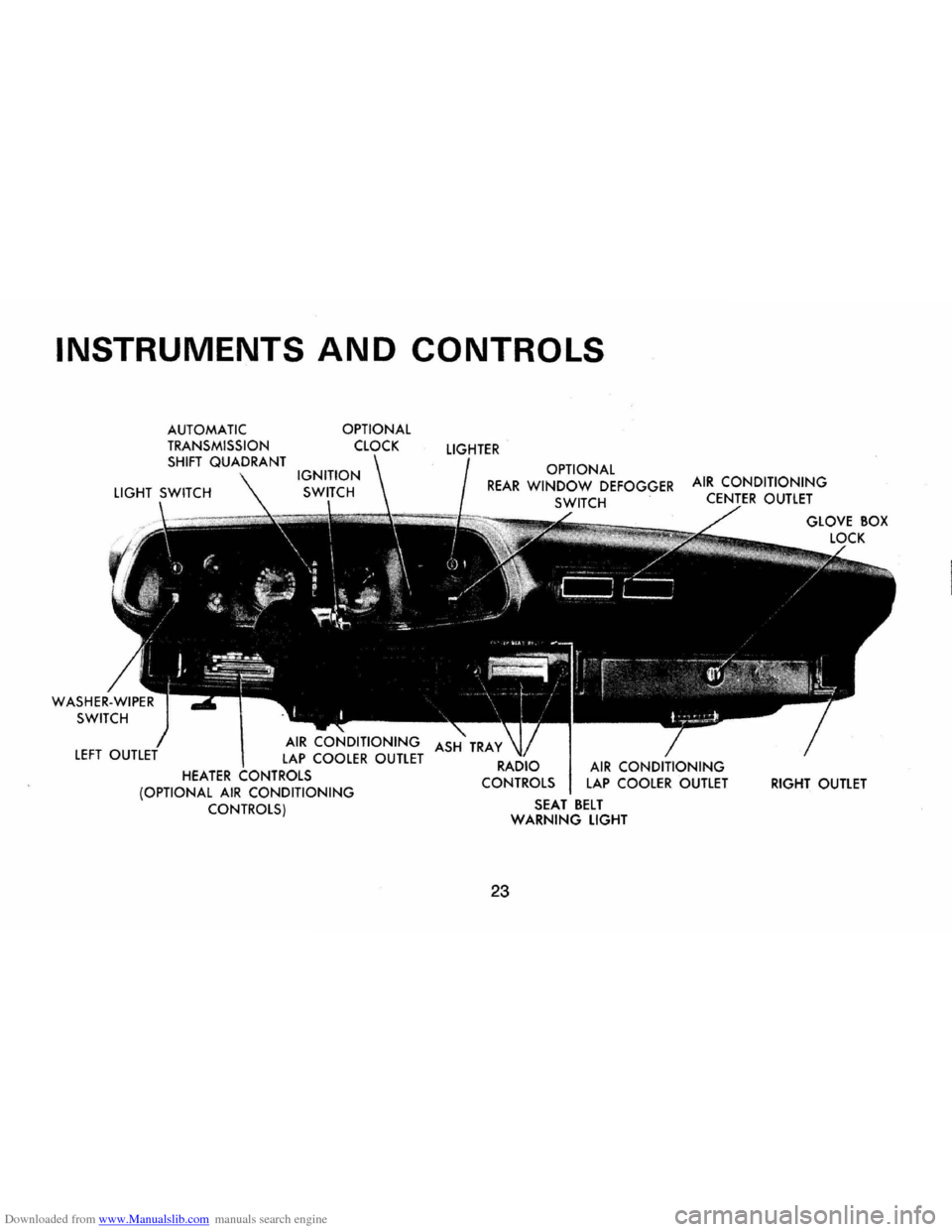
Downloaded from www.Manualslib.com manuals search engine INSTRUMENTS AND CONTROLS
AUTOMATIC TRANSMISSION
SHIFT QUADRANT
HEATER ,-,.., ... ,T,,,,",'
OPTIONAL
CLOCK
(OPTIONAL
AIR CONDITIONING CONTROLS)
LIGHTER
OPTIONAL REAR WINDOW DEFOGGER AIR CONDITIONING SWITCH CENTER OUTLET
ASH TRAY
RADIO
CONTROLS
23
SEAT BELT WARNING LIGHT
GLOVE BOX
RIGHT
OUTLET
Page 47 of 85
Downloaded from www.Manualslib.com manuals search engine cleaner (Solvent Type).
Combination Stains -In
cludes, candy, ice cream, mayon
naise, chili sauce
and unknown
stains. Carefully
scrape, off excess
stain; then clean first with
cool
water and allow to dry. If stain re
mains, clean with Fabric Cleaner
(Solvent Type).
Cleaning Vinyl or Leather
Trim
Ordinary soilage can be removed
from vinyl or leather with warm
Exterior Appearance
Your car is finished with General
Motors "Magic-Mirror" acrylic
lacquer. This
is a finish of maxi
mum beauty which, in depth of
color, gloss retention and durability
is superior to conventional lacquer
finishes. water
and a mild soap such
as
saddle soap, oil soap, or approved
equivalent. Apply a small amount
of soap solution and allow to soak
for a
few minutes to loosen dirt;
then, rub briskly with a clean
damp cloth to remove
dirt-and
soap residues-this operation may
be repeated several times if neces
sary. Some soilage such
as tars,
asphalts, shoe polish, etc. will stain
if allowed to remain on trim-they
should be wiped off as quickly as
possible and the area cleaned with
G.M. Fabric Clean (Solvent Type).
Washing Your Car
The best way to preserve the
finish and maintain original beauty
of appearance
is to keep it clean .
Wash the car in lukewarm
or cold
water.
Never use strong soap or
chemical detergents. Cleaning
agents should be quickly flushed
44
Seat Belt Care
• Clean only with mild soap solu
tion and lukewarm water.
• Do not bleach or dye belts since
this may severely weaken belts.
Interior Glass Surface
The interior glass surface should
be cleaned on a periodic basis ·f-or
continued good visibility. A com
mercial household glass cleaning
agent containing ammonia will re
move normal tobacco smoke and
dust
films sometimes caused by in
gredients used in vinyls, plastics
or
other interior trim materials.
from the surfaces.
Polishing and Waxing
Your Car
Although acrylic paint on your
car
is durable, you may wish to
wax
or polish for added protection.
Your Chevrolet Dealer offers
many
polishes and waxes now available
Page 52 of 85
Downloaded from www.Manualslib.com manuals search engine Checking Oil Level
The engine oil should be main
tained at proper level. The best
time to check it
is before operating
the engine or
as the last step in a
fuel stop. This will allow the oil ac
cumulation in the engine to drain
back in the crankcase.
To check
the level, remove the oil guage rod
(dip stick), wipe it clean and rein
sert
it firmly for an accurate read
ing. The oil gauge rod
is marked
"FULL" and "ADD." The oil level
should be maintained in the safety
margin, neither going above the
"FULL" line nor below the "ADD"
line. Reseat the gauge firmly after
taking the reading.
Supplemental Engine Oil
Additives
The regular use of supplemental
additives
is specifically not recom
mended and will increase operat
ing costs. However, supplemental additives
are available that can
effectively and economically solve
certain specific problems without
causing other difficulties.
For ex
ample, if higher detergency
is re
quired to reduce varnish and
sludge deposits resulting from
some unusual operational diffi
culty, a thoroughly tested and ap
proved additive -
"Super Engine
Oil Supplement" -is available at
your Chevrolet dealer.
In the event
of an operational problem, consult
your dealer for advice before
us
ing supplemental additives.
Drive Belts
Every 6,000 miles or 4 months
inspect drive belts for wear , fray
ing, cracking , and tension. Belts
which are in poor condition should
be replaced immediately.
Check tension by applying mod
erate thumb pressure midway be
tween pulleys.
If the center-to-
49
center distance between pulleys is
13 to 16 inches, the belt should
deflect
1;2 inch . If the center-to
center distance
is 7 to 10 inches,
the belt should deflect
1;4 inch.
Loose belts should be retensioned
to give the correct deflection.
It is recommended that belts be
replaced every 24 months or
24,000
miles , whichever occurs first.
Air Cleaner
CAUTIOH:Donot remo.vElfhe f1ngl,,~ al,. cleaner unlesstempo,ary removall$.nec~ essarrdur;ng repair ormaintenal1ce ot the vehicle; When t"ealrC/f1aneri$/~emoved backtlringcan cause tire in the engine
compartment. .',' . '
Flame Arrester -Every 12,000
miles-Clean the arrester (located
in the base of the air cleaner) with
kerosene or a suitable solvent. Dry
with compressed air.
Rear Axle
Standard -Every 4 months or
6,000 miles, whichever occurs
Page 59 of 85
Downloaded from www.Manualslib.com manuals search engine temperatures are not expected.
• Add ethylene glycol base coolant
that meets GM Specification
1899-M when coolant additions
are required because of coolant
loss or to provide additional pro
tection against freezing at tem
peratures lower than
-20°F
(-35°F in Canada).
NOTE: Alcohol or methanol base
coolants or plain water are not
recommended for your Camaro at
any time.
Radi~tor Pressure Cap
The radiator cap, a 15 lb. pres
sure type, must be installed tightly,
9therwise coolant may be lost and
damage to engine may result from
overheating.
Radiator pressure
caps should be checked periodi
cally for proper operation.
If re
placement
is required specify AC.
Thermostat
The cooling system is protected
and controlled by a thermostat in
stalled in the engine coolant outlet
to maintain a satisfactory operat
ing temperature of the engine. This
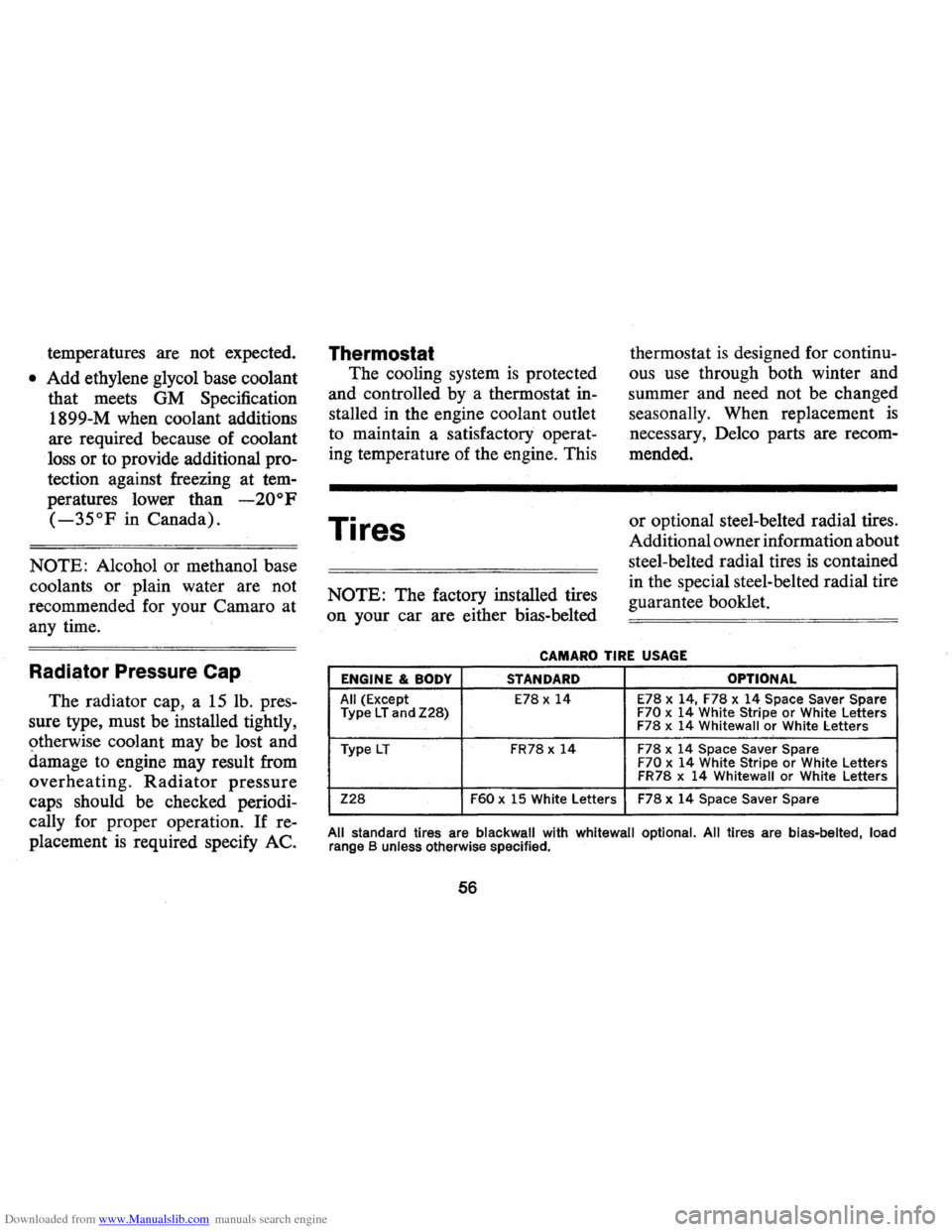
Tires
NOTE: The factory installed tires
on your car are either bias-belted thermostat
is designed
for continu
ous
. use through both winter and
summer and need not be changed
seasonally. When replacement
is
necessary, Delco parts are recom
mended.
or optional steel-belted radial tires.
Additional owner information about
steel-belted radial tires
is contained
in the special steel-belted radial tire
guarantee booklet.
CAMARO TIRE USAGE
ENGINE & BODY STANDARD OPTIONAL
All (Except E78 x 14 E78 x 14, F78 x 14 Space Saver Spare
Type LTand Z28) F70 x 14 White Stripe or White Letters
F78 x 14 Whitewall or White Letters
Type
LT FR78 x 14 F78 x 14 Space Saver Spare F70 x 14 White Stripe or White Letters
FR78 x 14 Whitewall or White Letters
Z28 F60 x 15 White Letters F78 x 14 Space Saver Spare
All standard tires are blackwall with whitewall optional. All tires are bias-belted load range B unless otherwise specified. '
56
Page 62 of 85
Downloaded from www.Manualslib.com manuals search engine ing when your tires have been
worn to the point of needing re
placement. These indicators ap
pear as
lh inch wide bands when
tire tread depth
is 1/16 inch or
less. When the indicators appear
in two
or more adjacent grooves,
at 3 locations around the tire
or
when cord or fabric is exposed,
tire replacement due to tread wear
is recommended.
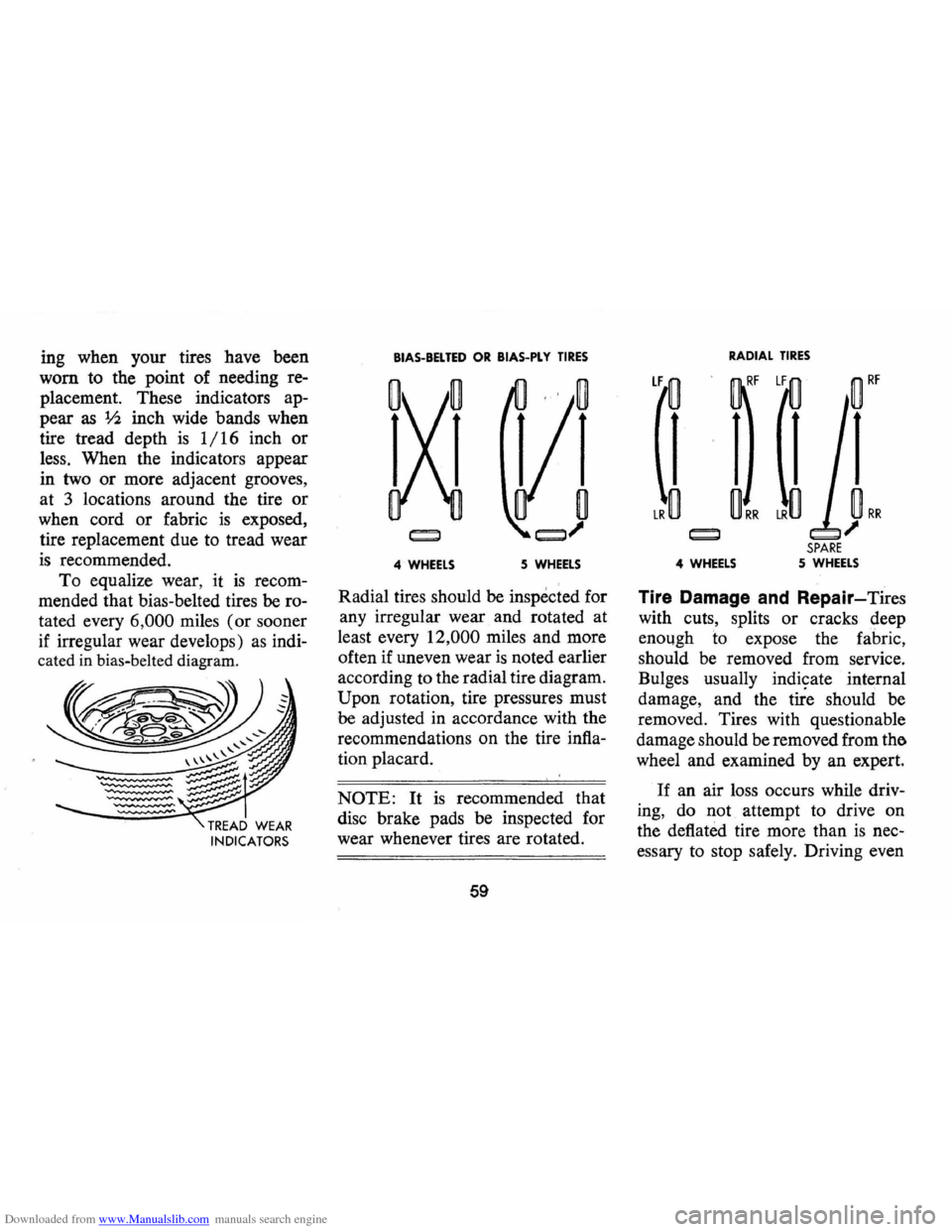
To equalize wear, it is recom
mended that bias-belted tires be ro
tated every
6,000 miles (or sooner
if irregular wear develops) as indi
cated in bias-belted diagram.
BIAS-BEL TED OR BIAS-PlY TIRES
4· WHEELS 5 WHEELS
Radial tires should be inspected for
any irregular wear
and rotated at
least every
12,000 miles and more
often if uneven wear
is noted earlier
according to the radial tire diagram.
Upon rotation, tire pressures must
be adjusted in accordance with the
recommendations
on the tire infla
tion placard.
NOTE: It is recommended that
disc brake pads be inspected for
wear whenever tires are rotated.
59
RADIAL TIRES
SPARE 4 WHEELS 5 WHEELS
Tire Damage and Repair-Tires
with cuts, splits or cracks deep
enough to expose the fabric,
should be removed from service.
Bulges usually
indi~ate internal
damage, and the tire should be
removed. Tires with questionable
damage should be removed from
the.
wheel and examined by an expert.
If an air loss occurs while driv
ing, do not attempt to drive on
the deflated tire more than
is nec
essary to stop safely. Driving even
Page 63 of 85
Downloaded from www.Manualslib.com manuals search engine a short distance can damage a tire
beyond repair.
Temporary repairs, such
as
"blowout" patches or any repair
made from the outside of the tire
should not be made except in
emergencies.
Such "stop-gap" de
vices
as plugs and aerosol-type
sealants are good for no more than
100 miles of driving at speeds not
over
50 mph. A permanent vul
canized repair, plug or patch ap
plied from inside the tire, should
be made
as soon as possible. Also,
the installation of an inner tube in
a damaged tubeless tire
is not a
recommended repair procedure.
Replacement Tires
When replacing tires, only the
size, load range, and construction
type (bias, bias-belted,
or radial)
originally installed on your vehi
cle are recommended. Use of any
other tire size or type tire may seriously
affect ride, handling,
speedometer/odometer calibration
vehicle ground clearance and tire
clearance to the body and chassis.
The following also should be con
sidered when replacing tires:
• To achieve best all around ve
hicle performance, belted-bias
tires and bias tires should not
be mixed on the same car.
• Because of possible adverse ef
fects on vehicle handling, do
not mix radial ply tires with
other type tires on the same
vehicle (such as bias
or bias
belted snow tires).
• It is recommended that new
tires be installed in pairs on the
same axle.
• When replacing only one tire, it
should be paired with the tire
having the least wear, to equal
ize braking traction.
• When replacing original tires
with an optional recommended
60
size of different diameter, the
speedometer must be recali
brated by installing the correct
speedometer driven gear.
Snow Tires
If you equip your vehicle with
snow tires, they should be inflated
4 psi above the recommended
pressures shown on the tire pla
card up to a maximum of 32 psi
( cold) for load range B tires and
40 psi for load range D tires. It is
recommended that vehicle speeds
be limited to a maximum of 75
mph if snow tires are installed.
If
your car is equipped with radial
tires, use only radial snow tires.
Replacement Wheels
When replacing wheels for any
reason, care should be taken to in
sure that the wheels are equiva
lent to those removed in diameter,
rim width and off-set.
Page 72 of 85
Downloaded from www.Manualslib.com manuals search engine as each spark plug cable for
tightness.
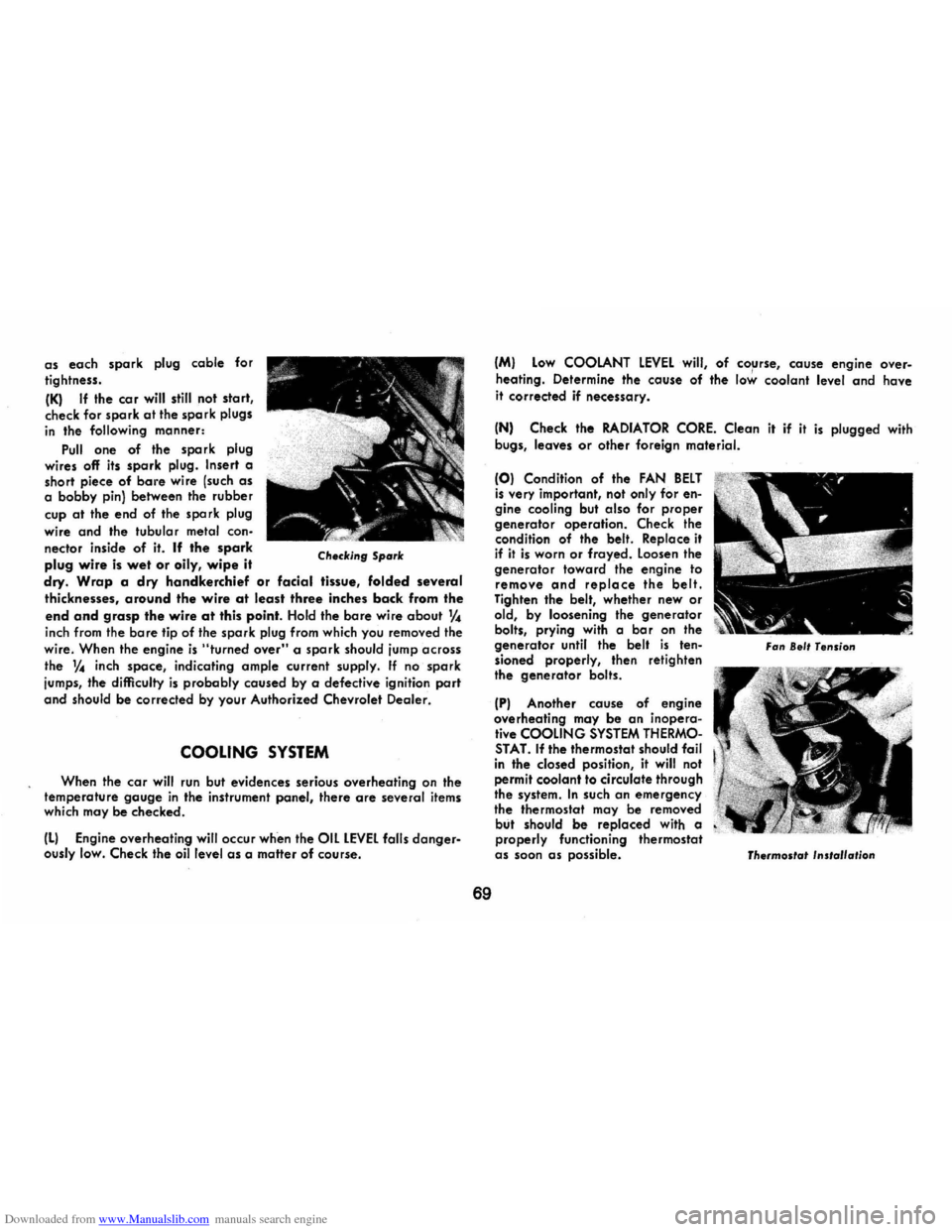
(K) If the co r will still not sta rt, check for spark at the spark plugs in the following manner:
Pull one of the spark plug
wires off its spark plug. Insert a
short piece of bare wire (such as a bobby pin) between the rubber
cup
at the end of the spark plug
wire
and the tubular metal connector inside of it. If the spark
plug wire is wet or oily, wipe it Checking Spark
dry. Wrap a dry handkerchief or facial tissue, folded several
thicknesses, around the wire at least three inches back from the
end and grasp the wire at this point. Hold the bare wire about 1f ..
inch from the bare tip of the spark plug from which you removed the
wire. When the engine is "turned over" a spark should jump across
the
~ inch space, indicating ample current supply. If no spark
jumps, the difficulty
is probably caused by a defective ignition part
and should be corrected by your Authorized Chevrolet Dealer.
COOLING SYSTEM
When the car will run but evidences serious overheating on the
temperature gauge in the instrument panel, there are several items
which may be checked.
(L) Engine overheating will occur whim the OIL LEVEL falls dangerously low. Check the oil level as a matter of course.
69
(M) Low COOLANT LEVEL will, of co~rse, cause engine over
heating. Determine the cause of the low coolant level and have
it corrected if necessary.
(N) Check the RADIATOR CORE. Clean it if it is plugged with
bugs, leaves or other foreign material.
(0) Condition of the FAN BELT is very impartant, not only for engine cooling but also for proper generator operation. Check the
condition of the belt. Replace it if it is worn or frayed. Loosen the generator toward the engine to remove and replace the belt. Tighten the belt, whether new or old, by loosening the generator bolts, prying with a bar on the generator until the belt is tensioned properly, then retighten
the generator bolts.
(P) Another cause of engine
overheating may be an inopera
tive COOLING SYSTEM THERMOSTAT. If the thermostat should fail in the closed position, it will not
permit coolant to circulate through
the system. In such on emergency
the thermostat may be removed but should be replaced with a
properly functioning thermostat
as soon as possible.
Fan 8e/f Tension
ThermoS/of Insfallafion