1973 CHEVROLET MONTE CARLO light
[x] Cancel search: lightPage 41 of 86
Downloaded from www.Manualslib.com manuals search engine and repeat procedures outlined
for AM band setting.
NOTE: Bands cannot be changed
if push button
is unlocked.
Antenna
The radio antenna is incorpo
rated in the windshield glass.
If
necessary, adjustments for maxi
mum antenna effectiveness can be
made
by your authorized Chevro
let dealer.
To Tune Your AM-FM
Stereo Radio
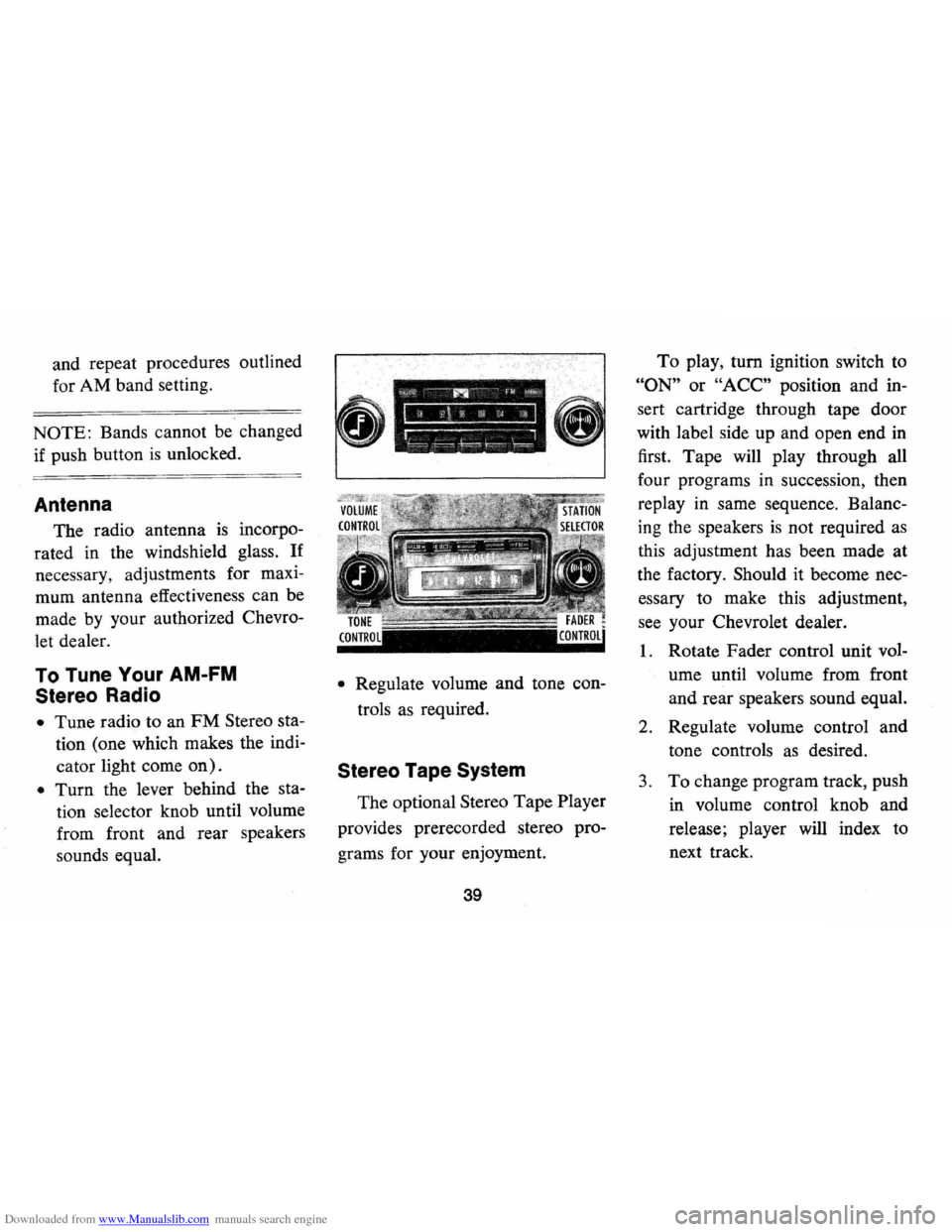
• Tune radio to an FM Stereo sta
tion (one which makes the indi
cator light come
on).
• Turn the lever behind the sta
tion selector knob until volume
from front and rear speakers
sounds equal.
• Regulate volume and tone con
trols
as required.
Stereo Tape System
The optional Stereo Tape Player
provides prerecorded stereo pro
grams for your enjoyment.
39
To play, turn ignition switch to
"ON" or "ACC" position and in
sert cartridge through tape door
with label side up and open end
in
first. Tape will play through all
four programs in succession , then
replay in same sequence. Balanc
ing the speakers
is not required as
this adjustment has been made at
the factory. Should it become nec
essary to make this adjustment,
see your Chevrolet dealer.
1. Rotate Fader control unit vol
ume until volume from front
and rear speakers sound equal.
2. Regulate volume control and
tone controls
as desired.
3. To change program track, push
in volume control knob and
release; player will index to
next track.
Page 43 of 86
Downloaded from www.Manualslib.com manuals search engine I n Case of Emergency
Four Way Hazard
Warning
Flasher
• Use the warning flasher to warn
other drivers any time your
ve
hicle becomes a traffic hazard,
day
or night.
• Avoid stopping on the roadway
if possible.
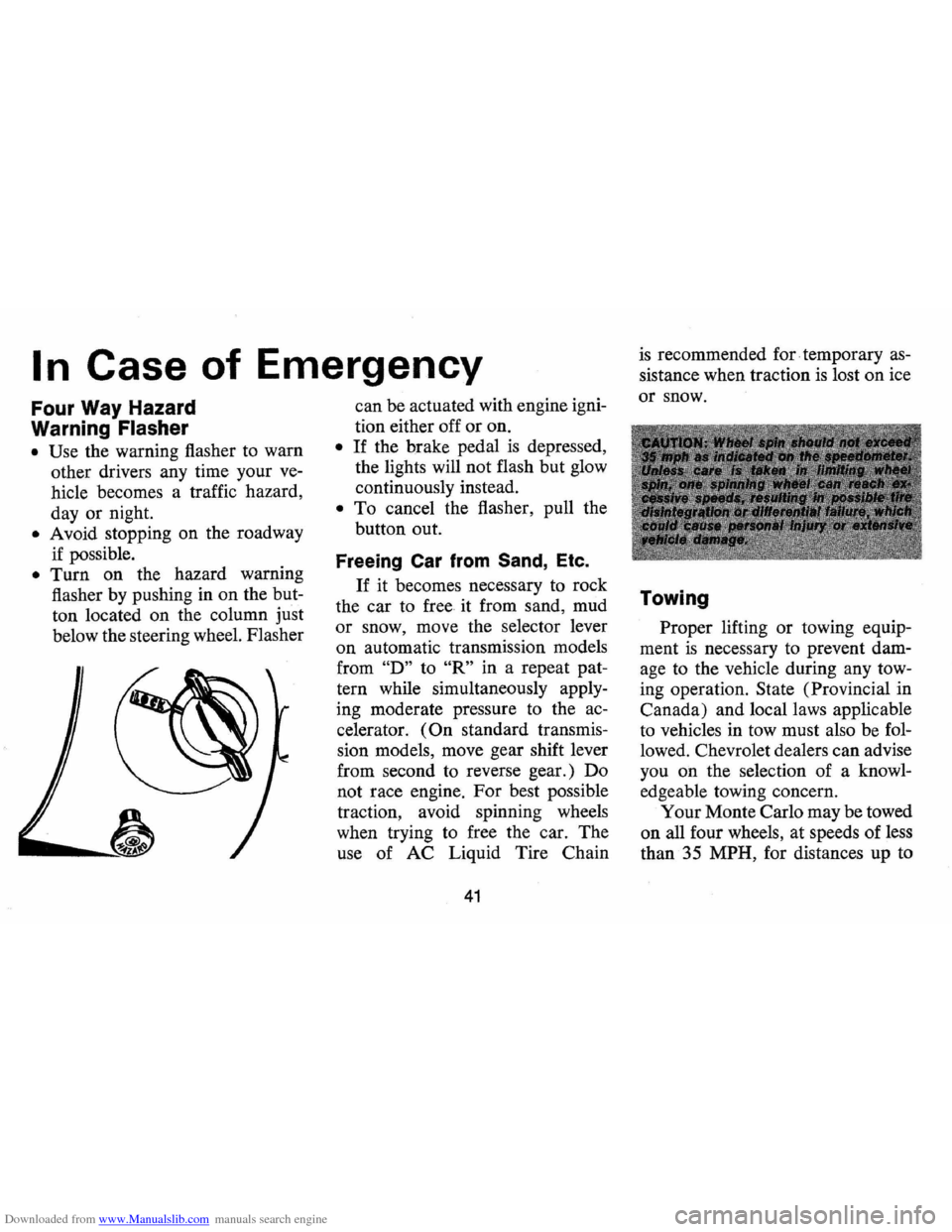
• Turn on the hazard warning
flasher by pushing in on the but
ton located on the column
just
below the steering wheel. Flasher
---~
can be actuated with engine igni
tion either off or on.
• If the brake pedal is depressed,
the lights will not flash but glow
continuously instead.
• To cancel the flasher, pull the
button out.
Freeing Car from Sand, Etc.
If it becomes necessary to rock
the car to free it from sand, mud
or snow, move the selector lever
on automatic transmission models
from
"D" to "R" in a repeat pat
tern while simultaneously apply
ing moderate pressure
to the ac
celerator.
(On standard transmis
sion models, move gear shift lever
from second to reverse gear.) Do
not race engine. For best possible
traction, avoid spinning wheels
when trying to free the car. The
use of AC Liquid Tire Chain
41
is recommended for. temporary as
sistance when traction is lost on ice
or snow.
Towing
Proper lifting or towing equip
ment
is necessary to prevent dam
age to the vehicle during any tow
ing operation.
State (Provincial in
Canada) and local laws applicable
to vehicles in tow must also be fol
lowed. Chevrolet dealers can advise
you on the selection of a knowl
edgeable towing concern.
Your Monte Carlo may be towed
on all four wheels, at speeds of less
than 35 MPH, for distances up to
Page 45 of 86

Downloaded from www.Manualslib.com manuals search engine or property damage. All General
Motors cars have negative-ground
electrical systems and can be used
to jump start one another.
If you
cannot determine how the other
vehicle
is grounded (by checking
specifications in the owner's man
ual, etc.) we recommend that you
attempt no jump starting with that
vehicle.
Jump Starting with
Auxiliary (Booster) Battery
Both booster and discharged
battery should be treated carefully
when using jumper cables. Follow
exactly the procedure outlined be
low, being careful not to cause
sparks:
1.
Set parking brake and place
automatic transmission in
"PARK" (neutral for manual
transmission).
Turn off lights,
heater and other electrical loads. 2.
Remove vent caps from both
the booster and the discharged
batteries. Lay a cloth over the
open vent wells of each battery.
These two actions help reduce
the explosion hazard always
present in either battery when
connecting
"live" booster bat
teries to
"dead" batteries.
3. Attach one end of one jumper
cable to the positive terminal of
the booster battery (identified
by a red color,
"+" or "P" on
the battery case, post or clamp)
and the other end of same cable
to positive terminal of discharged
battery. Do
NOT permit cars to
touch each other,
as this could
'establish a ground connection
and counteract the benefits of
this procedure.
4. Attach one end of the remaining
negative cable to the negative
terminal (black color,
"-" or
"N") of the booster battery, and
43
the other end to the' de1cotron
mounting bracket (see illustra
tion) of your 1973 Monte Carlo
(do not connect directly to neg
ative post of dead battery) -
taking care that clamps from
one cable do not inadvertently
touch the clamps on the other
cable. Do not lean over the
battery when making this con
nection.
Reverse this sequence exactly
when removing the jumper cables.
Re-install vent caps and throw
cloths away
as the cloths may have
corrosive acid on them.
Page 49 of 86
Downloaded from www.Manualslib.com manuals search engine Cleaning Fabrics with
Cleaning
Fluid
This type of cleaner should be
used for cleaning stains containing
grease, oil or fats. Excess stain
should be gently scraped off with
a clean dull knife or scraper.
Use
very little cleaner, light pressure,
and clean cloths (preferably cheese
cloth). Cleaning action with
cloth should be from outside of
stain towards center and constantly
changing to a clean section of
cloth. When stain
is cleaned from
fabric, immediately wipe
area
briskly with a clean absorbent
towel or cheese cloth to help dry
area and prevent a cleaning ring.
If ring forms, immediately clean
entire area or panel section of the
trim assembly.
NOTE: Sometimes a difficult spot
may require a second application
of cleaning fluid followed immedi
ately by a soft brush to completely
remove the spot.
Cleaning Fabrics with
Detergent Foam Cleaners
This type of cleaner is excellent
for cleaning general soilage from
fabrics and for cleaning a panel
section where a minor cleaning
ring may be left from spot clean
ing. Vacuum area to remove ex
cess loose dirt. Always clean at
least a full trim panel or section
of trim. Mask adjacent trim along
stitch or weld lines. Mix detergent
type foam cleaners in strict ac
cordance with directions on label
of container.
Use foam only on a
clean sponge or soft bristle brush
-Do not wet fabric excessively or
47
rub harshly with brush. Wipe clean
with a slightly damp absorbent
towel or cloth. Immediately after
cleaning fabric, dry fabric with a
dry towel or hair dryer. Rewipe
fabric with dry absorbent towel or
cloth to restore luster of the trim
and to eliminate any dried residue.
Seat Belt Care
• Clean only with mild soap solu
tion and lukewarm water.
• Do not bleach or dye belts since
this may severely weaken belts.
Removal of Specific Stains
Candy-Chocolate, use cloth soak
ed in lukewarm water; other than
chocolate, use very hot water. Dry.
If necessary, clean lightly with
fabric cleaning fluid.
Chewing Gum-Harden gum with
ice cube and scrape off with dull
knife. Moisten with fabric cleaning
fluid and scrape again,
Page 50 of 86
Downloaded from www.Manualslib.com manuals search engine Fruit Stains, Coffee, Soft
Drinks, Ice Cream and Milk
Wipe with cloth soaked in cold
water.
If necessary clean lightly
with fabric cleaning fluid.
Soap
and water is not recommended as
it might set the stain .
Catsup-Wipe with cloth soaked
in cool water.
If further cleaning
is necessary, use a detergent foam
cleaner.
Grease, Oil , Butter, Margarine
and Crayon -Scrape off excess
I with dull knife. Use fabric clean
ing fluid.
Paste or Wax Type Shoe Polish
-Light applications of fabric
cleaning fluid.
Exterior Appearance
Your car is finished with General
Motors
" Magic-Mirror" acrylic lac
quer. This
is a finish of maximum
beauty which, in depth of color,
Tar -Remove excess with dull
knife, moisten with fabric clean
ing fluid, scrape again, rub lightly
with additional cleaner.
Blood -Wipe with clean cloth
moistened with cold water.
Use
no soap.
Urine -Sponge stain with luke
warm soap suds from mild neutral
soap on clean cloth, rinse with
cloth soaked in cold water, satu
rate cloth with one part house
hold ammonia and 5 parts water,
apply for 1 minute, rinse with
clean, wet cloth.
Vomitus-Sponge with clean cloth
dipped in clean, cold water. Wash
gloss retention and durability
is
superior to conventional lacquer
finishes.
Washing Your Car
The best way to preserve the
finish and maintain original beauty
48
lightly with lukewarm water and
mild neutral soap.
If odor persists,
treat area with a water-baking soda
solution (1 teaspoon baking soda
to one cup of tepid water). Rub
again with cloth and cold water.
Finally, if necessary, clean lightly
with fabric cleaning fluid.
Interior Glass Surface
The interior glass surface should
be cleaned on a periodic basis for
continued good visibility. A com
mercial household glass cleaning
agent containing ammonia will re
move normal tobacco smoke and
dust
films sometimes caused by
ingredients used in vinyls, plastics
or other interior trim materials.
of appearance
is to keep it clean.
Wash the car in lukewarm or cold
water . Never use strong
soap or
chemical detergents. Cleaning
agents should be quickly flushed
from the surfaces.
Page 59 of 86
Downloaded from www.Manualslib.com manuals search engine hood latch assembly and hood
hinge assembly as follows:
1. Wipe off any accumulation of
dirt or contamination on latch
parts.
2. Apply Lubriplate or equivalent
to latch pilot bolts and latch
locking plate.
3. Apply light engine oil to all
pivot points in release mecha
nism, as well
as primary and
secondary latch mechanisms.
4. Lubricate hood hinges.
5. Make hood hinge and latch
mechanism functional check to
assure the assembly
is working
correctly.
Air Conditioning
Have your Chevrolet Dealer
check your Air Conditioning
sys
tem at some time during the winter
months to be sure there has been no
loss in cooling output. During
NOTE: On vehicles equipped with
a
Pour Season Air Conditioning
System, the system will not operate
below ambient temperatures of
300P. regardless of control posi
tion.
the summer,
see your Chevrolet
Dealer immediately if you suspect
the system
is not performing as it
should .
Cooling System Care
Check the coolant level at each
engine oil change.
Engine Cooling System
The recovery type cooling sys
tem is standard on all Chevrolet
passenger cars and
is designed to
maintain the engine at proper op-
57
erating temperatures. The recovery
tank collects coolant that expands
with rising temperature that would
otherwi se overflow from the sys
tem. When the system temperature
drops, the coolant
is drawn from
the recovery tank back into the
radiator by the suction created by
coolant contraction. The cooling
system has been filled at the factory
with a high-quality , inhibited, year
around coolant that meets the stan
dards of General Motors Specifica
tion 1899-M. This coolant solution
provides freezing protection to
-20oP (-32° P in Canada), and
it has been formulated to be used
for two full calendar years or
24,000 miles, whichever first oc
curs, of normal operation without
replacement.
Cooling System Care
Check the coolant level in the
'see thru' coolant recovery tank
Page 71 of 86
Downloaded from www.Manualslib.com manuals search engine The chart on the previous page, and the information on the pages which follow, contains information designed to aid the average driver to discover, and possibly correct, conditions resulting in minor
mechanical difficulties in his cor. The chart, designed to point out
possible solutions to several of the most common automotive malfunctions and point out a logical checking sequence, will lead step by step to the most likely causes and corrective procedures. If, after making the checks and adjustments suggested,' the source of the
trouble has not been found and corrected, it is strongly recommended that an Authorized Chevrolet Dealer inspect the vehicle and make whatever repairs or adjustments are necessary.
FUEL SYSTEM AND ENGINE
If the ignition switch will cause the engine to "turn over" or "crank" but the cor will not start,
check Steps A through D below. NOTE: If continual "f1ooding" of the carburetor is evidenced by a carburetor wet with fuel or black exhaust smoke, perform the operation suggested in paragraph 0 only. (A) The first and most obvious, and one of the most frequently Checlcing Fuel Flow
68
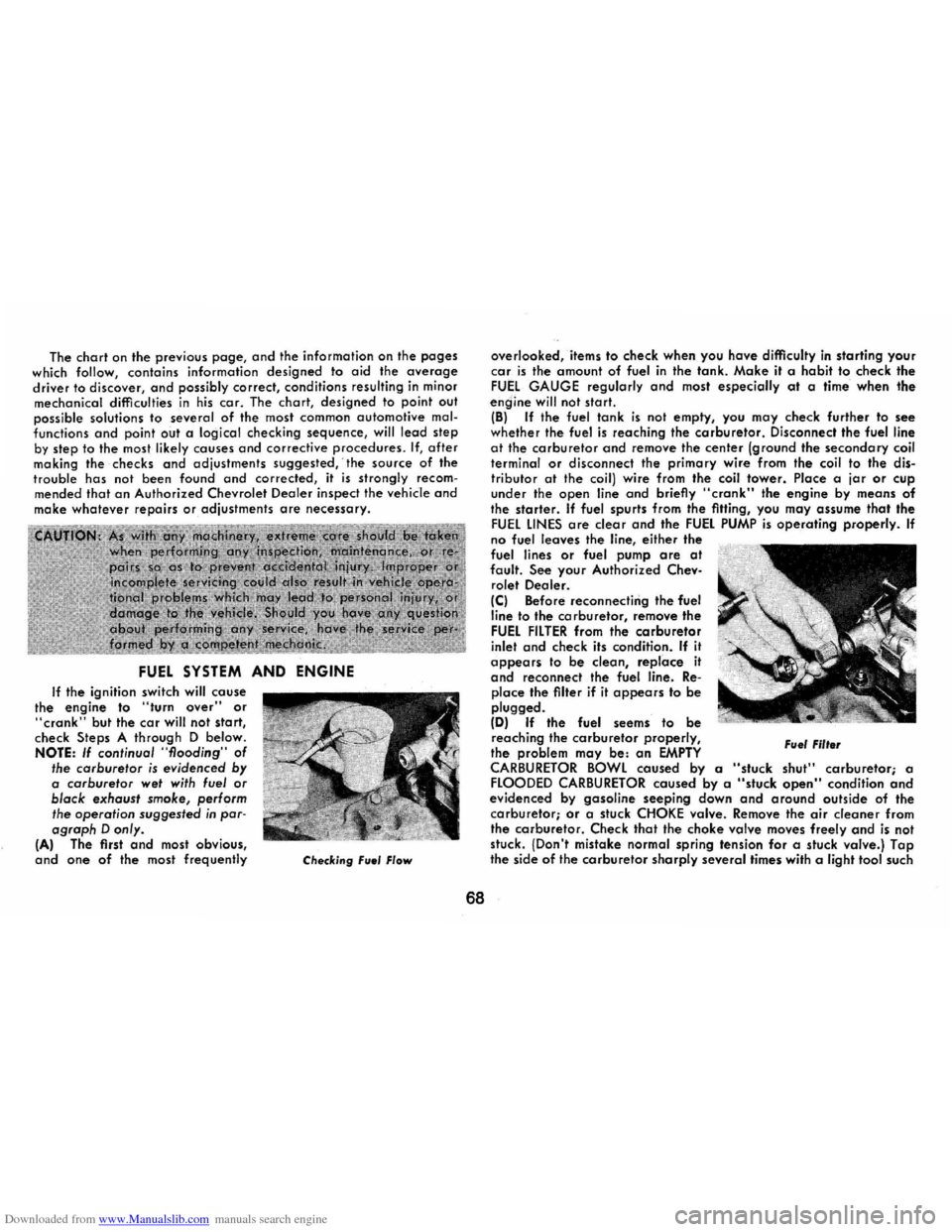
overlooked, items to check when you have difficulty in starting your car is the amount of fuel in the tank. Make it a habit to check the FUEL GAUGE regularly and most especially at a time' when the engine will not start. (B) If the fuel tank is not empty, you may check further to see whether the fuel is reaching the carburetor_ Disconnect the fuel line at the carburetor and remove the center (ground the secondary coil
terminal or disconnect the primary wire from the coil to the distributor at the coil) wire from the coil tower. Place a jar or cup under the open line and briefly "crank" the engine by means of the starter. If fuel spurts from the fitting, you may assume that the FUEL LINES are clear and the FUEL PUMP is operating properly. If no fuel leaves the line, either the
fuel lines or fuel pump are at fault. See your Authorized Chevrolet Dealer. (C) Before reconnecting the fuel
line to the carburetor, remove the FUEL FILTER from the carburetor inlet and check its condition. If it appears to be clean, replace it and reconnect the fuel line. Replace the filter if it appears to be plugged. (0) If the fuel seems to be reaching the carburetor properly, the problem may be: an EMPTY Fuel Filter
CARBURETOR BOWL caused by a "stuck shut" carburetor; a flOODED CARBURETOR caused by a "stuck open" condition and evidenced by gasoline seeping down and around outside of the carburetor; or a stuck CHOKE valve. Remove the air cleaner from
the carburetor. Check that the choke valve moves freely and is not
stuck. (Don't mistake normal spring tension for a stuck valve.) Tap the side of the carburetor sharply several times with a light tool such
Page 72 of 86

Downloaded from www.Manualslib.com manuals search engine as a screwdriver handle or pliers. Replace the oir cleaner and attempt to start the engine in the normal manner. (E) If the car will start but stalls when hot or has a rough idle, you can suspect a faulty IDLE ADJUSTMENT, a malfunctioning AUTOMATIC CHOKE or an extremely dirty and blocked AIR CLEANER ELEMENT. Replace paper element air cleaner if necessary. Idle adjustment or automatic choke service (other than that outlined in paragraph 0 above) should be performed by your Chevrolet
Dealer. If the above Fuel System checks and the checks suggested under
the Electrical System following do not correct the malfunction, it is recommended that you turn to your Authorized Chevrolet Dealer
for further checks, adjustments or repairs. ELECTRICAL SYSTEM If when the ignition key is turned to "Start", the engine will not turn' over, yOu have good reason to suspect electrical trouble. NOTE: Never'remove Delcotron bat lead without first disconnecting battery ground cable. IF) When there is no response at all to attempts to start the car,
check the obvious-your AUTOMATIC TRANSMISSION SELECTOR LEVER must be in Neutral or Park position (manual transmission
must have clutch depressed all the way to floor) before the engine
can be starfed. Turning the IGNITION SWITCH rapidly back and forth several times will sometimes correct a poor internal switch
contact.
(GI The BATTERY may be discharged. If so, lights will be dim and the horn will have a poor tone if it will blow at all.
Usually a garage recharge will be necessary to return the battery to operation. Occasionally, however, a long drive will recharge the battery. . , •
NOTE: If the baHery is determined to be dead, and for no apparent reason, have your :Aflthori~ed Chevrolet Dealer check the baHery, the GENERATOR and the VOLTAGE REGULATOR.
GENERATOR trouble shqiJld already have been indicated by
69
the generator indicator light on the instrument panel.
POOR BATTERY CONNECTIONS may be suspected if the car has operated properly a short time before and now not even the horn will operate. Check both ends of both battery cables. If the connections are corroded, a car may sometimes be restored to operation by removing all cable ends, scraping all contacting surfaces
clean with a pen knife, and reassembling. If the cables are broken,
they must be replaced. The power supply should now be restored unless-the battery is dead.
(HI If, however, the lights and horn work properly but the starter will still not turn over, check the STARTER connections. A "click" from the starter solenoid indicates that the wiring to the starter is properly installed. If the wiring seems to be clean and tightly installed, the trouble is probably in the starter itself and should be referred to your Authorized Chevrolet Dealer.
When the engine will "turn over" but will not start, the following
items may be checked along with the Fuel Systems Checks listed previously.
(II With a clean dry cloth wipe the ce-amic portions of the spark plugs dry. In particularly damp or rainy weather dampness may be the cause of not starting, espe
cially when the engine is cold.
(JI Check the cables at the top
of the distributor and coil as well as each spark plug cable for
tightness.
(KI If the car will still not start,
check for spark at the spark plugs in the following manner: Pull one of the spark plug
wires off its spark plug. Insert a
short piece of bare wire (such as Distributor and Coli Cables