1973 CHEVROLET CAMARO air condition
[x] Cancel search: air conditionPage 32 of 84
Downloaded from www.Manualslib.com manuals search engine Heater
The windshield defrosting and
defogging system assists in provid
ing good visibility through desig
nated areas of the windshield under
most inclement weather conditions.
For immediate operation of the
vehicle, the windshield should be
scraped clear.
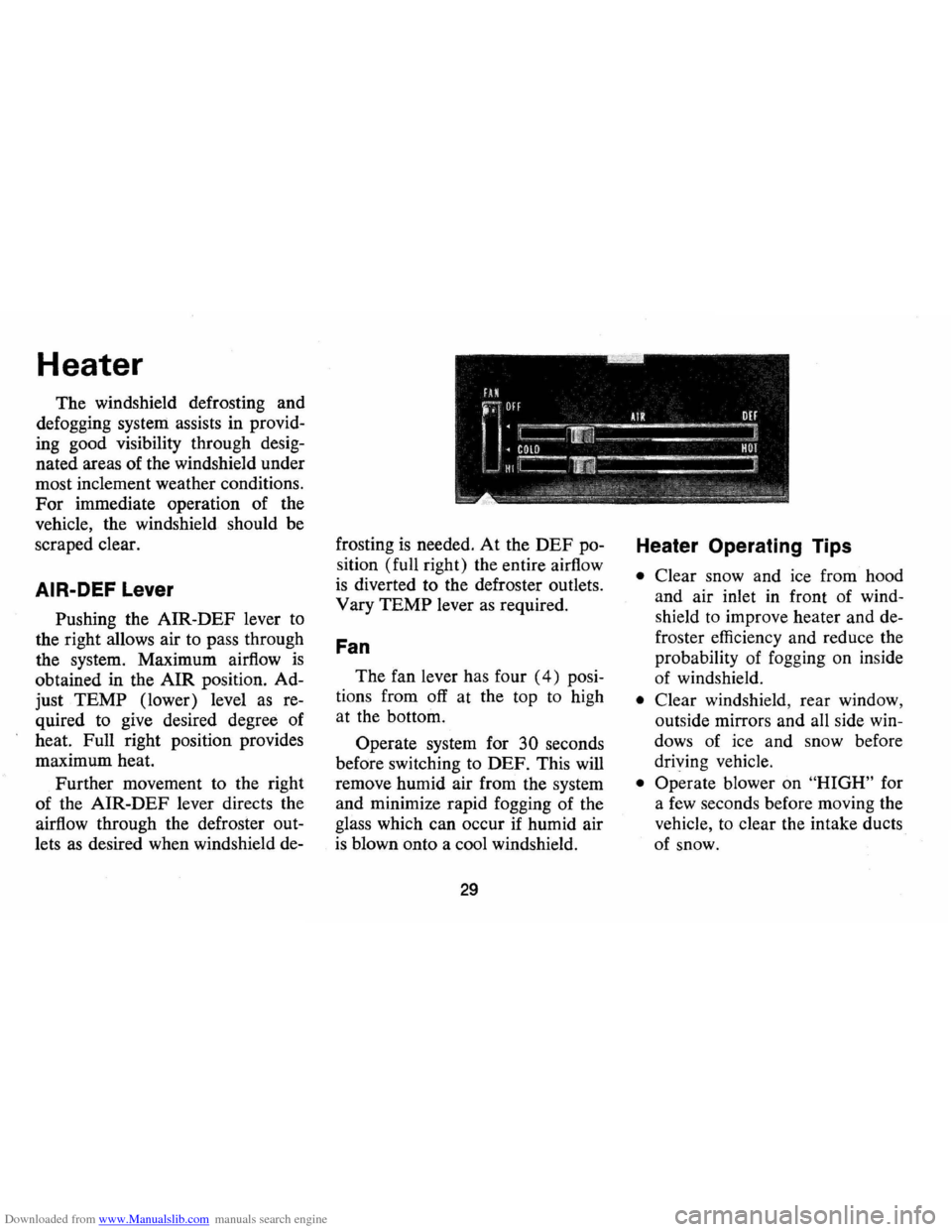
AIR-DEF Lever
Pushing the AIR-DEF lever to
the right allows air to pass through
the system. Maximum airflow
is
obtained in the AIR position. Ad
just
TEMP (lower) level as re
quired to give desired degree of
heat. Full right position provides
maximum heat.
Further movement to the right
of the AIR-DEF lever directs the
airflow through the defroster out
lets as desired when windshield de-frosting
is needed. At the DEF po
sition (full right) the entire airflow
is diverted to the defroster outlets.
Vary
TEMP lever as required.
Fan
The fan lever has four (4) posi
tions from off at the top
to high
at the bottom.
Operate system for
30 seconds
before switching to DEF. This will
remove humid air from the system
and minimize rapid fogging of the
glass which can occur if humid air
is blown onto a cool windshield.
29
Heater Operating Tips
• Clear snow and ice from hood
and air inlet
in front of wind
shield to improve heater and de
froster efficiency and reduce the
probability of fogging on inside
of windshield.
• Clear windshield, rear window,
outside mirrors and all side win
dows of ice and snow before
driving vehicle.
• Operate blower on "HIGH" for
a
few seconds before moving the
vehicle, to clear the intake ducts
of snow.
Page 33 of 84
Downloaded from www.Manualslib.com manuals search engine • Keep all windows and vents
closed to reduce dust, road and
wind noise and uncomfortable
drafts.
• For most satisfactory heater op
eration and air circulation , oper
ate fan
on low or medium speeds
for normal operation and high
speed for quick warm-up and
during extremely low tempera
tures.
• For adequate rear seat heating,
the area beneath the front seat
must not be blocked by carpet
ing, rags, paper or other mate
rial and fan should operate on
high blower.
• For additional summer ventila
tion move the
AIR lever to mid
position and the
DEFROSTER
lever to DEF. If greater air
flow is desired, move the FAN
lever down to operate the three
speed blower .
Rear Window Defroster
To insure clear vision through
the rear window during inclement
weather, the Rear Window De
froster has become established as a
popular accessory . This unit draws in
air from the passenger compart
ment and directs it against the back
window to remove frost or mois
ture . Its blower has a two-speed
control switch on the instrument
panel.
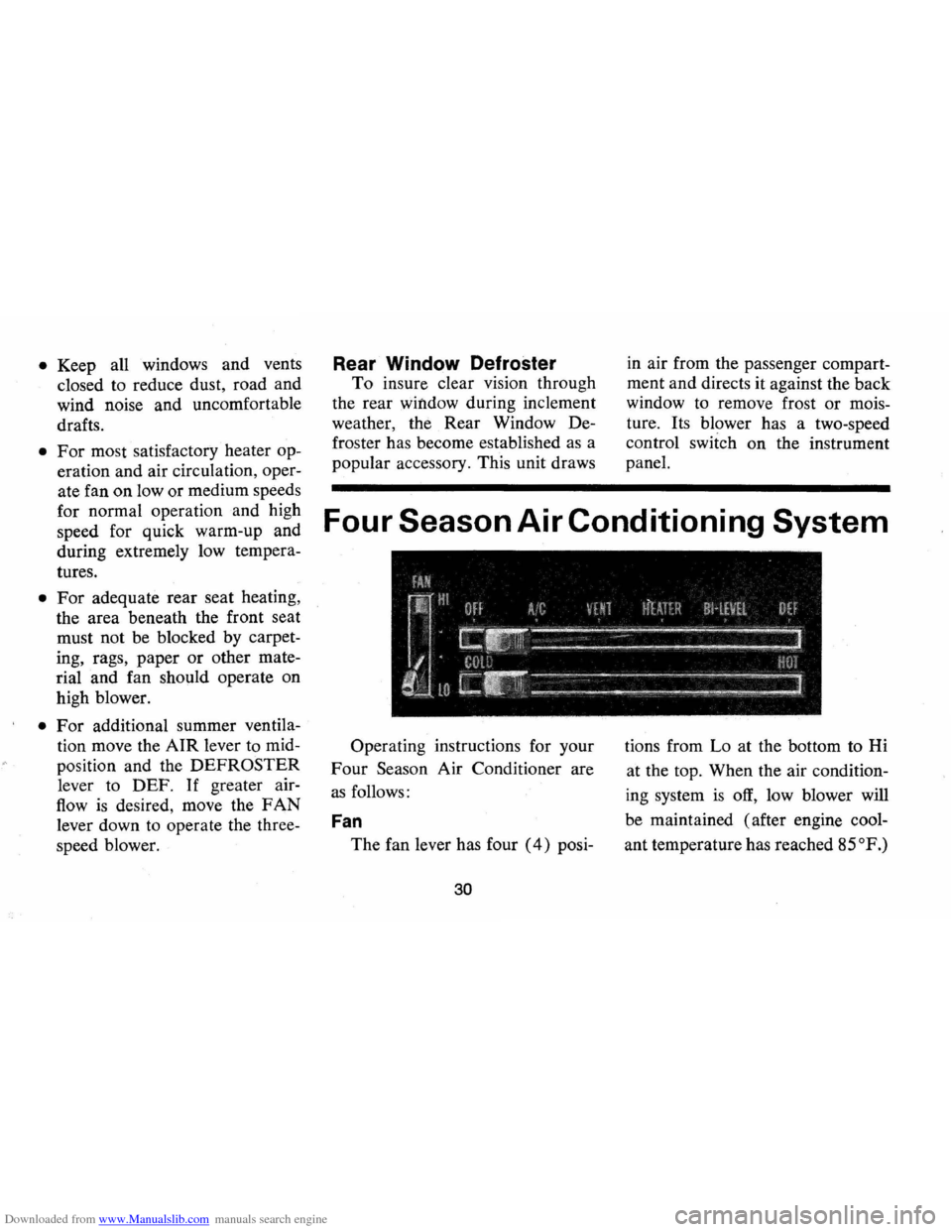
Four Season Air Conditioning System
Operating instructions for your
Four Season Air Conditioner are
as follows:
Fan
The fan lever has four (4) posi-
30
tions from Lo at the bottom to Hi
at the top. When the air condition
ing system
is off, low blower will
be maintained (after engine cool
ant temperature has reached
85°P.)
Page 34 of 84
Downloaded from www.Manualslib.com manuals search engine no matter which position the fan
switch
is in.
Temperature (Lower Level)
The temperature lever allows a
selection of air temperature from
Cold at the far left to Hot at the
far right. When the temperature
lever
is in the COLD position the
system will provide the coldest air
possible. When the temperature
lever
is moved to the right (toward
HOT), the system will operate on
outside air.
Selector (Upper Lever)
This lever provides a selection of
systems available to handle various
heating and cooling requirements
throughout the year. The Selector
lever has four
(4) major opera- tiona!
positions-"Off,"
"Air Con
ditioning," "Vent" and "Heating."
The "Air Conditioning" and "Heat
ing"
groups have several positions
which improve the effectiveness of
the system for various demands.
OFF-The system. operates on low
blower regardless of fan switch
position with air discharged into
vehicle through heater outlet.
A/C-Air from the passenger com
partment is recirculated through
the system with some outside air
and discharged from the upper
outlets when the temperature lever
is in Full COLD or extreme left. If
the Temperature lever is moved
right to the first stop or further,
the system will automatically go
on outside air. The
AIC position,
with Temp. lever in Full
COLD,
31
is used when maximum cooling is
required under conditions of high
temperature and humidity. High
fan speed
is automatically attained
in this position.
A/C(with Temp lever right to first
stop
)-Outside air is passed through
the system and discharged through
the upper outlets. This position
is
recommended for most air condi
tioning situations because of
re
duced blower noise and reduction
of cigarette smoke within the
vehicle.
Fan speed may be varied
as required.
VENT -Outside air is passed
through the system and discharged
from the upper and lower outlets.
This position
is provided for cool
to moderate weather when refrig
eration
is not required.
Page 35 of 84
Downloaded from www.Manualslib.com manuals search engine HEATER-Outside air is delivered
through the heater outlet and with
some air through defroster outlets.
Temperature may be adjusted
as
required. This position is recom
mended for most winter driving.
BI-LEVEL-Outside air is delivered
from the heater lower outlet and
the defroster duct and upper out
lets to provide comfort and keep
the windshield and side glass clear
under low fogging conditions.
DEF -Outside air is delivered
through the defroster outlets only,
Temperature and blower speeds
may be adjusted
as required. This
position
is recommended for con
ditions of severe fogging and icing
only.
Operating tip: When driving
in
snow, if defog or deice is not re
quired to keep the windshield from fogging,
it
is recommended that the
"Heater" position be used. This
keeps the windshield cold
so that
snow will not stick and melt and
will provide a cleaner view.
Four Season System
Air Outlets
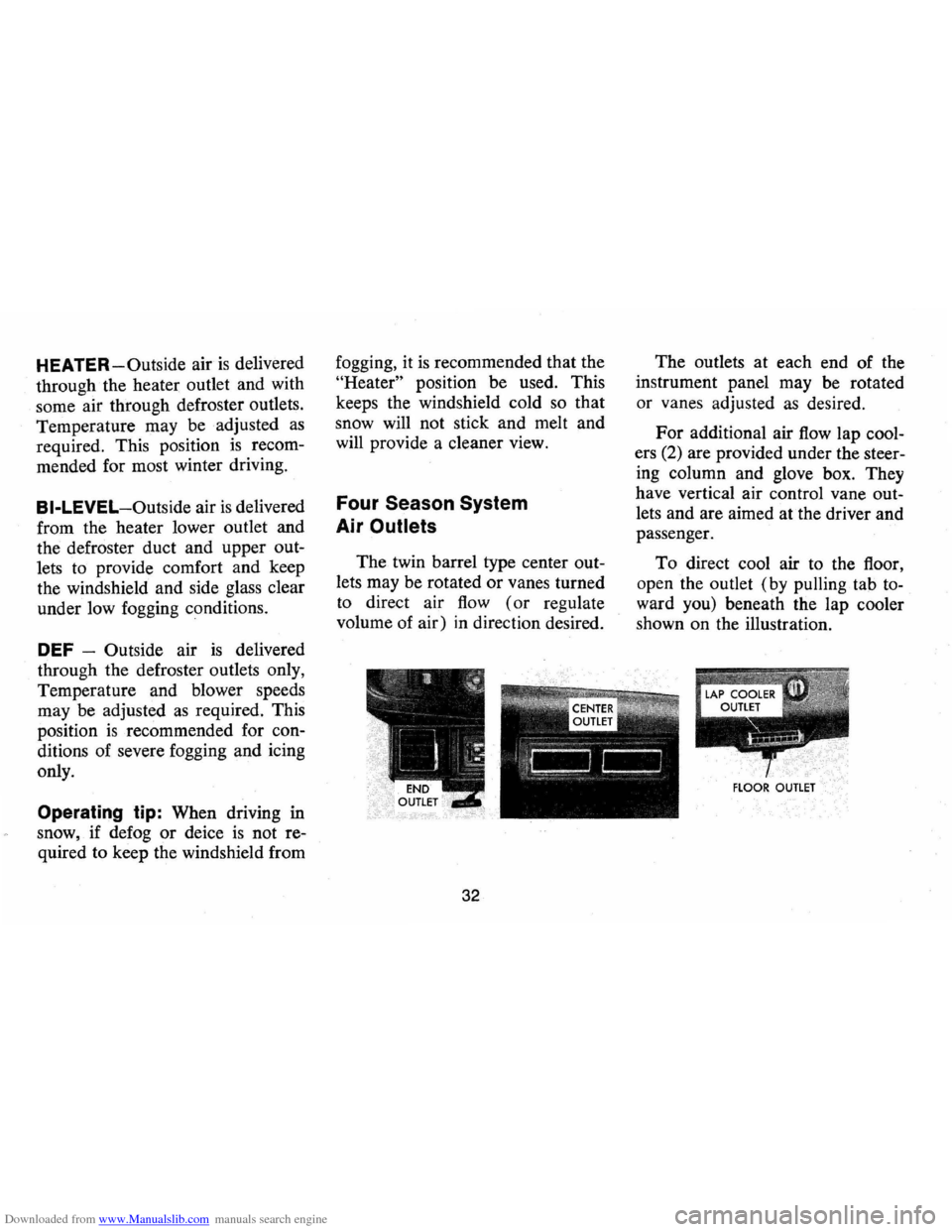
The twin barrel type center out
lets may be rotated
or vanes turned
to direct air flow ( or regulate
volume of air)
in direction desired.
32
The outlets at each end of the
instrument panel may be rotated
or vanes adjusted
as desired.
For additional air flow lap cool
ers (2) are provided under the steer
ing column and glove box. They
have vertical air control vane out
lets and are aimed at the driver and
passenger.
To direct cool air to the floor,
open the outlet (by pulling tab to
ward you) beneath the lap cooler
shown on the illustration.
FLOOR OUTLET
Page 51 of 84
Downloaded from www.Manualslib.com manuals search engine sert it firmly for an accurate read
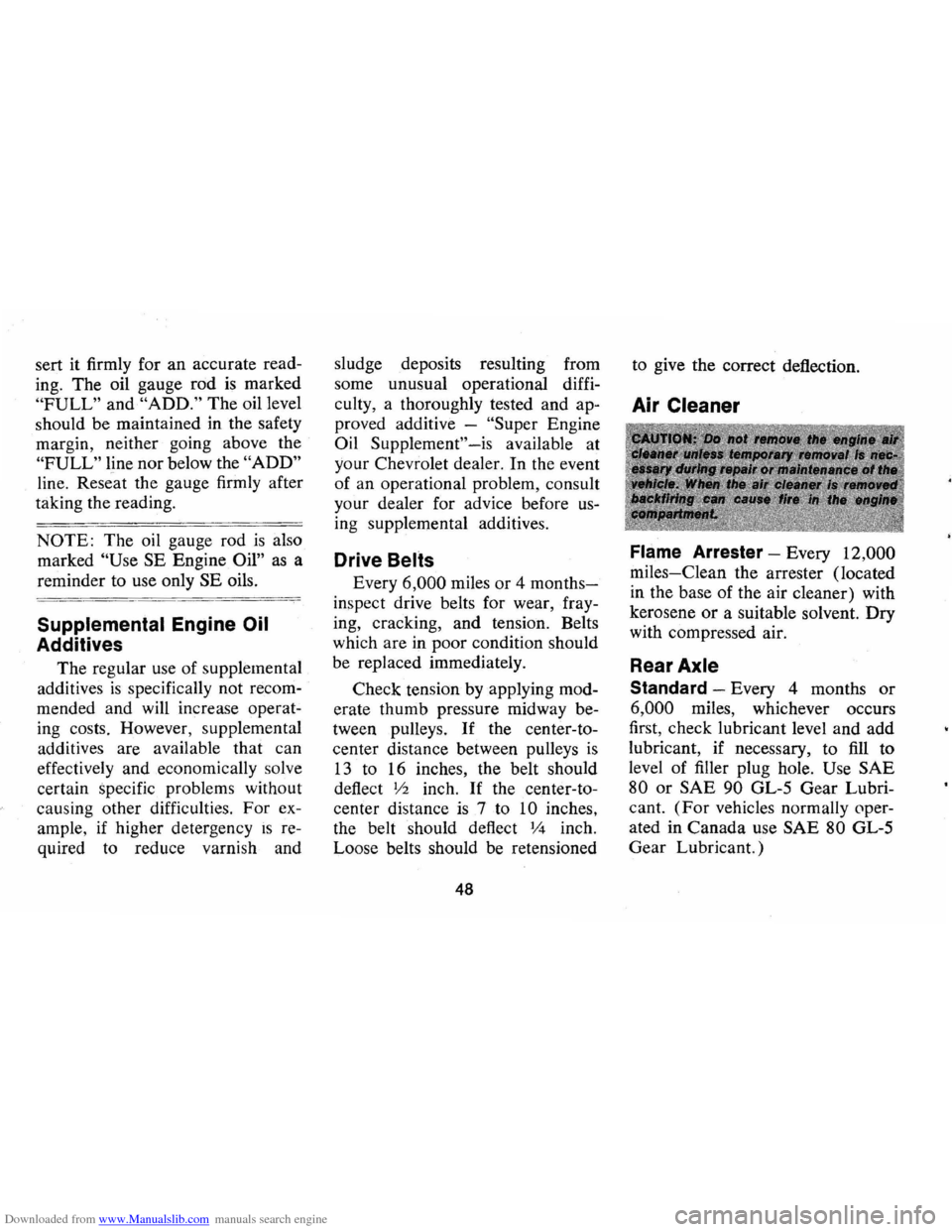
ing. The oil gauge rod
is marked
"FULL" and "ADD." The oil level
should be maintained in the safety
margin, neither going above the
"FULL" line nor below the "ADD"
line. Reseat the gauge firmly after
taking the reading.
NOTE: The oil gauge rod is also
marked
"Use SE Engine Oil" as a
reminder to use only
SE oils.
Supplemental Engine Oil
Additives
The regular use of supplemental
additives
is specifically not recom
mended and will increase operat
ing costs. However, supplemental
additives are available that can
effectively and economically solve
certain specific problems without
causing other difficulties. For ex
ample,
if higher detergency is re
quired to reduce varnish and sludge
deposits resulting from
some unusual operational diffi
culty, a thoroughly tested and ap
proved additive -
"Super Engine
Oil Supplement" -is available at
your Chevrolet dealer.
In the event
of an operational problem, consult
your dealer for advice before
us
ing supplemental additives.
Drive Belts
Every 6,000 miles or 4 months
inspect drive belts for wear, fray
ing, cracking, and tension. Belts
which are in poor condition should
be replaced immediately.
Check tension by applying mod
erate thumb pressure midway be
tween pulleys.
If the center-to
center distance between pulleys
is
13 to 16 inches, the belt should
deflect
Y2 inch . If the center-to
center distance
is7 to 10 inches,
the belt should deflect
1.4 inch.
Loose belts should be retensioned
48
to give the correct deflection.
Air Cleaner
Flame Arrester -Every 12,000
miles-Clean the arrester (located
in the base of the air cleaner) with
kerosene
or a suitable solvent. Dry
with compressed air.
Rear Axle
Standard -Every 4 months or
6,000 miles, whichever occurs
first, check lubricant level and add
lubricant, if necessary, to fill to
level of filler plug hole.
Use SAE
80 or SAE 90 GL-5 Gear Lubri
cant.
(For vehicles normally oper
ated in Canada use SAE 80 GL-5
Gear Lubricant.)
Page 55 of 84
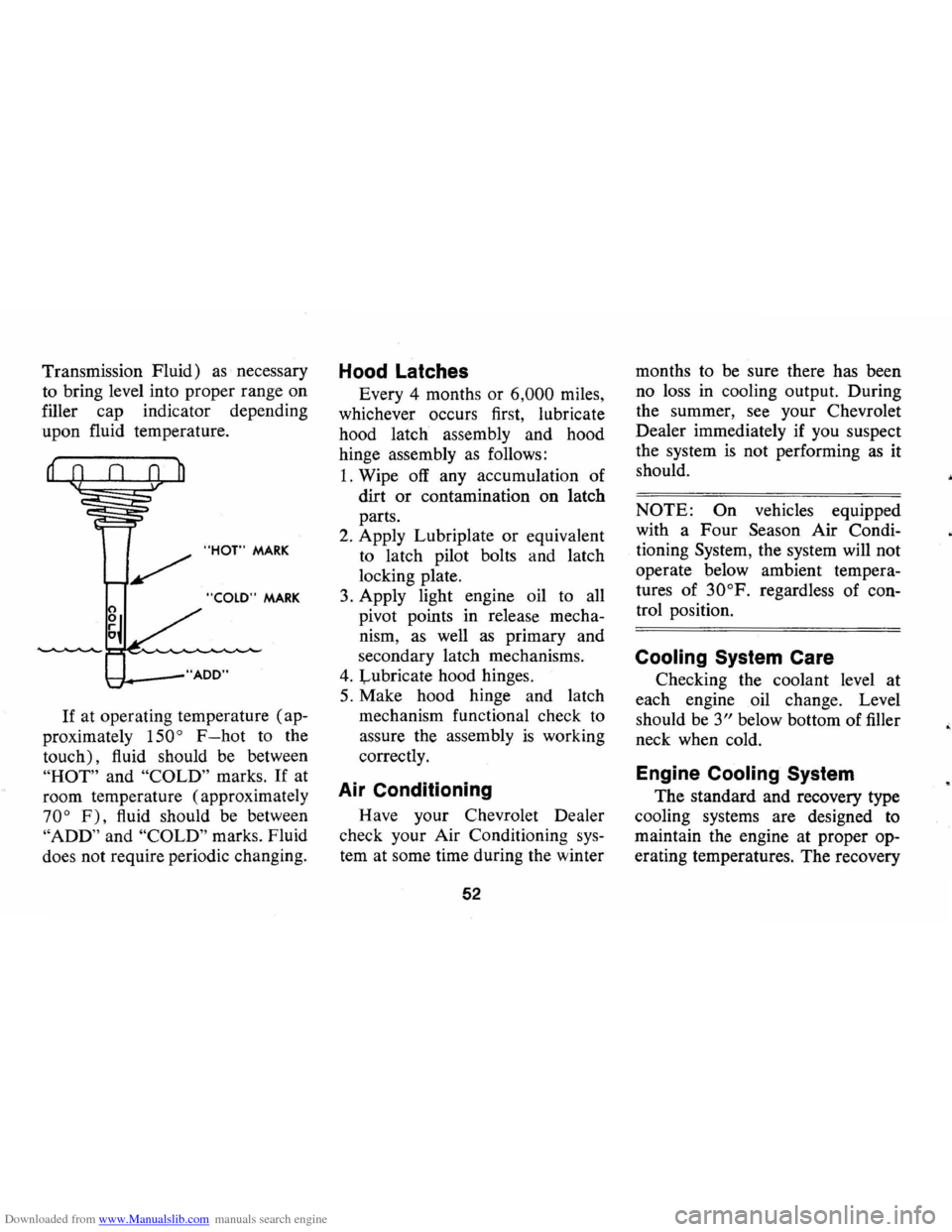
Downloaded from www.Manualslib.com manuals search engine Transmission Fluid) as necessary
to bring level into proper range on
filler cap indicator depending
upon fluid temperature .
"HOT" MARK
"COLD" MARK
t-"f. __ -"AOO"
If at operating temperature (ap
proximately
150 ° F-hot to the
touch), fluid should be between
"HOT" and "COLD" marks. If at
room temperature (approximately
70° F), fluid should be between
"ADD" and "COLD" marks . Fluid
does not require periodic changing.
Hood Latches
Every 4 months or 6,000 miles,
whichever occurs first, lubricate
hood latch assembly and hood
hinge assembly
as follows:
1. Wipe off any accumulation of
dirt
or contamination on latch
parts.
2. Apply Lubriplate or equivalent
to latch pilot bolts and latch
locking plate.
3. Apply light engine oil to all
pivot points in release mecha
nism,
as well as primary and
secondary latch mechanisms.
4. Lubricate hood hinges.
5. Make hood hinge and latch
mechanism functional check to
assure the assembly
is working
correctly.
Air Conditioning
Have your Chevrolet Dealer
check your Air Conditioning
sys
tem at some time during the winter
52
months to be sure there has been
no loss
in cooling output. During
the summer,
see your Chevrolet
Dealer immediately if you suspect
the system
is not performing as it
should.
NOTE: On vehicles equipped
with a Four
Season Air Condi
tioning
System, the system will not
operate below ambient tempera
tures of
30°F. regardless of con
trol position.
Cooling System Care
Checking the coolant level at
each engine oil change. Level
should be
3" below bottom of filler
neck when cold.
Engine Cooling System
The standard and recovery type
cooling systems are designed
to
maintain the engine at proper op
erating temperatures. The recovery
•
Page 56 of 84
Downloaded from www.Manualslib.com manuals search engine type cooling system is used on all
1973 Camaro air conditioned and
heavy duty cooling systems. It has
been filled at the factory with a
high-quality, inhibited, year-around
coolant that meets the standards
of General Motors Specification
1899-M. This coolant solution pro
vides freezing protection to
-20 0 F
(-32°F in Canada), and it has
been formulated to be used for
two full calendar years
or 24,000
miles, whichever first occurs, of
normal operation without draining,
provided the proper concentration
of coolant
is maintained.
• For Recovery Systems Only
Check the coolant level visually
at the see-through coolant reser
voir at each oil change interval
while the engine
is at normal
operating temperature. Do not
remove radiator cap except for
draining and refilling the system.
Coolant level should be at the
"Full Hot" mark on the reservoir.
If system is checked cold, the
coolant level should be at the
"Full Cold" mark on the reser
voir.
• For Other Than Recovery Sys
tems-Check the coolant level
only at oil change intervals, un
less there
is evidence of leaking
or overheating. Do not remove
radiator cap when solution
is
hot and under pressure. Coolant
level should be a maximum of
three inches below the level of
the filler neck when the engine
is cold.
• All Systems-Add a 50/50 mix
ture of high-quality ethylene
glycol antifreeze and water if
coolant additions are necessary.
Do not overfill.
NOTE: If recommended quality
antifreeze
is used, supplemental
inhibitors or additives claiming to
53
provide increased cooling capabil
ity are not necessary. They may be
detrimental to the efficient opera
tion of the system, and represent
an unnecessary operating expense.
Every year, the cooling system
should be serviced
as follows:
1. Wash radiator cap and filler
neck with clean water.
2. Check coolant for proper level
and freeze protection.
3. Pressure test system and radia
tor cap for proper pressure hold
ing capacity (15 psi).
If re
placement
of cap is required,
use the proper AC cap specified
for your car model.
4. Tighten hose clamps and inspect
all hoses. Replace hoses when
ever checked, swollen
or other
wise deteriorated.
5. Clean frontal area of radiator
core and air conditioning con
denser.
Page 59 of 84
Downloaded from www.Manualslib.com manuals search engine Tire Care
Tires should be checked regu
larly for proper inflation pressure,
wear, and damage. The following
information will assist you in prop
erly caring for your tires:
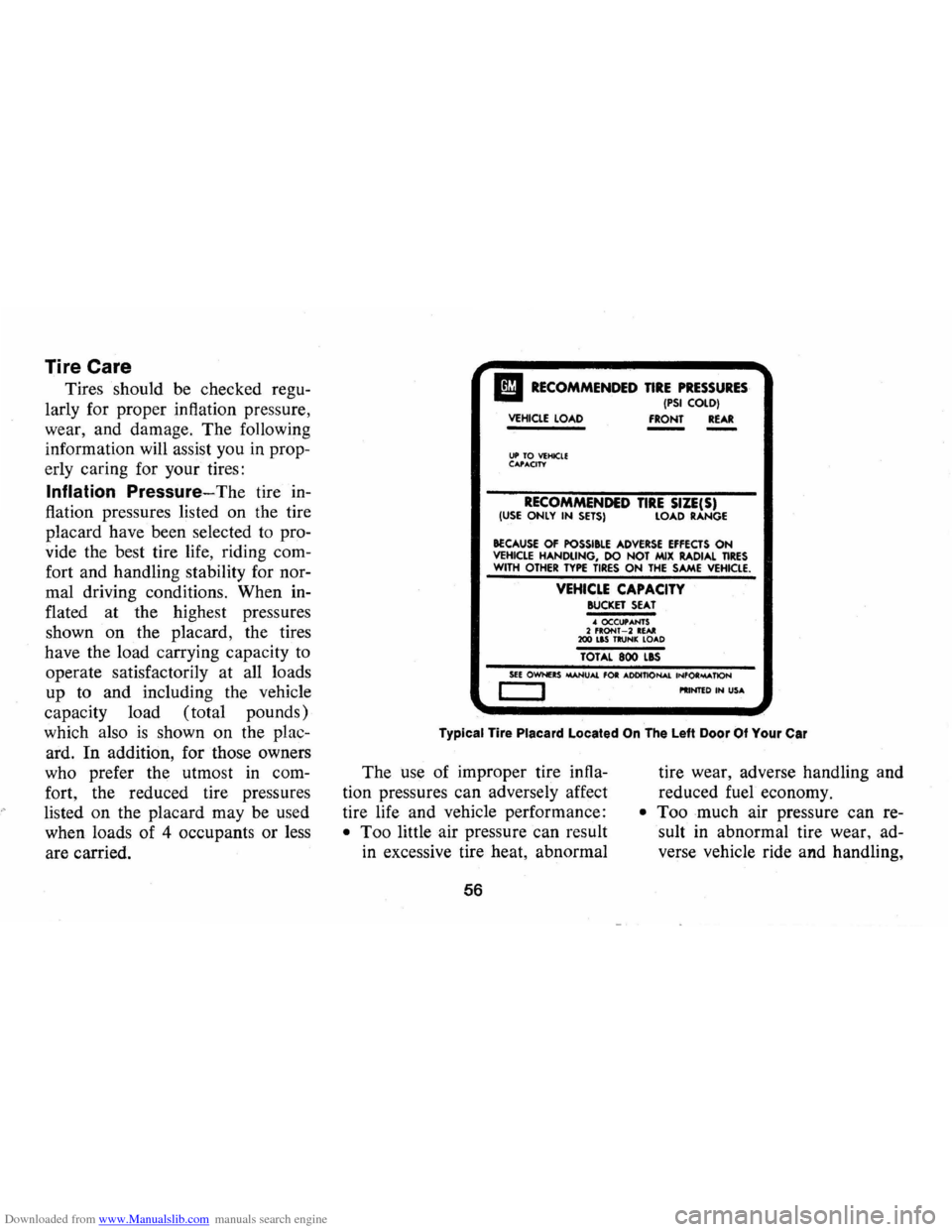
Inflation
Pressure-The tire in
flation pressures listed on the tire
placard have been selected to pro
vide the best tire life, riding com
fort and handling stability for nor
mal driving conditions. When in
flated at the highest pressures
shown
on the placard, the tires
have the load carrying capacity to
operate satisfactorily at all loads
up to and including the vehicle
capacity load (total pounds)
which also
is shown on the plac
ard.
In addition, for those owners
who prefer the utmost
in com
fort , the reduced tire pressures
listed on the placard may be used
when loads of 4 occupants or less
are carried.
II RECOMMENDED TIRE PRESSURES . (PSI COlD) VEHICLE LOAD
FRONT REAR
UP TO VEHICLE C"',"'CITY
RECOMMENDED TIRE SIZE(S) (USE ONLY IN SETS) LOAD RANGE
BECAUSE OF POSSI&lE ADVERSE EFFECTS ON VEHICLE HANDliNG, DO NOT MIX RADIAL TIRES WITH OTHER TYPE TIRES ON THE SAME VEHICLE.
VEHICLE CAPACITY BUCKET SEAT ~ OCCU,""NTS 2 fRONT -2 RE .... 200 lIS TRUNK lO ... D
TOTAL 800 lIS
SEE OWNERS oAANU"" fOR ... OOITlONAl INfOR""'TlON c::=:J I'IINTED IN US ...
Typical Tire Placard Located On The Left Door Of Your Car
The use of improper tire infla
tion pressures can adversely affect
tire life and vehicle performance:
• Too little air pressure can result
in excessive tire heat, abnormal
56 tire
wear, adverse handling and
reduced fuel economy.
• Too much air pressure can re
sult in abnormal tire wear, ad
verse vehicle ride and handling,