1969 FORD MUSTANG washer fluid
[x] Cancel search: washer fluidPage 181 of 413

03-13-02
Specifications
03-13-02
POWER STEERING PUMP
SERVICE
SPECIFICATIONS
Description
Pump Rotor Shaft End Play
Max. Torque Allowed
to
Rotate Rotor Shaft
Stamped Housing to Plate
Assy. Screw and Washer Assy.
Reservoir
to
Stamped Housing
Nut
Cam Ring to Pressure Plate
Screw
Housing to Cover Screw
Ford-Thompson
.017 in. Max.-.003 in. Min.
15 In-Lb.
28-32 Ft.-Lb.
43-47 Ft.-Lb.
_
-
Eaton
—
_
-
—
20 In-Lb.
15-20 Ft,-Lb.
FORD-THOMPSON POWER STEERING
PUMP
TORQUE
LIMITS (FT-LBS)
Description
Pump Rear Mounting Nut
Pressure Hose Nut
Pump Attaching Nuts
Bracket
to
Engine Attaching Nuts
6-Cyl.
302-351 CID
390,427,428,429 CID
Bracket
to
Cylinder Head
Belt Adjustment Bolt
Rear Support Bracket Attaching Nuts
Bracket
to
Engine Adapter
Engine Adapter
to
Engine
Engine Adapter
to
Pump
240 CID
170-200 CID
170-200 CID
250 CID
250 CID
Ford,
Mercury,
Meteor,
Thunderbird
14-18
20-30
25-35
1216
18-25
30-40
25-35
-
45-60
-
-
-
-
Cougar, Falcon,
Fairlane, Montego,
Mustang
20-30
20-30
30-40
7-10
18-25
30-40
25-35
25-35
-
25-35
17-25
30-40
25-35
INTEGRAL
POWER
STEERING GEAR SPECIFICATIONS
Description
Type
Ratio
Turns of Steering Wheel (Lock
to
Lock-Linkage Disconnected)
Fluid Specifications
Fluid Capacity (Included in Pump Reservoir Fill)
Phosphorescent Dye Additive (For Leak Detection)
Sector Shaft End Play -Linkage Disconnected
Sector Shaft Mesh Load. Total Over Mechanical Center
Position.
Must beCDGreater Than Worm
Bearing Preload Torque, Shown Below
Worm Bearing Preload
Clearance Between Valve Spool
&
Retaining Ring
Pressure Variation Between Right
&
Left Turn (At 250
P.S.I.)
-
Check Efforts Each Side
of
Center
Clearance Between Inner Sector Seal and Housing
Ford Design
(XR-«0)
Saginaw
Design
Recirculating Ball Torsion Bar
17:1
4
17.5:1
41/8
M-2C33-F
1.6 Pints (Approx.)
M99B103-A(4 0z. per quart)
None
14 In Lb (Max)
(Exc. Lincoln)
17
In
Lb (Max.)
(Lincoln)
2-7 la
U)
.0035-.0005"
Preferable .002"
4
In
Lb Max.
Variation
.025"
.002"
Max.
14
In
Lb (Max)
4-7 In Lb®
_
—
-
©8-9 In Lb (XR-50 Exc. Lincoln) 11-12 In Lb
for
Uncoln,
4-8 In
Lb
for
Saginaw Gear.
® 3 In Lb in Excess of Valve Assy. Drag Total Worm Bearing Preload and Seal Drag
not to
Exceed
8 In
Lb.procarmanuals.com
Page 204 of 413

04-02-07
Rear Axle — Removable Carrier Type
04-02-07
burrs are evident, remove them with a
fine crocus cloth, working in a rota-
tional motion, then wipe clean. Apply
a small quantity of lubricant to U-
joint splines.
9. Install the U-joint flange using
the tool shown in Fig. 46.
10.
Install a new integral attaching
nut and washer on the pinion shaft.
11.
Tighten the pinion attaching
nut, rotating the pinion several times
to seat the bearing, then torque the pin-
ion nut to 180-200 ft-lbs. Hold the
flange with the tool shown in Fig. 22
or Fig. 23 while the nut is being tight-
ened.
12.
Remove the oil seal replacer
tool from the transmission extension
housing. Install the front end of the
drive shaft on the transmission output
shaft.
13.
Connect the rear end of the
drive shaft to the axle U-joint flange,
aligning the scribe marks made on the
drive shaft end yoke and the axle U-
joint flange.
14.
Check the lubricant level, and
add whatever amount of specified lu-
bricant is necessary to reach the lower
edge of the filler plug hole. Make sure
the axle is in running position when
the level is checked
ORIGINAL U-JOINT FLANGE
(IN VEHICLE REPLACEMENT)
Use procedure as outlined under
Drive Pinion Oil Seal Replacement.
Synthetic seals must not be cleaned,
soaked or washed in cleaning solvent.
INSTALLATION OF A NEW
UNIVERSAL JOINT FLANGE
COLLAPSIBLE SPACER
1.
Raise the vehicle and install
safety stands. Remove both rear wheels
and brake drums.
2.
Disconnect the drive shaft from
the axle U-joint flange. Be careful to
avoid dropping the loose universal
joint bearing cups. Hold the cups on
the spider with tape. Mark the cups so
that they will be in their original posi-
tion in relation to the flange when
they are assembled. Remove the drive
shaft from the transmission extension
housing. Install an oil seal replacer
tool in the transmission extension
housing to prevent transmission fluid
leakage. Refer to the transmission
group for the appropriate tool.
3.
Install an in-lb torque wrench on
the pinion nut. Record the torque re-
quired to maintain rotation of the pin-
ion shaft through several revolutions.
4.
While holding the flange with the
tool shown in Fig. 23 or Fig. 24, re-
move the integral pinion nut and
washer.
5.
Clean the pinion bearing retainer
around the oil seal. Place a drain pan
under the seal, or raise the front of
the vehicle higher than the rear. Syn-
thetic seals must not be cleaned,
soaked or washed in cleaning solvent.
6. Using the tool shown in Fig. 23
or Fig. 24, remove the U-joint flange.
7.
Check splines on the pinion shaft
to be sure they are free of burrs. If
burrs are evident, remove them by
using a fine crocus cloth, working in a
rotational motion, then wipe clean.
Apply a small amount of lubricant
to U-joint splines.
8. Install the U-joint flange using
the tool shown in Fig. 46.
9. Install a new integral nut and
washer on the pinion shaft. (Apply a
small amount of lubricant on the
washer side of the nut.)
10.
Hold the flange with the tool
shown in Fig. 23 or Fig. 24 while the
nut is being tightened.
11.
Tighten the pinion shaft nut,
rotating the pinion occasionally to in-
sure proper bearing seating, and take
frequent preload readings until the
preload is at the original recorded
reading established in step 3.
12.
After original preload has been
reached, tighten the pinion nut slowly,
until an additional preload of 8 to 14
in-lb over the original reading is
reached. (The preload should not ex-
ceed 8 to 14 in-lb over the original
reading, or bearing failure may result.
Under no circumstances should the
pinion nut be backed off to lessen pre-
load. If this is done, a new pinion
bearing spacer must be installed. In
addition, the U-joint flange must
never be hammered on, or power tools
used.
13.
Remove the oil seal replacer
tool from the transmission extension
housing. Install the front end of the
drive shaft on the transmission output
shaft.
14.
Connect the rear end of the
drive shaft to the axle U-joint flange,
aligning the scribe marks made on the
drive shaft end yoke and the axle U-
joint flange.
15.
Check the lubricant level. Make
sure the axle is in running position.
Add whatever amount of specified lu-
bricant is required to reach the lower
edge of the filler plug hole.
SOLID SPACER
1.
Disconnect the drive shaft from
the axle U-joint flange. Be careful to
avoid dropping the loose universal
joint bearing cups. Hold the cups on
the spider with tape. Mark the cups so
that they will be in their original posi-
tion in relation to the flange when
they are assembled. Remove the drive
shaft from the transmission extension
housing. Install an oil seal replacer
tool in the transmission extension
housing to prevent transmission leak-
age.
Refer to the transmission group
for the appropriate tool.
2.
While holding the flange with the
tool shown in Fig. 23 or Fig. 24, re-
move the integral pinion nut and
washer.
3.
Clean the pinion bearing retainer
around the oil seal. Place a drain pan
under the seal, or raise the front of
the vehicle higher than the rear.
4.
Using the tool shown in Fig. 23
or Fig. 24, remove the U-joint flange.
5.
Check splines on the pinion shaft
to be sure they are free of burrs. If
burrs are evident, remove them by
using a fine crocus cloth, working in a
rotational motion, then wipe clean.
Apply a small amount of lubricant to
U-joint splines.
6. Install the U-joint flange using
the tool shown in Fig. 46.
7.
Install integral attaching nut and
washer on the pinion shaft.
8. Tighten the pinion attaching nut,
rotating the pinion several times to
seat the bearing, then torque the pin-
ion attaching nut to 180-220 ft-lbs.
Hold the flange with the tool shown in
Fig. 23 or Fig. 24 while the nut is
being tightened.
9. Remove the oil seal replacer tool
from the transmission extension hous-
ing. Install the front end of the drive
shaft on the transmission output shaft.
10.
Connect the rear end of the
drive shaft to the axle U-joint flange.
11.
Check the lubricant level, and
add whatever amount of specified lu-
bricant is necessary to reach the lower
edge of the filler plug hole. Make sure
the axle is in running position when
the level is checked.
DRIVE SHAFT PINION ANGLE
ADJUSTMENT
Refer to Group 3, Part 3-2 for this
procedure.procarmanuals.com
Page 225 of 413

04-03-05
Rear Axles — Integral Carrier Type
04-03-05
6. Using the tool shown in Fig. 10,
remove the pinion U-joint flange.
7.
Using the tool shown in Fig. 7,
remove the drive pinion oil seal.
8. Clean the oil seal seat.
9. Pinion oil seals have pre-applied
oil resistant sealer. Install the seal in
the retainer using the tool shown in
Fig. 11.
10.
Check splines on the pinion
shaft to be sure they are free of burrs.
If burrs are evident, remove them by
using a fine crocus cloth, working in a
rotational motion. Wipe the pinion
shaft clean.
11.
Apply a small amount of lubri-
cant to the U-joint splines.
12.
Align the punch mark on the
U-joint flange with the mark on the
end of the pinion shaft, and install the
flange.
13.
Install a new integral nut and
washer on the pinion shaft. (Apply a
small amount of lubricant on the
washer side of the nut.)
14.
Hold the flange with the tool
shown in Fig. 9 while tightening the
nut.
15.
Tighten the pinion shaft nut,
rotating the pinion occasionally to in-
sure proper bearing seating, and take
frequent preload readings (Fig. 6)
until the preload is at the original rec-
orded reading established in step 3.
16.
After original preload has been
reached, tighten the pinion nut slowly,
until an additional preload of 6 to 12
in-lbs has been added.
The preload should not exceed the
amount indicated above, or bearing
failure may result. Under no circum-
stances should the pinion nut be
backed-off to lessen preload. If this is
done, a new pinion bearing spacer
must be installed. In addition, the U-
joint flange must never be hammered
on, or power tools used.
17.
Remove the oil seal replacer
tool from the transmission extension
housing. Install the front end of the
drive shaft on the transmission output
shaft.
18.
Connect the rear end of the
drive shaft to the axle U-joint flange,
aligning the punch marks made on the
drive shaft end yoke and the axle U-
joint flange (Fig. 14).
19.
Check the lubricant level. Make
sure the axle is in running position.
Add whatever amount of specified lu-
bricant is required to reach the lower
edge of the filler plug hole, located in
the carrier casting or the housing
cover.
REMOVAL AND INSTALLATION
OF THE ORIGINAL U-JOINT
FLANGE
Use procedure as outlined under
drive pinion oil seal replacement.
Tool-T53T-4857-A
or
4851 -A
E1223-B
FIG. 10—Typical Drive Pinion
Flange Removal
El 906A
Tool-T55P-4676-A
or 4676-G
E1907A
INSTALLATION OF A NEW
UNIVERSAL JOINT FLANGE
1.
Raise the vehicle and install safe-
ty stands. Remove both rear wheels
and brake drums.
2.
Disconnect the drive shaft from
the axle U-joint flange. Be careful to
avoid dropping the loose universal
joint bearing cups. Hold the cups on
the spider with tape. Mark the cups so
that they will be in their original posi-
tion in relation to the flange when
they are assembled. Remove the drive
shaft from the transmission extension
housing. Install an oil seal replacer
tool in the transmission extension
housing to prevent transmission fluid
leakage. Refer to the transmission
group for the appropriate tool.
3.
Install an in-lb torque wrench on
the pinion nut Fig. 6. Record the tor-
que required to maintain rotation of
the pinion shaft through several revo-
lutions.
4.
While holding the flange with the
tool shown in Fig. 9, remove the inte-
gral pinion nut and washer.
5.
Clean the pinion bearing retainer
around the oil seal. Place a drain pan
under the seal, or raise the front of
the vehicle higher than the rear. Syn-
thetic seals must not be cleaned,
soaked or washed in cleaning solvents.
6. Using the tool shown in Fig. 10,
remove the U-joint flange.
7.
Check splines on the pinion shaft
to be sure they are free of burrs. If
burrs are evident, remove them by
using a fine crocus cloth, working in
rotational motion, then wipe clean.
Apply a small amount of lubricant
to U-joint splines.
8. Install the U-joint flange using
the tool shown in Fig. 12.
FIG. 9—Removing or Installing
Drive Pinion Nut
FIG.
11
— Typical Drive Pinion
Flange Seal Installation
FIG. 12—U-Joint Flange
Installationprocarmanuals.com
Page 250 of 413

05-01-03
Drive Shaft
05-01-03
DUST SEAL-4859
BALL SOCKET-4A031
UNIVERSAL
JOINT KIT-4635
WASHER
BALL SEAT i \ SPRING
BEARING \\ RETAINER
SEAL
0 \ X \
CENTER
\ \ RETAINER \ YOKE-47R4
SPRING \
BALL SOCKET-4A031
SLIP YOKE-4841
C1770-A
FIG.
3—Drive Shaft and Universal Joints Disassembled —Thunderbird, Continental Mark
REMOVAL AND INSTALLATION
REMOVAL
1.
To maintain drive line balance,
mark the relationship of the rear drive
shaft yoke and the drive pinion flange
of the axle (if the yellow alignment
marks are not visible) with the shaft
so that they may be installed in their
original positions.
2.
Disconnect the rear U-joint or
rear double cardan joint from the
companion flange. Wrap tape around
the loose bearing caps to prevent
them from falling off the spider. Pull
the drive shaft toward the rear of the
vehicle until the slip yoke clears the
transmission extension housing and
the seal. On Lincoln Continental
models, remove the three roller bear-
ing assemblies off the spline teeth in-
side the slip yoke (Fig. 3). Install the
appropriate tool in the extension
housing to prevent lubricant leakage.
INSTALLATION
1.
If either the rubber seal on the
output shaft or the seal in the end of
the transmission extension housing is
damaged in any manner, replace the
seal or seals as required. Also, if the
lugs on the axle pinion flange are
shaved or distorted so that the bear-
ings slide, replace the flange.
2.
On Lincoln Continental models,
install the bearing assemblies over the
spline teeth in the slip yoke. Lubricate
the yoke spline with B8A-19589-A lu-
bricant. This spline is sealed so that
the transmission fluid does not
"wash" away the spline lubricant
(Figs.
4 and 5). Remove the tool from
the extension housing. Install the yoke
on the transmission output shaft. Do
not allow the yoke assembly to bot-
tom on the output shaft with excessive
force.
Install the drive shaft so that the
index marks or the yellow mark (if
visible) on the yoke (light side) is in
line with the yellow mark on the com-
panion flange. This prevents vibration
which occurs when the balance of the
shaft and balance of the axle pinion
flange become additive instead of neu-
01L SEAL (AUTOMATIC TRANSMISSION ONLY)
YOKE
SNAP RING (WRAP TYPE)
. 4—Output Shaft Spline Seal — All except Continental
Mark III and Thunderbird
E U73-Cprocarmanuals.com
Page 295 of 413

07-01-04
General Transmission Service
07-01-04
taching bolts to the proper torque. If
necessary, replace the gasket.
Check the fluid filler tube connec-
tion at the transmission case or pan.
If leakage is found here, install a new
O-ring or tighten the fitting to the
specified torque.
Check the fluid lines and fittings
between the transmission and the
cooler in the radiator tank for loose-
ness,
wear, or damage. If leakage can-
not be stopped by tightening a fitting,
replace the damaged parts.
Check the engine coolant in the ra-
diator. If transmission fluid is present
in the coolant, the cooler in the radia-
tor is probably leaking.
The cooler can be further checked
for leaks by disconnecting the lines
from the cooler fittings and applying
50-75 psi air pressure to the fittings.
Remove the radiator cap to relieve the
pressure build at the exterior of the oil
cooler tank. If the cooler is leaking
and will not hold this pressure the
cooler must be replaced. Cooler re-
placement is described in the Cooling
System Section of Group 11.
If leakage is found at either the
downshift control lever shaft or the
manual lever shaft, replace either or
both seals.
Inspect the pipe plug on the left
side of the transmission case at the
front. If the plug shows leakage, tor-
que the plug to specifications. If tight-
ening does not stop the leaks, replace
the plug. On a C6 transmission, a TV
pressure plug is also provided on the
right rear side of the case.
When converter drain plugs leak,
remove drain plugs with a six-point
wrench. Coat the threads with FoMo-
Co Perfect Seal Sealing Compound or
its equivalent, and install the plugs.
Torque the drain plugs to specifica-
tion. Fluid leakage from the converter
housing may be caused by engine oil
leaking past the rear main bearing or
from oil gallery plugs, or power steer-
ing oil leakage from steering system.
Be sure to determine the exact cause
of the leak before repair procedures
are started.
Oil-soluble aniline or fluorescent dyes
premixed at the rate of 1/2 teaspoon
of dye powder to 1/2 pint of transmis-
sion fluid have proved helpful in locat-
ing the source of the fluid leakage.
Such dyes may be used to determine
whether an engine oil or transmission
fluid leak is present or if the fluid in
the oil cooler leaks into the engine
coolant system. A black light, how-
ever, must be used with the fluorescent
dye solution.
DISHED OR
FLAT WASHER
" O.D.,
a" STEEL PLATE
5/8"X \W,
DRILL TO SUIT
HEX. HEAD SCREW
3/8"-24 X Vl
HEX. NUT W—
24
WELD
TOGETHER
WING
NUT
>/2"_13
THREAD
CHAIN,
10"
LONG
RUBBER PLUG
1
Vi" DIA. X 2"
LONG Vl"
HOLE THRU
APPROXIMATELY
40 DUROMETER
FLAT WASHER
Vs" O.D.
PLUG
VALVE
STANDARD BOLT
W-13
X 4Vl"
LONG SQUARE
THREAD
END
REMOVE HEAD
AND WELD
TO
WASHER
STANDARD 1/8" FITTING-87971-S FOR
RETAPPED DRAIN PLUG THREADS-USE
1/4" OVERSIZE FITTING-87973-S
D 1067-B
WELD TOGETHER
SECURELY—MUST
NOT LEAK
FIG. 2—Converter Leak Checking Tool
CONVERTER LEAKAGE
CHECK
If there are indications that the
welds on the torque converter are
leaking, the converter will have to be
removed and the following check
made before the unit is replaced.
A leak checking tool (Fig. 2) can be
made from standard parts. The tool
can be used to check all converters.
1.
Install the plug in the converter
(Fig. 3) and expand it by tightening
the wing nut. Attach the safety chains.
2.
Install the air valve in one of the
drain plug holes.
3.
Introduce air pressure into the
converter. Check the pressure with a
tire gauge and adjust it to 20 psi.
4.
Place the converter in a tank of
water. Observe the weld areas for
bubbles. If no bubbles are observed, it
may be assumed that the welds are
not leaking.
ENGINE IDLE SPEED CHECK
Check and, if necessary, adjust the
engine idle speed, using the procedure
given in Group 10.
If the idle speed is too low, the en-
gine will run roughly. An idle speed
that is too high will cause the vehicle
to creep, have harsh engagements and
harsh closed-throttle downshifts.
ANTI-STALL DASHPOT
CLEARANCE CHECK
After the engine idle speed has been
properly adjusted, check the anti-stall
dashpot clearance. Follow the proce-
dure given in Group 10 for checking
and adjusting this clearance.
MANUAL LINKAGE CHECKS
Correct manual linkage adjustment
is necessary to position the manual
valve for proper fluid pressure direc-
tion to the different transmission com-
ponents. Improperly adjusted manual
Tire Pressure Gauge
D1921-A
FIG. 3—Converter Leak Checking
Tool Installationprocarmanuals.com
Page 303 of 413
07-01-12
General Transmission Service
07-01-12
the transmission,
any
metal particles
or clutch plate
or
band material that
may have been carried into
the
cooler
should
be
removed from
the
system
by
flushing
the
cooler
and
lines before
the transmission
is put
back into serv-
ice.
In no
case should
an
automatic
transmission having
a
clutch
or
band
failure
or
other internal trouble result-
ing
in
fluid contamination,
be put
back into service without first flushing
the transmission
oil
cooler.
To flush
the oil
cooler, follow
the
instruct!
on >
provided with
the
Rotun-
da Automatic Transmission Torque
Converter
and
Cooler Cleaner
LRE-
60081.
INSPECTION
TURBINE
AND
STATOR
END
PLAY CHECK
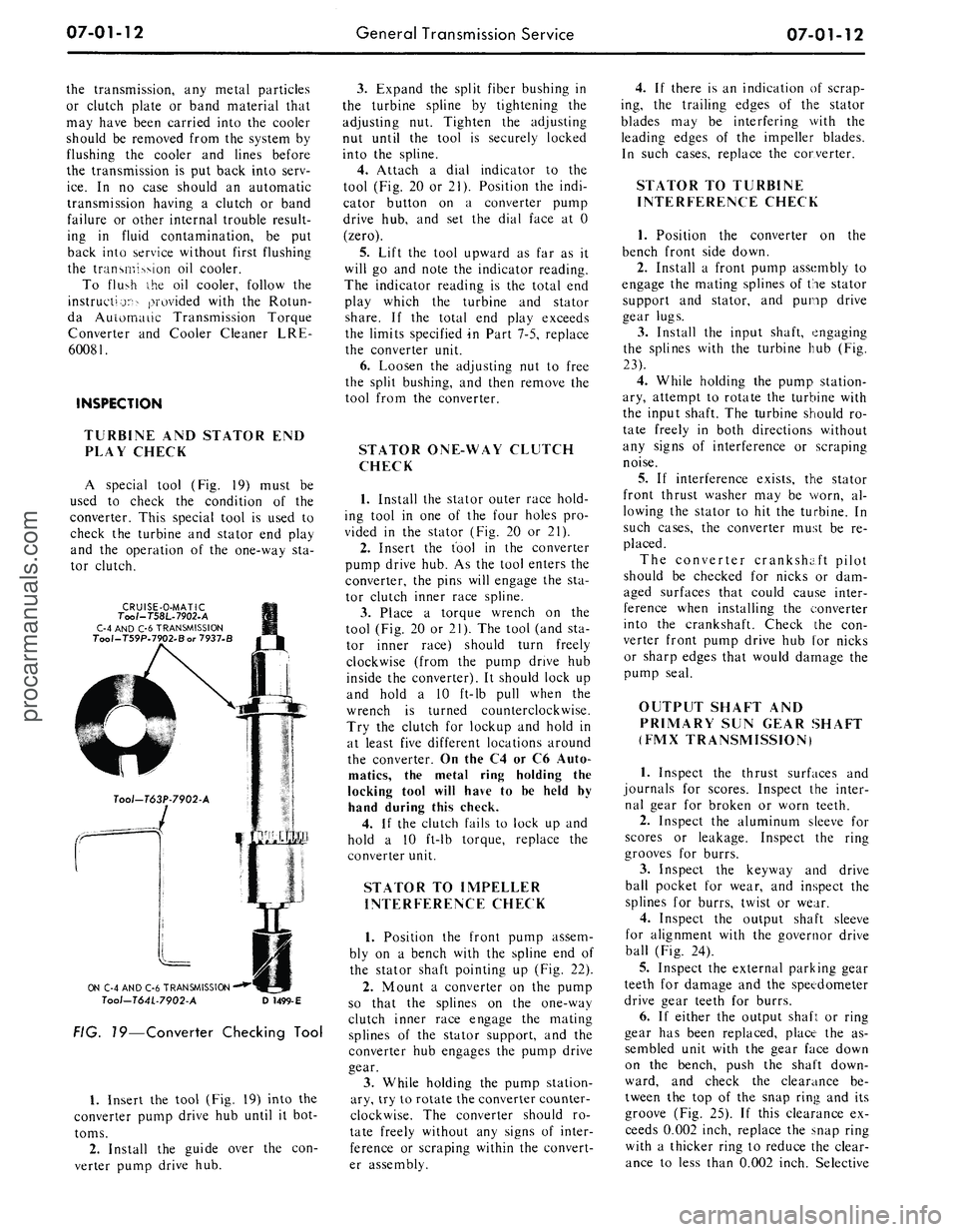
A special tool
(Fig. 19)
must
be
used
to
check
the
condition
of the
converter. This special tool
is
used
to
check
the
turbine
and
stator
end
play
and
the
operation
of the
one-way
sta-
tor clutch.
CRUISE-O-MATIC
Too/-T58L-7902-A
C-4 AND C-6 TRANSMISSION
Tool-T59P.7902.Bor 7937-B
ON C-4 AND C-6 TRANSMISSION
Tool-T64L-7902-A
D
1499-E
FIG. 19—Converter Checking Tool
1.
Insert
the
tool (Fig.
19)
into
the
converter pump drive
hub
until
it
bot-
toms.
2.
Install
the
guide over
the con-
verter pump drive
hub.
3.
Expand
the
split fiber bushing
in
the turbine spline
by
tightening
the
adjusting
nut.
Tighten
the
adjusting
nut until
the
tool
is
securely locked
into
the
spline.
4.
Attach
a
dial indicator
to the
tool (Fig.
20 or
21). Position
the
indi-
cator button
on a
converter pump
drive
hub, and set the
dial face
at 0
(zero).
5.
Lift
the
tool upward
as far as it
will
go and
note
the
indicator reading.
The indicator reading
is the
total
end
play which
the
turbine
and
stator
share.
If the
total
end
play exceeds
the limits specified
in
Part 7-5, replace
the converter unit.
6. Loosen
the
adjusting
nut to
free
the split bushing,
and
then remove
the
tool from
the
converter.
STATOR ONE-WAY CLUTCH
CHECK
1.
Install
the
stator outer race hold-
ing tool
in one of the
four holes
pro-
vided
in the
stator (Fig.
20 or 21).
2.
Insert
the
tool
in the
converter
pump drive hub.
As the
tool enters
the
converter,
the
pins will engage
the sta-
tor clutch inner race spline.
3.
Place
a
torque wrench
on the
tool (Fig.
20 or
21).
The
tool (and
sta-
tor inner race) should turn freely
clockwise (from
the
pump drive
hub
inside
the
converter).
It
should lock
up
and hold
a 10
ft-lb pull when
the
wrench
is
turned counterclockwise.
Try
the
clutch
for
lockup
and
hold
in
at least five different locations around
the converter.
On
the
C4
or C6
Auto-
matics,
the
metal ring holding
the
locking tool will have
to be
held
by
hand during this check.
4.
If the
clutch fails
to
lock
up and
hold
a 10
ft-lb torque, replace
the
converter unit.
STATOR
TO
IMPELLER
INTERFERENCE CHECK
1.
Position
the
front pump assem-
bly
on a
bench with
the
spline
end of
the stator shaft pointing
up
(Fig.
22).
2.
Mount
a
converter
on the
pump
so that
the
splines
on the
one-way
clutch inner race engage
the
mating
splines
of the
stator support,
and the
converter
hub
engages
the
pump drive
gear.
3.
While holding
the
pump station-
ary, try
to
rotate the converter counter-
clockwise.
The
converter should
ro-
tate freely without
any
signs
of
inter-
ference
or
scraping within
the
convert-
er assembly.
4.
If
there
is an
indication
of
scrap-
ing,
the
trailing edges
of the
stator
blades
may be
interfering with
the
leading edges
of the
impeller blades.
In such cases, replace
the
converter.
STATOR
TO
TURBINE
INTERFERENCE CHECK
1.
Position
the
converter
on the
bench front side down.
2.
Install
a
front pump assembly
to
engage
the
mating splines
of
the
stator
support
and
stator,
and
pump drive
gear lugs.
3.
Install
the
input shaft, engaging
the splines with
the
turbine
hub (Fig.
23).
4.
While holding
the
pump station-
ary, attempt
to
rotate
the
turbine with
the input shaft.
The
turbine should
ro-
tate freely
in
both directions without
any signs
of
interference
or
scraping
noise.
5.
If
interference exists,
the
stator
front thrust washer
may be
worn,
al-
lowing
the
stator
to hit the
turbine.
In
such cases,
the
converter must
be re-
placed.
The converter crankshaft pilot
should
be
checked
for
nicks
or dam-
aged surfaces that could cause inter-
ference when installing
the
converter
into
the
crankshaft. Check
the con-
verter front pump drive
hub for
nicks
or sharp edges that would damage
the
pump seal.
OUTPUT SHAFT
AND
PRIMARY
SUN
GEAR SHAFT
(FMX TRANSMISSION)
1.
Inspect
the
thrust surfaces
and
journals
for
scores. Inspect
the
inter-
nal gear
for
broken
or
worn teeth.
2.
Inspect
the
aluminum sleeve
for
scores
or
leakage. Inspect
the
ring
grooves
for
burrs.
3.
Inspect
the
keyway
and
drive
ball pocket
for
wear,
and
inspect
the
splines
for
burrs, twist
or
wear.
4.
Inspect
the
output shaft sleeve
for alignment with
the
governor drive
ball (Fig.
24).
5.
Inspect
the
external parking gear
teeth
for
damage
and the
speedometer
drive gear teeth
for
burrs.
6.
If
either
the
output shaft
or
ring
gear
has
been replaced, place
the as-
sembled unit with
the
gear face down
on
the
bench, push
the
shaft down-
ward,
and
check
the
clearance
be-
tween
the top of the
snap ring
and its
groove
(Fig. 25).
If
this clearance
ex-
ceeds 0.002 inch, replace
the
snap ring
with
a
thicker ring
to
reduce
the
clear-
ance
to
less than 0.002 inch. Selectiveprocarmanuals.com
Page 306 of 413
07-01-15
General Transmission Service
07-01-15
GOVERNOR
DRIVE BALL
POCKET
FRONT PUMP AND STATOR
SUPPORT SHAFT
D1922-A
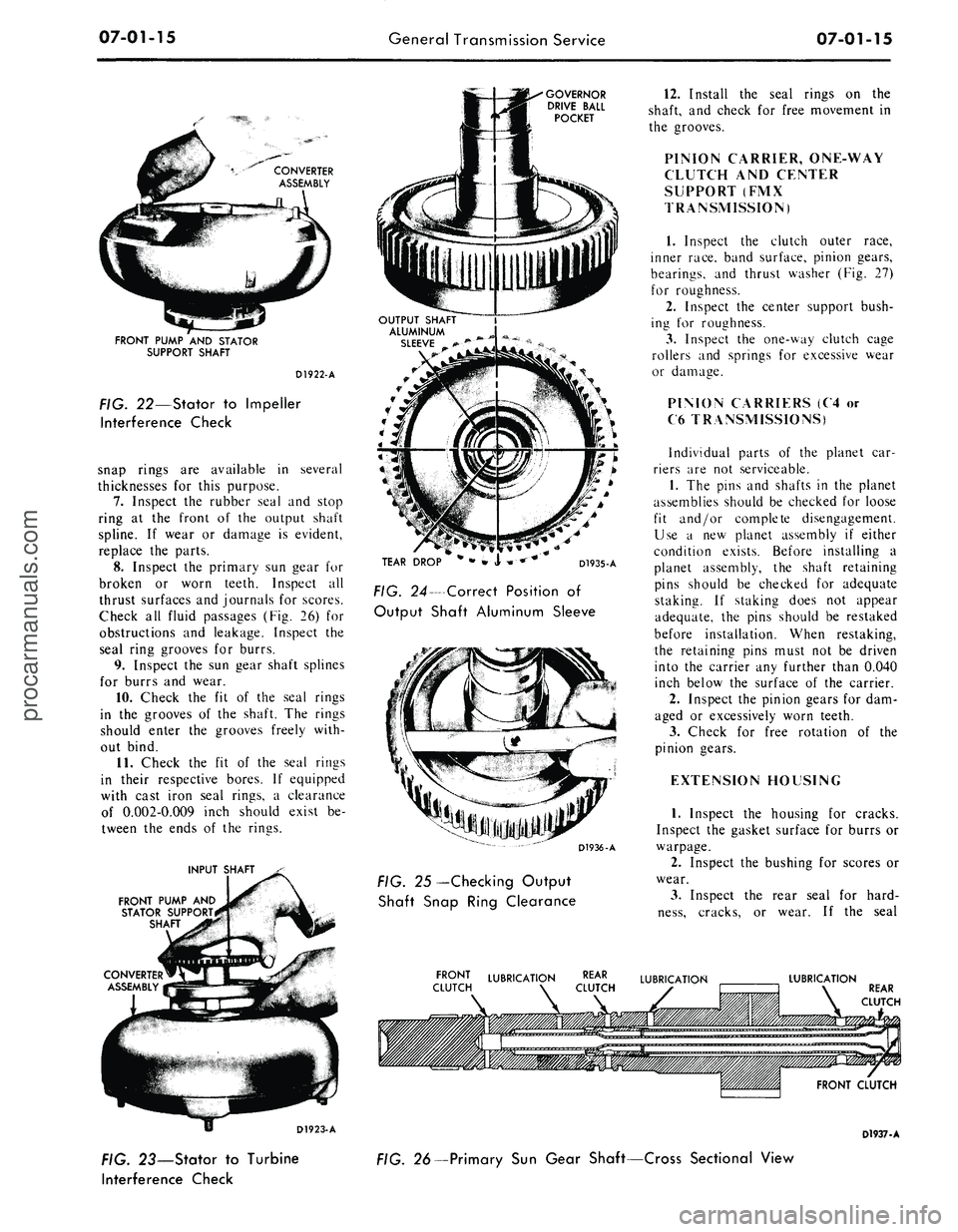
FIG. 22—Stator to Impeller
Interference Check
snap rings are available in several
thicknesses for this purpose.
7.
Inspect the rubber seal and stop
ring at the front of the output shaft
spline. If wear or damage is evident,
replace the parts.
8. Inspect the primary sun gear for
broken or worn teeth. Inspect all
thrust surfaces and journals for scores.
Check all fluid passages (Fig. 26) for
obstructions and leakage. Inspect the
seal ring grooves for burrs.
9. Inspect the sun gear shaft splines
for burrs and wear.
10.
Check the fit of the seal rings
in the grooves of the shaft. The rings
should enter the grooves freely with-
out bind.
11.
Check the fit of the seal rings
in their respective bores. If equipped
with cast iron seal rings, a clearance
of 0.002-0.009 inch should exist be-
tween the ends of the rings.
INPUT SHAFT
FRONT PUMP AND
STATOR SUPPORT
SHAFT
CONVERTER
ASSEMBLY
D1923-A
TEAR DROP
D1935-A
FIG. 24—Correct Position of
Output Shaft Aluminum Sleeve
D1936-A
FIG. 25—Checking Output
Shaft Snap Ring Clearance
12.
Install the seal rings on the
shaft, and check for free movement in
the grooves.
PINION CARRIER, ONE-WAY
CLUTCH AND CENTER
SUPPORT (FMX
TRANSMISSION)
1.
Inspect the clutch outer race,
inner race, band surface, pinion gears,
bearings, and thrust washer (Fig. 27)
for roughness.
2.
Inspect the center support bush-
ing for roughness.
3.
Inspect the one-way clutch cage
rollers and springs for excessive wear
or damage.
PINION CARRIERS (C4 or
C6 TRANSMISSIONS)
Individual parts of the planet car-
riers are not serviceable.
1.
The pins and shafts in the planet
assemblies should be checked for loose
fit and/or complete disengagement.
Use a new planet assembly if either
condition exists. Before installing a
planet assembly, the shaft retaining
pins should be checked for adequate
staking. If staking does not appear
adequate, the pins should be restaked
before installation. When restaking,
the retaining pins must not be driven
into the carrier any further than 0.040
inch below the surface of the carrier.
2.
Inspect the pinion gears for dam-
aged or excessively worn teeth.
3.
Check for free rotation of the
pinion gears.
EXTENSION HOUSING
1.
Inspect the housing for cracks.
Inspect the gasket surface for burrs or
warpage.
2.
Inspect the bushing for scores or
wear.
3.
Inspect the rear seal for hard-
ness,
cracks, or wear. If the seal
FRONT LUBRICATION REAR LUBRICATION
CLUTCH \ CLUTCH
LUBRICATION
FRONT CLUTCH
D1937-A
FIG. 23—Stator to Turbine
Interference Check
FIG. 26—Primary Sun Gear Shaft—Cross Sectional Viewprocarmanuals.com
Page 323 of 413

07-02-15
C4 Automatic Transmission
07-02-15
GOVERNOR DISTRIBUTOR
REVERSE RING GEAR
HUB RETAINING RING
D 2044-A
FIG.
37—Removing
or
Installing
Reverse
Ring Gear
Hub
Retaining
Ring
I®
LOW-RE'VERSE BAND
D1873-A
FIG.
38—Removing
or
Installing
Low-Reverse
Band
OUTPUT SHAFT
GOVERNOR
DISTRIBUTOR
SLEEVE
D1875-A
FIG.
39—Removing
or
Installing
Output
Shaft
and
Governor
Distributor
LOCK RING
D1876-A
FIG.
40—Removing
or
Installing
Governor
Distributor Snap Ring
or rollers.
The
outer race
of the one-
way clutch cannot
be
removed worn
the case until
the
extension housing,
output shaft
and
governor distributor
sleeve
are
removed.
21.
Remove
the
transmission from
the holding fixture. Position
the
trans-
mission
on the
bench
in a
vertical
po-
sition with
the
extension housing
up.
Remove
the
four extension housing-
to-case attaching bolts. Remove
the
extension housing
and
gasket from
the
case.
22.
Pull outward
on the
output
shaft
and
remove
the
output shaft
and
governor distributor assembly from
the governor distributor sleeve
(Fig.
39).
23.
Remove
the
governor distribu-
tor lock ring from
the
output shaft
(Fig.
40).
Remove
the
governor
dis-
tributor from
the
output shaft.
24.
Remove
the
four distributor
sleeve-to-case attaching bolts. Remove
the distributor sleeve from
the
case.
Do
not
bend
or
distort
the
fluid tubes
as
the
tubes
are
removed from
the
case with
the
distributor sleeve.
25.
Remove
the
parking pawl
re-
turn spring, pawl,
and
pawl retaining
pin from
the
case (Fig.
41).
26.
Remove
the
parking gear
and
thrust washer
No. 10
from
the
case.
27.
Remove
the six
one-way clutch
outer race-to-case attaching bolts with
the tool sh^'vn
in
Fig. 42.
As the
bolts
are removed, hold
the
outer race
lo-
cated inside
the
case
in
position.
Re-
move
the
outer race
and
thrust washer
No.
9
from
the
case (Fig.
36).
Too/-
T65P.7B456-8
D1879-A
FIG.
42—Removing One-Way
Clutch
Outer Race
Attaching
Bolts
PARKING GEAR
i^ffif
THRUST WASHER NO. 10 ^*t^
$
D1399-A
FIG.
41—Parking
Pawl,
Return Spring Retaining
Pin and
Gearprocarmanuals.com