1969 FORD MUSTANG height
[x] Cancel search: heightPage 113 of 413
03-04-04 Automatic Air Leveling System — Lincoln Continental 03-04-04
the cover and secure it with a snap down. Move the overtravel lever up vehicle. If delay is not within 4-18 sec-
ring, using snap ring pliers. and down for one minute to vent air onds, recheck the fluid level in the
8. Place the control valve vertically from the delay piston pin chamber. delay chamber. If the level is within
in a vise with the delay chamber Perform a time delay check off the specifications, replace the valve.
9. Install the height control valve.procarmanuals.com
Page 167 of 413
03-10-06
Ford-Thompson Power Steering Pump
03-10-06
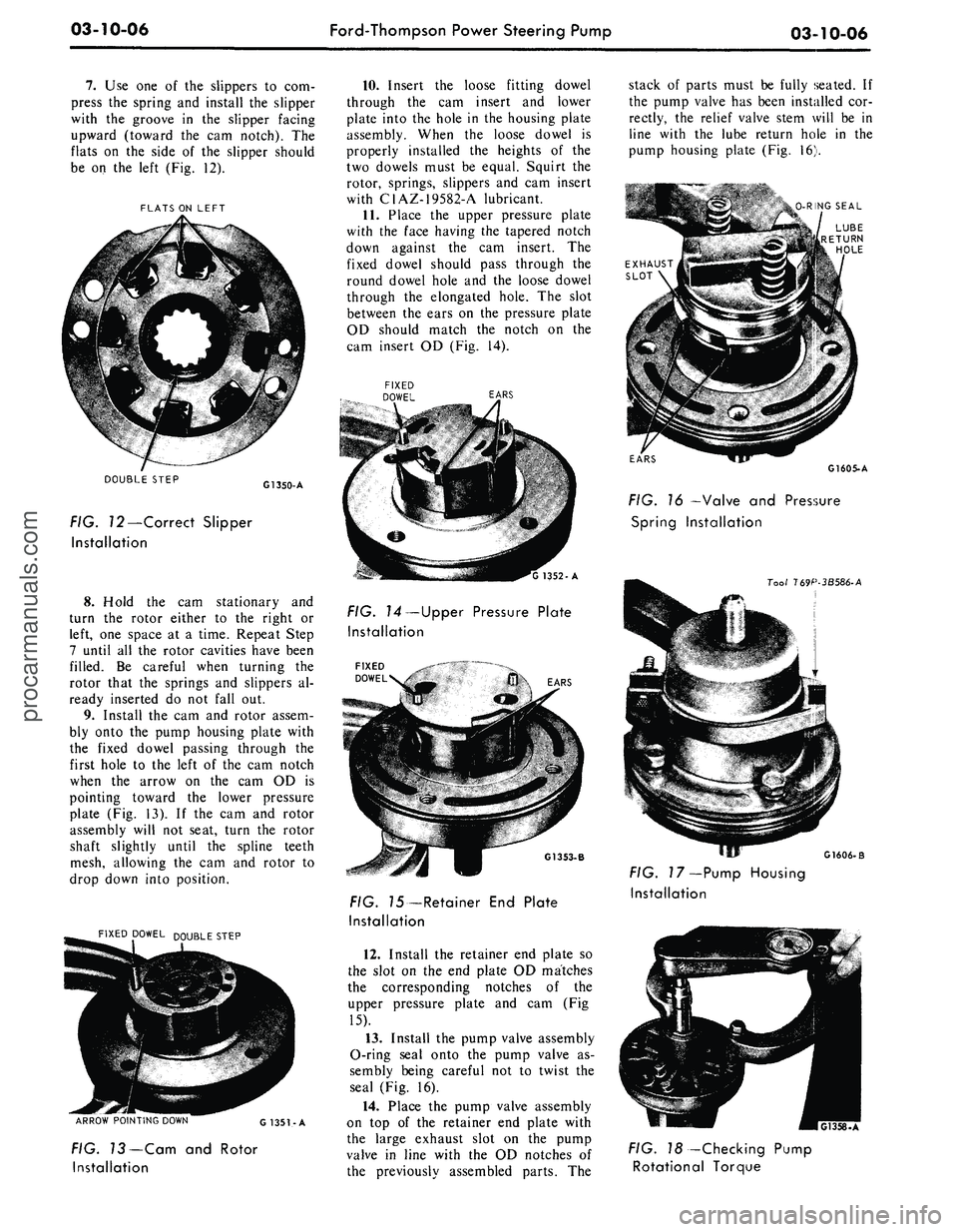
7.
Use one of the slippers to com-
press the spring and install the slipper
with the groove in the slipper facing
upward (toward the cam notch). The
flats on the side of the slipper should
be on the left (Fig. 12).
FLATS ON LEFT
DOUBLE STEP
G1350-A
FIG. 72—Correct Slipper
Installation
8. Hold the cam stationary and
turn the rotor either to the right or
left, one space at a time. Repeat Step
7 until all the rotor cavities have been
filled. Be careful when turning the
rotor that the springs and slippers al-
ready inserted do not fall out.
9. Install the cam and rotor assem-
bly onto the pump housing plate with
the fixed dowel passing through the
first hole to the left of the cam notch
when the arrow on the cam OD is
pointing toward the lower pressure
plate (Fig. 13). If the cam and rotor
assembly will not seat, turn the rotor
shaft slightly until the spline teeth
mesh, allowing the cam and rotor to
drop down into position.
FIXED DOWEL D0|JBLE STEP
ARROW POINTING DOWN
G 1351-A
FIG. 13—Cam and Rotor
Installation
10.
Insert the loose fitting dowel
through the cam insert and lower
plate into the hole in the housing plate
assembly. When the loose dowel is
properly installed the heights of the
two dowels must be equal. Squirt the
rotor, springs, slippers and cam insert
with C1AZ-19582-A lubricant.
11.
Place the upper pressure plate
with the face having the tapered notch
down against the cam insert. The
fixed dowel should pass through the
round dowel hole and the loose dowel
through the elongated hole. The slot
between the ears on the pressure plate
OD should match the notch on the
cam insert OD (Fig. 14).
EARS
'G 1352-A
FIG. 74—Upper Pressure Plate
Installation
\ EARS
G1353-B
FIG. 75—Retainer End Plate
Installation
12.
Install the retainer end plate so
the slot on the end plate OD matches
the corresponding notches of the
upper pressure plate and cam (Fig
15).
13.
Install the pump valve assembly
O-ring seal onto the pump valve as-
sembly being careful not to twist the
seal (Fig. 16).
14.
Place the pump valve assembly
on top of the retainer end plate with
the large exhaust slot on the pump
valve in line with the OD notches of
the previously assembled parts. The
stack of parts must be fully seated. If
the pump valve has been installed cor-
rectly, the relief valve stem will be in
line with the lube return hole in the
pump housing plate (Fig. 16).
O-RING SEAL
EARS
G1605-A
FIG. 16 —Valve and Pressure
Spring Installation
Tool 169P-3B586-A
G1606-B
FIG. 17—Pump Housing
Installation
FIG. 18 -Checking Pump
Rotational Torqueprocarmanuals.com
Page 185 of 413

03-13-06
Specifications
03-13-06
TORQUE LIMITS-FRONT SUSPENSION
LINCOLN CONTINENTAL
Description
Brace-Front Suspension to Sidemember (Model 74A Only)
Drag Strut
to
Strut Bracket Assembly
Lower Arm Assembly to Front Crossmember
-
(Attach Bracket)
Lower Arm Assembly to No. 2 Crossmember
Drag Strut
to
Lower Arm Assembly
Wheel Spindle to Lower Arm Ball Joint
Front Wheel Spindle to Upper Arm Ball Joint Assembly
Upper Arm Inner Shaft
to
Upper Arm
Upper Arm and Shaft Assembly to No. 2 Crossmember
Shock Absorber Bracket Assembly to No. 2 Crossmember Bracket
Shock Absorber Assembly to No. 2 Crossmember Assembly (Top End)
Shock Absorber Assembly Lower Arm Spring Seat Reinforcement Assembly
Upper Ball Joint
to
Control Arm
Stabilizer Bar Assembly
to
Underbody
Stabilizer Bar
to
Lower Arm
Jounce Bumper Assembly
to
Strut (Lower Arm)
Front Splash Shield to Spindle
Caliper to Spindle
FtLbs
90-110
70-90
55-75
110-140
70-90
70-90
55-75
25-35
100-125
40-55
20-30
20-30
21-29
20-30
5-10
22-28
9-14
100-140
TORQUE LIMITS-REAR SUSPENSION
FORD, MERCURY, METEOR
Description
Shock Absorber
to
Frame (Upper Attachment)
Upper Arm to Axle Bracket (Nut)
Track Bar to Axle Track Bar Stud
Track Bar Stud to Axle
Track Bar
to
Frame (Bolt Torque)
Track Bar Stud to Axle Bracket (Nut)
Wheel Lug Nut
Brake Backing Plate and Bearing Retainer to Axle-All Cars except those with 240
or
302 CID Engines
Brake Backing Plate and Bearing Retainer to Axle-All Cars with 240
or
302 CID Engines
Shock Absorber to Axle (Lower Attachment)
Bumper Assembly
to
Frame
Lower Arm to Axle-Bolt
Lower Arm to Axle-Nut
Upper Arm
to
Frame-BoU
Upper Arm
to
Frame-Nut
Lower Arm
to
Frame-Bolt
Lower Arm
to
Frame-Nut
Bumper Assembly to No. 4 Crossmember
Universal Joint
U-Bolt
Nut
Air Leveling Compressor
to
Apron
Height Control Valve to Bracket
Height Control Valve Bracket to No. 4 Crossmember
FtLbs
20-28
90-100
80-105
100-130
80-105
80-105
70-115
50-70
20-30
50-35
9-13
90-120
70-90
90-120
70-90
90-120
70-90
9-13
10-15
10-13
17-25
9-13procarmanuals.com
Page 197 of 413

04-01-10
General Axle Service
04-01-10
The pattern taken during disassem-
bly should be helpful in judging if
gears can be re-used. Worn gears can-
not be rebuilt to correct a noisy condi-
tion. Gear scoring is the result of ex-
cessive shock loading or the use of an
incorrect lubricant. Scored gears can-
not be re-used.
Examine the teeth and thrust surfa-
ces of the differential gears. Wear on
the hub of the differential gear can
cause a chucking noise known as
chuckle when the vehicle is driven at
low speeds. Wear of splines, thrust
surfaces, or thrust washers, can con-
tribute to excessive drive line back-
lash.
BEARING CUPS AND
CONE AND ROLLER
ASSEMBLIES
Check bearing cups for rings,
scores, galling, or excessively worn
wear patterns. Pinion cups must be
solidly seated. Check by attempting to
insert a 0.0015-inch feeler between
these cups and the bottoms of their
bores.
When operated in the cups, cone
and roller assemblies must turn with-
out roughness. Examine the roller
ends for wear. Step-wear on the roller
ends indicates the bearings were not
preloaded properly, or the rollers were
slightly misaligned.
If inspection reveals either a defec-
tive cup or a defective cone and roller
assembly, both parts should be re-
placed to avoid early failure.
DIFFERENTIAL BEARING
ADJUSTING NUTS
Temporarily install the bearing caps
and test the fit of the adjusting nuts in
their threads. The nuts should turn
easily when the caps are tightened to
25 ft-lbs. The faces of the nuts that
contact the bearing cups must be
smooth and square. Replace the nuts
or examine the threads in the carrier
if their fit is not proper. Be sure that
the bearing caps and adjusting nuts
are on the side they were machined to
fit. Observe the punch marks and
scribe marks made during disassem-
bly.
U-JOINT FLANGE
Be sure that the eai» of the flange
have not been damaged in removing
the drive shaft or in removing the
flange from the axle. The end of the
flange that contacts the front pinion
bearing inner race as well as the flat
surface of the pinion nut counterbore
must be smooth. Polish these surfaces
if necessary. Roughness aggravates
backlash noises and causes wear of
the flange and pinion nut with a resul-
tant loss in pinion bearing preload.
PINION RETAINER
Be sure that the pinion bearing cups
are seated. Remove any chips or burrs
from the mounting flange. Clean the
groove for the O-ring seal and all lu-
bricant passages. If the cups were re-
moved, examine the bores carefully.
Any nicks or burrs in these bores
must be removed to permit proper
seating of the cups.
CARRIER HOUSING
Make sure that the differential
bearing bores are smooth and the
threads are not damaged. Remove any
nicks or burrs from the mounting sur-
faces of the carrier housing.
DIFFERENTIAL CASE
Make sure that the hubs where the
bearings mount are smooth. Carefully
examine the differential case bearing
shoulders, which may have been dam-
aged when the bearings were removed.
The bearing assemblies will fail if they
do not seat firmly against the shoul-
ders.
Check the fit (free rotation) of
the differential side gears in their
counterbores. Be sure that the mating
surfaces of the two parts of the case
are smooth and free from nicks or
burrs.
LIMITED SLIP AND
TRACTION-LOK
DIFFERENTIAL PARTS
Inspect the clutch plates for uneven
or extreme wear. The dog-eared clutch
plates must be free from burrs, nicks
or scratches which could cause excess-
ive or erratic wear to the bonding ma-
terial of the internally splined clutch
plates.
The internally splined clutch
plates should be inspected for condi-
tion of the bond, bonding material,
and wear. Replace the bonded plates
if their thickness is less than 0.085
inch or if the bonded material is
scored or badly worn. Inspect the
bonded plate internal teeth for wear.
Replace them, if excessive wear is evi-
dent. Bonded plates should be re-
placed as a set only
Examine all thrust surfaces and
hubs for wear. Abnormal wear on
these surfaces can contribute to a
noisy axle.
Inspect the Belleville spring (limited
slip) for proper free height of 1/4
inch.
LUBRICANT LEVEL
The lubricant level should be
checked every 6000 miles with the ve-
hicle in normal curb attitude. The lu-
bricant level should be at the lower
edge of the filler plug hole located in
either the carrier casting or housing
cover. It is unnecessary to periodically
drain the axle lubricant. The factory
fill should remain in the housing for
the life of the vehicle, except when re-
pairs are made. The specified lubri-
cant should be installed when the axle
is overhauled.procarmanuals.com
Page 208 of 413
04-02-11
Rear Axle — Removable Carrier Type
04-02-11
If the axle housing is new, install a
new vent. The hose attaching portion
must face toward the front of the ve-
hicle.
2.
If leather-type wheel bearing ser-
vice seals are to be installed, soak the
new rear wheel bearing oil seals in
SAE 10 oil for 1/2 hour before instal-
lation. Wipe a small amount of an oil
resistant sealer on the outer edge of
each seal before it is installed. Do not
put any of the sealer on the sealing
lip.
Install the oil seals in the ends of
the axle housing with one of the tools
shown in Fig. 10 and 12.
3.
Position the replacement axle
housing under the vehicle, and raise
the axle with a hoist or floor jack.
Connect the suspension lower arms to
their mounting brackets on the axle
housing with pivot bolts and nuts. Do
not tighten the bolts and nuts at this
point.
4.
Position the suspension upper
arm in its mounting bracket on the
axle housing, and install the adjusting
bolt, eccentric washers, lock washer
and nut. Leave the bolt and nut loose
at this point.
5.
Position the brake lines to the
axle housing, and secure with the re-
taining clips.
6. Install the brake backing plates
on the axle housing flanges.
7.
Connect the track bar to the
mounting stud, install the washer and
attaching nut, and torque to specifica-
tions.
8. Position the rear coil springs and
insulators in the pockets provided.
9. Connect the lower studs of the
two rear shock absorbers to the
mounting brackets on the axle hous-
ing. Install the attaching nuts, and
torque to specifications.
10.
Connect the vent tube to the
vent on the housing. If axle housing is
new, install a new vent.
11.
Clean the mating surfaces of
the axle housing and differential car-
rier. Position the carrier on the
mounting studs on the housing using a
new gasket between carrier and hous-
ing. Install the copper washers and the
carrier-to-housing attaching nuts, and
torque to specifications.
12.
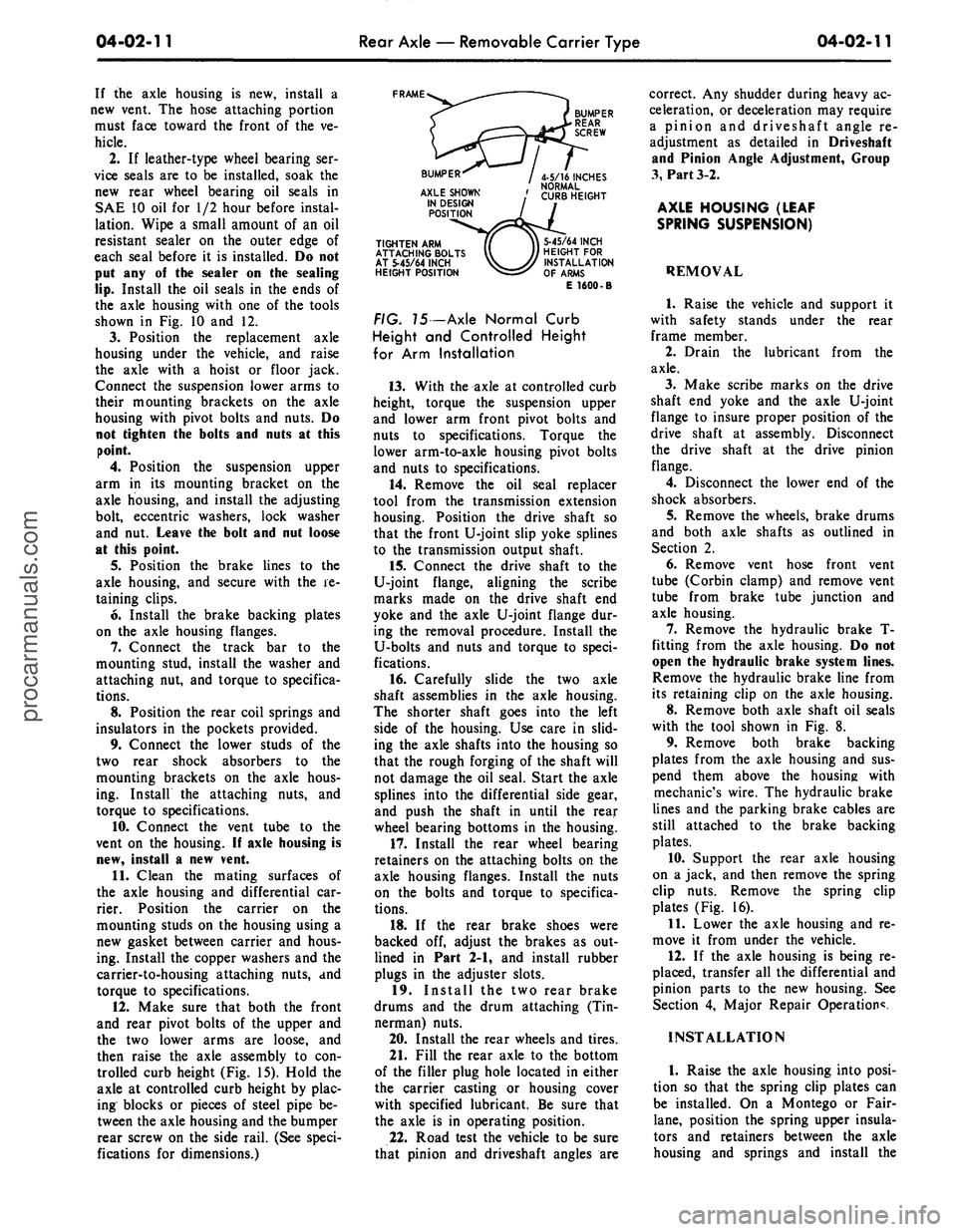
Make sure that both the front
and rear pivot bolts of the upper and
the two lower arms are loose, and
then raise the axle assembly to con-
trolled curb height (Fig. 15). Hold the
axle at controlled curb height by plac-
ing blocks or pieces of steel pipe be-
tween the axle housing and the bumper
rear screw on the side rail. (See speci-
fications for dimensions.)
FRAME
TIGHTEN ARM
ATTACHING BOLTS
AT 5-45/64 INCH
HEIGHT POSITION
5-45/64 INCH
HEIGHT FOR
INSTALLATION
OF ARMS
E 1600-B
FIG. 75 -Axle Normal Curb
Height and Controlled Height
for Arm Installation
13.
With the axle at controlled curb
height, torque the suspension upper
and lower arm front pivot bolts and
nuts to specifications. Torque the
lower arm-to-axle housing pivot bolts
and nuts to specifications.
14.
Remove the oil seal replacer
tool from the transmission extension
housing. Position the drive shaft so
that the front U-joint slip yoke splines
to the transmission output shaft.
15.
Connect the drive shaft to the
U-joint flange, aligning the scribe
marks made on the drive shaft end
yoke and the axle U-joint flange dur-
ing the removal procedure. Install the
U-bolts and nuts and torque to speci-
fications.
16.
Carefully slide the two axle
shaft assemblies in the axle housing.
The shorter shaft goes into the left
side of the housing. Use care in slid-
ing the axle shafts into the housing so
that the rough forging of the shaft will
not damage the oil seal. Start the axle
splines into the differential side gear,
and push the shaft in until the rear
wheel bearing bottoms in the housing.
17.
Install the rear wheel bearing
retainers on the attaching bolts on the
axle housing flanges. Install the nuts
on the bolts and torque to specifica-
tions.
18.
If the rear brake shoes were
backed off, adjust the brakes as out-
lined in Part 2-1, and install rubber
plugs in the adjuster slots.
19.
Install the two rear brake
drums and the drum attaching (Tin-
nerman) nuts.
20.
Install the rear wheels and tires.
21.
Fill the rear axle to the bottom
of the filler plug hole located in either
the carrier casting or housing cover
with specified lubricant. Be sure that
the axle is in operating position.
22.
Road test the vehicle to be sure
that pinion and driveshaft angles are
correct. Any shudder during heavy ac-
celeration, or deceleration may require
a pinion and driveshaft angle re-
adjustment as detailed in Driveshaft
and Pinion Angle Adjustment, Group
3,
Part 3-2.
AXLE HOUSING (LEAF
SPRING SUSPENSION)
REMOVAL
1.
Raise the vehicle and support it
with safety stands under the rear
frame member.
2.
Drain the lubricant from the
axle.
3.
Make scribe marks on the drive
shaft end yoke and the axle U-joint
flange to insure proper position of the
drive shaft at assembly. Disconnect
the drive shaft at the drive pinion
flange.
4.
Disconnect the lower end of the
shock absorbers.
5.
Remove the wheels, brake drums
and both axle shafts as outlined in
Section 2.
6. Remove vent hose front vent
tube (Corbin clamp) and remove vent
tube from brake tube junction and
axle housing.
7.
Remove the hydraulic brake T-
fitting from the axle housing. Do not
open the hydraulic brake system lines.
Remove the hydraulic brake line from
its retaining clip on the axle housing.
8. Remove both axle shaft oil seals
with the tool shown in Fig. 8.
9. Remove both brake backing
plates from the axle housing and sus-
pend them above the housing with
mechanic's wire. The hydraulic brake
lines and the parking brake cables are
still attached to the brake backing
plates.
10.
Support the rear axle housing
on a jack, and then remove the spring
clip nuts. Remove the spring clip
plates (Fig. 16).
11.
Lower the axle housing and re-
move it from under the vehicle.
12.
If the axle housing is being re-
placed, transfer all the differential and
pinion parts to the new housing. See
Section 4, Major Repair Operation*.
INSTALLATION
1.
Raise the axle housing into posi-
tion so that the spring clip plates can
be installed. On a Montego or Fair-
lane,
position the spring upper insula-
tors and retainers between the axle
housing and springs and install theprocarmanuals.com
Page 235 of 413
04-04-04
Rear Axle — Ford Light-Duty (WER)
04-04-04
REMOVAL AND INSTALLATION
AXLE HOUSING
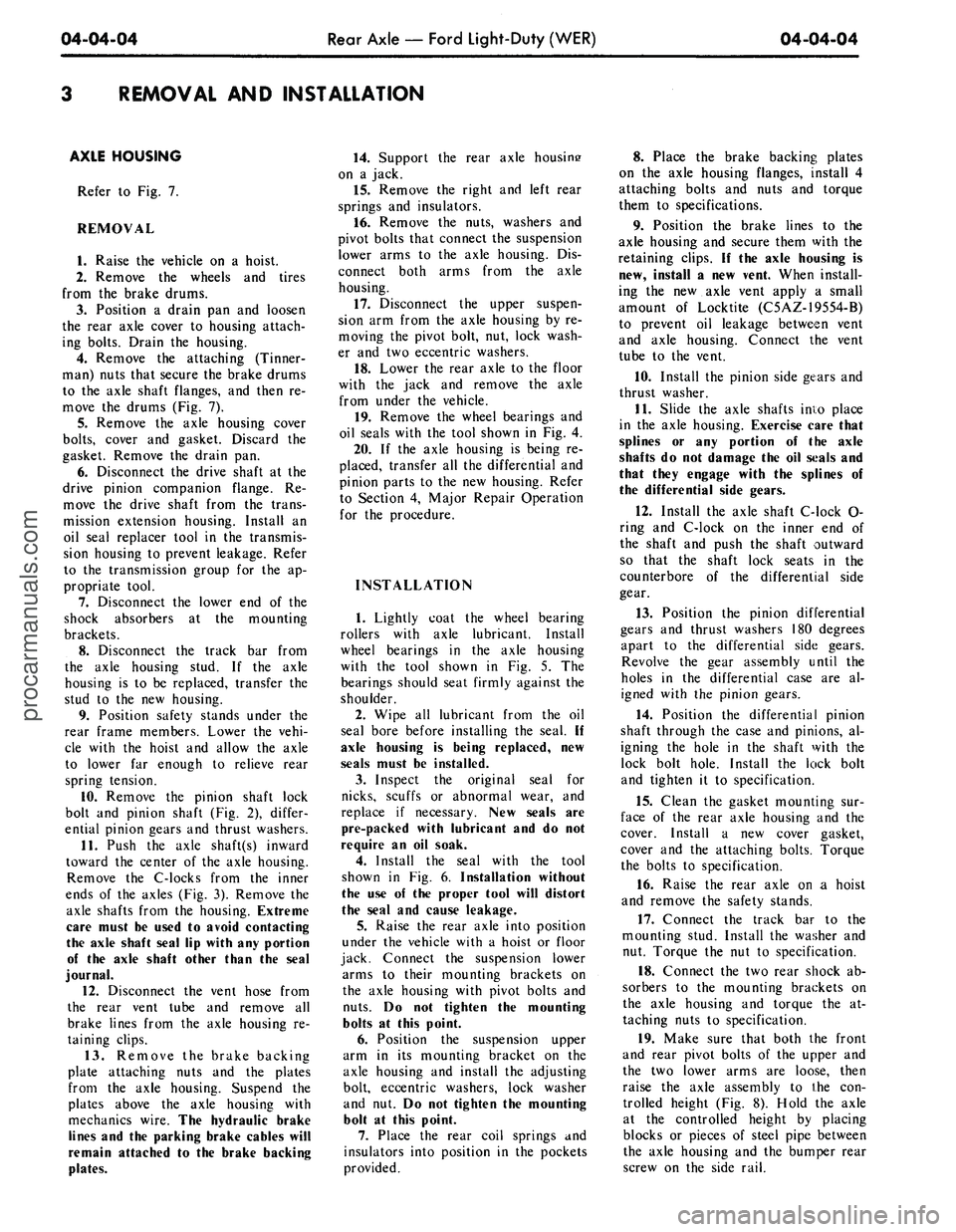
Refer to Fig. 7.
REMOVAL
1.
Raise the vehicle on a hoist.
2.
Remove the wheels and tires
from the brake drums.
3.
Position a drain pan and loosen
the rear axle cover to housing attach-
ing bolts. Drain the housing.
4.
Remove the attaching (Tinner-
man) nuts that secure the brake drums
to the axle shaft flanges, and then re-
move the drums (Fig. 7).
5.
Remove the axle housing cover
bolts,
cover and gasket. Discard the
gasket. Remove the drain pan.
6. Disconnect the drive shaft at the
drive pinion companion flange. Re-
move the drive shaft from the trans-
mission extension housing. Install an
oil seal replacer tool in the transmis-
sion housing to prevent leakage. Refer
to the transmission group for the ap-
propriate tool.
7.
Disconnect the lower end of the
shock absorbers at the mounting
brackets.
8. Disconnect the track bar from
the axle housing stud. If the axle
housing is to be replaced, transfer the
stud to the new housing.
9. Position safety stands under the
rear frame members. Lower the vehi-
cle with the hoist and allow the axle
to lower far enough to relieve rear
spring tension.
10.
Remove the pinion shaft lock
bolt and pinion shaft (Fig. 2), differ-
ential pinion gears and thrust washers.
11.
Push the axle shaft(s) inward
toward the center of the axle housing.
Remove the C-locks from the inner
ends of the axles (Fig. 3). Remove the
axle shafts from the housing. Extreme
care must be used to avoid contacting
the axle shaft seal lip with any portion
of the axle shaft other than the seal
journal.
12.
Disconnect the vent hose from
the rear vent tube and remove all
brake lines from the axle housing re-
taining clips.
13.
Remove the brake backing
plate attaching nuts and the plates
from the axle housing. Suspend the
plates above the axle housing with
mechanics wire. The hydraulic brake
lines and the parking brake cables will
remain attached to the brake backing
plates.
14.
Support the rear axle housine
on a jack.
15.
Remove the right and left rear
springs and insulators.
16.
Remove the nuts, washers and
pivot bolts that connect the suspension
lower arms to the axle housing. Dis-
connect both arms from the axle
housing.
17.
Disconnect the upper suspen-
sion arm from the axle housing by re-
moving the pivot bolt, nut, lock wash-
er and two eccentric washers.
18.
Lower the rear axle to the floor
with the jack and remove the axle
from under the vehicle.
19.
Remove the wheel bearings and
oil seals with the tool shown in Fig. 4.
20.
If the axle housing is being re-
placed, transfer all the differential and
pinion parts to the new housing. Refer
to Section 4, Major Repair Operation
for the procedure.
INSTALLATION
1.
Lightly coat the wheel bearing
rollers with axle lubricant. Install
wheel bearings in the axle housing
with the tool shown in Fig. 5. The
bearings should seat firmly against the
shoulder.
2.
Wipe all lubricant from the oil
seal bore before installing the seal. If
axle housing is being replaced, new
seals must be installed.
3.
Inspect the original seal for
nicks,
scuffs or abnormal wear, and
replace if necessary. New seals are
pre-packed with lubricant and do not
require an oil soak.
4.
Install the seal with the tool
shown in Fig. 6. Installation without
the use of the proper tool will distort
the seal and cause leakage.
5. Raise the rear axle into position
under the vehicle with a hoist or floor
jack. Connect the suspension lower
arms to their mounting brackets on
the axle housing with pivot bolts and
nuts.
Do not tighten the mounting
bolts at this point.
6. Position the suspension upper
arm in its mounting bracket on the
axle housing and install the adjusting
bolt, eccentric washers, lock washer
and nut. Do not tighten the mounting
bolt at this point.
7.
Place the rear coil springs and
insulators into position in the pockets
provided.
8. Place the brake backing plates
on the axle housing flanges, install 4
attaching bolts and nuts and torque
them to specifications.
9. Position the brake lines to the
axle housing and secure them with the
retaining clips. If the axle housing is
new, install a new vent. When install-
ing the new axle vent apply a small
amount of Locktite (C5AZ-19554-B)
to prevent oil leakage between vent
and axle housing. Connect the vent
tube to the vent.
10.
Install the pinion side gears and
thrust washer.
11.
Slide the axle shafts into place
in the axle housing. Exercise care that
splines or any portion of the axle
shafts do not damage the oil seals and
that they engage with the splines of
the differential side gears.
12.
Install the axle shaft C-lock O-
ring and C-lock on the inner end of
the shaft and push the shaft outward
so that the shaft lock seats in the
counterbore of the differential side
gear.
13.
Position the pinion differential
gears and thrust washers 180 degrees
apart to the differential side gears.
Revolve the gear assembly until the
holes in the differential case are al-
igned with the pinion gears.
14.
Position the differential pinion
shaft through the case and pinions, al-
igning the hole in the shaft with the
lock bolt hole. Install the lock bolt
and tighten it to specification.
15.
Clean the gasket mounting sur-
face of the rear axle housing and the
cover. Install a new cover gasket,
cover and the attaching bolts. Torque
the bolts to specification.
16.
Raise the rear axle on a hoist
and remove the safety stands.
17.
Connect the track bar to the
mounting stud. Install the washer and
nut. Torque the nut to specification.
18.
Connect the two rear shock ab-
sorbers to the mounting brackets on
the axle housing and torque the at-
taching nuts to specification.
19.
Make sure that both the front
and rear pivot bolts of the upper and
the two lower arms are loose, then
raise the axle assembly to the con-
trolled height (Fig. 8). Hold the axle
at the controlled height by placing
blocks or pieces of steel pipe between
the axle housing and the bumper rear
screw on the side rail.procarmanuals.com
Page 237 of 413

04-04-06
Rear Axle — Ford Light-Duty (WER)
04-04-06
20.
With the axle at controlled
height, torque the suspension upper
and lower arm front pivot bolts and
nuts to specifications. Torque the
lower arm to axle housing pivot bolts
and nuts to specifications.
21.
Remove the oil seal replacer
from the transmission extension hous-
ing. Install the drive shaft in the ex-
tension housing. Align the scribe
marks on the cups, flange and drive
shaft and connect the drive shaft at
the drive pinion flange. Torque the at-
taching bolts to specification
FRAME
TIGHTEN ARM
ATTACHING BOLTS
AT 5-45/64 INCH
HEIGHT POSITION
5-45/64 INCH
HEIGHT FOR
INSTALLATION
OF ARMS
E 1600-B
FIG.8—
Axle
Normal Curb Height
and Controlled Height for Arm
Installation
22.
Install the brake drum and at-
taching (Tinnerman) nuts.
23.
Install the wheel and tire on the
brake drum. Install the wheel covers.
24.
Adjust the drive shaft and pin-
ion angle to specification.
25.
Add the amount of specified lu-
bricant required to reach to the bot-
tom of the filler plug hole. Make sure
the rear axle is in running position.
Install the filler plug and torque it to
specification.
26.
Lower the vehicle.
4 MAJOR REPAIR OPERATIONS
DISASSEMBLY OF AXLE
The rear axle components are
shown in Fig. 9.
DIFFERENTIAL SIDE GEAR
AXLE SHAFT C-WASHER \
DIFFERENTIAL PINION SHAFT
THRUST WASHER
BEARING ASSEMBLY
CUP
THRUST WASHER
^^ DIFFERENTIAL PINION GEAR
BEARING ADJUSTING NUT
DIFFERENTIAL
PINION SHAFT
LOCK BOLT
LOCK WASHER
BOLT
LOCK WASHER
ADJUSTING NUT LOCK
DRIVE GEAR ATTACHING BOLT
BEARING CAP
AXLE HOUSING ASSEMBLY
PINION AND RING GEAR
PINION LOCATING SHIM(S)
BEARING CUP
BOLT
NUT
BEARING CUP
COLLAPSIBLE SPACER
AXLE SHAFT
E 1572-C
FIG. 9—Disassembled Light-Duty (WER) Rear Axleprocarmanuals.com
Page 262 of 413
05-03-04
Clutch
05-03-04
bushings, position the clutch pedal and
bushings in the pedal support.
8. Install the retaining ring on the
clutch pedal shaft.
9. Position the assist spring in the
pedal support bracket and the assist
spring bracket. Rotate the assist
spring bracket clockwise until the
upper bolt holes line up and install the
bolt. Torque both the upper and lower
bolts to specification.
10.
Check the clutch pedal free
travel and adjust as required.
MUSTANG, COUGAR
1.
Disconnect the battery ground
cable.
2.
Remove the steering column.
Refer to Group 3 of this manual for
the procedure.
3.
Remove the two capscrews re-
taining the master cylinder or booster
to the dash panel. Then remove the
two capscrews retaining the pedal sup-
port bracket to the dash panel.
4.
Working inside the vehicle, dis-
connect the clutch pedal-to-equalizer
rod at the clutch pedal by removing
the retainer and bushing.
5.
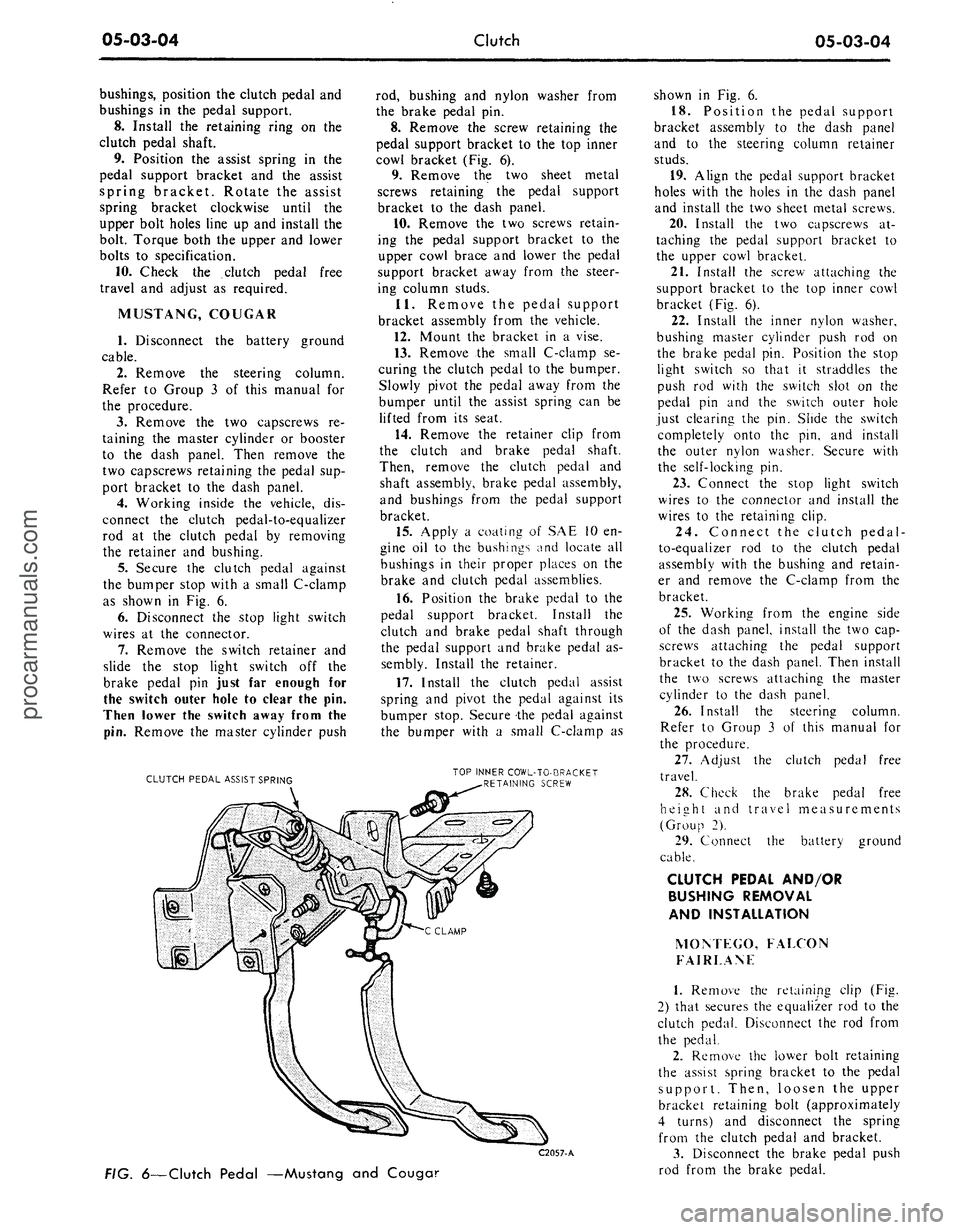
Secure the clutch pedal against
the bumper stop with a small C-clamp
as shown in Fig. 6.
6. Disconnect the stop light switch
wires at the connector.
7.
Remove the switch retainer and
slide the stop light switch off the
brake pedal pin just far enough for
the switch outer hole to clear the pin.
Then lower the switch away from the
pin.
Remove the master cylinder push
CLUTCH PEDAL ASSIST SPRING
rod, bushing and nylon washer from
the brake pedal pin.
8. Remove the screw retaining the
pedal support bracket to the top inner
cowl bracket (Fig. 6).
9. Remove the two sheet metal
screws retaining the pedal support
bracket to the dash panel.
10.
Remove the two screws retain-
ing the pedal support bracket to the
upper cowl brace and lower the pedal
support bracket away from the steer-
ing column studs.
11.
Remove the pedal support
bracket assembly from the vehicle.
12.
Mount the bracket in a vise.
13.
Remove the small C-clamp se-
curing the clutch pedal to the bumper.
Slowly pivot the pedal away from the
bumper until the assist spring can be
lifted from its seat.
14.
Remove the retainer clip from
the clutch and brake pedal shaft.
Then, remove the clutch pedal and
shaft assembly, brake pedal assembly,
and bushings from the pedal support
bracket.
15.
Apply a coating of SAE 10 en-
gine oil to the bushings and locate all
bushings in their proper places on the
brake and clutch pedal assemblies.
16.
Position the brake pedal to the
pedal support bracket. Install the
clutch and brake pedal shaft through
the pedal support and brake pedal as-
sembly. Install the retainer.
17.
Install the clutch pedal assist
spring and pivot the pedal against its
bumper stop. Secure the pedal against
the bumper with a small C-clamp as
TOP INNER COWL-TO-BRACKET
RETAINING SCREW
C2057-A
FIG.
6—Clutch
Pedal —Mustang and Couga?
shown in Fig. 6.
18.
Position the pedal support
bracket assembly to the dash panel
and to the steering column retainer
studs.
19.
Align the pedal support bracket
holes with the holes in the dash panel
and install the two sheet metal screws.
20.
Install the two capscrews at-
taching the pedal support bracket to
the upper cowl bracket.
21.
Install the screw attaching the
support bracket to the top inner cowl
bracket (Fig. 6).
22.
Install the inner nylon washer,
bushing master cylinder push rod on
the brake pedal pin. Position the stop
light switch so that it straddles the
push rod with the switch slot on the
pedal pin and the switch outer hole
just clearing the pin. Slide the switch
completely onto the pin, and install
the outer nylon washer. Secure with
the self-locking pin.
23.
Connect the stop light switch
wires to the connector and install the
wires to the retaining clip.
24.
Connect the clutch pedal-
to-equalizer rod to the clutch pedal
assembly with the bushing and retain-
er and remove the C-clamp from the
bracket.
25.
Working from the engine side
of the dash panel, install the two cap-
screws attaching the pedal support
bracket to the dash panel. Then install
the two screws attaching the master
cylinder to the dash panel.
26.
Install the steering column.
Refer to Group 3 of this manual for
the procedure.
27.
Adjust the clutch pedal free
travel.
28.
Check the brake pedal free
height and travel measurements
(Group 2).
29.
Connect the battery ground
cable.
CLUTCH PEDAL AND/OR
BUSHING REMOVAL
AND INSTALLATION
MOM EGO, FALCON
FAIRLANF
1.
Remove the retaining clip (Fig.
2) that secures the equalizer rod to the
clutch pedal. Disconnect the rod from
the pedal.
2.
Remove the lower bolt retaining
the assist spring bracket to the pedal
support. Then, loosen the upper
bracket retaining bolt (approximately
4 turns) and disconnect the spring
from the clutch pedal and bracket.
3.
Disconnect the brake pedal push
rod from the brake pedal.procarmanuals.com